PRESENTATION
ON INDIAN
RAILWAY
SIGNAL SYSTEM
INDEX
➔
CONTENTS-
(1)INTRODUCTION.
(2)RAILWAY SIGNALING.
(3)INTERLOCKING.
(4)TRAIN TRAFFIC CONTROL.
(5)COMMUNICATION SYSTEM.
(6)MICROWAVE TRANSMISSION.
(7)OPTICAL FIBRE COMMUNICATION.
INTRODUCTION
➔Founded in 16th
April 1853.
➔Head quarter in NEW DELHI.
➔Profit is approximately 160 billion INC.(2014-2015)
➔ Revenue is approximately 1441.57INC.(2014-2015)
➔About 1.6 million employees.(2015)
➔There are 17 railway zones.(2015)
➔INDIAN RAILWAYS is an Indian state-owned enterprise,owned and operated
by Government India through the ministry of railways.
➔Railways were first introduced to INDIA in 1853 from Bombay to Thane.
INTRODUCTION
➔
This is world's 4th
largest railway networks compromising 115,000
km track over a route of 65,436 km and 7,170 stations.
➔
Indian railway is the world's 9th
largest commercial or utility
employer, by number of employees.
➔
Indian railway operates both long distance and suburban rail
systems on a multi-gauge network of broad, metre and narrow
gauges.
➔
Its operations cover twenty nine states and seven union territories
and also provides limited international services to Nepal,
Bangladesh and Pakistan.

RAILWAY SIGNALING.
1.A railway signal is an electrical
and mechanical device erected
besides are railway lines to
pass information relating to
the state of the line ahead of
train.
2. It is a system use to safely
direct railway traffic in order
prevents trains from colliding.
AUTOMATIC SIGNAL SYSTEM.
TYPES OF SIGNAL.
I.BLOCK SIGNAL.
II.FIXED SIGNAL.
III.MECHANICAL SIGNAL.
IV.COLOUR LIGHT SIGNAL.
V.CAB SIGNAL.
INTERLOCKING.
An interlocking is an arrangement of apparatus that never
provides unsafe (conflicting) signals and the points are not
set for more than one train that might end up proceeding on
to the same section of track and hence suffering a collision,
various schemes have been developed to coordinate the
settings of the points and the signals within the region
controlled by a signalbox or signal cabin.
Interlocking system is used mechanical,eletrical device both
to operate the signaling device and ensure their operation.
TYPES OF INTERLOCKING.
Manually operated interlocking-This is a form of mechanical interlocking as well, but
relies on the signalman to move about from one set of points and signals to another
carrying with him the keys used to operate them. At points controlling catch sidings in
hilly areas, often the interlocking is manual where the driver has to use a key
provided by the stationmaster or signalman of the last station before the siding -- the
key is inserted into the interlock box which notifies the signal cabin and the points are
then set for the main line and the signal is pulled off, giving the train authority to
proceed.
Mechanically operated interlocking-The prevalent systems today are still mechanical
interlocking schemes that coordinate the positions of the levers controlling the points
with the signals governing that section of track and connected branches, loops, or
sidings. Ex-Detector,Slotting,Lock bar,plunger lock.
Electrically operated interlocking-In the more advanced electrical or electronic
interlocking schemes, the points and signals are worked from one integrated
mechanism in a signal cabin which features a display of the entire track layout with
indications of sections that are occupied, free, set for reception or dispatch, etc. The
interlocking is accomplished by electrical circuitry. Ex-Relays,track circuits,Axle
counters.
TYPES OF INTERLOCKING.
SOME SPECIAL INTERLOCKING-
1) RRI(ROUTE RELAY INTERLOCKING) purely electrically consist of
complex circuitry made up of relays in an arrangement of relay logic
that ascertain the state or position of each signal appliance. Means
stations is interlocked and worked with control panel located in RRI
office. Control panel has geometrical layout entire yard controlled by
route interlocking. This system used in large and busy stations that
have to handle high volumes of train movements.
2) Panel Interlocking (PI) is the system used in most medium-
sized stations on IR. In this, the points and signals are worked
by individual switches that control them.
3) Crank handle Interlocking is yard of the point machine has been
group into various group. One crank handle of a one group can not
be use on the point machine another group.
TRAIN TRAFFIC CONTROL.
➔Railway control circuits are omnibus
telephone circuits,which provide
communications with each train working
point.
➔They should provide satisfactory and
reliable communication between the
controller and various way side
station,important signal cables,loco
sheds,yard office.
TYPES OF CONTROL SYSTEM.
1)SECTIONS CONTROL/TRAIN CONTROL.
2)DEPUTY CONTROL.
3)TRAIN LOCO CONTROL.
4)S&T CONTROL.
5)EMERGENCY CONTROL.
6)EMERGENCY WIRELESS CONTROL
COMMUNICATION.
COMMUNICATION SYSTEM.
➔ The process of sending and receiving signal between two
station through different medium in known as
communication system.

In communication system there are three essential
components that should be consider.
A)Sending.(tx)
B)Receiving.(rx)
C)Medium.
COMMUNICATION SYSTEM FOR RAILWAY
OVER HEAD COMMUNICATION.
UNDERGROUND COMMUNICATION.
MICROWAVE COMMUNICATION.
OPTICAL COMMUNICATION.
COMMUNICATION SYSTEM.
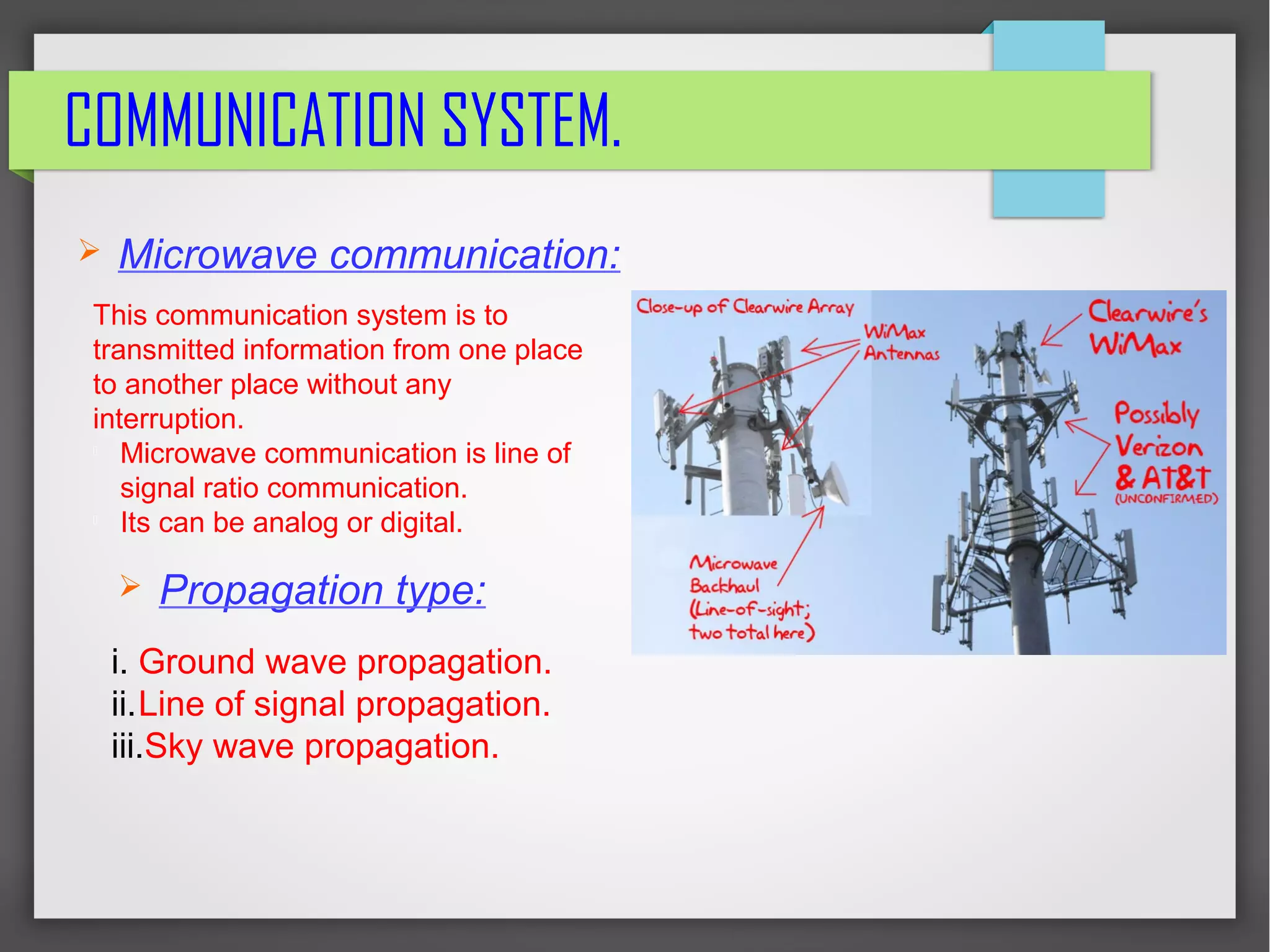
➢ Microwave communication:
➢ Propagation type:
This communication system is to
transmitted information from one place
to another place without any
interruption.

Microwave communication is line of
signal ratio communication.

Its can be analog or digital.
i. Ground wave propagation.
ii.Line of signal propagation.
iii.Sky wave propagation.
MICROWAVE TRANSMISSION
➢MICROWAVE TRANSMISSION:Its refers to the
technology of transmitting information of energy by using
electromagnetic wave,whose wave lengths are measured in
small number of centimetre,these are called microwaves. This
part radio spectrum ranges across frequencies of roughly
1.0Ghz to 30Ghz.
OPTICAL FIBRE COMMUNICATION.
✔Optical fibre communication:It is a method
of transmitting information from one place to another
by sending pulses of light through an optical fiber. The
forms an electromagnetic carrier wave that is
modulated to carry information.
OPTICAL FIBRE COMMUNICATION
➔SINGLE MODE OPTICAL FIBRE:
Its an optical fibre in which only the lowest order
bound mode can propagate of the wavelength of
1300-1320nm.
➔MULTI MODE OPTICAL FIBRE:
It is an optical fibre in which light waves are dispersed
into numerous path or modes as travel through cables
core typically 850-1300nm
THE END.
Project is presented by
Electronics engineering
students of JCGP
Krishnendu Karmakar
Turban Paul
Sujoy Das
Nilanjan Majumder
Subhasis Samanta

Railway signal

  • 1.
  • 2.
    INDEX ➔ CONTENTS- (1)INTRODUCTION. (2)RAILWAY SIGNALING. (3)INTERLOCKING. (4)TRAIN TRAFFICCONTROL. (5)COMMUNICATION SYSTEM. (6)MICROWAVE TRANSMISSION. (7)OPTICAL FIBRE COMMUNICATION.
  • 3.
    INTRODUCTION ➔Founded in 16th April1853. ➔Head quarter in NEW DELHI. ➔Profit is approximately 160 billion INC.(2014-2015) ➔ Revenue is approximately 1441.57INC.(2014-2015) ➔About 1.6 million employees.(2015) ➔There are 17 railway zones.(2015) ➔INDIAN RAILWAYS is an Indian state-owned enterprise,owned and operated by Government India through the ministry of railways. ➔Railways were first introduced to INDIA in 1853 from Bombay to Thane.
  • 4.
    INTRODUCTION ➔ This is world's4th largest railway networks compromising 115,000 km track over a route of 65,436 km and 7,170 stations. ➔ Indian railway is the world's 9th largest commercial or utility employer, by number of employees. ➔ Indian railway operates both long distance and suburban rail systems on a multi-gauge network of broad, metre and narrow gauges. ➔ Its operations cover twenty nine states and seven union territories and also provides limited international services to Nepal, Bangladesh and Pakistan. 
  • 5.
    RAILWAY SIGNALING. 1.A railwaysignal is an electrical and mechanical device erected besides are railway lines to pass information relating to the state of the line ahead of train. 2. It is a system use to safely direct railway traffic in order prevents trains from colliding.
  • 6.
  • 7.
    TYPES OF SIGNAL. I.BLOCKSIGNAL. II.FIXED SIGNAL. III.MECHANICAL SIGNAL. IV.COLOUR LIGHT SIGNAL. V.CAB SIGNAL.
  • 8.
    INTERLOCKING. An interlocking isan arrangement of apparatus that never provides unsafe (conflicting) signals and the points are not set for more than one train that might end up proceeding on to the same section of track and hence suffering a collision, various schemes have been developed to coordinate the settings of the points and the signals within the region controlled by a signalbox or signal cabin. Interlocking system is used mechanical,eletrical device both to operate the signaling device and ensure their operation.
  • 9.
    TYPES OF INTERLOCKING. Manuallyoperated interlocking-This is a form of mechanical interlocking as well, but relies on the signalman to move about from one set of points and signals to another carrying with him the keys used to operate them. At points controlling catch sidings in hilly areas, often the interlocking is manual where the driver has to use a key provided by the stationmaster or signalman of the last station before the siding -- the key is inserted into the interlock box which notifies the signal cabin and the points are then set for the main line and the signal is pulled off, giving the train authority to proceed. Mechanically operated interlocking-The prevalent systems today are still mechanical interlocking schemes that coordinate the positions of the levers controlling the points with the signals governing that section of track and connected branches, loops, or sidings. Ex-Detector,Slotting,Lock bar,plunger lock. Electrically operated interlocking-In the more advanced electrical or electronic interlocking schemes, the points and signals are worked from one integrated mechanism in a signal cabin which features a display of the entire track layout with indications of sections that are occupied, free, set for reception or dispatch, etc. The interlocking is accomplished by electrical circuitry. Ex-Relays,track circuits,Axle counters.
  • 10.
    TYPES OF INTERLOCKING. SOMESPECIAL INTERLOCKING- 1) RRI(ROUTE RELAY INTERLOCKING) purely electrically consist of complex circuitry made up of relays in an arrangement of relay logic that ascertain the state or position of each signal appliance. Means stations is interlocked and worked with control panel located in RRI office. Control panel has geometrical layout entire yard controlled by route interlocking. This system used in large and busy stations that have to handle high volumes of train movements. 2) Panel Interlocking (PI) is the system used in most medium- sized stations on IR. In this, the points and signals are worked by individual switches that control them. 3) Crank handle Interlocking is yard of the point machine has been group into various group. One crank handle of a one group can not be use on the point machine another group.
  • 11.
    TRAIN TRAFFIC CONTROL. ➔Railwaycontrol circuits are omnibus telephone circuits,which provide communications with each train working point. ➔They should provide satisfactory and reliable communication between the controller and various way side station,important signal cables,loco sheds,yard office.
  • 12.
    TYPES OF CONTROLSYSTEM. 1)SECTIONS CONTROL/TRAIN CONTROL. 2)DEPUTY CONTROL. 3)TRAIN LOCO CONTROL. 4)S&T CONTROL. 5)EMERGENCY CONTROL. 6)EMERGENCY WIRELESS CONTROL COMMUNICATION.
  • 13.
    COMMUNICATION SYSTEM. ➔ Theprocess of sending and receiving signal between two station through different medium in known as communication system.  In communication system there are three essential components that should be consider. A)Sending.(tx) B)Receiving.(rx) C)Medium.
  • 14.
    COMMUNICATION SYSTEM FORRAILWAY OVER HEAD COMMUNICATION. UNDERGROUND COMMUNICATION. MICROWAVE COMMUNICATION. OPTICAL COMMUNICATION.
  • 15.
  • 16.
    COMMUNICATION SYSTEM. ➢ Microwavecommunication: ➢ Propagation type: This communication system is to transmitted information from one place to another place without any interruption.  Microwave communication is line of signal ratio communication.  Its can be analog or digital. i. Ground wave propagation. ii.Line of signal propagation. iii.Sky wave propagation.
  • 17.
    MICROWAVE TRANSMISSION ➢MICROWAVE TRANSMISSION:Itsrefers to the technology of transmitting information of energy by using electromagnetic wave,whose wave lengths are measured in small number of centimetre,these are called microwaves. This part radio spectrum ranges across frequencies of roughly 1.0Ghz to 30Ghz.
  • 18.
    OPTICAL FIBRE COMMUNICATION. ✔Opticalfibre communication:It is a method of transmitting information from one place to another by sending pulses of light through an optical fiber. The forms an electromagnetic carrier wave that is modulated to carry information.
  • 19.
    OPTICAL FIBRE COMMUNICATION ➔SINGLEMODE OPTICAL FIBRE: Its an optical fibre in which only the lowest order bound mode can propagate of the wavelength of 1300-1320nm. ➔MULTI MODE OPTICAL FIBRE: It is an optical fibre in which light waves are dispersed into numerous path or modes as travel through cables core typically 850-1300nm
  • 20.
    THE END. Project ispresented by Electronics engineering students of JCGP Krishnendu Karmakar Turban Paul Sujoy Das Nilanjan Majumder Subhasis Samanta