SIGNALLING
AND
INTERLOCKING
Introduction
 Signalling is the device by which the
movement of trains is controlled
 Highly important in terms of safety
 Trains can be operated efficiently, utilization of
tracks and tracks can be done at maximum
levels
 Signalling includes signals, points, blocks and
other equipment;
Objects of Signalling
 Maintain safe distance between trains running in
the same direction on a single line.
 Safe distance between trains which are
approaching or crossing a crossing.
 To run the trains at restricted speeds during
repair works
 At junctions to prevent the trains from colliding
Objects of Signalling
 At the diverging tracks to give indication about
the direction to move
 In marshalling yards, to provide safety against
shunting
 To provide facilities for the maximum use of
track and rolling stock
 Increase the safety
Classification of signals
 Depending on the operational characteristics
 Fog or audible or detonating signals
 Visual indication hand signals
 Visual indication fixed signals
 Depending on the functional characteristics
 Stop or semaphore type signals
 Warner signals
 Shunting signals
 Coloured light signals
 Depending on the location characteristics
 Outer receptional signals
 Home receptional signals
 Starter signals
 Advance starter signals
 Special signals
 Routing signals
 Calling on signals
 Point indicators
 Repeater or co-acting signals
 Modified lower quadrant semaphore signals
 Miscellaneous signals
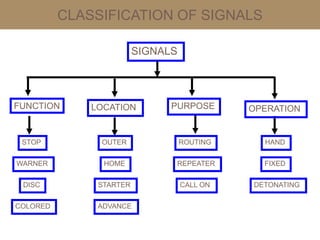
CLASSIFICATION OF SIGNALS
SIGNALS
FUNCTION PURPOSELOCATION OPERATION
STOP
WARNER
DISC
COLORED
OUTER
HOME
STARTER
ADVANCE
ROUTING
REPEATER
CALL ON
HAND
FIXED
DETONATING
CLASSIFICATION OF SIGNALS
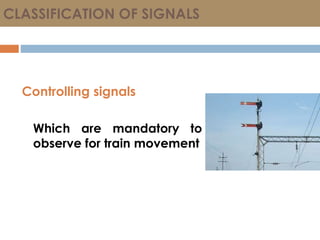
Controlling signals
Which are mandatory to
observe for train movement
CLASSIFICATION OF SIGNALS
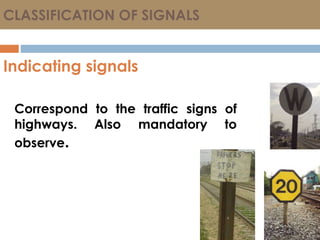
Indicating signals
Correspond to the traffic signs of
highways. Also mandatory to
observe.
CLASSIFICATION OF SIGNALS
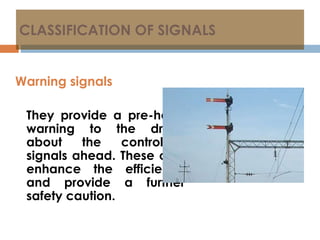
Warning signals
They provide a pre-hand
warning to the driver
about the controlling
signals ahead. These only
enhance the efficiency
and provide a further
safety caution.
Detonating Signals
 Used when hand and fixed signals or not visible
(foggy and cloudy conditions)
 Also used during emergencies (derailment,
accidents etc.,)
 These are in the form of detonators fixed on the
top of rails
 When engine passes over it explodes with big
sound and alerts the driver to stop the train.
 3 to 4 detonators are placed at an interval of
about 10 to 15m at 400 to 500m ahead.
Hand Signals
 Given by the guard using coloured flags or by
bare arms
 During night times kerosene lamps fitted with
movable green, red and yellow coloured
glasses are used.
o Green - proceed
o Red - dead stop
o Yellow – proceed with caution
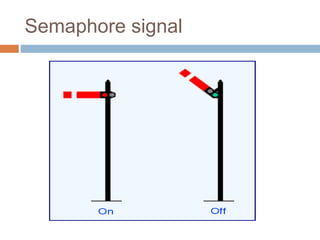
Semaphore Signals
 Consist of a vertical post on which a movable
arm is pivoted at the top.
 Arm can be kept horizontal or it can be inclined
at 45 degree to horizontal
 Outer end of arm is 2.45cm broader than that at
post.
 Movable arm is controlled by means of levers
and cables from the cabin.
 Spectacles of red and green or fixed in the arm
 These are fixed on the left hand side of track,
with spectacles towards driver.
 Horizontal arm indicates “ DANGER –STOP ”
and the inclined arm indicates “ CLEAR –
PROCEED”.
 In the day time position of arm indicates the
signal.
 During the night time light of lamp passing
through spectacle gives the signal.
Semaphore signal
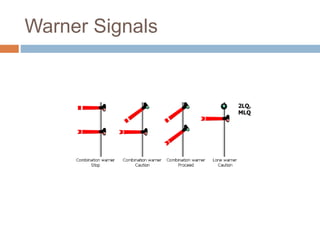
Warner Signal
 This is similar to semaphore signal
 Difference is it contains a fish tailed arm
 These signals are placed ahead the semaphore
signals to warn the driver before entering the
railway station.
 When the arm is horizontal – indicates signal
ahead is stop
 Warner signals are placed 540m away from the
first stop signal.
 Some times warner signals are provided with
yellow lights instead of red to distinguish them
from semaphore signals during nights.
 Some times both warner and semaphore
signals are placed on the same pole
 Both horizontal – stop line not clear
 Semaphore lower, warner horizontal – proceed
with caution
 Both lowered – proceed on with confidence
(this section and next section both are clear)
Warner Signals
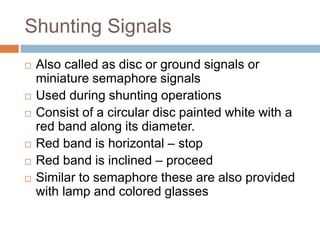
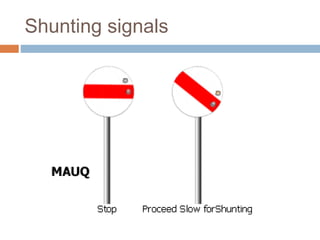
Shunting Signals
 Also called as disc or ground signals or
miniature semaphore signals
 Used during shunting operations
 Consist of a circular disc painted white with a
red band along its diameter.
 Red band is horizontal – stop
 Red band is inclined – proceed
 Similar to semaphore these are also provided
with lamp and colored glasses
Shunting signals
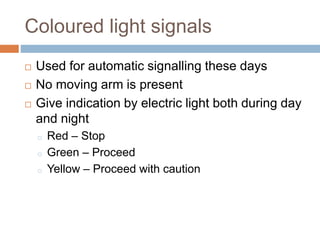
Coloured light signals
 Used for automatic signalling these days
 No moving arm is present
 Give indication by electric light both during day
and night
o Red – Stop
o Green – Proceed
o Yellow – Proceed with caution
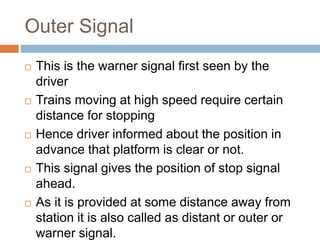
Outer Signal
 This is the warner signal first seen by the
driver
 Trains moving at high speed require certain
distance for stopping
 Hence driver informed about the position in
advance that platform is clear or not.
 This signal gives the position of stop signal
ahead.
 As it is provided at some distance away from
station it is also called as distant or outer or
warner signal.
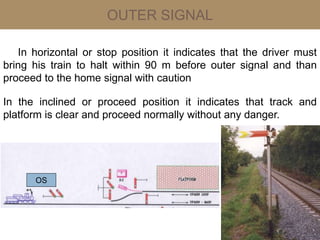
In the inclined or proceed position it indicates that track and
platform is clear and proceed normally without any danger.
In horizontal or stop position it indicates that the driver must
bring his train to halt within 90 m before outer signal and than
proceed to the home signal with caution
OUTER SIGNAL
OS
Home signal
 It is next signal after outer signal towards
station
 It is a simple semaphore signal and indicates
whether platform is clear or not
HOME SIGNAL
After the outer signal towards station is a stop signal and exactly
placed at the station limit is called home or stop signal. Its main
function is to protect the stations. The permission to enter the
platform is given by the operation of this signal. The maximum
unprotected distance between the signal and the point, it is
intended to protect is specified as 180 m due to its location at the
door of station, it is called home signal.
HSOHS
STARTER SIGNAL
This signal is provided at the forward end of platform and controls
the movement of the train as they leave the station. It gives
permission to the train to leave the platform for next station. No
train can leave the platform unless this signal is lowered, that is
why it is called starter signal. A separate signal is provided for
each line.
SS
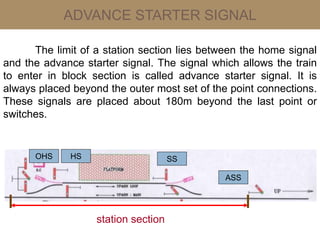
ADVANCE STARTER SIGNAL
The limit of a station section lies between the home signal
and the advance starter signal. The signal which allows the train
to enter in block section is called advance starter signal. It is
always placed beyond the outer most set of the point connections.
These signals are placed about 180m beyond the last point or
switches.
ASS
SSHSOHS
station section
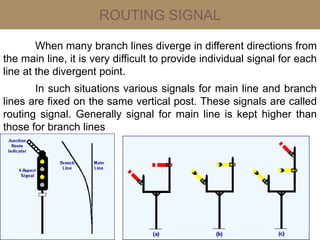
ROUTING SIGNAL
When many branch lines diverge in different directions from
the main line, it is very difficult to provide individual signal for each
line at the divergent point.
In such situations various signals for main line and branch
lines are fixed on the same vertical post. These signals are called
routing signal. Generally signal for main line is kept higher than
those for branch lines
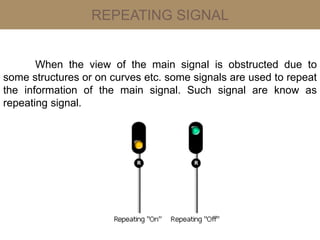
REPEATING SIGNAL
When the view of the main signal is obstructed due to
some structures or on curves etc. some signals are used to repeat
the information of the main signal. Such signal are know as
repeating signal.
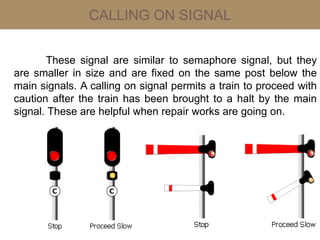
CALLING ON SIGNAL
These signal are similar to semaphore signal, but they
are smaller in size and are fixed on the same post below the
main signals. A calling on signal permits a train to proceed with
caution after the train has been brought to a halt by the main
signal. These are helpful when repair works are going on.
Signalling Systems
 Absolute block system
 Space interval system
 Time interval system
 Pilot guard system
Absolute Block System
 This system involves dividing the entire length
of the track into sections called block sections.
 A block section lies between two stations that
are provided with block instruments
 The block instruments of adjoining stations are
connected through railway lines.
 A token can be taken from the block
instrument of a particular station with the
consent of both the station masters.
Absolute Block system
 In the absolute block system, the departure of
a train from one station to another is not
permitted until and unless the previous train
has completely arrived at the next station.
 i.e., trains are not permitted to enter the
section between two stations at the same time.
 Each station has two block instruments;
 one for the station ahead and the other for the
previous station
 These are electrically interconnected
Time interval method
 Trains are Spaced Over an length of a track in
such a way that , if the first train stops, the
following train driver should be able to stop the
train in sufficient distance without colliding with
the first one.
 This type is used where traffic is less and
weight of the trains are less, e.g: Trams
 This Type of System cannot be used in
Passenger rails since weight and traffic is High
Space interval method
 In this method of “Control Over Movement”,
the length of the track is divided in to sections
called Blocks.
 The Entry of a train in to the ‘Block’ is
controlled in such a way that only when it is
free, a train can be allowed to enter it.
 This means that between two consecutive
trains , there is definite space interval.
Interlocking
 Arrangement of of signals, points and other
appliances, so interconnected by mechanical
or electrical locking that their operation takes
place in a predetermined sequence to ensure
that conflicting movement of signals and points
do not take place and train runs safely.
Necessity
 increase in the number of points and signals
 Increase in speeds
 Points and signals arranged in fool proof
manner. Conflicting movements are avoided
 Helps in proper and safe working of the
system
Essentials
 It should not be possible to turn a signal off unless
all points for the line on which the train is to be
received are correctly set, all the facing points are
locked, and all interlocked level crossings are
closed and inaccessible to road traffic.
 The line should be fully isolated before the signal is
turned off, i.e., no loose wagons should be able to
enter this line.
 After the signal has been turned off, it should not
be possible to make adjustments in the points or
locks on the route.
Essentials
 It should not be possible to turn any two
signals off at the same time, as this can lead to
conflicting movements of the trains.
 Wherever feasible, the points should be so
interlocked as to avoid any conflicting
movement
standards
 1st standard : makes use of key interlocking
 Running speed for trains restricted to 50kmph
 2nd standard:
 used on non trunk main routes
 Operated mechanically or electrically
 Speed less than 75kmph
 3rd standard;
 Makes used of mechanically or electrically
interconnected
 Uses latest interlocking techniques also.
Key Interlocking
 Simplest method of interlocking
 Involves the manipulation of keys in one form
or other
 This type of interlocking is normally provided
with standard 1 interlocking
 Arrangement of key interlocking is done as
below when a main line and branch line exist
on a single track.
Key interlocking
 Point can be set either for main line or branch line
 A, B are the keys for main and branch lines. At any
point only one of the keys can be taken out.
 Lever frame operating the signals is provided with 2
signals and will be operated by keys A and B only.
 If the train is to be received on main line, the key is
locked for point on main line, and A is taken out and
inserted in the lever for signal of main line.
 Thus lowering the signal of main line.
 This type of signal is called indirect interlocking.
 If there are multiple lines succession interlocking will
be used.
Mechanical Interlocking
 Improved form of interlocking compared to key
interlocking
 Greater safety and less manpower
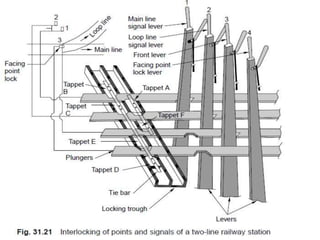
 Done using plungers and tie bars
 Plungers are of size 30cm x 1.6cm and have
notches in them
 Tie bars are placed at right angles to plungers
and are provided with suitable shaped riveted
cast iron pieces (tappets) that exactly fit in
notches.
Mechanical interlocking
 Main components are
 Locking frame
 Point frame
 Signal fittings
 And connecting devices
 Levers are arranged in a row in the frame
 Pulling a point lever operates the point to which it
is connected through a steel rod.
 Pulling a signal lever changes the signal by pulling
the wire connecting the lever and signal.
Mechanical interlocking
 This entire arrangement is provided in a
locking trough where tappets are provided,
which move at right angles to the plungers.
 When lever is pulled, it causes the plunger
which it is connected to move.
 Due to wedge action, the tappet
accommodated in the notch of the plunger is
pushed out at right angles to the movement of
plunger.
Mechanical interlocking
 The motion gets transferred to the other
tappets which are connected to the other
tappets by means of tie rod.
 Some tappets gets pushed in, some pushed
out as a result.
 In case a tappet is free and pushed into the
notch, it locks the lever connected to that
plunger.
 Else if it is already locked, it will come out of
notch, and the lever becomes free to be
operated.
Different cases of mechanical
interlocking
 Normal interlocking:
 Pulling one lever locks other lever in normal position
 Back locking or release locking:
 Lever in normal position locks the other lever in normal
position.
 When pulled other lever released and is free to operate
 When other pulled, first one gets locked in pulled position.
 Both wall locking:
 Once the lever is locked other lever locked in current
position.
 Conditional locking:
Electrical interlocking
 Achieved through electrical switches known as relays
 Manipulation of relays achieves interlocking
 In the place of plungers or in addition to plungers, lever
locks are attached with levers.
 These work by making use of the principle of
electromagnetism.
 Soft iron core wrapped inside a iron core turns into
magnet when current passes through it.
 An arrangement named armature is attached to this
magnet.
 Depending on whether the armature is attached or not
interlocking works here.
 This entire system is housed in a glass or metal box
Panel interlocking
 All points and signals are operated electrically
from a central location
 The switches for operating these points and
signals are mounted on a panel, which also
bears the diagram of the yard layout
 Electrical interlocking is achieved by means of
relays
 Centralized controlling of greater area is great
advantage
 With elimination of inter cabin controlling
greater number of trains can be run with less
Route Relay Interlocking
 Improvement over panel interlocking
 In panel interlocking each point in the line has
to be individually setup with a switch and
clearance of signal is obtained by operating
the switch.
 In R.R.I only a pair of switches are used for
doing all these operations automatically.
 Signal is also cleared in the similar automated
manner
 The main requirement for this type of
interlocking is entire track needs to be track
circuited.
Route Relay Interlocking
 The conditions of track circuit and various
indications of all signal are mirrored on the
panel that carries the diagram of the yard.
 By looking at these indications a panel
operator can a panel operator can easily know
whether a track is free or not.
 Once the route is set to allow, the portion gets
illuminated with white light.
 If the route is occupied, it will show in red
colour.
 If the train has cleared the track, the lights will
off.
The Automatic Warning System
(AWS)
 It is a device that triggers the automatic application
of brakes if the signal is indicating danger and the
driver has not taken any action.
 The system consists of a track device located at a
desirable braking distance at the rear end of the
first stop signal.
 The track device is activated when the signal
indicates danger and is ineffective when the signal
is ‘clear’.
 Alarm will sound if driver don’t take action during a
stop signal.
 Then emergency brakes are applied automatically.
Different components.
 Points:
 Points are set mechanically and are kept in locks
and stretcher bars.
 The mechanical arrangement for operating them
includes a solid rod and cranks.
 Point locks, detectors and lock bars used for
controlling and directing the points.
 Point locks
 A point lock is provided to ensure that each point
is set correctly.
 It is provided between two tongue rails and near
the toe of the switch assembly.
 The point lock consists of a plunger, which moves
in a plunger casing.
 The plunger is worked by means of a plunger rod,
which is connected to the signal cabin through a
lock bar.
 Detectors:
 Provided at all points
 To detect any defect or failure in the connection
between points and levers
 To ensure the correct signal is lowered
 It can be mechanical or electrical
 Lock bar
 A lock bar is provided to make it impossible to
change the point when a train is passing over it.

Signalling and Interlocking

  • 1.
  • 2.
    Introduction  Signalling isthe device by which the movement of trains is controlled  Highly important in terms of safety  Trains can be operated efficiently, utilization of tracks and tracks can be done at maximum levels  Signalling includes signals, points, blocks and other equipment;
  • 3.
    Objects of Signalling Maintain safe distance between trains running in the same direction on a single line.  Safe distance between trains which are approaching or crossing a crossing.  To run the trains at restricted speeds during repair works  At junctions to prevent the trains from colliding
  • 4.
    Objects of Signalling At the diverging tracks to give indication about the direction to move  In marshalling yards, to provide safety against shunting  To provide facilities for the maximum use of track and rolling stock  Increase the safety
  • 5.
    Classification of signals Depending on the operational characteristics  Fog or audible or detonating signals  Visual indication hand signals  Visual indication fixed signals  Depending on the functional characteristics  Stop or semaphore type signals  Warner signals  Shunting signals  Coloured light signals
  • 6.
     Depending onthe location characteristics  Outer receptional signals  Home receptional signals  Starter signals  Advance starter signals  Special signals  Routing signals  Calling on signals  Point indicators  Repeater or co-acting signals  Modified lower quadrant semaphore signals  Miscellaneous signals
  • 7.
    CLASSIFICATION OF SIGNALS SIGNALS FUNCTIONPURPOSELOCATION OPERATION STOP WARNER DISC COLORED OUTER HOME STARTER ADVANCE ROUTING REPEATER CALL ON HAND FIXED DETONATING
  • 9.
    CLASSIFICATION OF SIGNALS Controllingsignals Which are mandatory to observe for train movement
  • 10.
    CLASSIFICATION OF SIGNALS Indicatingsignals Correspond to the traffic signs of highways. Also mandatory to observe.
  • 11.
    CLASSIFICATION OF SIGNALS Warningsignals They provide a pre-hand warning to the driver about the controlling signals ahead. These only enhance the efficiency and provide a further safety caution.
  • 12.
    Detonating Signals  Usedwhen hand and fixed signals or not visible (foggy and cloudy conditions)  Also used during emergencies (derailment, accidents etc.,)  These are in the form of detonators fixed on the top of rails  When engine passes over it explodes with big sound and alerts the driver to stop the train.  3 to 4 detonators are placed at an interval of about 10 to 15m at 400 to 500m ahead.
  • 13.
    Hand Signals  Givenby the guard using coloured flags or by bare arms  During night times kerosene lamps fitted with movable green, red and yellow coloured glasses are used. o Green - proceed o Red - dead stop o Yellow – proceed with caution
  • 14.
    Semaphore Signals  Consistof a vertical post on which a movable arm is pivoted at the top.  Arm can be kept horizontal or it can be inclined at 45 degree to horizontal  Outer end of arm is 2.45cm broader than that at post.  Movable arm is controlled by means of levers and cables from the cabin.  Spectacles of red and green or fixed in the arm  These are fixed on the left hand side of track, with spectacles towards driver.
  • 15.
     Horizontal armindicates “ DANGER –STOP ” and the inclined arm indicates “ CLEAR – PROCEED”.  In the day time position of arm indicates the signal.  During the night time light of lamp passing through spectacle gives the signal.
  • 16.
  • 17.
    Warner Signal  Thisis similar to semaphore signal  Difference is it contains a fish tailed arm  These signals are placed ahead the semaphore signals to warn the driver before entering the railway station.  When the arm is horizontal – indicates signal ahead is stop  Warner signals are placed 540m away from the first stop signal.  Some times warner signals are provided with yellow lights instead of red to distinguish them from semaphore signals during nights.
  • 18.
     Some timesboth warner and semaphore signals are placed on the same pole  Both horizontal – stop line not clear  Semaphore lower, warner horizontal – proceed with caution  Both lowered – proceed on with confidence (this section and next section both are clear)
  • 19.
  • 20.
    Shunting Signals  Alsocalled as disc or ground signals or miniature semaphore signals  Used during shunting operations  Consist of a circular disc painted white with a red band along its diameter.  Red band is horizontal – stop  Red band is inclined – proceed  Similar to semaphore these are also provided with lamp and colored glasses
  • 21.
  • 22.
    Coloured light signals Used for automatic signalling these days  No moving arm is present  Give indication by electric light both during day and night o Red – Stop o Green – Proceed o Yellow – Proceed with caution
  • 24.
    Outer Signal  Thisis the warner signal first seen by the driver  Trains moving at high speed require certain distance for stopping  Hence driver informed about the position in advance that platform is clear or not.  This signal gives the position of stop signal ahead.  As it is provided at some distance away from station it is also called as distant or outer or warner signal.
  • 25.
    In the inclinedor proceed position it indicates that track and platform is clear and proceed normally without any danger. In horizontal or stop position it indicates that the driver must bring his train to halt within 90 m before outer signal and than proceed to the home signal with caution OUTER SIGNAL OS
  • 26.
    Home signal  Itis next signal after outer signal towards station  It is a simple semaphore signal and indicates whether platform is clear or not
  • 27.
    HOME SIGNAL After theouter signal towards station is a stop signal and exactly placed at the station limit is called home or stop signal. Its main function is to protect the stations. The permission to enter the platform is given by the operation of this signal. The maximum unprotected distance between the signal and the point, it is intended to protect is specified as 180 m due to its location at the door of station, it is called home signal. HSOHS
  • 28.
    STARTER SIGNAL This signalis provided at the forward end of platform and controls the movement of the train as they leave the station. It gives permission to the train to leave the platform for next station. No train can leave the platform unless this signal is lowered, that is why it is called starter signal. A separate signal is provided for each line. SS
  • 29.
    ADVANCE STARTER SIGNAL Thelimit of a station section lies between the home signal and the advance starter signal. The signal which allows the train to enter in block section is called advance starter signal. It is always placed beyond the outer most set of the point connections. These signals are placed about 180m beyond the last point or switches. ASS SSHSOHS station section
  • 30.
    ROUTING SIGNAL When manybranch lines diverge in different directions from the main line, it is very difficult to provide individual signal for each line at the divergent point. In such situations various signals for main line and branch lines are fixed on the same vertical post. These signals are called routing signal. Generally signal for main line is kept higher than those for branch lines
  • 31.
    REPEATING SIGNAL When theview of the main signal is obstructed due to some structures or on curves etc. some signals are used to repeat the information of the main signal. Such signal are know as repeating signal.
  • 32.
    CALLING ON SIGNAL Thesesignal are similar to semaphore signal, but they are smaller in size and are fixed on the same post below the main signals. A calling on signal permits a train to proceed with caution after the train has been brought to a halt by the main signal. These are helpful when repair works are going on.
  • 33.
    Signalling Systems  Absoluteblock system  Space interval system  Time interval system  Pilot guard system
  • 34.
    Absolute Block System This system involves dividing the entire length of the track into sections called block sections.  A block section lies between two stations that are provided with block instruments  The block instruments of adjoining stations are connected through railway lines.  A token can be taken from the block instrument of a particular station with the consent of both the station masters.
  • 35.
    Absolute Block system In the absolute block system, the departure of a train from one station to another is not permitted until and unless the previous train has completely arrived at the next station.  i.e., trains are not permitted to enter the section between two stations at the same time.  Each station has two block instruments;  one for the station ahead and the other for the previous station  These are electrically interconnected
  • 36.
    Time interval method Trains are Spaced Over an length of a track in such a way that , if the first train stops, the following train driver should be able to stop the train in sufficient distance without colliding with the first one.  This type is used where traffic is less and weight of the trains are less, e.g: Trams  This Type of System cannot be used in Passenger rails since weight and traffic is High
  • 37.
    Space interval method In this method of “Control Over Movement”, the length of the track is divided in to sections called Blocks.  The Entry of a train in to the ‘Block’ is controlled in such a way that only when it is free, a train can be allowed to enter it.  This means that between two consecutive trains , there is definite space interval.
  • 38.
    Interlocking  Arrangement ofof signals, points and other appliances, so interconnected by mechanical or electrical locking that their operation takes place in a predetermined sequence to ensure that conflicting movement of signals and points do not take place and train runs safely.
  • 39.
    Necessity  increase inthe number of points and signals  Increase in speeds  Points and signals arranged in fool proof manner. Conflicting movements are avoided  Helps in proper and safe working of the system
  • 40.
    Essentials  It shouldnot be possible to turn a signal off unless all points for the line on which the train is to be received are correctly set, all the facing points are locked, and all interlocked level crossings are closed and inaccessible to road traffic.  The line should be fully isolated before the signal is turned off, i.e., no loose wagons should be able to enter this line.  After the signal has been turned off, it should not be possible to make adjustments in the points or locks on the route.
  • 41.
    Essentials  It shouldnot be possible to turn any two signals off at the same time, as this can lead to conflicting movements of the trains.  Wherever feasible, the points should be so interlocked as to avoid any conflicting movement
  • 42.
    standards  1st standard: makes use of key interlocking  Running speed for trains restricted to 50kmph  2nd standard:  used on non trunk main routes  Operated mechanically or electrically  Speed less than 75kmph  3rd standard;  Makes used of mechanically or electrically interconnected  Uses latest interlocking techniques also.
  • 43.
    Key Interlocking  Simplestmethod of interlocking  Involves the manipulation of keys in one form or other  This type of interlocking is normally provided with standard 1 interlocking  Arrangement of key interlocking is done as below when a main line and branch line exist on a single track.
  • 44.
    Key interlocking  Pointcan be set either for main line or branch line  A, B are the keys for main and branch lines. At any point only one of the keys can be taken out.  Lever frame operating the signals is provided with 2 signals and will be operated by keys A and B only.  If the train is to be received on main line, the key is locked for point on main line, and A is taken out and inserted in the lever for signal of main line.  Thus lowering the signal of main line.  This type of signal is called indirect interlocking.  If there are multiple lines succession interlocking will be used.
  • 45.
    Mechanical Interlocking  Improvedform of interlocking compared to key interlocking  Greater safety and less manpower  Done using plungers and tie bars  Plungers are of size 30cm x 1.6cm and have notches in them  Tie bars are placed at right angles to plungers and are provided with suitable shaped riveted cast iron pieces (tappets) that exactly fit in notches.
  • 46.
    Mechanical interlocking  Maincomponents are  Locking frame  Point frame  Signal fittings  And connecting devices  Levers are arranged in a row in the frame  Pulling a point lever operates the point to which it is connected through a steel rod.  Pulling a signal lever changes the signal by pulling the wire connecting the lever and signal.
  • 47.
    Mechanical interlocking  Thisentire arrangement is provided in a locking trough where tappets are provided, which move at right angles to the plungers.  When lever is pulled, it causes the plunger which it is connected to move.  Due to wedge action, the tappet accommodated in the notch of the plunger is pushed out at right angles to the movement of plunger.
  • 48.
    Mechanical interlocking  Themotion gets transferred to the other tappets which are connected to the other tappets by means of tie rod.  Some tappets gets pushed in, some pushed out as a result.  In case a tappet is free and pushed into the notch, it locks the lever connected to that plunger.  Else if it is already locked, it will come out of notch, and the lever becomes free to be operated.
  • 49.
    Different cases ofmechanical interlocking  Normal interlocking:  Pulling one lever locks other lever in normal position  Back locking or release locking:  Lever in normal position locks the other lever in normal position.  When pulled other lever released and is free to operate  When other pulled, first one gets locked in pulled position.  Both wall locking:  Once the lever is locked other lever locked in current position.  Conditional locking:
  • 51.
    Electrical interlocking  Achievedthrough electrical switches known as relays  Manipulation of relays achieves interlocking  In the place of plungers or in addition to plungers, lever locks are attached with levers.  These work by making use of the principle of electromagnetism.  Soft iron core wrapped inside a iron core turns into magnet when current passes through it.  An arrangement named armature is attached to this magnet.  Depending on whether the armature is attached or not interlocking works here.  This entire system is housed in a glass or metal box
  • 52.
    Panel interlocking  Allpoints and signals are operated electrically from a central location  The switches for operating these points and signals are mounted on a panel, which also bears the diagram of the yard layout  Electrical interlocking is achieved by means of relays  Centralized controlling of greater area is great advantage  With elimination of inter cabin controlling greater number of trains can be run with less
  • 53.
    Route Relay Interlocking Improvement over panel interlocking  In panel interlocking each point in the line has to be individually setup with a switch and clearance of signal is obtained by operating the switch.  In R.R.I only a pair of switches are used for doing all these operations automatically.  Signal is also cleared in the similar automated manner  The main requirement for this type of interlocking is entire track needs to be track circuited.
  • 54.
    Route Relay Interlocking The conditions of track circuit and various indications of all signal are mirrored on the panel that carries the diagram of the yard.  By looking at these indications a panel operator can a panel operator can easily know whether a track is free or not.  Once the route is set to allow, the portion gets illuminated with white light.  If the route is occupied, it will show in red colour.  If the train has cleared the track, the lights will off.
  • 55.
    The Automatic WarningSystem (AWS)  It is a device that triggers the automatic application of brakes if the signal is indicating danger and the driver has not taken any action.  The system consists of a track device located at a desirable braking distance at the rear end of the first stop signal.  The track device is activated when the signal indicates danger and is ineffective when the signal is ‘clear’.  Alarm will sound if driver don’t take action during a stop signal.  Then emergency brakes are applied automatically.
  • 56.
    Different components.  Points: Points are set mechanically and are kept in locks and stretcher bars.  The mechanical arrangement for operating them includes a solid rod and cranks.  Point locks, detectors and lock bars used for controlling and directing the points.
  • 57.
     Point locks A point lock is provided to ensure that each point is set correctly.  It is provided between two tongue rails and near the toe of the switch assembly.  The point lock consists of a plunger, which moves in a plunger casing.  The plunger is worked by means of a plunger rod, which is connected to the signal cabin through a lock bar.
  • 58.
     Detectors:  Providedat all points  To detect any defect or failure in the connection between points and levers  To ensure the correct signal is lowered  It can be mechanical or electrical  Lock bar  A lock bar is provided to make it impossible to change the point when a train is passing over it.