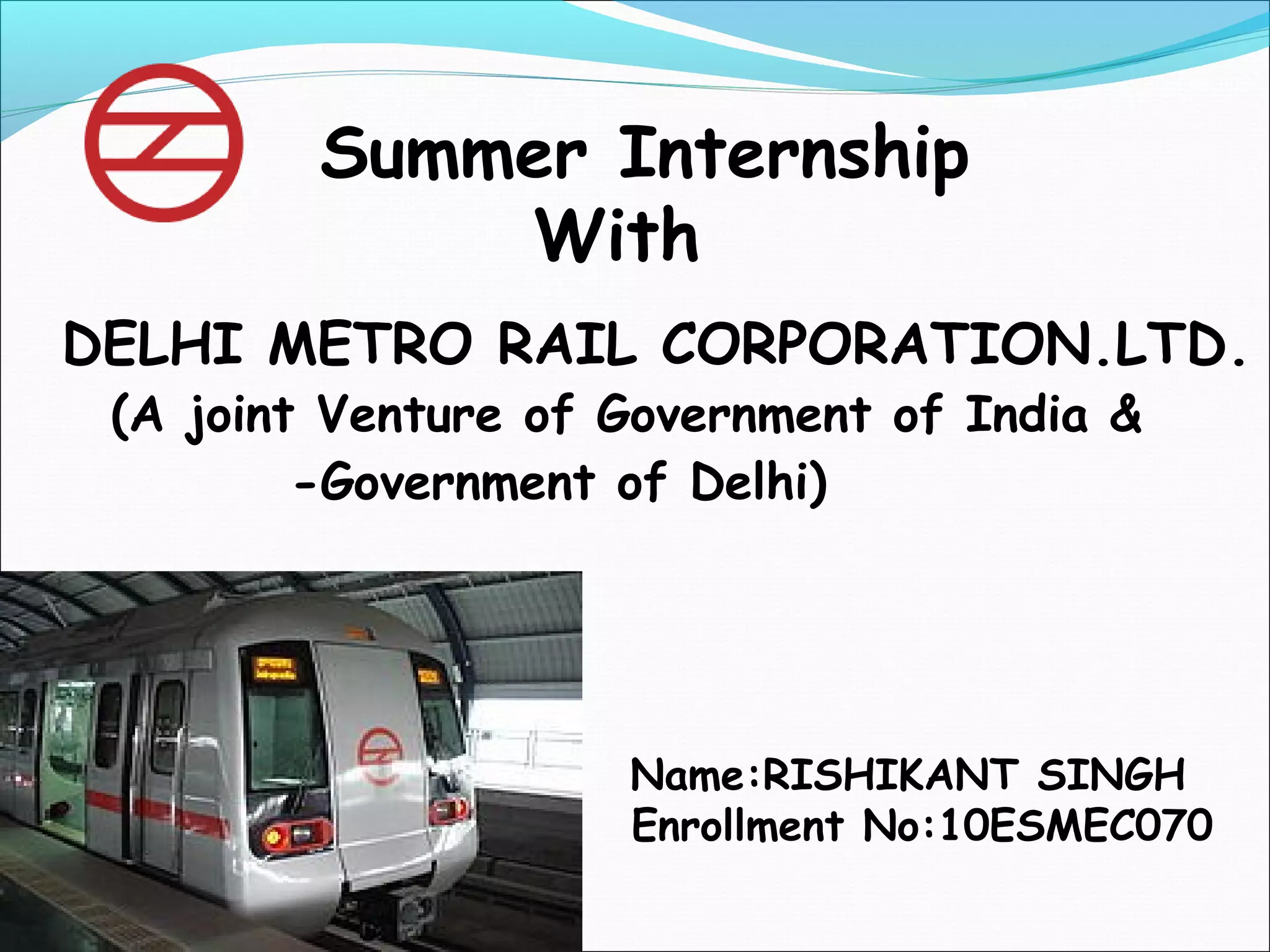
Summer Internship
With
DELHI METRO RAIL CORPORATION.LTD.
(A joint Venture of Government of India &
-Government of Delhi)

Name:RISHIKANT SINGH
Enrollment No:10ESMEC070
The basic components of telecommunication
department can be stated as follows:
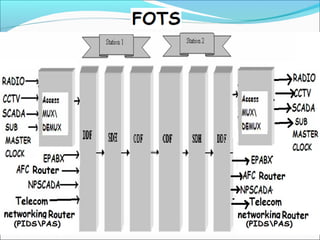
FOTS ( Fiber Optic Transmission System)
PIDS (Public Information Display System)
PAS (Public Address System)
Master Clock
CCTV (Closed Circuit Television)
Radio System
EPABX (Electronic Private Automatic Branch Exchange)
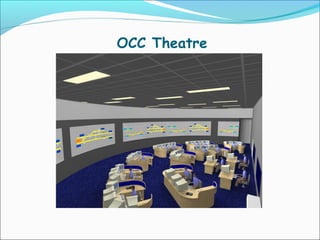
Operational Control Center (OCC)
Located at Shastri Park and Barakhamba.
It controls both Rail & Metro Corridor.
Here all the central systems of various systems are

located.
All the train movements are supervised and system

monitoring equipments are installed in OCC.
OCC Theatre
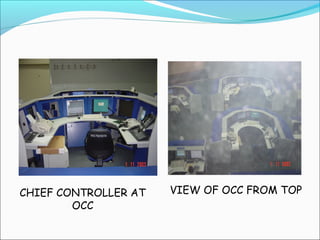
CHIEF CONTROLLER AT
OCC

VIEW OF OCC FROM TOP
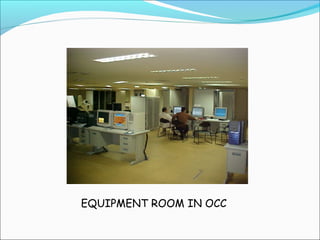
EQUIPMENT ROOM IN OCC
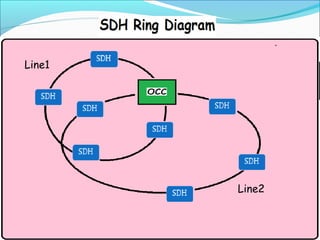
Line1

Line2
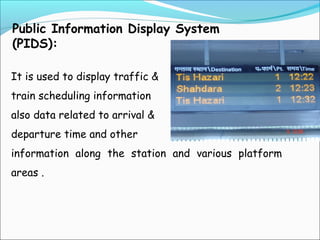
Public Information Display System
(PIDS):
It is used to display traffic &
train scheduling information
also data related to arrival &
departure time and other
information along the station and various platform
areas .
Public address system(PAS):
• It is used to broadcast voice messages to passengers/staff
in all stations , depots ,OCC and DMRC Headquarter.
•Also used for emergency evacuation broadcast .
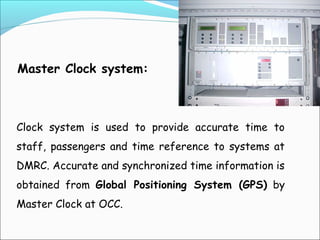
Master Clock system:

Clock system is used to provide accurate time to
staff, passengers and time reference to systems at
DMRC. Accurate and synchronized time information is
obtained from Global Positioning System (GPS) by
Master Clock at OCC.
Closed Circuit Television System(CCTV):
•This is used to monitor the station and the platforms
along with the metro corridors where it is very difficult
to keep a view on the corridors.
•Mostly it is used for security reasons and help train
operators in the curved station platforms.
Electronic Private Automatic Branch
Exchange (EPABX) :
For purpose of planting communication link between
different stations, DMRC has its self-sustained
telephone exchange. This system works on -48 V DC.
Data is processed at a rate of 64k bps.
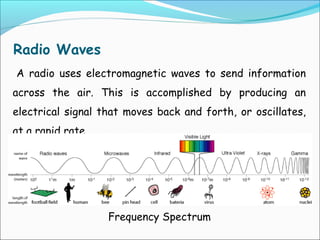
Radio Waves
A radio uses electromagnetic waves to send information
across the air. This is accomplished by producing an
electrical signal that moves back and forth, or oscillates,
at a rapid rate.

Frequency Spectrum
Technology in use:
• Terrestrial Trunked Radio (TETRA) (formerly known
as Trans European Trunked Radio) is a specialist
professional Mobile Radio and two-way transceiver
specification.
• This standard was developed by the ETSI for private
mobile radio. Open standard for private mobile radio. It
defines radio services and interfaces
• The TETRA standard defines the air interface between
mobile stations and the infrastructure.
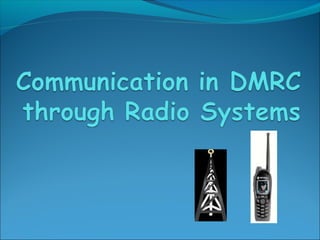
Radio system in DMRC
The Radio system is a digital trunked radio system,

operating in 380-400 MHz band and confirming to TETRA
standards.
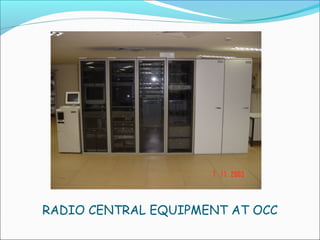
The Radio system have central control equipment installed

in OCC.
The Radio system uses EBTS towers for communication

in rail corridor & leaky coaxial cable along each track in
the tunnels for communication with train borne mobile
radio (in metro corridor) .
RADIO CENTRAL EQUIPMENT AT OCC
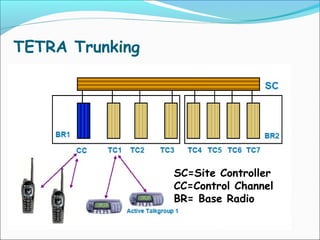
Trunking
The trunking concept allows channels or other
resources to be made available to users as they
are needed. It allows all the channels to be pooled
together. As a channel is needed, the controller
grants an available channel from its pool of
channels.
TETRA Trunking

SC=Site Controller
CC=Control Channel
BR= Base Radio
Talk group
 In most organizations, radio users work in groups that

are based on their functions and responsibilities. These
groups of radio users can be assigned to communication
talkgroups that reflect their function or responsibilities.

Calls are semi-duplex.
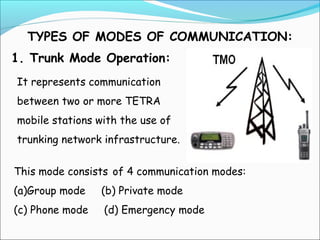
TYPES OF MODES OF COMMUNICATION:
1. Trunk Mode Operation:
It represents communication
between two or more TETRA
mobile stations with the use of
trunking network infrastructure.
This mode consists of 4 communication modes:
(a)Group mode

(b) Private mode

(c) Phone mode

(d) Emergency mode
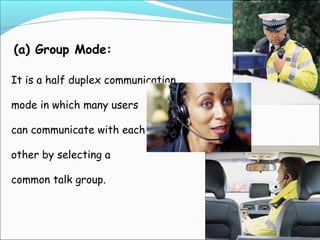
(a) Group Mode:
It is a half duplex communication
mode in which many users
can communicate with each
other by selecting a
common talk group.
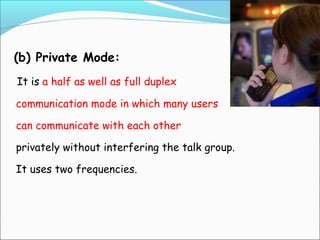
(b) Private Mode:
It is a half as well as full duplex
communication mode in which many users
can communicate with each other
privately without interfering the talk group.
It uses two frequencies.
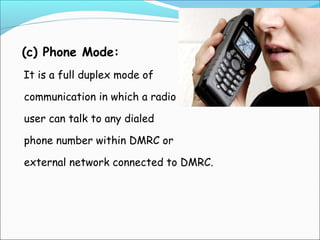
(c) Phone Mode:
It is a full duplex mode of
communication in which a radio
user can talk to any dialed
phone number within DMRC or
external network connected to DMRC.
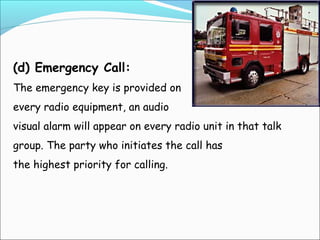
(d) Emergency Call:
The emergency key is provided on
every radio equipment, an audio
visual alarm will appear on every radio unit in that talk
group. The party who initiates the call has
the highest priority for calling.
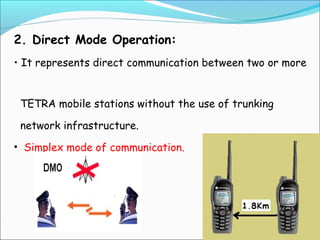
2. Direct Mode Operation:
• It represents direct communication between two or more
TETRA mobile stations without the use of trunking
network infrastructure.
• Simplex mode of communication.
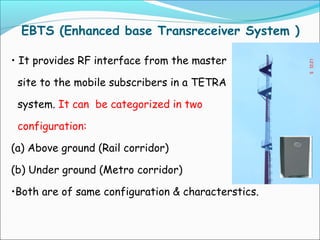
EBTS (Enhanced base Transreceiver System )
• It provides RF interface from the master
site to the mobile subscribers in a TETRA
system. It can be categorized in two
configuration:
(a) Above ground (Rail corridor)
(b) Under ground (Metro corridor)
•Both are of same configuration & characterstics.
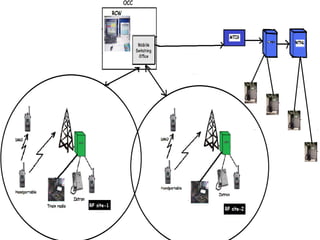
Call Through EBTS
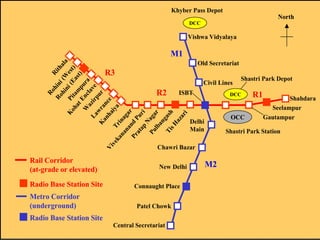
Khyber Pass Depot

North

DCC

Vishwa Vidyalaya

Ro
Ri
Ro hini
th
hi
(W ala
n
K
Pi i (E est
oh
t
)
at am ast
)
E p
W nc ura
l
a
La zir ave
p
K wra ur
an
n
ha c e
Vi
ve
iy
a
ka Tri
na na
na ga
r
Pr nd P
at
ap uri
N
Pu aga
r
lb
an
ga
Ti
s
sH h
az
ar
i

M1
Old Secretariat

R3

R2

Civil Lines

ISBT

DCC

OCC

Delhi
Main

Radio Base Station Site
Metro Corridor
(underground)
Radio Base Station Site

New Delhi
Connaught Place
Patel Chowk
Central Secretariat

R1

Shahdara
Seelampur
Gautampur

Shastri Park Station

Chawri Bazar

Rail Corridor
(at-grade or elevated)

Shastri Park Depot

M2
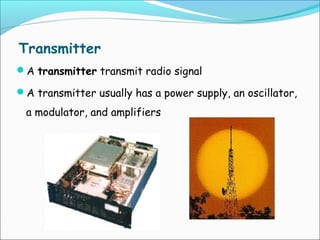
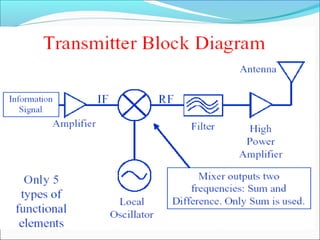
Transmitter
A transmitter transmit radio signal
A transmitter usually has a power supply, an oscillator,

a modulator, and amplifiers
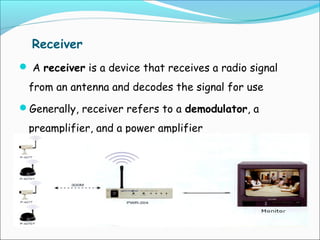
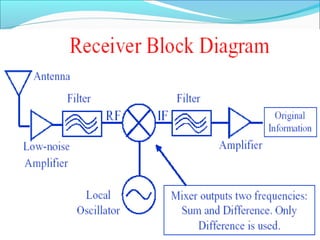
Receiver
 A receiver is a device that receives a radio signal

from an antenna and decodes the signal for use
Generally, receiver refers to a demodulator, a

preamplifier, and a power amplifier
Types of radio used in DMRC:
1. Mobile Vehicle radioFixed
(a) RAU (Radio Access Unit) or Zetron radio set or

Station radio
(b) Train radio set
(c) RCW (Radio console workstation)

2. Mobile Portable radio
Each radio has its radio identification which register
itself in central system for its function. The radio is
programmed for its ID, frequency, network code, talk
group and allowing types of call.

Radio consists of

trans and receiver and frequency synthesizer circuit
which

function

along

with

Processor) for digital function.

DSP

(Digital

Signal
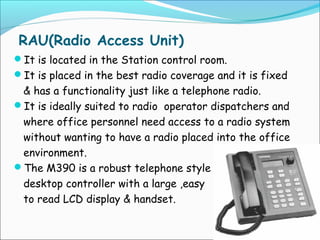
RAU(Radio Access Unit)
It is located in the Station control room.
It is placed in the best radio coverage and it is fixed

& has a functionality just like a telephone radio.
It is ideally suited to radio operator dispatchers and
where office personnel need access to a radio system
without wanting to have a radio placed into the office
environment.
The M390 is a robust telephone style
desktop controller with a large ,easy
to read LCD display & handset.
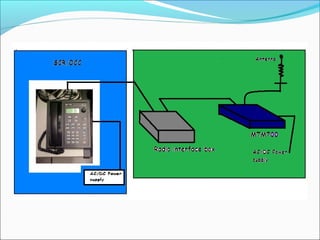
Block diagram of Zetron Setup
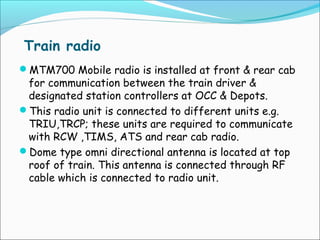
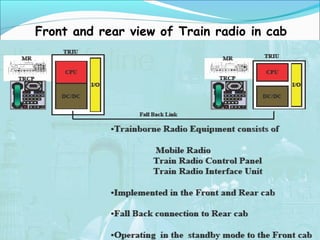
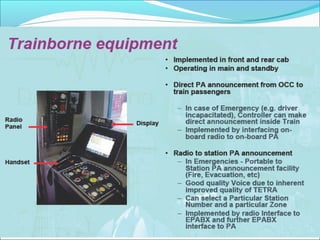
Train radio
MTM700 Mobile radio is installed at front & rear cab

for communication between the train driver &
designated station controllers at OCC & Depots.
This radio unit is connected to different units e.g.
TRIU,TRCP; these units are required to communicate
with RCW ,TIMS, ATS and rear cab radio.
Dome type omni directional antenna is located at top
roof of train. This antenna is connected through RF
cable which is connected to radio unit.
Front and rear view of Train radio in cab
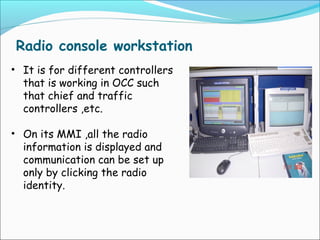
Radio console workstation
• It is for different controllers
that is working in OCC such
that chief and traffic
controllers ,etc.
• On its MMI ,all the radio
information is displayed and
communication can be set up
only by clicking the radio
identity.
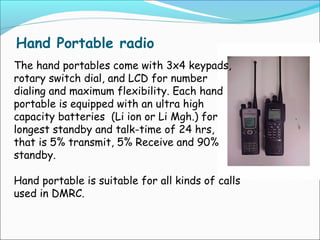
Hand Portable radio
The hand portables come with 3x4 keypads,
rotary switch dial, and LCD for number
dialing and maximum flexibility. Each hand
portable is equipped with an ultra high
capacity batteries (Li ion or Li Mgh.) for
longest standby and talk-time of 24 hrs,
that is 5% transmit, 5% Receive and 90%
standby.
Hand portable is suitable for all kinds of calls
used in DMRC.
Advantages of TETRA:
1. The frequency used gives longer range, which permits
high levels of geographic coverage with a smaller number of
transmitters, thus cutting infrastructure costs.
2.Unlike the cellular technologies, TETRA is built to do oneto-one, one-to-many and many-to-many.
3. Rapid deployment (transportable) network solutions are
available for disaster relief and temporary capacity
provision.
4. In the absence of a network mobiles/portables can use
'direct mode' whereby they share channels directly (walkietalkie mode).
Disadvantages of TETRA:
1. Requires a linear amplifier to meet the stringent RF
specifications that allow it to exist alongside other
radio services.
2. Handsets are more expensive than cellular.
3. Handsets can sometimes interfere with badly
designed (usually old) or sensitive electronic devices
such as broadcast (TV) receivers, hospital equipment,
speed cameras.
Conclusion:

TETRA communication system has been implemented

successfully

The signals are clear
The voice clarity is excellent
The TETRA technology effectively meets DMRC’s

operational and functional expectations
Conclusion:

In my training I have got to know about the different means
of communication systems used in DMRC. It consists of
radio communication techniques & radio systems; and data
transfer between stations and the OCC.
My presentation focuses on radio system. My conclusion
from this training is that DMRC uses two types of radio
systems:
a) Fixed Radio(Zetron, train radio, RCW)
b)Portable Radio(Tetra)
Both have their advantages and disadvantages. Fixed radio
equipments provide better voice clarity, but can not be
moved when placed at a particular place. Similarly Portable
radio equipment can be moved from place to place, but
voice clarity may vary as device might not provide 100%
signal at all places.

telecommunacation in`DMRC

  • 1.
    Summer Internship With DELHI METRORAIL CORPORATION.LTD. (A joint Venture of Government of India & -Government of Delhi) Name:RISHIKANT SINGH Enrollment No:10ESMEC070
  • 2.
    The basic componentsof telecommunication department can be stated as follows: FOTS ( Fiber Optic Transmission System) PIDS (Public Information Display System) PAS (Public Address System) Master Clock CCTV (Closed Circuit Television) Radio System EPABX (Electronic Private Automatic Branch Exchange)
  • 3.
    Operational Control Center(OCC) Located at Shastri Park and Barakhamba. It controls both Rail & Metro Corridor. Here all the central systems of various systems are located. All the train movements are supervised and system monitoring equipments are installed in OCC.
  • 4.
  • 5.
  • 6.
  • 8.
  • 9.
    Public Information DisplaySystem (PIDS): It is used to display traffic & train scheduling information also data related to arrival & departure time and other information along the station and various platform areas .
  • 10.
    Public address system(PAS): •It is used to broadcast voice messages to passengers/staff in all stations , depots ,OCC and DMRC Headquarter. •Also used for emergency evacuation broadcast .
  • 11.
    Master Clock system: Clocksystem is used to provide accurate time to staff, passengers and time reference to systems at DMRC. Accurate and synchronized time information is obtained from Global Positioning System (GPS) by Master Clock at OCC.
  • 12.
    Closed Circuit TelevisionSystem(CCTV): •This is used to monitor the station and the platforms along with the metro corridors where it is very difficult to keep a view on the corridors. •Mostly it is used for security reasons and help train operators in the curved station platforms.
  • 13.
    Electronic Private AutomaticBranch Exchange (EPABX) : For purpose of planting communication link between different stations, DMRC has its self-sustained telephone exchange. This system works on -48 V DC. Data is processed at a rate of 64k bps.
  • 15.
    Radio Waves A radiouses electromagnetic waves to send information across the air. This is accomplished by producing an electrical signal that moves back and forth, or oscillates, at a rapid rate. Frequency Spectrum
  • 16.
    Technology in use: •Terrestrial Trunked Radio (TETRA) (formerly known as Trans European Trunked Radio) is a specialist professional Mobile Radio and two-way transceiver specification. • This standard was developed by the ETSI for private mobile radio. Open standard for private mobile radio. It defines radio services and interfaces • The TETRA standard defines the air interface between mobile stations and the infrastructure.
  • 17.
    Radio system inDMRC The Radio system is a digital trunked radio system, operating in 380-400 MHz band and confirming to TETRA standards. The Radio system have central control equipment installed in OCC. The Radio system uses EBTS towers for communication in rail corridor & leaky coaxial cable along each track in the tunnels for communication with train borne mobile radio (in metro corridor) .
  • 18.
  • 19.
    Trunking The trunking conceptallows channels or other resources to be made available to users as they are needed. It allows all the channels to be pooled together. As a channel is needed, the controller grants an available channel from its pool of channels.
  • 20.
  • 21.
    Talk group  Inmost organizations, radio users work in groups that are based on their functions and responsibilities. These groups of radio users can be assigned to communication talkgroups that reflect their function or responsibilities. Calls are semi-duplex.
  • 22.
    TYPES OF MODESOF COMMUNICATION: 1. Trunk Mode Operation: It represents communication between two or more TETRA mobile stations with the use of trunking network infrastructure. This mode consists of 4 communication modes: (a)Group mode (b) Private mode (c) Phone mode (d) Emergency mode
  • 23.
    (a) Group Mode: Itis a half duplex communication mode in which many users can communicate with each other by selecting a common talk group.
  • 24.
    (b) Private Mode: Itis a half as well as full duplex communication mode in which many users can communicate with each other privately without interfering the talk group. It uses two frequencies.
  • 25.
    (c) Phone Mode: Itis a full duplex mode of communication in which a radio user can talk to any dialed phone number within DMRC or external network connected to DMRC.
  • 26.
    (d) Emergency Call: Theemergency key is provided on every radio equipment, an audio visual alarm will appear on every radio unit in that talk group. The party who initiates the call has the highest priority for calling.
  • 27.
    2. Direct ModeOperation: • It represents direct communication between two or more TETRA mobile stations without the use of trunking network infrastructure. • Simplex mode of communication.
  • 28.
    EBTS (Enhanced baseTransreceiver System ) • It provides RF interface from the master site to the mobile subscribers in a TETRA system. It can be categorized in two configuration: (a) Above ground (Rail corridor) (b) Under ground (Metro corridor) •Both are of same configuration & characterstics.
  • 29.
  • 30.
    Khyber Pass Depot North DCC VishwaVidyalaya Ro Ri Ro hini th hi (W ala n K Pi i (E est oh t ) at am ast ) E p W nc ura l a La zir ave p K wra ur an n ha c e Vi ve iy a ka Tri na na na ga r Pr nd P at ap uri N Pu aga r lb an ga Ti s sH h az ar i M1 Old Secretariat R3 R2 Civil Lines ISBT DCC OCC Delhi Main Radio Base Station Site Metro Corridor (underground) Radio Base Station Site New Delhi Connaught Place Patel Chowk Central Secretariat R1 Shahdara Seelampur Gautampur Shastri Park Station Chawri Bazar Rail Corridor (at-grade or elevated) Shastri Park Depot M2
  • 31.
    Transmitter A transmitter transmitradio signal A transmitter usually has a power supply, an oscillator, a modulator, and amplifiers
  • 33.
    Receiver  A receiveris a device that receives a radio signal from an antenna and decodes the signal for use Generally, receiver refers to a demodulator, a preamplifier, and a power amplifier
  • 35.
    Types of radioused in DMRC: 1. Mobile Vehicle radioFixed (a) RAU (Radio Access Unit) or Zetron radio set or Station radio (b) Train radio set (c) RCW (Radio console workstation) 2. Mobile Portable radio
  • 36.
    Each radio hasits radio identification which register itself in central system for its function. The radio is programmed for its ID, frequency, network code, talk group and allowing types of call. Radio consists of trans and receiver and frequency synthesizer circuit which function along with Processor) for digital function. DSP (Digital Signal
  • 37.
    RAU(Radio Access Unit) Itis located in the Station control room. It is placed in the best radio coverage and it is fixed & has a functionality just like a telephone radio. It is ideally suited to radio operator dispatchers and where office personnel need access to a radio system without wanting to have a radio placed into the office environment. The M390 is a robust telephone style desktop controller with a large ,easy to read LCD display & handset.
  • 38.
    Block diagram ofZetron Setup
  • 39.
    Train radio MTM700 Mobileradio is installed at front & rear cab for communication between the train driver & designated station controllers at OCC & Depots. This radio unit is connected to different units e.g. TRIU,TRCP; these units are required to communicate with RCW ,TIMS, ATS and rear cab radio. Dome type omni directional antenna is located at top roof of train. This antenna is connected through RF cable which is connected to radio unit.
  • 40.
    Front and rearview of Train radio in cab
  • 42.
    Radio console workstation •It is for different controllers that is working in OCC such that chief and traffic controllers ,etc. • On its MMI ,all the radio information is displayed and communication can be set up only by clicking the radio identity.
  • 43.
    Hand Portable radio Thehand portables come with 3x4 keypads, rotary switch dial, and LCD for number dialing and maximum flexibility. Each hand portable is equipped with an ultra high capacity batteries (Li ion or Li Mgh.) for longest standby and talk-time of 24 hrs, that is 5% transmit, 5% Receive and 90% standby. Hand portable is suitable for all kinds of calls used in DMRC.
  • 44.
    Advantages of TETRA: 1.The frequency used gives longer range, which permits high levels of geographic coverage with a smaller number of transmitters, thus cutting infrastructure costs. 2.Unlike the cellular technologies, TETRA is built to do oneto-one, one-to-many and many-to-many. 3. Rapid deployment (transportable) network solutions are available for disaster relief and temporary capacity provision. 4. In the absence of a network mobiles/portables can use 'direct mode' whereby they share channels directly (walkietalkie mode).
  • 45.
    Disadvantages of TETRA: 1.Requires a linear amplifier to meet the stringent RF specifications that allow it to exist alongside other radio services. 2. Handsets are more expensive than cellular. 3. Handsets can sometimes interfere with badly designed (usually old) or sensitive electronic devices such as broadcast (TV) receivers, hospital equipment, speed cameras.
  • 46.
    Conclusion: TETRA communication systemhas been implemented successfully The signals are clear The voice clarity is excellent The TETRA technology effectively meets DMRC’s operational and functional expectations
  • 47.
    Conclusion: In my trainingI have got to know about the different means of communication systems used in DMRC. It consists of radio communication techniques & radio systems; and data transfer between stations and the OCC. My presentation focuses on radio system. My conclusion from this training is that DMRC uses two types of radio systems: a) Fixed Radio(Zetron, train radio, RCW) b)Portable Radio(Tetra) Both have their advantages and disadvantages. Fixed radio equipments provide better voice clarity, but can not be moved when placed at a particular place. Similarly Portable radio equipment can be moved from place to place, but voice clarity may vary as device might not provide 100% signal at all places.