DELHI METRO PROJECT


A R P I TA DAG A 1 1 B S P 0 1 7 4
A N V I TA T R I V E D I 1 1 B S P 1 9 8 6
KS H I T I Z T I WA R I 1 1 B S P 1 1 7 2
MOHIT SHARMA 11BSP1978
M O N A KU K R E JA 1 1 B S P 1 9 5 4
V I N AY BA R D I A 1 1 B S P 1 1 2 5
V I JAY M U N D H R A 1 1 B S P 1 9 1 2
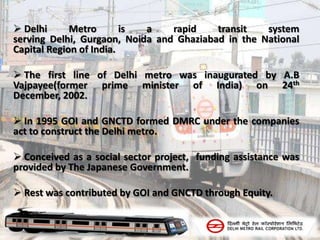
 Delhi      Metro       is a    rapid    transit   system
  .
serving Delhi, Gurgaon, Noida and Ghaziabad in the National
Capital Region of India.

 The first line of Delhi metro was inaugurated by A.B
Vajpayee(former prime minister of India) on 24th
December, 2002.

 In 1995 GOI and GNCTD formed DMRC under the companies
act to construct the Delhi metro.

 Conceived as a social sector project, funding assistance was
provided by The Japanese Government.

 Rest was contributed by GOI and GNCTD through Equity.
Dr. E Sreedharan was appointed
Managing Director of DMRC and
Project Manager of phase 1 of the
project in November 1997.
Learning
Understand the preliminary activities to be taken up
before a large infrastructure project can be started.

Appreciate the significance of the role of a project
manager in project execution

Understand the importance of the right work
culture in successful project management

Recognize the importance of managing the various
stakeholders in a project.
Delhi Metro: Urgency
 Metro is considered a transport option when population
of a city crosses 1 million mark.


 Automobiles contributed to more than 2/3rd of the total
atmospheric population.


 Delhi had more registered vehicles than Kolkata, Mumbai
and Chennai put together.
Delhi Metro- Social Sector Project.
 Globally, MRTS projects were financially
unviable.
 Estimated cost of first phase of the project
increased from Rs 60 billion to Rs 89.27 billion.
 In view of high cost and low financial IRR it was
considered a project for the regional economy in
more ways than one.
Delhi Metro- Project Team
   “Each member of the team was interviewed
personally by me. I went through their track record
    particularly with regard to their integrity.”
                                       -E. Sreedharan

    Most of the staff was between 18 & 30 years.
It had just two departments- Project Organization &
             Operations and Maintenance.
Delhi Metro- Problems in Recruiting
 Problem of Skill shortage.
 Problem of Training.
 Problem of Lack of experience.
 Problem of Corruption.

“ What is important is that I have created an
organization which has got a unique work culture and
organizational values. The team consists of hard
working, dedicated and professionally competent
people.”
                                     - E. Sreedharan
Delhi Metro- Planning Obstacles
 Lack of Funds
 Political Interference
 Lack of Professionalism
 Accountability, Property disputes etc.

“ Financial powers were vested in the Managing
Director. Also, the MD was the last authority on
tenders.”
  - Anuj Dayal, Chief Public Relations Officer, DMRC
Delhi Metro- Quality Management
 DMRC appointed a special quality assurance team
independent of field executives.

Each employee had to prepare a detailed project report(DPR)
as against a benchmark.

 To meet the deadlines they laid adherence to schedules and
reverse clocks.

 Every Monday, the heads of departments had to meet to
review progress, set new targets or revise targets.
Problems
Despite assurances that the DMRC would enjoy
autonomy, it faced political pressure not only in the
recruitment process, processes, promotions, and contract
awarding but also in land acquisition.
The DMRC also faced the difficult task of relocating the
people evicted from properties acquired for the project. It
had to built temporary accommodations for the people who
were to be relocated.
 With the Delhi Metro Act coming into force, the DMRC
faced few legal problems in acquiring properties. About 400
cases were filed against the DMRC on this issue, out of which
only 100 were pending as of 2006.
Delhi Metro- Cost Control
 The total expenditure of Delhi Metro was split into 3
broad heads-
• Manpower
• Energy
• Material including Maintenance

 Each of these accounted for approximately 1/3rd of the
project cost.
Continued….
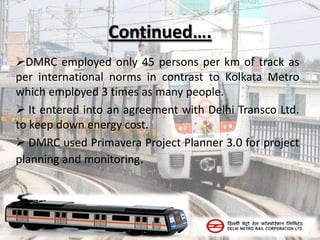
DMRC employed only 45 persons per km of track as
per international norms in contrast to Kolkata Metro
which employed 3 times as many people.
 It entered into an agreement with Delhi Transco Ltd.
to keep down energy cost.
 DMRC used Primavera Project Planner 3.0 for project
planning and monitoring.
Disagreement Between Sreedharan &
            Indian Railways
 Shreedharan was in favor of standard
gauge, generally used in metro system.
IR favor the broad gauge, the gauge used over
most of the railway network in India.
GOI intervene and asked the DMRC to adopt
the broad gauge for the Delhi metro.
Project Implementation
                    LINE 1- RED
“ incremental launching”- the use of these method
      caused minimum disturbance to traffic.
                 LINE 2- YELLOW
            “underground tunneling”
             “cut and cover method”
                   LINE 3- BLUE
                “U shaped girders”
Managing The Stakeholders.
 Government.

Contractors

Funding agency

General public
Protecting The Environment
It pursued environmental and safety objectives.

Construction sites were entirely covered.

They used silent generators at work sites and also
used light shields to reduce glare from work lights at
night.
DMRC took measures to dispose of water wastes.
OUTLOOK
The Delhi metro project was successful in
reducing pollution levels and vehicular traffic.
The DMRC earned revenues of Rs.1.50 billion in
the financial year ended march 2006, in
comparison to the Rs.720 million earned in the
previous year.
It earned additional income by providing
consultancy services to organizations and
cities, both in India and overseas
Outstanding Features Of Delhi
              Metro Project
The Delhi metro was considered an advance
MRTS. It followed all the appropriate Indian and
construction International codes.
The security system on Delhi metro were
comparable to be the best transport system in the
world.
All stations are fitted with seismic sensor to warn
of impending earthquakes
Continued…
Ticketing in the Delhi Metro was fully automatic.

A fully automatic computerized system i.e.
SCADA system was used for controlling the power
supply.

 CATC, ATP, ATO system was installed on Delhi
metro .
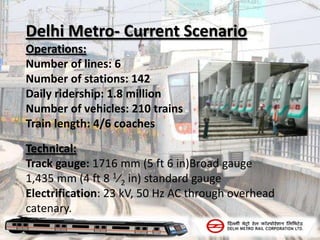
Delhi Metro- Current Scenario
Operations:
Number of lines: 6
Number of stations: 142
Daily ridership: 1.8 million
Number of vehicles: 210 trains
Train length: 4/6 coaches

Technical:
Track gauge: 1716 mm (5 ft 6 in)Broad gauge
1,435 mm (4 ft 8 1⁄2 in) standard gauge
Electrification: 23 kV, 50 Hz AC through overhead
catenary.
Thank You

Delhi metro project

  • 1.
    DELHI METRO PROJECT AR P I TA DAG A 1 1 B S P 0 1 7 4 A N V I TA T R I V E D I 1 1 B S P 1 9 8 6 KS H I T I Z T I WA R I 1 1 B S P 1 1 7 2 MOHIT SHARMA 11BSP1978 M O N A KU K R E JA 1 1 B S P 1 9 5 4 V I N AY BA R D I A 1 1 B S P 1 1 2 5 V I JAY M U N D H R A 1 1 B S P 1 9 1 2
  • 2.
     Delhi Metro is a rapid transit system . serving Delhi, Gurgaon, Noida and Ghaziabad in the National Capital Region of India.  The first line of Delhi metro was inaugurated by A.B Vajpayee(former prime minister of India) on 24th December, 2002.  In 1995 GOI and GNCTD formed DMRC under the companies act to construct the Delhi metro.  Conceived as a social sector project, funding assistance was provided by The Japanese Government.  Rest was contributed by GOI and GNCTD through Equity.
  • 3.
    Dr. E Sreedharanwas appointed Managing Director of DMRC and Project Manager of phase 1 of the project in November 1997.
  • 4.
    Learning Understand the preliminaryactivities to be taken up before a large infrastructure project can be started. Appreciate the significance of the role of a project manager in project execution Understand the importance of the right work culture in successful project management Recognize the importance of managing the various stakeholders in a project.
  • 5.
    Delhi Metro: Urgency Metro is considered a transport option when population of a city crosses 1 million mark.  Automobiles contributed to more than 2/3rd of the total atmospheric population.  Delhi had more registered vehicles than Kolkata, Mumbai and Chennai put together.
  • 6.
    Delhi Metro- SocialSector Project.  Globally, MRTS projects were financially unviable.  Estimated cost of first phase of the project increased from Rs 60 billion to Rs 89.27 billion.  In view of high cost and low financial IRR it was considered a project for the regional economy in more ways than one.
  • 7.
    Delhi Metro- ProjectTeam “Each member of the team was interviewed personally by me. I went through their track record particularly with regard to their integrity.” -E. Sreedharan Most of the staff was between 18 & 30 years. It had just two departments- Project Organization & Operations and Maintenance.
  • 8.
    Delhi Metro- Problemsin Recruiting  Problem of Skill shortage.  Problem of Training.  Problem of Lack of experience.  Problem of Corruption. “ What is important is that I have created an organization which has got a unique work culture and organizational values. The team consists of hard working, dedicated and professionally competent people.” - E. Sreedharan
  • 9.
    Delhi Metro- PlanningObstacles  Lack of Funds  Political Interference  Lack of Professionalism  Accountability, Property disputes etc. “ Financial powers were vested in the Managing Director. Also, the MD was the last authority on tenders.” - Anuj Dayal, Chief Public Relations Officer, DMRC
  • 10.
    Delhi Metro- QualityManagement  DMRC appointed a special quality assurance team independent of field executives. Each employee had to prepare a detailed project report(DPR) as against a benchmark.  To meet the deadlines they laid adherence to schedules and reverse clocks.  Every Monday, the heads of departments had to meet to review progress, set new targets or revise targets.
  • 11.
    Problems Despite assurances thatthe DMRC would enjoy autonomy, it faced political pressure not only in the recruitment process, processes, promotions, and contract awarding but also in land acquisition. The DMRC also faced the difficult task of relocating the people evicted from properties acquired for the project. It had to built temporary accommodations for the people who were to be relocated.  With the Delhi Metro Act coming into force, the DMRC faced few legal problems in acquiring properties. About 400 cases were filed against the DMRC on this issue, out of which only 100 were pending as of 2006.
  • 12.
    Delhi Metro- CostControl  The total expenditure of Delhi Metro was split into 3 broad heads- • Manpower • Energy • Material including Maintenance  Each of these accounted for approximately 1/3rd of the project cost.
  • 13.
    Continued…. DMRC employed only45 persons per km of track as per international norms in contrast to Kolkata Metro which employed 3 times as many people.  It entered into an agreement with Delhi Transco Ltd. to keep down energy cost.  DMRC used Primavera Project Planner 3.0 for project planning and monitoring.
  • 14.
    Disagreement Between Sreedharan& Indian Railways  Shreedharan was in favor of standard gauge, generally used in metro system. IR favor the broad gauge, the gauge used over most of the railway network in India. GOI intervene and asked the DMRC to adopt the broad gauge for the Delhi metro.
  • 15.
    Project Implementation LINE 1- RED “ incremental launching”- the use of these method caused minimum disturbance to traffic. LINE 2- YELLOW “underground tunneling” “cut and cover method” LINE 3- BLUE “U shaped girders”
  • 16.
    Managing The Stakeholders. Government. Contractors Funding agency General public
  • 17.
    Protecting The Environment Itpursued environmental and safety objectives. Construction sites were entirely covered. They used silent generators at work sites and also used light shields to reduce glare from work lights at night. DMRC took measures to dispose of water wastes.
  • 18.
    OUTLOOK The Delhi metroproject was successful in reducing pollution levels and vehicular traffic. The DMRC earned revenues of Rs.1.50 billion in the financial year ended march 2006, in comparison to the Rs.720 million earned in the previous year. It earned additional income by providing consultancy services to organizations and cities, both in India and overseas
  • 19.
    Outstanding Features OfDelhi Metro Project The Delhi metro was considered an advance MRTS. It followed all the appropriate Indian and construction International codes. The security system on Delhi metro were comparable to be the best transport system in the world. All stations are fitted with seismic sensor to warn of impending earthquakes
  • 20.
    Continued… Ticketing in theDelhi Metro was fully automatic. A fully automatic computerized system i.e. SCADA system was used for controlling the power supply.  CATC, ATP, ATO system was installed on Delhi metro .
  • 21.
    Delhi Metro- CurrentScenario Operations: Number of lines: 6 Number of stations: 142 Daily ridership: 1.8 million Number of vehicles: 210 trains Train length: 4/6 coaches Technical: Track gauge: 1716 mm (5 ft 6 in)Broad gauge 1,435 mm (4 ft 8 1⁄2 in) standard gauge Electrification: 23 kV, 50 Hz AC through overhead catenary.
  • 22.

Editor's Notes

  • #2 Slides 1-3 mona5-7arpita8-10 kshitiz11-13 anvita14-16 vinay17-18 mohit19-22 vijay
  • #6 Delhi crossed the milestone in 1940, in 1950 it saw a doubling of the cities population, with that the vehicular traffic of delhi also got solved.