SIGNALS ON
RAILWAY
Prepared By:
Arbaz Kazi
Asst. Professor
VCET, Vasai (W)
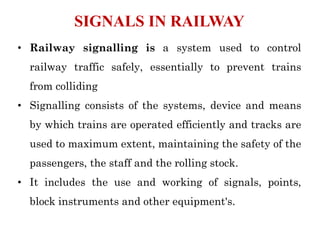
• Railway signalling is a system used to control
railway traffic safely, essentially to prevent trains
from colliding
• Signalling consists of the systems, device and means
by which trains are operated efficiently and tracks are
used to maximum extent, maintaining the safety of the
passengers, the staff and the rolling stock.
• It includes the use and working of signals, points,
block instruments and other equipment's.
SIGNALS IN RAILWAY
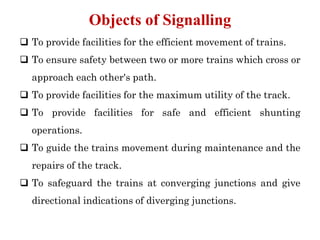
 To provide facilities for the efficient movement of trains.
 To ensure safety between two or more trains which cross or
approach each other's path.
 To provide facilities for the maximum utility of the track.
 To provide facilities for safe and efficient shunting
operations.
 To guide the trains movement during maintenance and the
repairs of the track.
 To safeguard the trains at converging junctions and give
directional indications of diverging junctions.
Objects of Signalling
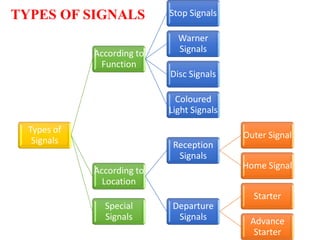
Types of
Signals
According to
Function
Stop Signals
Warner
Signals
Disc Signals
Coloured
Light Signals
According to
Location
Reception
Signals
Outer Signal
Home Signal
Departure
Signals
Starter
Advance
Starter
Special
Signals
TYPES OF SIGNALS
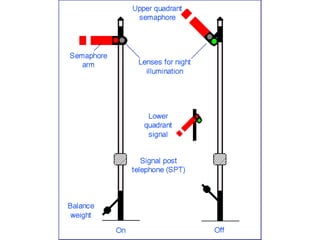
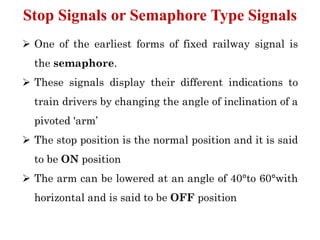
➢ One of the earliest forms of fixed railway signal is
the semaphore.
➢ These signals display their different indications to
train drivers by changing the angle of inclination of a
pivoted 'arm’
➢ The stop position is the normal position and it is said
to be ON position
➢ The arm can be lowered at an angle of 40°to 60°with
horizontal and is said to be OFF position
Stop Signals or Semaphore Type Signals
http://www.readorrefer.in/media/extra/sP3tplo.jpg
https://goo.gl/XEddaF
Stop Signals or Semaphore Type Signals
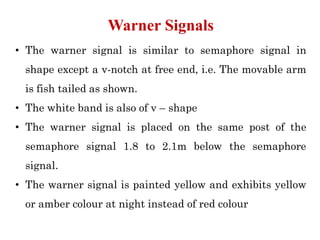
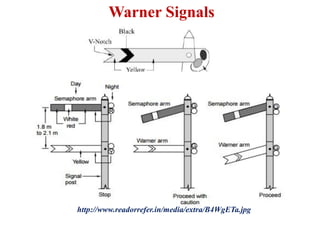
• The warner signal is similar to semaphore signal in
shape except a v-notch at free end, i.e. The movable arm
is fish tailed as shown.
• The white band is also of v – shape
• The warner signal is placed on the same post of the
semaphore signal 1.8 to 2.1m below the semaphore
signal.
• The warner signal is painted yellow and exhibits yellow
or amber colour at night instead of red colour
Warner Signals
http://www.readorrefer.in/media/extra/B4WgETa.jpg
Warner Signals
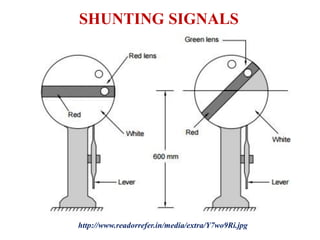
❖These signals are used for shunting operations in station
yards
❖They are of the shape of a circular disc with a red band on a
white back ground
❖The disc can revolve in a vertical plane by pulling the lever
by hand.
❖Two holes are provided, one for red lamp and the other for
the green lamp.
❖When the red band is horizontal or shows red light at night
it indicates ―STOP
❖When the red band is inclined at 45 degree or shown green
light at night indicates ―PROCEED
SHUNTING SIGNALS
SHUNTING SIGNALS
http://www.readorrefer.in/media/extra/Y7wo9Ri.jpg
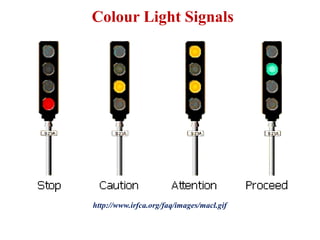
Semaphore signals are being replaced by high
intensity beam colour light signals both during day
and night
In case of colour light signals, the normal position is
to indicate ―PROCEED (i.e., shows green light)
When the section is blocked, it automatically
indicates ― STOP or ―DANGER (i.e., shows red
light)
In India these signals are used on urban and sub-
urban sections with heavy traffic
Colour Light Signals
http://www.irfca.org/faq/images/macl.gif
Colour Light Signals
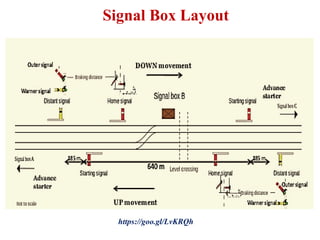
Signal Box Layout
https://goo.gl/LvKRQh
➢ This is the first stop signal which indicates the entry of the
train from block to the station
➢ It should be placed at an adequate distance (0.54km for BG
and 0.4 km for MG)
➢ It has one arm but may have a warner signal on the same
post nearly 2m below it.
➢ In the Stop position the driver must bring his train to a stop
at a distance of about 90m before the outer signal and then
proceed to the home signal with caution
➢ If it is in the Proceed position then the driver can take the
train at speed, assuming that home signal is also in the
proceed position.
Outer Signal
• Due to its location at the door of station, it is termed as
Home signal.
• The home signal has bracketed arms to indicate which
line is to be used.
• The function of home signal is to protect the sidings
already occupied.
• It is located at not more than 180m from the start of
points of switches.
• Home signals carry as many arms as the number of
diverging lines.
Home Signal
❖ It marks the limit up to which trains stopping at a
station should come to a stand
❖ The starter is the last stop signal at a station
❖ It controls the movements of the trains when they
depart from the stations.
❖ No train can leave the station unless the starter
signal shows the ―PROCEED position (i.e., inclined
position)
Starter Signal
 Besides the starter signal for each of the station
lines from which trains starts, an advance
starter may also be provided.
 The advance starter becomes the last stop
signal at the stations wherever it is provided.
 It is an indication for the train having left the
station
Advance Starter Signal
 When a train passes through a station without stopping, the
driver comes across the five signals in this sequence WARNER,
OUTER, HOME, STARTER and ADVANCE STARTER.
 When the drivers vision is obstructed by an over bridge between
the signals, a signal is provided with a duplicate arm of smaller
size at a suitable position which repeats the indication of signal
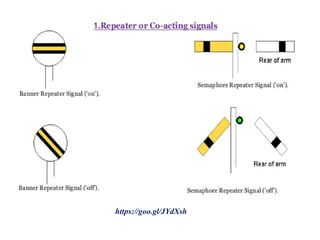
head. It is therefore termed as Repeater signal.
 This signal is linked with the main signal and therefore, when
the lever is pulled both signals are lowered simultaneously.
Also called as ―co-acting signal
Special Signal
Repeater Signal
https://goo.gl/JYdXsh
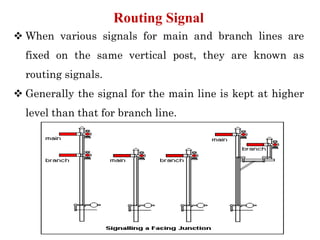
❖ When various signals for main and branch lines are
fixed on the same vertical post, they are known as
routing signals.
❖ Generally the signal for the main line is kept at higher
level than that for branch line.
Routing Signal
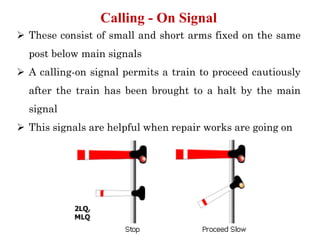
➢ These consist of small and short arms fixed on the same
post below main signals
➢ A calling-on signal permits a train to proceed cautiously
after the train has been brought to a halt by the main
signal
➢ This signals are helpful when repair works are going on
Calling - On Signal
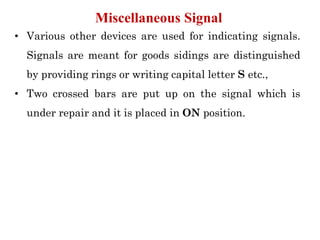
• Various other devices are used for indicating signals.
Signals are meant for goods sidings are distinguished
by providing rings or writing capital letter S etc.,
• Two crossed bars are put up on the signal which is
under repair and it is placed in ON position.
Miscellaneous Signal
It is quite essential that movements of trains on
particular tracks should be safe and for this
purpose various methods are found out
 (i)Following trains system
 (ii)Absolute block system
 (iii)Automatic signalling
 (iv)Pilot guard system
Control of Movement of Trains
• Used in case of emergencies such as failure of
telegraph and telephone systems.
• In this method, a fixed interval of time is
maintained between the departure of one train
and the departure of the next train along the
same time.
• This fixed interval is worked out in such a way
that sufficient distance or headway in maintained
between the tail of the first train and the head of
the next following train.
Following Trains Systems
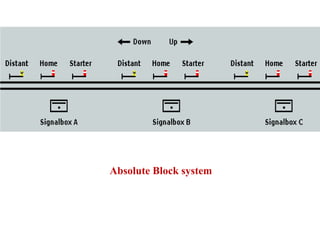
The principle of the absolute block system of railway signalling is to
ensure the safe operation of a railway by allowing only one train to occupy
a defined section of track at a time
• Instead of a fixed interval of time between successive trains, a varying
interval may be kept depending on the time, actually taken by
particular trains.
• It is a space interval system rather than a fixed interval system.
• In the absolute block system the line is assumed to be blocked until the
fact that the line is clear is established by some suitable information
conveyed by block instruments
• The electric telegraph provided the ability for signalmen to
communicate with each other and provided the basis for the absolute
block system
Absolute Block Systems
Absolute Block system
 In order to avoid accidents, automatic signalling has
been found out. In this signals are operated by trains
themselves.
 An electric current is conveyed through the track when a
train occupies that particular track and this current puts
the signal at danger position until the train has gone far
ahead so as to require no further protection
Automatic Signalling
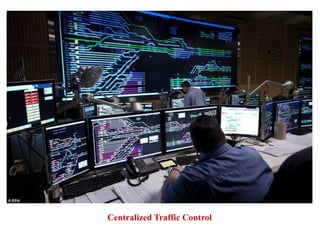
Centralized traffic control(CTC) is a form of railway
signalling that originated in North America
 The system consists of a centralized train dispatcher's office
that controls railroad switches in the CTC territory and the
signals that railroad engineers must obey in order to keep
the traffic moving safely and smoothly across the railroad.
 CTC systems are considered sufficient authority to run
trains based strictly on signal indications. This is because
CTC signals default to 'Stop' and require a human
dispatcher to 'Clear' them.
Centralized Traffic Control
In railway signalling, an interlocking is an arrangement of
signal apparatus that prevents conflicting movements
through an arrangement of tracks such as junctions or
crossings
✓ An arrangement of signals and signal appliances so
interconnected that their movements must succeed each
other in proper sequence".
✓ In general terms an interlocking is a location where plain
track ends and track work with points and crossings
complicate train movements. These areas are likely to be:-
o Junctions where two or more main lines meet.
o Complex yards or sidings are encountered. These may be at
larger towns or depot facilities.
✓ An interlocking provides for complex train movements
and shunting of trains.
✓ It provides for the protection of multiple train movements
within a localised area.
Interlocking of Signals
✓ Not possible to lower the signals for the admissions of trains from
opposite direction or converging directions at the same time to the
same line
✓ Not possible to lower a signal for any approaching train until the
correct points
✓ Not possible for loose wagons from any part of the yard to obstruct the
line which is set for incoming train after lowering the signal
✓ When the signal is lowered, it should not be possible to disconnect any
point or reverse unlock the points until the train has passed and
signals have been raised to its ― ON position.
✓ Not possible to lower warner signal unless home and starting signals
have lowered in advance
Principles of Interlocking
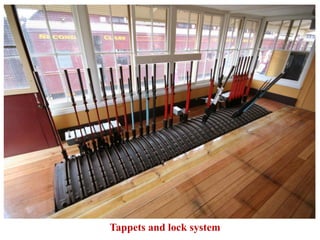
➢ The signals and points are operated by means of levers.
➢ Levers are located at ground level or platform level or
in an elevated structure called signal box or signal
cabin
➢ Interlocking is done by grouping levers at one point
➢ The levers are painted for easy identification
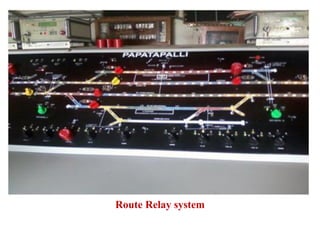
➢ There are three methods of interlocking
(i)Tappets and lock system
(ii)Key system
(iii)Route relay system.
Methods of Interlocking
Tappets and lock system
Route Relay system
Indian Railway Signals & Systems

Indian Railway Signals & Systems

  • 1.
    SIGNALS ON RAILWAY Prepared By: ArbazKazi Asst. Professor VCET, Vasai (W)
  • 2.
    • Railway signallingis a system used to control railway traffic safely, essentially to prevent trains from colliding • Signalling consists of the systems, device and means by which trains are operated efficiently and tracks are used to maximum extent, maintaining the safety of the passengers, the staff and the rolling stock. • It includes the use and working of signals, points, block instruments and other equipment's. SIGNALS IN RAILWAY
  • 4.
     To providefacilities for the efficient movement of trains.  To ensure safety between two or more trains which cross or approach each other's path.  To provide facilities for the maximum utility of the track.  To provide facilities for safe and efficient shunting operations.  To guide the trains movement during maintenance and the repairs of the track.  To safeguard the trains at converging junctions and give directional indications of diverging junctions. Objects of Signalling
  • 5.
    Types of Signals According to Function StopSignals Warner Signals Disc Signals Coloured Light Signals According to Location Reception Signals Outer Signal Home Signal Departure Signals Starter Advance Starter Special Signals TYPES OF SIGNALS
  • 6.
    ➢ One ofthe earliest forms of fixed railway signal is the semaphore. ➢ These signals display their different indications to train drivers by changing the angle of inclination of a pivoted 'arm’ ➢ The stop position is the normal position and it is said to be ON position ➢ The arm can be lowered at an angle of 40°to 60°with horizontal and is said to be OFF position Stop Signals or Semaphore Type Signals
  • 7.
  • 8.
    • The warnersignal is similar to semaphore signal in shape except a v-notch at free end, i.e. The movable arm is fish tailed as shown. • The white band is also of v – shape • The warner signal is placed on the same post of the semaphore signal 1.8 to 2.1m below the semaphore signal. • The warner signal is painted yellow and exhibits yellow or amber colour at night instead of red colour Warner Signals
  • 9.
  • 10.
    ❖These signals areused for shunting operations in station yards ❖They are of the shape of a circular disc with a red band on a white back ground ❖The disc can revolve in a vertical plane by pulling the lever by hand. ❖Two holes are provided, one for red lamp and the other for the green lamp. ❖When the red band is horizontal or shows red light at night it indicates ―STOP ❖When the red band is inclined at 45 degree or shown green light at night indicates ―PROCEED SHUNTING SIGNALS
  • 11.
  • 12.
    Semaphore signals arebeing replaced by high intensity beam colour light signals both during day and night In case of colour light signals, the normal position is to indicate ―PROCEED (i.e., shows green light) When the section is blocked, it automatically indicates ― STOP or ―DANGER (i.e., shows red light) In India these signals are used on urban and sub- urban sections with heavy traffic Colour Light Signals
  • 13.
  • 14.
  • 15.
    ➢ This isthe first stop signal which indicates the entry of the train from block to the station ➢ It should be placed at an adequate distance (0.54km for BG and 0.4 km for MG) ➢ It has one arm but may have a warner signal on the same post nearly 2m below it. ➢ In the Stop position the driver must bring his train to a stop at a distance of about 90m before the outer signal and then proceed to the home signal with caution ➢ If it is in the Proceed position then the driver can take the train at speed, assuming that home signal is also in the proceed position. Outer Signal
  • 16.
    • Due toits location at the door of station, it is termed as Home signal. • The home signal has bracketed arms to indicate which line is to be used. • The function of home signal is to protect the sidings already occupied. • It is located at not more than 180m from the start of points of switches. • Home signals carry as many arms as the number of diverging lines. Home Signal
  • 17.
    ❖ It marksthe limit up to which trains stopping at a station should come to a stand ❖ The starter is the last stop signal at a station ❖ It controls the movements of the trains when they depart from the stations. ❖ No train can leave the station unless the starter signal shows the ―PROCEED position (i.e., inclined position) Starter Signal
  • 18.
     Besides thestarter signal for each of the station lines from which trains starts, an advance starter may also be provided.  The advance starter becomes the last stop signal at the stations wherever it is provided.  It is an indication for the train having left the station Advance Starter Signal
  • 19.
     When atrain passes through a station without stopping, the driver comes across the five signals in this sequence WARNER, OUTER, HOME, STARTER and ADVANCE STARTER.  When the drivers vision is obstructed by an over bridge between the signals, a signal is provided with a duplicate arm of smaller size at a suitable position which repeats the indication of signal head. It is therefore termed as Repeater signal.  This signal is linked with the main signal and therefore, when the lever is pulled both signals are lowered simultaneously. Also called as ―co-acting signal Special Signal Repeater Signal
  • 20.
  • 21.
    ❖ When varioussignals for main and branch lines are fixed on the same vertical post, they are known as routing signals. ❖ Generally the signal for the main line is kept at higher level than that for branch line. Routing Signal
  • 22.
    ➢ These consistof small and short arms fixed on the same post below main signals ➢ A calling-on signal permits a train to proceed cautiously after the train has been brought to a halt by the main signal ➢ This signals are helpful when repair works are going on Calling - On Signal
  • 23.
    • Various otherdevices are used for indicating signals. Signals are meant for goods sidings are distinguished by providing rings or writing capital letter S etc., • Two crossed bars are put up on the signal which is under repair and it is placed in ON position. Miscellaneous Signal
  • 24.
    It is quiteessential that movements of trains on particular tracks should be safe and for this purpose various methods are found out  (i)Following trains system  (ii)Absolute block system  (iii)Automatic signalling  (iv)Pilot guard system Control of Movement of Trains
  • 25.
    • Used incase of emergencies such as failure of telegraph and telephone systems. • In this method, a fixed interval of time is maintained between the departure of one train and the departure of the next train along the same time. • This fixed interval is worked out in such a way that sufficient distance or headway in maintained between the tail of the first train and the head of the next following train. Following Trains Systems
  • 26.
    The principle ofthe absolute block system of railway signalling is to ensure the safe operation of a railway by allowing only one train to occupy a defined section of track at a time • Instead of a fixed interval of time between successive trains, a varying interval may be kept depending on the time, actually taken by particular trains. • It is a space interval system rather than a fixed interval system. • In the absolute block system the line is assumed to be blocked until the fact that the line is clear is established by some suitable information conveyed by block instruments • The electric telegraph provided the ability for signalmen to communicate with each other and provided the basis for the absolute block system Absolute Block Systems
  • 27.
  • 28.
     In orderto avoid accidents, automatic signalling has been found out. In this signals are operated by trains themselves.  An electric current is conveyed through the track when a train occupies that particular track and this current puts the signal at danger position until the train has gone far ahead so as to require no further protection Automatic Signalling
  • 29.
    Centralized traffic control(CTC)is a form of railway signalling that originated in North America  The system consists of a centralized train dispatcher's office that controls railroad switches in the CTC territory and the signals that railroad engineers must obey in order to keep the traffic moving safely and smoothly across the railroad.  CTC systems are considered sufficient authority to run trains based strictly on signal indications. This is because CTC signals default to 'Stop' and require a human dispatcher to 'Clear' them. Centralized Traffic Control
  • 30.
  • 31.
    In railway signalling,an interlocking is an arrangement of signal apparatus that prevents conflicting movements through an arrangement of tracks such as junctions or crossings ✓ An arrangement of signals and signal appliances so interconnected that their movements must succeed each other in proper sequence". ✓ In general terms an interlocking is a location where plain track ends and track work with points and crossings complicate train movements. These areas are likely to be:- o Junctions where two or more main lines meet. o Complex yards or sidings are encountered. These may be at larger towns or depot facilities. ✓ An interlocking provides for complex train movements and shunting of trains. ✓ It provides for the protection of multiple train movements within a localised area. Interlocking of Signals
  • 32.
    ✓ Not possibleto lower the signals for the admissions of trains from opposite direction or converging directions at the same time to the same line ✓ Not possible to lower a signal for any approaching train until the correct points ✓ Not possible for loose wagons from any part of the yard to obstruct the line which is set for incoming train after lowering the signal ✓ When the signal is lowered, it should not be possible to disconnect any point or reverse unlock the points until the train has passed and signals have been raised to its ― ON position. ✓ Not possible to lower warner signal unless home and starting signals have lowered in advance Principles of Interlocking
  • 33.
    ➢ The signalsand points are operated by means of levers. ➢ Levers are located at ground level or platform level or in an elevated structure called signal box or signal cabin ➢ Interlocking is done by grouping levers at one point ➢ The levers are painted for easy identification ➢ There are three methods of interlocking (i)Tappets and lock system (ii)Key system (iii)Route relay system. Methods of Interlocking
  • 34.
  • 35.