

Aman Bathla
(A.P.)
Review of Syllabus
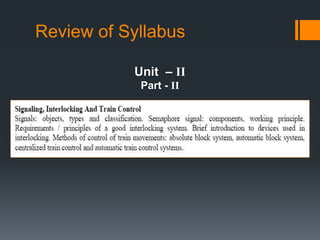
Unit – II
Part - II
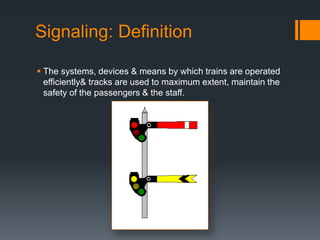
Signaling: Definition
 The systems, devices & means by which trains are operated
efficiently& tracks are used to maximum extent, maintain the
safety of the passengers & the staff.
Signaling: Objective
 To provide facilities for the efficient movement of trains.
 To ensure safety between two or more trains which cross or
approach each other’s path.
 To provide facilities for the maximum utility of the track
 To provide facilities for the safe & efficient shunting
operations.
 To guide train movement during maintenance & repairs of the
track.
 To safeguard the trains at converging junctions & give
directional indication at diverging junctions
Signaling:
Classifications & types
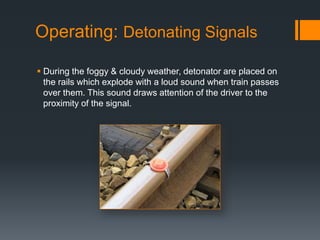
Operating: Detonating Signals
 During the foggy & cloudy weather, detonator are placed on
the rails which explode with a loud sound when train passes
over them. This sound draws attention of the driver to the
proximity of the signal.
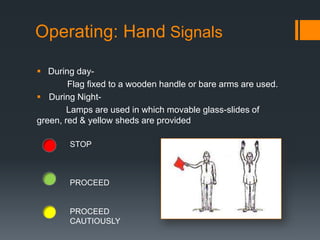
Operating: Hand Signals
 During day-
Flag fixed to a wooden handle or bare arms are used.
 During Night-
Lamps are used in which movable glass-slides of
green, red & yellow sheds are provided
STOP
PROCEED
PROCEED
CAUTIOUSLY
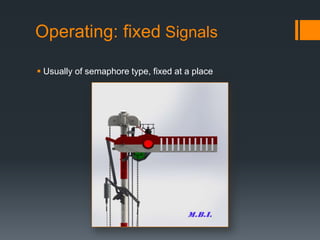
Operating: fixed Signals
 Usually of semaphore type, fixed at a place
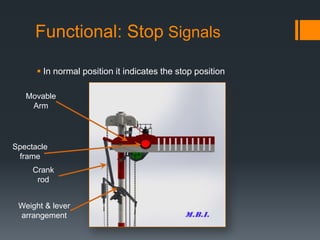
Functional: Stop Signals
 In normal position it indicates the stop position
Movable
Arm
Weight & lever
arrangement
Spectacle
frame
Crank
rod
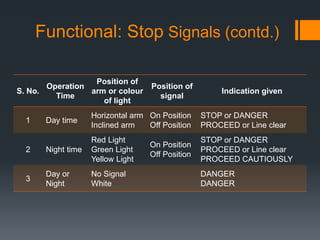
Functional: Stop Signals (contd.)
S. No.
Operation
Time
Position of
arm or colour
of light
Position of
signal
Indication given
1 Day time
Horizontal arm
Inclined arm
On Position
Off Position
STOP or DANGER
PROCEED or Line clear
2 Night time
Red Light
Green Light
Yellow Light
On Position
Off Position
STOP or DANGER
PROCEED or Line clear
PROCEED CAUTIOUSLY
3
Day or
Night
No Signal
White
DANGER
DANGER
Functional: Warner Signals
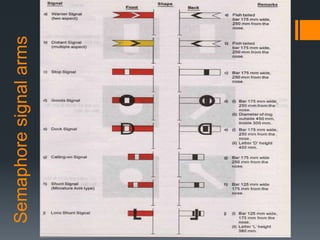
 Signal similar to semaphore signal in shape except a V-notch
at free end
Semaphore
signal
Warner signal
STOP
Proceed
With
cautions
Proceed
Semaphore
signal
arms
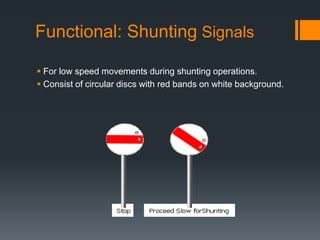
Functional: Shunting Signals
 For low speed movements during shunting operations.
 Consist of circular discs with red bands on white background.
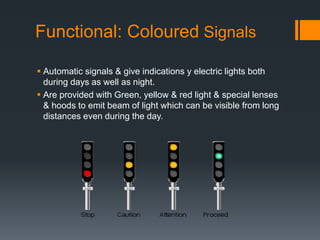
Functional: Coloured Signals
 Automatic signals & give indications y electric lights both
during days as well as night.
 Are provided with Green, yellow & red light & special lenses
& hoods to emit beam of light which can be visible from long
distances even during the day.
Locational: Reception & Departure
Reception: Outer Signals
 The first signal is provided at this distance beyond the station
limit, that is why it is know as outer signal
 Warner signal for the driver which gives the indication of the
position ahead whether the platform is clear or not.
 A certain distance is required to bring a moving train to halt.
This distance depends upon the speed of the train, its weight,
brake power of the locomotive etc.
 In horizontal or stop position it indicates that the driver must
bring his train to halt within 90m before outer signal & than
proceed to the home signal with caution.
 In the inclined or proceed position it indicates that track &
platform is clear & proceed normally without any danger.
Reception: Home Signals
 The signal after the outer signal towards station is a stop
signal and exactly placed at the station limit .
 The main function is to protect the stations.
 The permission to enter the platform is given by the operation
of this signal.
 The maximum unprotected distance between the signal and
the point, it is intended to protect is specified as 180 m due to
its location at the door of station.
Departure: Starter Signals
 This signal is provided at the forward end of platform and
controls the movement of the train as they leave the station.
 It gives permission to the train to leave the platform for next
station.
 No train can leave the platform unless this signal is lowered,
that is why it is called starter signal.
 A separate signal is provided for each line.
Departure: Advance Starter Signals
 The limit of a station section lies between the home signal
and the advance starter signal.
 The signal which allows the train to enter in block section is
called advance starter signal.
 It is always placed beyond the outer most set of the point
connections.
Special: Repeating Signals
 When the view of the main signal is obstructed due to some
structures or on curves etc. some signals are used to repeat
the information of the main signal. Such signal are know as
repeating signal.
Special: Routing Signals
 When many branch lines diverge in different directions from
the main line, it is very difficult to provide individual signal for
each line at the divergent point. In such situations various
signals for main line and branch lines are fixed on the same
vertical post. These signals are called routing signal.
 Generally signal for main line is kept higher than those for
branch lines.
Special: Calling on Signals
 These signal are similar to semaphore signal, but they are
smaller in size and are fixed on the same post below the
main signals.
 A calling on signal permits a train to proceed with caution
after the train has been brought to a halt by the main signal.
These are helpful when repair works are going on.
Controlling Trains
https://www.youtube.com/watch?v=b4q3i5aw6XQ&t=14s
Interlocking & its necessity
 Arrangement of signals, points and other appliances, so
interconnected by mechanical or electrical locking that their
operation takes place in a predetermined sequence to ensure
that conflicting movement of signals and points do not take
place and train runs safely.
 Conflicting movements are avoided.
 Helps in proper & safe working of the system.
Interlocking
https://www.youtube.com/watch?v=D1MGihPjaQM&t=13s
Interlocking:
Essentials/ Requirements/ Principles
 It should not be possible to turn a signal off unless all points
for the line on which the train is to be received are correctly
set, all the facing points are locked, and all interlocked level
crossings are closed and inaccessible to road traffic.
 The line should be fully isolated before the signal is turned
off, i.e., no loose wagons should be able to enter this line.
 After the signal has been turned off, it should not be possible
to make adjustments in the points or locks on the route.
 It should not be possible to turn any two signals off at the
same time, as this can lead to conflicting movements of the
trains.
 Wherever feasible, the points should be so interlocked as to
avoid any conflicting movement
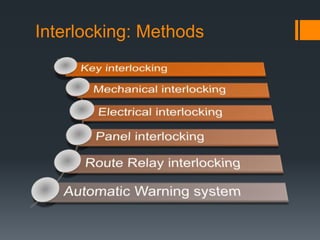
Interlocking: Methods
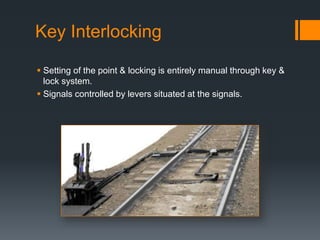
Key Interlocking
 Setting of the point & locking is entirely manual through key &
lock system.
 Signals controlled by levers situated at the signals.
Mechanical Interlocking
 Operation of points & signals from a fixed location with group
of levers through rigid connections.
Electrical Interlocking
 Operation is done through computer or panel.
 Microprocessor based interlocking system
 Interlocking is achieved through software.
Panel Interlocking (PI)
 Used in most medium-sized stations.
 Points & signals are worked by individual switches to control.
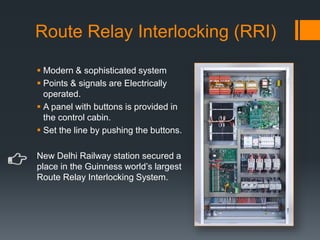
Route Relay Interlocking (RRI)
 Modern & sophisticated system
 Points & signals are Electrically
operated.
 A panel with buttons is provided in
the control cabin.
 Set the line by pushing the buttons.
New Delhi Railway station secured a
place in the Guinness world’s largest
Route Relay Interlocking System.
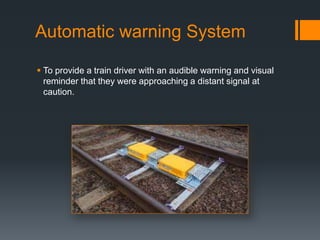
Automatic warning System
 To provide a train driver with an audible warning and visual
reminder that they were approaching a distant signal at
caution.
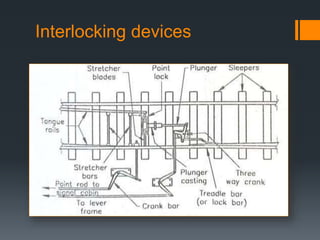
Interlocking devices
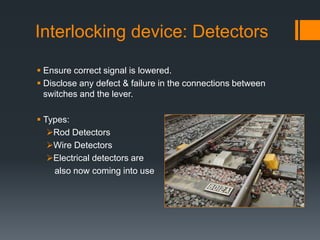
Interlocking device: Detectors
 Ensure correct signal is lowered.
 Disclose any defect & failure in the connections between
switches and the lever.
 Types:
Rod Detectors
Wire Detectors
Electrical detectors are
also now coming into use
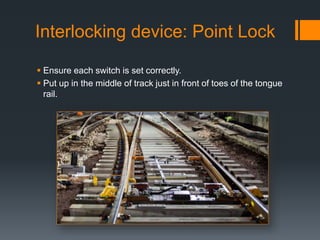
Interlocking device: Point Lock
 Ensure each switch is set correctly.
 Put up in the middle of track just in front of toes of the tongue
rail.
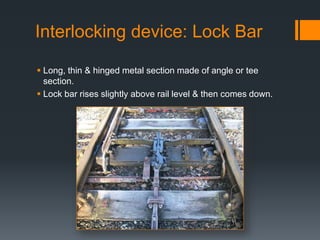
Interlocking device: Lock Bar
 Long, thin & hinged metal section made of angle or tee
section.
 Lock bar rises slightly above rail level & then comes down.
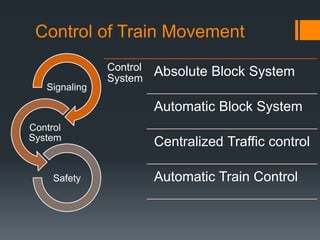
Control of Train Movement
Signaling
Control
System
Safety
Control
System
Absolute Block System
Automatic Block System
Centralized Traffic control
Automatic Train Control
Absolute Block System
https://www.youtube.com/watch?v=eT_AVJjnotc=23s
Automatic Block System
https://www.youtube.com/watch?v=N8iUDeNAOWM=6s
Centralized Traffic Control
https://www.youtube.com/watch?v=ZxyML8r5Dl4
Automatic Train Control
https://www.youtube.com/watch?v=Ex1cWwgI_mQ&t
Do you have Any Question?

Railway Engineering: signaling, interlocking, train control system

  • 1.
  • 2.
    Review of Syllabus Unit– II Part - II
  • 3.
    Signaling: Definition  Thesystems, devices & means by which trains are operated efficiently& tracks are used to maximum extent, maintain the safety of the passengers & the staff.
  • 4.
    Signaling: Objective  Toprovide facilities for the efficient movement of trains.  To ensure safety between two or more trains which cross or approach each other’s path.  To provide facilities for the maximum utility of the track  To provide facilities for the safe & efficient shunting operations.  To guide train movement during maintenance & repairs of the track.  To safeguard the trains at converging junctions & give directional indication at diverging junctions
  • 5.
  • 6.
    Operating: Detonating Signals During the foggy & cloudy weather, detonator are placed on the rails which explode with a loud sound when train passes over them. This sound draws attention of the driver to the proximity of the signal.
  • 7.
    Operating: Hand Signals During day- Flag fixed to a wooden handle or bare arms are used.  During Night- Lamps are used in which movable glass-slides of green, red & yellow sheds are provided STOP PROCEED PROCEED CAUTIOUSLY
  • 8.
    Operating: fixed Signals Usually of semaphore type, fixed at a place
  • 9.
    Functional: Stop Signals In normal position it indicates the stop position Movable Arm Weight & lever arrangement Spectacle frame Crank rod
  • 10.
    Functional: Stop Signals(contd.) S. No. Operation Time Position of arm or colour of light Position of signal Indication given 1 Day time Horizontal arm Inclined arm On Position Off Position STOP or DANGER PROCEED or Line clear 2 Night time Red Light Green Light Yellow Light On Position Off Position STOP or DANGER PROCEED or Line clear PROCEED CAUTIOUSLY 3 Day or Night No Signal White DANGER DANGER
  • 11.
    Functional: Warner Signals Signal similar to semaphore signal in shape except a V-notch at free end Semaphore signal Warner signal STOP Proceed With cautions Proceed
  • 12.
  • 13.
    Functional: Shunting Signals For low speed movements during shunting operations.  Consist of circular discs with red bands on white background.
  • 14.
    Functional: Coloured Signals Automatic signals & give indications y electric lights both during days as well as night.  Are provided with Green, yellow & red light & special lenses & hoods to emit beam of light which can be visible from long distances even during the day.
  • 15.
  • 16.
    Reception: Outer Signals The first signal is provided at this distance beyond the station limit, that is why it is know as outer signal  Warner signal for the driver which gives the indication of the position ahead whether the platform is clear or not.  A certain distance is required to bring a moving train to halt. This distance depends upon the speed of the train, its weight, brake power of the locomotive etc.  In horizontal or stop position it indicates that the driver must bring his train to halt within 90m before outer signal & than proceed to the home signal with caution.  In the inclined or proceed position it indicates that track & platform is clear & proceed normally without any danger.
  • 17.
    Reception: Home Signals The signal after the outer signal towards station is a stop signal and exactly placed at the station limit .  The main function is to protect the stations.  The permission to enter the platform is given by the operation of this signal.  The maximum unprotected distance between the signal and the point, it is intended to protect is specified as 180 m due to its location at the door of station.
  • 18.
    Departure: Starter Signals This signal is provided at the forward end of platform and controls the movement of the train as they leave the station.  It gives permission to the train to leave the platform for next station.  No train can leave the platform unless this signal is lowered, that is why it is called starter signal.  A separate signal is provided for each line.
  • 19.
    Departure: Advance StarterSignals  The limit of a station section lies between the home signal and the advance starter signal.  The signal which allows the train to enter in block section is called advance starter signal.  It is always placed beyond the outer most set of the point connections.
  • 20.
    Special: Repeating Signals When the view of the main signal is obstructed due to some structures or on curves etc. some signals are used to repeat the information of the main signal. Such signal are know as repeating signal.
  • 21.
    Special: Routing Signals When many branch lines diverge in different directions from the main line, it is very difficult to provide individual signal for each line at the divergent point. In such situations various signals for main line and branch lines are fixed on the same vertical post. These signals are called routing signal.  Generally signal for main line is kept higher than those for branch lines.
  • 22.
    Special: Calling onSignals  These signal are similar to semaphore signal, but they are smaller in size and are fixed on the same post below the main signals.  A calling on signal permits a train to proceed with caution after the train has been brought to a halt by the main signal. These are helpful when repair works are going on.
  • 23.
  • 24.
    Interlocking & itsnecessity  Arrangement of signals, points and other appliances, so interconnected by mechanical or electrical locking that their operation takes place in a predetermined sequence to ensure that conflicting movement of signals and points do not take place and train runs safely.  Conflicting movements are avoided.  Helps in proper & safe working of the system.
  • 25.
  • 26.
    Interlocking: Essentials/ Requirements/ Principles It should not be possible to turn a signal off unless all points for the line on which the train is to be received are correctly set, all the facing points are locked, and all interlocked level crossings are closed and inaccessible to road traffic.  The line should be fully isolated before the signal is turned off, i.e., no loose wagons should be able to enter this line.  After the signal has been turned off, it should not be possible to make adjustments in the points or locks on the route.  It should not be possible to turn any two signals off at the same time, as this can lead to conflicting movements of the trains.  Wherever feasible, the points should be so interlocked as to avoid any conflicting movement
  • 27.
  • 28.
    Key Interlocking  Settingof the point & locking is entirely manual through key & lock system.  Signals controlled by levers situated at the signals.
  • 29.
    Mechanical Interlocking  Operationof points & signals from a fixed location with group of levers through rigid connections.
  • 30.
    Electrical Interlocking  Operationis done through computer or panel.  Microprocessor based interlocking system  Interlocking is achieved through software.
  • 31.
    Panel Interlocking (PI) Used in most medium-sized stations.  Points & signals are worked by individual switches to control.
  • 32.
    Route Relay Interlocking(RRI)  Modern & sophisticated system  Points & signals are Electrically operated.  A panel with buttons is provided in the control cabin.  Set the line by pushing the buttons. New Delhi Railway station secured a place in the Guinness world’s largest Route Relay Interlocking System.
  • 33.
    Automatic warning System To provide a train driver with an audible warning and visual reminder that they were approaching a distant signal at caution.
  • 34.
  • 35.
    Interlocking device: Detectors Ensure correct signal is lowered.  Disclose any defect & failure in the connections between switches and the lever.  Types: Rod Detectors Wire Detectors Electrical detectors are also now coming into use
  • 36.
    Interlocking device: PointLock  Ensure each switch is set correctly.  Put up in the middle of track just in front of toes of the tongue rail.
  • 37.
    Interlocking device: LockBar  Long, thin & hinged metal section made of angle or tee section.  Lock bar rises slightly above rail level & then comes down.
  • 38.
    Control of TrainMovement Signaling Control System Safety Control System Absolute Block System Automatic Block System Centralized Traffic control Automatic Train Control
  • 39.
  • 40.
  • 41.
  • 42.
  • 43.
    Do you haveAny Question?