CONTENTS 
• INTRODUCTION 
• STEPS IN A PREVENTIVE PROGRAM 
• PATIENT COUNSELLING 
• PATIENT COMPLIANCE 
• MOTIVATIONAL INTERVIEWING 
• LEARNING PROCESS 
• PATIENT PLANNING 
• BASIC STEPS FOR MAINTAINING ORAL HYGIENE 
• TOOTH BRUSHES 
• DENTIFRICES 
• ORAL IRRIGATION DEVICES 
• FLOSS 
• INTERDENTAL CLEANING 
• RINSING 
• REGULAR DENTAL CHECKUPS 
• PROPER DIET 
• CONCLUSION 
• REFERENCES
INTRODUCTION 
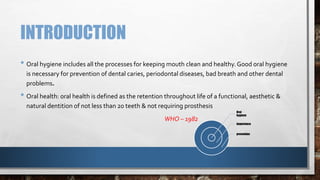
• Oral hygiene includes all the processes for keeping mouth clean and healthy. Good oral hygiene 
is necessary for prevention of dental caries, periodontal diseases, bad breath and other dental 
problems. 
• Oral health: oral health is defined as the retention throughout life of a functional, aesthetic & 
natural dentition of not less than 20 teeth & not requiring prosthesis 
WHO – 1982 
Oral 
hygiene 
Importance 
prevention
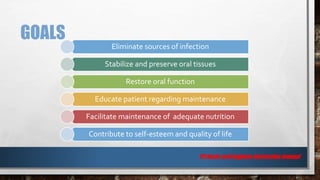
GOALS 
Eliminate sources of infection 
Stabilize and preserve oral tissues 
Restore oral function 
Educate patient regarding maintenance 
Facilitate maintenance of adequate nutrition 
Contribute to self-esteem and quality of life 
ITI basic oral hygiene instruction manual
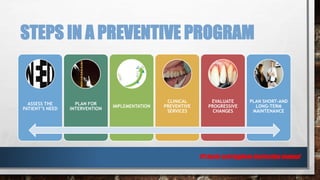
STEPS IN A PREVENTIVE PROGRAM 
ASSESS THE 
PATIENT’S NEED 
PLAN FOR 
INTERVENTION 
IMPLEMENTATION 
CLINICAL 
PREVENTIVE 
SERVICES 
EVALUATE 
PROGRESSIVE 
CHANGES 
PLAN SHORT-AND 
LONG-TERM 
MAINTENANCE 
ITI basic oral hygiene instruction manual
PATIENT COUNSELING 
• KNOWLEDGE 
• ATTITUDES 
• PRACTICES 
Psychological interventions to improve adherence to oral hygiene instructions in adults 
with periodontal diseases Renz a et al cochrane library 2007
PATIENT COMPLIANCE 
• Successful long term periodontal therapy requires exceptional patient compliance to a 
periodontal maintenance program 
• 100% patient compliance has been reported to be as low as 16%, with nearly 34% of 
patients failing to return for maintenance after completion of active therapy 
Self perception of generalized aggressive periodontitis and its influence on the compliance 
with the oral hygiene instructions renato correa et al braj j oral sci 2010
patient compliance contd… 
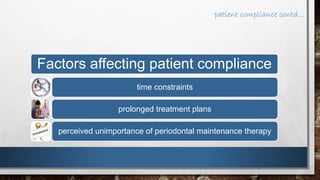
Factors affecting patient compliance 
time constraints 
prolonged treatment plans 
perceived unimportance of periodontal maintenance therapy
MODELS 
• The health belief model 
• Theory of planned behavior 
• Leventhal’s model 
• Trans theoretical model 
patient compliance contd… 
Psychological interventions to improve adherence to oral hygiene instructions in adults 
with periodontal diseases renz a et al cochrane library 2007
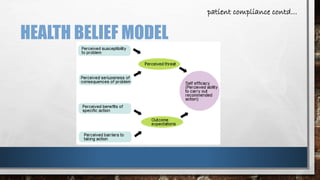
HEALTH BELIEF MODEL 
patient compliance contd…
patient compliance contd… 
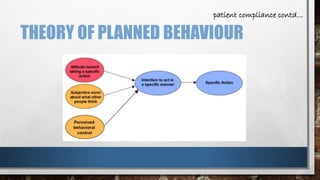
THEORY OF PLANNED BEHAVIOUR
PATIENTS NON COMPLIANCE 
• Current health beliefs 
• EI (emotional intelligence) 
• Psychosocial stressors 
• Personality traits
MOTIVATION INTERVIEWING 
• MI has been defined as a client centered, directive method for enhancing intrinsic 
motivation to change by exploring and resolving ambivalenc, miller and rollnick 2002 
Lindhe.Clinical-periodontology-implant-dentistry-2-volumes-5th-edition 
• Jane stenman 2012 A single freestanding MI session as a prelude to conventional 
periodontal treatment had no significant effect on the individuals' standard of self-performed 
periodontal infection control in a short-term perspective.
DEVELOPMENT 
Motivational interviewing contd… 
• Motivation is elicited from within the patient rather than externally imposed upon the 
patient by a practitioner. 
Lindhe.Clinical-periodontology-implant-dentistry-2-volumes-5th-edition
IMPLEMENTATION 
• Key principles of motivational interviewing 
1. Express empathy 
2. Develop discrepancy 
3. Roll with resistance 
4. Support self-efficacy 
Motivational interviewing contd… 
Lindhe.Clinical-periodontology-implant-dentistry-2-volumes-5th-edition
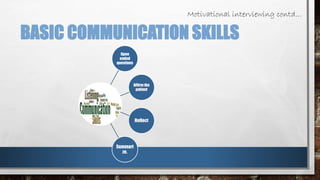
BASIC COMMUNICATION SKILLS 
Open 
ended 
questions 
Affirm the 
patient 
Reflect 
Summari 
ze. 
Motivational interviewing contd…
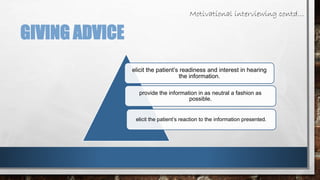
GIVING ADVICE 
Motivational interviewing contd… 
elicit the patient’s readiness and interest in hearing 
the information. 
provide the information in as neutral a fashion as 
possible. 
elicit the patient’s reaction to the information presented.
LEARNING PROCESS 
• Principles of learning 
• Learning is more effective when an individual is physiologically and psychologically 
ready to learn. 
• Individual differences must be considered if effective learning is to take place. 
• Motivation is essential for learning. 
• Evaluation of the results of instruction is essential to determine whether learning is taking 
place. 
Oral hygiene measures and promotion: review and considerations, Audrey choo et al 
australian dental journal 2001
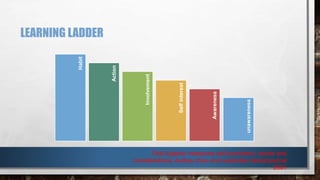
LEARNING LADDER 
unawareness 
Awareness 
Self interest 
Involvement 
Action 
Habit 
Oral hygiene measures and promotion: review and 
considerations, Audrey choo et al australian dental journal 
2001
INDIVIDUAL PATIENT PLANNING 
• When to teach 
• Initial instruction is best given first, before any clinical treatment 
• The setting 
• Teaching facility
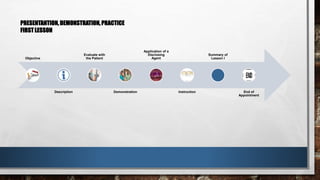
Objective 
Description 
Evaluate with 
the Patient 
Demonstration 
Application of a 
Disclosing 
Agent 
Instruction 
Summary of 
Lesson I 
End of 
Appointment 
PRESENTANTION, DEMONSTRATION, PRACTICE 
FIRST LESSON
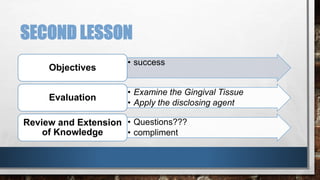
SECOND LESSON 
• success 
Objectives 
• Examine the Gingival Tissue 
• Apply the disclosing agent 
Evaluation 
• Questions??? 
• compliment 
Review and Extension 
of Knowledge
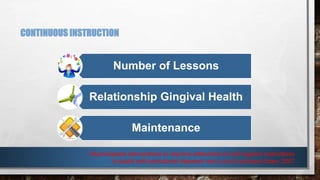
CONTINUOUS INSTRUCTION 
Number of Lessons 
Relationship Gingival Health 
Maintenance 
Psychological interventions to improve adherence to oral hygiene instructions 
in adults with periodontal diseases renz a et al cochrane library 2007
INSTRUCTION ADAPTABILITY 
• The methods for presentation, demonstration, practice, and evaluation can be adapted 
readily to various age levels. 
• Awareness of the changing motivation and interests of the young to the elderly, and 
adaptations of terminology with respect for the patient's level of understanding, ease the 
transition from patient to patient. 
Psychological interventions to improve adherence to oral 
hygiene instructions in adults with periodontal diseases 
renz a et al cochrane library 2007
THE TEACHING SYSTEM 
• Reevaluation 
• Outcomes
EVALUATION OF TEACHING AIDS 
General characteristics 
• Simplicity 
• Content 
• Cultural and linguistic appropriateness 
• Level of orientation 
• Durability 
• Cost 
• Objectives
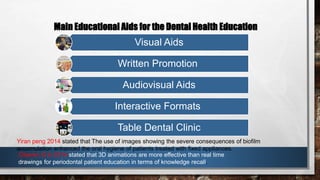
Main Educational Aids for the Dental Health Education 
Visual Aids 
Written Promotion 
Audiovisual Aids 
Interactive Formats 
Table Dental Clinic 
Yiran peng 2014 stated that The use of images showing the severe consequences of biofilm 
accumulation enhanced the oral hygiene of patients treated with fixed appliances. 
Cleeren G in 2014 stated that 3D animations are more effective than real time 
drawings for periodontal patient education in terms of knowledge recall.
READING MATERIAL FOR THE PATIENT 
• SELECTION 
• THE TEACHER: THE DENTAL HYGIENIST 
• Dental hygienists should pay more attention to instruction and education 
regarding oral hygiene preventive measures Malka askhanazi 2014 
• Elizabeth AH wilson 2012 Multimedia, health materials appears to be a promising 
medium for patient education; however, the majority of studies found that print and 
multimedia performed equally well in practice. Few studies involved patients in material 
development, and less than half assessed the readability of materials. 
Comparative analysis of print and multimedia health materials: A review of the 
literature,
USE OF MODELS. 
• Patient’s study cast 
• Commercially available models.
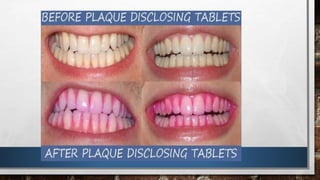
USE OF DISCLOSING AGENTS 
• Purpose 
• Methods for application 
• Solution for direct application (painting) 
• Rinsing 
• Tablet or wafer 
• Interpretation of findings 
• Patient INSTRUCTION 
• Explain dental biofilm 
• Show location and distribution of biofilm 
• Demonstrate methods for daily biofilm removal
• Iodine preparations 
• Mercurochrome preparations 
• Bismark brown 
• Merbromin 
• Erythrosin 
• Fast green 
• Fluorescin 
• Two tone 
• Tri plaque
TECHNICAL HINTS FOR DISCLOSING AGENTS 
• Avoid using disclosing or antiseptic solutions on teeth that have tooth-color restorations 
because these materials may be stained by coloring agents. 
• Do not apply a disclosing agent before a sealant is to be placed. 
• Purchase solutions in small quantities do not keep solutions containing alcohol longer than 2 
or 3 months because the alcohol will evaporate and render the solution too highly 
concentrated. 
• Use small bottles with dropper caps for solutions. Transfer solution to a dappen dish for use. 
Do not contaminate the solution by dipping cotton pliers with pellet directly into the container 
bottle. 
• Request local druggist to stock disclosing tablets for patients to purchase. Advise patients of 
the stores where the agents may be purchased.
BASIC STEPS FOR MAINTAINING ORAL 
HYGIENE 
• Brushing your teeth (at least twice a day or after every meal) 
• Floss your teeth regularly 
• Proper diet 
• Other interdental cleaning 
• Rinsing 
• Regular dental checkups
TOOTH BRUSHES 
• Uses 
• Biofilm removal 
• Application of treatment or preventive agents 
• Halitosis control 
• Sanitation of oral cavity 
Tooth brush a key to mechanical plaque control by Deepak grover Indian journal of oral science 
2012, vol3
• ADA specifications 
• Brushing surface 1 to 1.25 inches in length 
• 5/16 to 3/8 inches in width 
• 2-4 rows of bristles 
• 5-12 tufts per row 
• 80-120 bristles per tuft 
• Types of tooth brushes 
• Manual 
• Powered 
• Sonic and ultra sonic 
• Ionic 
Evolution of tooth brush Dr M Praksh, IDA times, Mumbai, June 2008.
Parts of a toothbrush 
• Handle: the part of the brush grasped in the hand during toothbrushing 
• Head: the working end of the toothbrush that holds the bristles or the filaments. 
• Tufts: clusters of bristles or filaments that are secured into the head. 
• Brushing plane: the surface formed by the free ends of the bristles or the filaments. 
• Shank: the section that connects head and handle. 
• Manual brush trim profiles: a variety of filament profiles are available.
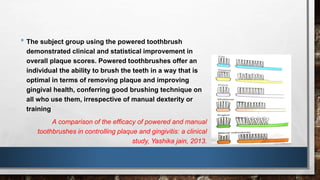
• The subject group using the powered toothbrush 
demonstrated clinical and statistical improvement in 
overall plaque scores. Powered toothbrushes offer an 
individual the ability to brush the teeth in a way that is 
optimal in terms of removing plaque and improving 
gingival health, conferring good brushing technique on 
all who use them, irrespective of manual dexterity or 
training 
A comparison of the efficacy of powered and manual 
toothbrushes in controlling plaque and gingivitis: a clinical 
study, Yashika jain, 2013.
• 
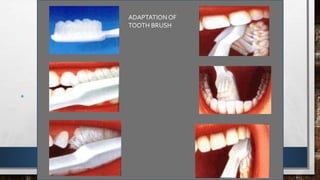
ADAPTATION OF 
TOOTH BRUSH
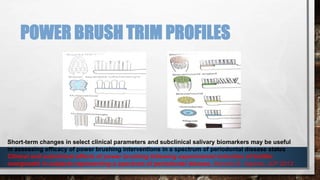
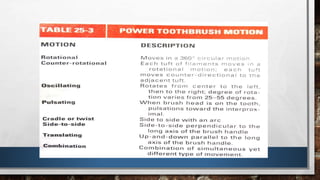
POWER BRUSH TRIM PROFILES 
Short-term changes in select clinical parameters and subclinical salivary biomarkers may be useful 
in assessing efficacy of power brushing interventions in a spectrum of periodontal disease states 
Clinical and subclinical effects of power brushing following experimental induction of biofilm 
overgrowth in subjects representing a spectrum of periodontal disease, Marcelo B. Aspiras, JCP 2013
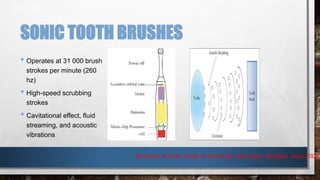
SONIC TOOTH BRUSHES 
• Operates at 31 000 brush 
strokes per minute (260 
hz) 
• High-speed scrubbing 
strokes 
• Cavitational effect, fluid 
streaming, and acoustic 
vibrations 
Evolution of tooth brush Dr M Praksh, IDA times, Mumbai, June 2008
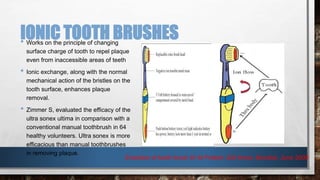
IONIC TOOTH BRUSHES 
• Works on the principle of changing 
surface charge of tooth to repel plaque 
even from inaccessible areas of teeth 
• Ionic exchange, along with the normal 
mechanical action of the bristles on the 
tooth surface, enhances plaque 
removal. 
• Zimmer S, evaluated the efficacy of the 
ultra sonex ultima in comparison with a 
conventional manual toothbrush in 64 
healthy volunteers. Ultra sonex is more 
efficacious than manual toothbrushes 
in removing plaque. 
Evolution of tooth brush Dr M Praksh, IDA times, Mumbai, June 2008
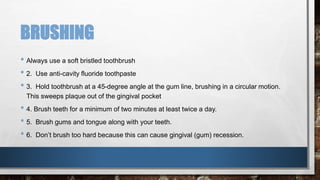
BRUSHING 
• Always use a soft bristled toothbrush 
• 2. Use anti-cavity fluoride toothpaste 
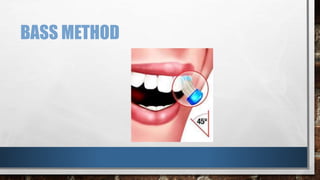
• 3. Hold toothbrush at a 45-degree angle at the gum line, brushing in a circular motion. 
This sweeps plaque out of the gingival pocket 
• 4. Brush teeth for a minimum of two minutes at least twice a day. 
• 5. Brush gums and tongue along with your teeth. 
• 6. Don’t brush too hard because this can cause gingival (gum) recession.
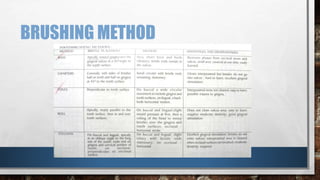
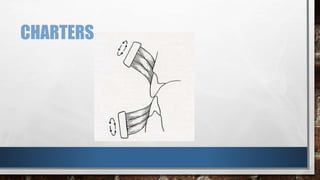
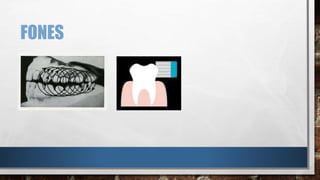
BRUSHING METHOD
BASS METHOD
CHARTERS
FONES
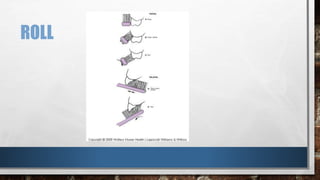
ROLL
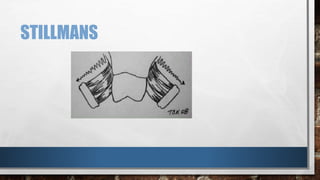
STILLMANS
CARE OF TOOTH BRUSHES 
• Supply of brushes 
• Brush replacement 
• Cleaning of tooth brushes 
• Storage of brush
INTERDENTAL CLEANING DEVICES 
• They are available as, 
• Dental floss 
• Interdental cleaners such as wooden (or) plastic tips 
• Interdental brushes
DENTAL FLOSS 
• Available as, 
• Multifilament nylon that is either 
• Twisted (or) non-twisted 
• Bonded (or) non- bonded 
• Waxed (or) unwaxed 
• Thick (or) thin
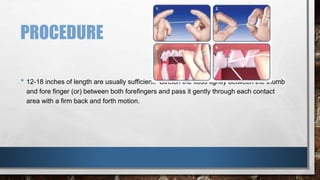
PROCEDURE 
• 12-18 inches of length are usually sufficient. Stretch the floss tightly between the thumb 
and fore finger (or) between both forefingers and pass it gently through each contact 
area with a firm back and forth motion.
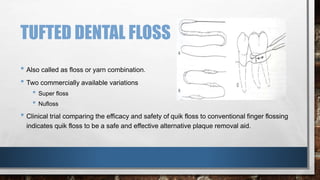
TUFTED DENTAL FLOSS 
• Also called as floss or yarn combination. 
• Two commercially available variations 
• Super floss 
• Nufloss 
• Clinical trial comparing the efficacy and safety of quik floss to conventional finger flossing 
indicates quik floss to be a safe and effective alternative plaque removal aid.
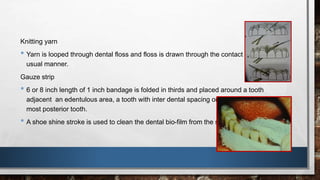
Knitting yarn 
• Yarn is looped through dental floss and floss is drawn through the contact area in the 
usual manner. 
Gauze strip 
• 6 or 8 inch length of 1 inch bandage is folded in thirds and placed around a tooth 
adjacent an edentulous area, a tooth with inter dental spacing or the distal surface of the 
most posterior tooth. 
• A shoe shine stroke is used to clean the dental bio-film from the surface
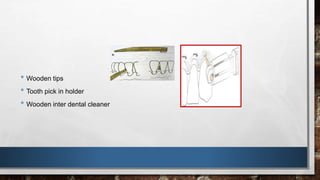
• Wooden tips 
• Tooth pick in holder 
• Wooden inter dental cleaner
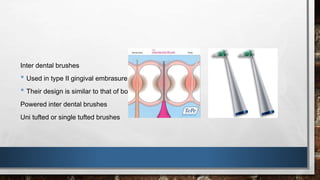
Inter dental brushes 
• Used in type II gingival embrasure. 
• Their design is similar to that of bottle brush 
Powered inter dental brushes 
Uni tufted or single tufted brushes
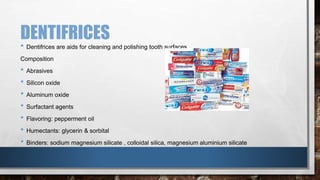
DENTIFRICES 
• Dentifrices are aids for cleaning and polishing tooth surfaces. 
Composition 
• Abrasives 
• Silicon oxide 
• Aluminum oxide 
• Surfactant agents 
• Flavoring: pepperment oil 
• Humectants: glycerin & sorbital 
• Binders: sodium magnesium silicate , colloidal silica, magnesium aluminium silicate
ORAL IRRIGATION DEVICES 
• Irrigation is targeted application of pulsated stream of water or other irrigants for 
therapeutic purpose. 
• Rationale for supragingival and sub gingival irrigation is to nonspecifically reduce the 
microbial deposits that induce periodontal diseases. 
• Primary objective of supragingival irrigation is to flush away the bacteria coronal to the 
gingival margin thereby diminishing the potential of developing gingivitis. 
• Sub gingival irrigation is to reduce the pocket micro-flora in an effort to prevent initiation 
& progression of periodontitis.
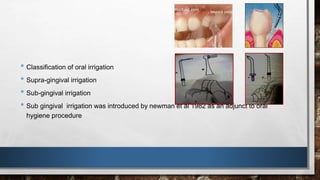
• Classification of oral irrigation 
• Supra-gingival irrigation 
• Sub-gingival irrigation 
• Sub gingival irrigation was introduced by newman et al 1982 as an adjunct to oral 
hygiene procedure
AGENTS USED FOR IRRIGATION 
• Chlorhexidine 
• Hydrogen peroxide 
• Water 
• Saline 
• Sanguinarine 
• Stannous fluoride 
• Povidone-iodine 
• Tetrapotassium peroxydiphosphate
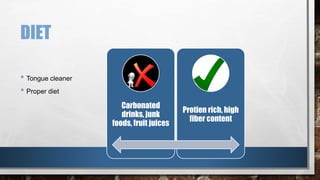
DIET 
• Tongue cleaner 
• Proper diet 
Carbonated 
drinks, junk 
foods, fruit juices 
Protien rich, high 
fiber content
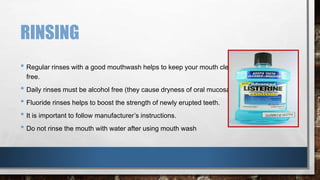
RINSING 
• Regular rinses with a good mouthwash helps to keep your mouth clean, fresh and germ 
free. 
• Daily rinses must be alcohol free (they cause dryness of oral mucosa) 
• Fluoride rinses helps to boost the strength of newly erupted teeth. 
• It is important to follow manufacturer’s instructions. 
• Do not rinse the mouth with water after using mouth wash
EXPANDED AND FUTURE USE OF MOUTH 
RINSES 
• Prophylaxis for bacterial endocarditis 
• Aerosol production 
• Oral candidiasis 
• Oral mucositis 
• After periodontal surgery 
• Regular dental checkups
SIGNS OF GOOD ORAL HYGIENE 
• Good oral hygiene results in a mouth that looks and smells healthy. 
• Teeth are clean and free of debris. 
• Gums are pink and do not hurt or bleed when you brush or floss. 
• Bad breath is not a constant problem.
ORAL HYGIENE INSTRUCTIONS 
SCALING AND ROOT PLANNING 
• Refrain from eating for at least 2 hours or until the anesthesia wear off 
• Medications: post treatment discomfort is normal. Discomfort should subside within a few 
hours to a few days. 
• Tooth sensitivity 
• Eating 
• Bleeding 
• Appearance 
• Oral hygiene
AFTER PERIODONTAL SURGERY 
• Periodontal dressing 
• Do not brush over the pack 
• If given a prescription for chlorhexidine (peridex), bathe the area of surgery without 
rinsing for 2 minutes after breakfast and before bedtime using a ½ of a capful of peridex.
ADDITIONAL INSTRUCTIONS FOR DENTAL IMPLANT SURGERY 
• Do not rinse your mouth vigorously during the first 24 hours after surgery. 
• If given a prescription for chlorhexidine (peridex), bathe the area of surgery without rinsing for 
2 minutes after breakfast and before bedtime with ½ of a capful of peridex. Continue its use 
until dentist tells you to stop. 
• If nose bleeding occurs, do not blow your nose vigorously. 
• Maintain a soft diet for the first 5 days after the operation and if possible, eat on the side of 
your mouth that did not have surgery. 
• Use an elevated headrest or an extra pillow for the first 2 nights after the operation. 
• Do not use your prosthesis until it has been relined
RESPIRATORY DISORDER 
• Patient should be encouraged to floss regularly and brush twice daily with a dentifrice 
that offers antibacterial protection and anti-inflammatory benefits. 
Chest. 2004 nov; 126(5):1575-82
INSTRUCTIONS DURING PREGNANCY 
• Brush teeth with fluoridated toothpaste twice a day, and floss once a day. 
• Limit foods containing sugar to mealtimes only. 
• Drink water or low-fat milk. Avoid carbonated beverages (pop or soda). 
• Choose fruit rather than fruit juice to meet the recommended daily intake 
of fruit. 
• Obtain necessary oral treatment before delivery. 
• Diagnosis (including necessary dental x-rays) and necessary treatment can 
be provided throughout pregnancy; however, the period between the 14th 
and the 20th week of pregnancy is the best time to receive treatment. 
• Treatment for conditions requiring immediate attention are safe during the 
first trimester of pregnancy. Delaying necessary treatment could result in 
significant risk to you, and indirectly to your baby.
ORAL HEALTH PROGRAM FOR CVS PATIENTS 
• Frequent dental prophylaxis (every 3 months to 6 months) 
• Twice daily brushing with fluoride toothpaste 
• Avoid rinsing after brushing to maximize fluoride effect 
• Use toothpaste containing 1,450 ppm fluoride or prescription toothpaste containing 2,500 ppm to 5,000 
ppm fluoride 
• Fluoride varnish application 
• Frequent sips of water and rinsing with water after 
• Meals and food supplements • saliva substitutes 
• Using a straw with food supplements to minimize contact with teeth 
• Power toothbrush 
• Alcohol-free mouthrinse 
• Floss
CONCLUSION 
• To promote healthy periodontal and dental tissues, current mechanical and 
chemotherapeutic approaches to oral hygiene aim to modify the oral micro flora. 
• The challenge for oral hygiene promotion is effective delivery of these measures 
combined with effectual motivation of individuals and communities to aspire to oral 
health.
REFERENCES 
• Soben peter. Essentials of preventive and community dentistry. Second edition. 
• Park .Social and preventive medicine.18th edition. 
• Wilkins. The clinical practice of the dental hygienist.10th edition. 
• Carranza's clinical periodontology.10th edition 
• Lindhe.Clinical-periodontology-implant-dentistry-2-volumes-5th-edition. 
• Guljot singh, d. S. Mehta, shruti chopra, and manish khatri. Comparison of sonic and ionic toothbrush in 
reduction in plaque and gingivitis. J indian soc periodontol. 2011 jul-sep; 15(3): 210–214. 
• Audrey choo,* david m delac,* louise brearley messer*.Oral hygiene measures and promotion: review 
and considerations. Australian dental journal 2001;46:(3):166-173
• Bakdash B. Current patterns of oral hygiene product use and practices. Periodontol 2000 
1995;8:11-14. 
• Carter-hanson c, gadbury-amycot c, killoy w. Comparison of the plaque removal efficacy 
of a new flossing aid (quik floss) to finger flossing. J clin periodontol 1996;23:873-878. 
• Kiger rd, nylund k, feller rp. A comparison of proximal plaque removal using floss and 
interdental brushes. J clin periodontol 1991;18:681-684. 
• Jenkins s, addy m, newcombe r. Evaluation of a mouthrinse containing chlorhexidine and 
fluoride as an adjunct to oral hygiene. J clin periodontol 1993;20:20-25. 
• Moran jm. Chemical plaque control – prevention for the masses. Periodontol 2000 
1997;15:109-117. 
• Smith aj, moran j, dangler lv, et al. The efficacy of an antigingivitis chewing gum. J clin 
periodontol 1996;23:19-23. 
• Claydon n, hunter l, moran j, et al. A 6-month home usage trial of 0.1% and 0.2% 
delmopinol mouthwashes (I). Effect onplaque, gingivitis, supragingival calculus and tooth 
staining. J clin periodontol 1996;23:220-228.

Oral hygiene instructions

  • 2.
    CONTENTS • INTRODUCTION • STEPS IN A PREVENTIVE PROGRAM • PATIENT COUNSELLING • PATIENT COMPLIANCE • MOTIVATIONAL INTERVIEWING • LEARNING PROCESS • PATIENT PLANNING • BASIC STEPS FOR MAINTAINING ORAL HYGIENE • TOOTH BRUSHES • DENTIFRICES • ORAL IRRIGATION DEVICES • FLOSS • INTERDENTAL CLEANING • RINSING • REGULAR DENTAL CHECKUPS • PROPER DIET • CONCLUSION • REFERENCES
  • 3.
    INTRODUCTION • Oralhygiene includes all the processes for keeping mouth clean and healthy. Good oral hygiene is necessary for prevention of dental caries, periodontal diseases, bad breath and other dental problems. • Oral health: oral health is defined as the retention throughout life of a functional, aesthetic & natural dentition of not less than 20 teeth & not requiring prosthesis WHO – 1982 Oral hygiene Importance prevention
  • 4.
    GOALS Eliminate sourcesof infection Stabilize and preserve oral tissues Restore oral function Educate patient regarding maintenance Facilitate maintenance of adequate nutrition Contribute to self-esteem and quality of life ITI basic oral hygiene instruction manual
  • 5.
    STEPS IN APREVENTIVE PROGRAM ASSESS THE PATIENT’S NEED PLAN FOR INTERVENTION IMPLEMENTATION CLINICAL PREVENTIVE SERVICES EVALUATE PROGRESSIVE CHANGES PLAN SHORT-AND LONG-TERM MAINTENANCE ITI basic oral hygiene instruction manual
  • 6.
    PATIENT COUNSELING •KNOWLEDGE • ATTITUDES • PRACTICES Psychological interventions to improve adherence to oral hygiene instructions in adults with periodontal diseases Renz a et al cochrane library 2007
  • 7.
    PATIENT COMPLIANCE •Successful long term periodontal therapy requires exceptional patient compliance to a periodontal maintenance program • 100% patient compliance has been reported to be as low as 16%, with nearly 34% of patients failing to return for maintenance after completion of active therapy Self perception of generalized aggressive periodontitis and its influence on the compliance with the oral hygiene instructions renato correa et al braj j oral sci 2010
  • 8.
    patient compliance contd… Factors affecting patient compliance time constraints prolonged treatment plans perceived unimportance of periodontal maintenance therapy
  • 9.
    MODELS • Thehealth belief model • Theory of planned behavior • Leventhal’s model • Trans theoretical model patient compliance contd… Psychological interventions to improve adherence to oral hygiene instructions in adults with periodontal diseases renz a et al cochrane library 2007
  • 10.
    HEALTH BELIEF MODEL patient compliance contd…
  • 11.
    patient compliance contd… THEORY OF PLANNED BEHAVIOUR
  • 12.
    PATIENTS NON COMPLIANCE • Current health beliefs • EI (emotional intelligence) • Psychosocial stressors • Personality traits
  • 13.
    MOTIVATION INTERVIEWING •MI has been defined as a client centered, directive method for enhancing intrinsic motivation to change by exploring and resolving ambivalenc, miller and rollnick 2002 Lindhe.Clinical-periodontology-implant-dentistry-2-volumes-5th-edition • Jane stenman 2012 A single freestanding MI session as a prelude to conventional periodontal treatment had no significant effect on the individuals' standard of self-performed periodontal infection control in a short-term perspective.
  • 14.
    DEVELOPMENT Motivational interviewingcontd… • Motivation is elicited from within the patient rather than externally imposed upon the patient by a practitioner. Lindhe.Clinical-periodontology-implant-dentistry-2-volumes-5th-edition
  • 15.
    IMPLEMENTATION • Keyprinciples of motivational interviewing 1. Express empathy 2. Develop discrepancy 3. Roll with resistance 4. Support self-efficacy Motivational interviewing contd… Lindhe.Clinical-periodontology-implant-dentistry-2-volumes-5th-edition
  • 16.
    BASIC COMMUNICATION SKILLS Open ended questions Affirm the patient Reflect Summari ze. Motivational interviewing contd…
  • 17.
    GIVING ADVICE Motivationalinterviewing contd… elicit the patient’s readiness and interest in hearing the information. provide the information in as neutral a fashion as possible. elicit the patient’s reaction to the information presented.
  • 18.
    LEARNING PROCESS •Principles of learning • Learning is more effective when an individual is physiologically and psychologically ready to learn. • Individual differences must be considered if effective learning is to take place. • Motivation is essential for learning. • Evaluation of the results of instruction is essential to determine whether learning is taking place. Oral hygiene measures and promotion: review and considerations, Audrey choo et al australian dental journal 2001
  • 19.
    LEARNING LADDER unawareness Awareness Self interest Involvement Action Habit Oral hygiene measures and promotion: review and considerations, Audrey choo et al australian dental journal 2001
  • 20.
    INDIVIDUAL PATIENT PLANNING • When to teach • Initial instruction is best given first, before any clinical treatment • The setting • Teaching facility
  • 21.
    Objective Description Evaluatewith the Patient Demonstration Application of a Disclosing Agent Instruction Summary of Lesson I End of Appointment PRESENTANTION, DEMONSTRATION, PRACTICE FIRST LESSON
  • 22.
    SECOND LESSON •success Objectives • Examine the Gingival Tissue • Apply the disclosing agent Evaluation • Questions??? • compliment Review and Extension of Knowledge
  • 23.
    CONTINUOUS INSTRUCTION Numberof Lessons Relationship Gingival Health Maintenance Psychological interventions to improve adherence to oral hygiene instructions in adults with periodontal diseases renz a et al cochrane library 2007
  • 24.
    INSTRUCTION ADAPTABILITY •The methods for presentation, demonstration, practice, and evaluation can be adapted readily to various age levels. • Awareness of the changing motivation and interests of the young to the elderly, and adaptations of terminology with respect for the patient's level of understanding, ease the transition from patient to patient. Psychological interventions to improve adherence to oral hygiene instructions in adults with periodontal diseases renz a et al cochrane library 2007
  • 25.
    THE TEACHING SYSTEM • Reevaluation • Outcomes
  • 26.
    EVALUATION OF TEACHINGAIDS General characteristics • Simplicity • Content • Cultural and linguistic appropriateness • Level of orientation • Durability • Cost • Objectives
  • 27.
    Main Educational Aidsfor the Dental Health Education Visual Aids Written Promotion Audiovisual Aids Interactive Formats Table Dental Clinic Yiran peng 2014 stated that The use of images showing the severe consequences of biofilm accumulation enhanced the oral hygiene of patients treated with fixed appliances. Cleeren G in 2014 stated that 3D animations are more effective than real time drawings for periodontal patient education in terms of knowledge recall.
  • 28.
    READING MATERIAL FORTHE PATIENT • SELECTION • THE TEACHER: THE DENTAL HYGIENIST • Dental hygienists should pay more attention to instruction and education regarding oral hygiene preventive measures Malka askhanazi 2014 • Elizabeth AH wilson 2012 Multimedia, health materials appears to be a promising medium for patient education; however, the majority of studies found that print and multimedia performed equally well in practice. Few studies involved patients in material development, and less than half assessed the readability of materials. Comparative analysis of print and multimedia health materials: A review of the literature,
  • 29.
    USE OF MODELS. • Patient’s study cast • Commercially available models.
  • 30.
    USE OF DISCLOSINGAGENTS • Purpose • Methods for application • Solution for direct application (painting) • Rinsing • Tablet or wafer • Interpretation of findings • Patient INSTRUCTION • Explain dental biofilm • Show location and distribution of biofilm • Demonstrate methods for daily biofilm removal
  • 32.
    • Iodine preparations • Mercurochrome preparations • Bismark brown • Merbromin • Erythrosin • Fast green • Fluorescin • Two tone • Tri plaque
  • 33.
    TECHNICAL HINTS FORDISCLOSING AGENTS • Avoid using disclosing or antiseptic solutions on teeth that have tooth-color restorations because these materials may be stained by coloring agents. • Do not apply a disclosing agent before a sealant is to be placed. • Purchase solutions in small quantities do not keep solutions containing alcohol longer than 2 or 3 months because the alcohol will evaporate and render the solution too highly concentrated. • Use small bottles with dropper caps for solutions. Transfer solution to a dappen dish for use. Do not contaminate the solution by dipping cotton pliers with pellet directly into the container bottle. • Request local druggist to stock disclosing tablets for patients to purchase. Advise patients of the stores where the agents may be purchased.
  • 34.
    BASIC STEPS FORMAINTAINING ORAL HYGIENE • Brushing your teeth (at least twice a day or after every meal) • Floss your teeth regularly • Proper diet • Other interdental cleaning • Rinsing • Regular dental checkups
  • 35.
    TOOTH BRUSHES •Uses • Biofilm removal • Application of treatment or preventive agents • Halitosis control • Sanitation of oral cavity Tooth brush a key to mechanical plaque control by Deepak grover Indian journal of oral science 2012, vol3
  • 36.
    • ADA specifications • Brushing surface 1 to 1.25 inches in length • 5/16 to 3/8 inches in width • 2-4 rows of bristles • 5-12 tufts per row • 80-120 bristles per tuft • Types of tooth brushes • Manual • Powered • Sonic and ultra sonic • Ionic Evolution of tooth brush Dr M Praksh, IDA times, Mumbai, June 2008.
  • 37.
    Parts of atoothbrush • Handle: the part of the brush grasped in the hand during toothbrushing • Head: the working end of the toothbrush that holds the bristles or the filaments. • Tufts: clusters of bristles or filaments that are secured into the head. • Brushing plane: the surface formed by the free ends of the bristles or the filaments. • Shank: the section that connects head and handle. • Manual brush trim profiles: a variety of filament profiles are available.
  • 38.
    • The subjectgroup using the powered toothbrush demonstrated clinical and statistical improvement in overall plaque scores. Powered toothbrushes offer an individual the ability to brush the teeth in a way that is optimal in terms of removing plaque and improving gingival health, conferring good brushing technique on all who use them, irrespective of manual dexterity or training A comparison of the efficacy of powered and manual toothbrushes in controlling plaque and gingivitis: a clinical study, Yashika jain, 2013.
  • 39.
    • ADAPTATION OF TOOTH BRUSH
  • 41.
    POWER BRUSH TRIMPROFILES Short-term changes in select clinical parameters and subclinical salivary biomarkers may be useful in assessing efficacy of power brushing interventions in a spectrum of periodontal disease states Clinical and subclinical effects of power brushing following experimental induction of biofilm overgrowth in subjects representing a spectrum of periodontal disease, Marcelo B. Aspiras, JCP 2013
  • 43.
    SONIC TOOTH BRUSHES • Operates at 31 000 brush strokes per minute (260 hz) • High-speed scrubbing strokes • Cavitational effect, fluid streaming, and acoustic vibrations Evolution of tooth brush Dr M Praksh, IDA times, Mumbai, June 2008
  • 44.
    IONIC TOOTH BRUSHES • Works on the principle of changing surface charge of tooth to repel plaque even from inaccessible areas of teeth • Ionic exchange, along with the normal mechanical action of the bristles on the tooth surface, enhances plaque removal. • Zimmer S, evaluated the efficacy of the ultra sonex ultima in comparison with a conventional manual toothbrush in 64 healthy volunteers. Ultra sonex is more efficacious than manual toothbrushes in removing plaque. Evolution of tooth brush Dr M Praksh, IDA times, Mumbai, June 2008
  • 45.
    BRUSHING • Alwaysuse a soft bristled toothbrush • 2. Use anti-cavity fluoride toothpaste • 3. Hold toothbrush at a 45-degree angle at the gum line, brushing in a circular motion. This sweeps plaque out of the gingival pocket • 4. Brush teeth for a minimum of two minutes at least twice a day. • 5. Brush gums and tongue along with your teeth. • 6. Don’t brush too hard because this can cause gingival (gum) recession.
  • 46.
  • 47.
  • 49.
  • 51.
  • 52.
  • 53.
  • 55.
    CARE OF TOOTHBRUSHES • Supply of brushes • Brush replacement • Cleaning of tooth brushes • Storage of brush
  • 56.
    INTERDENTAL CLEANING DEVICES • They are available as, • Dental floss • Interdental cleaners such as wooden (or) plastic tips • Interdental brushes
  • 57.
    DENTAL FLOSS •Available as, • Multifilament nylon that is either • Twisted (or) non-twisted • Bonded (or) non- bonded • Waxed (or) unwaxed • Thick (or) thin
  • 58.
    PROCEDURE • 12-18inches of length are usually sufficient. Stretch the floss tightly between the thumb and fore finger (or) between both forefingers and pass it gently through each contact area with a firm back and forth motion.
  • 59.
    TUFTED DENTAL FLOSS • Also called as floss or yarn combination. • Two commercially available variations • Super floss • Nufloss • Clinical trial comparing the efficacy and safety of quik floss to conventional finger flossing indicates quik floss to be a safe and effective alternative plaque removal aid.
  • 60.
    Knitting yarn •Yarn is looped through dental floss and floss is drawn through the contact area in the usual manner. Gauze strip • 6 or 8 inch length of 1 inch bandage is folded in thirds and placed around a tooth adjacent an edentulous area, a tooth with inter dental spacing or the distal surface of the most posterior tooth. • A shoe shine stroke is used to clean the dental bio-film from the surface
  • 61.
    • Wooden tips • Tooth pick in holder • Wooden inter dental cleaner
  • 62.
    Inter dental brushes • Used in type II gingival embrasure. • Their design is similar to that of bottle brush Powered inter dental brushes Uni tufted or single tufted brushes
  • 63.
    DENTIFRICES • Dentifricesare aids for cleaning and polishing tooth surfaces. Composition • Abrasives • Silicon oxide • Aluminum oxide • Surfactant agents • Flavoring: pepperment oil • Humectants: glycerin & sorbital • Binders: sodium magnesium silicate , colloidal silica, magnesium aluminium silicate
  • 64.
    ORAL IRRIGATION DEVICES • Irrigation is targeted application of pulsated stream of water or other irrigants for therapeutic purpose. • Rationale for supragingival and sub gingival irrigation is to nonspecifically reduce the microbial deposits that induce periodontal diseases. • Primary objective of supragingival irrigation is to flush away the bacteria coronal to the gingival margin thereby diminishing the potential of developing gingivitis. • Sub gingival irrigation is to reduce the pocket micro-flora in an effort to prevent initiation & progression of periodontitis.
  • 65.
    • Classification oforal irrigation • Supra-gingival irrigation • Sub-gingival irrigation • Sub gingival irrigation was introduced by newman et al 1982 as an adjunct to oral hygiene procedure
  • 66.
    AGENTS USED FORIRRIGATION • Chlorhexidine • Hydrogen peroxide • Water • Saline • Sanguinarine • Stannous fluoride • Povidone-iodine • Tetrapotassium peroxydiphosphate
  • 67.
    DIET • Tonguecleaner • Proper diet Carbonated drinks, junk foods, fruit juices Protien rich, high fiber content
  • 68.
    RINSING • Regularrinses with a good mouthwash helps to keep your mouth clean, fresh and germ free. • Daily rinses must be alcohol free (they cause dryness of oral mucosa) • Fluoride rinses helps to boost the strength of newly erupted teeth. • It is important to follow manufacturer’s instructions. • Do not rinse the mouth with water after using mouth wash
  • 69.
    EXPANDED AND FUTUREUSE OF MOUTH RINSES • Prophylaxis for bacterial endocarditis • Aerosol production • Oral candidiasis • Oral mucositis • After periodontal surgery • Regular dental checkups
  • 70.
    SIGNS OF GOODORAL HYGIENE • Good oral hygiene results in a mouth that looks and smells healthy. • Teeth are clean and free of debris. • Gums are pink and do not hurt or bleed when you brush or floss. • Bad breath is not a constant problem.
  • 71.
    ORAL HYGIENE INSTRUCTIONS SCALING AND ROOT PLANNING • Refrain from eating for at least 2 hours or until the anesthesia wear off • Medications: post treatment discomfort is normal. Discomfort should subside within a few hours to a few days. • Tooth sensitivity • Eating • Bleeding • Appearance • Oral hygiene
  • 72.
    AFTER PERIODONTAL SURGERY • Periodontal dressing • Do not brush over the pack • If given a prescription for chlorhexidine (peridex), bathe the area of surgery without rinsing for 2 minutes after breakfast and before bedtime using a ½ of a capful of peridex.
  • 73.
    ADDITIONAL INSTRUCTIONS FORDENTAL IMPLANT SURGERY • Do not rinse your mouth vigorously during the first 24 hours after surgery. • If given a prescription for chlorhexidine (peridex), bathe the area of surgery without rinsing for 2 minutes after breakfast and before bedtime with ½ of a capful of peridex. Continue its use until dentist tells you to stop. • If nose bleeding occurs, do not blow your nose vigorously. • Maintain a soft diet for the first 5 days after the operation and if possible, eat on the side of your mouth that did not have surgery. • Use an elevated headrest or an extra pillow for the first 2 nights after the operation. • Do not use your prosthesis until it has been relined
  • 74.
    RESPIRATORY DISORDER •Patient should be encouraged to floss regularly and brush twice daily with a dentifrice that offers antibacterial protection and anti-inflammatory benefits. Chest. 2004 nov; 126(5):1575-82
  • 75.
    INSTRUCTIONS DURING PREGNANCY • Brush teeth with fluoridated toothpaste twice a day, and floss once a day. • Limit foods containing sugar to mealtimes only. • Drink water or low-fat milk. Avoid carbonated beverages (pop or soda). • Choose fruit rather than fruit juice to meet the recommended daily intake of fruit. • Obtain necessary oral treatment before delivery. • Diagnosis (including necessary dental x-rays) and necessary treatment can be provided throughout pregnancy; however, the period between the 14th and the 20th week of pregnancy is the best time to receive treatment. • Treatment for conditions requiring immediate attention are safe during the first trimester of pregnancy. Delaying necessary treatment could result in significant risk to you, and indirectly to your baby.
  • 76.
    ORAL HEALTH PROGRAMFOR CVS PATIENTS • Frequent dental prophylaxis (every 3 months to 6 months) • Twice daily brushing with fluoride toothpaste • Avoid rinsing after brushing to maximize fluoride effect • Use toothpaste containing 1,450 ppm fluoride or prescription toothpaste containing 2,500 ppm to 5,000 ppm fluoride • Fluoride varnish application • Frequent sips of water and rinsing with water after • Meals and food supplements • saliva substitutes • Using a straw with food supplements to minimize contact with teeth • Power toothbrush • Alcohol-free mouthrinse • Floss
  • 77.
    CONCLUSION • Topromote healthy periodontal and dental tissues, current mechanical and chemotherapeutic approaches to oral hygiene aim to modify the oral micro flora. • The challenge for oral hygiene promotion is effective delivery of these measures combined with effectual motivation of individuals and communities to aspire to oral health.
  • 78.
    REFERENCES • Sobenpeter. Essentials of preventive and community dentistry. Second edition. • Park .Social and preventive medicine.18th edition. • Wilkins. The clinical practice of the dental hygienist.10th edition. • Carranza's clinical periodontology.10th edition • Lindhe.Clinical-periodontology-implant-dentistry-2-volumes-5th-edition. • Guljot singh, d. S. Mehta, shruti chopra, and manish khatri. Comparison of sonic and ionic toothbrush in reduction in plaque and gingivitis. J indian soc periodontol. 2011 jul-sep; 15(3): 210–214. • Audrey choo,* david m delac,* louise brearley messer*.Oral hygiene measures and promotion: review and considerations. Australian dental journal 2001;46:(3):166-173
  • 79.
    • Bakdash B.Current patterns of oral hygiene product use and practices. Periodontol 2000 1995;8:11-14. • Carter-hanson c, gadbury-amycot c, killoy w. Comparison of the plaque removal efficacy of a new flossing aid (quik floss) to finger flossing. J clin periodontol 1996;23:873-878. • Kiger rd, nylund k, feller rp. A comparison of proximal plaque removal using floss and interdental brushes. J clin periodontol 1991;18:681-684. • Jenkins s, addy m, newcombe r. Evaluation of a mouthrinse containing chlorhexidine and fluoride as an adjunct to oral hygiene. J clin periodontol 1993;20:20-25. • Moran jm. Chemical plaque control – prevention for the masses. Periodontol 2000 1997;15:109-117. • Smith aj, moran j, dangler lv, et al. The efficacy of an antigingivitis chewing gum. J clin periodontol 1996;23:19-23. • Claydon n, hunter l, moran j, et al. A 6-month home usage trial of 0.1% and 0.2% delmopinol mouthwashes (I). Effect onplaque, gingivitis, supragingival calculus and tooth staining. J clin periodontol 1996;23:220-228.