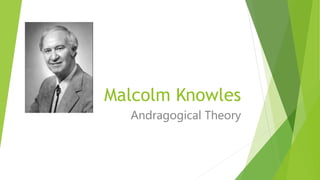
Malcolm Knowles
Andragogical Theory
The Bio
Malcolm Knowles
Author
Malcolm Shepherd Knowles was an American Adult Educator, famous for the
adoption of the theory of andragogy—
initially a term coined by the German teacher Alexander Kapp.
•Born: August 24, 1913, Livingston, Montana
•Died: November 27, 1997, Fayetteville, Arkansas
•Cause of Death: Stroke
•Nationality: American
•Spouse: Elisabet Fornell (m. 1935-1997)
Define Andragogy
 Definition: Andragogy is the process of helping
adults learn.
 While pedagogy refers to the teaching of children,
where the teacher is the focal
point,andragogy shifts the focus from the teacher
to the learner. Adults learn best when they have
control over their learning.
Knowles Theory
Knowles Concept
Background Information
 Andragogy is Distinct from Pedagogy
Education of adults has long been perceived as different from education of children in both theory and practice. In this section
general views of the purposes and characteristics will be given. In the next section, applications of critical theory and
reflective thinking in adult education will be explored.
Adult education in North America began to be organized in the 1920's, when educators of adults found problems with the
pedagogical assumption that the purpose of schooling was to transmit knowledge and skills. They also noted different
characteristics for adult learners than for children. Adult learners desired more than just knowledge, and resisted pedagogical
teaching strategies such as drills, rote memorization, and examinations. The andragogical model focuses more on the educator
as a facilitator who makes resources and procedures available to the adult learner. Mutual planning based on needs
assessment, formulating instructional objectives that respect the needs identified, creating learning experiences with
techniques and materials, and evaluating outcomes to determine the next level of needs are more characteristic of adult
instruction. The voluntary nature of adult learning is a cornerstone assumption of andragogy (Holmes & Abington-Cooper,
2000).
Knowles (1980) came from a humanistic orientation and believed that self-actualization was the prime objective of adult
learning, and the mission of educators was to assist adult learners to develop and achieve their full potential as emotional,
psychological, and intellectual beings. Knowles made four assumptions about adults as learners: (1) Adults tend to be more
self-directed as a result of their maturity, (2) Adults possess personal histories which defines their identities and serve as a
resource of experiential learning upon which new learnings can be applied, (3) Motivation in adults is directed to more socially
relevant learning, and (4) Adult learners have interest in immediate application for problem-solving.
Mr. Knowles Examples and Principles.
 Example
 Knowles (1984, Appendix D) provides an example of applying andragogy principles to the design of personal computer training:
 1. There is a need to explain why specific things are being taught (e.g., certain commands, functions, operations, etc.)
 2. Instruction should be task-oriented instead of memorization -- learning activities should be in the context of common tasks
to be performed.
 3. Instruction should take into account the wide range of different backgrounds of learners; learning materials and activities
should allow for different levels/types of previous experience with computers.
 4. Since adults are self-directed, instruction should allow learners to discover things for themselves, providing guidance and
help when mistakes are made.
 Principles
 Adults need to be involved in the planning and evaluation of their instruction.
 Experience (including mistakes) provides the basis for learning activities.
 Adults are most interested in learning subjects that have immediate relevance to their job or personal life.
 Adult learning is problem-centered rather than content-oriented.
Part of The Journey
Knowles 6 Assumptions
 Knowles' assumptions
 The need to know — adult learners need to know why they need to learn something before
undertaking to learn it.
 Learner self-concept —adults need to be responsible for their own decisions and to be treated as
capable of self-direction
 Role of learners' experience —adult learners have a variety of experiences of life which represent
the richest resource for learning. These experiences are however imbued with bias and
presupposition.
 Readiness to learn —adults are ready to learn those things they need to know in order to cope
effectively with life situations.
 Orientation to learning —adults are motivated to learn to the extent that they perceive that it will
help them perform tasks they confront in their life situations.

Read more: Knowles' andragogy: an angle on adult
learning http://www.learningandteaching.info/learning/knowlesa.htm#ixzz3Xp0XucFx
Under Creative Commons License: Attribution Non-Commercial No Derivatives
The Adult Learner:
Videos of Malcolm Knowles Andragogy
https://youtu.be/U4iMFu4CnLQ
https://youtu.be/RvAjpSv3CPg
Citations
 http://en.wikipedia.org/wiki/Malcolm_Knowles
 http://www.lifecircles-inc.com/Learningtheories/knowls.html
 http://www.learningandteaching.info/learning/knowlesa.htm
 http://leadcap.org/images/free_resources_pdf/pedagogy_vs_androgogy.pdf
 https://www.youtube.com/watch?v=RvAjpSv3CPg

14517181.ppt

  • 1.
  • 2.
    The Bio Malcolm Knowles Author MalcolmShepherd Knowles was an American Adult Educator, famous for the adoption of the theory of andragogy— initially a term coined by the German teacher Alexander Kapp. •Born: August 24, 1913, Livingston, Montana •Died: November 27, 1997, Fayetteville, Arkansas •Cause of Death: Stroke •Nationality: American •Spouse: Elisabet Fornell (m. 1935-1997)
  • 3.
    Define Andragogy  Definition:Andragogy is the process of helping adults learn.  While pedagogy refers to the teaching of children, where the teacher is the focal point,andragogy shifts the focus from the teacher to the learner. Adults learn best when they have control over their learning.
  • 4.
  • 5.
  • 6.
    Background Information  Andragogyis Distinct from Pedagogy Education of adults has long been perceived as different from education of children in both theory and practice. In this section general views of the purposes and characteristics will be given. In the next section, applications of critical theory and reflective thinking in adult education will be explored. Adult education in North America began to be organized in the 1920's, when educators of adults found problems with the pedagogical assumption that the purpose of schooling was to transmit knowledge and skills. They also noted different characteristics for adult learners than for children. Adult learners desired more than just knowledge, and resisted pedagogical teaching strategies such as drills, rote memorization, and examinations. The andragogical model focuses more on the educator as a facilitator who makes resources and procedures available to the adult learner. Mutual planning based on needs assessment, formulating instructional objectives that respect the needs identified, creating learning experiences with techniques and materials, and evaluating outcomes to determine the next level of needs are more characteristic of adult instruction. The voluntary nature of adult learning is a cornerstone assumption of andragogy (Holmes & Abington-Cooper, 2000). Knowles (1980) came from a humanistic orientation and believed that self-actualization was the prime objective of adult learning, and the mission of educators was to assist adult learners to develop and achieve their full potential as emotional, psychological, and intellectual beings. Knowles made four assumptions about adults as learners: (1) Adults tend to be more self-directed as a result of their maturity, (2) Adults possess personal histories which defines their identities and serve as a resource of experiential learning upon which new learnings can be applied, (3) Motivation in adults is directed to more socially relevant learning, and (4) Adult learners have interest in immediate application for problem-solving.
  • 7.
    Mr. Knowles Examplesand Principles.  Example  Knowles (1984, Appendix D) provides an example of applying andragogy principles to the design of personal computer training:  1. There is a need to explain why specific things are being taught (e.g., certain commands, functions, operations, etc.)  2. Instruction should be task-oriented instead of memorization -- learning activities should be in the context of common tasks to be performed.  3. Instruction should take into account the wide range of different backgrounds of learners; learning materials and activities should allow for different levels/types of previous experience with computers.  4. Since adults are self-directed, instruction should allow learners to discover things for themselves, providing guidance and help when mistakes are made.  Principles  Adults need to be involved in the planning and evaluation of their instruction.  Experience (including mistakes) provides the basis for learning activities.  Adults are most interested in learning subjects that have immediate relevance to their job or personal life.  Adult learning is problem-centered rather than content-oriented.
  • 8.
    Part of TheJourney
  • 9.
    Knowles 6 Assumptions Knowles' assumptions  The need to know — adult learners need to know why they need to learn something before undertaking to learn it.  Learner self-concept —adults need to be responsible for their own decisions and to be treated as capable of self-direction  Role of learners' experience —adult learners have a variety of experiences of life which represent the richest resource for learning. These experiences are however imbued with bias and presupposition.  Readiness to learn —adults are ready to learn those things they need to know in order to cope effectively with life situations.  Orientation to learning —adults are motivated to learn to the extent that they perceive that it will help them perform tasks they confront in their life situations.  Read more: Knowles' andragogy: an angle on adult learning http://www.learningandteaching.info/learning/knowlesa.htm#ixzz3Xp0XucFx Under Creative Commons License: Attribution Non-Commercial No Derivatives
  • 10.
  • 11.
    Videos of MalcolmKnowles Andragogy https://youtu.be/U4iMFu4CnLQ https://youtu.be/RvAjpSv3CPg
  • 12.
    Citations  http://en.wikipedia.org/wiki/Malcolm_Knowles  http://www.lifecircles-inc.com/Learningtheories/knowls.html http://www.learningandteaching.info/learning/knowlesa.htm  http://leadcap.org/images/free_resources_pdf/pedagogy_vs_androgogy.pdf  https://www.youtube.com/watch?v=RvAjpSv3CPg