ADULT LEARNING THEORY- ANDRAGOGY
Malcolm Shepherd Knowles (1913- 1997) was an
American educator well known for the use of the
term Andragogy as synonymous to adult
education. According to Malcolm Knowles,
andragogy is the art and science of adult learning,
thus andragogy refers to any form of adult
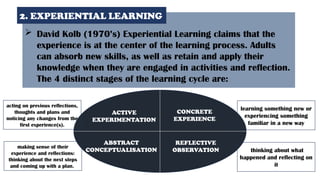
learning. (Kearsley, 2010).
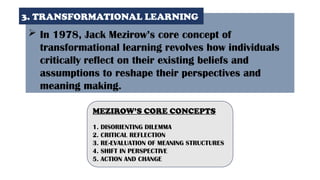
The term andragogy can be supposedly equivalent
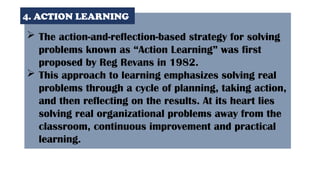
to the term pedagogy. Andragogy in Greek means
man-leading in comparison to pedagogy, which in
Greek means child-leading. However, it should be
noted that the term pedagogy has been used since
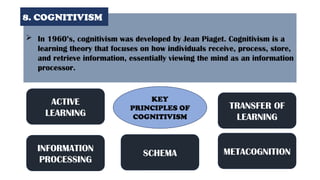
Ancient Greek times, while Alexander Kapp, a
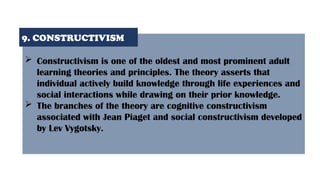
German Educator, first used the term andragogy in
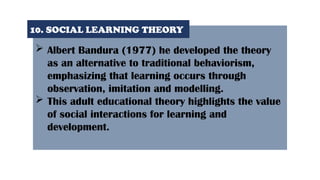
1833.
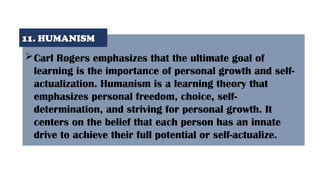
3.
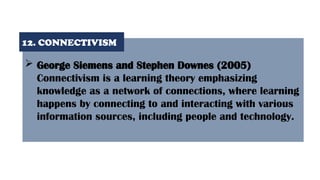
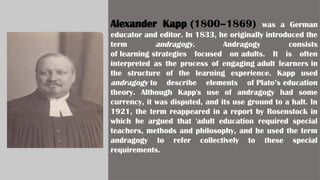
Alexander Kapp (1800–1869)was a German
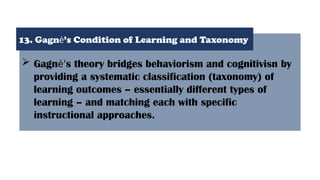
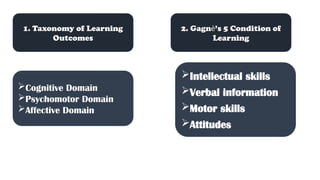
educator and editor. In 1833, he originally introduced the
term andragogy. Andragogy consists
of learning strategies focused on adults. It is often
interpreted as the process of engaging adult learners in
the structure of the learning experience. Kapp used
andragogy to describe elements of Plato’s education
theory. Although Kapp's use of andragogy had some
currency, it was disputed, and its use ground to a halt. In
1921, the term reappeared in a report by Rosenstock in
which he argued that 'adult education required special
teachers, methods and philosophy, and he used the term
andragogy to refer collectively to these special
requirements.
4.
Knowles’ 5 Assumption
ofAdult Learners
In 1980, Knowles made 4
assumption about the
characteristics of adult learners that
are different from the assumptions
about the characteristics of child
learners. In 1984, Knoles added the
5th
assumption,
Self-Concept
As a person matures
his/her self concept move
from one of being a
dependent personality
toward one of the being a
self-directed human being.
Readiness to Learn
As a person matures
his/her readiness to learn
becomes oriented
increasingly to the
developmental task of
his/her social roles.
Adult Learner
Experience
As a person matures
he/she accumulates a
growing reservoir of
experience that becomes
an increasing resource of
learning.
Orientation to Learning
As a person matures his/her
time perspective changes from
one of postponed application of
knowledge to immediacy of
application. As a result his/her
orientation toward learning shifts
from one of subject-centeredness
to one of problem centeredness.
Motivation to Learn
As a person matures the
motivation to learn is
internal (Knowles
1984:12).
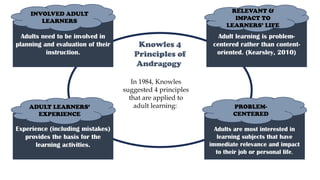
5.
Knowles 4
Principles of
Andragogy
In1984, Knowles
suggested 4 principles
that are applied to
adult learning:
Adults need to be involved in
planning and evaluation of their
instruction.
INVOLVED ADULT
LEARNERS
Adult learning is problem-
centered rather than content-
oriented. (Kearsley, 2010)
RELEVANT &
IMPACT TO
LEARNERS’ LIFE
Adults are most interested in
learning subjects that have
immediate relevance and impact
to their job or personal life.
PROBLEM-
CENTERED
Experience (including mistakes)
provides the basis for the
learning activities.
ADULT LEARNERS’
EXPERIENCE
6.
In 1968, MalcolmKnowles is credited with developing and
popularizing the term andragogy to describe the art and
science of adult learning.
Andragogy is the study of adult learning, as opposed to
pedagogy, which focuses on educating children. Andragogy
addresses the specific needs and characteristics of adult
learners.
Knowles theory emphasizes that adults are more likely to
learn when they see the practical implication of knowledge to
their real-world situations.
13 Adult Learning
Theories
1. ANDRAGOGY
7.
David Kolb(1970’s) Experiential Learning claims that the
experience is at the center of the learning process. Adults
can absorb new skills, as well as retain and apply their
knowledge when they are engaged in activities and reflection.
The 4 distinct stages of the learning cycle are:
2. EXPERIENTIAL LEARNING
CONCRETE
EXPERIENCE
REFLECTIVE
OBSERVATION
ACTIVE
EXPERIMENTATION
ABSTRACT
CONCEPTUALISATION
learning something new or
experiencing something
familiar in a new way
thinking about what
happened and reflecting on
it
acting on previous reflections,
thoughts and plans and
noticing any changes from the
first experience(s).
making sense of their
experience and reflections:
thinking about the next steps
and coming up with a plan.
8.
In 1978,Jack Mezirow’s core concept of
transformational learning revolves how individuals
critically reflect on their existing beliefs and
assumptions to reshape their perspectives and
meaning making.
3. TRANSFORMATIONAL LEARNING
MEZIROW’S CORE CONCEPTS
1. DISORIENTING DILEMMA
2. CRITICAL REFLECTION
3. RE-EVALUATION OF MEANING STRUCTURES
4. SHIFT IN PERSPECTIVE
5. ACTION AND CHANGE
9.
The action-and-reflection-basedstrategy for solving
problems known as “Action Learning” was first
proposed by Reg Revans in 1982.
This approach to learning emphasizes solving real
problems through a cycle of planning, taking action,
and then reflecting on the results. At its heart lies
solving real organizational problems away from the
classroom, continuous improvement and practical
learning.
4. ACTION LEARNING
10.
In 1997,D.R. Garrison’s self-directed learning theory
builds on educator Malcolm Knowles’ adult learning theory
principles and encourages students to take charge of their
education.
In this model, the learner takes the initiative in identifying
their own needs, goals, and resources and sets on a
learning journey, taking an active role in seeking and
applying knowledge.
5. SELF-DIRECTED LEARNING
11.
Learning throughreal-world examples and practical challenges is
a well-established adult education approach. Project-based
learning was introduced in 1897 by John Dewey, who called it
“learning by doing”.
6. PROJECT-BASED LEARNING
12.
Behaviorism, aprominent learning theory, was developed primarily by
John Watson and B.F Skinner. While Watson is often credited as the
“father” of behaviorism, Skinner also significantly contributed to its
development and application.
Watson argued that all behaviors are learned through environment
interactions.
Skinner’s work focused on operant conditioning, which involves
learning through the consequences of behaviors (rewards and
punishment). He also emphasized the role of environmental stimuli in
shaping behavior.
“ Teachers must learn how to teach …they need only to be taught
more effective ways of teaching.” – B.F. Skinner
7. BEHAVIORISM
13.
In 1960’s,cognitivism was developed by Jean Piaget. Cognitivism is a
learning theory that focuses on how individuals receive, process, store,
and retrieve information, essentially viewing the mind as an information
processor.
8. COGNITIVISM
KEY
PRINCIPLES OF
COGNITIVISM
ACTIVE
LEARNING
INFORMATION
PROCESSING
METACOGNITION
SCHEMA
TRANSFER OF
LEARNING
14.
Constructivism isone of the oldest and most prominent adult
learning theories and principles. The theory asserts that
individual actively build knowledge through life experiences and
social interactions while drawing on their prior knowledge.
The branches of the theory are cognitive constructivism
associated with Jean Piaget and social constructivism developed
by Lev Vygotsky.
9. CONSTRUCTIVISM
15.
Albert Bandura(1977) he developed the theory
as an alternative to traditional behaviorism,
emphasizing that learning occurs through
observation, imitation and modelling.
This adult educational theory highlights the value
of social interactions for learning and
development.
10. SOCIAL LEARNING THEORY
16.
Carl Rogers emphasizesthat the ultimate goal of
learning is the importance of personal growth and self-
actualization. Humanism is a learning theory that
emphasizes personal freedom, choice, self-
determination, and striving for personal growth. It
centers on the belief that each person has an innate
drive to achieve their full potential or self-actualize.
11. HUMANISM
17.
George Siemensand Stephen Downes (2005)
Connectivism is a learning theory emphasizing
knowledge as a network of connections, where learning
happens by connecting to and interacting with various
information sources, including people and technology.
12. CONNECTIVISM
18.
Gagnѐ’s theorybridges behaviorism and cognitivisn by
providing a systematic classification (taxonomy) of
learning outcomes – essentially different types of
learning – and matching each with specific
instructional approaches.
13. Gagnѐ’s Condition of Learning and Taxonomy
3. Gagnѐ’s 9Events of
Instruction
1. Gain attention.
2. Inform students of the objective.
3. Stimulate recall of prior learning.
4. Present the content.
5. Provide learning guidance.
6. Elicit performance (practice).
7. Provide feedback.
8. Assess performance.
9. Enhance retention and transfer to the job.
21.
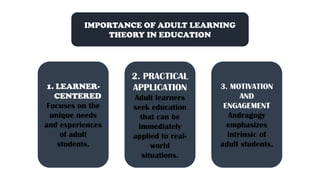
IMPORTANCE OF ADULTLEARNING
THEORY IN EDUCATION
1. LEARNER-
CENTERED
Focuses on the
unique needs
and experiences
of adult
students.
2. PRACTICAL
APPLICATION
Adult learners
seek education
that can be
immediately
applied to real-
world
situations.
3. MOTIVATION
AND
ENGAGEMENT
Andragogy
emphasizes
intrinsic of
adult students.
 Most read