Sanchita Garai, Sanjit Maiti & Deepak Chand Meena
Dairy Extension Division
ICAR-National Dairy Research Institute
Karnal-132001, Haryana
www.ndri.res.in
Sanchita.bckv@gmail.com
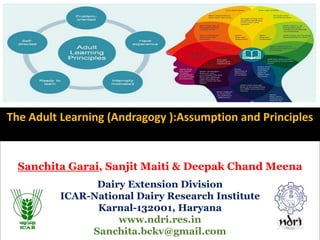
The Adult Learning (Andragogy ):Assumption and Principles
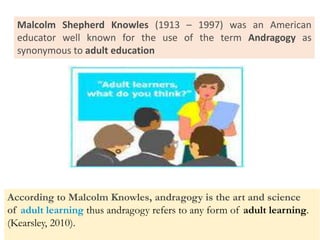
Malcolm Shepherd Knowles (1913 – 1997) was an American
educator well known for the use of the term Andragogy as
synonymous to adult education
According to Malcolm Knowles, andragogy is the art and science
of adult learning thus andragogy refers to any form of adult learning.
(Kearsley, 2010).
The term andragogy can be
supposedly equivalent to the term
pedagogy
Andragogy in Greek means man-
leading in comparison to pedagogy,
which in Greek means child-leading
 However, it should be noted that the term pedagogy
has been used since the Ancient Greek times, while
Alexander Kapp, a German educator, first used the
term andragogy in 1833
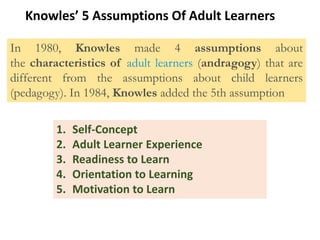
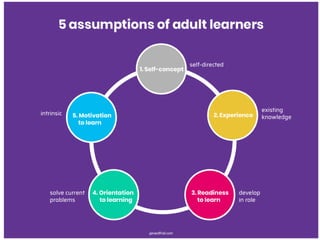
Knowles’ 5 Assumptions Of Adult Learners
In 1980, Knowles made 4 assumptions about
the characteristics of adult learners (andragogy) that are
different from the assumptions about child learners
(pedagogy). In 1984, Knowles added the 5th assumption
1. Self-Concept
2. Adult Learner Experience
3. Readiness to Learn
4. Orientation to Learning
5. Motivation to Learn
As a person matures his/her self concept moves from one of
being a dependent personality toward one of being a self-
directed human being
1. Self-Concept
Teachers, as (Merriam et al., 2007) and others assert, are stimulus
objects, attractive or repellent in their own right. By their very
presence, they have subtle but profound impact on students’ self-
concepts. The teacher’s task, therefore, is to behave in ways that
encourage positive perceptions in students regarding themselves
and their abilities.
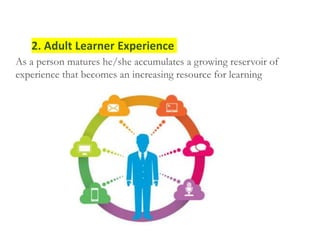
As a person matures he/she accumulates a growing reservoir of
experience that becomes an increasing resource for learning
2. Adult Learner Experience
3. Readiness to Learn
As a person matures his/her readiness to learn becomes oriented
increasingly to the developmental tasks of his/her social roles
Adults become ready to learn things they need to know and do
in order to cope effectively with real-life situations . Adults want
to learn what they can apply in the present, making training
focused on the future or that does not relate to their current
situations, less effective.
 As a person matures his/her time perspective changes from one
of postponed application of knowledge to immediacy of
application. As a result his/her orientation toward learning
shifts from one of subject- centeredness to one of problem
centeredness.
 They want to learn what will help them perform tasks or deal
with problems they confront in everyday situations and those
presented in the context of application to real-life (Knowles et
al., 2005; Merriam & Caffarella, 1999).
4. Orientation to Learning
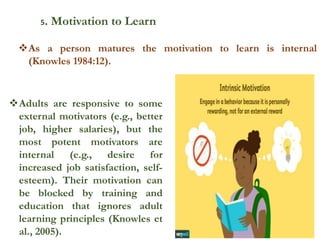
5. Motivation to Learn
Adults are responsive to some
external motivators (e.g., better
job, higher salaries), but the
most potent motivators are
internal (e.g., desire for
increased job satisfaction, self-
esteem). Their motivation can
be blocked by training and
education that ignores adult
learning principles (Knowles et
al., 2005).
As a person matures the motivation to learn is internal
(Knowles 1984:12).
Knowles’ 4 Principles Of Andragogy
In 1984, Knowles suggested 4 principles that are applied to adult
learning:
1. Adults need to be involved in the planning and evaluation of
their instruction.
2. Experience (including mistakes) provides the basis for the
learning activities.
3. Adults are most interested in learning subjects that have
immediate relevance and impact to their job or personal life.
4. Adult learning is problem-centered rather than content-
oriented. (Kearsley, 2010)
Adult learning

Adult learning

  • 2.
    Sanchita Garai, SanjitMaiti & Deepak Chand Meena Dairy Extension Division ICAR-National Dairy Research Institute Karnal-132001, Haryana www.ndri.res.in Sanchita.bckv@gmail.com The Adult Learning (Andragogy ):Assumption and Principles
  • 3.
    Malcolm Shepherd Knowles(1913 – 1997) was an American educator well known for the use of the term Andragogy as synonymous to adult education According to Malcolm Knowles, andragogy is the art and science of adult learning thus andragogy refers to any form of adult learning. (Kearsley, 2010).
  • 4.
    The term andragogycan be supposedly equivalent to the term pedagogy Andragogy in Greek means man- leading in comparison to pedagogy, which in Greek means child-leading  However, it should be noted that the term pedagogy has been used since the Ancient Greek times, while Alexander Kapp, a German educator, first used the term andragogy in 1833
  • 5.
    Knowles’ 5 AssumptionsOf Adult Learners In 1980, Knowles made 4 assumptions about the characteristics of adult learners (andragogy) that are different from the assumptions about child learners (pedagogy). In 1984, Knowles added the 5th assumption 1. Self-Concept 2. Adult Learner Experience 3. Readiness to Learn 4. Orientation to Learning 5. Motivation to Learn
  • 7.
    As a personmatures his/her self concept moves from one of being a dependent personality toward one of being a self- directed human being 1. Self-Concept Teachers, as (Merriam et al., 2007) and others assert, are stimulus objects, attractive or repellent in their own right. By their very presence, they have subtle but profound impact on students’ self- concepts. The teacher’s task, therefore, is to behave in ways that encourage positive perceptions in students regarding themselves and their abilities.
  • 8.
    As a personmatures he/she accumulates a growing reservoir of experience that becomes an increasing resource for learning 2. Adult Learner Experience
  • 9.
    3. Readiness toLearn As a person matures his/her readiness to learn becomes oriented increasingly to the developmental tasks of his/her social roles Adults become ready to learn things they need to know and do in order to cope effectively with real-life situations . Adults want to learn what they can apply in the present, making training focused on the future or that does not relate to their current situations, less effective.
  • 10.
     As aperson matures his/her time perspective changes from one of postponed application of knowledge to immediacy of application. As a result his/her orientation toward learning shifts from one of subject- centeredness to one of problem centeredness.  They want to learn what will help them perform tasks or deal with problems they confront in everyday situations and those presented in the context of application to real-life (Knowles et al., 2005; Merriam & Caffarella, 1999). 4. Orientation to Learning
  • 11.
    5. Motivation toLearn Adults are responsive to some external motivators (e.g., better job, higher salaries), but the most potent motivators are internal (e.g., desire for increased job satisfaction, self- esteem). Their motivation can be blocked by training and education that ignores adult learning principles (Knowles et al., 2005). As a person matures the motivation to learn is internal (Knowles 1984:12).
  • 12.
    Knowles’ 4 PrinciplesOf Andragogy In 1984, Knowles suggested 4 principles that are applied to adult learning: 1. Adults need to be involved in the planning and evaluation of their instruction. 2. Experience (including mistakes) provides the basis for the learning activities. 3. Adults are most interested in learning subjects that have immediate relevance and impact to their job or personal life. 4. Adult learning is problem-centered rather than content- oriented. (Kearsley, 2010)