ANDRAGOGY
Dr Shiva Shukla
Asst. Professor,
Central University of Punjab, Bathinda.
Andragogy: Concept and Meaning
• Etymology from Greek word Andr-Man & Agogos-Leader Of
• Method andTechniques ofTeaching Adults
• Malcom Knowles among first to identify that adult learning is different to
child learning and coined the term Andragogy
• Adult learning is a different process because they have more life
experience and are more capable than children
• Leonardo da Vinci, Socrates, Abraham Lincoln, Benjamin Franklin are
examples of self taught adult learners
Assumptions of Andragogy/Adult
Learner
Knowles identified characteristics of an adult learner that makes them different from child learners
a) Reason for learning: Learner is more inclined to learn when they are aware about what is it they are
learning hence learning outcome have to be disclosed in advance of the class
b) Self-Concept: Adults have self-concept of being accountable for themselves and learning is more
personal as learner is more matured and are naturally self directed and ownership of learning is high
c) Learner’s Experience: Learner have immense amount of experience before learning event and can
connect learning to their prior learning experience. Adult Learning Group is more Heterogenous
d) Readiness to Learn: it is more related to need to learn to enhance their societal roles and
responsibilities
e) Orientation to Learn: adult learners have more problem centred learning. The learning task should
include finding solutions
f) Motivation to Learn: Adults are most invested in learning as they have high motivation to learn and
this motivation increases with age and motivation is always intrinsic
Principles of Andragogy: Knowles
a) Involvement in the planning and evaluation of
instruction.
b) Experience should be the basis for the learning
activities including mistakes.
c) Subjects should have relevance and impact to their
immediate needs like professional or personal life.
d) Learning activity should be problem-centred rather
than content-centred.
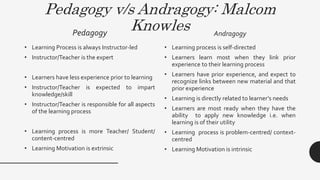
Pedagogy v/s Andragogy: Malcom
KnowlesPedagogy
• Learning Process is always Instructor-led
• Instructor/Teacher is the expert
• Learners have less experience prior to learning
• Instructor/Teacher is expected to impart
knowledge/skill
• Instructor/Teacher is responsible for all aspects
of the learning process
• Learning process is more Teacher/ Student/
content-centred
• Learning Motivation is extrinsic
Andragogy
• Learning process is self-directed
• Learners learn most when they link prior
experience to their learning process
• Learners have prior experience, and expect to
recognize links between new material and that
prior experience
• Learning is directly related to learner’s needs
• Learners are most ready when they have the
ability to apply new knowledge i.e. when
learning is of their utility
• Learning process is problem-centred/ context-
centred
• Learning Motivation is intrinsic
Self-Directed Learning(SDL) and
Andragogy
a) SDL aids in capacity building and development
b) Self-direction is an essential component in maturing process
c) SDL ensures learning experiences to be enriching as the resource for learner gets
complimented with the resources of experts
d) SDL assists in the readiness of the learner to cope with their life problems
e) SDL enables orientation of learning task to be problem-centred making it more
suitable forAndragogy
f) Self-direction is guaranteed when learners motivation is Intrinsic
g) Individuals who put effort in learning process tend to learn more then people who
wait for instructions
References:
• Blondy, L. C. (2007). Evaluation and application of andragogical
assumptions to the adult online learning environment. Journal of
Interactive Online Learning, 6, 116–130.
• Knowles, M. S. (1989). The making of an adult educator: An
autobiographical journey. San Francisco, CA: Jossey-Bass.
• Knowles, M. S., Holton III, E. F., & Swanson, R. A. (2005). The adult
learner: The definitive classic in adult education and human resource
development (6th ed.). San Diego, CA: Elsevier.

Andragogy

  • 1.
    ANDRAGOGY Dr Shiva Shukla Asst.Professor, Central University of Punjab, Bathinda.
  • 2.
    Andragogy: Concept andMeaning • Etymology from Greek word Andr-Man & Agogos-Leader Of • Method andTechniques ofTeaching Adults • Malcom Knowles among first to identify that adult learning is different to child learning and coined the term Andragogy • Adult learning is a different process because they have more life experience and are more capable than children • Leonardo da Vinci, Socrates, Abraham Lincoln, Benjamin Franklin are examples of self taught adult learners
  • 3.
    Assumptions of Andragogy/Adult Learner Knowlesidentified characteristics of an adult learner that makes them different from child learners a) Reason for learning: Learner is more inclined to learn when they are aware about what is it they are learning hence learning outcome have to be disclosed in advance of the class b) Self-Concept: Adults have self-concept of being accountable for themselves and learning is more personal as learner is more matured and are naturally self directed and ownership of learning is high c) Learner’s Experience: Learner have immense amount of experience before learning event and can connect learning to their prior learning experience. Adult Learning Group is more Heterogenous d) Readiness to Learn: it is more related to need to learn to enhance their societal roles and responsibilities e) Orientation to Learn: adult learners have more problem centred learning. The learning task should include finding solutions f) Motivation to Learn: Adults are most invested in learning as they have high motivation to learn and this motivation increases with age and motivation is always intrinsic
  • 4.
    Principles of Andragogy:Knowles a) Involvement in the planning and evaluation of instruction. b) Experience should be the basis for the learning activities including mistakes. c) Subjects should have relevance and impact to their immediate needs like professional or personal life. d) Learning activity should be problem-centred rather than content-centred.
  • 5.
    Pedagogy v/s Andragogy:Malcom KnowlesPedagogy • Learning Process is always Instructor-led • Instructor/Teacher is the expert • Learners have less experience prior to learning • Instructor/Teacher is expected to impart knowledge/skill • Instructor/Teacher is responsible for all aspects of the learning process • Learning process is more Teacher/ Student/ content-centred • Learning Motivation is extrinsic Andragogy • Learning process is self-directed • Learners learn most when they link prior experience to their learning process • Learners have prior experience, and expect to recognize links between new material and that prior experience • Learning is directly related to learner’s needs • Learners are most ready when they have the ability to apply new knowledge i.e. when learning is of their utility • Learning process is problem-centred/ context- centred • Learning Motivation is intrinsic
  • 6.
    Self-Directed Learning(SDL) and Andragogy a)SDL aids in capacity building and development b) Self-direction is an essential component in maturing process c) SDL ensures learning experiences to be enriching as the resource for learner gets complimented with the resources of experts d) SDL assists in the readiness of the learner to cope with their life problems e) SDL enables orientation of learning task to be problem-centred making it more suitable forAndragogy f) Self-direction is guaranteed when learners motivation is Intrinsic g) Individuals who put effort in learning process tend to learn more then people who wait for instructions
  • 7.
    References: • Blondy, L.C. (2007). Evaluation and application of andragogical assumptions to the adult online learning environment. Journal of Interactive Online Learning, 6, 116–130. • Knowles, M. S. (1989). The making of an adult educator: An autobiographical journey. San Francisco, CA: Jossey-Bass. • Knowles, M. S., Holton III, E. F., & Swanson, R. A. (2005). The adult learner: The definitive classic in adult education and human resource development (6th ed.). San Diego, CA: Elsevier.