A Constituent College of Yenepoya (Deemed to be University)
Naringana, Mangaluru
Introduction to Chromatography
Adsorption &Partition Chromatography
Ms.Sajini
Assistant professor
Dept of Pharmaceutical chemistry
Table of content
• Introduction
• Classification
• Basic principle and purpose
• Methodology
• Advantages
• Disadvantages
• Application
• Refernces
Introduction
• Chromatography is an analytical technique employed for the
purification and separation of organic and inorganic
substances.
• On the basis of hydrophobic interactions, Polarity, enzymes,
and net charges are separated by using chromatography.
• It is also found useful for the fractionation of complex
mixtures, the separation of closely related compounds, such as
isomers, and in the isolation of unstable substances.
• Greek: Khromatos- colour
• graphos-written
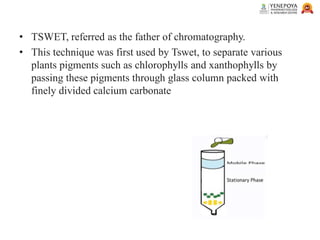
• TSWET, referred as the father of chromatography.
• This technique was first used by Tswet, to separate various
plants pigments such as chlorophylls and xanthophylls by
passing these pigments through glass column packed with
finely divided calcium carbonate
Purpose of chromatography
• Analytical: To determine the chemical composition of a
sample.
• Preparative: Used in the purification of a substance.
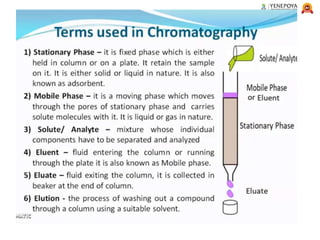
• The process of carrying the components out of the stationary
phase by the mobile phase.
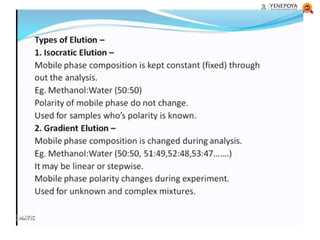
• Isocratic Elution: Constant mobile phase composition
throughout the run.
• Gradient Elution: Changing the composition of the mobile
phase during the run to improve separation efficiency.
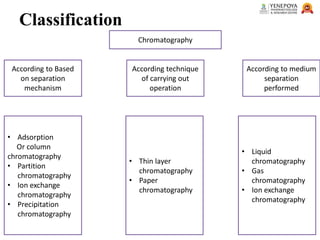
Classification
Chromatography
According to Based
on separation
mechanism
According to medium
separation
performed
According technique
of carrying out
operation
• Adsorption
Or column
chromatography
• Partition
chromatography
• Ion exchange
chromatography
• Precipitation
chromatography
• Liquid
chromatography
• Gas
chromatography
• Ion exchange
chromatography
• Thin layer
chromatography
• Paper
chromatography
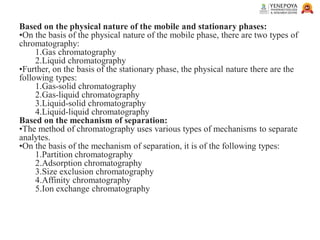
Based on the physical nature of the mobile and stationary phases:
•On the basis of the physical nature of the mobile phase, there are two types of
chromatography:
1.Gas chromatography
2.Liquid chromatography
•Further, on the basis of the stationary phase, the physical nature there are the
following types:
1.Gas-solid chromatography
2.Gas-liquid chromatography
3.Liquid-solid chromatography
4.Liquid-liquid chromatography
Based on the mechanism of separation:
•The method of chromatography uses various types of mechanisms to separate
analytes.
•On the basis of the mechanism of separation, it is of the following types:
1.Partition chromatography
2.Adsorption chromatography
3.Size exclusion chromatography
4.Affinity chromatography
5.Ion exchange chromatography
Based on the shape of the chromatographic bed:
On the basis of the chromatographic bed, there are the following
two types of chromatography-
1.Planar chromatography.
2.Column chromatography.
In planar chromatography
Where the stationary phase is either coated on the plate or it is a
piece of paper.
It is not packed in a column
Ex: paper chromatography, TLC, HPTLC
Column chromatography
Where the stationary phase is packed in a column
Ex: liquid chromatography, HPTLC, GC
Principle of chromatography
• The sample to be examine or analyzing is termed as solute or
analyte is allowed to interact or react with two immiscible
phases-
• Mobile phase
• Stationary phase
• The stationary phase which may be a solid is or a liquid
supported on a solid, which is immobile it means it does not
move.
• The mobile phase migrates the sample through stationary
phase.
• The mobile phase may be either liquid or gas.
• All chromatographic methods involve separation of mobile
phase through a stationary phase.
Adsorption(column) chromatography
• CC may be defined as a separation process involving the uniform
percolation of a liquid solute through a column packed with finely
divided material.
• The technique in which the stationary phase is solid( alumina or
silica) and the mobile phase is either a gas or liquid is known as
adsorption chromatography
• If the liquid is used as a stationary phase, then it is Partition CC
(liquid–liquid chromatography)
• Separation takes place when one component of a two-component
mixture is more strongly adsorbed than the other by the solid
stationary phase
• Adsorption is a surface phenomenon
• The degree of separation depends upon the surface area of the
adsorbent
Principle
• This technique is based on the principle of differential
adsorption, where different molecules in a mixture have
different affinities with the adsorbent present in the stationary
phase.
• The molecules having higher affinity remain adsorbed for a
longer time, decreasing their speed of movement through the
column.
• However, the molecules with lower affinity move faster, thus
allowing the molecules to be separated into different fractions.
Here, the stationary phase in the column
chromatography, also termed the adsorbent, is a
Solid (mostly silica), and the mobile phase is a liquid
that allows the molecules to move through the column
smoothly. The type of interaction between the stationary
phase (adsorbent) & the solute is reversible in nature.
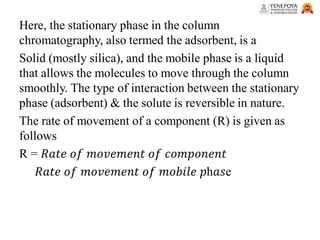
The rate of movement of a component (R) is given as
follows
R = 𝑅𝑎𝑡𝑒 𝑜𝑓 𝑚𝑜𝑣𝑒𝑚𝑒𝑛𝑡 𝑜𝑓 𝑐𝑜𝑚𝑝𝑜𝑛𝑒𝑛𝑡
𝑅𝑎𝑡𝑒 𝑜𝑓 𝑚𝑜𝑣𝑒𝑚𝑒𝑛𝑡 𝑜𝑓 𝑚𝑜𝑏𝑖𝑙𝑒 𝑝h𝑎𝑠e
• Normal-phase Chromatography: The stationary phase is
polar (e.g., silica gel, alumina), and the mobile phase is non-
polar. Non-polar compounds elute faster.
• Reverse-phase Chromatography: The stationary phase is
non-polar (e.g., C18-bonded silica), and the mobile phase is
polar. Polar compounds elute faster.
Adsorbent
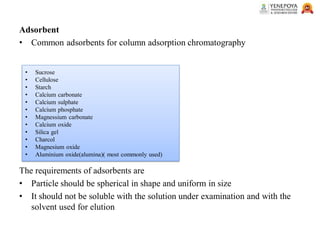
• Common adsorbents for column adsorption chromatography
The requirements of adsorbents are
• Particle should be spherical in shape and uniform in size
• It should not be soluble with the solution under examination and with the
solvent used for elution
• Sucrose
• Cellulose
• Starch
• Calcium carbonate
• Calcium sulphate
• Calcium phosphate
• Magnessium carbonate
• Calcium oxide
• Silica gel
• Charcol
• Magnesium oxide
• Aluminium oxide(alumina)( most commonly used)
• It is desirable to be colorless
• It should be chemically inert with the mixture under analysis
• Particle size of commercially available grade in the range of
50-200μm which allows for reasonable flow under the force of
gravity, and even packaging of the adsorbent during column
packaging
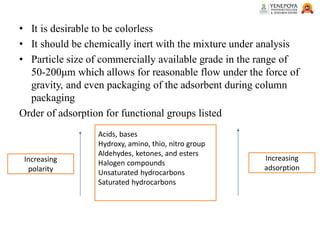
Order of adsorption for functional groups listed
Acids, bases
Hydroxy, amino, thio, nitro group
Aldehydes, ketones, and esters
Halogen compounds
Unsaturated hydrocarbons
Saturated hydrocarbons
Increasing
adsorption
Increasing
polarity
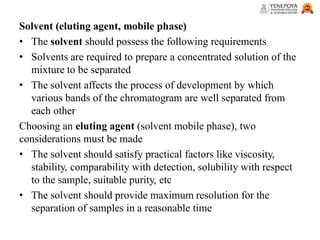
Solvent (eluting agent, mobile phase)
• The solvent should possess the following requirements
• Solvents are required to prepare a concentrated solution of the
mixture to be separated
• The solvent affects the process of development by which
various bands of the chromatogram are well separated from
each other
Choosing an eluting agent (solvent mobile phase), two
considerations must be made
• The solvent should satisfy practical factors like viscosity,
stability, comparability with detection, solubility with respect
to the sample, suitable purity, etc
• The solvent should provide maximum resolution for the
separation of samples in a reasonable time
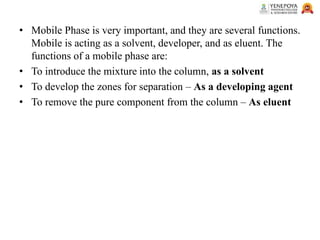
• Mobile Phase is very important, and they are several functions.
Mobile is acting as a solvent, developer, and as eluent. The
functions of a mobile phase are:
• To introduce the mixture into the column, as a solvent
• To develop the zones for separation – As a developing agent
• To remove the pure component from the column – As eluent
• Polarity plays an important role in adsorption chromatography
• A polar compound held in the stationary phase, and a non-
polar compound tend to move forward in the mobile phase
• In chromatography, benzene is more polar solvent than
cyclohexane, yet neither as a dipole moment, polar solvents
are good for desorption and elution
• Polar solvents like ethyl alcohol hold the solute fast separation
solute from these solvents by adsorption is more difficult than
nonpolar solvent petroleum, ether, and CCl4
• A grouping of solvents in order of chromatographic strength is
known as elutropic series
Light petroleum (petroleum ether,
hexane, heptane)
Cyclohexane
Carbon tetra chloride
Toluene
Benzene
Chloroform
Ehyl ether
Ethyl acetate
Acetone
N-propanol
Ethanol
Methanol’
Water
Pyridine
Organic acids
Inorganic acids and bases
Increasing
eluting
power
Column
• Function: support the stationary phase, i.e, adsorbent or
stationary liquid on an inert support
• A column for chromatographic use consists of 2 phases
confined in a space that is usually cylindrical and with an axial
length much greater than the diameter, i.e tube
• The tube is usually of glass, of constant cross-sectional area
and is mounted with the shaft axis vertical
• Various accessories are attached to the top and bottom of the
column for maintenance of the elution process and for the
collection of chromatographic substances
• It consists of a glass tube with a porous septum at the bottom
Preparation Of Column
• The bottom portion of the column is packed with cotton wool
or glass wool or asbestos pad, above which the column of
adsorbent is packed.
• A Whatman filter paper disc can also be used.
• After packing the column with the adsorbent, a similar paper
disc is kept on the top to avoid the disturbance of adsorbent
layer during the introduction of sample or mobile phase.
• Disturbance in the layer of adsorbent will lead to irregular
bands of separation.
• There are two types of preparing the column, which are called
packing techniques. They are:
1. Dry packing technique
2. Wet packing technique
• Dry packing is the method of choice for a microscale column.
The disadvantages of this technique are:
• Air bubbles are entrapped between the solvent & stationary
phase.
• Column is not packed uniformly.
• Cracks appear in the adsorbent present in the column.
Wet packing method (slurry method)
• The slurry method is often used for macro scale separations.
• Combine the solid stationary phase with a small amount of
nonpolar solvent in a beaker.
• Thoroughly mix the two until a consistent paste is formed, but
is still capable of flowing.
• Never allow your column to run dry.
• It is allowed to settle under gravity until a column of the
desired height is obtained.
Introduction of the sample
Wet application
• Dissolve the sample in the initial mobile phase and apply by
pipette to the top of the column.
• This is very good method but in most of cases the
samples are not soluble in the initial mobile phase.
Dry loading
• Dissolve sample in any volatile solvent.
• The sample solution is then adsorbed on small weight of
adsorbent and the solvent is allowed to evaporate.
Developmental technique
• By elution technique, the individual components are separated
out from the column.
• It can be achieved by two techniques:
• Isocratic elution technique: Same solvent composition or
solvent of same polarity is used throughout the process of
separation.
• Eg. Use of chloroform alone or Pet.ether: Benzene = 1:1 only,
etc.
• Gradient elution technique: Solvents of gradually ↑
(increasing) polarity or ↑ (increasing)
• elution strength are used during the process of separation.
• E.g. initially benzene, then chloroform, then ethyl acetate then
chloroform
Detection of compounds
• If the mixture to be separated contains colored compounds, then
monitoring the column is very simple.
• The colored bands will move down the column along with the
solvent and as they approach the end of the column, collect the
colors in individual containers.
• However, most organic molecules are colorless.
• To detect the components which are colorless, several techniques
depending on the properties absorption of radiations, refractive
index, TLC, fluorescence etc. are used
Recovery ofcompounds
• Recovery is done by collecting different fractions of mobile
phase of equal volume like 10ml, 20ml etc or unequal volume.
They can also be collected time wise i.e. a fraction every 10 or
20 minutes etc.
• Similar fractions are mixed so that the bulk of the compound
of each type is obtained in a pure form. If a fraction still
contains several components, it can be resolved by using
another column.
Advantages
• Any type of mixture can be separated by column
chromatography.
• Any quantity of the mixture can also be separated (µg to mg of
substance).
• Wider choice of mobile phase.
• In preparative type, the sample can be separated and reused.
• Automation is possible.
Disadvantages
• Time-consuming method
• More amounts of solvents are required which may be
expensive.
• Automation makes the technique more complicated
and costly.
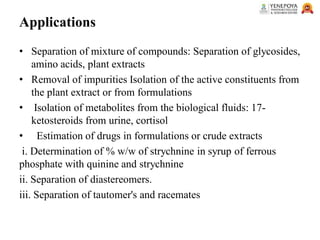
Applications
• Separation of mixture of compounds: Separation of glycosides,
amino acids, plant extracts
• Removal of impurities Isolation of the active constituents from
the plant extract or from formulations
• Isolation of metabolites from the biological fluids: 17-
ketosteroids from urine, cortisol
• Estimation of drugs in formulations or crude extracts
i. Determination of % w/w of strychnine in syrup of ferrous
phosphate with quinine and strychnine
ii. Separation of diastereomers.
iii. Separation of tautomer's and racemates
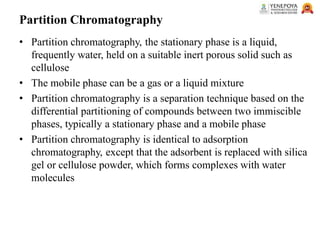
Partition Chromatography
• Partition chromatography, the stationary phase is a liquid,
frequently water, held on a suitable inert porous solid such as
cellulose
• The mobile phase can be a gas or a liquid mixture
• Partition chromatography is a separation technique based on the
differential partitioning of compounds between two immiscible
phases, typically a stationary phase and a mobile phase
• Partition chromatography is identical to adsorption
chromatography, except that the adsorbent is replaced with silica
gel or cellulose powder, which forms complexes with water
molecules
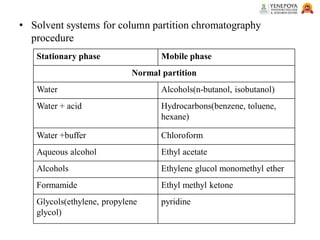
• Solvent systems for column partition chromatography
procedure
Stationary phase Mobile phase
Normal partition
Water Alcohols(n-butanol, isobutanol)
Water + acid Hydrocarbons(benzene, toluene,
hexane)
Water +buffer Chloroform
Aqueous alcohol Ethyl acetate
Alcohols Ethylene glucol monomethyl ether
Formamide Ethyl methyl ketone
Glycols(ethylene, propylene
glycol)
pyridine
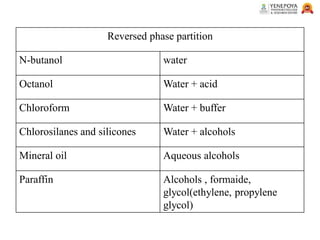
Reversed phase partition
N-butanol water
Octanol Water + acid
Chloroform Water + buffer
Chlorosilanes and silicones Water + alcohols
Mineral oil Aqueous alcohols
Paraffin Alcohols , formaide,
glycol(ethylene, propylene
glycol)
Methodology
Stationary phase
Silica gel :
The most widely used solid support in partition chromatography
It must first be deactivated by impregnating it with water or some
polar solvent
Kieselguhr or diatomaceous earth is available in several different
grades
It is used as support in reverse-phase chromatography
Cellulose: in the powdered form provides the advantage that it is
column packing which duplicates the sheet method, paper
chromatography
Cellulose is more often used where a large quantity of samples needs
to be separated
• Impregnating the support
• Stationary liquid phase is introduced onto the support prior to
packing the column
• Several different techniques used for impregnating the
support and its depends on several factors
• Nature of inert support
• Nature, kind, and amount of stationary liquid phase required
• mixing the support and the liquid
intimately in a motor and pestle
• Impregnated powder should be
free flowing not wet
• also possible to prepare a column
of support and pass the stationary
liquid through the column until
the support is evenly coated with
the liquid
Reverse phase support
Dissolve stationary liquid in a
volatile solvent and support is added
to the solution
Volatile solvent is removed by
evaporation leaving the support
uniformly coated
Mobile phase (eluting agent)
• In partition chromatography, the elution technique is favored
over displacement or frontal analysis
• The mobile phase may be a pure solvent or a mixture of
solvents that are at least partially miscible with the stationary
phase
• In general, molecules that are more soluble in the mobile
phase move faster than those that are less soluble
• The more soluble the molecule is in the stationary phase, the
more slowly it will move down the column
Detection of column effluents
• Column experiment is conducted, and the effluent (the liquid
exiting the column) is collected in separate fractions.
• These fractions are gathered in individual containers, with the
collection process often automated by a fraction collector
• This device is programmed to collect a specific volume of the
effluent in each container, and once one container is full, it
automatically switches to the next empty one.
• To analyze the separation, the chromatogram (a graphical
representation of the separation) is generated.
• The peaks on the chromatogram correspond to different
components of the mixture being separated.
• In chromatography, a detector is used to identify and quantify
the components of a mixture as they are separated by the
chromatographic process.
• In general 2 types of detection devices are widely used
Bulk property detector
Measure a change in some
overall physical property in
the mobile phase as it emerges
from the column
Ex: refractive index
conductance
Solute property detector
Sensitive to changes in a
physical property of a solute
as it emerges from the
column in the mobile phase
Ex: uv-visible absorption
Advantages
• Inexpensive and straightforward separation technique.
• The partition chromatography method can be used to isolate
both organic and inorganic substances.
• Time is saved since this procedure produces accurate findings,
is highly effective, and separates compounds quickly.
• Partition chromatography offers better selectivity since it is
simple to alter the mobile phase.
Disadvantages
• Sometimes the high volume of the mobile phase is required for
separation.
• Data storage is limited in several partition chromatography
applications.
• Automation is making it more difficult and costly.
Application
Drug Purification and Isolation:
Partition chromatography is employed to achieve high purity
levels necessary for safe and effective drug formulations.
Pharmacokinetic Studies:
Partition chromatography is used to analyze biological samples
(e.g., blood, urine) to track drug levels in the body over time.
This helps in determining the drug's pharmacokinetics and
optimizing dosage forms.
• Separation of Enantiomers:
• Natural Product Drug Discovery: Partition chromatography
is used to separate, isolate, and identify bioactive compounds
from natural sources
• Identification and Characterization of Metabolites:
Partition chromatography is used to separate and identify these
metabolites from biological fluids, helping researchers
understand the drug’s pharmacodynamics and potential side
effects.
References
B. K. Sharma, Instrumental Methods of Chemical
Analysis-Twenty Seventh Edition; 2011
Comprehensive Guide on Adsorption and Partition Chromatography Techniques

Comprehensive Guide on Adsorption and Partition Chromatography Techniques

  • 1.
    A Constituent Collegeof Yenepoya (Deemed to be University) Naringana, Mangaluru Introduction to Chromatography Adsorption &Partition Chromatography Ms.Sajini Assistant professor Dept of Pharmaceutical chemistry
  • 2.
    Table of content •Introduction • Classification • Basic principle and purpose • Methodology • Advantages • Disadvantages • Application • Refernces
  • 3.
    Introduction • Chromatography isan analytical technique employed for the purification and separation of organic and inorganic substances. • On the basis of hydrophobic interactions, Polarity, enzymes, and net charges are separated by using chromatography. • It is also found useful for the fractionation of complex mixtures, the separation of closely related compounds, such as isomers, and in the isolation of unstable substances. • Greek: Khromatos- colour • graphos-written
  • 4.
    • TSWET, referredas the father of chromatography. • This technique was first used by Tswet, to separate various plants pigments such as chlorophylls and xanthophylls by passing these pigments through glass column packed with finely divided calcium carbonate
  • 5.
    Purpose of chromatography •Analytical: To determine the chemical composition of a sample. • Preparative: Used in the purification of a substance.
  • 7.
    • The processof carrying the components out of the stationary phase by the mobile phase. • Isocratic Elution: Constant mobile phase composition throughout the run. • Gradient Elution: Changing the composition of the mobile phase during the run to improve separation efficiency.
  • 9.
    Classification Chromatography According to Based onseparation mechanism According to medium separation performed According technique of carrying out operation • Adsorption Or column chromatography • Partition chromatography • Ion exchange chromatography • Precipitation chromatography • Liquid chromatography • Gas chromatography • Ion exchange chromatography • Thin layer chromatography • Paper chromatography
  • 10.
    Based on thephysical nature of the mobile and stationary phases: •On the basis of the physical nature of the mobile phase, there are two types of chromatography: 1.Gas chromatography 2.Liquid chromatography •Further, on the basis of the stationary phase, the physical nature there are the following types: 1.Gas-solid chromatography 2.Gas-liquid chromatography 3.Liquid-solid chromatography 4.Liquid-liquid chromatography Based on the mechanism of separation: •The method of chromatography uses various types of mechanisms to separate analytes. •On the basis of the mechanism of separation, it is of the following types: 1.Partition chromatography 2.Adsorption chromatography 3.Size exclusion chromatography 4.Affinity chromatography 5.Ion exchange chromatography
  • 11.
    Based on theshape of the chromatographic bed: On the basis of the chromatographic bed, there are the following two types of chromatography- 1.Planar chromatography. 2.Column chromatography. In planar chromatography Where the stationary phase is either coated on the plate or it is a piece of paper. It is not packed in a column Ex: paper chromatography, TLC, HPTLC Column chromatography Where the stationary phase is packed in a column Ex: liquid chromatography, HPTLC, GC
  • 12.
    Principle of chromatography •The sample to be examine or analyzing is termed as solute or analyte is allowed to interact or react with two immiscible phases- • Mobile phase • Stationary phase • The stationary phase which may be a solid is or a liquid supported on a solid, which is immobile it means it does not move. • The mobile phase migrates the sample through stationary phase. • The mobile phase may be either liquid or gas. • All chromatographic methods involve separation of mobile phase through a stationary phase.
  • 13.
    Adsorption(column) chromatography • CCmay be defined as a separation process involving the uniform percolation of a liquid solute through a column packed with finely divided material. • The technique in which the stationary phase is solid( alumina or silica) and the mobile phase is either a gas or liquid is known as adsorption chromatography • If the liquid is used as a stationary phase, then it is Partition CC (liquid–liquid chromatography) • Separation takes place when one component of a two-component mixture is more strongly adsorbed than the other by the solid stationary phase • Adsorption is a surface phenomenon • The degree of separation depends upon the surface area of the adsorbent
  • 14.
    Principle • This techniqueis based on the principle of differential adsorption, where different molecules in a mixture have different affinities with the adsorbent present in the stationary phase. • The molecules having higher affinity remain adsorbed for a longer time, decreasing their speed of movement through the column. • However, the molecules with lower affinity move faster, thus allowing the molecules to be separated into different fractions.
  • 15.
    Here, the stationaryphase in the column chromatography, also termed the adsorbent, is a Solid (mostly silica), and the mobile phase is a liquid that allows the molecules to move through the column smoothly. The type of interaction between the stationary phase (adsorbent) & the solute is reversible in nature. The rate of movement of a component (R) is given as follows R = 𝑅𝑎𝑡𝑒 𝑜𝑓 𝑚𝑜𝑣𝑒𝑚𝑒𝑛𝑡 𝑜𝑓 𝑐𝑜𝑚𝑝𝑜𝑛𝑒𝑛𝑡 𝑅𝑎𝑡𝑒 𝑜𝑓 𝑚𝑜𝑣𝑒𝑚𝑒𝑛𝑡 𝑜𝑓 𝑚𝑜𝑏𝑖𝑙𝑒 𝑝h𝑎𝑠e
  • 16.
    • Normal-phase Chromatography:The stationary phase is polar (e.g., silica gel, alumina), and the mobile phase is non- polar. Non-polar compounds elute faster. • Reverse-phase Chromatography: The stationary phase is non-polar (e.g., C18-bonded silica), and the mobile phase is polar. Polar compounds elute faster.
  • 17.
    Adsorbent • Common adsorbentsfor column adsorption chromatography The requirements of adsorbents are • Particle should be spherical in shape and uniform in size • It should not be soluble with the solution under examination and with the solvent used for elution • Sucrose • Cellulose • Starch • Calcium carbonate • Calcium sulphate • Calcium phosphate • Magnessium carbonate • Calcium oxide • Silica gel • Charcol • Magnesium oxide • Aluminium oxide(alumina)( most commonly used)
  • 18.
    • It isdesirable to be colorless • It should be chemically inert with the mixture under analysis • Particle size of commercially available grade in the range of 50-200μm which allows for reasonable flow under the force of gravity, and even packaging of the adsorbent during column packaging Order of adsorption for functional groups listed Acids, bases Hydroxy, amino, thio, nitro group Aldehydes, ketones, and esters Halogen compounds Unsaturated hydrocarbons Saturated hydrocarbons Increasing adsorption Increasing polarity
  • 19.
    Solvent (eluting agent,mobile phase) • The solvent should possess the following requirements • Solvents are required to prepare a concentrated solution of the mixture to be separated • The solvent affects the process of development by which various bands of the chromatogram are well separated from each other Choosing an eluting agent (solvent mobile phase), two considerations must be made • The solvent should satisfy practical factors like viscosity, stability, comparability with detection, solubility with respect to the sample, suitable purity, etc • The solvent should provide maximum resolution for the separation of samples in a reasonable time
  • 20.
    • Mobile Phaseis very important, and they are several functions. Mobile is acting as a solvent, developer, and as eluent. The functions of a mobile phase are: • To introduce the mixture into the column, as a solvent • To develop the zones for separation – As a developing agent • To remove the pure component from the column – As eluent
  • 21.
    • Polarity playsan important role in adsorption chromatography • A polar compound held in the stationary phase, and a non- polar compound tend to move forward in the mobile phase • In chromatography, benzene is more polar solvent than cyclohexane, yet neither as a dipole moment, polar solvents are good for desorption and elution • Polar solvents like ethyl alcohol hold the solute fast separation solute from these solvents by adsorption is more difficult than nonpolar solvent petroleum, ether, and CCl4
  • 22.
    • A groupingof solvents in order of chromatographic strength is known as elutropic series Light petroleum (petroleum ether, hexane, heptane) Cyclohexane Carbon tetra chloride Toluene Benzene Chloroform Ehyl ether Ethyl acetate Acetone N-propanol Ethanol Methanol’ Water Pyridine Organic acids Inorganic acids and bases Increasing eluting power
  • 23.
    Column • Function: supportthe stationary phase, i.e, adsorbent or stationary liquid on an inert support • A column for chromatographic use consists of 2 phases confined in a space that is usually cylindrical and with an axial length much greater than the diameter, i.e tube • The tube is usually of glass, of constant cross-sectional area and is mounted with the shaft axis vertical • Various accessories are attached to the top and bottom of the column for maintenance of the elution process and for the collection of chromatographic substances • It consists of a glass tube with a porous septum at the bottom
  • 24.
    Preparation Of Column •The bottom portion of the column is packed with cotton wool or glass wool or asbestos pad, above which the column of adsorbent is packed. • A Whatman filter paper disc can also be used. • After packing the column with the adsorbent, a similar paper disc is kept on the top to avoid the disturbance of adsorbent layer during the introduction of sample or mobile phase. • Disturbance in the layer of adsorbent will lead to irregular bands of separation.
  • 25.
    • There aretwo types of preparing the column, which are called packing techniques. They are: 1. Dry packing technique 2. Wet packing technique • Dry packing is the method of choice for a microscale column. The disadvantages of this technique are: • Air bubbles are entrapped between the solvent & stationary phase. • Column is not packed uniformly. • Cracks appear in the adsorbent present in the column.
  • 26.
    Wet packing method(slurry method) • The slurry method is often used for macro scale separations. • Combine the solid stationary phase with a small amount of nonpolar solvent in a beaker. • Thoroughly mix the two until a consistent paste is formed, but is still capable of flowing. • Never allow your column to run dry. • It is allowed to settle under gravity until a column of the desired height is obtained.
  • 27.
    Introduction of thesample Wet application • Dissolve the sample in the initial mobile phase and apply by pipette to the top of the column. • This is very good method but in most of cases the samples are not soluble in the initial mobile phase. Dry loading • Dissolve sample in any volatile solvent. • The sample solution is then adsorbed on small weight of adsorbent and the solvent is allowed to evaporate.
  • 28.
    Developmental technique • Byelution technique, the individual components are separated out from the column. • It can be achieved by two techniques: • Isocratic elution technique: Same solvent composition or solvent of same polarity is used throughout the process of separation. • Eg. Use of chloroform alone or Pet.ether: Benzene = 1:1 only, etc. • Gradient elution technique: Solvents of gradually ↑ (increasing) polarity or ↑ (increasing) • elution strength are used during the process of separation. • E.g. initially benzene, then chloroform, then ethyl acetate then chloroform
  • 29.
    Detection of compounds •If the mixture to be separated contains colored compounds, then monitoring the column is very simple. • The colored bands will move down the column along with the solvent and as they approach the end of the column, collect the colors in individual containers. • However, most organic molecules are colorless. • To detect the components which are colorless, several techniques depending on the properties absorption of radiations, refractive index, TLC, fluorescence etc. are used
  • 30.
    Recovery ofcompounds • Recoveryis done by collecting different fractions of mobile phase of equal volume like 10ml, 20ml etc or unequal volume. They can also be collected time wise i.e. a fraction every 10 or 20 minutes etc. • Similar fractions are mixed so that the bulk of the compound of each type is obtained in a pure form. If a fraction still contains several components, it can be resolved by using another column.
  • 31.
    Advantages • Any typeof mixture can be separated by column chromatography. • Any quantity of the mixture can also be separated (µg to mg of substance). • Wider choice of mobile phase. • In preparative type, the sample can be separated and reused. • Automation is possible.
  • 32.
    Disadvantages • Time-consuming method •More amounts of solvents are required which may be expensive. • Automation makes the technique more complicated and costly.
  • 33.
    Applications • Separation ofmixture of compounds: Separation of glycosides, amino acids, plant extracts • Removal of impurities Isolation of the active constituents from the plant extract or from formulations • Isolation of metabolites from the biological fluids: 17- ketosteroids from urine, cortisol • Estimation of drugs in formulations or crude extracts i. Determination of % w/w of strychnine in syrup of ferrous phosphate with quinine and strychnine ii. Separation of diastereomers. iii. Separation of tautomer's and racemates
  • 34.
    Partition Chromatography • Partitionchromatography, the stationary phase is a liquid, frequently water, held on a suitable inert porous solid such as cellulose • The mobile phase can be a gas or a liquid mixture • Partition chromatography is a separation technique based on the differential partitioning of compounds between two immiscible phases, typically a stationary phase and a mobile phase • Partition chromatography is identical to adsorption chromatography, except that the adsorbent is replaced with silica gel or cellulose powder, which forms complexes with water molecules
  • 35.
    • Solvent systemsfor column partition chromatography procedure Stationary phase Mobile phase Normal partition Water Alcohols(n-butanol, isobutanol) Water + acid Hydrocarbons(benzene, toluene, hexane) Water +buffer Chloroform Aqueous alcohol Ethyl acetate Alcohols Ethylene glucol monomethyl ether Formamide Ethyl methyl ketone Glycols(ethylene, propylene glycol) pyridine
  • 36.
    Reversed phase partition N-butanolwater Octanol Water + acid Chloroform Water + buffer Chlorosilanes and silicones Water + alcohols Mineral oil Aqueous alcohols Paraffin Alcohols , formaide, glycol(ethylene, propylene glycol)
  • 37.
    Methodology Stationary phase Silica gel: The most widely used solid support in partition chromatography It must first be deactivated by impregnating it with water or some polar solvent Kieselguhr or diatomaceous earth is available in several different grades It is used as support in reverse-phase chromatography Cellulose: in the powdered form provides the advantage that it is column packing which duplicates the sheet method, paper chromatography Cellulose is more often used where a large quantity of samples needs to be separated
  • 38.
    • Impregnating thesupport • Stationary liquid phase is introduced onto the support prior to packing the column • Several different techniques used for impregnating the support and its depends on several factors • Nature of inert support • Nature, kind, and amount of stationary liquid phase required • mixing the support and the liquid intimately in a motor and pestle • Impregnated powder should be free flowing not wet • also possible to prepare a column of support and pass the stationary liquid through the column until the support is evenly coated with the liquid Reverse phase support Dissolve stationary liquid in a volatile solvent and support is added to the solution Volatile solvent is removed by evaporation leaving the support uniformly coated
  • 39.
    Mobile phase (elutingagent) • In partition chromatography, the elution technique is favored over displacement or frontal analysis • The mobile phase may be a pure solvent or a mixture of solvents that are at least partially miscible with the stationary phase • In general, molecules that are more soluble in the mobile phase move faster than those that are less soluble • The more soluble the molecule is in the stationary phase, the more slowly it will move down the column
  • 40.
    Detection of columneffluents • Column experiment is conducted, and the effluent (the liquid exiting the column) is collected in separate fractions. • These fractions are gathered in individual containers, with the collection process often automated by a fraction collector • This device is programmed to collect a specific volume of the effluent in each container, and once one container is full, it automatically switches to the next empty one. • To analyze the separation, the chromatogram (a graphical representation of the separation) is generated. • The peaks on the chromatogram correspond to different components of the mixture being separated.
  • 41.
    • In chromatography,a detector is used to identify and quantify the components of a mixture as they are separated by the chromatographic process. • In general 2 types of detection devices are widely used Bulk property detector Measure a change in some overall physical property in the mobile phase as it emerges from the column Ex: refractive index conductance Solute property detector Sensitive to changes in a physical property of a solute as it emerges from the column in the mobile phase Ex: uv-visible absorption
  • 42.
    Advantages • Inexpensive andstraightforward separation technique. • The partition chromatography method can be used to isolate both organic and inorganic substances. • Time is saved since this procedure produces accurate findings, is highly effective, and separates compounds quickly. • Partition chromatography offers better selectivity since it is simple to alter the mobile phase.
  • 43.
    Disadvantages • Sometimes thehigh volume of the mobile phase is required for separation. • Data storage is limited in several partition chromatography applications. • Automation is making it more difficult and costly.
  • 44.
    Application Drug Purification andIsolation: Partition chromatography is employed to achieve high purity levels necessary for safe and effective drug formulations. Pharmacokinetic Studies: Partition chromatography is used to analyze biological samples (e.g., blood, urine) to track drug levels in the body over time. This helps in determining the drug's pharmacokinetics and optimizing dosage forms.
  • 45.
    • Separation ofEnantiomers: • Natural Product Drug Discovery: Partition chromatography is used to separate, isolate, and identify bioactive compounds from natural sources • Identification and Characterization of Metabolites: Partition chromatography is used to separate and identify these metabolites from biological fluids, helping researchers understand the drug’s pharmacodynamics and potential side effects.
  • 46.
    References B. K. Sharma,Instrumental Methods of Chemical Analysis-Twenty Seventh Edition; 2011