Jeneesha Jude
MSc .chemistry
 Useful method for the separation and
purification of both solids and liquids .
 Solid – liquid technique
 stationary phase – solid
 Mobile phase – liquid
Principle
 Adsorption
 Mixture of compounds dissolved in
mobile phase is introduced into the
column .
 Separation occurs because of the
different rates at which the components
are carried over the stationary phase by
the mobile phase
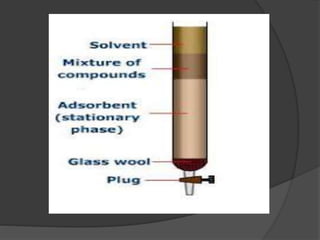
 Adsorption column chromatography , the
adsorbent packed in glass column .
 Solvent – mobile phase , moves slowly
through the packed column .
 Process of dissolving out the
components from the adsorbent using a
suitable solvent is called elution .
 This Solvent used as mobile phase –
eluent .
 Compound attracted more strongly by
the mobile phase will move rapidly
through the column .
 Compound more strongly attracted to
the stationary phase will move slowly
through the column
EXPERIMENTAL ASPECTS
OF COLUMN
CHROMATOGRAPHY
 ADSORBENTS : silica ,alumina, calcium
carbonate , calcium phosphate ,
magnesia and starch
 Alumina suitable for chromatography of
less polar compounds .
 Silica gel suitable for compounds
containing polar functional groups .
ADSORBENTS – CRITERIA
 Particles - spherical in shape , uniform in
size
 Mechanical stability must be great enough
to prevent the formation of fine dust which
might deposit in the channels of packing .
 Don’t react chemically either with eluent or
with sample .
 Useful for separating wide variety of
compounds.
 Inexpensive and freely available
SELECTION OF STATIONARY
PHASE
 Removal of impurities
 Number of components to be separated
 Length of column used
 Affinity difference between compenents
 Quantity of adsorbent used
SELECTION OF MOBILE
PHASE
 Acts as solvent , developer and eluent
 As developing agent
 To remove pure component out of the
column – as eluent
 Based on solubility – solvent selection
 Polarity – important factor
DIFFERENT MOBILE PHASE
USED
 Petroleum ether
 Carbon tetrachloride
 Cyclohexane
 Ether
 Ester
 Acetone
 Benzene
 Water
COLUMN CHARACTERISTICS
 Support stationary phase
 Column must be of good quality –
neutral glass
 column dimensions : length and
diameter ratio (10:1)
 Better separation : long narrow column
because number of plates will be more.
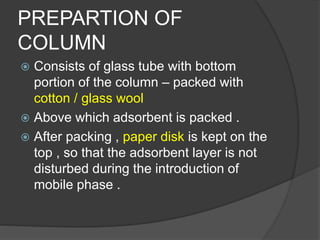
PREPARTION OF
COLUMN
 Consists of glass tube with bottom
portion of the column – packed with
cotton / glass wool
 Above which adsorbent is packed .
 After packing , paper disk is kept on the
top , so that the adsorbent layer is not
disturbed during the introduction of
mobile phase .
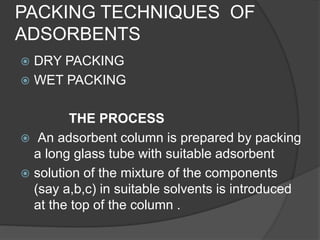
PACKING TECHNIQUES OF
ADSORBENTS
 DRY PACKING
 WET PACKING
THE PROCESS
 An adsorbent column is prepared by packing
a long glass tube with suitable adsorbent
 solution of the mixture of the components
(say a,b,c) in suitable solvents is introduced
at the top of the column .
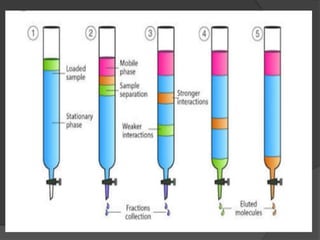
 It percolates through the adsorbent column ,
different components adsorbed to different
extend .
 Most readily adsorbed constituent(say a) is
held at the top .
 Other (say b and c) of decreasing
adsorbabilities are held up at different zones
or bands down the column in the same order
[say b and then c]
 This partial separation is improvised by
adding some amount of original solvent –
development of chromatogram.
 Individual components are extracted from the
adsorbent by a suitable solvent(eluent).
 Most weakly adsorbed component (c)
emerges first which is at the bottom of the
column .
 Most strongly adsorbed one (a ) comes out
last which was at the top of the column .
 Pure components are then recovered by
removing the solvent by suitable method .
APPLICATIONS
 Used for separation of two or more similar
organic components of a mixture
 Identification , separation and purification of
natural products.
 Used for identification of various industrial
products
 Separation of protein mixture.
Advantages of CC
 Any type and any quantity of mixture can be
separated .
 Wider choice of mobile phase
DISADVANTAGES OF CC
 Time consuming
 More amount of mobile phase is required .
THANK YOU

Column chromatography

  • 1.
  • 2.
     Useful methodfor the separation and purification of both solids and liquids .  Solid – liquid technique  stationary phase – solid  Mobile phase – liquid
  • 3.
    Principle  Adsorption  Mixtureof compounds dissolved in mobile phase is introduced into the column .  Separation occurs because of the different rates at which the components are carried over the stationary phase by the mobile phase
  • 4.
     Adsorption columnchromatography , the adsorbent packed in glass column .  Solvent – mobile phase , moves slowly through the packed column .  Process of dissolving out the components from the adsorbent using a suitable solvent is called elution .  This Solvent used as mobile phase – eluent .
  • 5.
     Compound attractedmore strongly by the mobile phase will move rapidly through the column .  Compound more strongly attracted to the stationary phase will move slowly through the column
  • 7.
    EXPERIMENTAL ASPECTS OF COLUMN CHROMATOGRAPHY ADSORBENTS : silica ,alumina, calcium carbonate , calcium phosphate , magnesia and starch  Alumina suitable for chromatography of less polar compounds .  Silica gel suitable for compounds containing polar functional groups .
  • 8.
    ADSORBENTS – CRITERIA Particles - spherical in shape , uniform in size  Mechanical stability must be great enough to prevent the formation of fine dust which might deposit in the channels of packing .  Don’t react chemically either with eluent or with sample .  Useful for separating wide variety of compounds.  Inexpensive and freely available
  • 9.
    SELECTION OF STATIONARY PHASE Removal of impurities  Number of components to be separated  Length of column used  Affinity difference between compenents  Quantity of adsorbent used
  • 10.
    SELECTION OF MOBILE PHASE Acts as solvent , developer and eluent  As developing agent  To remove pure component out of the column – as eluent  Based on solubility – solvent selection  Polarity – important factor
  • 11.
    DIFFERENT MOBILE PHASE USED Petroleum ether  Carbon tetrachloride  Cyclohexane  Ether  Ester  Acetone  Benzene  Water
  • 12.
    COLUMN CHARACTERISTICS  Supportstationary phase  Column must be of good quality – neutral glass  column dimensions : length and diameter ratio (10:1)  Better separation : long narrow column because number of plates will be more.
  • 13.
    PREPARTION OF COLUMN  Consistsof glass tube with bottom portion of the column – packed with cotton / glass wool  Above which adsorbent is packed .  After packing , paper disk is kept on the top , so that the adsorbent layer is not disturbed during the introduction of mobile phase .
  • 15.
    PACKING TECHNIQUES OF ADSORBENTS DRY PACKING  WET PACKING THE PROCESS  An adsorbent column is prepared by packing a long glass tube with suitable adsorbent  solution of the mixture of the components (say a,b,c) in suitable solvents is introduced at the top of the column .
  • 16.
     It percolatesthrough the adsorbent column , different components adsorbed to different extend .  Most readily adsorbed constituent(say a) is held at the top .  Other (say b and c) of decreasing adsorbabilities are held up at different zones or bands down the column in the same order [say b and then c]  This partial separation is improvised by adding some amount of original solvent – development of chromatogram.
  • 17.
     Individual componentsare extracted from the adsorbent by a suitable solvent(eluent).  Most weakly adsorbed component (c) emerges first which is at the bottom of the column .  Most strongly adsorbed one (a ) comes out last which was at the top of the column .  Pure components are then recovered by removing the solvent by suitable method .
  • 18.
    APPLICATIONS  Used forseparation of two or more similar organic components of a mixture  Identification , separation and purification of natural products.  Used for identification of various industrial products  Separation of protein mixture.
  • 19.
    Advantages of CC Any type and any quantity of mixture can be separated .  Wider choice of mobile phase DISADVANTAGES OF CC  Time consuming  More amount of mobile phase is required .
  • 20.