COLUMN CHROMATOGRAPHY
Presented by -
Amartya Nandi
M.Pharm (Pharmaceutics)
Introduction
Chromatography may be defined as a method of separating a mixture of components into
individual components through equilibrium distribution between two phases.
When a column of stationary phase is used, the technique is called as column
chromatography. When the mixture move through a porous medium (called stationary
phase) under the influence of some solvent or gas (called moving phase).
Elution: Passing of mobile phase through a stationary phase for separation.
Eluent: It is the solvent used to separate mixture of components (mobile phase).
Elute: Desired solute taken out from the chromatographic column using elution.
Principles
A solid stationary phase and a liquid mobile phase is used,
and the principle of separation is adsorption.
The mixture to be separated is dissolved in a suitable solvent
and allowed to pass through a tube containing the adsorbent
The component which have greater absorbing power is
adsorb in the upper part of the column.
The next component is adsorbed in lower portion of the
column which have less adsorbing power than the first
component.
The process is continued. As a result, the materials are
partially separated and adsorbed in the various part of the
column.
Types of Adsorbents
Use Weak adsorbent ( Sucrose , Starch, talc)
• Few components.
• Different affinities.
• Longer column.
Use Strong adsorbent ( Silica Gel, Activated Alumina, Activated Charcoal)
• More components.
• Similar affinities.
• Shorter column.
 The most commonly used adsorbent is silica gel of 80-100 mesh or 100-200 mesh size
which has a particle size of 60-200 μ.
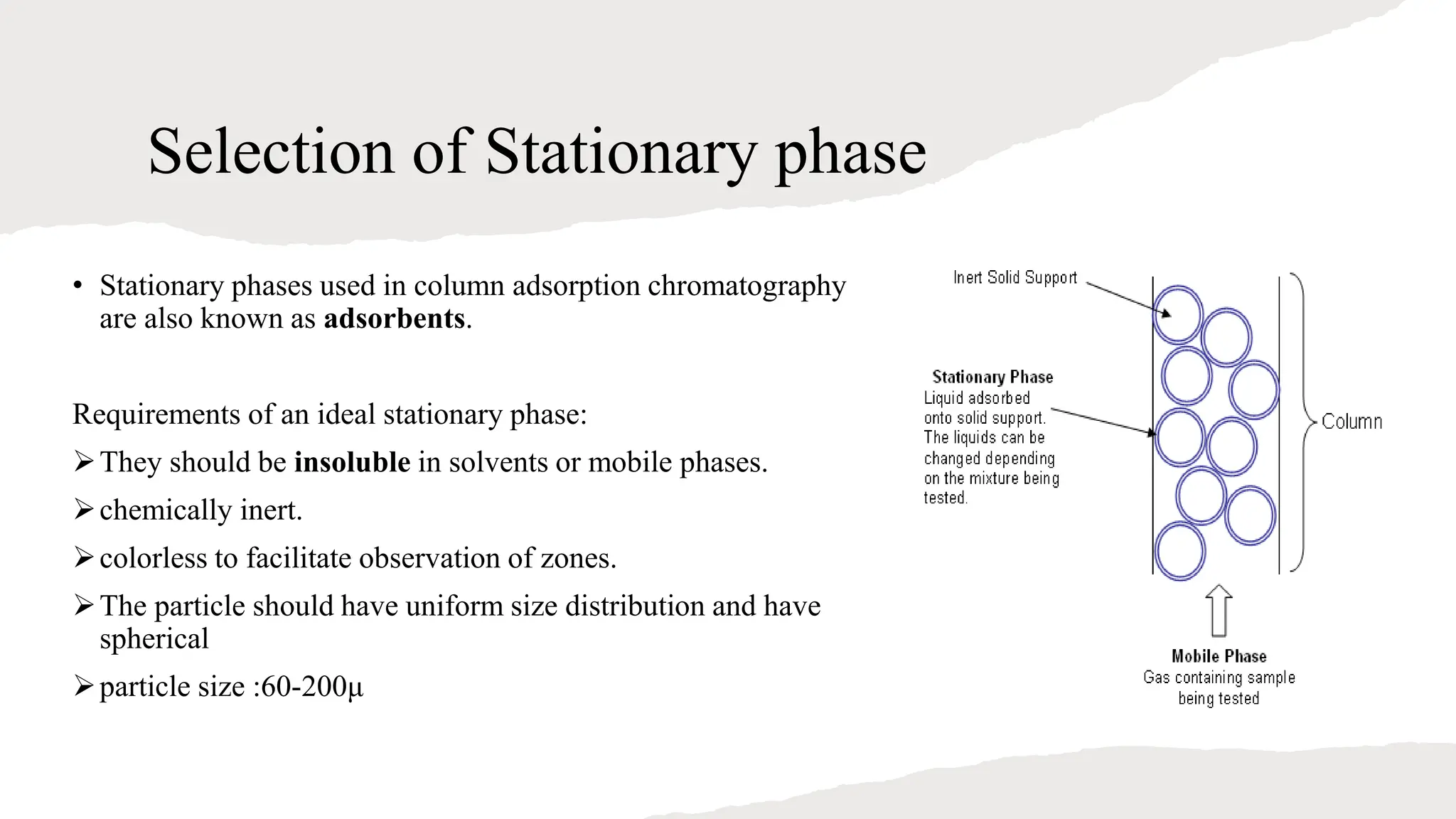
Selection of Stationary phase
• Stationary phases used in column adsorption chromatography
are also known as adsorbents.
Requirements of an ideal stationary phase:
They should be insoluble in solvents or mobile phases.
chemically inert.
colorless to facilitate observation of zones.
The particle should have uniform size distribution and have
spherical
particle size :60-200μ
Mobile Phase
They act as solvent, developer & eluent. The function of a mobile phase are:
 As developing agent
 To introduce the mixture into the column - as solvent
 To remove pure components out of the column - as eluent
 The choice of the solvent is dependent on the solubility characteristics of the
mixture. The solvents should also have sufficiently low boiling points to
permit ready recovery of eluted material.
Different mobile phases used: Petroleum ether, carbon tetrachloride,
cyclohexane, ether, acetone, benzene, toluene, esters, water
It can be used in either pure form or as mixture of solvents
Preparation of
Column
• Bottom portion of the column - packed with glass
wool/cotton wool or may contain asbestos pad.
• Above which adsorbent is packed
• After packing a paper disc kept on the top, so that the
adsorbent layer do not get disturbed on introduction of
sample or mobile phase.
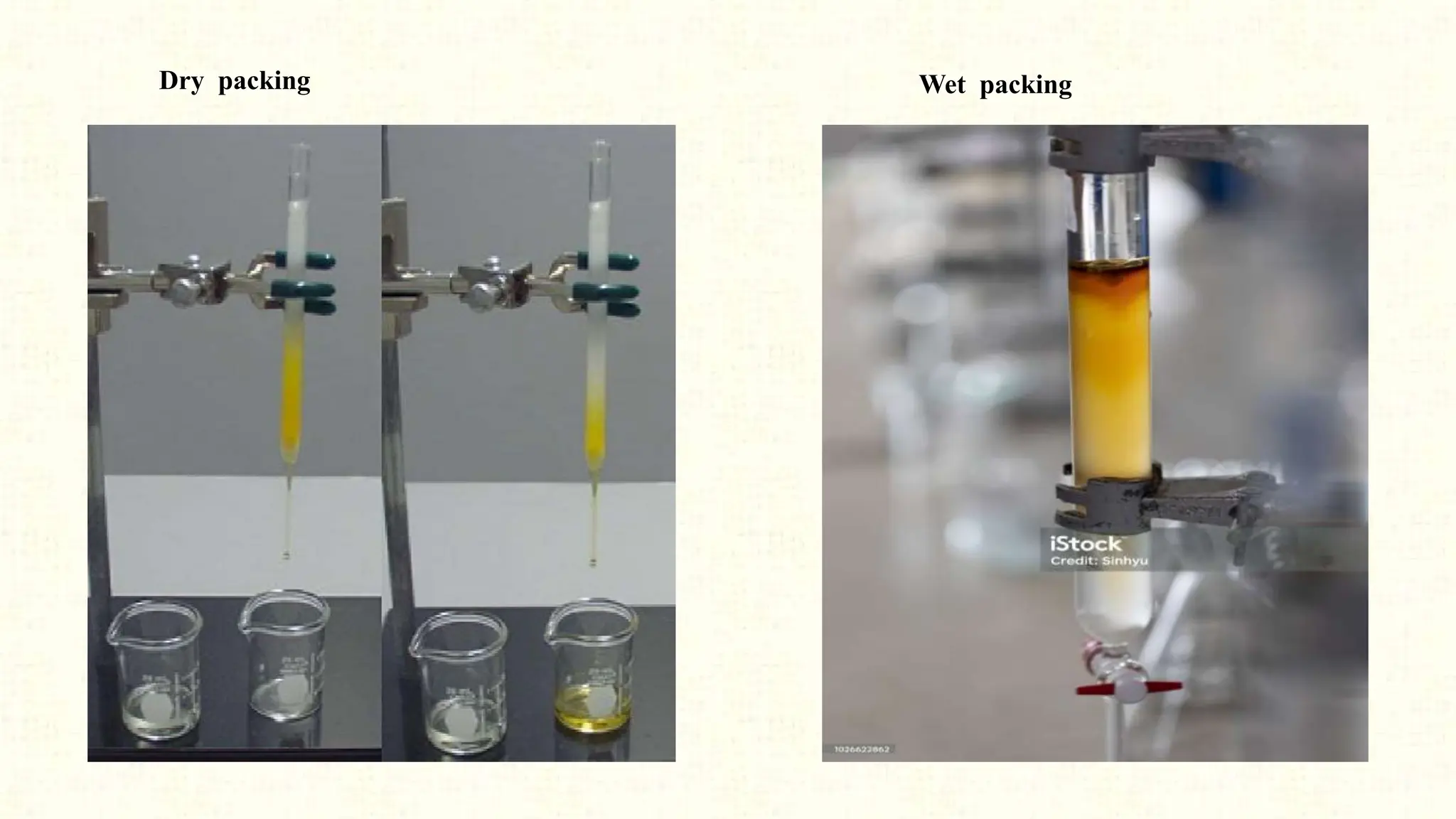
PACKING CAN BE:
• Dry packing
• Wet packing
Dissolve the sample in an
appropriate solvent. Transfer
it to a round bottomed flask
Add dry silica to the
dissolved sample (approx.
10-20 times the mass of the
sample).
stir gently to ensure all of
the silica is suspended
within the solution.
Gently evaporate the
solvent by using a rotary
evaporator until the silica is
dry and free-flowing. If it is
still an oil, add more silica
and repeat the procedure.
Carefully add solvent to
your column so that the
solvent level is about 2-3
cm above the top of the
silica.
Pour the dry silica that is
saturated with your sample
into the column and allow it
to settle.
Dry Packing
Dry packing Wet packing
Dissolve the sample in the minimum amount of solvent (5-10 drops).
Using a pipette or syringe with a thick needle, drip the sample directly onto the top of the silica.
Carefully add a layer of sand (approx. 2-5 mm). This will help prevent the surface of the silica from being
disturbed as more solvent is added.
Use a pipette to carefully add more solvent so that the solvent level is about 10 mm above the top of the sand.
Allow this solvent to drain until the solvent level is approximately 1-2 mm above the top of the sand.
Repeat steps 5 and 6 once or twice more. This will ensure that your sample is absorbed onto the silica.
Wet packing
Introducion of sample
The sample which is usually a mixture of
components is dissolved in minimum quantity of
the mobile phase used for preparing the column or a
solvent of minimum polarity. The entire sample is
introduced into the column at once and gets
adsorbed on the top portion of the column. From
this zone, the individual sample can be separated by
a process of elution.
Devolopment Technique
Isocratic elution technique
In this elution technique, the same solvent amposition or solvent of the
same polarity is used throughout the process of separation.
Chloroform only, petroleum ether: Benzene 1: 1
Gradient elution technique
In this elution technique, solvents gradually increasing polarity or
increasing elution strength are used during the process of separation.
Initially low polar solvent is used followed by gradually increasing the
polarity to a more polar solvent.
Benzene , Chloroform , Ethyl Acetate , Methanol
Application
 Separation of inorganic ions like copper, cobalt, nickel etc.
 Separation of tautomers and racemates.
 Isolation of metabolites from important components
 Used for determination of phytomenadione in tablets and injections
 Determination of flucinolone, acetonide, betamethasone in
formulations.
Advantages
Any type of mixture can be separated
Any quantity of mixture can be separated
Wider choice of Mobile Phase
Automation is possible
Disadvantages
Time consuming
more amount of Mobile Phase are required
Automation makes the techniques more
complicated & expensive
column chromatography details about column preparation

column chromatography details about column preparation

  • 1.
    COLUMN CHROMATOGRAPHY Presented by- Amartya Nandi M.Pharm (Pharmaceutics)
  • 2.
    Introduction Chromatography may bedefined as a method of separating a mixture of components into individual components through equilibrium distribution between two phases. When a column of stationary phase is used, the technique is called as column chromatography. When the mixture move through a porous medium (called stationary phase) under the influence of some solvent or gas (called moving phase). Elution: Passing of mobile phase through a stationary phase for separation. Eluent: It is the solvent used to separate mixture of components (mobile phase). Elute: Desired solute taken out from the chromatographic column using elution.
  • 3.
    Principles A solid stationaryphase and a liquid mobile phase is used, and the principle of separation is adsorption. The mixture to be separated is dissolved in a suitable solvent and allowed to pass through a tube containing the adsorbent The component which have greater absorbing power is adsorb in the upper part of the column. The next component is adsorbed in lower portion of the column which have less adsorbing power than the first component. The process is continued. As a result, the materials are partially separated and adsorbed in the various part of the column.
  • 4.
    Types of Adsorbents UseWeak adsorbent ( Sucrose , Starch, talc) • Few components. • Different affinities. • Longer column. Use Strong adsorbent ( Silica Gel, Activated Alumina, Activated Charcoal) • More components. • Similar affinities. • Shorter column.  The most commonly used adsorbent is silica gel of 80-100 mesh or 100-200 mesh size which has a particle size of 60-200 μ.
  • 5.
    Selection of Stationaryphase • Stationary phases used in column adsorption chromatography are also known as adsorbents. Requirements of an ideal stationary phase: They should be insoluble in solvents or mobile phases. chemically inert. colorless to facilitate observation of zones. The particle should have uniform size distribution and have spherical particle size :60-200μ
  • 6.
    Mobile Phase They actas solvent, developer & eluent. The function of a mobile phase are:  As developing agent  To introduce the mixture into the column - as solvent  To remove pure components out of the column - as eluent  The choice of the solvent is dependent on the solubility characteristics of the mixture. The solvents should also have sufficiently low boiling points to permit ready recovery of eluted material. Different mobile phases used: Petroleum ether, carbon tetrachloride, cyclohexane, ether, acetone, benzene, toluene, esters, water It can be used in either pure form or as mixture of solvents
  • 7.
    Preparation of Column • Bottomportion of the column - packed with glass wool/cotton wool or may contain asbestos pad. • Above which adsorbent is packed • After packing a paper disc kept on the top, so that the adsorbent layer do not get disturbed on introduction of sample or mobile phase. PACKING CAN BE: • Dry packing • Wet packing
  • 8.
    Dissolve the samplein an appropriate solvent. Transfer it to a round bottomed flask Add dry silica to the dissolved sample (approx. 10-20 times the mass of the sample). stir gently to ensure all of the silica is suspended within the solution. Gently evaporate the solvent by using a rotary evaporator until the silica is dry and free-flowing. If it is still an oil, add more silica and repeat the procedure. Carefully add solvent to your column so that the solvent level is about 2-3 cm above the top of the silica. Pour the dry silica that is saturated with your sample into the column and allow it to settle. Dry Packing
  • 9.
  • 10.
    Dissolve the samplein the minimum amount of solvent (5-10 drops). Using a pipette or syringe with a thick needle, drip the sample directly onto the top of the silica. Carefully add a layer of sand (approx. 2-5 mm). This will help prevent the surface of the silica from being disturbed as more solvent is added. Use a pipette to carefully add more solvent so that the solvent level is about 10 mm above the top of the sand. Allow this solvent to drain until the solvent level is approximately 1-2 mm above the top of the sand. Repeat steps 5 and 6 once or twice more. This will ensure that your sample is absorbed onto the silica. Wet packing
  • 11.
    Introducion of sample Thesample which is usually a mixture of components is dissolved in minimum quantity of the mobile phase used for preparing the column or a solvent of minimum polarity. The entire sample is introduced into the column at once and gets adsorbed on the top portion of the column. From this zone, the individual sample can be separated by a process of elution.
  • 12.
    Devolopment Technique Isocratic elutiontechnique In this elution technique, the same solvent amposition or solvent of the same polarity is used throughout the process of separation. Chloroform only, petroleum ether: Benzene 1: 1 Gradient elution technique In this elution technique, solvents gradually increasing polarity or increasing elution strength are used during the process of separation. Initially low polar solvent is used followed by gradually increasing the polarity to a more polar solvent. Benzene , Chloroform , Ethyl Acetate , Methanol
  • 13.
    Application  Separation ofinorganic ions like copper, cobalt, nickel etc.  Separation of tautomers and racemates.  Isolation of metabolites from important components  Used for determination of phytomenadione in tablets and injections  Determination of flucinolone, acetonide, betamethasone in formulations.
  • 14.
    Advantages Any type ofmixture can be separated Any quantity of mixture can be separated Wider choice of Mobile Phase Automation is possible Disadvantages Time consuming more amount of Mobile Phase are required Automation makes the techniques more complicated & expensive