Petabyte Scale Out Rocks
CEPH as replacement for Openstack's Swift & Co.
Udo Seidel
22JAN2014
Agenda
● Background
● Architecture of CEPH
● CEPH Storage
● Openstack
● Dream team: CEPH and Openstack
● Summary
22JAN2014
Background
22JAN2014
CEPH – what?
● So-called parallel distributed cluster file system
● Started as part of PhD studies at UCSC
●
Public announcement in 2006 at 7th
OSDI
● File system shipped with Linux kernel since
2.6.34
● Name derived from pet octopus - Cephalopods
22JAN2014
Shared file systems – short intro
● Multiple server access the same data
● Different approaches
● Network based, e.g. NFS, CIFS
● Clustered
– Shared disk, e.g. CXFS, CFS, GFS(2), OCFS2
– Distributed parallel, e.g. Lustre .. GlusterFS and CEPHFS
22JAN2014
Architecture of CEPH
22JAN2014
CEPH and storage
● Distributed file system => distributed storage
● Does not use traditional disks or RAID arrays
● Does use so-called OSD’s
– Object based Storage Devices
– Intelligent disks
22JAN2014
Object Based Storage I
● Objects of quite general nature
● Files
● Partitions
● ID for each storage object
● Separation of meta data operation and storing
file data
● HA not covered at all
● Object based Storage Devices
22JAN2014
Object Based Storage II
● OSD software implementation
● Usual an additional layer between between
computer and storage
● Presents object-based file system to the computer
● Use a “normal” file system to store data on the
storage
● Delivered as part of CEPH
● File systems: LUSTRE, EXOFS
22JAN2014
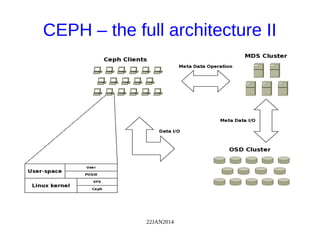
CEPH – the full architecture I
● 4 components
● Object based Storage Devices
– Any computer
– Form a cluster (redundancy and load balancing)
● Meta Data Servers
– Any computer
– Form a cluster (redundancy and load balancing)
● Cluster Monitors
– Any computer
● Clients ;-)
22JAN2014
CEPH – the full architecture II
22JAN2014
CEPH and Storage
22JAN2014
CEPH and OSD
● User land implementation
● Any computer can act as OSD
● Uses BTRFS as native file system
● Since 2009
● Before self-developed EBOFS
● Provides functions of OSD-2 standard
– Copy-on-write
– snapshots
● No redundancy on disk or even computer level
22JAN2014
CEPH and OSD – file systems
● BTRFS preferred
● Non-default configuration for mkfs
● XFS and EXT4 possible
● XATTR (size) is key -> EXT4 less recommended
● XFS recommended for Production
22JAN2014
OSD failure approach
● Any OSD expected to fail
● New OSD dynamically added/integrated
● Data distributed and replicated
● Redistribution of data after change in OSD
landscape
22JAN2014
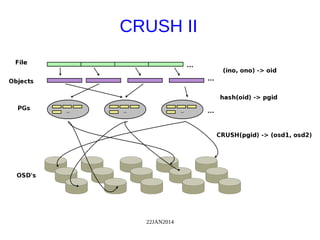
Data distribution
● File stripped
● File pieces mapped to object IDs
● Assignment of so-called placement group to
object ID
● Via hash function
● Placement group (PG): logical container of storage
objects
● Calculation of list of OSD’s out of PG
● CRUSH algorithm
22JAN2014
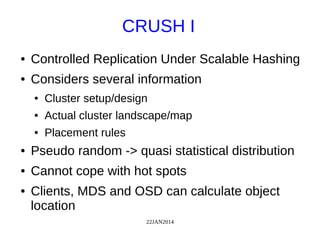
CRUSH I
● Controlled Replication Under Scalable Hashing
● Considers several information
● Cluster setup/design
● Actual cluster landscape/map
● Placement rules
● Pseudo random -> quasi statistical distribution
● Cannot cope with hot spots
● Clients, MDS and OSD can calculate object
location
22JAN2014
CRUSH II
22JAN2014
Data replication
● N-way replication
● N OSD’s per placement group
● OSD’s in different failure domains
● First non-failed OSD in PG -> primary
● Read and write to primary only
● Writes forwarded by primary to replica OSD’s
● Final write commit after all writes on replica OSD
● Replication traffic within OSD network
22JAN2014
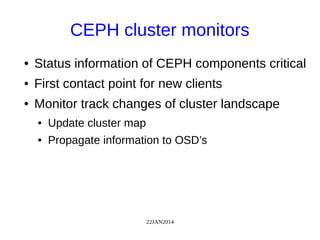
CEPH cluster monitors
● Status information of CEPH components critical
● First contact point for new clients
● Monitor track changes of cluster landscape
● Update cluster map
● Propagate information to OSD’s
22JAN2014
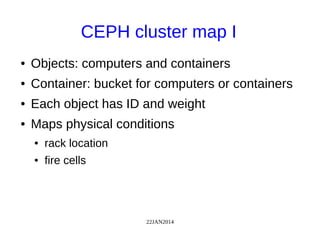
CEPH cluster map I
● Objects: computers and containers
● Container: bucket for computers or containers
● Each object has ID and weight
● Maps physical conditions
● rack location
● fire cells
22JAN2014
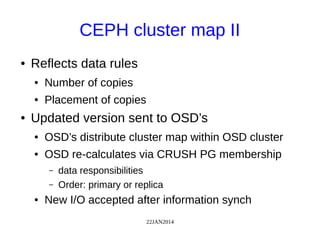
CEPH cluster map II
● Reflects data rules
● Number of copies
● Placement of copies
● Updated version sent to OSD’s
● OSD’s distribute cluster map within OSD cluster
● OSD re-calculates via CRUSH PG membership
– data responsibilities
– Order: primary or replica
● New I/O accepted after information synch
22JAN2014
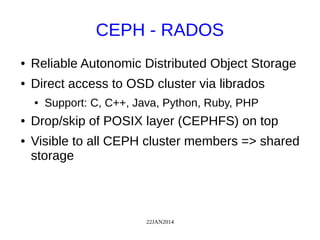
CEPH - RADOS
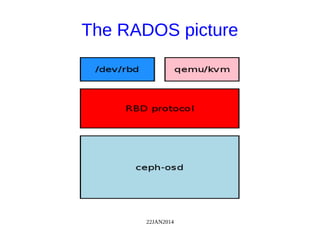
● Reliable Autonomic Distributed Object Storage
● Direct access to OSD cluster via librados
● Support: C, C++, Java, Python, Ruby, PHP
● Drop/skip of POSIX layer (CEPHFS) on top
● Visible to all CEPH cluster members => shared
storage
22JAN2014
CEPH Block Device
● Aka RADOS block device (RBD)
● Upstream since kernel 2.6.37
● RADOS storage exposed as block device
● /dev/rdb
● qemu/KVM storage driver via librados/librdb
● Alternative to
● shared SAN/iSCSI for HA environments
● Storage HA solutions for qemu/KVM
22JAN2014
The RADOS picture
22JAN2014
CEPH Object Gateway
● Aka RADOS Gateway (RGW)
● RESTful API
● Amazon S3 -> s3 tools work
● SWIFT API's
● Proxy HTTP to RADOS
● Tested with apache and lighthttpd
22JAN2014
CEPH Take Aways
● Scalable
● Flexible configuration
● No SPOF but build on commodity hardware
● Accessible via different interfaces
22JAN2014
Openstack
22JAN2014
What?
● Infrastructure as a Service (IaaS)
● 'Open source' version of AWS
● New versions every 6 months
● Current called Havana
● Previous called Grizzly
● Managed by Openstack Foundation
22JAN2014
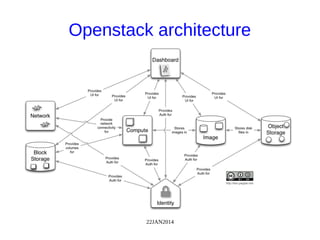
Openstack architecture
22JAN2014
Openstack Components
● Keystone – identity
● Glance - image
● Nova - compute
● Cinder - block
● Swift - object
● Neutron - network
● Horizon - dashboard
22JAN2014
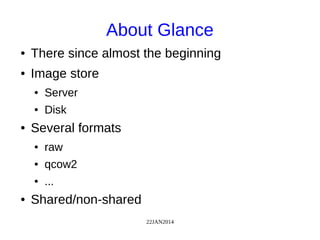
About Glance
● There since almost the beginning
● Image store
● Server
● Disk
● Several formats
● raw
● qcow2
● ...
● Shared/non-shared
22JAN2014
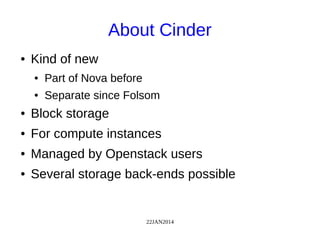
About Cinder
● Kind of new
● Part of Nova before
● Separate since Folsom
● Block storage
● For compute instances
● Managed by Openstack users
● Several storage back-ends possible
22JAN2014
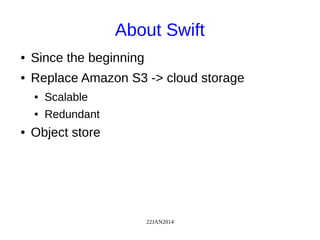
About Swift
● Since the beginning
● Replace Amazon S3 -> cloud storage
● Scalable
● Redundant
● Object store
22JAN2014
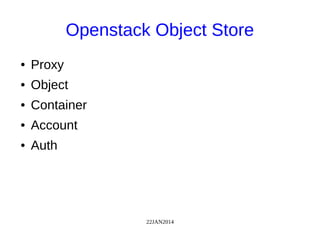
Openstack Object Store
● Proxy
● Object
● Container
● Account
● Auth
22JAN2014
Dream Team: CEPH and Openstack
22JAN2014
Why CEPH in the first place?
● Full blown storage solution
● Support
● Operational model
● Cloud'ish
● Separation of duties
● One solution for different storage needs
22JAN2014
Integration
● Full integration with RADOS
● Since Folsom
● Two parts
● Authentication
● Technical access
● Both parties must be aware
● Independent for each of the storage
components
● Different RADOS pools
22JAN2014
Authentication
● CEPH part
● Key rings
● Configuration
● For Cinder and Glance
● Openstack part
● Keystone
– Only for Swift
– Needs RGW
22JAN2014
Access to RADOS/RBD I
● Via API/libraries => no CEPHFS needed
● Easy for Glance/Cinder
● CEPH keyring configuration
● Update of CEPH.conf
● Update of Glance/Cinder API configuration
22JAN2014
Access to RADOS/RBD II
● Swift => more work needed
● CEPHFS => again: not needed
● CEPH Object Gateway
– Web server
– RGW software
– Keystone certificates
– No support for v2 Swift authentication
● Keystone authentication
– Endlist configuration -> RGW
22JAN2014
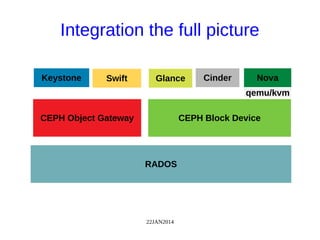
Integration the full picture
RADOS
qemu/kvm
CEPH Object Gateway CEPH Block Device
SwiftKeystone CinderGlance Nova
22JAN2014
Integration pitfalls
● CEPH versions not in sync
● Authentication
● CEPH Object Gateway setup
22JAN2014
Why CEPH - reviewed
● Previous arguments still valid :-)
● Modular usage
● High integration
● Built-in HA
● No need for POSIX compatible interface
● Works even with other IaaS implementations
22JAN2014
Summary
22JAN2014
Take Aways
● Sophisticated storage engine
● Mature OSS distributed storage solution
● Other use cases
● Can be used elsewhere
● Full integration in Openstack
22JAN2014
References
● http://ceph.com
● http://www.openstack.org
22JAN2014
Thank you!
22JAN2014
Petabyte Scale Out Rocks
CEPH as replacement for Openstack's Swift & Co.
Udo Seidel

adp.ceph.openstack.talk

  • 1.
    Petabyte Scale OutRocks CEPH as replacement for Openstack's Swift & Co. Udo Seidel
  • 2.
    22JAN2014 Agenda ● Background ● Architectureof CEPH ● CEPH Storage ● Openstack ● Dream team: CEPH and Openstack ● Summary
  • 3.
  • 4.
    22JAN2014 CEPH – what? ●So-called parallel distributed cluster file system ● Started as part of PhD studies at UCSC ● Public announcement in 2006 at 7th OSDI ● File system shipped with Linux kernel since 2.6.34 ● Name derived from pet octopus - Cephalopods
  • 5.
    22JAN2014 Shared file systems– short intro ● Multiple server access the same data ● Different approaches ● Network based, e.g. NFS, CIFS ● Clustered – Shared disk, e.g. CXFS, CFS, GFS(2), OCFS2 – Distributed parallel, e.g. Lustre .. GlusterFS and CEPHFS
  • 6.
  • 7.
    22JAN2014 CEPH and storage ●Distributed file system => distributed storage ● Does not use traditional disks or RAID arrays ● Does use so-called OSD’s – Object based Storage Devices – Intelligent disks
  • 8.
    22JAN2014 Object Based StorageI ● Objects of quite general nature ● Files ● Partitions ● ID for each storage object ● Separation of meta data operation and storing file data ● HA not covered at all ● Object based Storage Devices
  • 9.
    22JAN2014 Object Based StorageII ● OSD software implementation ● Usual an additional layer between between computer and storage ● Presents object-based file system to the computer ● Use a “normal” file system to store data on the storage ● Delivered as part of CEPH ● File systems: LUSTRE, EXOFS
  • 10.
    22JAN2014 CEPH – thefull architecture I ● 4 components ● Object based Storage Devices – Any computer – Form a cluster (redundancy and load balancing) ● Meta Data Servers – Any computer – Form a cluster (redundancy and load balancing) ● Cluster Monitors – Any computer ● Clients ;-)
  • 11.
    22JAN2014 CEPH – thefull architecture II
  • 12.
  • 13.
    22JAN2014 CEPH and OSD ●User land implementation ● Any computer can act as OSD ● Uses BTRFS as native file system ● Since 2009 ● Before self-developed EBOFS ● Provides functions of OSD-2 standard – Copy-on-write – snapshots ● No redundancy on disk or even computer level
  • 14.
    22JAN2014 CEPH and OSD– file systems ● BTRFS preferred ● Non-default configuration for mkfs ● XFS and EXT4 possible ● XATTR (size) is key -> EXT4 less recommended ● XFS recommended for Production
  • 15.
    22JAN2014 OSD failure approach ●Any OSD expected to fail ● New OSD dynamically added/integrated ● Data distributed and replicated ● Redistribution of data after change in OSD landscape
  • 16.
    22JAN2014 Data distribution ● Filestripped ● File pieces mapped to object IDs ● Assignment of so-called placement group to object ID ● Via hash function ● Placement group (PG): logical container of storage objects ● Calculation of list of OSD’s out of PG ● CRUSH algorithm
  • 17.
    22JAN2014 CRUSH I ● ControlledReplication Under Scalable Hashing ● Considers several information ● Cluster setup/design ● Actual cluster landscape/map ● Placement rules ● Pseudo random -> quasi statistical distribution ● Cannot cope with hot spots ● Clients, MDS and OSD can calculate object location
  • 18.
  • 19.
    22JAN2014 Data replication ● N-wayreplication ● N OSD’s per placement group ● OSD’s in different failure domains ● First non-failed OSD in PG -> primary ● Read and write to primary only ● Writes forwarded by primary to replica OSD’s ● Final write commit after all writes on replica OSD ● Replication traffic within OSD network
  • 20.
    22JAN2014 CEPH cluster monitors ●Status information of CEPH components critical ● First contact point for new clients ● Monitor track changes of cluster landscape ● Update cluster map ● Propagate information to OSD’s
  • 21.
    22JAN2014 CEPH cluster mapI ● Objects: computers and containers ● Container: bucket for computers or containers ● Each object has ID and weight ● Maps physical conditions ● rack location ● fire cells
  • 22.
    22JAN2014 CEPH cluster mapII ● Reflects data rules ● Number of copies ● Placement of copies ● Updated version sent to OSD’s ● OSD’s distribute cluster map within OSD cluster ● OSD re-calculates via CRUSH PG membership – data responsibilities – Order: primary or replica ● New I/O accepted after information synch
  • 23.
    22JAN2014 CEPH - RADOS ●Reliable Autonomic Distributed Object Storage ● Direct access to OSD cluster via librados ● Support: C, C++, Java, Python, Ruby, PHP ● Drop/skip of POSIX layer (CEPHFS) on top ● Visible to all CEPH cluster members => shared storage
  • 24.
    22JAN2014 CEPH Block Device ●Aka RADOS block device (RBD) ● Upstream since kernel 2.6.37 ● RADOS storage exposed as block device ● /dev/rdb ● qemu/KVM storage driver via librados/librdb ● Alternative to ● shared SAN/iSCSI for HA environments ● Storage HA solutions for qemu/KVM
  • 25.
  • 26.
    22JAN2014 CEPH Object Gateway ●Aka RADOS Gateway (RGW) ● RESTful API ● Amazon S3 -> s3 tools work ● SWIFT API's ● Proxy HTTP to RADOS ● Tested with apache and lighthttpd
  • 27.
    22JAN2014 CEPH Take Aways ●Scalable ● Flexible configuration ● No SPOF but build on commodity hardware ● Accessible via different interfaces
  • 28.
  • 29.
    22JAN2014 What? ● Infrastructure asa Service (IaaS) ● 'Open source' version of AWS ● New versions every 6 months ● Current called Havana ● Previous called Grizzly ● Managed by Openstack Foundation
  • 30.
  • 31.
    22JAN2014 Openstack Components ● Keystone– identity ● Glance - image ● Nova - compute ● Cinder - block ● Swift - object ● Neutron - network ● Horizon - dashboard
  • 32.
    22JAN2014 About Glance ● Theresince almost the beginning ● Image store ● Server ● Disk ● Several formats ● raw ● qcow2 ● ... ● Shared/non-shared
  • 33.
    22JAN2014 About Cinder ● Kindof new ● Part of Nova before ● Separate since Folsom ● Block storage ● For compute instances ● Managed by Openstack users ● Several storage back-ends possible
  • 34.
    22JAN2014 About Swift ● Sincethe beginning ● Replace Amazon S3 -> cloud storage ● Scalable ● Redundant ● Object store
  • 35.
    22JAN2014 Openstack Object Store ●Proxy ● Object ● Container ● Account ● Auth
  • 36.
  • 37.
    22JAN2014 Why CEPH inthe first place? ● Full blown storage solution ● Support ● Operational model ● Cloud'ish ● Separation of duties ● One solution for different storage needs
  • 38.
    22JAN2014 Integration ● Full integrationwith RADOS ● Since Folsom ● Two parts ● Authentication ● Technical access ● Both parties must be aware ● Independent for each of the storage components ● Different RADOS pools
  • 39.
    22JAN2014 Authentication ● CEPH part ●Key rings ● Configuration ● For Cinder and Glance ● Openstack part ● Keystone – Only for Swift – Needs RGW
  • 40.
    22JAN2014 Access to RADOS/RBDI ● Via API/libraries => no CEPHFS needed ● Easy for Glance/Cinder ● CEPH keyring configuration ● Update of CEPH.conf ● Update of Glance/Cinder API configuration
  • 41.
    22JAN2014 Access to RADOS/RBDII ● Swift => more work needed ● CEPHFS => again: not needed ● CEPH Object Gateway – Web server – RGW software – Keystone certificates – No support for v2 Swift authentication ● Keystone authentication – Endlist configuration -> RGW
  • 42.
    22JAN2014 Integration the fullpicture RADOS qemu/kvm CEPH Object Gateway CEPH Block Device SwiftKeystone CinderGlance Nova
  • 43.
    22JAN2014 Integration pitfalls ● CEPHversions not in sync ● Authentication ● CEPH Object Gateway setup
  • 44.
    22JAN2014 Why CEPH -reviewed ● Previous arguments still valid :-) ● Modular usage ● High integration ● Built-in HA ● No need for POSIX compatible interface ● Works even with other IaaS implementations
  • 45.
  • 46.
    22JAN2014 Take Aways ● Sophisticatedstorage engine ● Mature OSS distributed storage solution ● Other use cases ● Can be used elsewhere ● Full integration in Openstack
  • 47.
  • 48.
  • 49.
    22JAN2014 Petabyte Scale OutRocks CEPH as replacement for Openstack's Swift & Co. Udo Seidel