CEPH AND ROCKSDB
SAGE WEIL
HIVEDATA ROCKSDB MEETUP - 2016.02.03
2
OUTLINE
●
Ceph background
●
FileStore - why POSIX failed us
●
BlueStore – a new Ceph OSD backend
●
RocksDB changes
– journal recycling
– BlueRocksEnv
– EnvMirror
– delayed merge?
●
Summary
3
CEPH
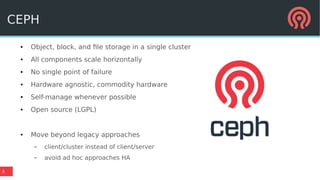
● Object, block, and file storage in a single cluster
● All components scale horizontally
● No single point of failure
● Hardware agnostic, commodity hardware
● Self-manage whenever possible
● Open source (LGPL)
● Move beyond legacy approaches
– client/cluster instead of client/server
– avoid ad hoc approaches HA
4
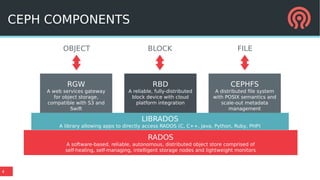
CEPH COMPONENTS
RGW
A web services gateway
for object storage,
compatible with S3 and
Swift
LIBRADOS
A library allowing apps to directly access RADOS (C, C++, Java, Python, Ruby, PHP)
RADOS
A software-based, reliable, autonomous, distributed object store comprised of
self-healing, self-managing, intelligent storage nodes and lightweight monitors
RBD
A reliable, fully-distributed
block device with cloud
platform integration
CEPHFS
A distributed file system
with POSIX semantics and
scale-out metadata
management
OBJECT BLOCK FILE
5
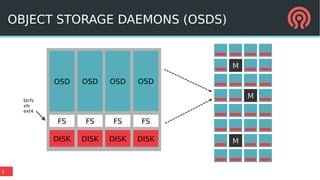
OBJECT STORAGE DAEMONS (OSDS)
FS
DISK
OSD
DISK
OSD
FS
DISK
OSD
FS
DISK
OSD
FS
btrfs
xfs
ext4
M
M
M
6
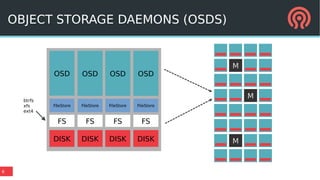
OBJECT STORAGE DAEMONS (OSDS)
FS
DISK
OSD
DISK
OSD
FS
DISK
OSD
FS
DISK
OSD
FS
btrfs
xfs
ext4
M
M
M
FileStore FileStoreFileStoreFileStore
7
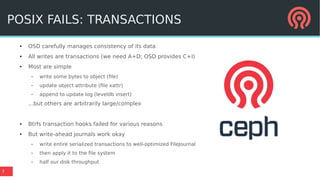
POSIX FAILS: TRANSACTIONS
●
OSD carefully manages consistency of its data
●
All writes are transactions (we need A+D; OSD provides C+I)
●
Most are simple
– write some bytes to object (file)
– update object attribute (file xattr)
– append to update log (leveldb insert)
...but others are arbitrarily large/complex
● Btrfs transaction hooks failed for various reasons
● But write-ahead journals work okay
– write entire serialized transactions to well-optimized FileJournal
– then apply it to the file system
– half our disk throughput
8
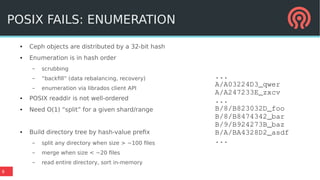
POSIX FAILS: ENUMERATION
● Ceph objects are distributed by a 32-bit hash
● Enumeration is in hash order
– scrubbing
– “backfill” (data rebalancing, recovery)
– enumeration via librados client API
● POSIX readdir is not well-ordered
● Need O(1) “split” for a given shard/range
● Build directory tree by hash-value prefix
– split any directory when size > ~100 files
– merge when size < ~20 files
– read entire directory, sort in-memory
...
A/A03224D3_qwer
A/A247233E_zxcv
...
B/8/B823032D_foo
B/8/B8474342_bar
B/9/B924273B_baz
B/A/BA4328D2_asdf
...
9
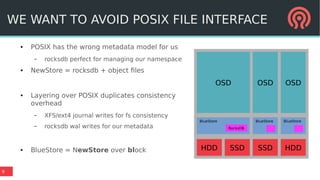
WE WANT TO AVOID POSIX FILE INTERFACE
● POSIX has the wrong metadata model for us
– rocksdb perfect for managing our namespace
● NewStore = rocksdb + object files
● Layering over POSIX duplicates consistency
overhead
– XFS/ext4 journal writes for fs consistency
– rocksdb wal writes for our metadata
● BlueStore = NewStore over block HDD
OSD
SSD SSD
OSD
HDD
OSD
BlueStore BlueStore BlueStore
RocksDBRocksDB
10
WHY ROCKSDB?
● Ideal key/value interface
– transactions
– ordered enumeration
– fast commits to log/journal
● Common interface
– can always swap in another KV DB if we want
● Abstract storage backend (rocksdb::Env)
● C++ interface
● Strong and active open source community
11
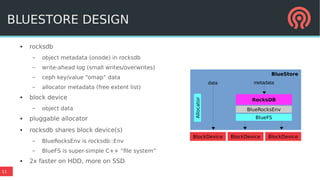
BlueStore
BLUESTORE DESIGN
BlueFS
RocksDB
BlockDeviceBlockDeviceBlockDevice
BlueRocksEnv
data metadata
● rocksdb
– object metadata (onode) in rocksdb
– write-ahead log (small writes/overwrites)
– ceph key/value “omap” data
– allocator metadata (free extent list)
● block device
– object data
● pluggable allocator
● rocksdb shares block device(s)
– BlueRocksEnv is rocksdb::Env
– BlueFS is super-simple C++ “file system”
● 2x faster on HDD, more on SSD
Allocator
ROCKSDB
13
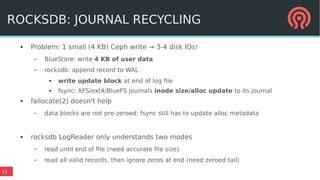
ROCKSDB: JOURNAL RECYCLING
● Problem: 1 small (4 KB) Ceph write → 3-4 disk IOs!
– BlueStore: write 4 KB of user data
– rocksdb: append record to WAL
● write update block at end of log file
● fsync: XFS/ext4/BlueFS journals inode size/alloc update to its journal
● fallocate(2) doesn't help
– data blocks are not pre-zeroed; fsync still has to update alloc metadata
● rocksdb LogReader only understands two modes
– read until end of file (need accurate file size)
– read all valid records, then ignore zeros at end (need zeroed tail)
14
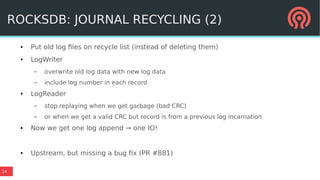
ROCKSDB: JOURNAL RECYCLING (2)
● Put old log files on recycle list (instead of deleting them)
● LogWriter
– overwrite old log data with new log data
– include log number in each record
● LogReader
– stop replaying when we get garbage (bad CRC)
– or when we get a valid CRC but record is from a previous log incarnation
● Now we get one log append → one IO!
● Upstream, but missing a bug fix (PR #881)
15
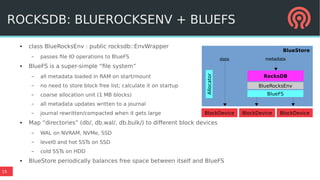
ROCKSDB: BLUEROCKSENV + BLUEFS
● class BlueRocksEnv : public rocksdb::EnvWrapper
– passes file IO operations to BlueFS
● BlueFS is a super-simple “file system”
– all metadata loaded in RAM on start/mount
– no need to store block free list; calculate it on startup
– coarse allocation unit (1 MB blocks)
– all metadata updates written to a journal
– journal rewritten/compacted when it gets large
● Map “directories” (db/, db.wal/, db.bulk/) to different block devices
– WAL on NVRAM, NVMe, SSD
– level0 and hot SSTs on SSD
– cold SSTs on HDD
● BlueStore periodically balances free space between itself and BlueFS
BlueStore
BlueFS
RocksDB
BlockDeviceBlockDeviceBlockDevice
BlueRocksEnv
data metadata
Allocator
16
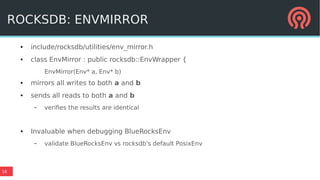
ROCKSDB: ENVMIRROR
● include/rocksdb/utilities/env_mirror.h
● class EnvMirror : public rocksdb::EnvWrapper {
EnvMirror(Env* a, Env* b)
● mirrors all writes to both a and b
● sends all reads to both a and b
– verifies the results are identical
● Invaluable when debugging BlueRocksEnv
– validate BlueRocksEnv vs rocksdb's default PosixEnv
17
ROCKSDB: DELAYED LOG MERGE
● We write lots of short-lived records to log
– insert wal_1 = 4 KB
– insert wal_2 = 8 KB
– …
– insert wal_10 = 4 KB
– delete wal_1
– insert wal_11 = 4 KB
● Goal
– prevent short-lived records from ever getting amplified
– keep, say, 2N logs
– merge oldest N to new level0 SST, but also remove keys updated/deleted in
newest N logs
18
SUMMARY
● Ceph is great
● POSIX was poor choice for storing objects
● Our new BlueStore backend is awesome
● RocksDB rocks and was easy to embed
● Log recycling speeds up commits (now upstream)
● Delayed merge will help too (coming soon)
THANK YOU!
Sage Weil
CEPH PRINCIPAL ARCHITECT
sage@redhat.com
@liewegas

Ceph and RocksDB

  • 1.
    CEPH AND ROCKSDB SAGEWEIL HIVEDATA ROCKSDB MEETUP - 2016.02.03
  • 2.
    2 OUTLINE ● Ceph background ● FileStore -why POSIX failed us ● BlueStore – a new Ceph OSD backend ● RocksDB changes – journal recycling – BlueRocksEnv – EnvMirror – delayed merge? ● Summary
  • 3.
    3 CEPH ● Object, block,and file storage in a single cluster ● All components scale horizontally ● No single point of failure ● Hardware agnostic, commodity hardware ● Self-manage whenever possible ● Open source (LGPL) ● Move beyond legacy approaches – client/cluster instead of client/server – avoid ad hoc approaches HA
  • 4.
    4 CEPH COMPONENTS RGW A webservices gateway for object storage, compatible with S3 and Swift LIBRADOS A library allowing apps to directly access RADOS (C, C++, Java, Python, Ruby, PHP) RADOS A software-based, reliable, autonomous, distributed object store comprised of self-healing, self-managing, intelligent storage nodes and lightweight monitors RBD A reliable, fully-distributed block device with cloud platform integration CEPHFS A distributed file system with POSIX semantics and scale-out metadata management OBJECT BLOCK FILE
  • 5.
    5 OBJECT STORAGE DAEMONS(OSDS) FS DISK OSD DISK OSD FS DISK OSD FS DISK OSD FS btrfs xfs ext4 M M M
  • 6.
    6 OBJECT STORAGE DAEMONS(OSDS) FS DISK OSD DISK OSD FS DISK OSD FS DISK OSD FS btrfs xfs ext4 M M M FileStore FileStoreFileStoreFileStore
  • 7.
    7 POSIX FAILS: TRANSACTIONS ● OSDcarefully manages consistency of its data ● All writes are transactions (we need A+D; OSD provides C+I) ● Most are simple – write some bytes to object (file) – update object attribute (file xattr) – append to update log (leveldb insert) ...but others are arbitrarily large/complex ● Btrfs transaction hooks failed for various reasons ● But write-ahead journals work okay – write entire serialized transactions to well-optimized FileJournal – then apply it to the file system – half our disk throughput
  • 8.
    8 POSIX FAILS: ENUMERATION ●Ceph objects are distributed by a 32-bit hash ● Enumeration is in hash order – scrubbing – “backfill” (data rebalancing, recovery) – enumeration via librados client API ● POSIX readdir is not well-ordered ● Need O(1) “split” for a given shard/range ● Build directory tree by hash-value prefix – split any directory when size > ~100 files – merge when size < ~20 files – read entire directory, sort in-memory ... A/A03224D3_qwer A/A247233E_zxcv ... B/8/B823032D_foo B/8/B8474342_bar B/9/B924273B_baz B/A/BA4328D2_asdf ...
  • 9.
    9 WE WANT TOAVOID POSIX FILE INTERFACE ● POSIX has the wrong metadata model for us – rocksdb perfect for managing our namespace ● NewStore = rocksdb + object files ● Layering over POSIX duplicates consistency overhead – XFS/ext4 journal writes for fs consistency – rocksdb wal writes for our metadata ● BlueStore = NewStore over block HDD OSD SSD SSD OSD HDD OSD BlueStore BlueStore BlueStore RocksDBRocksDB
  • 10.
    10 WHY ROCKSDB? ● Idealkey/value interface – transactions – ordered enumeration – fast commits to log/journal ● Common interface – can always swap in another KV DB if we want ● Abstract storage backend (rocksdb::Env) ● C++ interface ● Strong and active open source community
  • 11.
    11 BlueStore BLUESTORE DESIGN BlueFS RocksDB BlockDeviceBlockDeviceBlockDevice BlueRocksEnv data metadata ●rocksdb – object metadata (onode) in rocksdb – write-ahead log (small writes/overwrites) – ceph key/value “omap” data – allocator metadata (free extent list) ● block device – object data ● pluggable allocator ● rocksdb shares block device(s) – BlueRocksEnv is rocksdb::Env – BlueFS is super-simple C++ “file system” ● 2x faster on HDD, more on SSD Allocator
  • 12.
  • 13.
    13 ROCKSDB: JOURNAL RECYCLING ●Problem: 1 small (4 KB) Ceph write → 3-4 disk IOs! – BlueStore: write 4 KB of user data – rocksdb: append record to WAL ● write update block at end of log file ● fsync: XFS/ext4/BlueFS journals inode size/alloc update to its journal ● fallocate(2) doesn't help – data blocks are not pre-zeroed; fsync still has to update alloc metadata ● rocksdb LogReader only understands two modes – read until end of file (need accurate file size) – read all valid records, then ignore zeros at end (need zeroed tail)
  • 14.
    14 ROCKSDB: JOURNAL RECYCLING(2) ● Put old log files on recycle list (instead of deleting them) ● LogWriter – overwrite old log data with new log data – include log number in each record ● LogReader – stop replaying when we get garbage (bad CRC) – or when we get a valid CRC but record is from a previous log incarnation ● Now we get one log append → one IO! ● Upstream, but missing a bug fix (PR #881)
  • 15.
    15 ROCKSDB: BLUEROCKSENV +BLUEFS ● class BlueRocksEnv : public rocksdb::EnvWrapper – passes file IO operations to BlueFS ● BlueFS is a super-simple “file system” – all metadata loaded in RAM on start/mount – no need to store block free list; calculate it on startup – coarse allocation unit (1 MB blocks) – all metadata updates written to a journal – journal rewritten/compacted when it gets large ● Map “directories” (db/, db.wal/, db.bulk/) to different block devices – WAL on NVRAM, NVMe, SSD – level0 and hot SSTs on SSD – cold SSTs on HDD ● BlueStore periodically balances free space between itself and BlueFS BlueStore BlueFS RocksDB BlockDeviceBlockDeviceBlockDevice BlueRocksEnv data metadata Allocator
  • 16.
    16 ROCKSDB: ENVMIRROR ● include/rocksdb/utilities/env_mirror.h ●class EnvMirror : public rocksdb::EnvWrapper { EnvMirror(Env* a, Env* b) ● mirrors all writes to both a and b ● sends all reads to both a and b – verifies the results are identical ● Invaluable when debugging BlueRocksEnv – validate BlueRocksEnv vs rocksdb's default PosixEnv
  • 17.
    17 ROCKSDB: DELAYED LOGMERGE ● We write lots of short-lived records to log – insert wal_1 = 4 KB – insert wal_2 = 8 KB – … – insert wal_10 = 4 KB – delete wal_1 – insert wal_11 = 4 KB ● Goal – prevent short-lived records from ever getting amplified – keep, say, 2N logs – merge oldest N to new level0 SST, but also remove keys updated/deleted in newest N logs
  • 18.
    18 SUMMARY ● Ceph isgreat ● POSIX was poor choice for storing objects ● Our new BlueStore backend is awesome ● RocksDB rocks and was easy to embed ● Log recycling speeds up commits (now upstream) ● Delayed merge will help too (coming soon)
  • 19.
    THANK YOU! Sage Weil CEPHPRINCIPAL ARCHITECT sage@redhat.com @liewegas