OpenSource Trends Days 2012
Ksplice
Linux kernel patching without a reboot
Udo Seidel
OpenSource Trends Days 2012
Agenda
● Who?
● Why?
● How?
● Show!
● And?
OpenSource Trends Days 2012
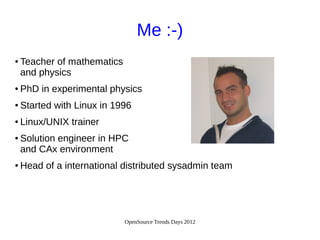
Me :-)
● Teacher of mathematics
and physics
● PhD in experimental physics
● Started with Linux in 1996
● Linux/UNIX trainer
● Solution engineer in HPC
and CAx environment
● Head of a international distributed sysadmin team
OpenSource Trends Days 2012
Why?
OpenSource Trends Days 2012
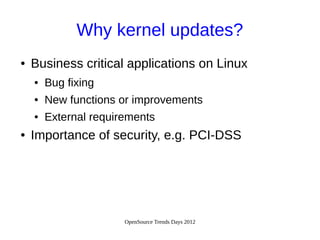
Why kernel updates?
● Business critical applications on Linux
● Bug fixing
● New functions or improvements
● External requirements
● Importance of security, e.g. PCI-DSS
OpenSource Trends Days 2012
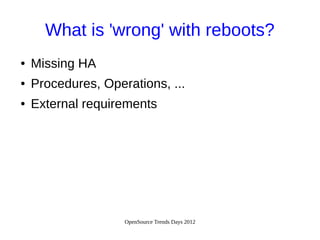
What is 'wrong' with reboots?
● Missing HA
● Procedures, Operations, ...
● External requirements
OpenSource Trends Days 2012
Do we really need a reboot?
Question ....
OpenSource Trends Days 2012
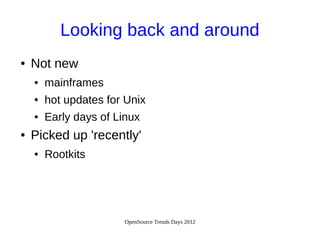
Looking back and around
● Not new
● mainframes
● hot updates for Unix
● Early days of Linux
● Picked up 'recently'
● Rootkits
OpenSource Trends Days 2012
How?
Hotfix preparation
OpenSource Trends Days 2012
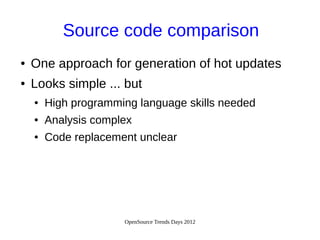
Source code comparison
● One approach for generation of hot updates
● Looks simple ... but
● High programming language skills needed
● Analysis complex
● Code replacement unclear
OpenSource Trends Days 2012
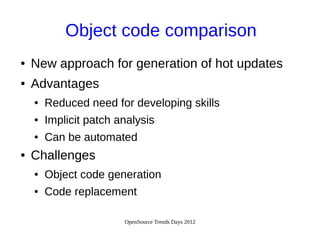
Object code comparison
● New approach for generation of hot updates
● Advantages
● Reduced need for developing skills
● Implicit patch analysis
● Can be automated
● Challenges
● Object code generation
● Code replacement
OpenSource Trends Days 2012
Ksplice arises ...
● 2008/2009
● 4 students @ MIT
– Thesis from Jeff Arnolds
● Ksplice Inc. founded
– GPLv2
– Supported: Debian, Ubuntu, Fedora, CentOS, RHEL
● July 2011
● Acquired by Oracle
OpenSource Trends Days 2012
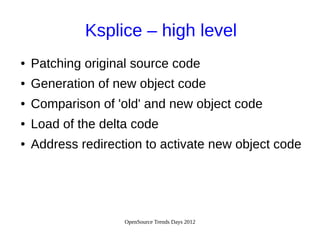
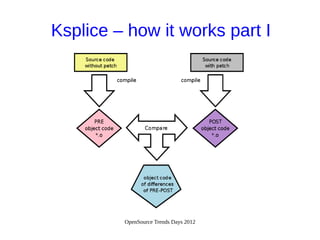
Ksplice – high level
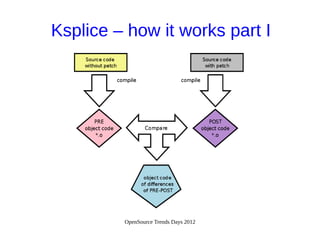
● Patching original source code
● Generation of new object code
● Comparison of 'old' and new object code
● Load of the delta code
● Address redirection to activate new object code
OpenSource Trends Days 2012
Ksplice – how it works part I
OpenSource Trends Days 2012
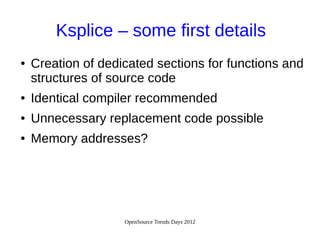
Ksplice – some first details
● Creation of dedicated sections for functions and
structures of source code
● Identical compiler recommended
● Unnecessary replacement code possible
● Memory addresses?
OpenSource Trends Days 2012
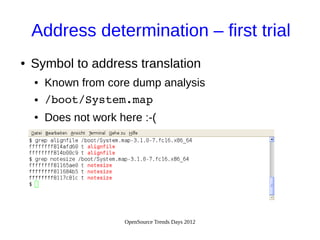
Address determination – first trial
● Symbol to address translation
● Known from core dump analysis
● /boot/System.map
● Does not work here :-(
OpenSource Trends Days 2012
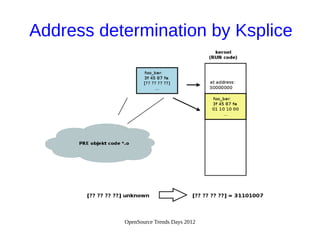
Address determination by Ksplice
● Pair up object code on disk (PRE) with object
code in memory (RUN)
● Filter of 'wrong' symbols
● Analysis of unknown address in PRE objects
via RUN objects
OpenSource Trends Days 2012
Address determination by Ksplice
OpenSource Trends Days 2012
Ksplice - more details
● Cancel if unexpected event during PRE-RUN
comparison
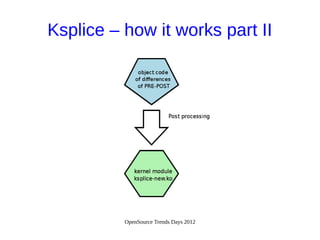
● PRE-RUN comparison => kernel module
OpenSource Trends Days 2012
Ksplice – how it works part I
OpenSource Trends Days 2012
Ksplice – how it works part II
OpenSource Trends Days 2012
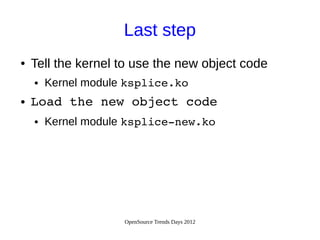
Last step
● Tell the kernel to use the new object code
● Kernel module ksplice.ko
● Load the new object code
● Kernel module ksplice­new.ko
OpenSource Trends Days 2012
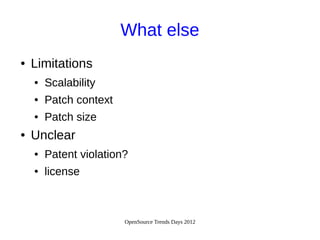
What else
● Limitations
● Scalability
● Patch context
● Patch size
● Unclear
● Patent violation?
● license
OpenSource Trends Days 2012
How?
Hotfix application
OpenSource Trends Days 2012
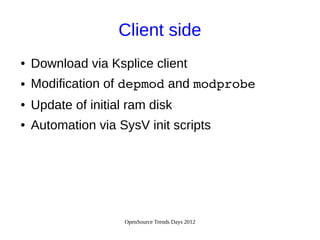
Client side
● Download via Ksplice client
● Modification of depmod and modprobe
● Update of initial ram disk
● Automation via SysV init scripts
OpenSource Trends Days 2012
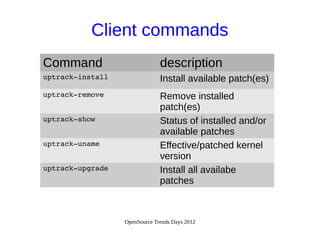
Client commands
Command description
uptrack­install Install available patch(es)
uptrack­remove Remove installed
patch(es)
uptrack­show Status of installed and/or
available patches
uptrack­uname Effective/patched kernel
version
uptrack­upgrade Install all availabe
patches
OpenSource Trends Days 2012
Show!
OpenSource Trends Days 2012
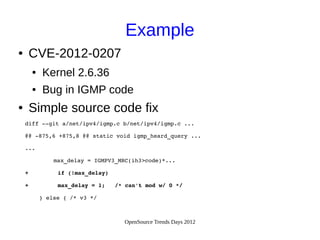
Example
● CVE-2012-0207
● Kernel 2.6.36
● Bug in IGMP code
● Simple source code fix
   diff ­­git a/net/ipv4/igmp.c b/net/ipv4/igmp.c ...
   @@ ­875,6 +875,8 @@ static void igmp_heard_query ...
   ...
        max_delay = IGMPV3_MRC(ih3>code)*...
   +    if (!max_delay)
   + max_delay = 1; /* can't mod w/ 0 */
     } else { /* v3 */
OpenSource Trends Days 2012
And?
OpenSource Trends Days 2012
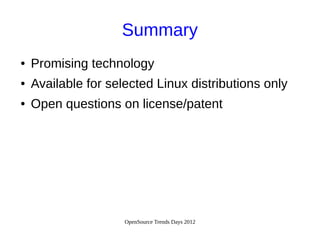
Summary
● Promising technology
● Available for selected Linux distributions only
● Open questions on license/patent
OpenSource Trends Days 2012
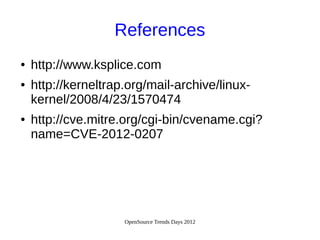
References
● http://www.ksplice.com
● http://kerneltrap.org/mail-archive/linux-
kernel/2008/4/23/1570474
● http://cve.mitre.org/cgi-bin/cvename.cgi?
name=CVE-2012-0207
OpenSource Trends Days 2012
Thank you!
OpenSource Trends Days 2012
Ksplice
Linux kernel patching without a reboot
Udo Seidel

Ostd.ksplice.talk

  • 1.
    OpenSource Trends Days2012 Ksplice Linux kernel patching without a reboot Udo Seidel
  • 2.
    OpenSource Trends Days2012 Agenda ● Who? ● Why? ● How? ● Show! ● And?
  • 3.
    OpenSource Trends Days2012 Me :-) ● Teacher of mathematics and physics ● PhD in experimental physics ● Started with Linux in 1996 ● Linux/UNIX trainer ● Solution engineer in HPC and CAx environment ● Head of a international distributed sysadmin team
  • 4.
  • 5.
    OpenSource Trends Days2012 Why kernel updates? ● Business critical applications on Linux ● Bug fixing ● New functions or improvements ● External requirements ● Importance of security, e.g. PCI-DSS
  • 6.
    OpenSource Trends Days2012 What is 'wrong' with reboots? ● Missing HA ● Procedures, Operations, ... ● External requirements
  • 7.
    OpenSource Trends Days2012 Do we really need a reboot? Question ....
  • 8.
    OpenSource Trends Days2012 Looking back and around ● Not new ● mainframes ● hot updates for Unix ● Early days of Linux ● Picked up 'recently' ● Rootkits
  • 9.
    OpenSource Trends Days2012 How? Hotfix preparation
  • 10.
    OpenSource Trends Days2012 Source code comparison ● One approach for generation of hot updates ● Looks simple ... but ● High programming language skills needed ● Analysis complex ● Code replacement unclear
  • 11.
    OpenSource Trends Days2012 Object code comparison ● New approach for generation of hot updates ● Advantages ● Reduced need for developing skills ● Implicit patch analysis ● Can be automated ● Challenges ● Object code generation ● Code replacement
  • 12.
    OpenSource Trends Days2012 Ksplice arises ... ● 2008/2009 ● 4 students @ MIT – Thesis from Jeff Arnolds ● Ksplice Inc. founded – GPLv2 – Supported: Debian, Ubuntu, Fedora, CentOS, RHEL ● July 2011 ● Acquired by Oracle
  • 13.
    OpenSource Trends Days2012 Ksplice – high level ● Patching original source code ● Generation of new object code ● Comparison of 'old' and new object code ● Load of the delta code ● Address redirection to activate new object code
  • 14.
    OpenSource Trends Days2012 Ksplice – how it works part I
  • 15.
    OpenSource Trends Days2012 Ksplice – some first details ● Creation of dedicated sections for functions and structures of source code ● Identical compiler recommended ● Unnecessary replacement code possible ● Memory addresses?
  • 16.
    OpenSource Trends Days2012 Address determination – first trial ● Symbol to address translation ● Known from core dump analysis ● /boot/System.map ● Does not work here :-(
  • 17.
    OpenSource Trends Days2012 Address determination by Ksplice ● Pair up object code on disk (PRE) with object code in memory (RUN) ● Filter of 'wrong' symbols ● Analysis of unknown address in PRE objects via RUN objects
  • 18.
    OpenSource Trends Days2012 Address determination by Ksplice
  • 19.
    OpenSource Trends Days2012 Ksplice - more details ● Cancel if unexpected event during PRE-RUN comparison ● PRE-RUN comparison => kernel module
  • 20.
    OpenSource Trends Days2012 Ksplice – how it works part I
  • 21.
    OpenSource Trends Days2012 Ksplice – how it works part II
  • 22.
    OpenSource Trends Days2012 Last step ● Tell the kernel to use the new object code ● Kernel module ksplice.ko ● Load the new object code ● Kernel module ksplice­new.ko
  • 23.
    OpenSource Trends Days2012 What else ● Limitations ● Scalability ● Patch context ● Patch size ● Unclear ● Patent violation? ● license
  • 24.
    OpenSource Trends Days2012 How? Hotfix application
  • 25.
    OpenSource Trends Days2012 Client side ● Download via Ksplice client ● Modification of depmod and modprobe ● Update of initial ram disk ● Automation via SysV init scripts
  • 26.
    OpenSource Trends Days2012 Client commands Command description uptrack­install Install available patch(es) uptrack­remove Remove installed patch(es) uptrack­show Status of installed and/or available patches uptrack­uname Effective/patched kernel version uptrack­upgrade Install all availabe patches
  • 27.
  • 28.
    OpenSource Trends Days2012 Example ● CVE-2012-0207 ● Kernel 2.6.36 ● Bug in IGMP code ● Simple source code fix    diff ­­git a/net/ipv4/igmp.c b/net/ipv4/igmp.c ...    @@ ­875,6 +875,8 @@ static void igmp_heard_query ...    ...         max_delay = IGMPV3_MRC(ih3>code)*...    +    if (!max_delay)    + max_delay = 1; /* can't mod w/ 0 */      } else { /* v3 */
  • 29.
  • 30.
    OpenSource Trends Days2012 Summary ● Promising technology ● Available for selected Linux distributions only ● Open questions on license/patent
  • 31.
    OpenSource Trends Days2012 References ● http://www.ksplice.com ● http://kerneltrap.org/mail-archive/linux- kernel/2008/4/23/1570474 ● http://cve.mitre.org/cgi-bin/cvename.cgi? name=CVE-2012-0207
  • 32.
    OpenSource Trends Days2012 Thank you!
  • 33.
    OpenSource Trends Days2012 Ksplice Linux kernel patching without a reboot Udo Seidel