Boilers
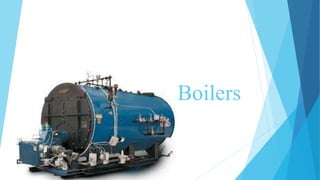
Boiler
 Boiler is an apparatus to produce steam.
 Thermal energy released by combustion of fuel issued to make steam at the
desired temperature and pressure.
The steam produced is used for:
1). generating power in steam engines or steam turbines.
2). Heating the residential and industrial buildings.
3). Performing certain processes in the sugar mills, chemical and textile
industries
Selection of boiler
 The working pressure & quality of steam.
 Steam generation.
 Floor area available.
 Accessibility for repair & inspection.
 Comparative initial cost.
 The fuel & water available.
 Operating & maintenance cost
BOILER PROPERTIES
 a). Safety: The boiler should be safe under the operating conditions.
 b). Accessibility: the various part of boiler should be accessible for repair &
maintenance.
 c). Capacity: Should be capable of supplying Steam according to the
requirements.
 d). Efficiency: Should be able to absorb a maximum amount of heat produced
due to burning of fuel in the furnace.
 e). It should be simple in construction.
 f). Its initial cost and maintenance cost is low.
 g). It should be capable of quick starting and loading
CLASSIFICATION OF BOILERS
 Horizontal, vertical or inclined
 Fire tube & water tube
 Externally fired & internally fired
 Forced circulation & internally fired
 High pressure & low pressure
 Forced circulation & natural circulation
 Stationary & portable
 Single tube & multi tube boilers
Horizontal , vertical or inclined
 If the axis of boiler is horizontal, the boiler is called horizontal
 If the axis is vertical then it is called vertical
 If the axis is inclined then it is called inclined
Advantage of horizontal boiler:
 a. it can repaired easily.
 b. occupies less floor area
Fire tube & water tube boiler
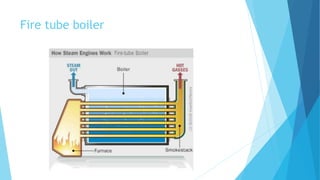
 In the fire tube boiler the hot gases are inside the tubes & the water
surrounds in the tube. ex. Cochran, locomotive etc.
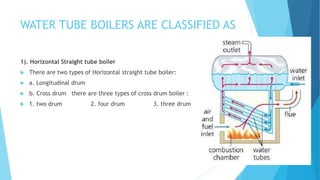
 In the water tube boiler the water is inside the tube & the hot gases are
surround them. ex. Stirling
Externally & internally fired
 The boiler is known as externally fired if the fire is outside the shell. ex.
Babcock & wilcox
 In case of internally fired boilers, the furnace is located inside the boiler
shell. ex: cochran, lancashire etc
Forced circulation & natural circulation
 In forced circulation type of boilers the circulation of water is done by forced
pumps. ex. Velox,lamont .
 In natural circulation type of boiler the circulation of water in boiler takes
place due to natural convention. ex. Lancashire, babcock
High pressure & low pressure boilers
 The boilers which produce steam at pressure of 80 bar and above are called
high pressure boiler. ex. Velox
 The boiler which produce steam at pressure below 80 bar are called low
pressure boiler. ex. cochran
Single tube multi-tube boilers
 The fire tube boilers are classified as single tube & multi tube boilers,
depending upon the fire tube is one more than one. Ex: cornish boiler
 Boiler mainly classified as:
 a. fire tube
 b. water tube
Fire tube boiler
Water tube boiler
TYPES OF FIRE TUBE BOILERS
There are mainly five types of fire tube boilers :
 1). Simple vertical boiler
 2). Cochran boiler
 3.) Cornish boiler
 4). Lancashire boiler
 5). Locomotive boiler
SIMPLE VERTICAL BOILER
 It consist of a cylindrical shell, the greater portion of which is full of water &
remaining is the steam space.
 At the bottom of the fire box is grate on which fuel is burnt and the ash from
it falls in the ash pit.
 A simple vertical boiler is self-contained & can be easily transported.
COCHRAN BOILER
 It is one of the best types of vertical multi-tubular boiler, and has a number of
horizontal fir tubes.
 Cochran boiler consist of a cylindrical shell with a dome shaped top where the
space is provided for steam
LANCASHIRE BOILER
 This boiler is reliable, has simplicity of design, ease of operation & less
operating & maintenance costs.
 It is commonly used in sugarmills & textile industries where along with the
power system & steam for the process work is also needed
Locomotive boiler
 Locomotive boiler is a horizontal fire tube type mobile boiler. The main
requirement of this boiler is that it should produce steam at a very high rate.
Therefore, this boiler requires a large amount of heating surface and large
grate area to burn coal at a rapid rate. In order to provide the large heating
surface area, a large number of fire tubes are setup and heat transfer rate is
increased by creating strong draught by means of steam jet.
 ADVANTAGE :
 a. Large rate of steam generation per square meter of heating surface. To
some extent this is due to the vibration caused by the motion.
 b. It is very compact.
 c. The pressure of the steam is limited to about 20 bar.
Locomotive boiler
WATER TUBE BOILERS ARE CLASSIFIED AS
1). Horizontal Straight tube boiler
 There are two types of Horizontal straight tube boiler:
 a. Longitudinal drum
 b. Cross drum there are three types of cross drum boiler :
 1. two drum 2. four drum 3. three drum
2). Bent tube boiler
 There are one type of bent tube boiler :
 a. Low head three drum
Thank You
for your attention

Boiler presentation

  • 1.
  • 2.
    Boiler  Boiler isan apparatus to produce steam.  Thermal energy released by combustion of fuel issued to make steam at the desired temperature and pressure. The steam produced is used for: 1). generating power in steam engines or steam turbines. 2). Heating the residential and industrial buildings. 3). Performing certain processes in the sugar mills, chemical and textile industries
  • 3.
    Selection of boiler The working pressure & quality of steam.  Steam generation.  Floor area available.  Accessibility for repair & inspection.  Comparative initial cost.  The fuel & water available.  Operating & maintenance cost
  • 4.
    BOILER PROPERTIES  a).Safety: The boiler should be safe under the operating conditions.  b). Accessibility: the various part of boiler should be accessible for repair & maintenance.  c). Capacity: Should be capable of supplying Steam according to the requirements.  d). Efficiency: Should be able to absorb a maximum amount of heat produced due to burning of fuel in the furnace.  e). It should be simple in construction.  f). Its initial cost and maintenance cost is low.  g). It should be capable of quick starting and loading
  • 5.
    CLASSIFICATION OF BOILERS Horizontal, vertical or inclined  Fire tube & water tube  Externally fired & internally fired  Forced circulation & internally fired  High pressure & low pressure  Forced circulation & natural circulation  Stationary & portable  Single tube & multi tube boilers
  • 6.
    Horizontal , verticalor inclined  If the axis of boiler is horizontal, the boiler is called horizontal  If the axis is vertical then it is called vertical  If the axis is inclined then it is called inclined Advantage of horizontal boiler:  a. it can repaired easily.  b. occupies less floor area
  • 7.
    Fire tube &water tube boiler  In the fire tube boiler the hot gases are inside the tubes & the water surrounds in the tube. ex. Cochran, locomotive etc.  In the water tube boiler the water is inside the tube & the hot gases are surround them. ex. Stirling
  • 8.
    Externally & internallyfired  The boiler is known as externally fired if the fire is outside the shell. ex. Babcock & wilcox  In case of internally fired boilers, the furnace is located inside the boiler shell. ex: cochran, lancashire etc
  • 9.
    Forced circulation &natural circulation  In forced circulation type of boilers the circulation of water is done by forced pumps. ex. Velox,lamont .  In natural circulation type of boiler the circulation of water in boiler takes place due to natural convention. ex. Lancashire, babcock
  • 10.
    High pressure &low pressure boilers  The boilers which produce steam at pressure of 80 bar and above are called high pressure boiler. ex. Velox  The boiler which produce steam at pressure below 80 bar are called low pressure boiler. ex. cochran
  • 11.
    Single tube multi-tubeboilers  The fire tube boilers are classified as single tube & multi tube boilers, depending upon the fire tube is one more than one. Ex: cornish boiler  Boiler mainly classified as:  a. fire tube  b. water tube
  • 12.
  • 13.
  • 14.
    TYPES OF FIRETUBE BOILERS There are mainly five types of fire tube boilers :  1). Simple vertical boiler  2). Cochran boiler  3.) Cornish boiler  4). Lancashire boiler  5). Locomotive boiler
  • 15.
    SIMPLE VERTICAL BOILER It consist of a cylindrical shell, the greater portion of which is full of water & remaining is the steam space.  At the bottom of the fire box is grate on which fuel is burnt and the ash from it falls in the ash pit.  A simple vertical boiler is self-contained & can be easily transported.
  • 16.
    COCHRAN BOILER  Itis one of the best types of vertical multi-tubular boiler, and has a number of horizontal fir tubes.  Cochran boiler consist of a cylindrical shell with a dome shaped top where the space is provided for steam
  • 17.
    LANCASHIRE BOILER  Thisboiler is reliable, has simplicity of design, ease of operation & less operating & maintenance costs.  It is commonly used in sugarmills & textile industries where along with the power system & steam for the process work is also needed
  • 18.
    Locomotive boiler  Locomotiveboiler is a horizontal fire tube type mobile boiler. The main requirement of this boiler is that it should produce steam at a very high rate. Therefore, this boiler requires a large amount of heating surface and large grate area to burn coal at a rapid rate. In order to provide the large heating surface area, a large number of fire tubes are setup and heat transfer rate is increased by creating strong draught by means of steam jet.  ADVANTAGE :  a. Large rate of steam generation per square meter of heating surface. To some extent this is due to the vibration caused by the motion.  b. It is very compact.  c. The pressure of the steam is limited to about 20 bar.
  • 19.
  • 20.
    WATER TUBE BOILERSARE CLASSIFIED AS 1). Horizontal Straight tube boiler  There are two types of Horizontal straight tube boiler:  a. Longitudinal drum  b. Cross drum there are three types of cross drum boiler :  1. two drum 2. four drum 3. three drum
  • 21.
    2). Bent tubeboiler  There are one type of bent tube boiler :  a. Low head three drum
  • 22.