Veeral Additives Private Limited – Mahad
CHILLER PPT
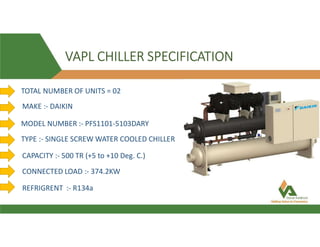
VAPL CHILLER SPECIFICATION
TOTAL NUMBER OF UNITS = 02
MAKE :- DAIKIN
MODEL NUMBER :- PFS1101-5103DARY
TYPE :- SINGLE SCREW WATER COOLED CHILLER
CAPACITY :- 500 TR (+5 to +10 Deg. C.)
CONNECTED LOAD :- 374.2KW
REFRIGRENT :- R134a
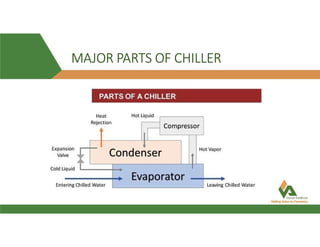
MAJOR PARTS OF CHILLER
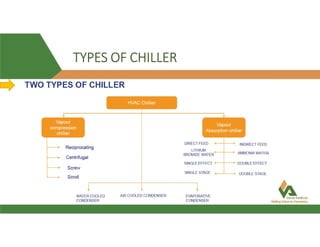
TYPES OF CHILLER
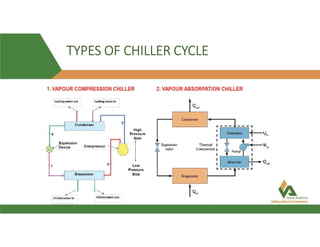
TYPES OF CHILLER CYCLE
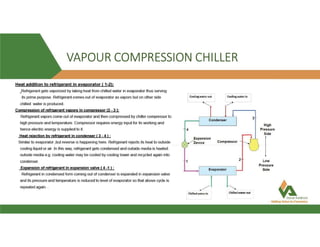
VAPOUR COMPRESSION CHILLER
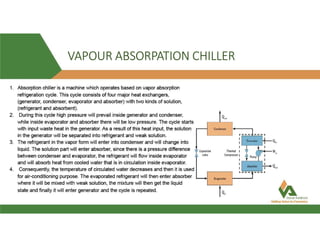
VAPOUR ABSORPATION CHILLER
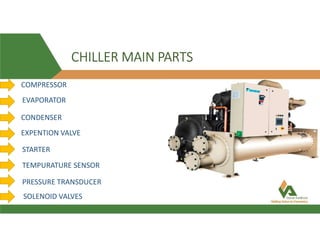
COMPRESSOR
EVAPORATOR
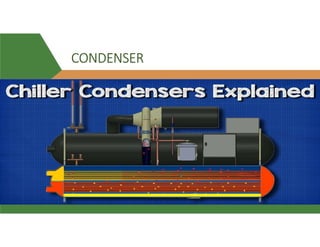
CONDENSER
EXPENTION VALVE
STARTER
TEMPURATURE SENSOR
PRESSURE TRANSDUCER
CHILLER MAIN PARTS
SOLENOID VALVES
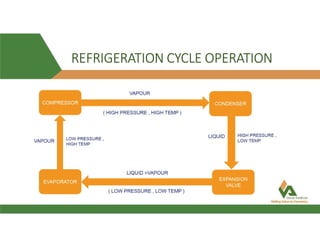
REFRIGERATION CYCLE OPERATION
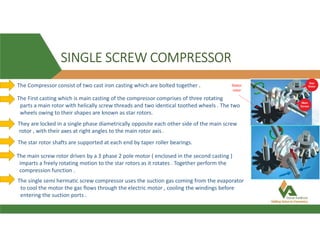
SINGLE SCREW COMPRESSOR
The Compressor consist of two cast iron casting which are bolted together . Stator
rotor
The First casting which is main casting of the compressor comprises of three rotating
parts a main rotor with helically screw threads and two identical toothed wheels . The two
wheels owing to their shapes are known as star rotors.
They are locked in a single phase diametrically opposite each other side of the main screw
rotor , with their axes at right angles to the main rotor axis .
The star rotor shafts are supported at each end by taper roller bearings.
The main screw rotor driven by a 3 phase 2 pole motor ( enclosed in the second casting )
imparts a freely rotating motion to the star rotors as it rotates . Together perform the
compression function .
The single semi hermatic screw compressor uses the suction gas coming from the evaporator
to cool the motor the gas flows through the electric motor , cooling the windings before
entering the suction ports .
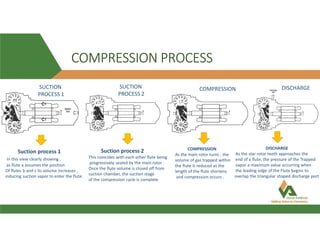
COMPRESSION PROCESS
SUCTION
PROCESS 1
SUCTION
PROCESS 2
COMPRESSION DISCHARGE
Suction process 1
In this view clearly showing ,
as flute a assumes the position
Of flutes b and c its volume increases ,
inducing suction vapor to enter the flute.
Suction process 2
This coincides with each other flute being
progressively sealed by the main rotor .
Once the flute volume is closed off from
suction chamber, the suction stage
of the compression cycle is complete
COMPRESSION
As the main rotor turns , the
volume of gas trapped within
the flute Is reduced as the
length of the flute shortens
and compression occurs .
DISCHARGE
As the star rotor teeth approaches the
end of a flute, the pressure of the Trapped
vapor a maximum value occurring when
the leading edge of the Flute begins to
overlap the triangular shaped discharge port
REFRIGERATION CYCLE OPERATION
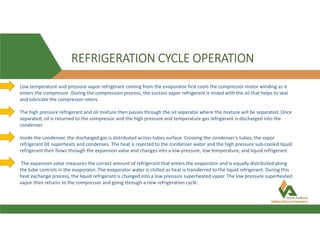
Low temperature and pressure vapor refrigerant coming from the evaporator first cools the compressor motor winding as it
enters the compressor .During the compression process, the suction vapor refrigerant is mixed with the oil that helps to seal
and lubricate the compressor rotors.
The high pressure refrigerant and oil mixture then passes through the oil separator where the mixture will be separated. Once
separated, oil is returned to the compressor and the high pressure and temperature gas refrigerant is discharged into the
condenser.
Inside the condenser, the discharged gas is distributed across tubes surface. Crossing the condenser’s tubes, the vapor
refrigerant DE superheats and condenses. The heat is rejected to the condenser water and the high pressure sub-cooled liquid
refrigerant then flows through the expansion valve and changes into a low pressure, low temperature, and liquid refrigerant.
The expansion valve measures the correct amount of refrigerant that enters the evaporator and is equally distributed along
the tube controls in the evaporator. The evaporator water is chilled as heat is transferred to the liquid refrigerant. During this
heat exchange process, the liquid refrigerant is changed into a low pressure superheated vapor. The low pressure superheated
vapor then returns to the compressor and going through a new refrigeration cycle.
EVAPORATOR
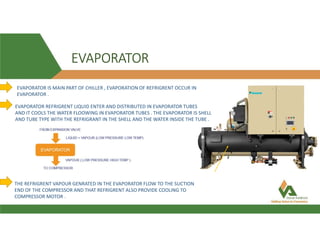
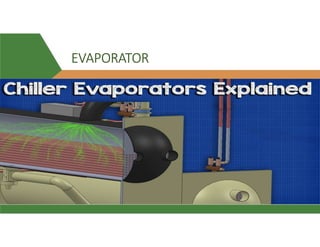
EVAPORATOR IS MAIN PART OF CHILLER , EVAPORATION OF REFRIGRENT OCCUR IN
EVAPORATOR .
EVAPORATOR REFRIGRENT LIQUID ENTER AND DISTRIBUTED IN EVAPORATOR TUBES
AND IT COOLS THE WATER FLOOWING IN EVAPORATOR TUBES . THE EVAPORATOR IS SHELL
AND TUBE TYPE WITH THE REFRIGRANT IN THE SHELL AND THE WATER INSIDE THE TUBE .
THE REFRIGRENT VAPOUR GENRATED IN THE EVAPORATOR FLOW TO THE SUCTION
END OF THE COMPRESSOR AND THAT REFRIGRENT ALSO PROVIDE COOLING TO
COMPRESSOR MOTOR .
CONDENSER
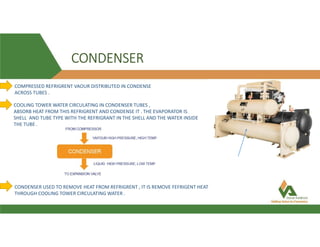
COMPRESSED REFRIGRENT VAOUR DISTRIBUTED IN CONDENSE
ACROSS TUBES .
COOLING TOWER WATER CIRCULATING IN CONDENSER TUBES ,
ABSORB HEAT FROM THIS REFRIGRENT AND CONDENSE IT . THE EVAPORATOR IS
SHELL AND TUBE TYPE WITH THE REFRIGRANT IN THE SHELL AND THE WATER INSIDE
THE TUBE .
CONDENSER USED TO REMOVE HEAT FROM REFRIGRENT , IT IS REMOVE FEFRIGENT HEAT
THROUGH COOLING TOWER CIRCULATING WATER .
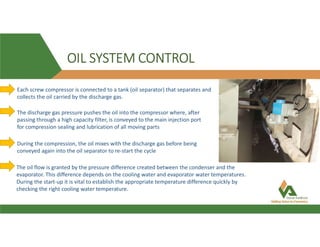
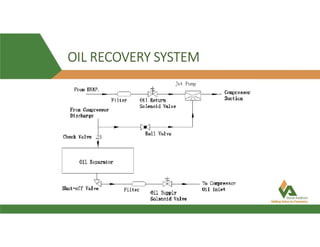
Each screw compressor is connected to a tank (oil separator) that separates and
collects the oil carried by the discharge gas.
OIL SYSTEM CONTROL
The discharge gas pressure pushes the oil into the compressor where, after
passing through a high capacity filter, is conveyed to the main injection port
for compression sealing and lubrication of all moving parts
During the compression, the oil mixes with the discharge gas before being
conveyed again into the oil separator to re-start the cycle
The oil flow is granted by the pressure difference created between the condenser and the
evaporator. This difference depends on the cooling water and evaporator water temperatures.
During the start-up it is vital to establish the appropriate temperature difference quickly by
checking the right cooling water temperature.
HEATING ELEMENT
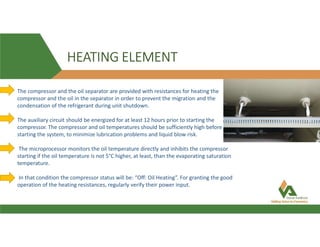
The compressor and the oil separator are provided with resistances for heating the
compressor and the oil in the separator in order to prevent the migration and the
condensation of the refrigerant during unit shutdown.
The auxiliary circuit should be energized for at least 12 hours prior to starting the
compressor. The compressor and oil temperatures should be sufficiently high before
starting the system, to minimize lubrication problems and liquid blow risk.
The microprocessor monitors the oil temperature directly and inhibits the compressor
starting if the oil temperature is not 5°C higher, at least, than the evaporating saturation
temperature.
In that condition the compressor status will be: “Off: Oil Heating”. For granting the good
operation of the heating resistances, regularly verify their power input.
CAPACITY SENSOR
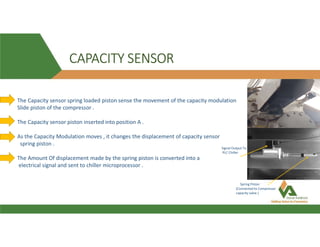
The Capacity sensor spring loaded piston sense the movement of the capacity modulation
Slide piston of the compressor .
The Capacity sensor piston inserted into position A .
As the Capacity Modulation moves , it changes the displacement of capacity sensor
spring piston .
The Amount Of displacement made by the spring piston is converted into a
electrical signal and sent to chiller microprocessor .
Signal Output To
PLC Chiller
Spring Piston
(Connected to Compressor
capacity valve )
OIL SEPRATOR
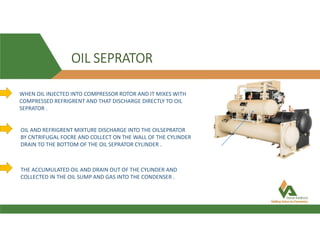
WHEN OIL INJECTED INTO COMPRESSOR ROTOR AND IT MIXES WITH
COMPRESSED REFRIGRENT AND THAT DISCHARGE DIRECTLY TO OIL
SEPRATOR .
OIL AND REFRIGRENT MIXTURE DISCHARGE INTO THE OILSEPRATOR
BY CNTRIFUGAL FOCRE AND COLLECT ON THE WALL OF THE CYLINDER
DRAIN TO THE BOTTOM OF THE OIL SEPRATOR CYLINDER .
THE ACCUMULATED OIL AND DRAIN OUT OF THE CYLINDER AND
COLLECTED IN THE OIL SUMP AND GAS INTO THE CONDENSER .
Compressor Load Unload Valve
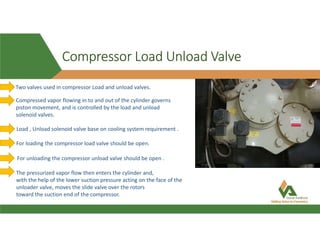
Two valves used in compressor Load and unload valves.
Compressed vapor flowing in to and out of the cylinder governs
piston movement, and is controlled by the load and unload
solenoid valves.
Load , Unload solenoid valve base on cooling system requirement .
For loading the compressor load valve should be open.
For unloading the compressor unload valve should be open .
The pressurized vapor flow then enters the cylinder and,
with the help of the lower suction pressure acting on the face of the
unloader valve, moves the slide valve over the rotors
toward the suction end of the compressor.
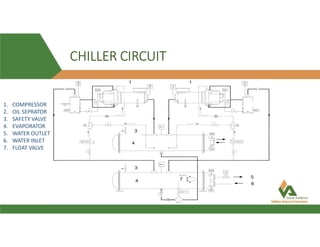
CHILLER CIRCUIT
1. COMPRESSOR
2. OIL SEPRATOR
3. SAFETY VALVE
4. EVAPORATOR
5. WATER OUTLET
6. WATER INLET
7. FLOAT VALVE
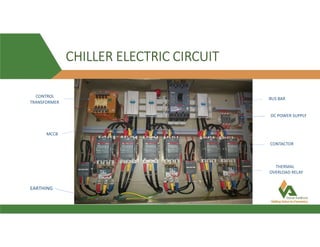
CHILLER ELECTRIC CIRCUIT
BUS BAR
DC POWER SUPPLY
CONTACTOR
THERMAL
OVERLOAD RELAY
CONTROL
TRANSFORMER
MCCB
EARTHING
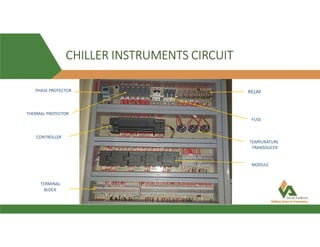
CHILLER INSTRUMENTS CIRCUIT
PHASE PROTECTOR
CONTROLLER
TERMINAL
BLOCK
THERMAL PROTECTOR
RELAY
FUSE
TEMPURATURE
TRANSDUCER
MODULE
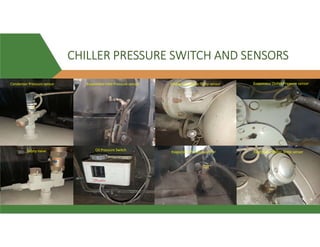
CHILLER PRESSURE SWITCH AND SENSORS
Condenser Pressure sensor Evaporator Inlet Pressure sensor Condenser Water Temp sensor
Evaporator Water Temp sensor
Evaporator Pressure sensor
Evaporator Outlet Pressure sensor
Safety Valve Oil Pressure Switch
OIL RECOVERY SYSTEM
EXPANSION VALVE
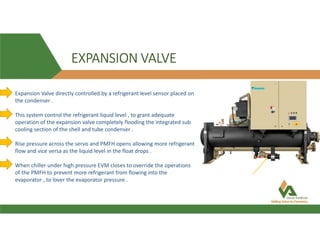
Expansion Valve directly controlled by a refrigerant level sensor placed on
the condenser .
This system control the refrigerant liquid level , to grant adequate
operation of the expansion valve completely flooding the integrated sub
cooling section of the shell and tube condenser .
Rise pressure across the servo and PMFH opens allowing more refrigerant
flow and vice versa as the liquid level in the float drops .
When chiller under high pressure EVM closes to override the operations
of the PMFH to prevent more refrigerant from flowing into the
evaporator , to lover the evaporator pressure .
ELECTRONIC EXPENSION VALVE
EVAPORATOR
CONDENSER
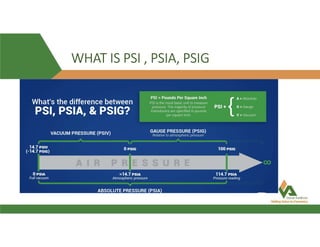
WHAT IS PSI , PSIA, PSIG
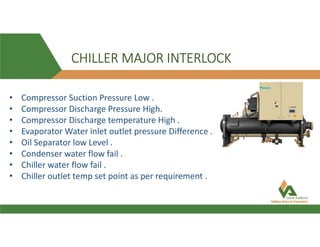
CHILLER MAJOR INTERLOCK
• Compressor Suction Pressure Low .
• Compressor Discharge Pressure High.
• Compressor Discharge temperature High .
• Evaporator Water inlet outlet pressure Difference .
• Oil Separator low Level .
• Condenser water flow fail .
• Chiller water flow fail .
• Chiller outlet temp set point as per requirement .
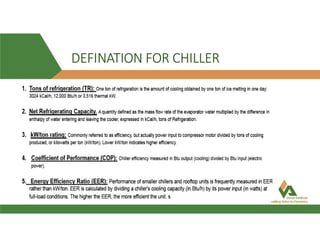
DEFINATION FOR CHILLER
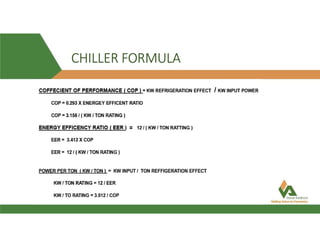
CHILLER FORMULA
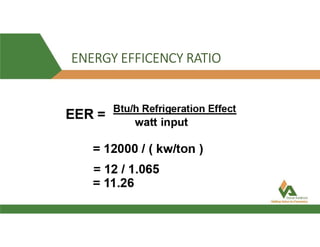
ENERGY EFFICENCY RATIO
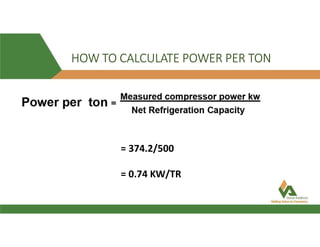
HOW TO CALCULATE POWER PER TON
= 374.2/500
= 0.74 KW/TR
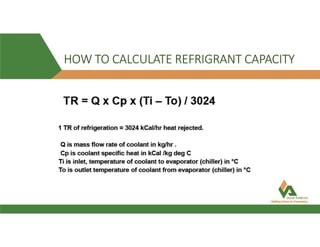
HOW TO CALCULATE REFRIGRANT CAPACITY
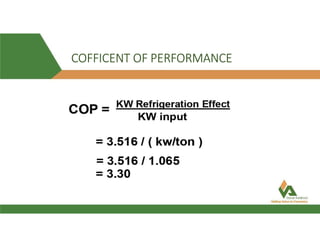
COFFICENT OF PERFORMANCE
Thank you
DEEPAK SINGH
9634844138

Chiller ppt

  • 1.
    Veeral Additives PrivateLimited – Mahad CHILLER PPT
  • 2.
    VAPL CHILLER SPECIFICATION TOTALNUMBER OF UNITS = 02 MAKE :- DAIKIN MODEL NUMBER :- PFS1101-5103DARY TYPE :- SINGLE SCREW WATER COOLED CHILLER CAPACITY :- 500 TR (+5 to +10 Deg. C.) CONNECTED LOAD :- 374.2KW REFRIGRENT :- R134a
  • 3.
  • 4.
  • 5.
  • 6.
  • 7.
  • 8.
  • 9.
  • 10.
    SINGLE SCREW COMPRESSOR TheCompressor consist of two cast iron casting which are bolted together . Stator rotor The First casting which is main casting of the compressor comprises of three rotating parts a main rotor with helically screw threads and two identical toothed wheels . The two wheels owing to their shapes are known as star rotors. They are locked in a single phase diametrically opposite each other side of the main screw rotor , with their axes at right angles to the main rotor axis . The star rotor shafts are supported at each end by taper roller bearings. The main screw rotor driven by a 3 phase 2 pole motor ( enclosed in the second casting ) imparts a freely rotating motion to the star rotors as it rotates . Together perform the compression function . The single semi hermatic screw compressor uses the suction gas coming from the evaporator to cool the motor the gas flows through the electric motor , cooling the windings before entering the suction ports .
  • 11.
    COMPRESSION PROCESS SUCTION PROCESS 1 SUCTION PROCESS2 COMPRESSION DISCHARGE Suction process 1 In this view clearly showing , as flute a assumes the position Of flutes b and c its volume increases , inducing suction vapor to enter the flute. Suction process 2 This coincides with each other flute being progressively sealed by the main rotor . Once the flute volume is closed off from suction chamber, the suction stage of the compression cycle is complete COMPRESSION As the main rotor turns , the volume of gas trapped within the flute Is reduced as the length of the flute shortens and compression occurs . DISCHARGE As the star rotor teeth approaches the end of a flute, the pressure of the Trapped vapor a maximum value occurring when the leading edge of the Flute begins to overlap the triangular shaped discharge port
  • 12.
    REFRIGERATION CYCLE OPERATION Lowtemperature and pressure vapor refrigerant coming from the evaporator first cools the compressor motor winding as it enters the compressor .During the compression process, the suction vapor refrigerant is mixed with the oil that helps to seal and lubricate the compressor rotors. The high pressure refrigerant and oil mixture then passes through the oil separator where the mixture will be separated. Once separated, oil is returned to the compressor and the high pressure and temperature gas refrigerant is discharged into the condenser. Inside the condenser, the discharged gas is distributed across tubes surface. Crossing the condenser’s tubes, the vapor refrigerant DE superheats and condenses. The heat is rejected to the condenser water and the high pressure sub-cooled liquid refrigerant then flows through the expansion valve and changes into a low pressure, low temperature, and liquid refrigerant. The expansion valve measures the correct amount of refrigerant that enters the evaporator and is equally distributed along the tube controls in the evaporator. The evaporator water is chilled as heat is transferred to the liquid refrigerant. During this heat exchange process, the liquid refrigerant is changed into a low pressure superheated vapor. The low pressure superheated vapor then returns to the compressor and going through a new refrigeration cycle.
  • 13.
    EVAPORATOR EVAPORATOR IS MAINPART OF CHILLER , EVAPORATION OF REFRIGRENT OCCUR IN EVAPORATOR . EVAPORATOR REFRIGRENT LIQUID ENTER AND DISTRIBUTED IN EVAPORATOR TUBES AND IT COOLS THE WATER FLOOWING IN EVAPORATOR TUBES . THE EVAPORATOR IS SHELL AND TUBE TYPE WITH THE REFRIGRANT IN THE SHELL AND THE WATER INSIDE THE TUBE . THE REFRIGRENT VAPOUR GENRATED IN THE EVAPORATOR FLOW TO THE SUCTION END OF THE COMPRESSOR AND THAT REFRIGRENT ALSO PROVIDE COOLING TO COMPRESSOR MOTOR .
  • 14.
    CONDENSER COMPRESSED REFRIGRENT VAOURDISTRIBUTED IN CONDENSE ACROSS TUBES . COOLING TOWER WATER CIRCULATING IN CONDENSER TUBES , ABSORB HEAT FROM THIS REFRIGRENT AND CONDENSE IT . THE EVAPORATOR IS SHELL AND TUBE TYPE WITH THE REFRIGRANT IN THE SHELL AND THE WATER INSIDE THE TUBE . CONDENSER USED TO REMOVE HEAT FROM REFRIGRENT , IT IS REMOVE FEFRIGENT HEAT THROUGH COOLING TOWER CIRCULATING WATER .
  • 15.
    Each screw compressoris connected to a tank (oil separator) that separates and collects the oil carried by the discharge gas. OIL SYSTEM CONTROL The discharge gas pressure pushes the oil into the compressor where, after passing through a high capacity filter, is conveyed to the main injection port for compression sealing and lubrication of all moving parts During the compression, the oil mixes with the discharge gas before being conveyed again into the oil separator to re-start the cycle The oil flow is granted by the pressure difference created between the condenser and the evaporator. This difference depends on the cooling water and evaporator water temperatures. During the start-up it is vital to establish the appropriate temperature difference quickly by checking the right cooling water temperature.
  • 16.
    HEATING ELEMENT The compressorand the oil separator are provided with resistances for heating the compressor and the oil in the separator in order to prevent the migration and the condensation of the refrigerant during unit shutdown. The auxiliary circuit should be energized for at least 12 hours prior to starting the compressor. The compressor and oil temperatures should be sufficiently high before starting the system, to minimize lubrication problems and liquid blow risk. The microprocessor monitors the oil temperature directly and inhibits the compressor starting if the oil temperature is not 5°C higher, at least, than the evaporating saturation temperature. In that condition the compressor status will be: “Off: Oil Heating”. For granting the good operation of the heating resistances, regularly verify their power input.
  • 17.
    CAPACITY SENSOR The Capacitysensor spring loaded piston sense the movement of the capacity modulation Slide piston of the compressor . The Capacity sensor piston inserted into position A . As the Capacity Modulation moves , it changes the displacement of capacity sensor spring piston . The Amount Of displacement made by the spring piston is converted into a electrical signal and sent to chiller microprocessor . Signal Output To PLC Chiller Spring Piston (Connected to Compressor capacity valve )
  • 18.
    OIL SEPRATOR WHEN OILINJECTED INTO COMPRESSOR ROTOR AND IT MIXES WITH COMPRESSED REFRIGRENT AND THAT DISCHARGE DIRECTLY TO OIL SEPRATOR . OIL AND REFRIGRENT MIXTURE DISCHARGE INTO THE OILSEPRATOR BY CNTRIFUGAL FOCRE AND COLLECT ON THE WALL OF THE CYLINDER DRAIN TO THE BOTTOM OF THE OIL SEPRATOR CYLINDER . THE ACCUMULATED OIL AND DRAIN OUT OF THE CYLINDER AND COLLECTED IN THE OIL SUMP AND GAS INTO THE CONDENSER .
  • 19.
    Compressor Load UnloadValve Two valves used in compressor Load and unload valves. Compressed vapor flowing in to and out of the cylinder governs piston movement, and is controlled by the load and unload solenoid valves. Load , Unload solenoid valve base on cooling system requirement . For loading the compressor load valve should be open. For unloading the compressor unload valve should be open . The pressurized vapor flow then enters the cylinder and, with the help of the lower suction pressure acting on the face of the unloader valve, moves the slide valve over the rotors toward the suction end of the compressor.
  • 20.
    CHILLER CIRCUIT 1. COMPRESSOR 2.OIL SEPRATOR 3. SAFETY VALVE 4. EVAPORATOR 5. WATER OUTLET 6. WATER INLET 7. FLOAT VALVE
  • 21.
    CHILLER ELECTRIC CIRCUIT BUSBAR DC POWER SUPPLY CONTACTOR THERMAL OVERLOAD RELAY CONTROL TRANSFORMER MCCB EARTHING
  • 22.
    CHILLER INSTRUMENTS CIRCUIT PHASEPROTECTOR CONTROLLER TERMINAL BLOCK THERMAL PROTECTOR RELAY FUSE TEMPURATURE TRANSDUCER MODULE
  • 23.
    CHILLER PRESSURE SWITCHAND SENSORS Condenser Pressure sensor Evaporator Inlet Pressure sensor Condenser Water Temp sensor Evaporator Water Temp sensor Evaporator Pressure sensor Evaporator Outlet Pressure sensor Safety Valve Oil Pressure Switch
  • 24.
  • 25.
    EXPANSION VALVE Expansion Valvedirectly controlled by a refrigerant level sensor placed on the condenser . This system control the refrigerant liquid level , to grant adequate operation of the expansion valve completely flooding the integrated sub cooling section of the shell and tube condenser . Rise pressure across the servo and PMFH opens allowing more refrigerant flow and vice versa as the liquid level in the float drops . When chiller under high pressure EVM closes to override the operations of the PMFH to prevent more refrigerant from flowing into the evaporator , to lover the evaporator pressure .
  • 26.
  • 27.
  • 28.
  • 29.
    WHAT IS PSI, PSIA, PSIG
  • 30.
    CHILLER MAJOR INTERLOCK •Compressor Suction Pressure Low . • Compressor Discharge Pressure High. • Compressor Discharge temperature High . • Evaporator Water inlet outlet pressure Difference . • Oil Separator low Level . • Condenser water flow fail . • Chiller water flow fail . • Chiller outlet temp set point as per requirement .
  • 31.
  • 32.
  • 33.
  • 34.
    HOW TO CALCULATEPOWER PER TON = 374.2/500 = 0.74 KW/TR
  • 35.
    HOW TO CALCULATEREFRIGRANT CAPACITY
  • 36.
  • 37.