Veeral Additives Private Limited – Mahad
ICOG BREAKER AND RELAYS
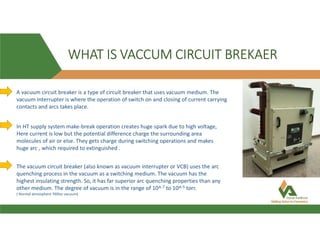
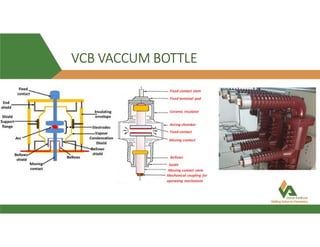
WHAT IS VACCUM CIRCUIT BREKAER
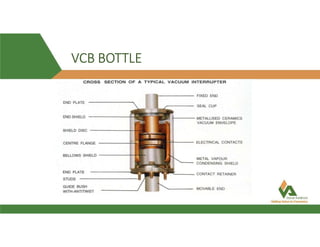
A vacuum circuit breaker is a type of circuit breaker that uses vacuum medium. The
vacuum interrupter is where the operation of switch on and closing of current carrying
contacts and arcs takes place.
In HT supply system make-break operation creates huge spark due to high voltage,
Here current is low but the potential difference charge the surrounding area
molecules of air or else. They gets charge during switching operations and makes
huge arc , which required to extinguished .
The vacuum circuit breaker (also known as vacuum interrupter or VCB) uses the arc
quenching process in the vacuum as a switching medium. The vacuum has the
highest insulating strength. So, it has far superior arc quenching properties than any
other medium. The degree of vacuum is in the range of 10^-7 to 10^-5 torr.
( Normal atmosphere 760tor vacuum)
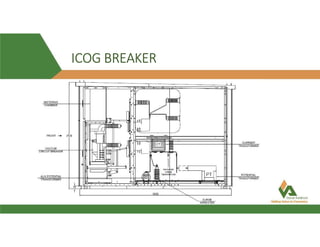
ICOG BREAKER
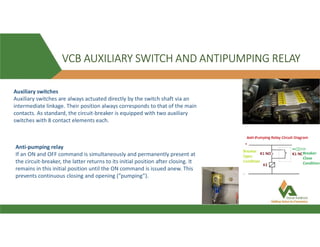
VCB AUXILIARY SWITCH AND ANTIPUMPING RELAY
Auxiliary switches
Auxiliary switches are always actuated directly by the switch shaft via an
intermediate linkage. Their position always corresponds to that of the main
contacts. As standard, the circuit-breaker is equipped with two auxiliary
switches with 8 contact elements each.
Anti-pumping relay
If an ON and OFF command is simultaneously and permanently present at
the circuit-breaker, the latter returns to its initial position after closing. It
remains in this initial position until the ON command is issued anew. This
prevents continuous closing and opening (”pumping”).
VCB VACCUM BOTTLE
VCB BOTTLE
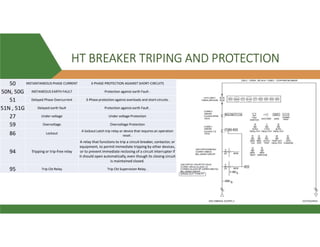
HT BREAKER TRIPING AND PROTECTION
50 INSTANTANEOUS PHASE CURRENT 3-PHASE PROTECTION AGAINST SHORT-CIRCUITS
50N, 50G INSTANEOUS EARTH FAULT Protection against earth Fault .
51 Delayed Phase Overcurrent 3-Phase protection against overloads and short-circuits.
51N , 51G Delayed earth fault Protection against earth Fault .
27 Under voltage Under voltage Protection
59 Overvoltage Overvoltage Protection
86 Lockout
A lockout Latch trip relay or device that requires an operation
reset .
94 Tripping or trip-free relay
A relay that functions to trip a circuit breaker, contactor, or
equipment, to permit immediate tripping by other devices,
or to prevent immediate reclosing of a circuit interrupter if
it should open automatically, even though its closing circuit
is maintained closed.
95 Trip Ckt Relay Trip Ckt Supervision Relay .
TECHANICAL DATA
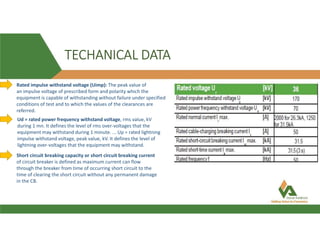
Rated impulse withstand voltage (Uimp): The peak value of
an impulse voltage of prescribed form and polarity which the
equipment is capable of withstanding without failure under specified
conditions of test and to which the values of the clearances are
referred.
Ud = rated power frequency withstand voltage, rms value, kV
during 1 mn. It defines the level of rms over-voltages that the
equipment may withstand during 1 minute. ... Up = rated lightning
impulse withstand voltage, peak value, kV. It defines the level of
lightning over-voltages that the equipment may withstand.
Short circuit breaking capacity or short circuit breaking current
of circuit breaker is defined as maximum current can flow
through the breaker from time of occurring short circuit to the
time of clearing the short circuit without any permanent damage
in the CB.
VACCUM CIRCUIT BREAKER
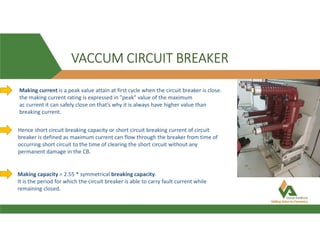
Making current is a peak value attain at first cycle when the circuit breaker is close.
the making current rating is expressed in "peak" value of the maximum
ac current it can safely close on that's why it is always have higher value than
breaking current.
Hence short circuit breaking capacity or short circuit breaking current of circuit
breaker is defined as maximum current can flow through the breaker from time of
occurring short circuit to the time of clearing the short circuit without any
permanent damage in the CB.
Making capacity = 2.55 * symmetrical breaking capacity.
It is the period for which the circuit breaker is able to carry fault current while
remaining closed.
VCB RESISTANCE TEST
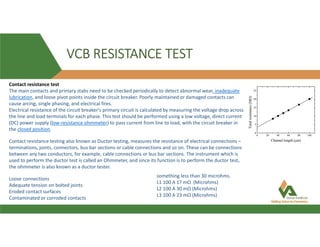
Contact resistance test
The main contacts and primary stabs need to be checked periodically to detect abnormal wear, inadequate
lubrication, and loose pivot points inside the circuit breaker. Poorly maintained or damaged contacts can
cause arcing, single phasing, and electrical fires.
Electrical resistance of the circuit breaker's primary circuit is calculated by measuring the voltage drop across
the line and load terminals for each phase. This test should be performed using a low voltage, direct current
(DC) power supply (low-resistance ohmmeter) to pass current from line to load, with the circuit breaker in
the closed position.
Contact resistance testing also known as Ductor testing, measures the resistance of electrical connections –
terminations, joints, connectors, bus bar sections or cable connections and so on. These can be connections
between any two conductors, for example, cable connections or bus bar sections. The instrument which is
used to perform the ductor test is called an Ohmmeter, and since its function is to perform the ductor test,
the ohmmeter is also known as a ductor tester.
Loose connections
Adequate tension on bolted joints
Eroded contact surfaces
Contaminated or corroded contacts
something less than 30 microhms.
L1 100 A 17 mΩ (Microhms)
L2 100 A 30 mΩ (Microhms)
L3 100 A 23 mΩ (Microhms)
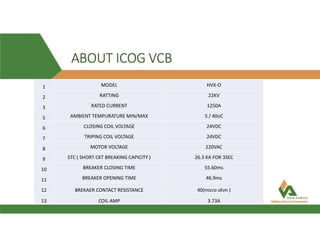
ABOUT ICOG VCB
1 MODEL HVX-O
2 RATTING 22KV
3 RATED CURRENT 1250A
5 AMBIENT TEMPURATURE MIN/MAX 5 / 40oC
6 CLOSING COIL VOLTAGE 24VDC
7 TRIPING COIL VOLTAGE 24VDC
8 MOTOR VOLTAGE 220VAC
9 STC ( SHORT CKT BREAKING CAPICITY ) 26.3 KA FOR 3SEC
10 BREAKER CLOSING TIME 55.60ms
11 BREAKER OPENING TIME 46.9ms
12 BREKAER CONTACT RESISTANCE 40(micro ohm )
13 COIL AMP 3.73A
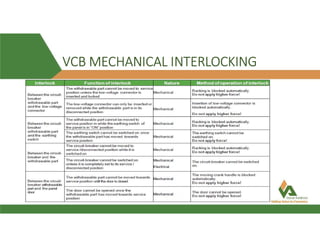
VCB MECHANICAL INTERLOCKING
DIFFRENACE BETWEEN UV RELEASE AND SHUNT RELEASE
What is the difference between a shunt trip and under voltage release?
The main difference between a shunt trip and an under voltage release is that the shunt trip opens the circuit
breaker when a control voltage is applied to its coil. On the other hand, the under voltage release trips the breaker
when a control voltage is removed from its coil
MN under voltage release
The MN release opens the circuit breaker when its supply voltage drops to a value
below 35% of its rated voltage Un.
Under voltage tripping, combined with an emergency-off button, provides fail-safe
tripping. The MN release is continuously supplied, i.e. if supply is interrupted:
either voluntarily, by the emergency-off button,
or accidentally, through loss of power or faulty wiring,
the release provokes opening of the circuit breaker.
MX shunt release
The MX release opens the circuit breaker via an impulse-type (u 20 ms) or
maintained order.
Opening conditions
When the MX release is supplied, it automatically opens the circuit breaker. Opening
is ensured for a voltage U u 0.7 x Un.
VCB OTHER ACCOSSORIES
• Shunt tripping release .
• Additional shunt tripping release
• Shunt closing release
• Opening solenoid (for self-supplied overcurrent relay)
• Under voltage release
• Electronic time delay (which must be mounted externally in
relation to the circuit breaker) for under voltage release
• Mechanical override for under voltage release
• Opening and closing pushbuttons protection
• Opening and closing pushbuttons padlock
• Key-lock in open position
• 5 extra auxiliary contacts
VCB FEATURES
• Vacuum interruption technique
• Contacts in vacuum protected against oxidation and contamination
• Sealed for life vacuum interrupters
• Vacuum interrupters and EL mechanical actuator already used and tested in new series
• Limited switching energy
• 10,000 mechanical operations
• Stored energy operating mechanism with built-in anti-pumping device and closing spring
charging lever
• Insulating monobloc
• Operating mechanism and monobloc fixed to a sturdy metal frame
• Easy customization with a complete range of accessories
• Locks to prevent incorrect and hazardous operations
• Motor gear for closing spring charging.
• Signalling contact closing spring charged or signalling contact
closing spring discharged
• Locking magnet in the truck to prevent racking-in with auxiliary
circuits disconnected (for withdrawable CB only)
• Transmitted contacts in the truck for signalling inserted or isolated
circuit breaker (for withdrawable CB only)
• Interlock for fixed circuit breaker which is converted in
withdrawable ones by the customer (to prevent racking-out/in with
the circuit breaker closed and to prevent closing operation during
the translation)
VCB OTHER FEATURES
VCB STANDARD EQUIPMENT
• Mechanical signalling device for CB open/closed
• Mechanical signalling device for closing spring charged/discharged
• Opening and closing pushbuttons
• Mechanical operation counter
• Built-in lever for manually charging of closing spring
• Anti-pumping mechanical built-in function
• 5 + 5 auxiliary contacts
• Connection terminals and terminal board for auxiliary circuits (for
fixed CB)
• Isolating contacts, cord with connector (plug only), racking-in/out
lever (for withdrawable CB)
ADVANTAGES OF VCB
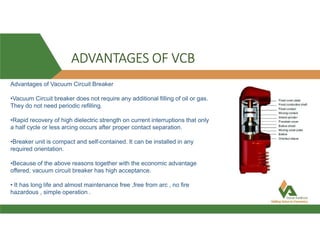
Advantages of Vacuum Circuit Breaker
•Vacuum Circuit breaker does not require any additional filling of oil or gas.
They do not need periodic refilling.
•Rapid recovery of high dielectric strength on current interruptions that only
a half cycle or less arcing occurs after proper contact separation.
•Breaker unit is compact and self-contained. It can be installed in any
required orientation.
•Because of the above reasons together with the economic advantage
offered, vacuum circuit breaker has high acceptance.
• It has long life and almost maintenance free ,free from arc , no fire
hazardous , simple operation .
DISADVATAGES OF VCB
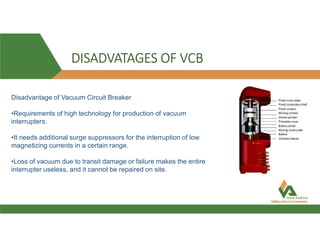
Disadvantage of Vacuum Circuit Breaker
•Requirements of high technology for production of vacuum
interrupters.
•It needs additional surge suppressors for the interruption of low
magnetizing currents in a certain range.
•Loss of vacuum due to transit damage or failure makes the entire
interrupter useless, and it cannot be repaired on site.
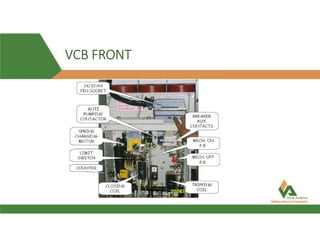
VCB FRONT
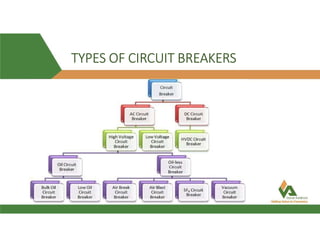
TYPES OF CIRCUIT BREAKERS
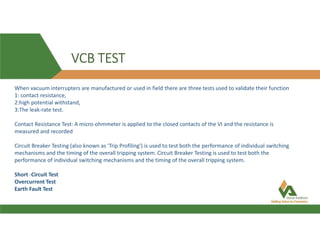
VCB TEST
When vacuum interrupters are manufactured or used in field there are three tests used to validate their function
1: contact resistance,
2:high potential withstand,
3:The leak-rate test.
Contact Resistance Test: A micro-ohmmeter is applied to the closed contacts of the VI and the resistance is
measured and recorded
Circuit Breaker Testing (also known as 'Trip Profiling') is used to test both the performance of individual switching
mechanisms and the timing of the overall tripping system. Circuit Breaker Testing is used to test both the
performance of individual switching mechanisms and the timing of the overall tripping system.
Short -Circuit Test
Overcurrent Test
Earth Fault Test
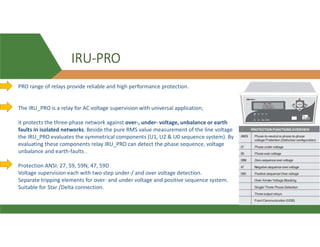
IRU-PRO
PRO range of relays provide reliable and high performance protection.
The IRU_PRO is a relay for AC voltage supervision with universal application;
it protects the three-phase network against over-, under- voltage, unbalance or earth
faults in isolated networks. Beside the pure RMS value measurement of the line voltage
the IRU_PRO evaluates the symmetrical components (U1, U2 & U0 sequence system). By
evaluating these components relay IRU_PRO can detect the phase sequence, voltage
unbalance and earth-faults .
Protection ANSI: 27, 59, 59N, 47, 59D
Voltage supervision each with two step under-/ and over voltage detection.
Separate tripping elements for over- and under voltage and positive sequence system.
Suitable for Star /Delta connection.
MICOM P111
1 – Green “Healthy” LED: Watchdog
2 – Red “Trip” LED: Protection trip
3 – Yellow “Alarm” LED: Alarm signaling
4, 5, 6, 7, 8 – Red programmable LED
9 – 16-character by 2-line alphanumeric liquid crystal
display (LCD)
10 – Clear key
11 – Read key
12 – 4 arrow keys, an enter key
14 – CB Close key
15 – CB Open Key
16 – USB port for local connection
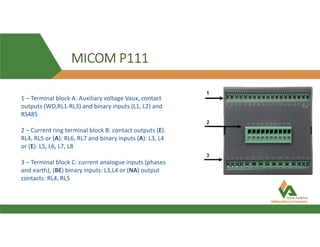
MICOM P111
1 – Terminal block A: Auxiliary voltage Vaux, contact
outputs (WD,RL1-RL3) and binary inputs (L1, L2) and
RS485
2 – Current ring terminal block B: contact outputs (E):
RL4, RL5 or (A): RL6, RL7 and binary inputs (A): L3, L4
or (E): L5, L6, L7, L8
3 – Terminal block C: current analogue inputs (phases
and earth), (BE) binary inputs: L3,L4 or (NA) output
contacts: RL4, RL5
MICOM P111
Each setting group includes: -
Protection settings - Output relay
configuration - Binary input
configuration - Programmable
LED configuration
MICOM P-111 PROTECTION
Phase O/C [50/51]:- The overcurrent protection included in the P111 relay provides non-directional three-phase overcurrent
protection with independent time-delay characteristics. All overcurrent settings apply to all of the three phases but are
independent for each of the three stages.
SOTF (Switch On To Fault function) :- With the Switch On To Fault (SOTF) submenu, it is possible to shorten the time to trip
when for example the relay has detected a fault that is still present on a feeder after energizing.
The SOTF overcurrent element is activated after the CB's state changes from open to closed. SOTF is blocked when the auto-
recloser is running (E)
E/Gnd Fault [50N/51N] :- The earth fault element operates from earth fault current that is measured directly from the
system; either by means of a separate CT located in a power system earth connection or via a residual connection of the
three line CTs. All overcurrent settings are independent for each of the two stages (Model E: three stages).
The first stage of e/f non-directional overcurrent protection has time-delayed characteristics which are selectable between
inverse definite minimum time (IDMT) and definite time (DMT). The second stage and the third (E) have definite time
characteristics only.
Negative Sequence O/C [46] (E)
Broken Conductor (E)
Thermal Overload [49]
CB Fail [50BF]
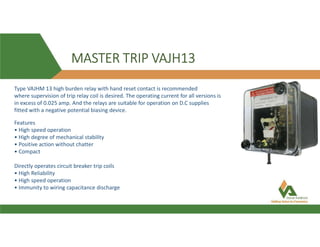
MASTER TRIP VAJH13
Features
• High speed operation
• High degree of mechanical stability
• Positive action without chatter
• Compact
Directly operates circuit breaker trip coils
• High Reliability
• High speed operation
• Immunity to wiring capacitance discharge
Type VAJHM 13 high burden relay with hand reset contact is recommended
where supervision of trip relay coil is desired. The operating current for all versions is
in excess of 0.025 amp. And the relays are suitable for operation on D.C supplies
fitted with a negative potential biasing device.
Thank you
DEEPAK SINGH
9634844138

Vcb ppt.

  • 1.
    Veeral Additives PrivateLimited – Mahad ICOG BREAKER AND RELAYS
  • 2.
    WHAT IS VACCUMCIRCUIT BREKAER A vacuum circuit breaker is a type of circuit breaker that uses vacuum medium. The vacuum interrupter is where the operation of switch on and closing of current carrying contacts and arcs takes place. In HT supply system make-break operation creates huge spark due to high voltage, Here current is low but the potential difference charge the surrounding area molecules of air or else. They gets charge during switching operations and makes huge arc , which required to extinguished . The vacuum circuit breaker (also known as vacuum interrupter or VCB) uses the arc quenching process in the vacuum as a switching medium. The vacuum has the highest insulating strength. So, it has far superior arc quenching properties than any other medium. The degree of vacuum is in the range of 10^-7 to 10^-5 torr. ( Normal atmosphere 760tor vacuum)
  • 3.
  • 4.
    VCB AUXILIARY SWITCHAND ANTIPUMPING RELAY Auxiliary switches Auxiliary switches are always actuated directly by the switch shaft via an intermediate linkage. Their position always corresponds to that of the main contacts. As standard, the circuit-breaker is equipped with two auxiliary switches with 8 contact elements each. Anti-pumping relay If an ON and OFF command is simultaneously and permanently present at the circuit-breaker, the latter returns to its initial position after closing. It remains in this initial position until the ON command is issued anew. This prevents continuous closing and opening (”pumping”).
  • 5.
  • 6.
  • 7.
    HT BREAKER TRIPINGAND PROTECTION 50 INSTANTANEOUS PHASE CURRENT 3-PHASE PROTECTION AGAINST SHORT-CIRCUITS 50N, 50G INSTANEOUS EARTH FAULT Protection against earth Fault . 51 Delayed Phase Overcurrent 3-Phase protection against overloads and short-circuits. 51N , 51G Delayed earth fault Protection against earth Fault . 27 Under voltage Under voltage Protection 59 Overvoltage Overvoltage Protection 86 Lockout A lockout Latch trip relay or device that requires an operation reset . 94 Tripping or trip-free relay A relay that functions to trip a circuit breaker, contactor, or equipment, to permit immediate tripping by other devices, or to prevent immediate reclosing of a circuit interrupter if it should open automatically, even though its closing circuit is maintained closed. 95 Trip Ckt Relay Trip Ckt Supervision Relay .
  • 8.
    TECHANICAL DATA Rated impulsewithstand voltage (Uimp): The peak value of an impulse voltage of prescribed form and polarity which the equipment is capable of withstanding without failure under specified conditions of test and to which the values of the clearances are referred. Ud = rated power frequency withstand voltage, rms value, kV during 1 mn. It defines the level of rms over-voltages that the equipment may withstand during 1 minute. ... Up = rated lightning impulse withstand voltage, peak value, kV. It defines the level of lightning over-voltages that the equipment may withstand. Short circuit breaking capacity or short circuit breaking current of circuit breaker is defined as maximum current can flow through the breaker from time of occurring short circuit to the time of clearing the short circuit without any permanent damage in the CB.
  • 9.
    VACCUM CIRCUIT BREAKER Makingcurrent is a peak value attain at first cycle when the circuit breaker is close. the making current rating is expressed in "peak" value of the maximum ac current it can safely close on that's why it is always have higher value than breaking current. Hence short circuit breaking capacity or short circuit breaking current of circuit breaker is defined as maximum current can flow through the breaker from time of occurring short circuit to the time of clearing the short circuit without any permanent damage in the CB. Making capacity = 2.55 * symmetrical breaking capacity. It is the period for which the circuit breaker is able to carry fault current while remaining closed.
  • 10.
    VCB RESISTANCE TEST Contactresistance test The main contacts and primary stabs need to be checked periodically to detect abnormal wear, inadequate lubrication, and loose pivot points inside the circuit breaker. Poorly maintained or damaged contacts can cause arcing, single phasing, and electrical fires. Electrical resistance of the circuit breaker's primary circuit is calculated by measuring the voltage drop across the line and load terminals for each phase. This test should be performed using a low voltage, direct current (DC) power supply (low-resistance ohmmeter) to pass current from line to load, with the circuit breaker in the closed position. Contact resistance testing also known as Ductor testing, measures the resistance of electrical connections – terminations, joints, connectors, bus bar sections or cable connections and so on. These can be connections between any two conductors, for example, cable connections or bus bar sections. The instrument which is used to perform the ductor test is called an Ohmmeter, and since its function is to perform the ductor test, the ohmmeter is also known as a ductor tester. Loose connections Adequate tension on bolted joints Eroded contact surfaces Contaminated or corroded contacts something less than 30 microhms. L1 100 A 17 mΩ (Microhms) L2 100 A 30 mΩ (Microhms) L3 100 A 23 mΩ (Microhms)
  • 11.
    ABOUT ICOG VCB 1MODEL HVX-O 2 RATTING 22KV 3 RATED CURRENT 1250A 5 AMBIENT TEMPURATURE MIN/MAX 5 / 40oC 6 CLOSING COIL VOLTAGE 24VDC 7 TRIPING COIL VOLTAGE 24VDC 8 MOTOR VOLTAGE 220VAC 9 STC ( SHORT CKT BREAKING CAPICITY ) 26.3 KA FOR 3SEC 10 BREAKER CLOSING TIME 55.60ms 11 BREAKER OPENING TIME 46.9ms 12 BREKAER CONTACT RESISTANCE 40(micro ohm ) 13 COIL AMP 3.73A
  • 12.
  • 13.
    DIFFRENACE BETWEEN UVRELEASE AND SHUNT RELEASE What is the difference between a shunt trip and under voltage release? The main difference between a shunt trip and an under voltage release is that the shunt trip opens the circuit breaker when a control voltage is applied to its coil. On the other hand, the under voltage release trips the breaker when a control voltage is removed from its coil MN under voltage release The MN release opens the circuit breaker when its supply voltage drops to a value below 35% of its rated voltage Un. Under voltage tripping, combined with an emergency-off button, provides fail-safe tripping. The MN release is continuously supplied, i.e. if supply is interrupted: either voluntarily, by the emergency-off button, or accidentally, through loss of power or faulty wiring, the release provokes opening of the circuit breaker. MX shunt release The MX release opens the circuit breaker via an impulse-type (u 20 ms) or maintained order. Opening conditions When the MX release is supplied, it automatically opens the circuit breaker. Opening is ensured for a voltage U u 0.7 x Un.
  • 14.
    VCB OTHER ACCOSSORIES •Shunt tripping release . • Additional shunt tripping release • Shunt closing release • Opening solenoid (for self-supplied overcurrent relay) • Under voltage release • Electronic time delay (which must be mounted externally in relation to the circuit breaker) for under voltage release • Mechanical override for under voltage release • Opening and closing pushbuttons protection • Opening and closing pushbuttons padlock • Key-lock in open position • 5 extra auxiliary contacts
  • 15.
    VCB FEATURES • Vacuuminterruption technique • Contacts in vacuum protected against oxidation and contamination • Sealed for life vacuum interrupters • Vacuum interrupters and EL mechanical actuator already used and tested in new series • Limited switching energy • 10,000 mechanical operations • Stored energy operating mechanism with built-in anti-pumping device and closing spring charging lever • Insulating monobloc • Operating mechanism and monobloc fixed to a sturdy metal frame • Easy customization with a complete range of accessories • Locks to prevent incorrect and hazardous operations
  • 16.
    • Motor gearfor closing spring charging. • Signalling contact closing spring charged or signalling contact closing spring discharged • Locking magnet in the truck to prevent racking-in with auxiliary circuits disconnected (for withdrawable CB only) • Transmitted contacts in the truck for signalling inserted or isolated circuit breaker (for withdrawable CB only) • Interlock for fixed circuit breaker which is converted in withdrawable ones by the customer (to prevent racking-out/in with the circuit breaker closed and to prevent closing operation during the translation) VCB OTHER FEATURES
  • 17.
    VCB STANDARD EQUIPMENT •Mechanical signalling device for CB open/closed • Mechanical signalling device for closing spring charged/discharged • Opening and closing pushbuttons • Mechanical operation counter • Built-in lever for manually charging of closing spring • Anti-pumping mechanical built-in function • 5 + 5 auxiliary contacts • Connection terminals and terminal board for auxiliary circuits (for fixed CB) • Isolating contacts, cord with connector (plug only), racking-in/out lever (for withdrawable CB)
  • 18.
    ADVANTAGES OF VCB Advantagesof Vacuum Circuit Breaker •Vacuum Circuit breaker does not require any additional filling of oil or gas. They do not need periodic refilling. •Rapid recovery of high dielectric strength on current interruptions that only a half cycle or less arcing occurs after proper contact separation. •Breaker unit is compact and self-contained. It can be installed in any required orientation. •Because of the above reasons together with the economic advantage offered, vacuum circuit breaker has high acceptance. • It has long life and almost maintenance free ,free from arc , no fire hazardous , simple operation .
  • 19.
    DISADVATAGES OF VCB Disadvantageof Vacuum Circuit Breaker •Requirements of high technology for production of vacuum interrupters. •It needs additional surge suppressors for the interruption of low magnetizing currents in a certain range. •Loss of vacuum due to transit damage or failure makes the entire interrupter useless, and it cannot be repaired on site.
  • 20.
  • 21.
  • 22.
    VCB TEST When vacuuminterrupters are manufactured or used in field there are three tests used to validate their function 1: contact resistance, 2:high potential withstand, 3:The leak-rate test. Contact Resistance Test: A micro-ohmmeter is applied to the closed contacts of the VI and the resistance is measured and recorded Circuit Breaker Testing (also known as 'Trip Profiling') is used to test both the performance of individual switching mechanisms and the timing of the overall tripping system. Circuit Breaker Testing is used to test both the performance of individual switching mechanisms and the timing of the overall tripping system. Short -Circuit Test Overcurrent Test Earth Fault Test
  • 23.
    IRU-PRO PRO range ofrelays provide reliable and high performance protection. The IRU_PRO is a relay for AC voltage supervision with universal application; it protects the three-phase network against over-, under- voltage, unbalance or earth faults in isolated networks. Beside the pure RMS value measurement of the line voltage the IRU_PRO evaluates the symmetrical components (U1, U2 & U0 sequence system). By evaluating these components relay IRU_PRO can detect the phase sequence, voltage unbalance and earth-faults . Protection ANSI: 27, 59, 59N, 47, 59D Voltage supervision each with two step under-/ and over voltage detection. Separate tripping elements for over- and under voltage and positive sequence system. Suitable for Star /Delta connection.
  • 24.
    MICOM P111 1 –Green “Healthy” LED: Watchdog 2 – Red “Trip” LED: Protection trip 3 – Yellow “Alarm” LED: Alarm signaling 4, 5, 6, 7, 8 – Red programmable LED 9 – 16-character by 2-line alphanumeric liquid crystal display (LCD) 10 – Clear key 11 – Read key 12 – 4 arrow keys, an enter key 14 – CB Close key 15 – CB Open Key 16 – USB port for local connection
  • 25.
    MICOM P111 1 –Terminal block A: Auxiliary voltage Vaux, contact outputs (WD,RL1-RL3) and binary inputs (L1, L2) and RS485 2 – Current ring terminal block B: contact outputs (E): RL4, RL5 or (A): RL6, RL7 and binary inputs (A): L3, L4 or (E): L5, L6, L7, L8 3 – Terminal block C: current analogue inputs (phases and earth), (BE) binary inputs: L3,L4 or (NA) output contacts: RL4, RL5
  • 26.
    MICOM P111 Each settinggroup includes: - Protection settings - Output relay configuration - Binary input configuration - Programmable LED configuration
  • 27.
    MICOM P-111 PROTECTION PhaseO/C [50/51]:- The overcurrent protection included in the P111 relay provides non-directional three-phase overcurrent protection with independent time-delay characteristics. All overcurrent settings apply to all of the three phases but are independent for each of the three stages. SOTF (Switch On To Fault function) :- With the Switch On To Fault (SOTF) submenu, it is possible to shorten the time to trip when for example the relay has detected a fault that is still present on a feeder after energizing. The SOTF overcurrent element is activated after the CB's state changes from open to closed. SOTF is blocked when the auto- recloser is running (E) E/Gnd Fault [50N/51N] :- The earth fault element operates from earth fault current that is measured directly from the system; either by means of a separate CT located in a power system earth connection or via a residual connection of the three line CTs. All overcurrent settings are independent for each of the two stages (Model E: three stages). The first stage of e/f non-directional overcurrent protection has time-delayed characteristics which are selectable between inverse definite minimum time (IDMT) and definite time (DMT). The second stage and the third (E) have definite time characteristics only. Negative Sequence O/C [46] (E) Broken Conductor (E) Thermal Overload [49] CB Fail [50BF]
  • 28.
    MASTER TRIP VAJH13 Features •High speed operation • High degree of mechanical stability • Positive action without chatter • Compact Directly operates circuit breaker trip coils • High Reliability • High speed operation • Immunity to wiring capacitance discharge Type VAJHM 13 high burden relay with hand reset contact is recommended where supervision of trip relay coil is desired. The operating current for all versions is in excess of 0.025 amp. And the relays are suitable for operation on D.C supplies fitted with a negative potential biasing device.
  • 29.