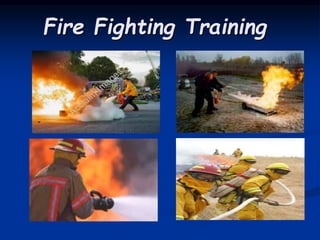
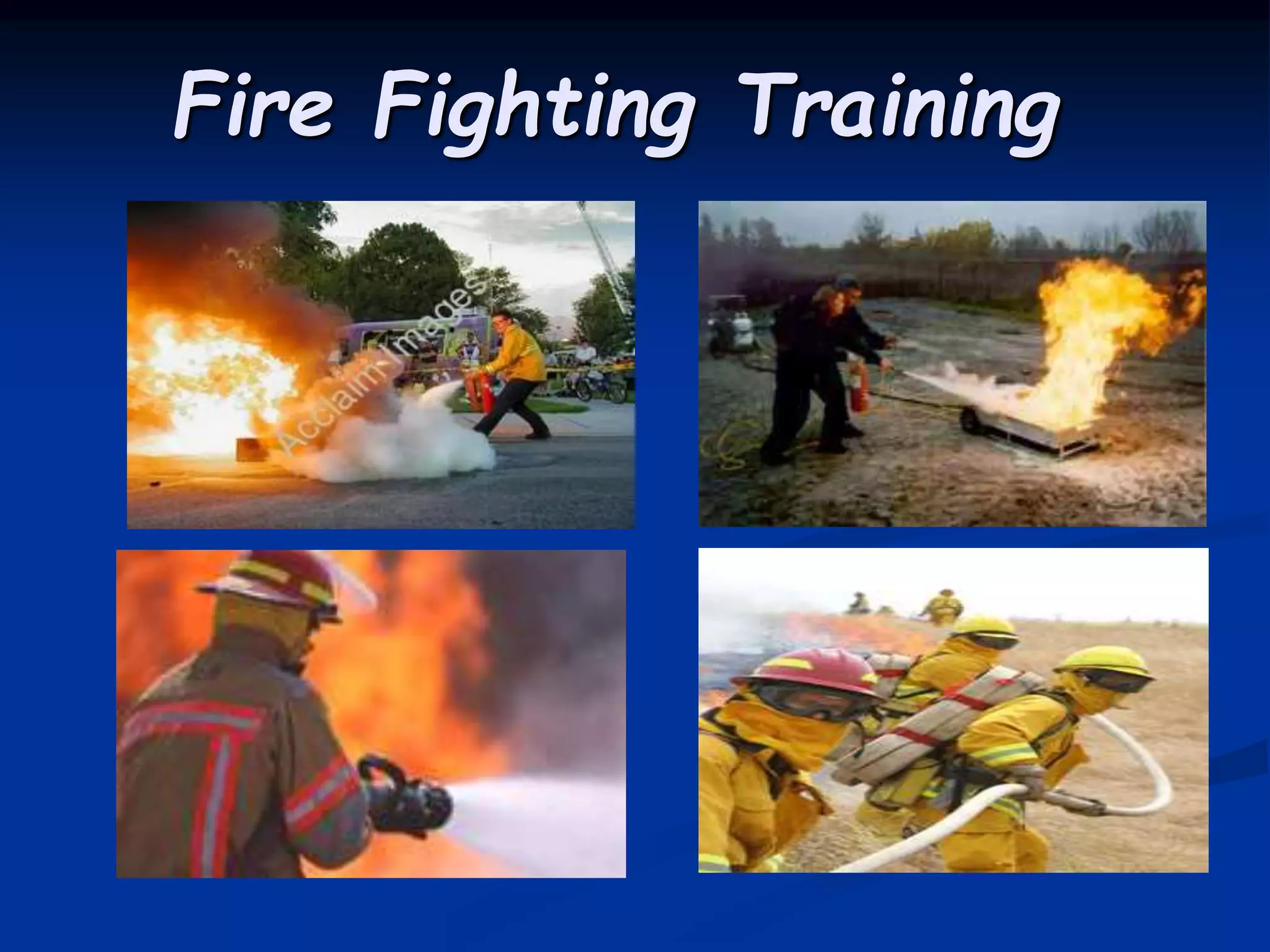
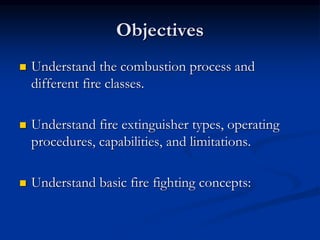
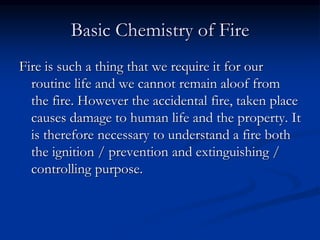
Fire Fighting Training
 Understand the combustion process and
different fire classes.
 Understand fire extinguisher types, operating
procedures, capabilities, and limitations.
 Understand basic fire fighting concepts:
Objectives
Basic Chemistry of Fire
Fire is such a thing that we require it for our
routine life and we cannot remain aloof from
the fire. However the accidental fire, taken place
causes damage to human life and the property. It
is therefore necessary to understand a fire both
the ignition / prevention and extinguishing /
controlling purpose.
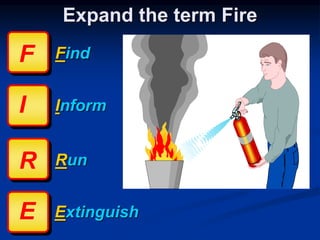
Extinguish
Inform
Run
FindF
I
R
E
Expand the term Fire
SOME DEFINITIONS RELATED TO FIRE
 Flesh Point : It is the lowest temperature at
which a liquid will give off enough flammable
vapour at or near its surface, such that its
mixture with air can be ignited by a spark or
flame.
 Auto Ignition Temperature : It is the lowest
temperature at which a liquid will give off
enough flammable vapour at or near its surface,
such that its mixture with air will self ignite in
the absence of spark or flame.
SOME DEFINITIONS RELATED TO FIRE
 Flammable Limits (Explosive Ranges) : The Values
(i.e. upper & lower) expressed in percentage volume of
fuel vapour in air, is the range of concentration within
which a particular vapour or gas mixture with air will
burn or explode when ignited.
Below LEL, the mixture is lean to burn & above UEL
the mixture is too rich to burn.
 Explosion : It is an extremely rapid chemical
(Explosive) transformation of fuel accompanied by
release of energy and compression of gases capable of
producing mechanical energy.
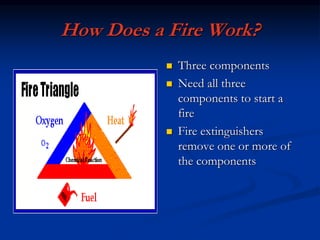
How Does a Fire Work?
 Three components
 Need all three
components to start a
fire
 Fire extinguishers
remove one or more of
the components
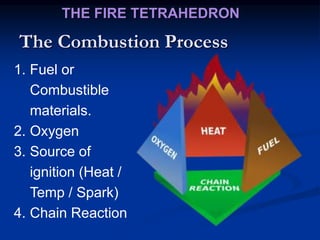
The Combustion Process
THE FIRE TETRAHEDRON
1. Fuel or
Combustible
materials.
2. Oxygen
3. Source of
ignition (Heat /
Temp / Spark)
4. Chain Reaction
The fire can extinguished by the following methods.
1. Heat Control (Cooling effect)
2. Oxygen Control (Smothering / blanketing)
3. Fuel Control (Removal of combustible material)
4. Beating out (Breaking of chain reaction by hitting )
The controlling of fire depends on the characteristics of a
material, situation in which fire taken place, available
resources etc. are to be considered for extinguishing
the fire.
Method of Fire Control
DIFFERENT MATERIALS
TO EXTINGUISH THE FIRE
 Water
 Carbon Dioxide (CO2)
 Dry Chemical Powder (DCP)
 Sand / Earth
 Foam Compound
 AFFF (Aqueous Film Forming Foam)
 ARFC (Alcohol Resistance Foam Compound)
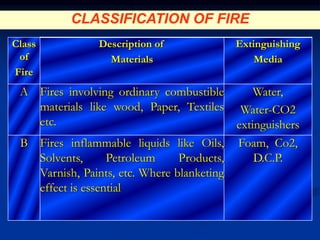
Class
of
Fire
Description of
Materials
Extinguishing
Media
A Fires involving ordinary combustible
materials like wood, Paper, Textiles
etc.
Water,
Water-CO2
extinguishers
B Fires inflammable liquids like Oils,
Solvents, Petroleum Products,
Varnish, Paints, etc. Where blanketing
effect is essential
Foam, Co2,
D.C.P.
CLASSIFICATION OF FIRE
Class
of
Fire
Description of
Materials
Extinguishing
Media
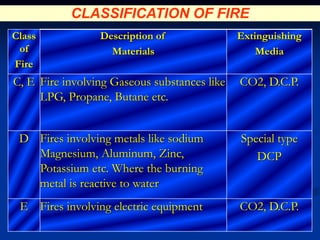
C, E Fire involving Gaseous substances like
LPG, Propane, Butane etc.
CO2, D.C.P.
D Fires involving metals like sodium
Magnesium, Aluminum, Zinc,
Potassium etc. Where the burning
metal is reactive to water
Special type
DCP
E Fires involving electric equipment CO2, D.C.P.
CLASSIFICATION OF FIRE
Causes of Fire :
Causes of Fire Preventive Methods
Open flames - Proper design
Short circuit - Maintenance, Periodic Inspection
Sparks - Spark arrestor, Insulation
Static Charge - Grounding Earthling
Friction - Lubrication, Insulation
Dust explosion - Sufficient ventilation
Lightening - Lightening arrestor
Chemical reaction - Parameter control, Monitoring
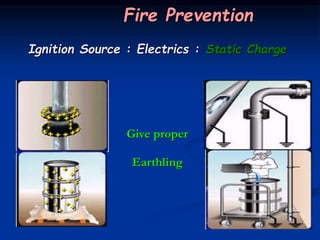
Ignition Source : Electrics : Static Charge
Fire Prevention
Give proper
Earthling
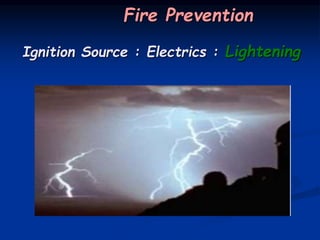
Ignition Source : Electrics : Lightening
Fire Prevention
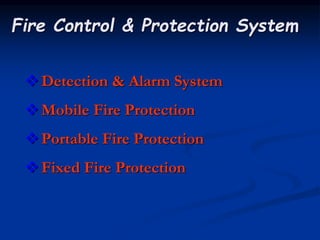
Detection & Alarm System
Mobile Fire Protection
Portable Fire Protection
Fixed Fire Protection
Fire Control & Protection System
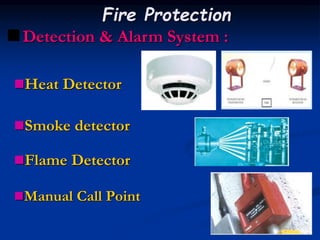
Heat Detector
Smoke detector
Flame Detector
Manual Call Point
Detection & Alarm System :
Fire Protection
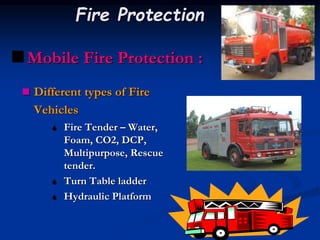
 Different types of Fire
Vehicles
 Fire Tender – Water,
Foam, CO2, DCP,
Multipurpose, Rescue
tender.
 Turn Table ladder
 Hydraulic Platform
Mobile Fire Protection :
Fire Protection
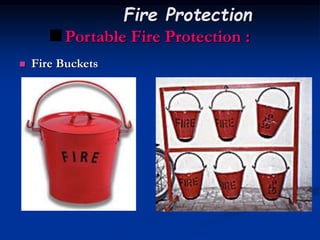
Portable Fire Protection :
 Fire Buckets
Fire Protection
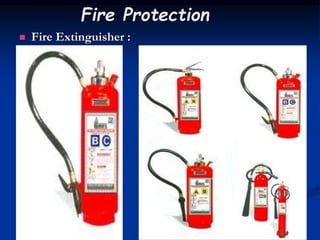
 Fire Extinguisher :
Fire Protection
 Fire Extinguisher :
Fire Protection
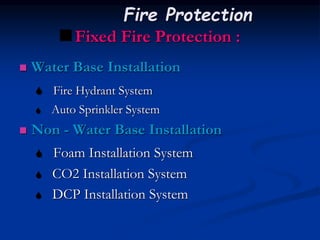
 Water Base Installation
 Fire Hydrant System
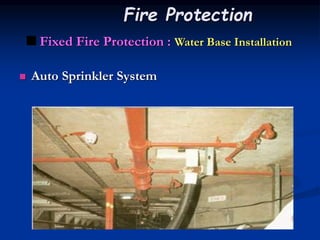
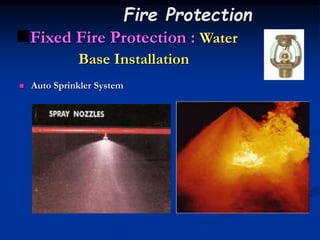
 Auto Sprinkler System
 Non - Water Base Installation
 Foam Installation System
 CO2 Installation System
 DCP Installation System
Fixed Fire Protection :
Fire Protection
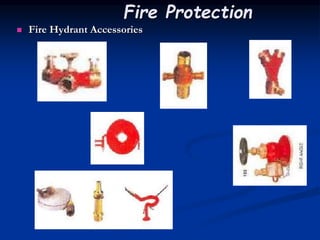
 Fire Hydrant Accessories
Fire Protection
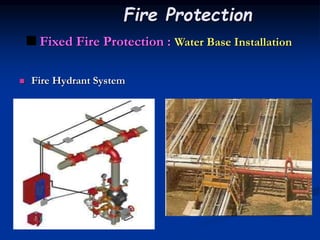
 Fire Hydrant System
 Fixed Fire Protection : Water Base Installation
Fire Protection
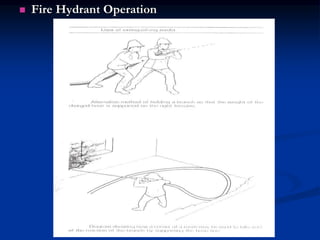
 Fire Hydrant Operation
 Auto Sprinkler System
 Fixed Fire Protection : Water Base Installation
Fire Protection
 Auto Sprinkler System
Fixed Fire Protection : Water
Base Installation
Fire Protection
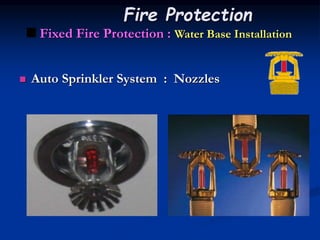
 Auto Sprinkler System : Nozzles
 Fixed Fire Protection : Water Base Installation
Fire Protection
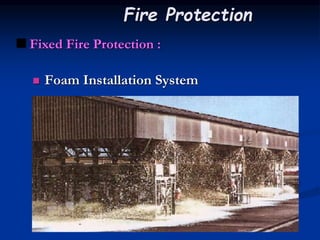
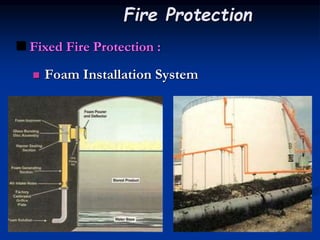
 Fixed Fire Protection :
 Foam Installation System
Fire Protection
 Fixed Fire Protection :
 Foam Installation System
Fire Protection
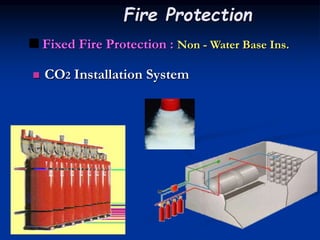
 Fixed Fire Protection : Non - Water Base Ins.
 CO2 Installation System
Fire Protection
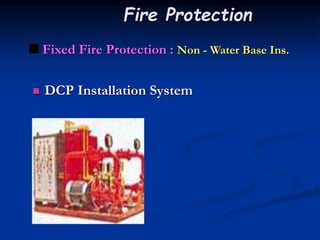
 Fixed Fire Protection : Non - Water Base Ins.
 DCP Installation System
Fire Protection
 Fire has a tremendous destruction power.
 Small fire can become too big to fight.
 Fire can destroy whole industry and many lives can
be lost and many families are affected.
 Restoring the damage is only part of the cost.
 If there is a serious fire, morale of work force gets
badly eroded.
 Productivity will get affected.
 Takes considerable times to restore.
Effect of Fire
Thank You

Fire fighting ert

  • 1.
  • 2.
     Understand thecombustion process and different fire classes.  Understand fire extinguisher types, operating procedures, capabilities, and limitations.  Understand basic fire fighting concepts: Objectives
  • 3.
    Basic Chemistry ofFire Fire is such a thing that we require it for our routine life and we cannot remain aloof from the fire. However the accidental fire, taken place causes damage to human life and the property. It is therefore necessary to understand a fire both the ignition / prevention and extinguishing / controlling purpose.
  • 4.
  • 5.
    SOME DEFINITIONS RELATEDTO FIRE  Flesh Point : It is the lowest temperature at which a liquid will give off enough flammable vapour at or near its surface, such that its mixture with air can be ignited by a spark or flame.  Auto Ignition Temperature : It is the lowest temperature at which a liquid will give off enough flammable vapour at or near its surface, such that its mixture with air will self ignite in the absence of spark or flame.
  • 6.
    SOME DEFINITIONS RELATEDTO FIRE  Flammable Limits (Explosive Ranges) : The Values (i.e. upper & lower) expressed in percentage volume of fuel vapour in air, is the range of concentration within which a particular vapour or gas mixture with air will burn or explode when ignited. Below LEL, the mixture is lean to burn & above UEL the mixture is too rich to burn.  Explosion : It is an extremely rapid chemical (Explosive) transformation of fuel accompanied by release of energy and compression of gases capable of producing mechanical energy.
  • 7.
    How Does aFire Work?  Three components  Need all three components to start a fire  Fire extinguishers remove one or more of the components
  • 8.
    The Combustion Process THEFIRE TETRAHEDRON 1. Fuel or Combustible materials. 2. Oxygen 3. Source of ignition (Heat / Temp / Spark) 4. Chain Reaction
  • 9.
    The fire canextinguished by the following methods. 1. Heat Control (Cooling effect) 2. Oxygen Control (Smothering / blanketing) 3. Fuel Control (Removal of combustible material) 4. Beating out (Breaking of chain reaction by hitting ) The controlling of fire depends on the characteristics of a material, situation in which fire taken place, available resources etc. are to be considered for extinguishing the fire. Method of Fire Control
  • 10.
    DIFFERENT MATERIALS TO EXTINGUISHTHE FIRE  Water  Carbon Dioxide (CO2)  Dry Chemical Powder (DCP)  Sand / Earth  Foam Compound  AFFF (Aqueous Film Forming Foam)  ARFC (Alcohol Resistance Foam Compound)
  • 11.
    Class of Fire Description of Materials Extinguishing Media A Firesinvolving ordinary combustible materials like wood, Paper, Textiles etc. Water, Water-CO2 extinguishers B Fires inflammable liquids like Oils, Solvents, Petroleum Products, Varnish, Paints, etc. Where blanketing effect is essential Foam, Co2, D.C.P. CLASSIFICATION OF FIRE
  • 12.
    Class of Fire Description of Materials Extinguishing Media C, EFire involving Gaseous substances like LPG, Propane, Butane etc. CO2, D.C.P. D Fires involving metals like sodium Magnesium, Aluminum, Zinc, Potassium etc. Where the burning metal is reactive to water Special type DCP E Fires involving electric equipment CO2, D.C.P. CLASSIFICATION OF FIRE
  • 13.
    Causes of Fire: Causes of Fire Preventive Methods Open flames - Proper design Short circuit - Maintenance, Periodic Inspection Sparks - Spark arrestor, Insulation Static Charge - Grounding Earthling Friction - Lubrication, Insulation Dust explosion - Sufficient ventilation Lightening - Lightening arrestor Chemical reaction - Parameter control, Monitoring
  • 14.
    Ignition Source :Electrics : Static Charge Fire Prevention Give proper Earthling
  • 15.
    Ignition Source :Electrics : Lightening Fire Prevention
  • 16.
    Detection & AlarmSystem Mobile Fire Protection Portable Fire Protection Fixed Fire Protection Fire Control & Protection System
  • 17.
    Heat Detector Smoke detector FlameDetector Manual Call Point Detection & Alarm System : Fire Protection
  • 18.
     Different typesof Fire Vehicles  Fire Tender – Water, Foam, CO2, DCP, Multipurpose, Rescue tender.  Turn Table ladder  Hydraulic Platform Mobile Fire Protection : Fire Protection
  • 19.
    Portable Fire Protection:  Fire Buckets Fire Protection
  • 20.
     Fire Extinguisher: Fire Protection
  • 21.
     Fire Extinguisher: Fire Protection
  • 22.
     Water BaseInstallation  Fire Hydrant System  Auto Sprinkler System  Non - Water Base Installation  Foam Installation System  CO2 Installation System  DCP Installation System Fixed Fire Protection : Fire Protection
  • 23.
     Fire HydrantAccessories Fire Protection
  • 24.
     Fire HydrantSystem  Fixed Fire Protection : Water Base Installation Fire Protection
  • 25.
  • 26.
     Auto SprinklerSystem  Fixed Fire Protection : Water Base Installation Fire Protection
  • 27.
     Auto SprinklerSystem Fixed Fire Protection : Water Base Installation Fire Protection
  • 28.
     Auto SprinklerSystem : Nozzles  Fixed Fire Protection : Water Base Installation Fire Protection
  • 29.
     Fixed FireProtection :  Foam Installation System Fire Protection
  • 30.
     Fixed FireProtection :  Foam Installation System Fire Protection
  • 31.
     Fixed FireProtection : Non - Water Base Ins.  CO2 Installation System Fire Protection
  • 32.
     Fixed FireProtection : Non - Water Base Ins.  DCP Installation System Fire Protection
  • 33.
     Fire hasa tremendous destruction power.  Small fire can become too big to fight.  Fire can destroy whole industry and many lives can be lost and many families are affected.  Restoring the damage is only part of the cost.  If there is a serious fire, morale of work force gets badly eroded.  Productivity will get affected.  Takes considerable times to restore. Effect of Fire
  • 34.