Veeral Additives Private Limited – Mahad
ELECTRICAL SAFETY
WHAT IS ELECTRICITY
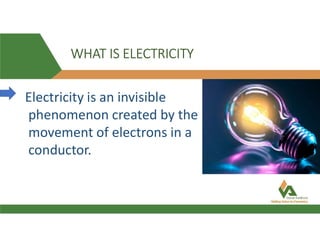
Electricity is an invisible
phenomenon created by the
movement of electrons in a
conductor.
ELECTRICAL MATERIAL
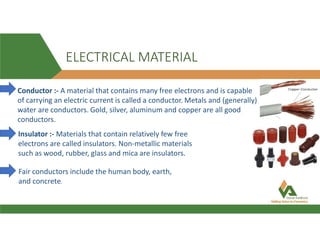
Conductor :- A material that contains many free electrons and is capable
of carrying an electric current is called a conductor. Metals and (generally)
water are conductors. Gold, silver, aluminum and copper are all good
conductors.
Insulator :- Materials that contain relatively few free
electrons are called insulators. Non-metallic materials
such as wood, rubber, glass and mica are insulators.
Fair conductors include the human body, earth,
and concrete.
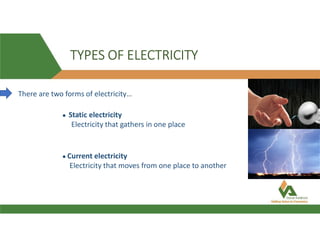
TYPES OF ELECTRICITY
There are two forms of electricity…
● Static electricity
Electricity that gathers in one place
● Current electricity
Electricity that moves from one place to another
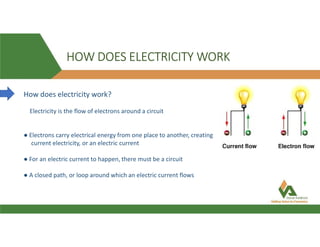
HOW DOES ELECTRICITY WORK
How does electricity work?
Electricity is the flow of electrons around a circuit
● Electrons carry electrical energy from one place to another, creating
current electricity, or an electric current
● For an electric current to happen, there must be a circuit
● A closed path, or loop around which an electric current flows
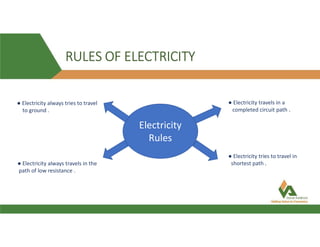
RULES OF ELECTRICITY
Electricity
Rules
● Electricity travels in a
completed circuit path .
● Electricity always travels in the
path of low resistance .
● Electricity tries to travel in
shortest path .
● Electricity always tries to travel
to ground .
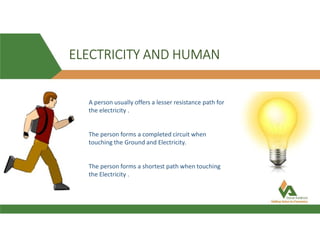
ELECTRICITY AND HUMAN
A person usually offers a lesser resistance path for
the electricity .
The person forms a completed circuit when
touching the Ground and Electricity.
The person forms a shortest path when touching
the Electricity .
WHERE TO START ?
Safety
Starts
Here………………
Think Safe ……
Work Safe ……
Be Safe
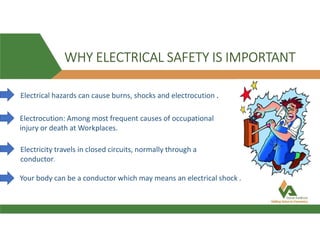
WHY ELECTRICAL SAFETY IS IMPORTANT
Electrical hazards can cause burns, shocks and electrocution .
Electrocution: Among most frequent causes of occupational
injury or death at Workplaces.
Electricity travels in closed circuits, normally through a
conductor.
Your body can be a conductor which may means an electrical shock .
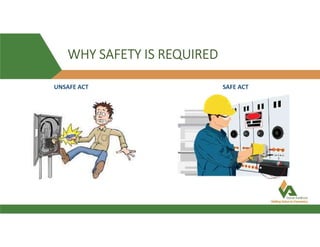
WHY SAFETY IS REQUIRED
UNSAFE ACT SAFE ACT
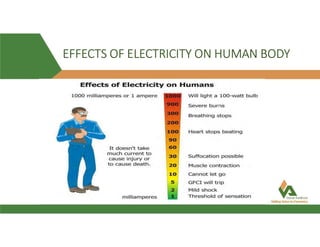
EFFECTS OF ELECTRICITY ON HUMAN BODY
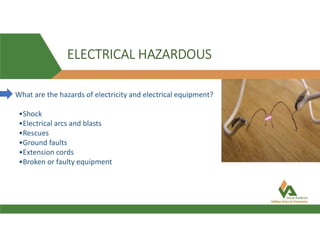
ELECTRICAL HAZARDOUS
What are the hazards of electricity and electrical equipment?
•Shock
•Electrical arcs and blasts
•Rescues
•Ground faults
•Extension cords
•Broken or faulty equipment
EFFECTS OF ELECTRICITY ON THE
HUMAN BODY
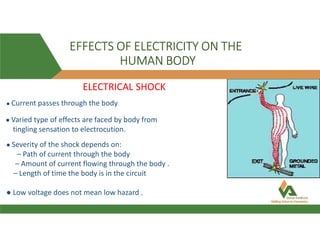
ELECTRICAL SHOCK
● Current passes through the body.
● Varied type of effects are faced by body from
tingling sensation to electrocution.
● Severity of the shock depends on:
– Path of current through the body
– Amount of current flowing through the body .
– Length of time the body is in the circuit
● Low voltage does not mean low hazard .
EFFECTS OF ELECTRICITY ON THE
HUMAN BODY
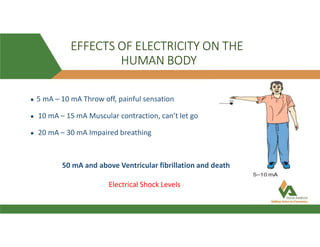
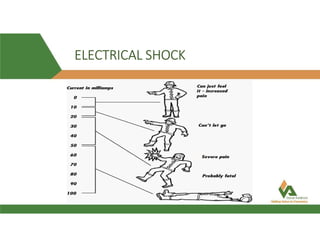
● 5 mA – 10 mA Throw off, painful sensation.
● 10 mA – 15 mA Muscular contraction, can’t let go
● 20 mA – 30 mA Impaired breathing
50 mA and above Ventricular fibrillation and death
Electrical Shock Levels
TYPES OF INJURIES CAUSED BY
ELECTRIC SHOCK
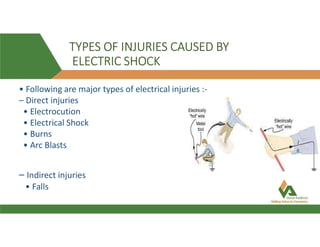
• Following are major types of electrical injuries :-
– Direct injuries
• Electrocution
• Electrical Shock
• Burns
• Arc Blasts
– Indirect injuries
• Falls
ELECTRICAL SHOCK
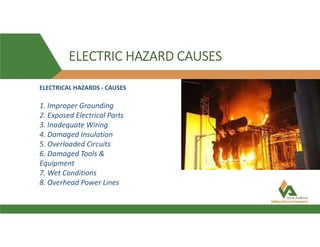
ELECTRIC HAZARD CAUSES
ELECTRICAL HAZARDS - CAUSES
1. Improper Grounding
2. Exposed Electrical Parts
3. Inadequate Wiring
4. Damaged Insulation
5. Overloaded Circuits
6. Damaged Tools &
Equipment
7. Wet Conditions
8. Overhead Power Lines
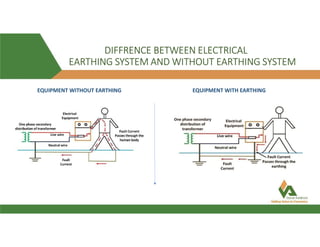
DIFFRENCE BETWEEN ELECTRICAL
EARTHING SYSTEM AND WITHOUT EARTHING SYSTEM
EQUIPMENT WITHOUT EARTHING EQUIPMENT WITH EARTHING
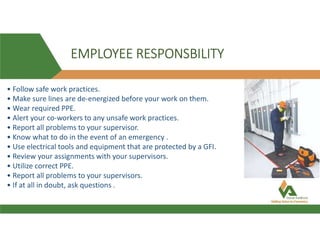
EMPLOYEE RESPONSBILITY
• Follow safe work practices.
• Make sure lines are de-energized before your work on them.
• Wear required PPE.
• Alert your co-workers to any unsafe work practices.
• Report all problems to your supervisor.
• Know what to do in the event of an emergency .
• Use electrical tools and equipment that are protected by a GFI.
• Review your assignments with your supervisors.
• Utilize correct PPE.
• Report all problems to your supervisors.
• If at all in doubt, ask questions .
ELECTRICAL QUALIFIED VS UNQUALIFIED PERSONS
QUALIFIED PERSONS UNQUALIFIED PERSONS
• The standard defines a qualified person as one
familiar with the construction and
operation of the equipment and the hazards
involved those who are permitted to
work on or near exposed energized parts .
• Whether an employee is considered to be a "qualified
person" will depend on various circumstances in the
workplace. It is possible and, in fact, likely for an
individual to be considered "qualified" with regard to
certain equipment in the workplace, but
"unqualified" as to other equipment..
• The training requirements contained in this
section apply to employees who face a risk of
electric shock that is not reduced to a safe level by
the electrical installation requirements .
• Employees shall be trained in and familiar with
the safety-related work practices required to their
respective job assignments.
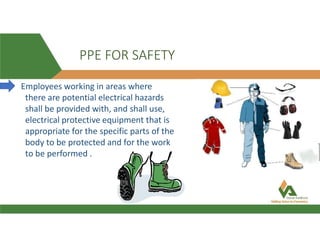
PPE FOR SAFETY
Employees working in areas where
there are potential electrical hazards
shall be provided with, and shall use,
electrical protective equipment that is
appropriate for the specific parts of the
body to be protected and for the work
to be performed .
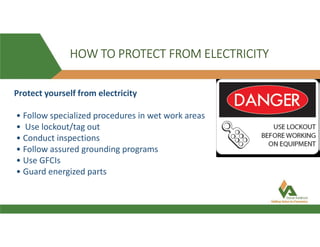
HOW TO PROTECT FROM ELECTRICITY
Protect yourself from electricity
• Follow specialized procedures in wet work areas
• Use lockout/tag out
• Conduct inspections
• Follow assured grounding programs
• Use GFCIs
• Guard energized parts
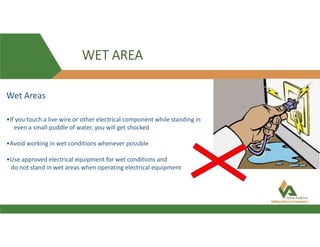
WET AREA
Wet Areas
•If you touch a live wire or other electrical component while standing in
even a small puddle of water, you will get shocked
•Avoid working in wet conditions whenever possible
•Use approved electrical equipment for wet conditions and
do not stand in wet areas when operating electrical equipment
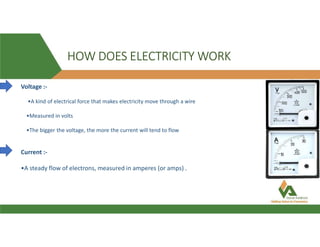
HOW DOES ELECTRICITY WORK
Voltage :-
•A kind of electrical force that makes electricity move through a wire
•Measured in volts
•The bigger the voltage, the more the current will tend to flow
Current :-
•A steady flow of electrons, measured in amperes (or amps) .
LOCKOUT / TAGOUT
Lockout/ Tagout :-
• Proper lockout/tag out procedures protect
workers from the unexpected start-up of electrical
equipment.
• These procedures make sure that electrical
equipment is de-energized before it is repaired and
protect workers against electric shock.
INSPECTION
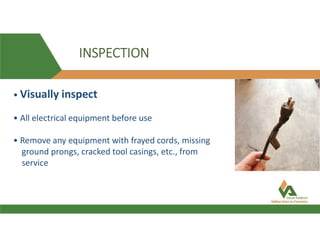
• Visually inspect
• All electrical equipment before use
• Remove any equipment with frayed cords, missing
ground prongs, cracked tool casings, etc., from
service
ASSURED GROUNDING PROGRAM
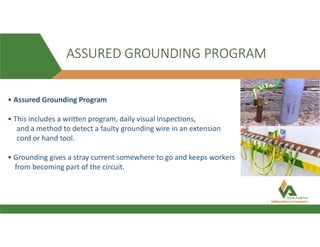
• Assured Grounding Program
• This includes a written program, daily visual inspections,
and a method to detect a faulty grounding wire in an extension
cord or hand tool.
• Grounding gives a stray current somewhere to go and keeps workers
from becoming part of the circuit.
ELECTRICAL GROUNDING
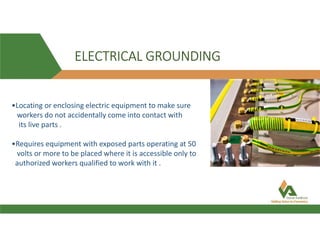
•Locating or enclosing electric equipment to make sure
workers do not accidentally come into contact with
its live parts .
•Requires equipment with exposed parts operating at 50
volts or more to be placed where it is accessible only to
authorized workers qualified to work with it .
SAFETY TO BE FOLLOW AT SITE
Safety
First
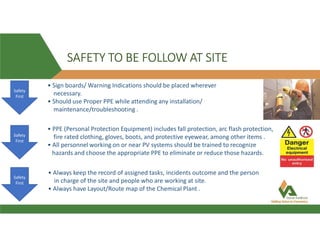
• Sign boards/ Warning Indications should be placed wherever
necessary.
• Should use Proper PPE while attending any installation/
maintenance/troubleshooting .
Safety
First
Safety
First
• PPE (Personal Protection Equipment) includes fall protection, arc flash protection,
fire rated clothing, gloves, boots, and protective eyewear, among other items .
• All personnel working on or near PV systems should be trained to recognize
hazards and choose the appropriate PPE to eliminate or reduce those hazards.
• Always keep the record of assigned tasks, incidents outcome and the person
in charge of the site and people who are working at site.
• Always have Layout/Route map of the Chemical Plant .
Thank you
DEEPAK SINGH
9634844138

Electrical safety ppt

  • 1.
    Veeral Additives PrivateLimited – Mahad ELECTRICAL SAFETY
  • 2.
    WHAT IS ELECTRICITY Electricityis an invisible phenomenon created by the movement of electrons in a conductor.
  • 3.
    ELECTRICAL MATERIAL Conductor :-A material that contains many free electrons and is capable of carrying an electric current is called a conductor. Metals and (generally) water are conductors. Gold, silver, aluminum and copper are all good conductors. Insulator :- Materials that contain relatively few free electrons are called insulators. Non-metallic materials such as wood, rubber, glass and mica are insulators. Fair conductors include the human body, earth, and concrete.
  • 4.
    TYPES OF ELECTRICITY Thereare two forms of electricity… ● Static electricity Electricity that gathers in one place ● Current electricity Electricity that moves from one place to another
  • 5.
    HOW DOES ELECTRICITYWORK How does electricity work? Electricity is the flow of electrons around a circuit ● Electrons carry electrical energy from one place to another, creating current electricity, or an electric current ● For an electric current to happen, there must be a circuit ● A closed path, or loop around which an electric current flows
  • 6.
    RULES OF ELECTRICITY Electricity Rules ●Electricity travels in a completed circuit path . ● Electricity always travels in the path of low resistance . ● Electricity tries to travel in shortest path . ● Electricity always tries to travel to ground .
  • 7.
    ELECTRICITY AND HUMAN Aperson usually offers a lesser resistance path for the electricity . The person forms a completed circuit when touching the Ground and Electricity. The person forms a shortest path when touching the Electricity .
  • 8.
    WHERE TO START? Safety Starts Here……………… Think Safe …… Work Safe …… Be Safe
  • 9.
    WHY ELECTRICAL SAFETYIS IMPORTANT Electrical hazards can cause burns, shocks and electrocution . Electrocution: Among most frequent causes of occupational injury or death at Workplaces. Electricity travels in closed circuits, normally through a conductor. Your body can be a conductor which may means an electrical shock .
  • 10.
    WHY SAFETY ISREQUIRED UNSAFE ACT SAFE ACT
  • 11.
  • 12.
    ELECTRICAL HAZARDOUS What arethe hazards of electricity and electrical equipment? •Shock •Electrical arcs and blasts •Rescues •Ground faults •Extension cords •Broken or faulty equipment
  • 13.
    EFFECTS OF ELECTRICITYON THE HUMAN BODY ELECTRICAL SHOCK ● Current passes through the body. ● Varied type of effects are faced by body from tingling sensation to electrocution. ● Severity of the shock depends on: – Path of current through the body – Amount of current flowing through the body . – Length of time the body is in the circuit ● Low voltage does not mean low hazard .
  • 14.
    EFFECTS OF ELECTRICITYON THE HUMAN BODY ● 5 mA – 10 mA Throw off, painful sensation. ● 10 mA – 15 mA Muscular contraction, can’t let go ● 20 mA – 30 mA Impaired breathing 50 mA and above Ventricular fibrillation and death Electrical Shock Levels
  • 15.
    TYPES OF INJURIESCAUSED BY ELECTRIC SHOCK • Following are major types of electrical injuries :- – Direct injuries • Electrocution • Electrical Shock • Burns • Arc Blasts – Indirect injuries • Falls
  • 16.
  • 17.
    ELECTRIC HAZARD CAUSES ELECTRICALHAZARDS - CAUSES 1. Improper Grounding 2. Exposed Electrical Parts 3. Inadequate Wiring 4. Damaged Insulation 5. Overloaded Circuits 6. Damaged Tools & Equipment 7. Wet Conditions 8. Overhead Power Lines
  • 18.
    DIFFRENCE BETWEEN ELECTRICAL EARTHINGSYSTEM AND WITHOUT EARTHING SYSTEM EQUIPMENT WITHOUT EARTHING EQUIPMENT WITH EARTHING
  • 19.
    EMPLOYEE RESPONSBILITY • Followsafe work practices. • Make sure lines are de-energized before your work on them. • Wear required PPE. • Alert your co-workers to any unsafe work practices. • Report all problems to your supervisor. • Know what to do in the event of an emergency . • Use electrical tools and equipment that are protected by a GFI. • Review your assignments with your supervisors. • Utilize correct PPE. • Report all problems to your supervisors. • If at all in doubt, ask questions .
  • 20.
    ELECTRICAL QUALIFIED VSUNQUALIFIED PERSONS QUALIFIED PERSONS UNQUALIFIED PERSONS • The standard defines a qualified person as one familiar with the construction and operation of the equipment and the hazards involved those who are permitted to work on or near exposed energized parts . • Whether an employee is considered to be a "qualified person" will depend on various circumstances in the workplace. It is possible and, in fact, likely for an individual to be considered "qualified" with regard to certain equipment in the workplace, but "unqualified" as to other equipment.. • The training requirements contained in this section apply to employees who face a risk of electric shock that is not reduced to a safe level by the electrical installation requirements . • Employees shall be trained in and familiar with the safety-related work practices required to their respective job assignments.
  • 21.
    PPE FOR SAFETY Employeesworking in areas where there are potential electrical hazards shall be provided with, and shall use, electrical protective equipment that is appropriate for the specific parts of the body to be protected and for the work to be performed .
  • 22.
    HOW TO PROTECTFROM ELECTRICITY Protect yourself from electricity • Follow specialized procedures in wet work areas • Use lockout/tag out • Conduct inspections • Follow assured grounding programs • Use GFCIs • Guard energized parts
  • 23.
    WET AREA Wet Areas •Ifyou touch a live wire or other electrical component while standing in even a small puddle of water, you will get shocked •Avoid working in wet conditions whenever possible •Use approved electrical equipment for wet conditions and do not stand in wet areas when operating electrical equipment
  • 24.
    HOW DOES ELECTRICITYWORK Voltage :- •A kind of electrical force that makes electricity move through a wire •Measured in volts •The bigger the voltage, the more the current will tend to flow Current :- •A steady flow of electrons, measured in amperes (or amps) .
  • 25.
    LOCKOUT / TAGOUT Lockout/Tagout :- • Proper lockout/tag out procedures protect workers from the unexpected start-up of electrical equipment. • These procedures make sure that electrical equipment is de-energized before it is repaired and protect workers against electric shock.
  • 26.
    INSPECTION • Visually inspect •All electrical equipment before use • Remove any equipment with frayed cords, missing ground prongs, cracked tool casings, etc., from service
  • 27.
    ASSURED GROUNDING PROGRAM •Assured Grounding Program • This includes a written program, daily visual inspections, and a method to detect a faulty grounding wire in an extension cord or hand tool. • Grounding gives a stray current somewhere to go and keeps workers from becoming part of the circuit.
  • 28.
    ELECTRICAL GROUNDING •Locating orenclosing electric equipment to make sure workers do not accidentally come into contact with its live parts . •Requires equipment with exposed parts operating at 50 volts or more to be placed where it is accessible only to authorized workers qualified to work with it .
  • 29.
    SAFETY TO BEFOLLOW AT SITE Safety First • Sign boards/ Warning Indications should be placed wherever necessary. • Should use Proper PPE while attending any installation/ maintenance/troubleshooting . Safety First Safety First • PPE (Personal Protection Equipment) includes fall protection, arc flash protection, fire rated clothing, gloves, boots, and protective eyewear, among other items . • All personnel working on or near PV systems should be trained to recognize hazards and choose the appropriate PPE to eliminate or reduce those hazards. • Always keep the record of assigned tasks, incidents outcome and the person in charge of the site and people who are working at site. • Always have Layout/Route map of the Chemical Plant .
  • 30.