COGENERATION

               PresentedBy:
   PRUTHIRAJ SWAIN(12PS21F)
Definition :

    Cogeneration is the simultaneous generation in one process of
    thermal energy and electrical and/or mechanical energy;


    Useful heat is heat produced in a cogeneration process to satisfy
    an economically justifiable demand for heating or cooling;

     The heat produced by cogeneration can be delivered through
    various mediums, including warm water (e.g., for space heating
    and hot water systems), steam or hot air (e.g., for commercial and
    industrial uses).

     It is also possible to do Trigeneration, the production of
    electricity, heat and cooling.

     Trigeneration is an attractive option in situations where all three
    needs exist, such as in production processes with cooling
    requirements.
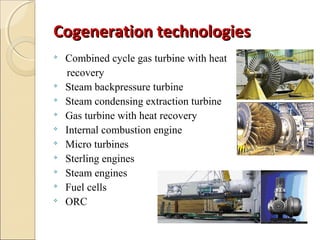
Cogeneration technologies

    Combined cycle gas turbine with heat
    recovery

    Steam backpressure turbine

    Steam condensing extraction turbine

    Gas turbine with heat recovery

    Internal combustion engine

    Micro turbines

    Sterling engines

    Steam engines

    Fuel cells

    ORC
 Other classifications:
       Topping cycle
       Bottoming cycle

    Cogeneration units:
     
       Micro-cogeneration means below 50 kWe;
     
       Small-scale cogeneration means below 1 MWe.

    Power to heat ratio (P/H):
     
       the ratio between electricity from cogeneration and
       useful heat when operating in full cogeneration mode
Efficiency coefficient for heat generation
 only
              Fuel type              Overall
                                    efficiency
Solid fuels        Hard coal/coke      0.88
                   Peat                0.86
                   Wood fuels          0.86
                   Oil, LPG            0.89
                   Biofuels            0.89
                   Natural gas          0.9
                   Biogas               0.7
Efficiency coefficient for electricity
generation only
              Fuel type              Overall
                                    efficiency
Solid fuels        Hard coal/coke     0.442
                   Peat               0.390
                   Wood fuels         0.330
                   Oil, LPG           0.442
                   Biofuels           0.442
                   Natural gas        0.525
                   Biogas             0.420
Alternatives for heat and electricity supply

Condensing power plant

                Electricity
                                                 CHP
                                   Electricity


                                   Heat energy


                 Heat energy


 Boiler house
Where can CHP be Economically
Attractive?
Data Centers                  Nursing Homes
Colleges & Universities       Office Buildings
Ethanol/ Biofuel Process      Large Multi-Family
  Plants                        Apartments
Food Processing Plants        Refrigerated Warehouses
Hospitals                     Restaurants
Hotels                        Supermarkets
Ice Arenas                    Theatres
Chemicals, Pulp & Paper,      Greenhouses
Fabricated Metals, Plastics   Wastewater Treatment
                                Facilities
Why is There an Opportunity?
     Rising Concerns Over
           – Blackouts/Brownouts
           – Power Supply Constraints
           – Marked Increases in Electricity & Fuel Prices
     Selected Power Outage Costs
Generators
          Two Types of Generators
Induction                  Synchronous
• Requires Grid Power      • Self Excited (Does
   Source to Operate          Not Need Grid to
                              Operate)
• When Grid Goes
   Down, CHP System        • CHP System can
   Goes Down                  Continue to
                              Operate thru Grid
• Less Complicated &          Outages
   Less Costly to          • More Complicated &
   Interconnect               Costly to
• Preferred by Utilities      Interconnect (Safety)
                           • Preferred by
                              Customers
CHP Recycles the Waste Heat from Power
Generation achieving efficiencies of over 80%.
CHP and separate generation
 Fuel input                       Output                        Fuel input


               Separate
              generation                           CHP

               Power station    Electricity       Electricity
81                                                   35%
                  43%               35
                                                                       100
                                                 Useful heat
53                                 Heat
               Boiler house                         50%
                                    50
                   95%


Total 134                                                       Total 100
                                         134 − 100
                Primary energy savings =           = 25%
                                           134
Benefits of CHP
High Efficiency, On-Site Generation Means :
   Improved Reliability.(Avoiding business disruptions)

   50% less CO2 emissions.(Monetizing Environmental benefits)

   Up to 80% energy efficient.(Reducing Fuel use)
   Removes requirement for back-up diesels (Conserve Natural Resources)

   Can uplift Green Star ratings by 1-2 stars.
   Usually cost-effective.
   Support Grid Infrastructure
     Fewer T&D Constraints
     Defer Costly Grid Upgrades
     Price Stability
   Facilitates Deployment of New Clean Energy Technologies
Environmental benefits
           250


           200


           150
   W


           100
   O
   h
   C
   2
   k
   /


           50
O mo
   h
   n
C 2e
   a
   g
   y
   s
   r
   t
   f
   ,
   i


             0
                 2005   2006   2007   2008   2009   2010   2011   2013   2015   2018   2020


       
             CO2 emissions reduced by 75%-90% (44-54 thousand Tonnes/year)
       
             Overall efficiency in CHP mode – 89%
Efficiency Benefits of CHP
Environmental Benefits of CHP
(NOx)
Conclusion:
The  main reasons for higher specific energy
 consumption in Indian Industries are obsolete
 technology, lower capacity utilization and poor
 operating and maintenance practices.
EC has received increased attention in India since
 the mid seventies but its impact is felt at a low
 face due to inhibiting attitudes, insufficient
 technical know-how, market distortions, high cost
 of efficient end use devices, capital shortage etc.
There is a need to design interventions in terms
 of policies and institutions which addresses these
 issues and create incentives for energy
 conservation.
THANK YOU

Cogeneration Concept

  • 1.
    COGENERATION PresentedBy: PRUTHIRAJ SWAIN(12PS21F)
  • 2.
    Definition :  Cogeneration is the simultaneous generation in one process of thermal energy and electrical and/or mechanical energy;  Useful heat is heat produced in a cogeneration process to satisfy an economically justifiable demand for heating or cooling;  The heat produced by cogeneration can be delivered through various mediums, including warm water (e.g., for space heating and hot water systems), steam or hot air (e.g., for commercial and industrial uses).  It is also possible to do Trigeneration, the production of electricity, heat and cooling.  Trigeneration is an attractive option in situations where all three needs exist, such as in production processes with cooling requirements.
  • 3.
    Cogeneration technologies  Combined cycle gas turbine with heat recovery  Steam backpressure turbine  Steam condensing extraction turbine  Gas turbine with heat recovery  Internal combustion engine  Micro turbines  Sterling engines  Steam engines  Fuel cells  ORC
  • 4.
     Other classifications: Topping cycle Bottoming cycle  Cogeneration units:  Micro-cogeneration means below 50 kWe;  Small-scale cogeneration means below 1 MWe.  Power to heat ratio (P/H):  the ratio between electricity from cogeneration and useful heat when operating in full cogeneration mode
  • 5.
    Efficiency coefficient forheat generation only Fuel type Overall efficiency Solid fuels Hard coal/coke 0.88 Peat 0.86 Wood fuels 0.86 Oil, LPG 0.89 Biofuels 0.89 Natural gas 0.9 Biogas 0.7
  • 6.
    Efficiency coefficient forelectricity generation only Fuel type Overall efficiency Solid fuels Hard coal/coke 0.442 Peat 0.390 Wood fuels 0.330 Oil, LPG 0.442 Biofuels 0.442 Natural gas 0.525 Biogas 0.420
  • 7.
    Alternatives for heatand electricity supply Condensing power plant Electricity CHP Electricity Heat energy Heat energy Boiler house
  • 8.
    Where can CHPbe Economically Attractive? Data Centers Nursing Homes Colleges & Universities Office Buildings Ethanol/ Biofuel Process Large Multi-Family Plants Apartments Food Processing Plants Refrigerated Warehouses Hospitals Restaurants Hotels Supermarkets Ice Arenas Theatres Chemicals, Pulp & Paper, Greenhouses Fabricated Metals, Plastics Wastewater Treatment Facilities
  • 9.
    Why is Therean Opportunity?  Rising Concerns Over  – Blackouts/Brownouts  – Power Supply Constraints  – Marked Increases in Electricity & Fuel Prices  Selected Power Outage Costs
  • 10.
    Generators Two Types of Generators Induction Synchronous • Requires Grid Power • Self Excited (Does Source to Operate Not Need Grid to Operate) • When Grid Goes Down, CHP System • CHP System can Goes Down Continue to Operate thru Grid • Less Complicated & Outages Less Costly to • More Complicated & Interconnect Costly to • Preferred by Utilities Interconnect (Safety) • Preferred by Customers
  • 11.
    CHP Recycles theWaste Heat from Power Generation achieving efficiencies of over 80%.
  • 12.
    CHP and separategeneration Fuel input Output Fuel input Separate generation CHP Power station Electricity Electricity 81 35% 43% 35 100 Useful heat 53 Heat Boiler house 50% 50 95% Total 134 Total 100 134 − 100 Primary energy savings = = 25% 134
  • 13.
    Benefits of CHP HighEfficiency, On-Site Generation Means :  Improved Reliability.(Avoiding business disruptions)  50% less CO2 emissions.(Monetizing Environmental benefits)  Up to 80% energy efficient.(Reducing Fuel use)  Removes requirement for back-up diesels (Conserve Natural Resources)  Can uplift Green Star ratings by 1-2 stars.  Usually cost-effective.  Support Grid Infrastructure  Fewer T&D Constraints  Defer Costly Grid Upgrades  Price Stability  Facilitates Deployment of New Clean Energy Technologies
  • 14.
    Environmental benefits 250 200 150 W 100 O h C 2 k / 50 O mo h n C 2e a g y s r t f , i 0 2005 2006 2007 2008 2009 2010 2011 2013 2015 2018 2020  CO2 emissions reduced by 75%-90% (44-54 thousand Tonnes/year)  Overall efficiency in CHP mode – 89%
  • 15.
  • 16.
  • 17.
    Conclusion: The mainreasons for higher specific energy consumption in Indian Industries are obsolete technology, lower capacity utilization and poor operating and maintenance practices. EC has received increased attention in India since the mid seventies but its impact is felt at a low face due to inhibiting attitudes, insufficient technical know-how, market distortions, high cost of efficient end use devices, capital shortage etc. There is a need to design interventions in terms of policies and institutions which addresses these issues and create incentives for energy conservation.
  • 18.

Editor's Notes

  • #3 economically justifiable demand is a demand that does not exceed the needs for heat or cooling and which would otherwise be satisfied at market conditions by energy generation processes other than cogeneration.