
Global Risk Forum Davos 2012


        Adaptive Disaster Risk Reduction


               PD. Dr.-Ing Joern Birkmann

               Head of Section, UNU-EHS
                    Bonn, Germany
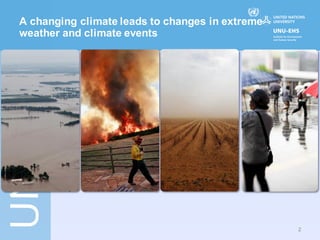
A changing climate leads to changes in extreme
weather and climate events


                                                 2
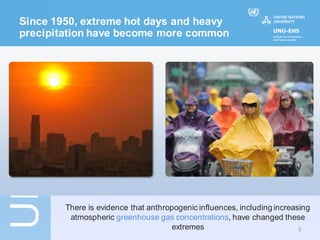
Since 1950, extreme hot days and heavy
precipitation have become more common


        There is evidence that anthropogenic influences, including increasing
         atmospheric greenhouse gas concentrations, have changed these
                                      extremes                            3
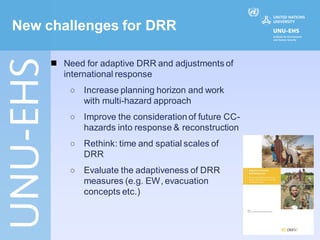
New challenges for DRR

        Need for adaptive DRR and adjustments of
         international response
          ◯   Increase planning horizon and work
              with multi-hazard approach
          ◯   Improve the consideration of future CC-
              hazards into response & reconstruction
          ◯   Rethink: time and spatial scales of
              DRR
          ◯   Evaluate the adaptiveness of DRR
              measures (e.g. EW, evacuation
              concepts etc.)
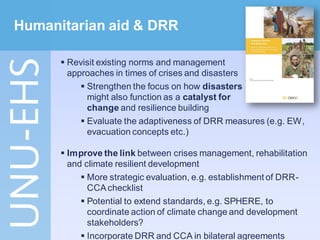
Humanitarian aid & DRR

       Revisit existing norms and management
        approaches in times of crises and disasters
            Strengthen the focus on how disasters
             might also function as a catalyst for
             change and resilience building
            Evaluate the adaptiveness of DRR measures (e.g. EW,
             evacuation concepts etc.)

       Improve the link between crises management, rehabilitation
        and climate resilient development
            More strategic evaluation, e.g. establishment of DRR-
             CCA checklist
            Potential to extend standards, e.g. SPHERE, to
             coordinate action of climate change and development
             stakeholders?
            Incorporate DRR and CCA in bilateral agreements
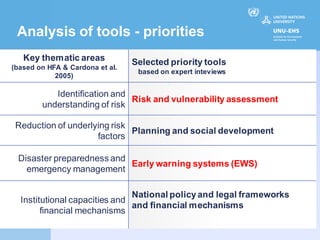
Analysis of tools - priorities
   Key thematic areas            Selected priority tools
(based on HFA & Cardona et al.
                                  based on expert inteviews
            2005)

           Identification and
                              Risk and vulnerability assessment
        understanding of risk

 Reduction of underlying risk
                              Planning and social development
                     factors

 Disaster preparedness and
                           Early warning systems (EWS)
   emergency management

                               National policy and legal frameworks
  Institutional capacities and
                               and financial mechanisms
        financial mechanisms
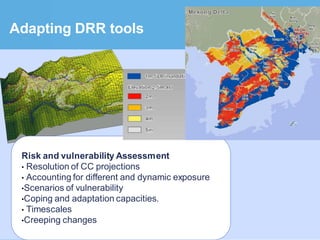
Adapting DRR tools


 Risk and vulnerability Assessment
 • Resolution of CC projections
 • Accounting for different and dynamic exposure
 •Scenarios of vulnerability
 •Coping and adaptation capacities.
 • Timescales
 •Creeping changes
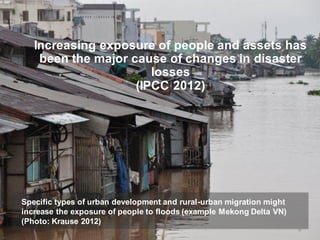
Increasing exposure of people and assets has
    been the major cause of changes in disaster
                       losses
                    (IPCC 2012)


Specific types of urban development and rural-urban migration might
increase the exposure of people to floods (example Mekong Delta VN)
(Photo: Krause 2012)
                                                                      8
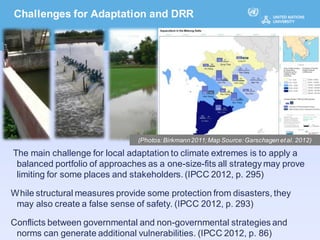
Challenges for Adaptation and DRR


                                (Photos: Birkmann 2011; Map Source: Garschagen et al. 2012)

The main challenge for local adaptation to climate extremes is to apply a
 balanced portfolio of approaches as a one-size-fits all strategy may prove
 limiting for some places and stakeholders. (IPCC 2012, p. 295)

While structural measures provide some protection from disasters, they
 may also create a false sense of safety. (IPCC 2012, p. 293)

Conflicts between governmental and non-governmental strategies and
 norms can generate additional vulnerabilities. (IPCC 2012, p. 86)
Conclusions


•   We observe an emerging cooperation between Disaster Risk Reduction
    and Climate Change Adaptation research (IPCC SREX). This
    cooperation has also to be strengthened in various countries, e.g.
    between different ministries (MoNRE – MARD).

•   Exposure and vulnerability are dynamic. Hence we need also to develop
    different scenarios for vulnerability and risks (in addition to climate
    change scenarios).

•   Vulnerability and risk assessment as well as adaptation strategies need
    to combine different data and knowledge sources as well as
    methodologies.

•   Lastly, we have to critically review DRR measures that worked in the
    past (e.g. dyke construction), but might not work in the future.
PD Dr. Joern Birkmann

UNITED NATIONS UNIVERSITY
Institute for Environment
and Human Security (UNU-EHS)

Hermann-Ehlers-Str. 10
53113 Bonn, Germany
Phone: ++ 49 (0) 228 815-0208
Fax:   ++ 49 (0) 228 815-0299
E-Mail: birkmann@ehs.unu.edu    11

Adaptive Disaster Risk Reduction

  • 1.
    Global Risk ForumDavos 2012 Adaptive Disaster Risk Reduction PD. Dr.-Ing Joern Birkmann Head of Section, UNU-EHS Bonn, Germany
  • 2.
    A changing climateleads to changes in extreme weather and climate events 2
  • 3.
    Since 1950, extremehot days and heavy precipitation have become more common There is evidence that anthropogenic influences, including increasing atmospheric greenhouse gas concentrations, have changed these extremes 3
  • 4.
    New challenges forDRR  Need for adaptive DRR and adjustments of international response ◯ Increase planning horizon and work with multi-hazard approach ◯ Improve the consideration of future CC- hazards into response & reconstruction ◯ Rethink: time and spatial scales of DRR ◯ Evaluate the adaptiveness of DRR measures (e.g. EW, evacuation concepts etc.)
  • 5.
    Humanitarian aid &DRR  Revisit existing norms and management approaches in times of crises and disasters  Strengthen the focus on how disasters might also function as a catalyst for change and resilience building  Evaluate the adaptiveness of DRR measures (e.g. EW, evacuation concepts etc.)  Improve the link between crises management, rehabilitation and climate resilient development  More strategic evaluation, e.g. establishment of DRR- CCA checklist  Potential to extend standards, e.g. SPHERE, to coordinate action of climate change and development stakeholders?  Incorporate DRR and CCA in bilateral agreements
  • 6.
    Analysis of tools- priorities Key thematic areas Selected priority tools (based on HFA & Cardona et al. based on expert inteviews 2005) Identification and Risk and vulnerability assessment understanding of risk Reduction of underlying risk Planning and social development factors Disaster preparedness and Early warning systems (EWS) emergency management National policy and legal frameworks Institutional capacities and and financial mechanisms financial mechanisms
  • 7.
    Adapting DRR tools Risk and vulnerability Assessment • Resolution of CC projections • Accounting for different and dynamic exposure •Scenarios of vulnerability •Coping and adaptation capacities. • Timescales •Creeping changes
  • 8.
    Increasing exposure ofpeople and assets has been the major cause of changes in disaster losses (IPCC 2012) Specific types of urban development and rural-urban migration might increase the exposure of people to floods (example Mekong Delta VN) (Photo: Krause 2012) 8
  • 9.
    Challenges for Adaptationand DRR (Photos: Birkmann 2011; Map Source: Garschagen et al. 2012) The main challenge for local adaptation to climate extremes is to apply a balanced portfolio of approaches as a one-size-fits all strategy may prove limiting for some places and stakeholders. (IPCC 2012, p. 295) While structural measures provide some protection from disasters, they may also create a false sense of safety. (IPCC 2012, p. 293) Conflicts between governmental and non-governmental strategies and norms can generate additional vulnerabilities. (IPCC 2012, p. 86)
  • 10.
    Conclusions • We observe an emerging cooperation between Disaster Risk Reduction and Climate Change Adaptation research (IPCC SREX). This cooperation has also to be strengthened in various countries, e.g. between different ministries (MoNRE – MARD). • Exposure and vulnerability are dynamic. Hence we need also to develop different scenarios for vulnerability and risks (in addition to climate change scenarios). • Vulnerability and risk assessment as well as adaptation strategies need to combine different data and knowledge sources as well as methodologies. • Lastly, we have to critically review DRR measures that worked in the past (e.g. dyke construction), but might not work in the future.
  • 11.
    PD Dr. JoernBirkmann UNITED NATIONS UNIVERSITY Institute for Environment and Human Security (UNU-EHS) Hermann-Ehlers-Str. 10 53113 Bonn, Germany Phone: ++ 49 (0) 228 815-0208 Fax: ++ 49 (0) 228 815-0299 E-Mail: birkmann@ehs.unu.edu 11