
Organizational Safety and Security Management


                 Boğaziçi University
         Department of Tourism Administration
 Course:
 TRM 474 _Organizational Safety and Security
          Management


 Instructor:
               Zeynep Türkmen Sanduvaç,MA.
               Office: B 327
               Office hours: Tuesday 13.00-14.00 or
               by appointment
               E-Mail: zturkmen@boun.edu.tr
                      zeynepturkmen@zeynepturkmen.com
                                                        1
CONTENT

Week # 1   Introduction
           What is Safety and Security Management?
           Why this course: Who Needs it and Why


Week # 2   Introduction (Continued)
           Terminology/Most Commonly Used Definitions;
           emergency, disaster, hazard, risk, capacity
           and vulnerability.
           Prevention, Mitigation, Preparedness, Response


                                                        2
IS IT SECURITY OR SAFETY ?


                             Photographer: Ben & Nastassia
                             South America_Ecuador

                                                             3
IS IT SECURITY OR SAFETY ?


                             www.tuv.com

                                           4
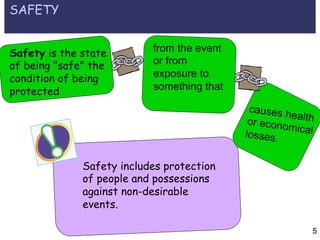
SAFETY


Safety is the state        from the event
of being "safe" the        or from
condition of being         exposure to
protected                  something that

                                             causes h
                                                      ealth
                                             or econo
                                                      mical
                                            losses.


              Safety includes protection
              of people and possessions
              against non-desirable
              events.

                                                          5
Warning signs, can improve
safety awareness.            6
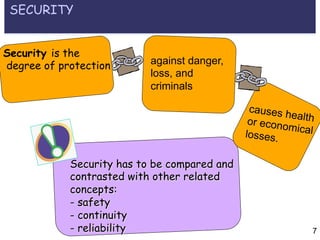
SECURITY


Security is the
degree of protection       against danger,
                           loss, and
                           criminals

                                               causes h
                                                        ealth
                                               or econo
                                                        mical
                                              losses.

            Security has to be compared and
            contrasted with other related
            concepts:
            - safety
            - continuity
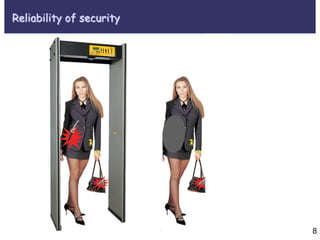
            - reliability                                   7
Reliability of security


                          8
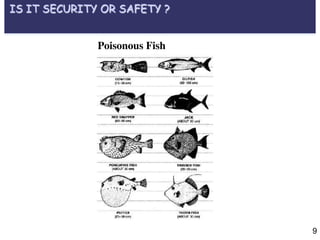
IS IT SECURITY OR SAFETY ?


              Poisonous Fish


                                                               9
IS IT SECURITY OR SAFETY ?


                             10
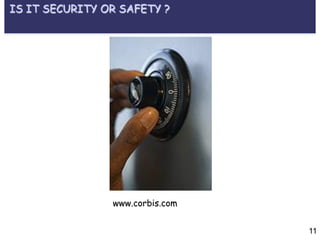
IS IT SECURITY OR SAFETY ?


                www.corbis.com


                                 11
IS IT SECURITY OR SAFETY ?


               www.health.vic.gov.au


                                       12
IS IT SECURITY OR SAFETY ?


                      Image:  © DADANG TRI/Reuters/Corbis


                                                            13
IS IT SECURITY OR SAFETY ?


                             14
15
CONTENT

Week # 1   Introduction
           What is Safety and Security Management?
            Why this course: Who Needs it and Why


Week # 2   Introduction (Continued)
           Terminology / Most Commonly Used Definitions;
            emergency/ disaster, hazard risk, capacity
            and vulnerability.
            Prevention, Mitigation, Preparedness, Response


                                                        16
Learning objectives


• To identify key elements of most
 commonly used definitions:
 - disaster, hazard, risk, capacity and vulnerability.


• To explain the difference among:
 - disaster preparedness, disaster prevention
   disaster mitigation.
- risk management, cris management


                                                         17
Blind mens describ an elephant
                                 18
THE BLIND MEN AND THE ELEPHANT


John Godfrey Saxe's ( 1816-1887) version of the famous Indian legend. 19
TERMINOLOGY: Emergency - Disaster


  • Affects people
  • Usually triggered by a hazard
  • Directly related to vulnerability


  • Exceeds capacity of household, community
    or group of people to cope


                                               20
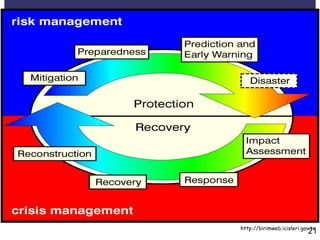
http://birimweb.icisleri.gov.tr
                            21
RİSK YÖNETİMİ
                                  Tahmin ve Erken
                Hazırlık          Uyarı

 Risk Azaltma                                       AFET

                       KORUMA

                       İYİLEŞME
                                                EtkiDeğerlen-
Yeniden Yapılanma                               dirmesi


                 İyileşme         Müdahale


KRİZ YÖNETİMİ
                                              http://birimweb.icisleri.gov.tr
                                                                          22
Most commonly used definitions


• Hazard


• Risk


• Vulnerability


• Capacity


                                 23
What is a hazard?

• A hazard is a physical or human-made event
  that can potentially trigger a disaster.

•  Examples include earthquakes, mud-slides,
   floods, volcanic eruptions, tsunamis, drought,
   economic collapse, and war.
OR
•  Bombing, terrorist attack, food poisoning,
epidemics

• These physical events need not necessarily
  result in disaster.
                                                    24
HAZARD/TEHLIKE


                 25
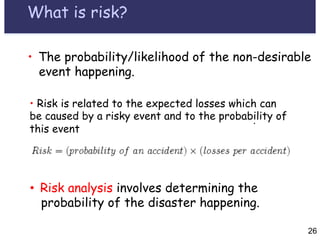
What is risk?

• The probability/likelihood of the non-desirable
  event happening.

•  Risk is related to the expected losses which can
        	

be caused by a risky event and to the probability of
                                                                             . 	

this event


• Risk analysis involves determining the
  probability of the disaster happening.

                                                                                     26
RISK


       27
The ingredients?

H      x     V     -     C         =   R

                   or


    Risk = Hazard x Vulnerabilty
                Capacity


                                           28
What is vulnerability?

• Human vulnerability is:
   - the degree to which people are susceptible to loss,
     damage, suffering and death, in the event of a
     disaster.
 • This is a function of:
   - physical, economic, social, political, technical,
     ideological, cultural, educational, ecological and
     institutional conditions.
• Vulnerability relates to:
  - an individual or community capacity to cope with
    specific threats.


                                                           29
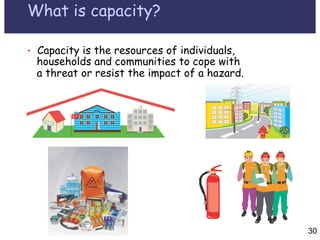
What is capacity?

• Capacity is the resources of individuals,
 households and communities to cope with
 a threat or resist the impact of a hazard.


                                              30
Courtesy of Zeynep Turkmen Sanduvac
İllustratiuon: Arzu Ozler
Temel Afet Bilgisi El Kiabı.2009


31
Courtesy of Zeynep Turkmen Sanduvac
İllustratiuon: Arzu Ozler
Temel Afet Bilgisi El Kiabı.2009
                                                      Hazard


                                      Vulnerability
                                      Capacity
                                                      Risk


32
Hazard x Vulnerability - Capacity = Risk


   Hazard            Potential threat to humans
     x               and their welfare

 Vulnerability       Exposure and susceptibility
      -              to loss of life or dignity

   Capacity          Available and potential
      =              resources
     Risk            Probability of disaster
                     occurrence

  *Emergency
  *Disaster         Realization of a risk
                                                   33
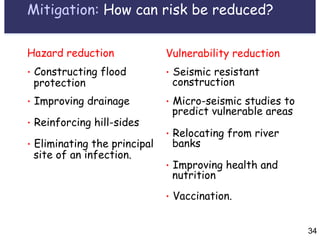
Mitigation: How can risk be reduced?

Hazard reduction              Vulnerability reduction
• Constructing flood          • Seismic resistant
 protection                    construction
• Improving drainage          • Micro-seismic studies to
                               predict vulnerable areas
• Reinforcing hill-sides
                              • Relocating from river
• Eliminating the principal    banks
 site of an infection.
                              • Improving health and
                               nutrition
                              • Vaccination.


                                                           34
What are the differences?


• Disaster   preparedness

• Disaster   mitigation

• Disaster   prevention


                            35
What are the differences?


• Disaster   preparedness

• Disaster   mitigation

• Disaster   prevention


                            36
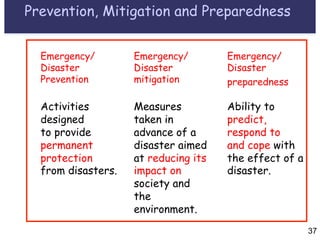
Prevention, Mitigation and Preparedness


  Emergency/        Emergency/        Emergency/
  Disaster          Disaster          Disaster
  Prevention        mitigation        preparedness

  Activities        Measures          Ability to
  designed          taken in          predict,
  to provide        advance of a      respond to
  permanent         disaster aimed    and cope with
  protection        at reducing its   the effect of a
  from disasters.   impact on         disaster.
                    society and
                    the
                    environment.
                                                        37
BEFORE ENDING


                38

Disaster Risk Reduction Terminology

  • 1.
    Organizational Safety andSecurity Management Boğaziçi University Department of Tourism Administration Course: TRM 474 _Organizational Safety and Security Management Instructor: Zeynep Türkmen Sanduvaç,MA. Office: B 327 Office hours: Tuesday 13.00-14.00 or by appointment E-Mail: zturkmen@boun.edu.tr zeynepturkmen@zeynepturkmen.com 1
  • 2.
    CONTENT Week # 1 Introduction What is Safety and Security Management? Why this course: Who Needs it and Why Week # 2 Introduction (Continued) Terminology/Most Commonly Used Definitions; emergency, disaster, hazard, risk, capacity and vulnerability. Prevention, Mitigation, Preparedness, Response 2
  • 3.
    IS IT SECURITYOR SAFETY ? Photographer: Ben & Nastassia South America_Ecuador 3
  • 4.
    IS IT SECURITYOR SAFETY ? www.tuv.com 4
  • 5.
    SAFETY Safety is thestate from the event of being "safe" the or from condition of being exposure to protected something that causes h ealth or econo mical losses. Safety includes protection of people and possessions against non-desirable events. 5
  • 6.
    Warning signs, canimprove safety awareness. 6
  • 7.
    SECURITY Security is the degreeof protection against danger, loss, and criminals causes h ealth or econo mical losses. Security has to be compared and contrasted with other related concepts: - safety - continuity - reliability 7
  • 8.
  • 9.
    IS IT SECURITYOR SAFETY ? Poisonous Fish                                      9
  • 10.
    IS IT SECURITYOR SAFETY ? 10
  • 11.
    IS IT SECURITYOR SAFETY ? www.corbis.com 11
  • 12.
    IS IT SECURITYOR SAFETY ? www.health.vic.gov.au 12
  • 13.
    IS IT SECURITYOR SAFETY ? Image:  © DADANG TRI/Reuters/Corbis 13
  • 14.
    IS IT SECURITYOR SAFETY ? 14
  • 15.
  • 16.
    CONTENT Week # 1 Introduction What is Safety and Security Management? Why this course: Who Needs it and Why Week # 2 Introduction (Continued) Terminology / Most Commonly Used Definitions; emergency/ disaster, hazard risk, capacity and vulnerability. Prevention, Mitigation, Preparedness, Response 16
  • 17.
    Learning objectives • Toidentify key elements of most commonly used definitions: - disaster, hazard, risk, capacity and vulnerability. • To explain the difference among: - disaster preparedness, disaster prevention disaster mitigation. - risk management, cris management 17
  • 18.
    Blind mens describan elephant 18
  • 19.
    THE BLIND MENAND THE ELEPHANT John Godfrey Saxe's ( 1816-1887) version of the famous Indian legend. 19
  • 20.
    TERMINOLOGY: Emergency -Disaster • Affects people • Usually triggered by a hazard • Directly related to vulnerability • Exceeds capacity of household, community or group of people to cope 20
  • 21.
  • 22.
    RİSK YÖNETİMİ Tahmin ve Erken Hazırlık Uyarı Risk Azaltma AFET KORUMA İYİLEŞME EtkiDeğerlen- Yeniden Yapılanma dirmesi İyileşme Müdahale KRİZ YÖNETİMİ http://birimweb.icisleri.gov.tr 22
  • 23.
    Most commonly useddefinitions • Hazard • Risk • Vulnerability • Capacity 23
  • 24.
    What is ahazard? • A hazard is a physical or human-made event that can potentially trigger a disaster. •  Examples include earthquakes, mud-slides, floods, volcanic eruptions, tsunamis, drought, economic collapse, and war. OR •  Bombing, terrorist attack, food poisoning, epidemics • These physical events need not necessarily result in disaster. 24
  • 25.
  • 26.
    What is risk? •The probability/likelihood of the non-desirable event happening. •  Risk is related to the expected losses which can be caused by a risky event and to the probability of                                                                 . this event • Risk analysis involves determining the probability of the disaster happening. 26
  • 27.
  • 28.
    The ingredients? H x V - C = R or Risk = Hazard x Vulnerabilty Capacity 28
  • 29.
    What is vulnerability? •Human vulnerability is: - the degree to which people are susceptible to loss, damage, suffering and death, in the event of a disaster. • This is a function of: - physical, economic, social, political, technical, ideological, cultural, educational, ecological and institutional conditions. • Vulnerability relates to: - an individual or community capacity to cope with specific threats. 29
  • 30.
    What is capacity? •Capacity is the resources of individuals, households and communities to cope with a threat or resist the impact of a hazard. 30
  • 31.
    Courtesy of ZeynepTurkmen Sanduvac İllustratiuon: Arzu Ozler Temel Afet Bilgisi El Kiabı.2009 31
  • 32.
    Courtesy of ZeynepTurkmen Sanduvac İllustratiuon: Arzu Ozler Temel Afet Bilgisi El Kiabı.2009 Hazard Vulnerability Capacity Risk 32
  • 33.
    Hazard x Vulnerability- Capacity = Risk Hazard Potential threat to humans x and their welfare Vulnerability Exposure and susceptibility - to loss of life or dignity Capacity Available and potential = resources Risk Probability of disaster occurrence *Emergency *Disaster Realization of a risk 33
  • 34.
    Mitigation: How canrisk be reduced? Hazard reduction Vulnerability reduction • Constructing flood • Seismic resistant protection construction • Improving drainage • Micro-seismic studies to predict vulnerable areas • Reinforcing hill-sides • Relocating from river • Eliminating the principal banks site of an infection. • Improving health and nutrition • Vaccination. 34
  • 35.
    What are thedifferences? • Disaster preparedness • Disaster mitigation • Disaster prevention 35
  • 36.
    What are thedifferences? • Disaster preparedness • Disaster mitigation • Disaster prevention 36
  • 37.
    Prevention, Mitigation andPreparedness Emergency/ Emergency/ Emergency/ Disaster Disaster Disaster Prevention mitigation preparedness Activities Measures Ability to designed taken in predict, to provide advance of a respond to permanent disaster aimed and cope with protection at reducing its the effect of a from disasters. impact on disaster. society and the environment. 37
  • 38.