COMMUNITY MANAGED DISASTER RISK REDUCTION (
 CMDRR) APPROACH/CLIMATE CHANGE ADAPTATION
                PROGRAMME

          PRESENTATION MADE AT

     STRENGTHENING CLIMATE RESILIENCE
            PROJECTWORKSHOP

                24th June 2010

              BY: SAFIA ABDI
                CORDAID-
Outline

  About Cordaid
  Link between view of CMDRR/CCA /SD
  Cordaid CMDRR/CCA
   programme/approach
  Climate smart approach/CMDRR
  Challenges
  Way Forward
ABOUT CORDAID

    Catholic Organization for Relief and Development Aid
     [Cordaid]
    Dutch International relief and development NGO

    Works in 36 countries with over 1000 partners- in
     Africa, Asia, Latin America and Eastern Europe
    Partners/donors: Dutch Ministry of Development
     Cooperation, EC, ECHO, Dutch public, Caritas
     Internationalis…
    4 programmes- In Kenya- enhanced pastoralist voice,
     CMDRR, and Urban slums
How we view CCA/DRR/devpt
    With climate change- frequency and intensity of Hazard increases
    Increase in hazard/disaster events adversely affect sustainable
     development and growth of nations and communities- funds are diverted
     to relief activities.. (Co-relation between hazard event and GDP)
    With CC there are opportunities and risks- Adaptation- addressing risk,
     turn opportunities into assets
    Adaptation and DRR measurs aim at reducing impacts of hazards and
     enhance peoples/nations adaptive capacity –by extension contribute to
     sustainable development-
     CCA/DRR intervention planning that take into consideration the various
     future scenarios based on the science is a building block for sustainable
     development.
    Enjoyment of equal and inalienable rights of people is the foundation of
     freedom, justice, peace and safety. Poor governance = increase in
     vulnerability=not safe/resilient- therefore need to link the 3.
    The three are mutually inclusive/mutually beneficial
CMDRR/CCA in Kenya

    Implemented in the pastoralist areas- active in Moyale,
     Mandera, Isiolo, Samburu, and Marsabit
    Overall objective- build safe and resilient communities.
    Priority activities ( after PDRA&A) supported. These
     could be prevention, mitigation activities targeting the
     hazard, preparedness, response, recovery and
     reconstruction.
    Mainly focus on drought as a hazard but others-
     conflict management, floods, livestock
     disease...shaped by PDRA and analysis
    Combine drought cycle management and DRR/CCA
     approaches and strategies
CMDRR Programme
 Core Principles of CMDRR
  Communities are at the centre of CMDRR
  They manage DRR process/PDRA&A
  Development organizations’ role is facilitation ( not
   solution providers) and employees are learning agents
   and not change agents
  CMDRR is multi-stakeholder process and facilitation
   done through multi-agency approach ( broad based
   partnership )
  CMDRR best done through multi-hazard approach
  Effective community organization is the foundation of
   CMDRR
  MEL & ADVOCACY an integral part of CMDRR.
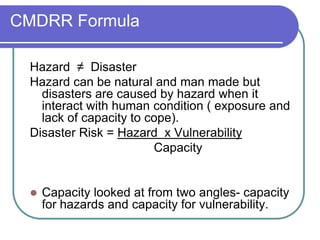
CMDRR Formula

 Hazard ≠ Disaster
 Hazard can be natural and man made but
   disasters are caused by hazard when it
   interact with human condition ( exposure and
   lack of capacity to cope).
 Disaster Risk = Hazard x Vulnerability
                        Capacity


    Capacity looked at from two angles- capacity
     for hazards and capacity for vulnerability.
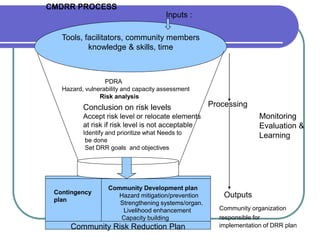
CMDRR PROCESS
                                         Inputs :

   Tools, facilitators, community members
           knowledge & skills, time


                  PDRA
   Hazard, vulnerability and capacity assessment
                Risk analysis
          Conclusion on risk levels                  Processing
          Accept risk level or relocate elements                    Monitoring
          at risk if risk level is not acceptable                   Evaluation &
          Identify and prioritize what Needs to
                                                                    Learning
           be done
           Set DRR goals and objectives


                   Community Development plan
 Contingency                                             Outputs
                      Hazard mitigation/prevention
 plan
                      Strengthening systems/organ.
                       Livelihood enhancement          Community organization
                      Capacity building                responsible for
      Community Risk Reduction Plan                    implementation of DRR plan
Climate smart approach of our
programme
 Tackling exposure to changing extremes:
  Making DRR a priority
      Lobby at International/ national level through networks like Kenya Climate
        Change working Group, CIDSE- the National climate Change Response
        strategy have plans for DRR actions.
      Cordaid is a member of the national DRR platform (
    Assessing changing risks and vulnerabilities
        Risk assessment mostly based on local knowledge but also other secondary
         data. plans to use data based on regional and down-scaled climate
         information..
       Vulnerability and Capacity Assessments – Depend on local knowledge and
         experience- Element at risk include human, productive assets and critical
         structures
    Increase public awareness of climate change and disaster risks
       investing in building own staff, partners and community capacity on DRR/
         climate change
         Early warning and preparedness – communities EWS and modern used.
         Proactive Local institutions – After PDRA&A) , community organization is
          formed- for mobilization of community and resources
Tackling exposure to changing extremes


  Reduce exposure of physical environment to
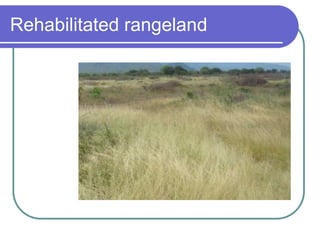
    changing risks : e.g activities like rangeland
    rehabilitation to enhance pasture growth.
        Relocation in some region
  Reduce exposure of livelihood strategies to
    changing risks
        Local Economy : livelihood diversification options like- fish
         farming, dry land farming, petty trade, sericulture, eco-tourism,
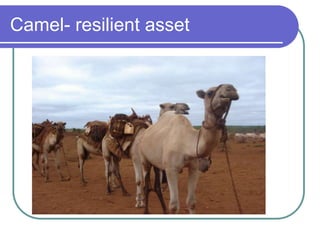
         restocking with resilient animals like camels and goats.
        Social relations – promote social cohesion e.g conflict
         transformation- development of resource use pacts btw
         communities- saved many lives and livelihood in the drought
         of 2008/2009
Enhancing adaptive capacity


     Creating flexible and effective institutions
          Effective delivery –strengthening community institutions – e.g Rangeland Users
           Association in Isiolo district (more still need to be done)
          Flexibility – Cordaid and partners staff well trained on DRR and Climate Change.
           Partners sale their CAP/Contingency plans to various actors.
          Whatever comes out of well facilitated PDRA&A process is flexibly funded, of course
           depending on resources available...
          At national level, effective institutions are necessary but the capacity of existing
           structures is inadequate in terms of leadership on the subject and outreach.
     Promoting learning
      Interactive learning – Mandated- linking and learning.
           Intra/inter country/ community and partners Learning tours
           documentation of best practices
          Reaching out to other actors- eg ECHO.
     Adopting multi-Level perspectives
      Linkages across scales – local level experiences have been used as evidence in lobby and
      advocacy (REGLAP)
     Considering greater uncertainty
      Scenario planning- Contingency plans developed at community level based on worst case
      scenario exercise. But scientific prediction fairly used.
Addressing Poverty, Vulnerability
and their Causes
    Some of the interventions under 1 and 2 above by extension
     deals with this.
    invested in developing livestock marketing infrastructure
    Support heath projects
    Support schools with water facilities to reduce drop-out during
     drought.
    A different Cordaid programme support issues of civic education
     and other lobby work to enhance voices of pastoralist in the local
     and national government agenda’s.
    Environmental Impact Assessment /audit done for projects for
     environmental sustainability but not for carbon stewardship
Challenges

At policy/national level
 DRR policy still in draft=moneraty allocations and
   establishment of certain structures and system
   delayed
 Limited integration of policies: DRR and CC have good
   link but what about other sectoral policies.
 Blame game = using CC
 Poor co-ordination between ministries- not effective
   and efficient.
Challenges contd
 At local level
  Different actors using different tools- confusing the
    community.
  Poor co-ordination of activities among actors.
  Communities local knowledge esp. on EWS often
    ignore and not incorporated into the modern EWS.
  Some overarching systems killing local initiatives and
    coping mechanism- e.g relief food distribution
    throughout the year for over 10 yrs.
  Documentation of best practices not adequately done.
Way forward
    Improve institutional linkages-practice.
    Government to provide leadership and outreach.
    More research esp. CC - to generate information
    CSOs to document best practices and lessons- for advocacy and
     replication.
    Capacity building on DRR/CC
    Develop a common approach/tools
    Build on indigenous knowledge
    Advocate for good governance as it it the foundation of safety.
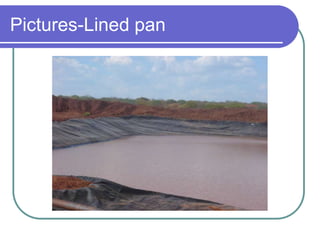
Pictures-Lined pan
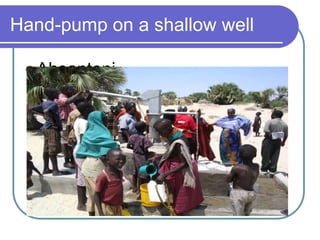
Hand-pump on a shallow well

  Ahsanteni
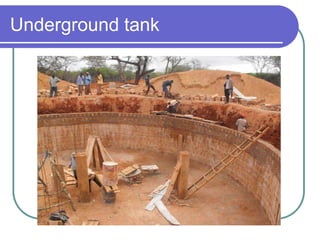
Underground tank
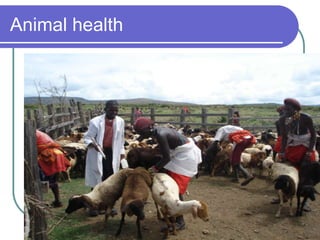
Animal health
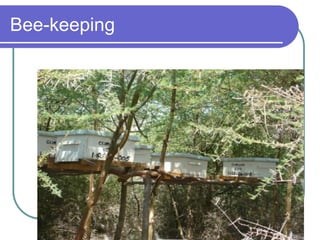
Bee-keeping
Camel- resilient asset
Rehabilitated rangeland
   Thank you.

Community managed drr coraid - regional consultation

  • 1.
    COMMUNITY MANAGED DISASTERRISK REDUCTION ( CMDRR) APPROACH/CLIMATE CHANGE ADAPTATION PROGRAMME PRESENTATION MADE AT STRENGTHENING CLIMATE RESILIENCE PROJECTWORKSHOP 24th June 2010 BY: SAFIA ABDI CORDAID-
  • 2.
    Outline  AboutCordaid  Link between view of CMDRR/CCA /SD  Cordaid CMDRR/CCA programme/approach  Climate smart approach/CMDRR  Challenges  Way Forward
  • 3.
    ABOUT CORDAID  Catholic Organization for Relief and Development Aid [Cordaid]  Dutch International relief and development NGO  Works in 36 countries with over 1000 partners- in Africa, Asia, Latin America and Eastern Europe  Partners/donors: Dutch Ministry of Development Cooperation, EC, ECHO, Dutch public, Caritas Internationalis…  4 programmes- In Kenya- enhanced pastoralist voice, CMDRR, and Urban slums
  • 4.
    How we viewCCA/DRR/devpt  With climate change- frequency and intensity of Hazard increases  Increase in hazard/disaster events adversely affect sustainable development and growth of nations and communities- funds are diverted to relief activities.. (Co-relation between hazard event and GDP)  With CC there are opportunities and risks- Adaptation- addressing risk, turn opportunities into assets  Adaptation and DRR measurs aim at reducing impacts of hazards and enhance peoples/nations adaptive capacity –by extension contribute to sustainable development-  CCA/DRR intervention planning that take into consideration the various future scenarios based on the science is a building block for sustainable development.  Enjoyment of equal and inalienable rights of people is the foundation of freedom, justice, peace and safety. Poor governance = increase in vulnerability=not safe/resilient- therefore need to link the 3.  The three are mutually inclusive/mutually beneficial
  • 5.
    CMDRR/CCA in Kenya  Implemented in the pastoralist areas- active in Moyale, Mandera, Isiolo, Samburu, and Marsabit  Overall objective- build safe and resilient communities.  Priority activities ( after PDRA&A) supported. These could be prevention, mitigation activities targeting the hazard, preparedness, response, recovery and reconstruction.  Mainly focus on drought as a hazard but others- conflict management, floods, livestock disease...shaped by PDRA and analysis  Combine drought cycle management and DRR/CCA approaches and strategies
  • 6.
    CMDRR Programme CorePrinciples of CMDRR  Communities are at the centre of CMDRR  They manage DRR process/PDRA&A  Development organizations’ role is facilitation ( not solution providers) and employees are learning agents and not change agents  CMDRR is multi-stakeholder process and facilitation done through multi-agency approach ( broad based partnership )  CMDRR best done through multi-hazard approach  Effective community organization is the foundation of CMDRR  MEL & ADVOCACY an integral part of CMDRR.
  • 7.
    CMDRR Formula Hazard≠ Disaster Hazard can be natural and man made but disasters are caused by hazard when it interact with human condition ( exposure and lack of capacity to cope). Disaster Risk = Hazard x Vulnerability Capacity  Capacity looked at from two angles- capacity for hazards and capacity for vulnerability.
  • 8.
    CMDRR PROCESS Inputs : Tools, facilitators, community members knowledge & skills, time PDRA Hazard, vulnerability and capacity assessment Risk analysis Conclusion on risk levels Processing Accept risk level or relocate elements Monitoring at risk if risk level is not acceptable Evaluation & Identify and prioritize what Needs to Learning be done Set DRR goals and objectives Community Development plan Contingency Outputs Hazard mitigation/prevention plan Strengthening systems/organ. Livelihood enhancement Community organization Capacity building responsible for Community Risk Reduction Plan implementation of DRR plan
  • 9.
    Climate smart approachof our programme Tackling exposure to changing extremes:  Making DRR a priority  Lobby at International/ national level through networks like Kenya Climate Change working Group, CIDSE- the National climate Change Response strategy have plans for DRR actions.  Cordaid is a member of the national DRR platform (  Assessing changing risks and vulnerabilities  Risk assessment mostly based on local knowledge but also other secondary data. plans to use data based on regional and down-scaled climate information..  Vulnerability and Capacity Assessments – Depend on local knowledge and experience- Element at risk include human, productive assets and critical structures  Increase public awareness of climate change and disaster risks  investing in building own staff, partners and community capacity on DRR/ climate change  Early warning and preparedness – communities EWS and modern used.  Proactive Local institutions – After PDRA&A) , community organization is formed- for mobilization of community and resources
  • 10.
    Tackling exposure tochanging extremes Reduce exposure of physical environment to changing risks : e.g activities like rangeland rehabilitation to enhance pasture growth.  Relocation in some region Reduce exposure of livelihood strategies to changing risks  Local Economy : livelihood diversification options like- fish farming, dry land farming, petty trade, sericulture, eco-tourism, restocking with resilient animals like camels and goats.  Social relations – promote social cohesion e.g conflict transformation- development of resource use pacts btw communities- saved many lives and livelihood in the drought of 2008/2009
  • 11.
    Enhancing adaptive capacity  Creating flexible and effective institutions  Effective delivery –strengthening community institutions – e.g Rangeland Users Association in Isiolo district (more still need to be done)  Flexibility – Cordaid and partners staff well trained on DRR and Climate Change. Partners sale their CAP/Contingency plans to various actors.  Whatever comes out of well facilitated PDRA&A process is flexibly funded, of course depending on resources available...  At national level, effective institutions are necessary but the capacity of existing structures is inadequate in terms of leadership on the subject and outreach.  Promoting learning Interactive learning – Mandated- linking and learning.  Intra/inter country/ community and partners Learning tours  documentation of best practices  Reaching out to other actors- eg ECHO.  Adopting multi-Level perspectives Linkages across scales – local level experiences have been used as evidence in lobby and advocacy (REGLAP)  Considering greater uncertainty Scenario planning- Contingency plans developed at community level based on worst case scenario exercise. But scientific prediction fairly used.
  • 12.
    Addressing Poverty, Vulnerability andtheir Causes  Some of the interventions under 1 and 2 above by extension deals with this.  invested in developing livestock marketing infrastructure  Support heath projects  Support schools with water facilities to reduce drop-out during drought.  A different Cordaid programme support issues of civic education and other lobby work to enhance voices of pastoralist in the local and national government agenda’s.  Environmental Impact Assessment /audit done for projects for environmental sustainability but not for carbon stewardship
  • 13.
    Challenges At policy/national level DRR policy still in draft=moneraty allocations and establishment of certain structures and system delayed  Limited integration of policies: DRR and CC have good link but what about other sectoral policies.  Blame game = using CC  Poor co-ordination between ministries- not effective and efficient.
  • 14.
    Challenges contd Atlocal level  Different actors using different tools- confusing the community.  Poor co-ordination of activities among actors.  Communities local knowledge esp. on EWS often ignore and not incorporated into the modern EWS.  Some overarching systems killing local initiatives and coping mechanism- e.g relief food distribution throughout the year for over 10 yrs.  Documentation of best practices not adequately done.
  • 15.
    Way forward  Improve institutional linkages-practice.  Government to provide leadership and outreach.  More research esp. CC - to generate information  CSOs to document best practices and lessons- for advocacy and replication.  Capacity building on DRR/CC  Develop a common approach/tools  Build on indigenous knowledge  Advocate for good governance as it it the foundation of safety.
  • 16.
  • 17.
    Hand-pump on ashallow well  Ahsanteni
  • 18.
  • 19.
  • 20.
  • 21.
  • 22.
  • 25.
    Thank you.