CHAPTER 4
NUMERICAL CONTROL/ COMPUTER NUMERICAL CONTROL
4.1 Numerical Control.
Numerical control (NC) is a form of programmable automation in which the
mechanical actions of a machine tool or other equipment are controlled by a
program containing coded alphanumeric data. The alphanumerical data represent
relative positions between a work-head and a workpart as well as other instructions
needed to operate the machine. The workhead is a cutting tool or other processing
apparatus, and the workpart is the object being processed. When the current job is
completed, the program of instructions can be changed to process a new job. The
capability to change the program makes NC suitable for low and medium
production. It is much easier to write new programs than to make major alterations
of the processing equipment.
Numerical control can be applied to a wide variety of processes. The applications
divide into two categories:
(1) machine tool applications, such as drilling, milling, turning, and other metal
working; (2) nonmachine tool applications, such as assembly, drafting, and
inspection.
The common operating feature of NC in all of these applications is control of the
workhead movement relative to the workpart.
Early NC lathers and mills required a program of instructions to be prepared as
patterns of holes punched into paper of plastic tape. The tape was read one
instruction at a time while the workpiece was machined. The program tapes were
typed using equipment specifically designed to punch tape.
Later, read/write memory was added in NC controllers, so the tape had to be read
only once into memory. The NC equipment became known as Computer
Numerical Control (CNC) equipment. Meanwhile, advances in tape punchers
allowed programmers to write whole NC programs at a standard computer
terminal, then send the program to a tape puncher.
Logically, the tape was eliminated in the next evolution by having the central
computer write programs directly into CNC memory. The CNC equipment
became known as Direct Numerical Control (DNC) equipment.
1
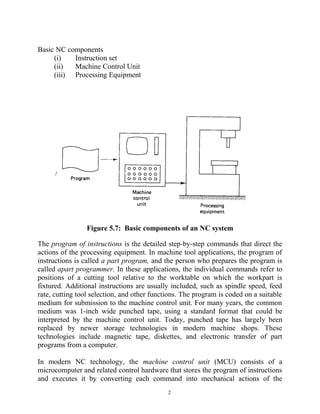
Basic NC components
(i) Instruction set
(ii) Machine Control Unit
(iii) Processing Equipment
Figure 5.7: Basic components of an NC system
The program of instructions is the detailed step-by-step commands that direct the
actions of the processing equipment. In machine tool applications, the program of
instructions is called a part program, and the person who prepares the program is
called apart programmer. In these applications, the individual commands refer to
positions of a cutting tool relative to the worktable on which the workpart is
fixtured. Additional instructions are usually included, such as spindle speed, feed
rate, cutting tool selection, and other functions. The program is coded on a suitable
medium for submission to the machine control unit. For many years, the common
medium was 1-inch wide punched tape, using a standard format that could be
interpreted by the machine control unit. Today, punched tape has largely been
replaced by newer storage technologies in modern machine shops. These
technologies include magnetic tape, diskettes, and electronic transfer of part
programs from a computer.
In modern NC technology, the machine control unit (MCU) consists of a
microcomputer and related control hardware that stores the program of instructions
and executes it by converting each command into mechanical actions of the
2
processing equipment, one command at a time. The related hardware of the MCU
includes components to interface with the processing equipment and feedback
control elements. The MCU also includes one or more reading devices for entering
part programs into memory. The type of readers depends on the storage media used
for part programs in the machine shop (e.g., punched tape reader, magnetic tape
reader, floppy disk drive). The MCU also includes control system software,
calculation algorithms, and translation software to convert the NC part program
into a usable format for the MCU. Because the MCU is a computer, the term
computer numerical control (CNC) is used to distinguish this type of NC from its
technological predecessors that were based entirely on hard-wired electronics.
Today, virtually all new MCUs are based on computer technology; hence, when
we refer to NC in this chapter and elsewhere, we mean CNC.
The third basic component of an NC system is the processing equipment that per-
forms useful work. It accomplishes the processing steps to transform the starting
work-piece into a completed part. Its operation is directed by the MCU, which in
turn is driven by instructions contained in the part program. In the most common
example of NC, machining, the processing equipment consists of the worktable
and spindle as well as the motors and controls to drive them.
5.4.1 Motion control system
There are two types of movement controls used by an NC.
(i) point to point
(ii) Continuous straight cut
contour
Point to point
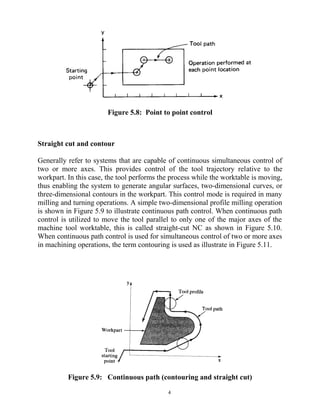
Point to point system is also called positioning system, move the worktable to a
programmed location without regard for the path taken to get the location. Once
the move has been completed, some processing action is accomplished by the
work head at the location , such as drilling or punching a hole. . The program
consists of series of point locations at which operation s are performed as shown is
Figure 5.8.
3
Figure 5.8: Point to point control
Straight cut and contour
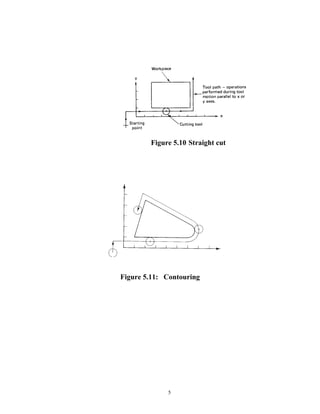
Generally refer to systems that are capable of continuous simultaneous control of
two or more axes. This provides control of the tool trajectory relative to the
workpart. In this case, the tool performs the process while the worktable is moving,
thus enabling the system to generate angular surfaces, two-dimensional curves, or
three-dimensional contours in the workpart. This control mode is required in many
milling and turning operations. A simple two-dimensional profile milling operation
is shown in Figure 5.9 to illustrate continuous path control. When continuous path
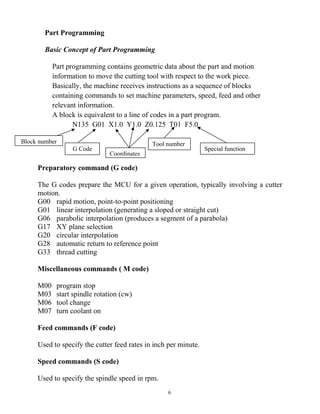
control is utilized to move the tool parallel to only one of the major axes of the
machine tool worktable, this is called straight-cut NC as shown in Figure 5.10.
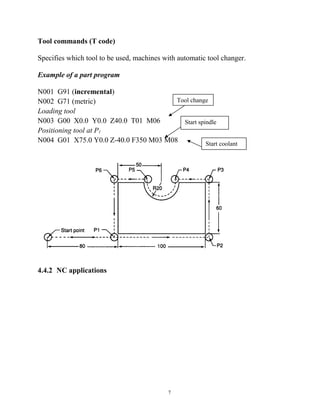
When continuous path control is used for simultaneous control of two or more axes
in machining operations, the term contouring is used as illustrate in Figure 5.11.
Figure 5.9: Continuous path (contouring and straight cut)
4
Figure 5.10 Straight cut
Figure 5.11: Contouring
5
Part Programming
Basic Concept of Part Programming
Part programming contains geometric data about the part and motion
information to move the cutting tool with respect to the work piece.
Basically, the machine receives instructions as a sequence of blocks
containing commands to set machine parameters, speed, feed and other
relevant information.
A block is equivalent to a line of codes in a part program.
N135 G01 X1.0 Y1.0 Z0.125 T01 F5.0
Preparatory command (G code)
The G codes prepare the MCU for a given operation, typically involving a cutter
motion.
G00 rapid motion, point-to-point positioning
G01 linear interpolation (generating a sloped or straight cut)
G06 parabolic interpolation (produces a segment of a parabola)
G17 XY plane selection
G20 circular interpolation
G28 automatic return to reference point
G33 thread cutting
Miscellaneous commands ( M code)
M00 program stop
M03 start spindle rotation (cw)
M06 tool change
M07 turn coolant on
Feed commands (F code)
Used to specify the cutter feed rates in inch per minute.
Speed commands (S code)
Used to specify the spindle speed in rpm.
6
Block number
G Code
Tool number
Special function
Coordinates
Tool commands (T code)
Specifies which tool to be used, machines with automatic tool changer.
Example of a part program
N001 G91 (incremental)
N002 G71 (metric)
Loading tool
N003 G00 X0.0 Y0.0 Z40.0 T01 M06
Positioning tool at P1
N004 G01 X75.0 Y0.0 Z-40.0 F350 M03 M08
4.4.2 NC applications
7
Tool change
Start spindle
Start coolant
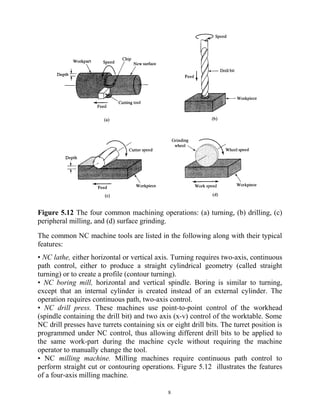
Figure 5.12 The four common machining operations: (a) turning, (b) drilling, (c)
peripheral milling, and (d) surface grinding.
The common NC machine tools are listed in the following along with their typical
features:
• NC lathe, either horizontal or vertical axis. Turning requires two-axis, continuous
path control, either to produce a straight cylindrical geometry (called straight
turning) or to create a profile (contour turning).
• NC boring mill, horizontal and vertical spindle. Boring is similar to turning,
except that an internal cylinder is created instead of an external cylinder. The
operation requires continuous path, two-axis control.
• NC drill press. These machines use point-to-point control of the workhead
(spindle containing the drill bit) and two axis (x-v) control of the worktable. Some
NC drill presses have turrets containing six or eight drill bits. The turret position is
programmed under NC control, thus allowing different drill bits to be applied to
the same work-part during the machine cycle without requiring the machine
operator to manually change the tool.
• NC milling machine. Milling machines require continuous path control to
perform straight cut or contouring operations. Figure 5.12 illustrates the features
of a four-axis milling machine.
8
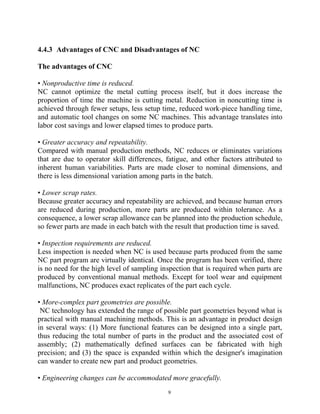
4.4.3 Advantages of CNC and Disadvantages of NC
The advantages of CNC
• Nonproductive time is reduced.
NC cannot optimize the metal cutting process itself, but it does increase the
proportion of time the machine is cutting metal. Reduction in noncutting time is
achieved through fewer setups, less setup time, reduced work-piece handling time,
and automatic tool changes on some NC machines. This advantage translates into
labor cost savings and lower elapsed times to produce parts.
• Greater accuracy and repeatability.
Compared with manual production methods, NC reduces or eliminates variations
that are due to operator skill differences, fatigue, and other factors attributed to
inherent human variabilities. Parts are made closer to nominal dimensions, and
there is less dimensional variation among parts in the batch.
• Lower scrap rates.
Because greater accuracy and repeatability are achieved, and because human errors
are reduced during production, more parts are produced within tolerance. As a
consequence, a lower scrap allowance can be planned into the production schedule,
so fewer parts are made in each batch with the result that production time is saved.
• Inspection requirements are reduced.
Less inspection is needed when NC is used because parts produced from the same
NC part program are virtually identical. Once the program has been verified, there
is no need for the high level of sampling inspection that is required when parts are
produced by conventional manual methods. Except for tool wear and equipment
malfunctions, NC produces exact replicates of the part each cycle.
• More-complex part geometries are possible.
NC technology has extended the range of possible part geometries beyond what is
practical with manual machining methods. This is an advantage in product design
in several ways: (1) More functional features can be designed into a single part,
thus reducing the total number of parts in the product and the associated cost of
assembly; (2) mathematically defined surfaces can be fabricated with high
precision; and (3) the space is expanded within which the designer's imagination
can wander to create new part and product geometries.
• Engineering changes can be accommodated more gracefully.
9
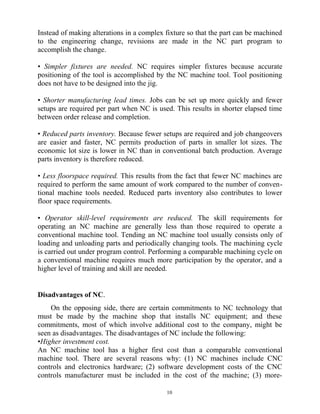
Instead of making alterations in a complex fixture so that the part can be machined
to the engineering change, revisions are made in the NC part program to
accomplish the change.
• Simpler fixtures are needed. NC requires simpler fixtures because accurate
positioning of the tool is accomplished by the NC machine tool. Tool positioning
does not have to be designed into the jig.
• Shorter manufacturing lead times. Jobs can be set up more quickly and fewer
setups are required per part when NC is used. This results in shorter elapsed time
between order release and completion.
• Reduced parts inventory. Because fewer setups are required and job changeovers
are easier and faster, NC permits production of parts in smaller lot sizes. The
economic lot size is lower in NC than in conventional batch production. Average
parts inventory is therefore reduced.
• Less floorspace required. This results from the fact that fewer NC machines are
required to perform the same amount of work compared to the number of conven-
tional machine tools needed. Reduced parts inventory also contributes to lower
floor space requirements.
• Operator skill-level requirements are reduced. The skill requirements for
operating an NC machine are generally less than those required to operate a
conventional machine tool. Tending an NC machine tool usually consists only of
loading and unloading parts and periodically changing tools. The machining cycle
is carried out under program control. Performing a comparable machining cycle on
a conventional machine requires much more participation by the operator, and a
higher level of training and skill are needed.
Disadvantages of NC.
On the opposing side, there are certain commitments to NC technology that
must be made by the machine shop that installs NC equipment; and these
commitments, most of which involve additional cost to the company, might be
seen as disadvantages. The disadvantages of NC include the following:
•Higher investment cost.
An NC machine tool has a higher first cost than a comparable conventional
machine tool. There are several reasons why: (1) NC machines include CNC
controls and electronics hardware; (2) software development costs of the CNC
controls manufacturer must be included in the cost of the machine; (3) more-
10
reliable mechanical components are generally used in NC machines; and (4) NC
machine tools often possess additional features not included on conventional
machines, such as automatic tool changers and part changers .
• Higher maintenance effort
. In general, NC equipment requires a higher level of maintenance than
conventional equipment requires, which translates to higher maintenance and
repair costs. This is due largely to the computer and other electronics that are
included in a modern NC system. The maintenance staff must include personnel
who are trained in maintaining and repairing this type of equipment.
•Part programming.
NC equipment must be programmed. To be fair, it should be mentioned that
process planning must be accomplished for any part, whether or not it is produced
on NC equipment. However, NC part programming is a special preparation step in
batch production that is absent in conventional machine shop operations.
•Higher utilization of NC equipment.
To maximize the economic benefits of an NC machine tool, it usually must be
operated multiple shifts. This might mean adding one or two extra shifts to the
plant's normal operations, with the requirement for supervision and other staff
support.
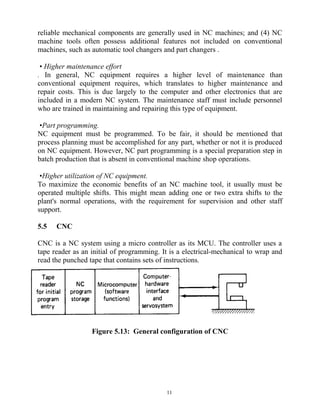
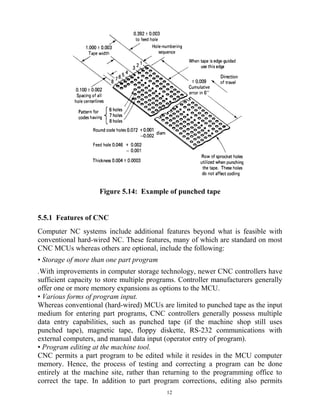
5.5 CNC
CNC is a NC system using a micro controller as its MCU. The controller uses a
tape reader as an initial of programming. It is a electrical-mechanical to wrap and
read the punched tape that contains sets of instructions.
Figure 5.13: General configuration of CNC
11
Figure 5.14: Example of punched tape
5.5.1 Features of CNC
Computer NC systems include additional features beyond what is feasible with
conventional hard-wired NC. These features, many of which are standard on most
CNC MCUs whereas others are optional, include the following:
• Storage of more than one part program
.With improvements in computer storage technology, newer CNC controllers have
sufficient capacity to store multiple programs. Controller manufacturers generally
offer one or more memory expansions as options to the MCU.
• Various forms of program input.
Whereas conventional (hard-wired) MCUs are limited to punched tape as the input
medium for entering part programs, CNC controllers generally possess multiple
data entry capabilities, such as punched tape (if the machine shop still uses
punched tape), magnetic tape, floppy diskette, RS-232 communications with
external computers, and manual data input (operator entry of program).
• Program editing at the machine tool.
CNC permits a part program to be edited while it resides in the MCU computer
memory. Hence, the process of testing and correcting a program can be done
entirely at the machine site, rather than returning to the programming office to
correct the tape. In addition to part program corrections, editing also permits
12
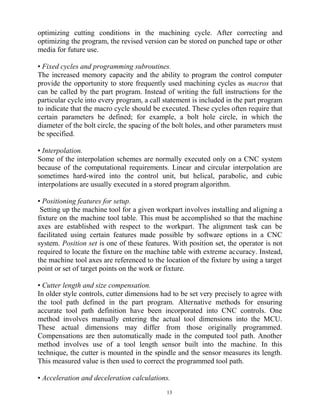
optimizing cutting conditions in the machining cycle. After correcting and
optimizing the program, the revised version can be stored on punched tape or other
media for future use.
• Fixed cycles and programming subroutines.
The increased memory capacity and the ability to program the control computer
provide the opportunity to store frequently used machining cycles as macros that
can be called by the part program. Instead of writing the full instructions for the
particular cycle into every program, a call statement is included in the part program
to indicate that the macro cycle should be executed. These cycles often require that
certain parameters be defined; for example, a bolt hole circle, in which the
diameter of the bolt circle, the spacing of the bolt holes, and other parameters must
be specified.
• Interpolation.
Some of the interpolation schemes are normally executed only on a CNC system
because of the computational requirements. Linear and circular interpolation are
sometimes hard-wired into the control unit, but helical, parabolic, and cubic
interpolations are usually executed in a stored program algorithm.
• Positioning features for setup.
Setting up the machine tool for a given workpart involves installing and aligning a
fixture on the machine tool table. This must be accomplished so that the machine
axes are established with respect to the workpart. The alignment task can be
facilitated using certain features made possible by software options in a CNC
system. Position set is one of these features. With position set, the operator is not
required to locate the fixture on the machine table with extreme accuracy. Instead,
the machine tool axes are referenced to the location of the fixture by using a target
point or set of target points on the work or fixture.
• Cutter length and size compensation.
In older style controls, cutter dimensions had to be set very precisely to agree with
the tool path defined in the part program. Alternative methods for ensuring
accurate tool path definition have been incorporated into CNC controls. One
method involves manually entering the actual tool dimensions into the MCU.
These actual dimensions may differ from those originally programmed.
Compensations are then automatically made in the computed tool path. Another
method involves use of a tool length sensor built into the machine. In this
technique, the cutter is mounted in the spindle and the sensor measures its length.
This measured value is then used to correct the programmed tool path.
• Acceleration and deceleration calculations.
13
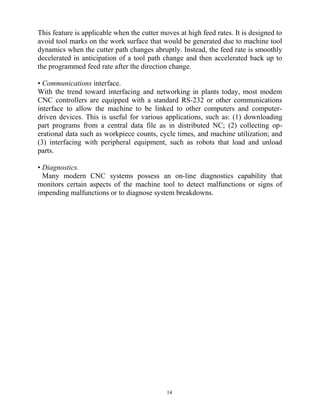
This feature is applicable when the cutter moves at high feed rates. It is designed to
avoid tool marks on the work surface that would be generated due to machine tool
dynamics when the cutter path changes abruptly. Instead, the feed rate is smoothly
decelerated in anticipation of a tool path change and then accelerated back up to
the programmed feed rate after the direction change.
• Communications interface.
With the trend toward interfacing and networking in plants today, most modem
CNC controllers are equipped with a standard RS-232 or other communications
interface to allow the machine to be linked to other computers and computer-
driven devices. This is useful for various applications, such as: (1) downloading
part programs from a central data file as in distributed NC; (2) collecting op-
erational data such as workpiece counts, cycle times, and machine utilization; and
(3) interfacing with peripheral equipment, such as robots that load and unload
parts.
• Diagnostics.
Many modern CNC systems possess an on-line diagnostics capability that
monitors certain aspects of the machine tool to detect malfunctions or signs of
impending malfunctions or to diagnose system breakdowns.
14

Cnc

  • 1.
    CHAPTER 4 NUMERICAL CONTROL/COMPUTER NUMERICAL CONTROL 4.1 Numerical Control. Numerical control (NC) is a form of programmable automation in which the mechanical actions of a machine tool or other equipment are controlled by a program containing coded alphanumeric data. The alphanumerical data represent relative positions between a work-head and a workpart as well as other instructions needed to operate the machine. The workhead is a cutting tool or other processing apparatus, and the workpart is the object being processed. When the current job is completed, the program of instructions can be changed to process a new job. The capability to change the program makes NC suitable for low and medium production. It is much easier to write new programs than to make major alterations of the processing equipment. Numerical control can be applied to a wide variety of processes. The applications divide into two categories: (1) machine tool applications, such as drilling, milling, turning, and other metal working; (2) nonmachine tool applications, such as assembly, drafting, and inspection. The common operating feature of NC in all of these applications is control of the workhead movement relative to the workpart. Early NC lathers and mills required a program of instructions to be prepared as patterns of holes punched into paper of plastic tape. The tape was read one instruction at a time while the workpiece was machined. The program tapes were typed using equipment specifically designed to punch tape. Later, read/write memory was added in NC controllers, so the tape had to be read only once into memory. The NC equipment became known as Computer Numerical Control (CNC) equipment. Meanwhile, advances in tape punchers allowed programmers to write whole NC programs at a standard computer terminal, then send the program to a tape puncher. Logically, the tape was eliminated in the next evolution by having the central computer write programs directly into CNC memory. The CNC equipment became known as Direct Numerical Control (DNC) equipment. 1
  • 2.
    Basic NC components (i)Instruction set (ii) Machine Control Unit (iii) Processing Equipment Figure 5.7: Basic components of an NC system The program of instructions is the detailed step-by-step commands that direct the actions of the processing equipment. In machine tool applications, the program of instructions is called a part program, and the person who prepares the program is called apart programmer. In these applications, the individual commands refer to positions of a cutting tool relative to the worktable on which the workpart is fixtured. Additional instructions are usually included, such as spindle speed, feed rate, cutting tool selection, and other functions. The program is coded on a suitable medium for submission to the machine control unit. For many years, the common medium was 1-inch wide punched tape, using a standard format that could be interpreted by the machine control unit. Today, punched tape has largely been replaced by newer storage technologies in modern machine shops. These technologies include magnetic tape, diskettes, and electronic transfer of part programs from a computer. In modern NC technology, the machine control unit (MCU) consists of a microcomputer and related control hardware that stores the program of instructions and executes it by converting each command into mechanical actions of the 2
  • 3.
    processing equipment, onecommand at a time. The related hardware of the MCU includes components to interface with the processing equipment and feedback control elements. The MCU also includes one or more reading devices for entering part programs into memory. The type of readers depends on the storage media used for part programs in the machine shop (e.g., punched tape reader, magnetic tape reader, floppy disk drive). The MCU also includes control system software, calculation algorithms, and translation software to convert the NC part program into a usable format for the MCU. Because the MCU is a computer, the term computer numerical control (CNC) is used to distinguish this type of NC from its technological predecessors that were based entirely on hard-wired electronics. Today, virtually all new MCUs are based on computer technology; hence, when we refer to NC in this chapter and elsewhere, we mean CNC. The third basic component of an NC system is the processing equipment that per- forms useful work. It accomplishes the processing steps to transform the starting work-piece into a completed part. Its operation is directed by the MCU, which in turn is driven by instructions contained in the part program. In the most common example of NC, machining, the processing equipment consists of the worktable and spindle as well as the motors and controls to drive them. 5.4.1 Motion control system There are two types of movement controls used by an NC. (i) point to point (ii) Continuous straight cut contour Point to point Point to point system is also called positioning system, move the worktable to a programmed location without regard for the path taken to get the location. Once the move has been completed, some processing action is accomplished by the work head at the location , such as drilling or punching a hole. . The program consists of series of point locations at which operation s are performed as shown is Figure 5.8. 3
  • 4.
    Figure 5.8: Pointto point control Straight cut and contour Generally refer to systems that are capable of continuous simultaneous control of two or more axes. This provides control of the tool trajectory relative to the workpart. In this case, the tool performs the process while the worktable is moving, thus enabling the system to generate angular surfaces, two-dimensional curves, or three-dimensional contours in the workpart. This control mode is required in many milling and turning operations. A simple two-dimensional profile milling operation is shown in Figure 5.9 to illustrate continuous path control. When continuous path control is utilized to move the tool parallel to only one of the major axes of the machine tool worktable, this is called straight-cut NC as shown in Figure 5.10. When continuous path control is used for simultaneous control of two or more axes in machining operations, the term contouring is used as illustrate in Figure 5.11. Figure 5.9: Continuous path (contouring and straight cut) 4
  • 5.
    Figure 5.10 Straightcut Figure 5.11: Contouring 5
  • 6.
    Part Programming Basic Conceptof Part Programming Part programming contains geometric data about the part and motion information to move the cutting tool with respect to the work piece. Basically, the machine receives instructions as a sequence of blocks containing commands to set machine parameters, speed, feed and other relevant information. A block is equivalent to a line of codes in a part program. N135 G01 X1.0 Y1.0 Z0.125 T01 F5.0 Preparatory command (G code) The G codes prepare the MCU for a given operation, typically involving a cutter motion. G00 rapid motion, point-to-point positioning G01 linear interpolation (generating a sloped or straight cut) G06 parabolic interpolation (produces a segment of a parabola) G17 XY plane selection G20 circular interpolation G28 automatic return to reference point G33 thread cutting Miscellaneous commands ( M code) M00 program stop M03 start spindle rotation (cw) M06 tool change M07 turn coolant on Feed commands (F code) Used to specify the cutter feed rates in inch per minute. Speed commands (S code) Used to specify the spindle speed in rpm. 6 Block number G Code Tool number Special function Coordinates
  • 7.
    Tool commands (Tcode) Specifies which tool to be used, machines with automatic tool changer. Example of a part program N001 G91 (incremental) N002 G71 (metric) Loading tool N003 G00 X0.0 Y0.0 Z40.0 T01 M06 Positioning tool at P1 N004 G01 X75.0 Y0.0 Z-40.0 F350 M03 M08 4.4.2 NC applications 7 Tool change Start spindle Start coolant
  • 8.
    Figure 5.12 Thefour common machining operations: (a) turning, (b) drilling, (c) peripheral milling, and (d) surface grinding. The common NC machine tools are listed in the following along with their typical features: • NC lathe, either horizontal or vertical axis. Turning requires two-axis, continuous path control, either to produce a straight cylindrical geometry (called straight turning) or to create a profile (contour turning). • NC boring mill, horizontal and vertical spindle. Boring is similar to turning, except that an internal cylinder is created instead of an external cylinder. The operation requires continuous path, two-axis control. • NC drill press. These machines use point-to-point control of the workhead (spindle containing the drill bit) and two axis (x-v) control of the worktable. Some NC drill presses have turrets containing six or eight drill bits. The turret position is programmed under NC control, thus allowing different drill bits to be applied to the same work-part during the machine cycle without requiring the machine operator to manually change the tool. • NC milling machine. Milling machines require continuous path control to perform straight cut or contouring operations. Figure 5.12 illustrates the features of a four-axis milling machine. 8
  • 9.
    4.4.3 Advantages ofCNC and Disadvantages of NC The advantages of CNC • Nonproductive time is reduced. NC cannot optimize the metal cutting process itself, but it does increase the proportion of time the machine is cutting metal. Reduction in noncutting time is achieved through fewer setups, less setup time, reduced work-piece handling time, and automatic tool changes on some NC machines. This advantage translates into labor cost savings and lower elapsed times to produce parts. • Greater accuracy and repeatability. Compared with manual production methods, NC reduces or eliminates variations that are due to operator skill differences, fatigue, and other factors attributed to inherent human variabilities. Parts are made closer to nominal dimensions, and there is less dimensional variation among parts in the batch. • Lower scrap rates. Because greater accuracy and repeatability are achieved, and because human errors are reduced during production, more parts are produced within tolerance. As a consequence, a lower scrap allowance can be planned into the production schedule, so fewer parts are made in each batch with the result that production time is saved. • Inspection requirements are reduced. Less inspection is needed when NC is used because parts produced from the same NC part program are virtually identical. Once the program has been verified, there is no need for the high level of sampling inspection that is required when parts are produced by conventional manual methods. Except for tool wear and equipment malfunctions, NC produces exact replicates of the part each cycle. • More-complex part geometries are possible. NC technology has extended the range of possible part geometries beyond what is practical with manual machining methods. This is an advantage in product design in several ways: (1) More functional features can be designed into a single part, thus reducing the total number of parts in the product and the associated cost of assembly; (2) mathematically defined surfaces can be fabricated with high precision; and (3) the space is expanded within which the designer's imagination can wander to create new part and product geometries. • Engineering changes can be accommodated more gracefully. 9
  • 10.
    Instead of makingalterations in a complex fixture so that the part can be machined to the engineering change, revisions are made in the NC part program to accomplish the change. • Simpler fixtures are needed. NC requires simpler fixtures because accurate positioning of the tool is accomplished by the NC machine tool. Tool positioning does not have to be designed into the jig. • Shorter manufacturing lead times. Jobs can be set up more quickly and fewer setups are required per part when NC is used. This results in shorter elapsed time between order release and completion. • Reduced parts inventory. Because fewer setups are required and job changeovers are easier and faster, NC permits production of parts in smaller lot sizes. The economic lot size is lower in NC than in conventional batch production. Average parts inventory is therefore reduced. • Less floorspace required. This results from the fact that fewer NC machines are required to perform the same amount of work compared to the number of conven- tional machine tools needed. Reduced parts inventory also contributes to lower floor space requirements. • Operator skill-level requirements are reduced. The skill requirements for operating an NC machine are generally less than those required to operate a conventional machine tool. Tending an NC machine tool usually consists only of loading and unloading parts and periodically changing tools. The machining cycle is carried out under program control. Performing a comparable machining cycle on a conventional machine requires much more participation by the operator, and a higher level of training and skill are needed. Disadvantages of NC. On the opposing side, there are certain commitments to NC technology that must be made by the machine shop that installs NC equipment; and these commitments, most of which involve additional cost to the company, might be seen as disadvantages. The disadvantages of NC include the following: •Higher investment cost. An NC machine tool has a higher first cost than a comparable conventional machine tool. There are several reasons why: (1) NC machines include CNC controls and electronics hardware; (2) software development costs of the CNC controls manufacturer must be included in the cost of the machine; (3) more- 10
  • 11.
    reliable mechanical componentsare generally used in NC machines; and (4) NC machine tools often possess additional features not included on conventional machines, such as automatic tool changers and part changers . • Higher maintenance effort . In general, NC equipment requires a higher level of maintenance than conventional equipment requires, which translates to higher maintenance and repair costs. This is due largely to the computer and other electronics that are included in a modern NC system. The maintenance staff must include personnel who are trained in maintaining and repairing this type of equipment. •Part programming. NC equipment must be programmed. To be fair, it should be mentioned that process planning must be accomplished for any part, whether or not it is produced on NC equipment. However, NC part programming is a special preparation step in batch production that is absent in conventional machine shop operations. •Higher utilization of NC equipment. To maximize the economic benefits of an NC machine tool, it usually must be operated multiple shifts. This might mean adding one or two extra shifts to the plant's normal operations, with the requirement for supervision and other staff support. 5.5 CNC CNC is a NC system using a micro controller as its MCU. The controller uses a tape reader as an initial of programming. It is a electrical-mechanical to wrap and read the punched tape that contains sets of instructions. Figure 5.13: General configuration of CNC 11
  • 12.
    Figure 5.14: Exampleof punched tape 5.5.1 Features of CNC Computer NC systems include additional features beyond what is feasible with conventional hard-wired NC. These features, many of which are standard on most CNC MCUs whereas others are optional, include the following: • Storage of more than one part program .With improvements in computer storage technology, newer CNC controllers have sufficient capacity to store multiple programs. Controller manufacturers generally offer one or more memory expansions as options to the MCU. • Various forms of program input. Whereas conventional (hard-wired) MCUs are limited to punched tape as the input medium for entering part programs, CNC controllers generally possess multiple data entry capabilities, such as punched tape (if the machine shop still uses punched tape), magnetic tape, floppy diskette, RS-232 communications with external computers, and manual data input (operator entry of program). • Program editing at the machine tool. CNC permits a part program to be edited while it resides in the MCU computer memory. Hence, the process of testing and correcting a program can be done entirely at the machine site, rather than returning to the programming office to correct the tape. In addition to part program corrections, editing also permits 12
  • 13.
    optimizing cutting conditionsin the machining cycle. After correcting and optimizing the program, the revised version can be stored on punched tape or other media for future use. • Fixed cycles and programming subroutines. The increased memory capacity and the ability to program the control computer provide the opportunity to store frequently used machining cycles as macros that can be called by the part program. Instead of writing the full instructions for the particular cycle into every program, a call statement is included in the part program to indicate that the macro cycle should be executed. These cycles often require that certain parameters be defined; for example, a bolt hole circle, in which the diameter of the bolt circle, the spacing of the bolt holes, and other parameters must be specified. • Interpolation. Some of the interpolation schemes are normally executed only on a CNC system because of the computational requirements. Linear and circular interpolation are sometimes hard-wired into the control unit, but helical, parabolic, and cubic interpolations are usually executed in a stored program algorithm. • Positioning features for setup. Setting up the machine tool for a given workpart involves installing and aligning a fixture on the machine tool table. This must be accomplished so that the machine axes are established with respect to the workpart. The alignment task can be facilitated using certain features made possible by software options in a CNC system. Position set is one of these features. With position set, the operator is not required to locate the fixture on the machine table with extreme accuracy. Instead, the machine tool axes are referenced to the location of the fixture by using a target point or set of target points on the work or fixture. • Cutter length and size compensation. In older style controls, cutter dimensions had to be set very precisely to agree with the tool path defined in the part program. Alternative methods for ensuring accurate tool path definition have been incorporated into CNC controls. One method involves manually entering the actual tool dimensions into the MCU. These actual dimensions may differ from those originally programmed. Compensations are then automatically made in the computed tool path. Another method involves use of a tool length sensor built into the machine. In this technique, the cutter is mounted in the spindle and the sensor measures its length. This measured value is then used to correct the programmed tool path. • Acceleration and deceleration calculations. 13
  • 14.
    This feature isapplicable when the cutter moves at high feed rates. It is designed to avoid tool marks on the work surface that would be generated due to machine tool dynamics when the cutter path changes abruptly. Instead, the feed rate is smoothly decelerated in anticipation of a tool path change and then accelerated back up to the programmed feed rate after the direction change. • Communications interface. With the trend toward interfacing and networking in plants today, most modem CNC controllers are equipped with a standard RS-232 or other communications interface to allow the machine to be linked to other computers and computer- driven devices. This is useful for various applications, such as: (1) downloading part programs from a central data file as in distributed NC; (2) collecting op- erational data such as workpiece counts, cycle times, and machine utilization; and (3) interfacing with peripheral equipment, such as robots that load and unload parts. • Diagnostics. Many modern CNC systems possess an on-line diagnostics capability that monitors certain aspects of the machine tool to detect malfunctions or signs of impending malfunctions or to diagnose system breakdowns. 14