ACUTE OSTEOMYELITIS
NUR HANISAH ZAINOREN
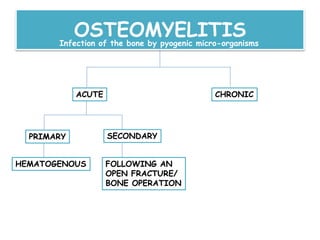
OSTEOMYELITIS
ACUTE CHRONIC
PRIMARY SECONDARY
HEMATOGENOUS FOLLOWING AN
OPEN FRACTURE/
BONE OPERATION
Infection of the bone by pyogenic micro-organisms
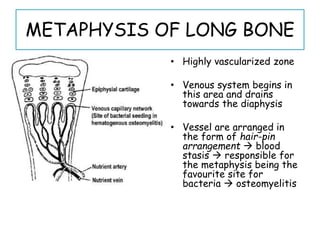
• Highly vascularized zone
• Venous system begins in
this area and drains
towards the diaphysis
• Vessel are arranged in
the form of hair-pin
arrangement  blood
stasis  responsible for
the metaphysis being the
favourite site for
bacteria  osteomyelitis
METAPHYSIS OF LONG BONE
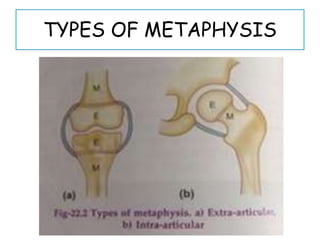
TYPES OF METAPHYSIS
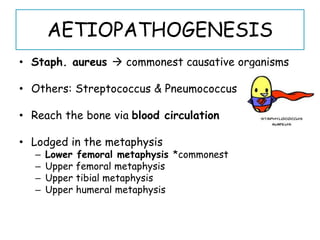
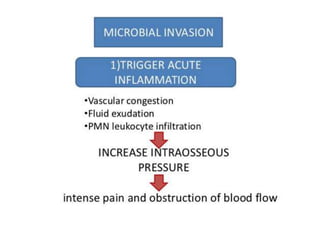
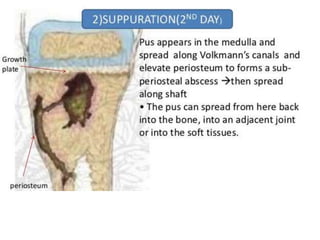
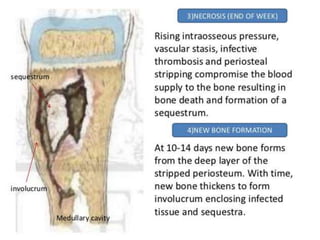
AETIOPATHOGENESIS
• Staph. aureus  commonest causative organisms
• Others: Streptococcus & Pneumococcus
• Reach the bone via blood circulation
• Lodged in the metaphysis
– Lower femoral metaphysis *commonest
– Upper femoral metaphysis
– Upper tibial metaphysis
– Upper humeral metaphysis
• Disease of CHILDHOOD, more common in BOYS, probably
because they are more prone to injury
• Diagnosis is clinical
• Presenting complaints:
– Pain
– Swelling
– Fever
– Chills and rigor
• Examination:
– Febrile and dehydrated
– Red, hot, tender, swelling, edema
– Abscess in the muscle or subcutaneous plane (later stages)
– There may be swelling of the adjacent joint
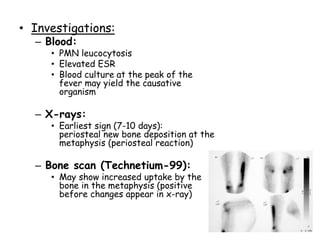
• Investigations:
– Blood:
• PMN leucocytosis
• Elevated ESR
• Blood culture at the peak of the
fever may yield the causative
organism
– X-rays:
• Earliest sign (7-10 days):
periosteal new bone deposition at the
metaphysis (periosteal reaction)
– Bone scan (Technetium-99):
• May show increased uptake by the
bone in the metaphysis (positive
before changes appear in x-ray)
• Differential diagnosis:
a) Acute septic arthritis
b) Acute rheumatic arthritis
c) Scurvy
d) Acute poliomyelitis
*Any acute inflammatory disease at the end of a
bone, in a child, should be taken as acute
osteomyelitis unless proved otherwise.
*Any history of trauma, must be thoroughly
questioned
• Treatment:
Within 48 hours of the onset of symptoms
• Pus not yet formed and the inflammatory
process can be halted by systemic antibiotics
• Consists of rest, antibiotics and general
building-up of the patient
 Rest - Limb is put to rest in a splint or by traction
 Antibiotics - choices varies depend on the age of the
child & choice of the doctor
 General – rehydration with IV fluids, weight bearing
restriction for 6-8 weeks
• Treatment:
After 48 hours of the onset of symptoms
• Child is brought late or does not respond to
conservative treament  Collection of pus
within or outside the bone
• Detection of pus by ultrasound examination
(because it may lie deep to the periosteum)
• Surgical exploration and drainage
• Antibiotics are continued for 6 weeks
• Complications:
– General complications:
• Septicaemia
• Pyemia
– Local complications:
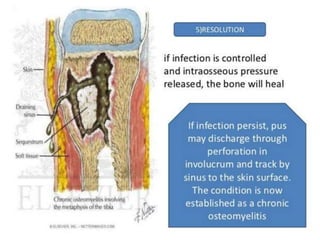
• Chronic osteomyelitis
• Acute pyogenic arthritis
• Pathological fracture
• Growth plate disturbances
SECONDARY OSTEOMYELITIS
• Arises from a wound infection in an open
fractures or after operations on the bone
• Less severe than hematogenous osteomyelitis
(as wound provide some drainage)
• Prevention:
– adequate initial treatment of open fractures
– adherence to sterile operating conditions
THANK YOU :)

Acute osteomyelitis

  • 1.
  • 2.
    OSTEOMYELITIS ACUTE CHRONIC PRIMARY SECONDARY HEMATOGENOUSFOLLOWING AN OPEN FRACTURE/ BONE OPERATION Infection of the bone by pyogenic micro-organisms
  • 3.
    • Highly vascularizedzone • Venous system begins in this area and drains towards the diaphysis • Vessel are arranged in the form of hair-pin arrangement  blood stasis  responsible for the metaphysis being the favourite site for bacteria  osteomyelitis METAPHYSIS OF LONG BONE
  • 4.
  • 5.
    AETIOPATHOGENESIS • Staph. aureus commonest causative organisms • Others: Streptococcus & Pneumococcus • Reach the bone via blood circulation • Lodged in the metaphysis – Lower femoral metaphysis *commonest – Upper femoral metaphysis – Upper tibial metaphysis – Upper humeral metaphysis
  • 10.
    • Disease ofCHILDHOOD, more common in BOYS, probably because they are more prone to injury • Diagnosis is clinical • Presenting complaints: – Pain – Swelling – Fever – Chills and rigor • Examination: – Febrile and dehydrated – Red, hot, tender, swelling, edema – Abscess in the muscle or subcutaneous plane (later stages) – There may be swelling of the adjacent joint
  • 11.
    • Investigations: – Blood: •PMN leucocytosis • Elevated ESR • Blood culture at the peak of the fever may yield the causative organism – X-rays: • Earliest sign (7-10 days): periosteal new bone deposition at the metaphysis (periosteal reaction) – Bone scan (Technetium-99): • May show increased uptake by the bone in the metaphysis (positive before changes appear in x-ray)
  • 12.
    • Differential diagnosis: a)Acute septic arthritis b) Acute rheumatic arthritis c) Scurvy d) Acute poliomyelitis *Any acute inflammatory disease at the end of a bone, in a child, should be taken as acute osteomyelitis unless proved otherwise. *Any history of trauma, must be thoroughly questioned
  • 13.
    • Treatment: Within 48hours of the onset of symptoms • Pus not yet formed and the inflammatory process can be halted by systemic antibiotics • Consists of rest, antibiotics and general building-up of the patient  Rest - Limb is put to rest in a splint or by traction  Antibiotics - choices varies depend on the age of the child & choice of the doctor  General – rehydration with IV fluids, weight bearing restriction for 6-8 weeks
  • 14.
    • Treatment: After 48hours of the onset of symptoms • Child is brought late or does not respond to conservative treament  Collection of pus within or outside the bone • Detection of pus by ultrasound examination (because it may lie deep to the periosteum) • Surgical exploration and drainage • Antibiotics are continued for 6 weeks
  • 15.
    • Complications: – Generalcomplications: • Septicaemia • Pyemia – Local complications: • Chronic osteomyelitis • Acute pyogenic arthritis • Pathological fracture • Growth plate disturbances
  • 16.
    SECONDARY OSTEOMYELITIS • Arisesfrom a wound infection in an open fractures or after operations on the bone • Less severe than hematogenous osteomyelitis (as wound provide some drainage) • Prevention: – adequate initial treatment of open fractures – adherence to sterile operating conditions
  • 17.