SEPTIC ARTHRITISNURUL HIDAYU | NIK NOR LIYANA | NURUL HUSNA
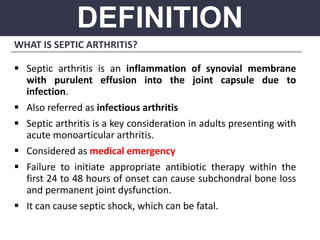
 Septic arthritis is an inflammation of synovial membrane
with purulent effusion into the joint capsule due to
infection.
 Also referred as infectious arthritis
 Septic arthritis is a key consideration in adults presenting with
acute monoarticular arthritis.
 Considered as medical emergency
 Failure to initiate appropriate antibiotic therapy within the
first 24 to 48 hours of onset can cause subchondral bone loss
and permanent joint dysfunction.
 It can cause septic shock, which can be fatal.
DEFINITION
WHAT IS SEPTIC ARTHRITIS?
ANATOMY
SYNOVIAL JOINT
Protection of joint cavity
Lines joint & cavity and
secretes synovial fluid for
lubrication
Prevents grinding of the
bone and allow for
smooth articulation
ANATOMY
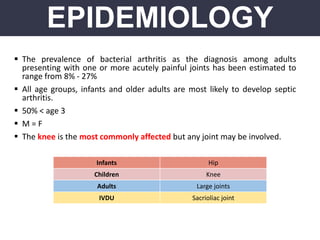
 The prevalence of bacterial arthritis as the diagnosis among adults
presenting with one or more acutely painful joints has been estimated to
range from 8% - 27%
 All age groups, infants and older adults are most likely to develop septic
arthritis.
 50% < age 3
 M = F
 The knee is the most commonly affected but any joint may be involved.
EPIDEMIOLOGY
Infants Hip
Children Knee
Adults Large joints
IVDU Sacrioliac joint
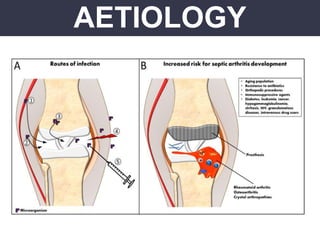
 The infection can originate anywhere in the body.
 May also begin as the result of an open wound, trauma, surgery, or
unsterile injection.
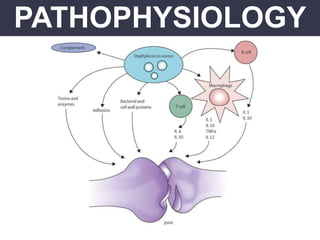
 Septic arthritis occurs when the infective organism travels through blood
stream to the joint.
 The infection can be caused by bacteria, virus or fungus.
AETIOLOGY
AETIOLOGY
AETIOLOGY
AETIOLOGY
1. AGE
2. EXISTING JOINT PROBLEMS
3. MEDICATIONS
Age > 80 years old
Chronic diseases and conditions that affect the joints — such as osteoarthritis, gout, rheumatoid
arthritis or lupus — can increase the risk of septic arthritis, as can an artificial joint, previous joint
surgery and joint injury.
Taking medications for rheumatoid arthritis. People with rheumatoid arthritis have a further
increase in risk because of medications they take that can suppress the immune system, making
infections more likely to occur. Diagnosing septic arthritis in people with rheumatoid arthritis is
difficult because many of the signs and symptoms are similar.
4. SKIN FRAGILITY
Skin that breaks easily and heals poorly can give bacteria access to your body. Skin conditions such
as psoriasis and eczema increase your risk of septic arthritis, as do infected skin wounds. People
who regularly inject drugs also have a higher risk of infection at the site of injection.
AETIOLOGY
5. WEAK IMMUNE SYSTEM
6. ALCOLOISM AND IVDU
People with a weak immune system are at greater risk of septic arthritis. This includes people with
diabetes, kidney and liver problems, and those taking drugs that suppress their immune systems.
Having a combination of risk factors puts you at greater risk than
having just one risk factor does.
AETIOLOGY
PATHOPHYSIOLOGY
Hematogenous
spread
Direct
Innoculation
Continuous
extension from
adjacent structure
PATHOPHYSIOLOGY
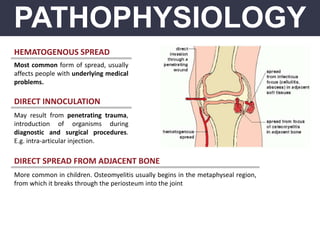
HEMATOGENOUS SPREAD
DIRECT INNOCULATION
Most common form of spread, usually
affects people with underlying medical
problems.
May result from penetrating trauma,
introduction of organisms during
diagnostic and surgical procedures.
E.g. intra-articular injection.
DIRECT SPREAD FROM ADJACENT BONE
More common in children. Osteomyelitis usually begins in the metaphyseal region,
from which it breaks through the periosteum into the joint
PATHOPHYSIOLOGY
PATHOPHYSIOLOGY
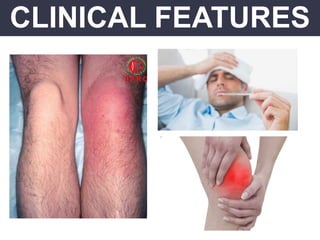
CLINICAL FEATURES
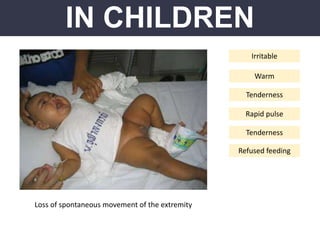
IN CHILDREN
Loss of spontaneous movement of the extremity
Irritable
Warm
Tenderness
Rapid pulse
Tenderness
Refused feeding
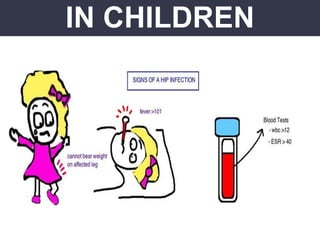
IN CHILDREN
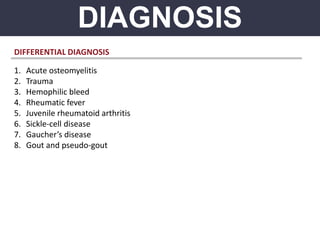
DIAGNOSIS
DIFFERENTIAL DIAGNOSIS
1. Acute osteomyelitis
2. Trauma
3. Hemophilic bleed
4. Rheumatic fever
5. Juvenile rheumatoid arthritis
6. Sickle-cell disease
7. Gaucher’s disease
8. Gout and pseudo-gout
WHAT IS NEXT?
SEPTIC ARTHRITIS SUSPECTED
BLOOD AND SYNOVIAL FLUID SAMPLE
EMPIRIC PARENTERAL ANTIBIOTICS BASED ON GRAM STAIN
JOINT DRAINAGE
ADJUST ANTIBIOTICS BASED ON CULTURE AND SENSITIVITY RESULT
INVESTIGATIONS
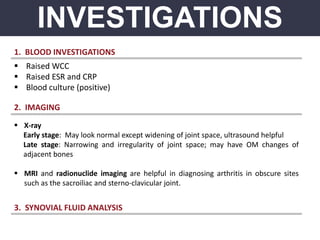
1. BLOOD INVESTIGATIONS
 Raised WCC
 Raised ESR and CRP
 Blood culture (positive)
2. IMAGING
 X-ray
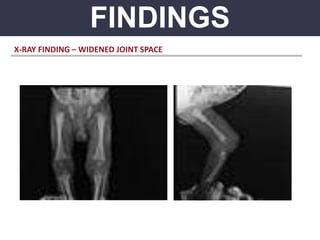
Early stage: May look normal except widening of joint space, ultrasound helpful
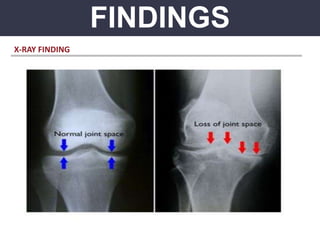
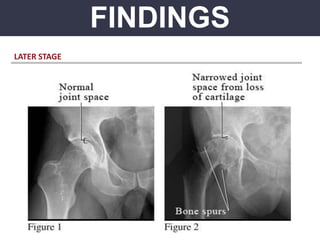
Late stage: Narrowing and irregularity of joint space; may have OM changes of
adjacent bones
 MRI and radionuclide imaging are helpful in diagnosing arthritis in obscure sites
such as the sacroiliac and sterno-clavicular joint.
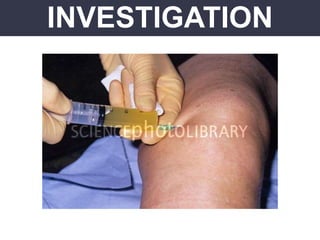
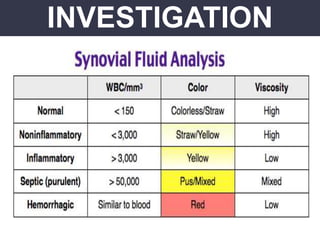
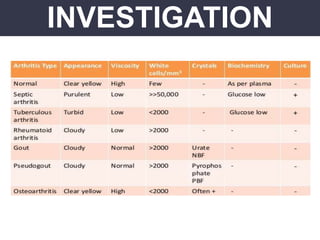
3. SYNOVIAL FLUID ANALYSIS
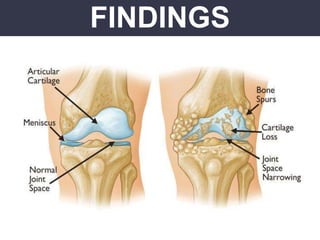
FINDINGS
FINDINGS
X-RAY FINDING
FINDINGS
X-RAY FINDING – WIDENED JOINT SPACE
FINDINGS
LATER STAGE
FINDINGS
HIP ULTRASOUND
INVESTIGATION
INVESTIGATION
INVESTIGATION
INVESTIGATION
KOCHER CRITERIA
Kocker et al in 1999: the presence or absence of the above 4 clinical predictors could be
used to accurately predict the likelihood of a septic hip in a child with limp.
TREATMENT
 1st priority – aspirate the joint and examine the fluid
 General supportive care – analgesics and IV fluid
 Splintage
 Antibiotics
a. Neonates and infants up to 6 months – penicillin ( flucloxacillin) + 3rd gen
cephalosporin
b. Children from 6 months to puberty – similar to above.
c. Older teenager and adults – flucloxacillin and fusidic acid and 3rd
generation cephalosporin
Antibiotics given IV for 4-7 days, then orally for 3 weeks.
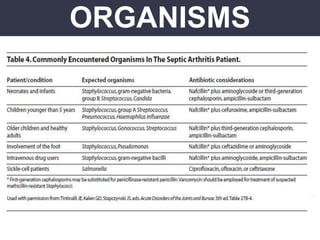
ORGANISMS
COMPLICATIONS
1. Bone destruction and dislocation of the joint (especially hip)
2. Cartilage destruction
3. May lead to either fibrosis or bony ankylosis
4. In adult partial destruction of the joint will result in secondary
osteoarthritis
5. Growth disturbance
6. Presenting as either localized deformity or shortening of the
bone

Septic Arthritis

  • 1.
    SEPTIC ARTHRITISNURUL HIDAYU| NIK NOR LIYANA | NURUL HUSNA
  • 2.
     Septic arthritisis an inflammation of synovial membrane with purulent effusion into the joint capsule due to infection.  Also referred as infectious arthritis  Septic arthritis is a key consideration in adults presenting with acute monoarticular arthritis.  Considered as medical emergency  Failure to initiate appropriate antibiotic therapy within the first 24 to 48 hours of onset can cause subchondral bone loss and permanent joint dysfunction.  It can cause septic shock, which can be fatal. DEFINITION WHAT IS SEPTIC ARTHRITIS?
  • 3.
    ANATOMY SYNOVIAL JOINT Protection ofjoint cavity Lines joint & cavity and secretes synovial fluid for lubrication Prevents grinding of the bone and allow for smooth articulation
  • 4.
  • 5.
     The prevalenceof bacterial arthritis as the diagnosis among adults presenting with one or more acutely painful joints has been estimated to range from 8% - 27%  All age groups, infants and older adults are most likely to develop septic arthritis.  50% < age 3  M = F  The knee is the most commonly affected but any joint may be involved. EPIDEMIOLOGY Infants Hip Children Knee Adults Large joints IVDU Sacrioliac joint
  • 6.
     The infectioncan originate anywhere in the body.  May also begin as the result of an open wound, trauma, surgery, or unsterile injection.  Septic arthritis occurs when the infective organism travels through blood stream to the joint.  The infection can be caused by bacteria, virus or fungus. AETIOLOGY
  • 7.
  • 8.
  • 9.
    AETIOLOGY 1. AGE 2. EXISTINGJOINT PROBLEMS 3. MEDICATIONS Age > 80 years old Chronic diseases and conditions that affect the joints — such as osteoarthritis, gout, rheumatoid arthritis or lupus — can increase the risk of septic arthritis, as can an artificial joint, previous joint surgery and joint injury. Taking medications for rheumatoid arthritis. People with rheumatoid arthritis have a further increase in risk because of medications they take that can suppress the immune system, making infections more likely to occur. Diagnosing septic arthritis in people with rheumatoid arthritis is difficult because many of the signs and symptoms are similar. 4. SKIN FRAGILITY Skin that breaks easily and heals poorly can give bacteria access to your body. Skin conditions such as psoriasis and eczema increase your risk of septic arthritis, as do infected skin wounds. People who regularly inject drugs also have a higher risk of infection at the site of injection.
  • 10.
    AETIOLOGY 5. WEAK IMMUNESYSTEM 6. ALCOLOISM AND IVDU People with a weak immune system are at greater risk of septic arthritis. This includes people with diabetes, kidney and liver problems, and those taking drugs that suppress their immune systems. Having a combination of risk factors puts you at greater risk than having just one risk factor does.
  • 11.
  • 12.
  • 13.
    PATHOPHYSIOLOGY HEMATOGENOUS SPREAD DIRECT INNOCULATION Mostcommon form of spread, usually affects people with underlying medical problems. May result from penetrating trauma, introduction of organisms during diagnostic and surgical procedures. E.g. intra-articular injection. DIRECT SPREAD FROM ADJACENT BONE More common in children. Osteomyelitis usually begins in the metaphyseal region, from which it breaks through the periosteum into the joint
  • 14.
  • 15.
  • 16.
  • 17.
    IN CHILDREN Loss ofspontaneous movement of the extremity Irritable Warm Tenderness Rapid pulse Tenderness Refused feeding
  • 18.
  • 19.
    DIAGNOSIS DIFFERENTIAL DIAGNOSIS 1. Acuteosteomyelitis 2. Trauma 3. Hemophilic bleed 4. Rheumatic fever 5. Juvenile rheumatoid arthritis 6. Sickle-cell disease 7. Gaucher’s disease 8. Gout and pseudo-gout
  • 20.
    WHAT IS NEXT? SEPTICARTHRITIS SUSPECTED BLOOD AND SYNOVIAL FLUID SAMPLE EMPIRIC PARENTERAL ANTIBIOTICS BASED ON GRAM STAIN JOINT DRAINAGE ADJUST ANTIBIOTICS BASED ON CULTURE AND SENSITIVITY RESULT
  • 21.
    INVESTIGATIONS 1. BLOOD INVESTIGATIONS Raised WCC  Raised ESR and CRP  Blood culture (positive) 2. IMAGING  X-ray Early stage: May look normal except widening of joint space, ultrasound helpful Late stage: Narrowing and irregularity of joint space; may have OM changes of adjacent bones  MRI and radionuclide imaging are helpful in diagnosing arthritis in obscure sites such as the sacroiliac and sterno-clavicular joint. 3. SYNOVIAL FLUID ANALYSIS
  • 22.
  • 23.
  • 24.
    FINDINGS X-RAY FINDING –WIDENED JOINT SPACE
  • 25.
  • 26.
  • 27.
  • 28.
  • 29.
  • 30.
  • 31.
    KOCHER CRITERIA Kocker etal in 1999: the presence or absence of the above 4 clinical predictors could be used to accurately predict the likelihood of a septic hip in a child with limp.
  • 32.
    TREATMENT  1st priority– aspirate the joint and examine the fluid  General supportive care – analgesics and IV fluid  Splintage  Antibiotics a. Neonates and infants up to 6 months – penicillin ( flucloxacillin) + 3rd gen cephalosporin b. Children from 6 months to puberty – similar to above. c. Older teenager and adults – flucloxacillin and fusidic acid and 3rd generation cephalosporin Antibiotics given IV for 4-7 days, then orally for 3 weeks.
  • 33.
  • 34.
    COMPLICATIONS 1. Bone destructionand dislocation of the joint (especially hip) 2. Cartilage destruction 3. May lead to either fibrosis or bony ankylosis 4. In adult partial destruction of the joint will result in secondary osteoarthritis 5. Growth disturbance 6. Presenting as either localized deformity or shortening of the bone

Editor's Notes

  • #6 Septic arthritis of the sacroiliac joint is a relatively rare disorder, affecting between 1% and 2% of all patients with septic arthritis.
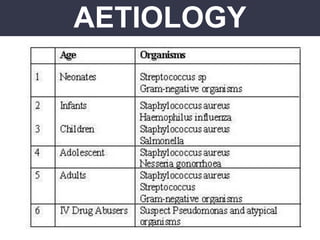
  • #9 AETIOLOGY S aureus Most common pathogen in infectious arthritis of both native & prosthetic joints Infections caused by Methicillin-resistant S aureus are usually more aggressive, w/ involvement of >1 joint S epidermidis More common in prosthetic joint infection Streptococci Next to S aureus, most common Gram positive aerobes causing infectious arthritis Group B streptococci is a common cause of infectious arthritis in neonates while S pyogenes & S pneumoniaeare are common pathogens in children ≤ 5 years old who have infectious arthritis Streptococci are important infectious arthritis pathogens in patients w/ serious infections of the genitourinary or gastrointestinal tract Gram-negative bacilli Common etiologic agents of infectious arthritis in intravenous (IV) drug users, elderly & immunocompromised persons Elderly patients frequently have underlying joint diseases & concomitant diseases like diabetes mellitus (DM)  & rheumatoid arthritis Disease-modifying drugs used to treat rheumatoid arthritis (eg Infliximab & Etanercept) may predispose patients to the development of infectious arthritis H influenzae was formerly a common pathogen in infectious arthritis in children aged 1 month-5 years but widespread vaccination against the organism has drastically reduced the number of cases P aeruginosa may be a cause of infectious arthritis in IV drugs users, premature infants & patients w/ central vascular catheters N gonorrhoeae Possible etiologic agent in young, healthy, sexually active adults w/ infectious arthritis Incidence frequently related to socioeconomic status Anaerobes More common in patients w/ DM & those w/ prosthetic joint infection Mycobacterial species & fungi Much less common cause of infectious arthritis compared to bacteria Low immune system, recent travel & living in endemic areas are determinants for people susceptible to mycobacterial infections Infectious arthritis caused by these organisms usually presents w/ marked joint swelling, mild signs of acute inflammation & few systemic symptoms Tuberculous infectious arthritis may be more common in low-income groups while other mycobacterial species can cause infectious arthritis in human immunodeficiency virus (HIV)-infected persons Candida arthritis is more common in immunocompromised persons & is associated w/ the presence of a central vascular catheter MIMS MALAYSIA https://specialty.mims.com/infectious%20arthritis/signs%20and%20symptoms?channel=infectious-diseases
  • #11 Reference – Mayo Clinic & MIMS Malaysia