Reproduction www.freelivedoctor.com
Reproduction Reproductive System Not needed for the survival of the individual Species survival Sexual reproduction Genes from two individual Combine at random Creates new combinations Increases chances of species survival www.freelivedoctor.com
Sexual Reproduction Each individual produces gametes Formed in gonads by meiosis Male: testes produce: Sperm Testosterone Female: ovaries produce: Ova Estrogens, Progesterone Gametes unite in process of fertilization Restores diploid number Forms zygote www.freelivedoctor.com
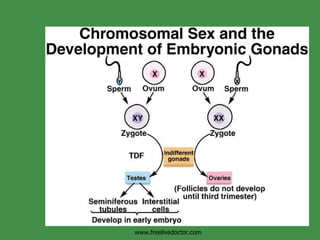
Sexual Determination Each zygote inherits 23 chromosomes from mother 23 chromosomes from father. 23 pairs of homologous chromosomes. alleles Kinds of chromosomes 1-22 pairs of chromosomes: autosomal 23 rd  pair are sex chromosomes. Male: XY Female: XX Chromosomal gender of zygote determined by fertilizing sperm. www.freelivedoctor.com
Formation of Testes First 40 days after conception the gonads of males and females are similar in appearance. During this time: Spermatogonia and oogonia migrate from yolk sac to developing embryonic gonads Gonads could become either. TDF (testis-determining factor): hypothetical promotes the conversion to testes: gene located on short arm of Y, called SRY (sex determining region of Y chromosome) Found in all mammals www.freelivedoctor.com
Formation of Testes Structures in the testes: Seminiferous tubules:  43 to 50 days post conception Germinal cells: sperm. Nongerminal cells: Sertoli cells (sustentacular cells). Leydig cells (interstitial cells):  Appear about day 65. Endocrine function: secrete androgens Main: Testosterone www.freelivedoctor.com
Formation of Testes Leydig cells secrete testosterone. Begins 8 th  week and peaks at 12-14 th  week. Masculinizes embryonic structures. Testosterone then declines to very low levels until puberty. Decline occurs by end of second trimester Testes descend into scrotum shortly before birth. Temp about 3 degrees below internal temp 35 degrees C www.freelivedoctor.com
Formation of Ovaries Absence of Y chromosome and TDF, female develop ovaries. Ovarian follicles do not appear until 2 nd  trimester. www.freelivedoctor.com
www.freelivedoctor.com
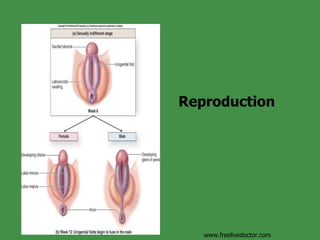
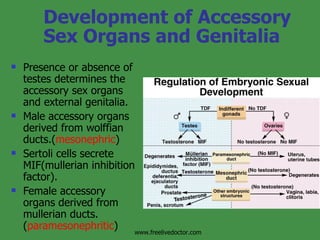
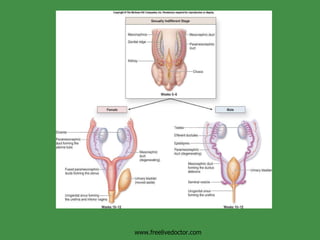
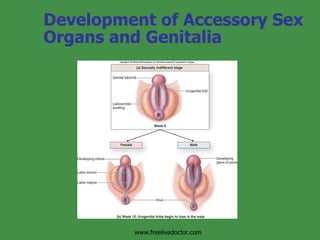
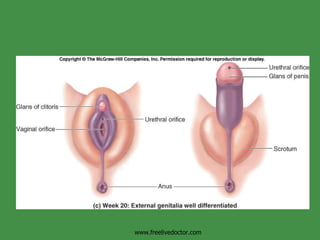
Development of Accessory Sex Organs and Genitalia Presence or absence of testes determines the accessory sex organs and external genitalia. Male accessory organs derived from wolffian ducts.( mesonephric ) Sertoli cells secrete MIF(mullerian inhibition factor). Female accessory organs derived from mullerian ducts. ( paramesonephritic ) www.freelivedoctor.com
www.freelivedoctor.com
Development of Accessory Sex Organs and Genitalia Both duct systems in both sexes  between days 25 and 50 Regression of mullarian ducts begins about day 60 Testosterone responsible for development of male accessory sex organs External genitalia identical first 6 weeks, then testosterone stimulates development of penis Not the active agent in all cells converted to dihydrotestosterone (DHT) in some target cells Needed for penis, spongy urethra, scrotum, prostrate Testosterone directly needed for wolfian derivatives: Epididymis, ductus deferens, ejaculatory duct, SV www.freelivedoctor.com
Development of Accessory Sex Organs and Genitalia www.freelivedoctor.com
www.freelivedoctor.com
Endocrine Regulation of Reproduction First trimester Embryonic testes are active endocrine glands Secrete large amounts of testosterone Embryonic ovaries not mature until third trimester Time of birth: Gonads in both sexes relatively inactive Before puberty: Low levels of sex steroids in both Due to lack of stimulation Puberty: Increased stimulation from gonadotropic hormones Induce increase in sex steroids www.freelivedoctor.com
Endocrine Regulation of Reproduction Hypothalamus releases LHRH (GnRH) into hypothalamo-hypophyseal portal vessels. Anterior pituitary secretes: LH: luteinizing hormone.  In male: interstitial-cell stimulating hormone (ICSH) FSH: follicle-stimulating hormone. Secreted in pulsatile fashion to prevent desensitization and down regulation of receptors. www.freelivedoctor.com
Endocrine Interactions Primary effects of LH and FSH on gonads: Stimulation of spermatogenesis and oogenesis. Stimulation of gonadal hormone secretion. Maintenance of gonadal structure. www.freelivedoctor.com
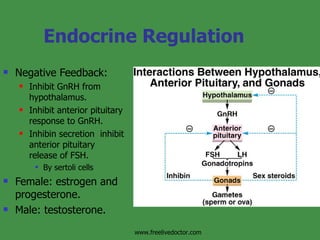
Endocrine Regulation Negative Feedback: Inhibit GnRH from hypothalamus. Inhibit anterior pituitary response to GnRH. Inhibin secretion  inhibit anterior pituitary release of FSH. By sertoli cells Female: estrogen and progesterone. Male: testosterone. www.freelivedoctor.com
www.freelivedoctor.com
Onset of Puberty FSH and LH high in newborn, falls to low levels in few weeks. Puberty: driven by increased secretion of FSH and LH www.freelivedoctor.com
Onset of Puberty FSH and LH Brain maturation increases GnRH secretion. Decreased sensitivity of GnRH to negative feedback.  LH: Increased secretion triggers puberty Late puberty, pulsatile secretion of LH and FSH increase during sleep. Stimulate a rise in sex steroid secretion. www.freelivedoctor.com
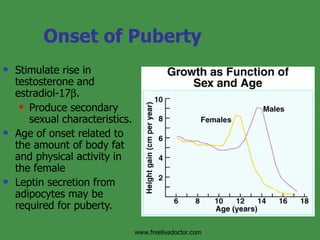
Onset of Puberty Stimulate rise in testosterone and estradiol-17  . Produce secondary sexual characteristics. Age of onset related to the amount of body fat and physical activity in the female Leptin secretion from adipocytes may be required for puberty. www.freelivedoctor.com
Pineal Gland Secretes melatonin. Secretion influenced by light-dark cycles. Inhibit gonadotropin secretion. Role in humans not established. www.freelivedoctor.com
4 Phases of Human Sexual Response Excitation phase (arousal): Myotonia and vasocongestion.  Engorgement of a sexual organ with blood. Erection of the nipples. Plateau phase: Clitoris becomes partially hidden. Erected nipples become partially hidden by swelling of areolae. Orgasm: Uterus and orgasmic platform of vagina contract. Contractions accompanying ejaculation. Resolution phase: Body return to preexcitation conditions. Refractory period In males Erection possible, but not ejaculation www.freelivedoctor.com
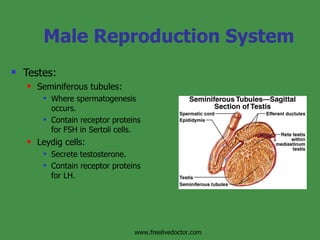
Male Reproduction System Testes: Seminiferous tubules: Where spermatogenesis occurs. Contain receptor proteins for FSH in Sertoli cells. Leydig cells:  Secrete testosterone. Contain receptor proteins for LH. www.freelivedoctor.com
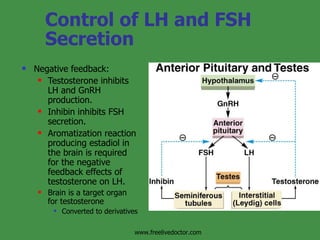
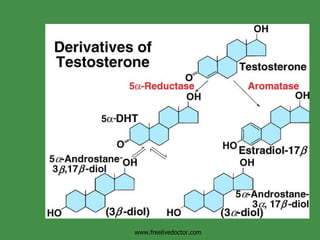
Control of LH and FSH Secretion Negative feedback: Testosterone inhibits LH and GnRH production. Inhibin inhibits FSH secretion.  Aromatization reaction producing estadiol in the brain is required for the negative feedback effects of testosterone on LH. Brain is a target organ for testosterone Converted to derivatives www.freelivedoctor.com
www.freelivedoctor.com
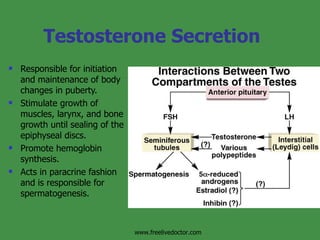
Testosterone Secretion Responsible for initiation and maintenance of body changes in puberty. Stimulate growth of muscles, larynx, and bone growth until sealing of the epiphyseal discs. Promote hemoglobin synthesis. Acts in paracrine fashion and is responsible for spermatogenesis. www.freelivedoctor.com
Testosterone Secretion Negative feedback of testosterone and inhibin Keep relatively constant levels of gonadotropins Results in relatively constant levels Different in female At menopause: no more sex steroids In males, gradual decrease www.freelivedoctor.com
Endocrine function: testes Testosterone: main androgen Sertoli and Leydig cells secrete small amounts of estradiol. Have receptors for estradiol (as do other male structures) May be needed for spermatogenesis Estradiol may be responsible for:  Negative feedback in brain. Sealing of epiphyseal plates. Regulatory function in fertility. www.freelivedoctor.com
Spermatogenesis Spermatogonia: Replicate initially by mitosis. Produce two cells One becomes a primary spermatocytes undergoes  meiosis: 2 nuclear divisions. 2 nd  meiotic division produce 4 spermatids. www.freelivedoctor.com
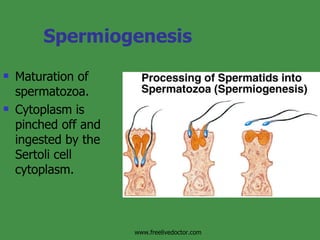
Spermiogenesis Maturation of spermatozoa.  Cytoplasm is pinched off and ingested by the Sertoli cell cytoplasm. www.freelivedoctor.com
Sertoli Cells Blood-testes barrier: Prevents autoimmune destruction of sperm. Produce FAS ligand which binds to the FAS receptor on surface to T lymphocytes, triggering apoptosis.  Secretes inhibin. Phagocytize residual bodies:  Transmit information molecules from germ cells to Sertoli cells. Secrete ABP (androgen-binding protein): Binds to testosterone and concentrates testosterone in the tubules. www.freelivedoctor.com
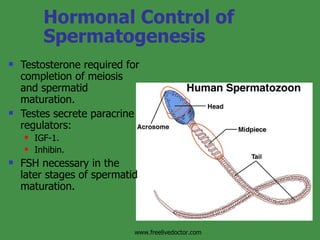
Hormonal Control of Spermatogenesis Testosterone required for completion of meiosis and spermatid maturation. Testes secrete paracrine regulators: IGF-1. Inhibin. FSH necessary in the later stages of spermatid maturation. www.freelivedoctor.com
Male Accessory Organs Epididymis:  Maturational changes.  Resistance to pH changes and temperature. Storage. Prostate secretes:  Alkaline fluid. Citric acid. Ca ++ .  Coagulation proteins. Seminal vesicles secrete:  Fructose. www.freelivedoctor.com
Erection, Emission, and Ejaculation Erection: Increased vasodilation of arterioles. NO is the NT. Blood flow into the erectile tissues of the penis. Parasympathetic Emission: Movement of semen into the urethra. Sympathetic Ejaculation: Forcible expulsion of semen from the urethra out of the penis. Sympathetic www.freelivedoctor.com
Female Reproductive System Ovaries: Contain large number of follicles which enclose ova. Extensions called fimbriae partially cover each ovary. At ovulation, secondary oocyte is extruded. www.freelivedoctor.com
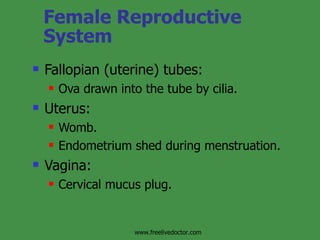
Female Reproductive System Fallopian (uterine) tubes: Ova drawn into the tube by cilia. Uterus: Womb. Endometrium shed during menstruation. Vagina: Cervical mucus plug.  www.freelivedoctor.com
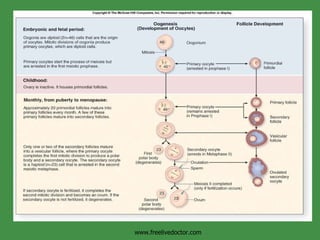
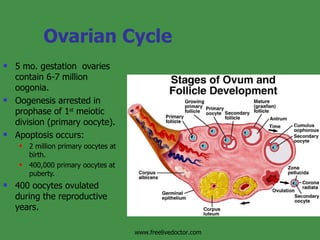
Ovarian Cycle 5 mo. gestation  ovaries contain 6-7 million oogonia. Oogenesis arrested in prophase of 1 st  meiotic division (primary oocyte). Apoptosis occurs: 2 million primary oocytes at birth. 400,000 primary oocytes at puberty. 400 oocytes ovulated during the reproductive years. www.freelivedoctor.com
Ovarian Cycle Primary oocytes contained in primary follicles. FSH stimulates cell growth. Develop into secondary follicles. Fusion of its vesicles into the antrum. Mature graafian follicle: 1 st  meiotic division completed (secondary oocyte). www.freelivedoctor.com
www.freelivedoctor.com
Ovarian Cycle Secondary oocyte: Under FSH stimulation: Theca cells secrete testosterone. Granulosa cells: contain the enzyme aromatase to convert testosterone into estrogen. www.freelivedoctor.com
Ovulation  Graafian follicle forms bulge on surface of ovary. Extrudes secondary oocyte into the uterine tube. Empty follicle becomes corpus luteum and secretes: Progesterone. Estrogen. If not fertilized becomes corpus albicans. www.freelivedoctor.com
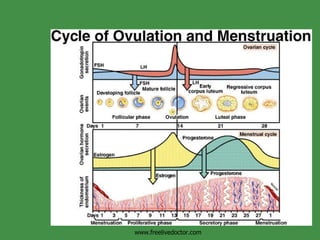
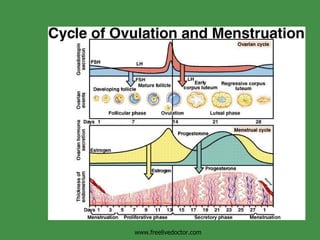
Menstrual Cycle 3 phases: Ovarian Follicular Phase Ovulation Luteal Phase Duration approximately 28 days. Day 1 is the first day of menstruation. www.freelivedoctor.com
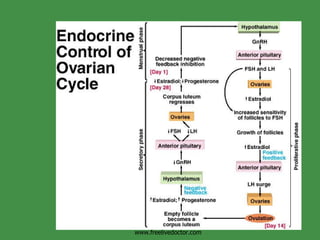
Follicular Phase FSH: Stimulates production of FSH receptors on granulosa cells. Follicles grow and become secondary follicle. Granulosa cells secrete estradiol. Increases sensitivity of FSH receptors. FSH and estradiol stimulate production of LH receptors in graafian follicle. www.freelivedoctor.com
Follicular Phase Rapid rise in estradiol: Negative feedback on LH and FSH. Hypothalamus increase frequency of GnRH pulses. Augments the ability of anterior pituitary to respond to GnRH to increase LH secretion. www.freelivedoctor.com
Follicular Phase Positive feedback: LH surge begins 24 hours before ovulation. Triggers ovulation. FSH increase stimulates development of new follicles. www.freelivedoctor.com
Ovulation Under FSH, graafian follicle grows large and thin-walled. Triggers LH surge. Wall of graafian follicle ruptures. Day 14. Ist meiotic division is completed. www.freelivedoctor.com
Luteal Phase LH stimulates formation of the empty follicle into corpus luteum. Corpus luteum secretes: Progesterone: Plasma concentration rapidly rises.  Estradiol.  Negative feedback on LH and FSH.  Inhibin: suppress FSH. www.freelivedoctor.com
Luteal Phase Corpus luteum regresses unless fertilization occurs:  Estradiol decreases. Progesterone decreases. Withdrawal of estradiol and progesterone cause menstruation to occur.  www.freelivedoctor.com
www.freelivedoctor.com
Endometrial Changes 3 phases of endometrium changes: Proliferative phase. Secretory phase. Menstrual phase. www.freelivedoctor.com
Proliferative Phase Ovary is in follicular phase. Estradiol stimulate growth of endometrium. Spiral arteries develop. Stimulate production of receptor proteins for progesterone. Cornification of vaginal epithelium occurs. www.freelivedoctor.com
Secretory Phase Ovary is in luteal phase. Progesterone stimulates development of uterine glands, which become engorged with glycogen. Endometrium becomes thick, vascular and spongy. Cervical mucus thickens and becomes sticky. www.freelivedoctor.com
Menstrual Phase Progesterone cause constriction of spiral arteries. Necrosis and sloughing of endometrium occurs.  Lasts 1-5 days. www.freelivedoctor.com
www.freelivedoctor.com
Menopause Cessation of ovarian activity.  Age ~ 50 years. Ovaries depleted of follicles. Estradiol and inhibin withdrawl causes hot flashes, and atrophy of the vaginal wall. LH and FSH increase. www.freelivedoctor.com
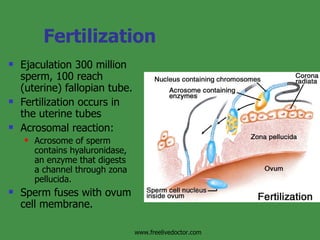
Fertilization Ejaculation 300 million sperm, 100 reach (uterine) fallopian tube. Fertilization occurs in the uterine tubes Acrosomal reaction: Acrosome of sperm contains hyaluronidase, an enzyme that digests a channel through zona pellucida. Sperm fuses with ovum cell membrane. www.freelivedoctor.com
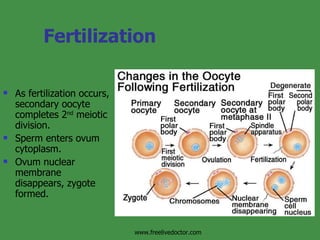
Fertilization As fertilization occurs, secondary oocyte completes 2 nd  meiotic division. Sperm enters ovum cytoplasm. Ovum nuclear membrane disappears, zygote formed. www.freelivedoctor.com
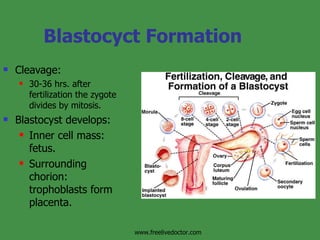
Blastocyct Formation Cleavage: 30-36 hrs. after fertilization the zygote divides by mitosis.  Blastocyst develops: Inner cell mass: fetus. Surrounding chorion: trophoblasts form placenta. www.freelivedoctor.com
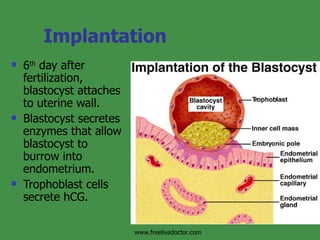
Implantation 6 th  day after fertilization, blastocyst attaches to uterine wall. Blastocyst secretes enzymes that allow blastocyst to burrow into endometrium. Trophoblast cells secrete hCG. www.freelivedoctor.com
hCG Human chorionic gonadotropin. Trophoblast cells secrete hCG. Signals corpus luteum not to degenerate until placenta secretes adequate [hormone]. Effects similar to LH. Basis of pregnancy test. www.freelivedoctor.com
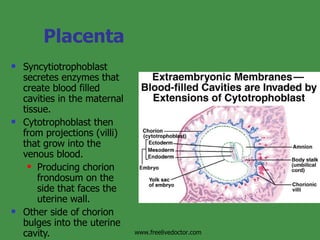
Placenta Syncytiotrophoblast secretes enzymes that create blood filled cavities in the maternal tissue. Cytotrophoblast then from projections (villi) that grow into the venous blood. Producing chorion frondosum on the side that faces the uterine wall. Other side of chorion bulges into the uterine cavity. www.freelivedoctor.com
Placental Changes Decidual reaction: Endometrial growth. Accumulation of glycogen. Decidua basalis: maternal tissue in contact with the chorion frondosum. Maternal and fetal blood do not mix.  www.freelivedoctor.com
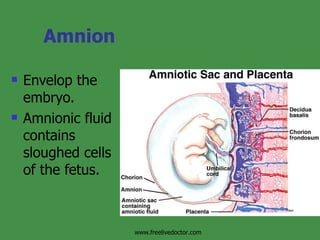
Amnion Envelop the embryo. Amnionic fluid contains sloughed cells of the fetus. www.freelivedoctor.com
Placenta Function Gas exchange: 0 2  and C0 2 . Nutrient exchange. Waste exchange. Synthesis of proteins and enzymes. www.freelivedoctor.com
Placental Hormones hCS: Chorionic somatomammotropin. GH effects. Diabetic-like effect: Glucose sparing effect. Polyuria. Lipolysis. www.freelivedoctor.com
Placental Hormones Fetal-placental unit: Placenta must cooperate with the adrenal cortex in the fetus to produce estrogen. Estrogen stimulates: Endometrial growth. Inhibit prolactin secretion. Growth of mammary ducts. Enlargement of mother’s uterus. www.freelivedoctor.com
Placental Hormones Progesterone: Suppresses uterine contractions. Stimulates uterine growth . Suppresses LH and FSH. Stimulate development of alveolar tissue of the mammary gland. www.freelivedoctor.com
Parturition Estrogen in late pregnancy: Increases amount of oxytocin stored. Stimulate production of oxytocin receptors in myometrium. Stimulate prostaglandin production. Uterine contractions: Oxytocin. Prostaglandins. www.freelivedoctor.com
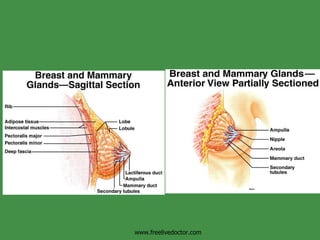
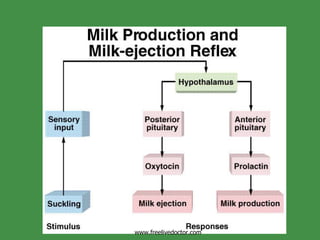
Lactation Hypothalamus releases PRH. Anterior pituitary releases prolactin: Stimulate milk production. Oxytocin needed for “milk letdown”. www.freelivedoctor.com
www.freelivedoctor.com

Formation&Development Of Reproductive System

  • 1.
  • 2.
    Reproduction Reproductive SystemNot needed for the survival of the individual Species survival Sexual reproduction Genes from two individual Combine at random Creates new combinations Increases chances of species survival www.freelivedoctor.com
  • 3.
    Sexual Reproduction Eachindividual produces gametes Formed in gonads by meiosis Male: testes produce: Sperm Testosterone Female: ovaries produce: Ova Estrogens, Progesterone Gametes unite in process of fertilization Restores diploid number Forms zygote www.freelivedoctor.com
  • 4.
    Sexual Determination Eachzygote inherits 23 chromosomes from mother 23 chromosomes from father. 23 pairs of homologous chromosomes. alleles Kinds of chromosomes 1-22 pairs of chromosomes: autosomal 23 rd pair are sex chromosomes. Male: XY Female: XX Chromosomal gender of zygote determined by fertilizing sperm. www.freelivedoctor.com
  • 5.
    Formation of TestesFirst 40 days after conception the gonads of males and females are similar in appearance. During this time: Spermatogonia and oogonia migrate from yolk sac to developing embryonic gonads Gonads could become either. TDF (testis-determining factor): hypothetical promotes the conversion to testes: gene located on short arm of Y, called SRY (sex determining region of Y chromosome) Found in all mammals www.freelivedoctor.com
  • 6.
    Formation of TestesStructures in the testes: Seminiferous tubules: 43 to 50 days post conception Germinal cells: sperm. Nongerminal cells: Sertoli cells (sustentacular cells). Leydig cells (interstitial cells): Appear about day 65. Endocrine function: secrete androgens Main: Testosterone www.freelivedoctor.com
  • 7.
    Formation of TestesLeydig cells secrete testosterone. Begins 8 th week and peaks at 12-14 th week. Masculinizes embryonic structures. Testosterone then declines to very low levels until puberty. Decline occurs by end of second trimester Testes descend into scrotum shortly before birth. Temp about 3 degrees below internal temp 35 degrees C www.freelivedoctor.com
  • 8.
    Formation of OvariesAbsence of Y chromosome and TDF, female develop ovaries. Ovarian follicles do not appear until 2 nd trimester. www.freelivedoctor.com
  • 9.
  • 10.
    Development of AccessorySex Organs and Genitalia Presence or absence of testes determines the accessory sex organs and external genitalia. Male accessory organs derived from wolffian ducts.( mesonephric ) Sertoli cells secrete MIF(mullerian inhibition factor). Female accessory organs derived from mullerian ducts. ( paramesonephritic ) www.freelivedoctor.com
  • 11.
  • 12.
    Development of AccessorySex Organs and Genitalia Both duct systems in both sexes between days 25 and 50 Regression of mullarian ducts begins about day 60 Testosterone responsible for development of male accessory sex organs External genitalia identical first 6 weeks, then testosterone stimulates development of penis Not the active agent in all cells converted to dihydrotestosterone (DHT) in some target cells Needed for penis, spongy urethra, scrotum, prostrate Testosterone directly needed for wolfian derivatives: Epididymis, ductus deferens, ejaculatory duct, SV www.freelivedoctor.com
  • 13.
    Development of AccessorySex Organs and Genitalia www.freelivedoctor.com
  • 14.
  • 15.
    Endocrine Regulation ofReproduction First trimester Embryonic testes are active endocrine glands Secrete large amounts of testosterone Embryonic ovaries not mature until third trimester Time of birth: Gonads in both sexes relatively inactive Before puberty: Low levels of sex steroids in both Due to lack of stimulation Puberty: Increased stimulation from gonadotropic hormones Induce increase in sex steroids www.freelivedoctor.com
  • 16.
    Endocrine Regulation ofReproduction Hypothalamus releases LHRH (GnRH) into hypothalamo-hypophyseal portal vessels. Anterior pituitary secretes: LH: luteinizing hormone. In male: interstitial-cell stimulating hormone (ICSH) FSH: follicle-stimulating hormone. Secreted in pulsatile fashion to prevent desensitization and down regulation of receptors. www.freelivedoctor.com
  • 17.
    Endocrine Interactions Primaryeffects of LH and FSH on gonads: Stimulation of spermatogenesis and oogenesis. Stimulation of gonadal hormone secretion. Maintenance of gonadal structure. www.freelivedoctor.com
  • 18.
    Endocrine Regulation NegativeFeedback: Inhibit GnRH from hypothalamus. Inhibit anterior pituitary response to GnRH. Inhibin secretion inhibit anterior pituitary release of FSH. By sertoli cells Female: estrogen and progesterone. Male: testosterone. www.freelivedoctor.com
  • 19.
  • 20.
    Onset of PubertyFSH and LH high in newborn, falls to low levels in few weeks. Puberty: driven by increased secretion of FSH and LH www.freelivedoctor.com
  • 21.
    Onset of PubertyFSH and LH Brain maturation increases GnRH secretion. Decreased sensitivity of GnRH to negative feedback. LH: Increased secretion triggers puberty Late puberty, pulsatile secretion of LH and FSH increase during sleep. Stimulate a rise in sex steroid secretion. www.freelivedoctor.com
  • 22.
    Onset of PubertyStimulate rise in testosterone and estradiol-17  . Produce secondary sexual characteristics. Age of onset related to the amount of body fat and physical activity in the female Leptin secretion from adipocytes may be required for puberty. www.freelivedoctor.com
  • 23.
    Pineal Gland Secretesmelatonin. Secretion influenced by light-dark cycles. Inhibit gonadotropin secretion. Role in humans not established. www.freelivedoctor.com
  • 24.
    4 Phases ofHuman Sexual Response Excitation phase (arousal): Myotonia and vasocongestion. Engorgement of a sexual organ with blood. Erection of the nipples. Plateau phase: Clitoris becomes partially hidden. Erected nipples become partially hidden by swelling of areolae. Orgasm: Uterus and orgasmic platform of vagina contract. Contractions accompanying ejaculation. Resolution phase: Body return to preexcitation conditions. Refractory period In males Erection possible, but not ejaculation www.freelivedoctor.com
  • 25.
    Male Reproduction SystemTestes: Seminiferous tubules: Where spermatogenesis occurs. Contain receptor proteins for FSH in Sertoli cells. Leydig cells: Secrete testosterone. Contain receptor proteins for LH. www.freelivedoctor.com
  • 26.
    Control of LHand FSH Secretion Negative feedback: Testosterone inhibits LH and GnRH production. Inhibin inhibits FSH secretion. Aromatization reaction producing estadiol in the brain is required for the negative feedback effects of testosterone on LH. Brain is a target organ for testosterone Converted to derivatives www.freelivedoctor.com
  • 27.
  • 28.
    Testosterone Secretion Responsiblefor initiation and maintenance of body changes in puberty. Stimulate growth of muscles, larynx, and bone growth until sealing of the epiphyseal discs. Promote hemoglobin synthesis. Acts in paracrine fashion and is responsible for spermatogenesis. www.freelivedoctor.com
  • 29.
    Testosterone Secretion Negativefeedback of testosterone and inhibin Keep relatively constant levels of gonadotropins Results in relatively constant levels Different in female At menopause: no more sex steroids In males, gradual decrease www.freelivedoctor.com
  • 30.
    Endocrine function: testesTestosterone: main androgen Sertoli and Leydig cells secrete small amounts of estradiol. Have receptors for estradiol (as do other male structures) May be needed for spermatogenesis Estradiol may be responsible for: Negative feedback in brain. Sealing of epiphyseal plates. Regulatory function in fertility. www.freelivedoctor.com
  • 31.
    Spermatogenesis Spermatogonia: Replicateinitially by mitosis. Produce two cells One becomes a primary spermatocytes undergoes meiosis: 2 nuclear divisions. 2 nd meiotic division produce 4 spermatids. www.freelivedoctor.com
  • 32.
    Spermiogenesis Maturation ofspermatozoa. Cytoplasm is pinched off and ingested by the Sertoli cell cytoplasm. www.freelivedoctor.com
  • 33.
    Sertoli Cells Blood-testesbarrier: Prevents autoimmune destruction of sperm. Produce FAS ligand which binds to the FAS receptor on surface to T lymphocytes, triggering apoptosis. Secretes inhibin. Phagocytize residual bodies: Transmit information molecules from germ cells to Sertoli cells. Secrete ABP (androgen-binding protein): Binds to testosterone and concentrates testosterone in the tubules. www.freelivedoctor.com
  • 34.
    Hormonal Control ofSpermatogenesis Testosterone required for completion of meiosis and spermatid maturation. Testes secrete paracrine regulators: IGF-1. Inhibin. FSH necessary in the later stages of spermatid maturation. www.freelivedoctor.com
  • 35.
    Male Accessory OrgansEpididymis: Maturational changes. Resistance to pH changes and temperature. Storage. Prostate secretes: Alkaline fluid. Citric acid. Ca ++ . Coagulation proteins. Seminal vesicles secrete: Fructose. www.freelivedoctor.com
  • 36.
    Erection, Emission, andEjaculation Erection: Increased vasodilation of arterioles. NO is the NT. Blood flow into the erectile tissues of the penis. Parasympathetic Emission: Movement of semen into the urethra. Sympathetic Ejaculation: Forcible expulsion of semen from the urethra out of the penis. Sympathetic www.freelivedoctor.com
  • 37.
    Female Reproductive SystemOvaries: Contain large number of follicles which enclose ova. Extensions called fimbriae partially cover each ovary. At ovulation, secondary oocyte is extruded. www.freelivedoctor.com
  • 38.
    Female Reproductive SystemFallopian (uterine) tubes: Ova drawn into the tube by cilia. Uterus: Womb. Endometrium shed during menstruation. Vagina: Cervical mucus plug. www.freelivedoctor.com
  • 39.
    Ovarian Cycle 5mo. gestation ovaries contain 6-7 million oogonia. Oogenesis arrested in prophase of 1 st meiotic division (primary oocyte). Apoptosis occurs: 2 million primary oocytes at birth. 400,000 primary oocytes at puberty. 400 oocytes ovulated during the reproductive years. www.freelivedoctor.com
  • 40.
    Ovarian Cycle Primaryoocytes contained in primary follicles. FSH stimulates cell growth. Develop into secondary follicles. Fusion of its vesicles into the antrum. Mature graafian follicle: 1 st meiotic division completed (secondary oocyte). www.freelivedoctor.com
  • 41.
  • 42.
    Ovarian Cycle Secondaryoocyte: Under FSH stimulation: Theca cells secrete testosterone. Granulosa cells: contain the enzyme aromatase to convert testosterone into estrogen. www.freelivedoctor.com
  • 43.
    Ovulation Graafianfollicle forms bulge on surface of ovary. Extrudes secondary oocyte into the uterine tube. Empty follicle becomes corpus luteum and secretes: Progesterone. Estrogen. If not fertilized becomes corpus albicans. www.freelivedoctor.com
  • 44.
    Menstrual Cycle 3phases: Ovarian Follicular Phase Ovulation Luteal Phase Duration approximately 28 days. Day 1 is the first day of menstruation. www.freelivedoctor.com
  • 45.
    Follicular Phase FSH:Stimulates production of FSH receptors on granulosa cells. Follicles grow and become secondary follicle. Granulosa cells secrete estradiol. Increases sensitivity of FSH receptors. FSH and estradiol stimulate production of LH receptors in graafian follicle. www.freelivedoctor.com
  • 46.
    Follicular Phase Rapidrise in estradiol: Negative feedback on LH and FSH. Hypothalamus increase frequency of GnRH pulses. Augments the ability of anterior pituitary to respond to GnRH to increase LH secretion. www.freelivedoctor.com
  • 47.
    Follicular Phase Positivefeedback: LH surge begins 24 hours before ovulation. Triggers ovulation. FSH increase stimulates development of new follicles. www.freelivedoctor.com
  • 48.
    Ovulation Under FSH,graafian follicle grows large and thin-walled. Triggers LH surge. Wall of graafian follicle ruptures. Day 14. Ist meiotic division is completed. www.freelivedoctor.com
  • 49.
    Luteal Phase LHstimulates formation of the empty follicle into corpus luteum. Corpus luteum secretes: Progesterone: Plasma concentration rapidly rises. Estradiol. Negative feedback on LH and FSH. Inhibin: suppress FSH. www.freelivedoctor.com
  • 50.
    Luteal Phase Corpusluteum regresses unless fertilization occurs: Estradiol decreases. Progesterone decreases. Withdrawal of estradiol and progesterone cause menstruation to occur. www.freelivedoctor.com
  • 51.
  • 52.
  • 53.
    Endometrial Changes 3phases of endometrium changes: Proliferative phase. Secretory phase. Menstrual phase. www.freelivedoctor.com
  • 54.
    Proliferative Phase Ovaryis in follicular phase. Estradiol stimulate growth of endometrium. Spiral arteries develop. Stimulate production of receptor proteins for progesterone. Cornification of vaginal epithelium occurs. www.freelivedoctor.com
  • 55.
    Secretory Phase Ovaryis in luteal phase. Progesterone stimulates development of uterine glands, which become engorged with glycogen. Endometrium becomes thick, vascular and spongy. Cervical mucus thickens and becomes sticky. www.freelivedoctor.com
  • 56.
    Menstrual Phase Progesteronecause constriction of spiral arteries. Necrosis and sloughing of endometrium occurs. Lasts 1-5 days. www.freelivedoctor.com
  • 57.
  • 58.
    Menopause Cessation ofovarian activity. Age ~ 50 years. Ovaries depleted of follicles. Estradiol and inhibin withdrawl causes hot flashes, and atrophy of the vaginal wall. LH and FSH increase. www.freelivedoctor.com
  • 59.
    Fertilization Ejaculation 300million sperm, 100 reach (uterine) fallopian tube. Fertilization occurs in the uterine tubes Acrosomal reaction: Acrosome of sperm contains hyaluronidase, an enzyme that digests a channel through zona pellucida. Sperm fuses with ovum cell membrane. www.freelivedoctor.com
  • 60.
    Fertilization As fertilizationoccurs, secondary oocyte completes 2 nd meiotic division. Sperm enters ovum cytoplasm. Ovum nuclear membrane disappears, zygote formed. www.freelivedoctor.com
  • 61.
    Blastocyct Formation Cleavage:30-36 hrs. after fertilization the zygote divides by mitosis. Blastocyst develops: Inner cell mass: fetus. Surrounding chorion: trophoblasts form placenta. www.freelivedoctor.com
  • 62.
    Implantation 6 th day after fertilization, blastocyst attaches to uterine wall. Blastocyst secretes enzymes that allow blastocyst to burrow into endometrium. Trophoblast cells secrete hCG. www.freelivedoctor.com
  • 63.
    hCG Human chorionicgonadotropin. Trophoblast cells secrete hCG. Signals corpus luteum not to degenerate until placenta secretes adequate [hormone]. Effects similar to LH. Basis of pregnancy test. www.freelivedoctor.com
  • 64.
    Placenta Syncytiotrophoblast secretesenzymes that create blood filled cavities in the maternal tissue. Cytotrophoblast then from projections (villi) that grow into the venous blood. Producing chorion frondosum on the side that faces the uterine wall. Other side of chorion bulges into the uterine cavity. www.freelivedoctor.com
  • 65.
    Placental Changes Decidualreaction: Endometrial growth. Accumulation of glycogen. Decidua basalis: maternal tissue in contact with the chorion frondosum. Maternal and fetal blood do not mix. www.freelivedoctor.com
  • 66.
    Amnion Envelop theembryo. Amnionic fluid contains sloughed cells of the fetus. www.freelivedoctor.com
  • 67.
    Placenta Function Gasexchange: 0 2 and C0 2 . Nutrient exchange. Waste exchange. Synthesis of proteins and enzymes. www.freelivedoctor.com
  • 68.
    Placental Hormones hCS:Chorionic somatomammotropin. GH effects. Diabetic-like effect: Glucose sparing effect. Polyuria. Lipolysis. www.freelivedoctor.com
  • 69.
    Placental Hormones Fetal-placentalunit: Placenta must cooperate with the adrenal cortex in the fetus to produce estrogen. Estrogen stimulates: Endometrial growth. Inhibit prolactin secretion. Growth of mammary ducts. Enlargement of mother’s uterus. www.freelivedoctor.com
  • 70.
    Placental Hormones Progesterone:Suppresses uterine contractions. Stimulates uterine growth . Suppresses LH and FSH. Stimulate development of alveolar tissue of the mammary gland. www.freelivedoctor.com
  • 71.
    Parturition Estrogen inlate pregnancy: Increases amount of oxytocin stored. Stimulate production of oxytocin receptors in myometrium. Stimulate prostaglandin production. Uterine contractions: Oxytocin. Prostaglandins. www.freelivedoctor.com
  • 72.
    Lactation Hypothalamus releasesPRH. Anterior pituitary releases prolactin: Stimulate milk production. Oxytocin needed for “milk letdown”. www.freelivedoctor.com
  • 73.
  • 74.