Osteomyelitis
by
DR. FARAN MAHMOOD
FCPS Ortho
1
Osteomyelitis
is an acute or chronic inflammatory process of bone,
bone marrow and its structure secondary to infection
with micro organisms.
2
CLASSIFICATION
Duration
- Acute / Subacute / Chronic
Mechanism
- Heamatogenous (tonsil , lungs , ear/ GIT)
- Exogenous (injection , open fractures)
Host response
- Pyogenic / Granulomatous
3
 Age : Infancy and childhood.
 Sex : Males predominate 4:1
 Location : Metaphysis of long bone.
 Poor nutrition, unhygienic
surroundings.
4
ACUTE
OSTEOMYELITIS
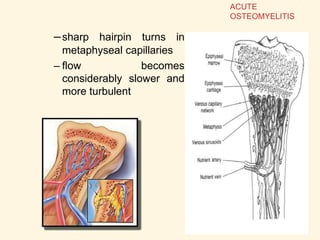
–sharp hairpin turns in
metaphyseal capillaries
– flow becomes
considerably slower and
more turbulent
ACUTE
OSTEOMYELITIS
Pathophysiology
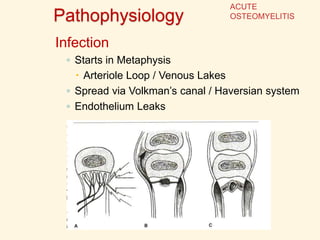
Infection
◦ Starts in Metaphysis
 Arteriole Loop / Venous Lakes
◦ Spread via Volkman’s canal / Haversian system
◦ Endothelium Leaks
ACUTE
OSTEOMYELITIS
Pathophysiology
 Role of growth plate
◦ Over 18/12
◦ Impermeable to spread
◦ Under 18/12 infection crosses growth plate
ACUTE
OSTEOMYELITIS
Acute Osteomyelitis Infants
 Joint involvement is
common
 Nutrient metaphyseal
capillaries perforate the
epiphyseal growth plate,
particularly in the hip,
shoulder, and knee.
8
ACUTE
OSTEOMYELITIS
Etiological Agents
 Infants < 1 year – Group B streptococci
Staph aureus
E.coli
 1- 16 years – S. aureus ,
S. pyogens ,
H. Influenza
 > 16 years – S.aureus ,
S.epidermidis ,
Gram –ve bacteria
9
ACUTE
OSTEOMYELITIS
Rare organisms Isolated in Bacterial
Osteomyelitis
Bartonella henselae
Pasteurella multocida or Eikenella
corrodens
Aspergillus species, Mycobacterium
avium-intracellulare or Candida
albicans
Mycobacterium tuberculosis
Brucella species, Coxiella burnetii
(cause of chronic Q fever) or other
fungi found in specific
geographic areas
Human immunodeficiency virus
infection
Human or animal bites
Immunocompromised patients
Populations in which tuberculosis
is prevalent.
Population in which these
pathogens are endemic
Pathogenesis
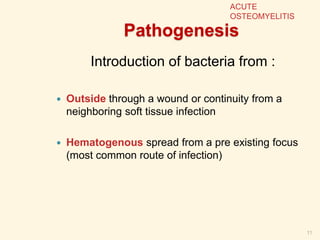
Introduction of bacteria from :
 Outside through a wound or continuity from a
neighboring soft tissue infection
 Hematogenous spread from a pre existing focus
(most common route of infection)
11
ACUTE
OSTEOMYELITIS
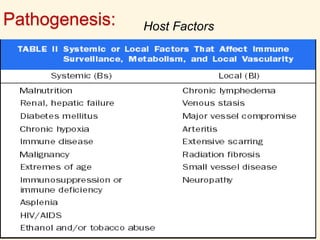
Pathogenesis: Host Factors
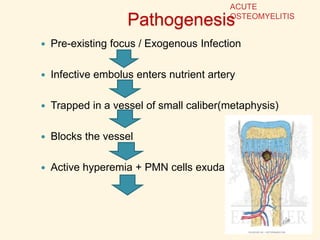
Pathogenesis
 Pre-existing focus / Exogenous Infection
 Infective embolus enters nutrient artery
 Trapped in a vessel of small caliber(metaphysis)
 Blocks the vessel
 Active hyperemia + PMN cells exudate
ACUTE
OSTEOMYELITIS
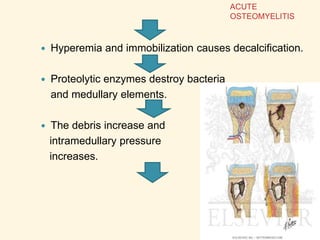
 Hyperemia and immobilization causes decalcification.
 Proteolytic enzymes destroy bacteria
and medullary elements.
 The debris increase and
intramedullary pressure
increases.
ACUTE
OSTEOMYELITIS
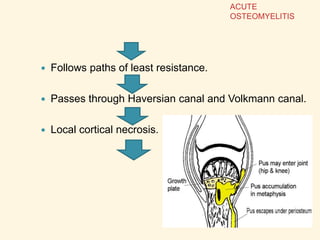
 Follows paths of least resistance.
 Passes through Haversian canal and Volkmann canal.
 Local cortical necrosis.
ACUTE
OSTEOMYELITIS
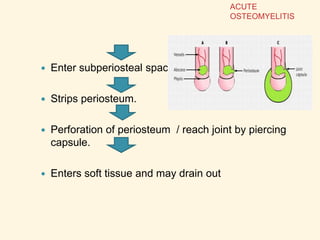
 Enter subperiosteal space.
 Strips periosteum.
 Perforation of periosteum / reach joint by piercing
capsule.
 Enters soft tissue and may drain out
ACUTE
OSTEOMYELITIS
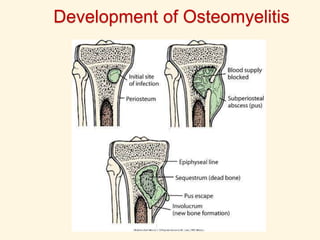
Development of Osteomyelitis
CLINICAL FEATURES
 Fever (High Grade)
 Child refuses to use limb (pseudoparalysis)
 Local redness , swelling , warmth , oedema
 Newborn – failure to thrive , drowsy , irritable.
18
ACUTE
OSTEOMYELITIS
Laboratory Tests
 Elevations in the peripheral white blood cell count
(WBC),
 Erythrocyte sedimentation rate (ESR), and C-
reactive protein (CRP) in children with
hematogenous osteomyelitis are variable and
nonspecific.
 Blood culture is positive in half of cases.
19
ACUTE
OSTEOMYELITIS
X-ray findings
It takes from 10 to 21 days for an osseous lesion
to become visible conventional radiography,
because a 30–50% reduction of bone density must
occur before radiographic change is apparent
ACUTE
OSTEOMYELITIS
ACUTE
OSTEOMYELITIS
Differential Diagnosis
 Rheumatic fever : Onset is more gradual,
pain and tenderness are less intense. Involvement
is polyarticular. Response to salicylates and ACTH
is dramatic.
 Acute suppurative arthritis : Pain and
tenderness are , limted to the joint, joint
movements is greatly restricted, muscle spasm is
intense, and aspiration reveals purulent synovial
fluid.
22
ACUTE
OSTEOMYELITIS
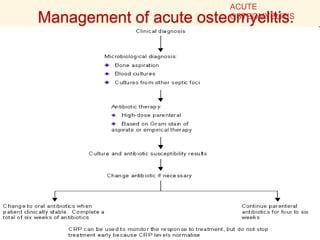
Management of acute osteomyelitis.
ACUTE
OSTEOMYELITIS
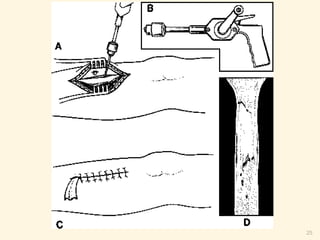
Drainage technique of acute
Hematigenous Osteomyelitis of tibia
 Use tourniquet whenever possibe.
 Make an anteromedial incision 5 – 7.5 cm long over
the affected part of tibia.
 Incise periosteum longitudinally, gently elevate the
periostum 1.5 cm on each side.
 Drill several holes 4mm in diameter through the cortex
into the medullary cannal. If pus escapes through
these holes, use drill to outline a corticle window 1.3 ×
2.5 cm and remove the cortex with osteotome.
24
ACUTE
OSTEOMYELITIS
25
 Evavuate the intramedullary pus and remove the
necrotic tissue.
 Irrigate the cavity with at least 3 L of saline with a
pulsatile lavage system.
 Close the skin loosely over drains.
 Limb is splinted in neutral position.
 Generally 6 weeks course of antibiotics is given.
26
ACUTE
OSTEOMYELITIS
 Bone abscess
 Septic Arthritis
 Septicemia
 Fracture
 Growth arrest
 Overlying soft-tissue cellulitis
 Chronic infection
27
ACUTE
OSTEOMYELITIS
Subacute Osteomyelitis
 It has an insidious onset, mild symptoms, lack of
systemic reaction
 Its relative mildness is due to:
a) Organism being less virulent OR
b) Patient more resistant OR
c) (Both)
 Most common site: Distal femur, Proximal & Distal
Tibia
28
Causative Organism
a) Staphyloccocus aureus (30-60%)
b) Others (Streptococcus, Pseudomonas,
Haemophilus influenzae)
c) Pseudomonas aeruginosa (IV drug user)
d) Salmonella (patient with sickle cell anaemia)
29
Clinical Features
 Pain (several weeks / months)
 Limping
 Swelling & Local tenderness
 Muscle wasting
 Body temperature usually normal (no fever)
30
Radiological Finding
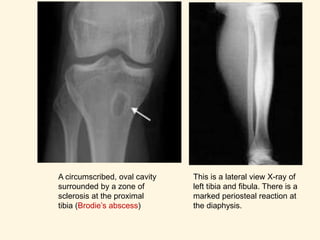
Brodie’s abscess
 A circumscribed, round/oval cavity containing pus and
pieces of dead bone (sequestra) surrounded by
sclerosis.
 Most commonly seen in tibial / femoral metaphysis.
 May occur in epiphysis / cuboidal bone (eg:
calcaneum).
 Metaphyseal lesion cause no / little periosteal
reaction.
31
A circumscribed, oval cavity
surrounded by a zone of
sclerosis at the proximal
tibia (Brodie’s abscess)
This is a lateral view X-ray of
left tibia and fibula. There is a
marked periosteal reaction at
the diaphysis.
Investigations
 X-ray (may resemble osteoid osteoma / malignant
bone tumour)
 Biopsy
 Fluid aspiration & culture
 ESR raised
 WBC count may be normal
33
Treatment
Conservative :
a) Immobilization
b) Antibiotics (flucloxacillin + fusidic acid) for 6weeks
Surgical (if the diagnosis is in doubt / failed conservative
treatment) :
a) Open biopsy
b) Perform curettage on the lesion
34
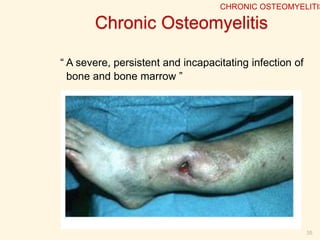
Chronic Osteomyelitis
“ A severe, persistent and incapacitating infection of
bone and bone marrow ”
35
CHRONIC OSTEOMYELITIS
Aetiological Agents
Usual organisms (with time there is always a mixed
infection)
 Staph.aureus(commonest)
 Staph.pyogenes
 E.coli
 Pseudomonas
 Staph.epidermidis
(commonest in surgical implant)
 Animal bites – pasturella multocida
 Human bites – eikenella corrodens
36
CHRONIC OSTEOMYELITIS
Aetiology
 Inadequately treated acute osteomyelitis
 Haematogenous spread
 Iatrogenic
 Penetrating trauma
 Open fractures
37
CHRONIC OSTEOMYELITIS
Clinical Features
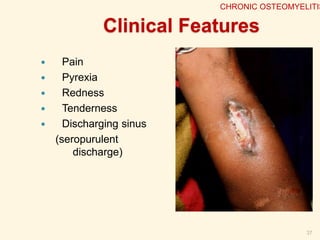
 Pain
 Pyrexia
 Redness
 Tenderness
 Discharging sinus
(seropurulent
discharge)
38
CHRONIC OSTEOMYELITIS
 Incidence of infection increases with increase in
grade of open fractures (Guistilo, Anderson) :
◦ Approx. 2% for type I and type II
◦ Approx. 10% to 50% for type III
 The tibia most common site for infection.
CHRONIC OSTEOMYELITIS
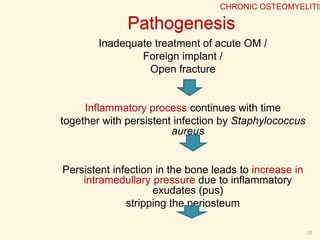
Pathogenesis
Inadequate treatment of acute OM /
Foreign implant /
Open fracture
Inflammatory process continues with time
together with persistent infection by Staphylococcus
aureus
Persistent infection in the bone leads to increase in
intramedullary pressure due to inflammatory
exudates (pus)
stripping the periosteum
40
CHRONIC OSTEOMYELITIS
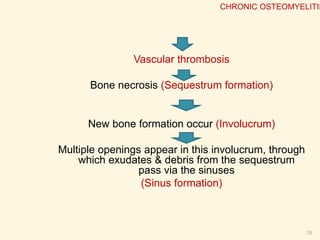
Vascular thrombosis
Bone necrosis (Sequestrum formation)
New bone formation occur (Involucrum)
Multiple openings appear in this involucrum, through
which exudates & debris from the sequestrum
pass via the sinuses
(Sinus formation)
41
CHRONIC OSTEOMYELITIS
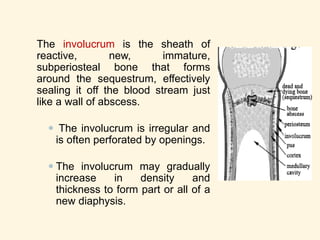
The involucrum is the sheath of reactive, new, immature,
subperiosteal bone that forms around the sequestrum,
effectively sealing it off the blood stream just like a wall of
abscess.
 The involucrum is irregular and is often perforated by
openings.
 The involucrum may gradually increase in density and
thickness to form part or all of a new diaphysis.
CHRONIC OSTEOMYELITIS
44
SEQUESTRUM
PERIOSTEAL NEW BONE
FORMATION
INVOLUCRUM
CHRONIC OSTEOMYELITIS
INVOLUCRUM (the new bone)
46
CHRONIC OSTEOMYELITIS
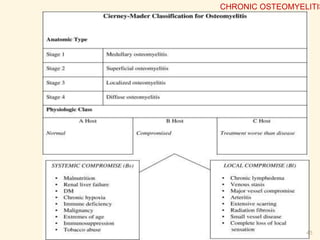
Staging Of Osteomyelitis:
 The Cierny-Mader staging system.
 It is determined by the status of the disease
process.
 It takes into account the state of the bone, the
patient's overall condition and factors affecting the
development of osteomyelitis.
47
CHRONIC OSTEOMYELITIS
48
CHRONIC OSTEOMYELITIS
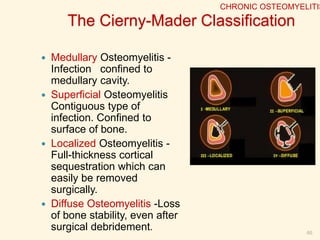
The Cierny-Mader Classification
 Medullary Osteomyelitis -
Infection confined to
medullary cavity.
 Superficial Osteomyelitis
Contiguous type of
infection. Confined to
surface of bone.
 Localized Osteomyelitis -
Full-thickness cortical
sequestration which can
easily be removed
surgically.
 Diffuse Osteomyelitis -Loss
of bone stability, even after
surgical debridement. 49
CHRONIC OSTEOMYELITIS
Classification (Cierny)
Type I Medullary cortical de-roofing and medullary debridement
Type II Superficial shallow decortication back to bleeding bone
Type III Localised saucerisation and debridement
Type IV Diffuse infected area excised en-bloc and stabilised
with ex-fix
50
CHRONIC OSTEOMYELITIS
51
52
CHRONIC OSTEOMYELITIS
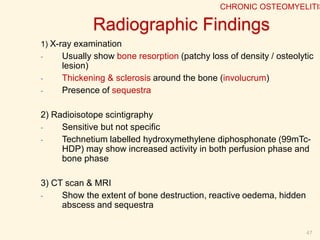
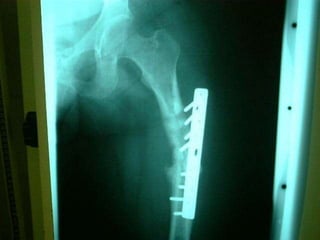
Radiographic Findings
1) X-ray examination
- Usually show bone resorption (patchy loss of density / osteolytic
lesion)
- Thickening & sclerosis around the bone (involucrum)
- Presence of sequestra
2) Radioisotope scintigraphy
- Sensitive but not specific
- Technetium labelled hydroxymethylene diphosphonate (99mTc-
HDP) may show increased activity in both perfusion phase and
bone phase
3) CT scan & MRI
- Show the extent of bone destruction, reactive oedema, hidden
abscess and sequestra
53
CHRONIC OSTEOMYELITIS
Radiology
 Plain xray
◦ Specificity 75-83%
◦ Sensitivity 43-75%
 Soft tissue swelling 48hrs
 Periosteal reaction 5-7d
 Osteolysis 10d to 2 wks
◦ (need 50% bone loss)
CHRONIC OSTEOMYELITIS
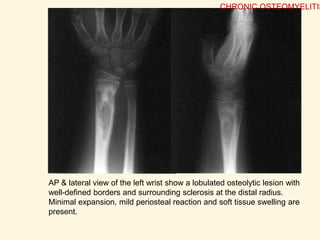
AP & lateral view of the left wrist show a lobulated osteolytic lesion with
well-defined borders and surrounding sclerosis at the distal radius.
Minimal expansion, mild periosteal reaction and soft tissue swelling are
present.
CHRONIC OSTEOMYELITIS
Bone
scan  Radioisotopic bone scanning is valuable in
early localization (within 48 hrs) of bone
infection.
 The specificity of radioactive isotopic imaging
techniques have improved in the evaluation of
musculoskeletal infection.
 Technitium-99m imaging is very sensitive , it is
the choice for acute hematogenous
osteomyelitis, the overall accuracy being 92%.
Bone scan revealing hot
spot in right tibia
CHRONIC OSTEOMYELITIS
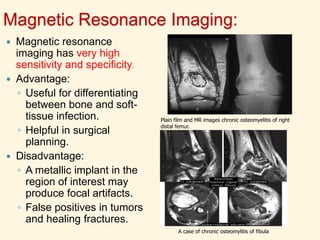
MR
I
 Has very high
sensitivity and
specificity.
 Advantage:
◦ Useful for
differentiating
between bone and
soft-tissue infection.
◦ Helpful in surgical
planning.
 Disadvantage:
◦ A metallic implant in
the region of interest
may produce focal
artifacts.
◦ False positives in
tumors and healing
fractures.
Plain film and MR images chronic osteomyelitis of right distal femur.
Acaseofchronicosteomylitisoffibula
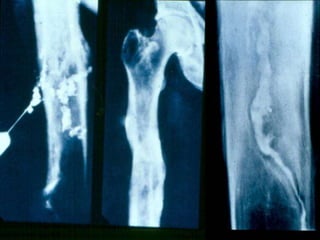
Sinograph
y
•Sinography can be
performed if a sinus track is
present
•Roentgenograms made in
two planes after injection of
radiopaque liquid into sinus.
•Helpful in locating focus of
infection in chronic
osteomyelitis.
•A valuable adjunct to
surgical planning
Treatmen
t
1.General treatment:
nutritional therapy or
general supportive
treatment by intaking
enough caloric, protein,
vitamin etc.
2. Antibiotic therapy
3. Surgical treatment
4. Immobilization
Treatment -
Antibiotics
- Chronic infection is seldom eradicated by
antibiotics alone.
- Bactericidal drugs are important to:
a) Stop the spread of infection to healthy bone
b) Control acute flares
- Antibiotics used in treating chronic osteomyelitis
(Fusidic acid, Clindamycin, Vancomycin,
Cefazolin)
65
CHRONIC OSTEOMYELITIS
Antibiotic
choice
 Guided by microbiology department
 Clindamycin (98% serum level) and
vancomycin(14% serum level) have good bone
penetration
 Minimum length 6 weeks with 3 months being the
standard treatment course
 May need to treat for 6-12 months
66
CHRONIC OSTEOMYELITIS
- Antibiotic (IV route) is given for 10 days prior to
surgery.
- After the major debridement surgery, antibiotic is
continued for another 6 weeks (min) but usually
>3months.
[treat until inflammatory parameters (ESR) are
normal]
67
CHRONIC OSTEOMYELITIS
Surgical
Treatment
- After 10 days of antibiotic administration,
debridement is done to remove:
a) All the infected tissue
b) Dead / devitalised bone (Sequestrectomy)
c) Sinus tract
68
CHRONIC OSTEOMYELITIS
Sequestrectomy and curettage. A, Affected bone is exposed, and sequestrum is
removed. B, All infected matter is removed. C, Wound is either packed open or closed
loosely over drains.
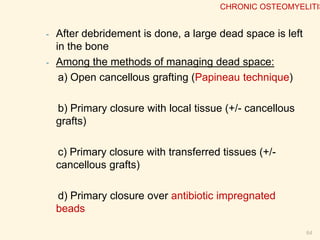
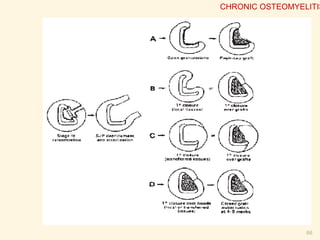
Closure of dead space
- After debridement is done, a large dead space is left in the
bone
- Among the methods of managing dead space:
Open cancellous grafting – Papineau technique
 Useful for bone deficiencies of less than 4cm
 (preferably autogenous) mixed with an antibiotic and fibrin
sealant
Vascularised bone graft
 Heals as a segmental fracture
 Indicated when defect is > 6cm
 Iliac crest for defects > 8cm
 Fibula 6-35cm can be bridged
Bypass graft
 Involves the establishment of a cross union between the fibula
70
CHRONIC OSTEOMYELITIS
71
72
CHRONIC OSTEOMYELITIS
73
CHRONIC OSTEOMYELITIS
74
CHRONIC OSTEOMYELITIS
75
- Primary closure with transferred tissue:
In muscle flap transfer, a suitable large wad of
muscle with its blood supply intact can be mobilized and
laid into the cavity. The surface is later closed with a
split-skin graft
- Primary closure with antibiotic impregnated beads:
Porous gentamicin-impregnated beads are used to
sterilize the cavity. It is easier but less successful.
Furthermore, they are extremely difficult to be removed if
not taken out by 2-3 weeks
CHRONIC OSTEOMYELITIS
76
CHRONIC OSTEOMYELITIS
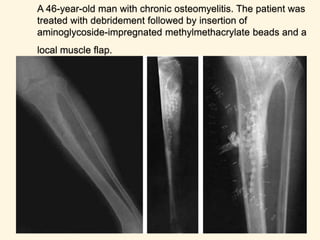
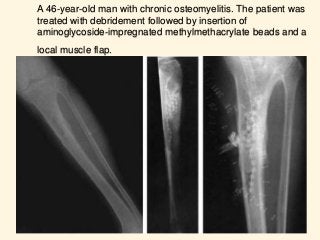
A 46-year-old man with chronic osteomyelitis. The patient was
treated with debridement followed by insertion of
aminoglycoside-impregnated methylmethacrylate beads and a
local muscle flap.
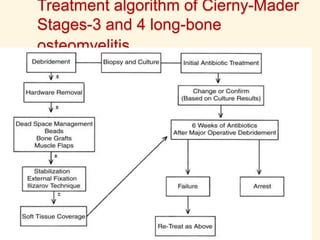
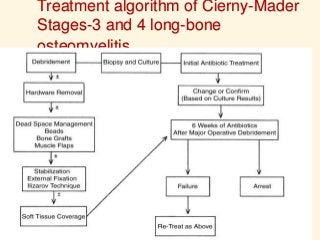
Treatment algorithm of Cierny-Mader
Stages-3 and 4 long-bone
osteomyelitis.
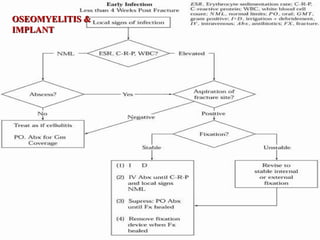
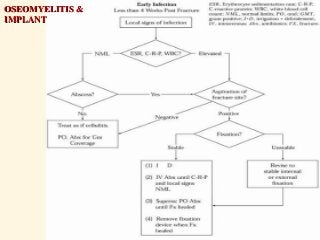
OSEOMYELITIS &
IMPLANT
OSEOMYELITIS &
IMPLANT
In either case it is critical to preserve the
involucrum
preferable to wait at least 3-6 months before
performing a sequestrectomy
Early sequestrectomy
- Eradicate infection
-Better environment for
periosteum to respond
Delayed sequestrectomy
Wait till sufficient
involucrum has formed
before doing a
sequestrectomy to
mimimize the risk of
fracture, deformity &
segmental loss
When to do sequestrectomy?
CHRONIC OSTEOMYELITIS
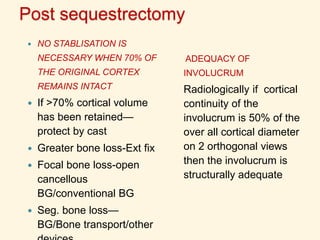
Post sequestrectomy
 NO STABLISATION IS
NECESSARY WHEN 70% OF
THE ORIGINAL CORTEX
REMAINS INTACT
 If >70% cortical volume
has been retained—
protect by cast
 Greater bone loss-Ext fix
 Focal bone loss-open
cancellous
BG/conventional BG
 Seg. bone loss—
BG/Bone transport/other
ADEQUACY OF
INVOLUCRUM
Radiologically if cortical
continuity of the
involucrum is 50% of the
over all cortical diameter
on 2 orthogonal views
then the involucrum is
structurally adequate
CHRONIC OSTEOMYELITIS
Complications
1) Pathological Fracture
- This occurs in the bone weakened by chronic
osteomyelitis
2) Deformity
– In children the focus of osteomyelitis destroys
part of the epiphysis growth plate.
3) Shortening/ lengthening
- Destruction of growth plate arrest growth.
- Stimulation of growth plate due to hyperemia.
83
CHRONIC OSTEOMYELITIS
84

Osteomyelitis

  • 1.
  • 2.
    Osteomyelitis is an acuteor chronic inflammatory process of bone, bone marrow and its structure secondary to infection with micro organisms. 2
  • 3.
    CLASSIFICATION Duration - Acute /Subacute / Chronic Mechanism - Heamatogenous (tonsil , lungs , ear/ GIT) - Exogenous (injection , open fractures) Host response - Pyogenic / Granulomatous 3
  • 4.
     Age :Infancy and childhood.  Sex : Males predominate 4:1  Location : Metaphysis of long bone.  Poor nutrition, unhygienic surroundings. 4 ACUTE OSTEOMYELITIS
  • 5.
    –sharp hairpin turnsin metaphyseal capillaries – flow becomes considerably slower and more turbulent ACUTE OSTEOMYELITIS
  • 6.
    Pathophysiology Infection ◦ Starts inMetaphysis  Arteriole Loop / Venous Lakes ◦ Spread via Volkman’s canal / Haversian system ◦ Endothelium Leaks ACUTE OSTEOMYELITIS
  • 7.
    Pathophysiology  Role ofgrowth plate ◦ Over 18/12 ◦ Impermeable to spread ◦ Under 18/12 infection crosses growth plate ACUTE OSTEOMYELITIS
  • 8.
    Acute Osteomyelitis Infants Joint involvement is common  Nutrient metaphyseal capillaries perforate the epiphyseal growth plate, particularly in the hip, shoulder, and knee. 8 ACUTE OSTEOMYELITIS
  • 9.
    Etiological Agents  Infants< 1 year – Group B streptococci Staph aureus E.coli  1- 16 years – S. aureus , S. pyogens , H. Influenza  > 16 years – S.aureus , S.epidermidis , Gram –ve bacteria 9 ACUTE OSTEOMYELITIS
  • 10.
    Rare organisms Isolatedin Bacterial Osteomyelitis Bartonella henselae Pasteurella multocida or Eikenella corrodens Aspergillus species, Mycobacterium avium-intracellulare or Candida albicans Mycobacterium tuberculosis Brucella species, Coxiella burnetii (cause of chronic Q fever) or other fungi found in specific geographic areas Human immunodeficiency virus infection Human or animal bites Immunocompromised patients Populations in which tuberculosis is prevalent. Population in which these pathogens are endemic
  • 11.
    Pathogenesis Introduction of bacteriafrom :  Outside through a wound or continuity from a neighboring soft tissue infection  Hematogenous spread from a pre existing focus (most common route of infection) 11 ACUTE OSTEOMYELITIS
  • 12.
  • 13.
    Pathogenesis  Pre-existing focus/ Exogenous Infection  Infective embolus enters nutrient artery  Trapped in a vessel of small caliber(metaphysis)  Blocks the vessel  Active hyperemia + PMN cells exudate ACUTE OSTEOMYELITIS
  • 14.
     Hyperemia andimmobilization causes decalcification.  Proteolytic enzymes destroy bacteria and medullary elements.  The debris increase and intramedullary pressure increases. ACUTE OSTEOMYELITIS
  • 15.
     Follows pathsof least resistance.  Passes through Haversian canal and Volkmann canal.  Local cortical necrosis. ACUTE OSTEOMYELITIS
  • 16.
     Enter subperiostealspace.  Strips periosteum.  Perforation of periosteum / reach joint by piercing capsule.  Enters soft tissue and may drain out ACUTE OSTEOMYELITIS
  • 17.
  • 18.
    CLINICAL FEATURES  Fever(High Grade)  Child refuses to use limb (pseudoparalysis)  Local redness , swelling , warmth , oedema  Newborn – failure to thrive , drowsy , irritable. 18 ACUTE OSTEOMYELITIS
  • 19.
    Laboratory Tests  Elevationsin the peripheral white blood cell count (WBC),  Erythrocyte sedimentation rate (ESR), and C- reactive protein (CRP) in children with hematogenous osteomyelitis are variable and nonspecific.  Blood culture is positive in half of cases. 19 ACUTE OSTEOMYELITIS
  • 20.
    X-ray findings It takesfrom 10 to 21 days for an osseous lesion to become visible conventional radiography, because a 30–50% reduction of bone density must occur before radiographic change is apparent ACUTE OSTEOMYELITIS
  • 21.
  • 22.
    Differential Diagnosis  Rheumaticfever : Onset is more gradual, pain and tenderness are less intense. Involvement is polyarticular. Response to salicylates and ACTH is dramatic.  Acute suppurative arthritis : Pain and tenderness are , limted to the joint, joint movements is greatly restricted, muscle spasm is intense, and aspiration reveals purulent synovial fluid. 22 ACUTE OSTEOMYELITIS
  • 23.
    Management of acuteosteomyelitis. ACUTE OSTEOMYELITIS
  • 24.
    Drainage technique ofacute Hematigenous Osteomyelitis of tibia  Use tourniquet whenever possibe.  Make an anteromedial incision 5 – 7.5 cm long over the affected part of tibia.  Incise periosteum longitudinally, gently elevate the periostum 1.5 cm on each side.  Drill several holes 4mm in diameter through the cortex into the medullary cannal. If pus escapes through these holes, use drill to outline a corticle window 1.3 × 2.5 cm and remove the cortex with osteotome. 24 ACUTE OSTEOMYELITIS
  • 25.
  • 26.
     Evavuate theintramedullary pus and remove the necrotic tissue.  Irrigate the cavity with at least 3 L of saline with a pulsatile lavage system.  Close the skin loosely over drains.  Limb is splinted in neutral position.  Generally 6 weeks course of antibiotics is given. 26 ACUTE OSTEOMYELITIS
  • 27.
     Bone abscess Septic Arthritis  Septicemia  Fracture  Growth arrest  Overlying soft-tissue cellulitis  Chronic infection 27 ACUTE OSTEOMYELITIS
  • 28.
    Subacute Osteomyelitis  Ithas an insidious onset, mild symptoms, lack of systemic reaction  Its relative mildness is due to: a) Organism being less virulent OR b) Patient more resistant OR c) (Both)  Most common site: Distal femur, Proximal & Distal Tibia 28
  • 29.
    Causative Organism a) Staphyloccocusaureus (30-60%) b) Others (Streptococcus, Pseudomonas, Haemophilus influenzae) c) Pseudomonas aeruginosa (IV drug user) d) Salmonella (patient with sickle cell anaemia) 29
  • 30.
    Clinical Features  Pain(several weeks / months)  Limping  Swelling & Local tenderness  Muscle wasting  Body temperature usually normal (no fever) 30
  • 31.
    Radiological Finding Brodie’s abscess A circumscribed, round/oval cavity containing pus and pieces of dead bone (sequestra) surrounded by sclerosis.  Most commonly seen in tibial / femoral metaphysis.  May occur in epiphysis / cuboidal bone (eg: calcaneum).  Metaphyseal lesion cause no / little periosteal reaction. 31
  • 32.
    A circumscribed, ovalcavity surrounded by a zone of sclerosis at the proximal tibia (Brodie’s abscess) This is a lateral view X-ray of left tibia and fibula. There is a marked periosteal reaction at the diaphysis.
  • 33.
    Investigations  X-ray (mayresemble osteoid osteoma / malignant bone tumour)  Biopsy  Fluid aspiration & culture  ESR raised  WBC count may be normal 33
  • 34.
    Treatment Conservative : a) Immobilization b)Antibiotics (flucloxacillin + fusidic acid) for 6weeks Surgical (if the diagnosis is in doubt / failed conservative treatment) : a) Open biopsy b) Perform curettage on the lesion 34
  • 35.
    Chronic Osteomyelitis “ Asevere, persistent and incapacitating infection of bone and bone marrow ” 35 CHRONIC OSTEOMYELITIS
  • 36.
    Aetiological Agents Usual organisms(with time there is always a mixed infection)  Staph.aureus(commonest)  Staph.pyogenes  E.coli  Pseudomonas  Staph.epidermidis (commonest in surgical implant)  Animal bites – pasturella multocida  Human bites – eikenella corrodens 36 CHRONIC OSTEOMYELITIS
  • 37.
    Aetiology  Inadequately treatedacute osteomyelitis  Haematogenous spread  Iatrogenic  Penetrating trauma  Open fractures 37 CHRONIC OSTEOMYELITIS
  • 38.
    Clinical Features  Pain Pyrexia  Redness  Tenderness  Discharging sinus (seropurulent discharge) 38 CHRONIC OSTEOMYELITIS
  • 39.
     Incidence ofinfection increases with increase in grade of open fractures (Guistilo, Anderson) : ◦ Approx. 2% for type I and type II ◦ Approx. 10% to 50% for type III  The tibia most common site for infection. CHRONIC OSTEOMYELITIS
  • 40.
    Pathogenesis Inadequate treatment ofacute OM / Foreign implant / Open fracture Inflammatory process continues with time together with persistent infection by Staphylococcus aureus Persistent infection in the bone leads to increase in intramedullary pressure due to inflammatory exudates (pus) stripping the periosteum 40 CHRONIC OSTEOMYELITIS
  • 41.
    Vascular thrombosis Bone necrosis(Sequestrum formation) New bone formation occur (Involucrum) Multiple openings appear in this involucrum, through which exudates & debris from the sequestrum pass via the sinuses (Sinus formation) 41 CHRONIC OSTEOMYELITIS
  • 42.
  • 43.
    The involucrum isthe sheath of reactive, new, immature, subperiosteal bone that forms around the sequestrum, effectively sealing it off the blood stream just like a wall of abscess.  The involucrum is irregular and is often perforated by openings.  The involucrum may gradually increase in density and thickness to form part or all of a new diaphysis. CHRONIC OSTEOMYELITIS
  • 44.
  • 45.
  • 46.
    INVOLUCRUM (the newbone) 46 CHRONIC OSTEOMYELITIS
  • 47.
    Staging Of Osteomyelitis: The Cierny-Mader staging system.  It is determined by the status of the disease process.  It takes into account the state of the bone, the patient's overall condition and factors affecting the development of osteomyelitis. 47 CHRONIC OSTEOMYELITIS
  • 48.
  • 49.
    The Cierny-Mader Classification Medullary Osteomyelitis - Infection confined to medullary cavity.  Superficial Osteomyelitis Contiguous type of infection. Confined to surface of bone.  Localized Osteomyelitis - Full-thickness cortical sequestration which can easily be removed surgically.  Diffuse Osteomyelitis -Loss of bone stability, even after surgical debridement. 49 CHRONIC OSTEOMYELITIS
  • 50.
    Classification (Cierny) Type IMedullary cortical de-roofing and medullary debridement Type II Superficial shallow decortication back to bleeding bone Type III Localised saucerisation and debridement Type IV Diffuse infected area excised en-bloc and stabilised with ex-fix 50 CHRONIC OSTEOMYELITIS
  • 51.
  • 52.
  • 53.
    Radiographic Findings 1) X-rayexamination - Usually show bone resorption (patchy loss of density / osteolytic lesion) - Thickening & sclerosis around the bone (involucrum) - Presence of sequestra 2) Radioisotope scintigraphy - Sensitive but not specific - Technetium labelled hydroxymethylene diphosphonate (99mTc- HDP) may show increased activity in both perfusion phase and bone phase 3) CT scan & MRI - Show the extent of bone destruction, reactive oedema, hidden abscess and sequestra 53 CHRONIC OSTEOMYELITIS
  • 54.
    Radiology  Plain xray ◦Specificity 75-83% ◦ Sensitivity 43-75%  Soft tissue swelling 48hrs  Periosteal reaction 5-7d  Osteolysis 10d to 2 wks ◦ (need 50% bone loss) CHRONIC OSTEOMYELITIS
  • 55.
    AP & lateralview of the left wrist show a lobulated osteolytic lesion with well-defined borders and surrounding sclerosis at the distal radius. Minimal expansion, mild periosteal reaction and soft tissue swelling are present. CHRONIC OSTEOMYELITIS
  • 60.
    Bone scan  Radioisotopicbone scanning is valuable in early localization (within 48 hrs) of bone infection.  The specificity of radioactive isotopic imaging techniques have improved in the evaluation of musculoskeletal infection.  Technitium-99m imaging is very sensitive , it is the choice for acute hematogenous osteomyelitis, the overall accuracy being 92%. Bone scan revealing hot spot in right tibia CHRONIC OSTEOMYELITIS
  • 61.
    MR I  Has veryhigh sensitivity and specificity.  Advantage: ◦ Useful for differentiating between bone and soft-tissue infection. ◦ Helpful in surgical planning.  Disadvantage: ◦ A metallic implant in the region of interest may produce focal artifacts. ◦ False positives in tumors and healing fractures. Plain film and MR images chronic osteomyelitis of right distal femur. Acaseofchronicosteomylitisoffibula
  • 62.
    Sinograph y •Sinography can be performedif a sinus track is present •Roentgenograms made in two planes after injection of radiopaque liquid into sinus. •Helpful in locating focus of infection in chronic osteomyelitis. •A valuable adjunct to surgical planning
  • 64.
    Treatmen t 1.General treatment: nutritional therapyor general supportive treatment by intaking enough caloric, protein, vitamin etc. 2. Antibiotic therapy 3. Surgical treatment 4. Immobilization
  • 65.
    Treatment - Antibiotics - Chronicinfection is seldom eradicated by antibiotics alone. - Bactericidal drugs are important to: a) Stop the spread of infection to healthy bone b) Control acute flares - Antibiotics used in treating chronic osteomyelitis (Fusidic acid, Clindamycin, Vancomycin, Cefazolin) 65 CHRONIC OSTEOMYELITIS
  • 66.
    Antibiotic choice  Guided bymicrobiology department  Clindamycin (98% serum level) and vancomycin(14% serum level) have good bone penetration  Minimum length 6 weeks with 3 months being the standard treatment course  May need to treat for 6-12 months 66 CHRONIC OSTEOMYELITIS
  • 67.
    - Antibiotic (IVroute) is given for 10 days prior to surgery. - After the major debridement surgery, antibiotic is continued for another 6 weeks (min) but usually >3months. [treat until inflammatory parameters (ESR) are normal] 67 CHRONIC OSTEOMYELITIS
  • 68.
    Surgical Treatment - After 10days of antibiotic administration, debridement is done to remove: a) All the infected tissue b) Dead / devitalised bone (Sequestrectomy) c) Sinus tract 68 CHRONIC OSTEOMYELITIS
  • 69.
    Sequestrectomy and curettage.A, Affected bone is exposed, and sequestrum is removed. B, All infected matter is removed. C, Wound is either packed open or closed loosely over drains.
  • 70.
    Closure of deadspace - After debridement is done, a large dead space is left in the bone - Among the methods of managing dead space: Open cancellous grafting – Papineau technique  Useful for bone deficiencies of less than 4cm  (preferably autogenous) mixed with an antibiotic and fibrin sealant Vascularised bone graft  Heals as a segmental fracture  Indicated when defect is > 6cm  Iliac crest for defects > 8cm  Fibula 6-35cm can be bridged Bypass graft  Involves the establishment of a cross union between the fibula 70 CHRONIC OSTEOMYELITIS
  • 71.
  • 72.
  • 73.
  • 74.
  • 75.
    75 - Primary closurewith transferred tissue: In muscle flap transfer, a suitable large wad of muscle with its blood supply intact can be mobilized and laid into the cavity. The surface is later closed with a split-skin graft - Primary closure with antibiotic impregnated beads: Porous gentamicin-impregnated beads are used to sterilize the cavity. It is easier but less successful. Furthermore, they are extremely difficult to be removed if not taken out by 2-3 weeks CHRONIC OSTEOMYELITIS
  • 76.
  • 77.
    A 46-year-old manwith chronic osteomyelitis. The patient was treated with debridement followed by insertion of aminoglycoside-impregnated methylmethacrylate beads and a local muscle flap.
  • 78.
    Treatment algorithm ofCierny-Mader Stages-3 and 4 long-bone osteomyelitis.
  • 79.
  • 80.
  • 81.
    In either caseit is critical to preserve the involucrum preferable to wait at least 3-6 months before performing a sequestrectomy Early sequestrectomy - Eradicate infection -Better environment for periosteum to respond Delayed sequestrectomy Wait till sufficient involucrum has formed before doing a sequestrectomy to mimimize the risk of fracture, deformity & segmental loss When to do sequestrectomy? CHRONIC OSTEOMYELITIS
  • 82.
    Post sequestrectomy  NOSTABLISATION IS NECESSARY WHEN 70% OF THE ORIGINAL CORTEX REMAINS INTACT  If >70% cortical volume has been retained— protect by cast  Greater bone loss-Ext fix  Focal bone loss-open cancellous BG/conventional BG  Seg. bone loss— BG/Bone transport/other ADEQUACY OF INVOLUCRUM Radiologically if cortical continuity of the involucrum is 50% of the over all cortical diameter on 2 orthogonal views then the involucrum is structurally adequate CHRONIC OSTEOMYELITIS
  • 83.
    Complications 1) Pathological Fracture -This occurs in the bone weakened by chronic osteomyelitis 2) Deformity – In children the focus of osteomyelitis destroys part of the epiphysis growth plate. 3) Shortening/ lengthening - Destruction of growth plate arrest growth. - Stimulation of growth plate due to hyperemia. 83 CHRONIC OSTEOMYELITIS
  • 84.