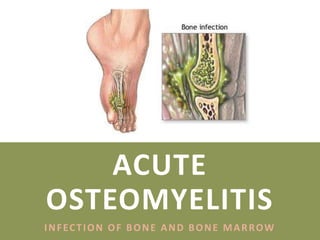
ACUTE
OSTEOMYELITIS
INFECTION OF BONE AND BONE MARROW
INTRODUCTION
 Infection of bone and bone marrow
 Can progress to osteonecrosis, bone destruction and septic arthritis
 Bimodal age distribution:
 Children under 5 years old
 Adults over 50 years of age
 Risk factors:
 Recent trauma or surgery
 Immunocompromised patients
 Illicit IV drug use
 Poor vascular supply
 Systemic conditions such as diabetes and sickle cells
 Peripheral neuropathy
CLASSIFICATION
I. Acute
within 2 weeks
II. Subacute
2 – 6 weeks
III. Chronic
after 6 weeks
Incidence of infection increases with increase in grade of open fracture:
 Type I – II : 2%
 Type III : 10 – 50%
based on duration, mechanism, and host response
DURAT I ON
CLASSIFICATION
I. Hematogenous
 Originated or transported by blood
 Etiology of 20% of osteomyelitis
 Vertebrae most common site; and metaphysis of long bone
 S. aureus is most common organism
II. Contiguous factor
 Associated with previous surgery, trauma, wounds or poor vascularity
 Can be bacterial (most common), mycobacterial or fungal in nature
III. Direct inoculation
 Penetrating injuries
 Surgical contamination
based on duration, mechanism, and host response
MECHANI SM
CLASSIFICATION
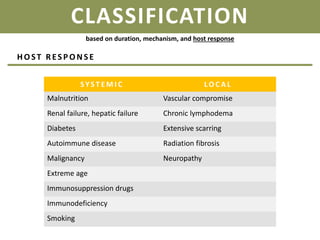
based on duration, mechanism, and host response
HOST RESPONSE
SY S T E M I C LO C A L
Malnutrition Vascular compromise
Renal failure, hepatic failure Chronic lymphodema
Diabetes Extensive scarring
Autoimmune disease Radiation fibrosis
Malignancy Neuropathy
Extreme age
Immunosuppression drugs
Immunodeficiency
Smoking
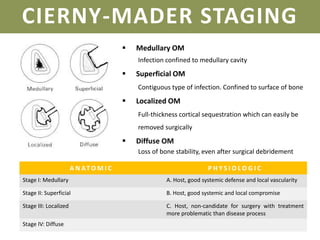
CIERNY-MADER STAGING
 Medullary OM
Infection confined to medullary cavity
 Superficial OM
Contiguous type of infection. Confined to surface of bone
 Localized OM
Full-thickness cortical sequestration which can easily be
removed surgically
 Diffuse OM
Loss of bone stability, even after surgical debridement
A N AT O M I C P H Y S I O L O G I C
Stage I: Medullary A. Host, good systemic defense and local vascularity
Stage II: Superficial B. Host, good systemic and local compromise
Stage III: Localized C. Host, non-candidate for surgery with treatment
more problematic than disease process
Stage IV: Diffuse
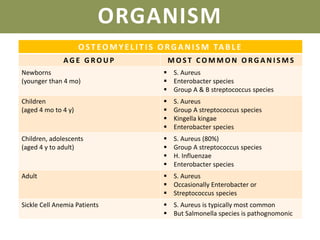
ORGANISM
OST EOMYEL I T I S ORGANI SM TAB L E
A G E G R O U P M O S T C O M M O N O R G A N I S M S
Newborns
(younger than 4 mo)
 S. Aureus
 Enterobacter species
 Group A & B streptococcus species
Children
(aged 4 mo to 4 y)
 S. Aureus
 Group A streptococcus species
 Kingella kingae
 Enterobacter species
Children, adolescents
(aged 4 y to adult)
 S. Aureus (80%)
 Group A streptococcus species
 H. Influenzae
 Enterobacter species
Adult  S. Aureus
 Occasionally Enterobacter or
 Streptococcus species
Sickle Cell Anemia Patients  S. Aureus is typically most common
 But Salmonella species is pathognomonic
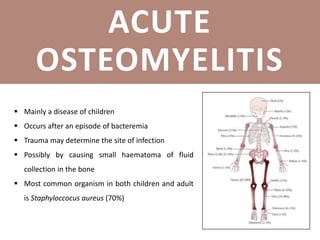
ACUTE
OSTEOMYELITIS
 Mainly a disease of children
 Occurs after an episode of bacteremia
 Trauma may determine the site of infection
 Possibly by causing small haematoma of fluid
collection in the bone
 Most common organism in both children and adult
is Staphyloccocus aureus (70%)
PATHOPHYSIOLOGY
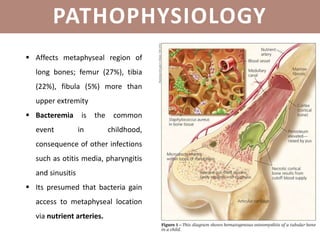
 Affects metaphyseal region of
long bones; femur (27%), tibia
(22%), fibula (5%) more than
upper extremity
 Bacteremia is the common
event in childhood,
consequence of other infections
such as otitis media, pharyngitis
and sinusitis
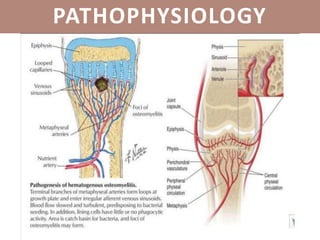
 Its presumed that bacteria gain
access to metaphyseal location
via nutrient arteries.
PATHOPHYSIOLOGY
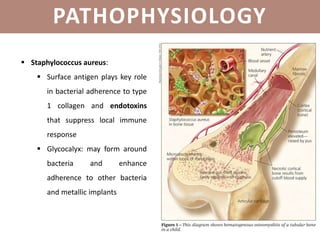
 Staphylococcus aureus:
 Surface antigen plays key role
in bacterial adherence to type
1 collagen and endotoxins
that suppress local immune
response
 Glycocalyx: may form around
bacteria and enhance
adherence to other bacteria
and metallic implants
PATHOPHYSIOLOGY
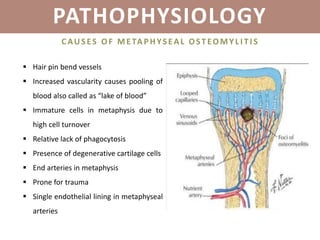
CAUSES OF METAPHYSEAL OST EOMYL I T I S
 Hair pin bend vessels
 Increased vascularity causes pooling of
blood also called as “lake of blood”
 Immature cells in metaphysis due to
high cell turnover
 Relative lack of phagocytosis
 Presence of degenerative cartilage cells
 End arteries in metaphysis
 Prone for trauma
 Single endothelial lining in metaphyseal
arteries
PATHOPHYSIOLOGY
CASCADE OF EV ENTS
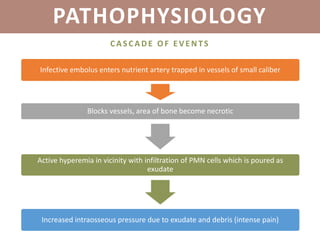
Infective embolus enters nutrient artery trapped in vessels of small caliber
Blocks vessels, area of bone become necrotic
Active hyperemia in vicinity with infiltration of PMN cells which is poured as
exudate
Increased intraosseous pressure due to exudate and debris (intense pain)
PATHOPHYSIOLOGY
CASCADE OF EV ENTS
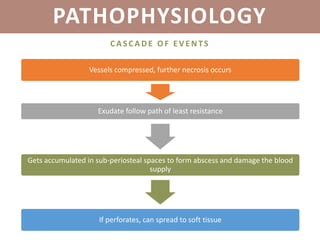
Vessels compressed, further necrosis occurs
Exudate follow path of least resistance
Gets accumulated in sub-periosteal spaces to form abscess and damage the blood
supply
If perforates, can spread to soft tissue
PATHOPHYSIOLOGY
SECOND ROUT E OF SPREAD OF I NF EC T I ON
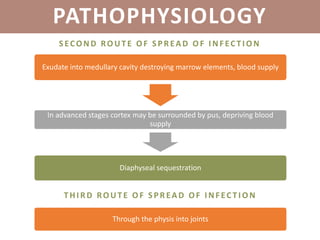
Exudate into medullary cavity destroying marrow elements, blood supply
In advanced stages cortex may be surrounded by pus, depriving blood
supply
Diaphyseal sequestration
T HI RD ROUT E OF SPREAD OF I NF EC T I ON
Through the physis into joints
PATHOPHYSIOLOGY
CLINICAL FEATURE
infant, children and adult
I NFANT
 Failure to thrive
 Metaphyseal tenderness, restricted joint movement
CHI L DREN
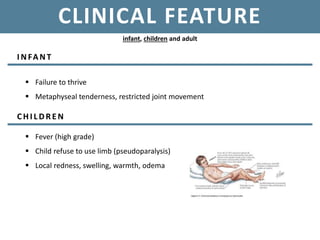
 Fever (high grade)
 Child refuse to use limb (pseudoparalysis)
 Local redness, swelling, warmth, odema
CLINICAL FEATURE
infant, children and adult
ADULT
 Commonest site is thoracolumbar spine
 History of urological procedure
 Followed by mild fever and backache
 Local tenderness
PHYSICAL EXAMINATION
 Ill looking
 Increase temperature and pulse
 Limb is held still
 Local redness, swelling and warmth
 Tenderness at near one of the larger joint
 Restricted joint movement – pseudoparalysis
 Edema
 Lymphadenopathy
INVESTIGATIONS
 A physical examination may shows bone tenderness and possibly swelling and redness
 Tests may include:
 Blood cultures
 Bone biopsy
 Bone scan
 Bone x-ray
 Full blood count
 C-reactive protein (CRP)
 Erythrocyte sedimentation rate (ESR)
 MRI of the bone
 Needle aspiration of the area around affected bone
INVESTIGATION
B LOOD & F LUI D
 Leukocytosis
 Elevated CRP & ESR
 Anti-staphylococcal antibody titre may be elevated
 Positive fluid or tissue aspiration
 Blood culture at the peak of fever may yield the causative organism
X-RAY
 Earliest abnormality detected after first week of the onset of symptom
 Extra cortical outline (periosteal new bone formation at metaphysis)
INVESTIGATION
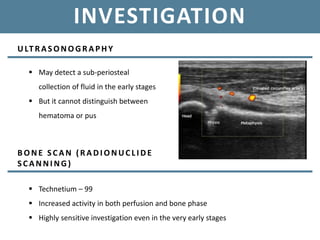
ULT RASONOGRAPHY
 May detect a sub-periosteal
collection of fluid in the early stages
 But it cannot distinguish between
hematoma or pus
B ONE SCAN (RADI ONUCL I DE
SCANNI NG)
 Technetium – 99
 Increased activity in both perfusion and bone phase
 Highly sensitive investigation even in the very early stages
INVESTIGATION
MAGNET I C RESONANCE I MAGI NG (MRI )
 Helpful in cases of doubtful diagnosis
 Best method of demonstrating bone marrow inflammation
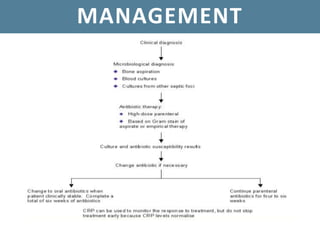
MANAGEMENT
TREATMENT
I. Supportive treatment for pain and dehydration
 Analgesic
 IV fluid
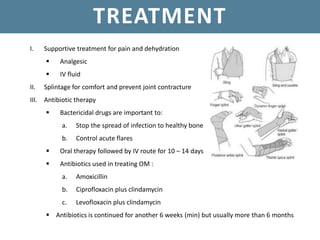
II. Splintage for comfort and prevent joint contracture
III. Antibiotic therapy
 Bactericidal drugs are important to:
a. Stop the spread of infection to healthy bone
b. Control acute flares
 Oral therapy followed by IV route for 10 – 14 days
 Antibiotics used in treating OM :
a. Amoxicillin
b. Ciprofloxacin plus clindamycin
c. Levofloxacin plus clindamycin
 Antibiotics is continued for another 6 weeks (min) but usually more than 6 months
TREATMENT
IV. Surgical drainage
 If antibiotics are given early (within first 48 hours) it is often unnecessary
 But if clinical features do not improve within 36 hours of starting treatment, or even
earlier and there is sign of deep pus, drainage is required
 Debridement of infected tissues
WHEN ANTIBIOTICS CAN BE STOPPED?
 CLINICALLY : Signs of healing, reduction of pain, no fever, can walk, no
discharging sinus
 INFLAMMATORY PARAMETERS : normalizes
 SERIAL X-RAY : bone healing, no new OM changes
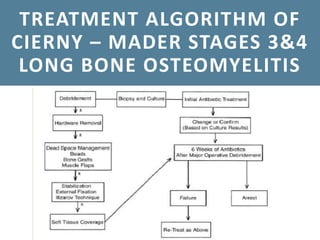
TREATMENT ALGORITHM OF
CIERNY – MADER STAGES 3&4
LONG BONE OSTEOMYELITIS
DIFFERENTIAL DIAGNOSIS
I. Rheumatic fever
Gradual, poly-joint swelling
II. Ewing’s sarcoma
Radiological signs
III. Acute suppurative arthritis
Muscle spasm more marked, limited movements, effusions
IV. Cellulitis
No intense pain
V. Erysipelas
Raised red margin
COMPLICATIONS
I. Epiphyseal damage and altered bone growth
II. Suppurative arthritis
III. Metastatic infection
IV. Pathological fracture
V. Chronic osteomyelitis

Acute Osteomyelitis

  • 1.
  • 2.
    INTRODUCTION  Infection ofbone and bone marrow  Can progress to osteonecrosis, bone destruction and septic arthritis  Bimodal age distribution:  Children under 5 years old  Adults over 50 years of age  Risk factors:  Recent trauma or surgery  Immunocompromised patients  Illicit IV drug use  Poor vascular supply  Systemic conditions such as diabetes and sickle cells  Peripheral neuropathy
  • 3.
    CLASSIFICATION I. Acute within 2weeks II. Subacute 2 – 6 weeks III. Chronic after 6 weeks Incidence of infection increases with increase in grade of open fracture:  Type I – II : 2%  Type III : 10 – 50% based on duration, mechanism, and host response DURAT I ON
  • 4.
    CLASSIFICATION I. Hematogenous  Originatedor transported by blood  Etiology of 20% of osteomyelitis  Vertebrae most common site; and metaphysis of long bone  S. aureus is most common organism II. Contiguous factor  Associated with previous surgery, trauma, wounds or poor vascularity  Can be bacterial (most common), mycobacterial or fungal in nature III. Direct inoculation  Penetrating injuries  Surgical contamination based on duration, mechanism, and host response MECHANI SM
  • 5.
    CLASSIFICATION based on duration,mechanism, and host response HOST RESPONSE SY S T E M I C LO C A L Malnutrition Vascular compromise Renal failure, hepatic failure Chronic lymphodema Diabetes Extensive scarring Autoimmune disease Radiation fibrosis Malignancy Neuropathy Extreme age Immunosuppression drugs Immunodeficiency Smoking
  • 6.
    CIERNY-MADER STAGING  MedullaryOM Infection confined to medullary cavity  Superficial OM Contiguous type of infection. Confined to surface of bone  Localized OM Full-thickness cortical sequestration which can easily be removed surgically  Diffuse OM Loss of bone stability, even after surgical debridement A N AT O M I C P H Y S I O L O G I C Stage I: Medullary A. Host, good systemic defense and local vascularity Stage II: Superficial B. Host, good systemic and local compromise Stage III: Localized C. Host, non-candidate for surgery with treatment more problematic than disease process Stage IV: Diffuse
  • 7.
    ORGANISM OST EOMYEL IT I S ORGANI SM TAB L E A G E G R O U P M O S T C O M M O N O R G A N I S M S Newborns (younger than 4 mo)  S. Aureus  Enterobacter species  Group A & B streptococcus species Children (aged 4 mo to 4 y)  S. Aureus  Group A streptococcus species  Kingella kingae  Enterobacter species Children, adolescents (aged 4 y to adult)  S. Aureus (80%)  Group A streptococcus species  H. Influenzae  Enterobacter species Adult  S. Aureus  Occasionally Enterobacter or  Streptococcus species Sickle Cell Anemia Patients  S. Aureus is typically most common  But Salmonella species is pathognomonic
  • 8.
    ACUTE OSTEOMYELITIS  Mainly adisease of children  Occurs after an episode of bacteremia  Trauma may determine the site of infection  Possibly by causing small haematoma of fluid collection in the bone  Most common organism in both children and adult is Staphyloccocus aureus (70%)
  • 9.
    PATHOPHYSIOLOGY  Affects metaphysealregion of long bones; femur (27%), tibia (22%), fibula (5%) more than upper extremity  Bacteremia is the common event in childhood, consequence of other infections such as otitis media, pharyngitis and sinusitis  Its presumed that bacteria gain access to metaphyseal location via nutrient arteries.
  • 10.
    PATHOPHYSIOLOGY  Staphylococcus aureus: Surface antigen plays key role in bacterial adherence to type 1 collagen and endotoxins that suppress local immune response  Glycocalyx: may form around bacteria and enhance adherence to other bacteria and metallic implants
  • 11.
    PATHOPHYSIOLOGY CAUSES OF METAPHYSEALOST EOMYL I T I S  Hair pin bend vessels  Increased vascularity causes pooling of blood also called as “lake of blood”  Immature cells in metaphysis due to high cell turnover  Relative lack of phagocytosis  Presence of degenerative cartilage cells  End arteries in metaphysis  Prone for trauma  Single endothelial lining in metaphyseal arteries
  • 12.
    PATHOPHYSIOLOGY CASCADE OF EVENTS Infective embolus enters nutrient artery trapped in vessels of small caliber Blocks vessels, area of bone become necrotic Active hyperemia in vicinity with infiltration of PMN cells which is poured as exudate Increased intraosseous pressure due to exudate and debris (intense pain)
  • 13.
    PATHOPHYSIOLOGY CASCADE OF EVENTS Vessels compressed, further necrosis occurs Exudate follow path of least resistance Gets accumulated in sub-periosteal spaces to form abscess and damage the blood supply If perforates, can spread to soft tissue
  • 14.
    PATHOPHYSIOLOGY SECOND ROUT EOF SPREAD OF I NF EC T I ON Exudate into medullary cavity destroying marrow elements, blood supply In advanced stages cortex may be surrounded by pus, depriving blood supply Diaphyseal sequestration T HI RD ROUT E OF SPREAD OF I NF EC T I ON Through the physis into joints
  • 15.
  • 16.
    CLINICAL FEATURE infant, childrenand adult I NFANT  Failure to thrive  Metaphyseal tenderness, restricted joint movement CHI L DREN  Fever (high grade)  Child refuse to use limb (pseudoparalysis)  Local redness, swelling, warmth, odema
  • 17.
    CLINICAL FEATURE infant, childrenand adult ADULT  Commonest site is thoracolumbar spine  History of urological procedure  Followed by mild fever and backache  Local tenderness
  • 18.
    PHYSICAL EXAMINATION  Illlooking  Increase temperature and pulse  Limb is held still  Local redness, swelling and warmth  Tenderness at near one of the larger joint  Restricted joint movement – pseudoparalysis  Edema  Lymphadenopathy
  • 19.
    INVESTIGATIONS  A physicalexamination may shows bone tenderness and possibly swelling and redness  Tests may include:  Blood cultures  Bone biopsy  Bone scan  Bone x-ray  Full blood count  C-reactive protein (CRP)  Erythrocyte sedimentation rate (ESR)  MRI of the bone  Needle aspiration of the area around affected bone
  • 20.
    INVESTIGATION B LOOD &F LUI D  Leukocytosis  Elevated CRP & ESR  Anti-staphylococcal antibody titre may be elevated  Positive fluid or tissue aspiration  Blood culture at the peak of fever may yield the causative organism X-RAY  Earliest abnormality detected after first week of the onset of symptom  Extra cortical outline (periosteal new bone formation at metaphysis)
  • 21.
    INVESTIGATION ULT RASONOGRAPHY  Maydetect a sub-periosteal collection of fluid in the early stages  But it cannot distinguish between hematoma or pus B ONE SCAN (RADI ONUCL I DE SCANNI NG)  Technetium – 99  Increased activity in both perfusion and bone phase  Highly sensitive investigation even in the very early stages
  • 22.
    INVESTIGATION MAGNET I CRESONANCE I MAGI NG (MRI )  Helpful in cases of doubtful diagnosis  Best method of demonstrating bone marrow inflammation
  • 23.
  • 24.
    TREATMENT I. Supportive treatmentfor pain and dehydration  Analgesic  IV fluid II. Splintage for comfort and prevent joint contracture III. Antibiotic therapy  Bactericidal drugs are important to: a. Stop the spread of infection to healthy bone b. Control acute flares  Oral therapy followed by IV route for 10 – 14 days  Antibiotics used in treating OM : a. Amoxicillin b. Ciprofloxacin plus clindamycin c. Levofloxacin plus clindamycin  Antibiotics is continued for another 6 weeks (min) but usually more than 6 months
  • 25.
    TREATMENT IV. Surgical drainage If antibiotics are given early (within first 48 hours) it is often unnecessary  But if clinical features do not improve within 36 hours of starting treatment, or even earlier and there is sign of deep pus, drainage is required  Debridement of infected tissues WHEN ANTIBIOTICS CAN BE STOPPED?  CLINICALLY : Signs of healing, reduction of pain, no fever, can walk, no discharging sinus  INFLAMMATORY PARAMETERS : normalizes  SERIAL X-RAY : bone healing, no new OM changes
  • 26.
    TREATMENT ALGORITHM OF CIERNY– MADER STAGES 3&4 LONG BONE OSTEOMYELITIS
  • 27.
    DIFFERENTIAL DIAGNOSIS I. Rheumaticfever Gradual, poly-joint swelling II. Ewing’s sarcoma Radiological signs III. Acute suppurative arthritis Muscle spasm more marked, limited movements, effusions IV. Cellulitis No intense pain V. Erysipelas Raised red margin
  • 28.
    COMPLICATIONS I. Epiphyseal damageand altered bone growth II. Suppurative arthritis III. Metastatic infection IV. Pathological fracture V. Chronic osteomyelitis