ACUTE EYE IRRITATION
OECD GUIDELINE 405
BY: PRIYA SHUKLA
SSR COLLEGE OF PHARMACY
DEPARTMENT PHARMACOLOGY
INTRODUCTION
• Acute Eye Irritation/Corrosion Guideline was
adopted in 1981 and updated in 1987, 2002,
and 2012.
• The latest article was updated on 9 october
2017.
• In previous reviews of this Test Guideline,
special attention was given to possible
improvements through the evaluation of all
existing information on the test substance in
order to avoid unnecessary testing in
laboratory animals and thereby address
animal welfare concerns.
• Testing in animals should only be conducted if
determined to be necessary after
consideration of available alternative
methods, and use of those determined tobe
appropriate.
• The latest update mainly focused on the use
of analgesics and anesthetics without
impacting the basic concept and structure of
the Test Guideline.
• The review concluded that the use of topical
anesthetics and systemic analgesics could
avoid most or all pain and distress without
affecting the outcome of the test, and
recommended that these substances should
always be used.
• Topical anesthetics, systemic analgesics, and
humane endpointsshould be routinely used
during acute eye irritation and corrosion in
vivotesting.Exceptions to their use should be
justified.
• The refinements described in this proposal will
substantially reduceor avoid animal pain and
distress in most testing situations
• Balanced preemptive pain management should
include
• (i) routine pretreatment with a topical anesthetic
(e.g., proparacaine or tetracaine) and a systemic
analgesic (e.g. buprenorphine),
• (ii)routine post-treatment schedule of systemic
analgesia (e.g., buprenorphine and meloxicam),
• (iii) scheduled observation, monitoring, and
recording of animals for clinical signs of pain
and/or distress, and
• (iv) scheduled observation, monitoring, and
recording of the nature, severity, and progression
of all eye injuries.
INITIAL CONSIDERATIONS
• For certain substances, such an analysis may
indicate the need for in vivo studies of the ocular
corrosion/irritation potential of the substance.
• In all such cases, before considering the use of
the in vivo eye test, preferably a study of the in
vitroand/or in vivo skin corrosion effects of the
substance should be conducted first and
evaluated in accordance with the sequential
testing strategy in Test Guideline 404
PRINCIPLE OF THE IN VIVO TEST
• Following pretreatment with a systemic
analgesic and induction of appropriate topical
anesthesia, the substance to be tested is
applied in a single dose to one of the eyes of
the experimental animal; the untreated eye
serves as the control.
• The degree of eye irritation/corrosion is
evaluated by scoring lesions of conjunctiva,
cornea, and iris, at specific intervals.
• Other effects in the eye and adverse systemic
effects are also described to provide a
complete evaluation of the effects. The
duration of the study should be sufficient to
evaluate the reversibility or irreversibility of
the effects.
PREPARATIONS FOR THE IN VIVO TEST
• 1. Selection of species :-
• The albino rabbit is the preferable laboratory
animal and healthy young adult animals are
used. A rationale for using other strains or
species should be provided.
2. Preparation of animals
• Both eyes of each experimental animal
provisionally selected for testing should be
examined within 24 hours before testing
starts. Animals showing eye irritation, ocular
defects, or pre-existing corneal injury should
not be used.
3. Housing and feeding conditions
• Animals should be individually housed.
• The temperature of the experimental animal
room should be 20°C (± 3°C) for rabbits.
• Although the relative humidity should be at
least 30% and preferably not exceed 70%,
other than during room cleaning, the aim
should be 50-60%.
• Lighting should be artificial, the sequence
being 12 hours light, 12 hours dark.
• Excessive light intensity should be avoided.
TEST PROCEDURE
Use of topical anesthetics and systemic
analgesics
• The following procedures are recommended
to avoid or minimize pain and distress in
ocular safety testing procedures.
1. Sixty minutes prior to test substance
application (TSA), buprenorphine 0.01 mg/kg
is administered by subcutaneous injection (SC)
to provide a therapeutic level of systemic
analgesia.
2. Buprenorphine and other similar opiod
analgesics administered systemically are not
known or expected to alter ocular responses
3. Five minutes prior to TSA, one or two drops of
a topical ocular anesthetic (e.g. 0.5%
proparacaine hydrochloride or 0.5% tetracaine
hydrochloride) are applied to each eye.
4. In order to avoid possible interference with
the study, a topical anesthetic that does not
contain preservatives is recommended.
5. The eye of each animal that is not treated
with a test article, but which is treated with
topical anesthetics, serves as a control.
6. If the test substance is anticipated to cause
significant pain and distress, it should not
normally be tested in vivo.
7.However, in case of doubt or where testing is
necessary, consideration should be given to
additional applications of the topical
anesthetic at 5-minute intervals prior to TSA.
8.Users should be aware that multiple
applications of topical anesthetics could
potentially cause a slight increase in the
severity and/or time required for chemically-
induced lesions to clear.
9. Eight hours after TSA, buprenorphine 0.01
mg/kg SC and meloxicam 0.5 mg/kg SC are
administered to provide a continued
therapeutic level of systemic analgesia.
10. While there are no data to suggest that
meloxicam has anti-inflammatory effects on
the eye when administered SC once daily,
meloxicam should not be administered until at
least 8 hours after TSA in order to avoid any
possible interference with the study
11. After the initial 8-hour post-TSA treatment,
buprenorphine 0.01 mg/kg SC should be
administered every 12 hours, in conjunction
with meloxicam 0.5 mg/kg SC every 24 hours,
until the ocular lesions resolve and no clinical
signs of pain and distress are present.
12. Sustained-release preparations of analgesics
are available that could be considered to
decrease the frequency of analgesic dosing.
13. “Rescue” analgesia should be given
immediately after TSA if pre-emptive
analgesia and topical anesthesia are
inadequate.
14. If an animal shows signs of pain and distress
during the study, a “rescue” dose of
buprenorphine 0.03 mg/kg SC would be given
immediately and repeated as often as every 8
hours, if necessary, instead of 0.01 mg/kg SC
every 12 hours.
15. Meloxicam 0.5 mg/kg SC would be
administered every 24 hours in conjunction
with the “rescue” dose of buprenorphine, but
not until at least 8 hours post-TSA.
Application of the test substance
• The test substance should be placed in the
conjunctival sac of one eye of each animal
after gently pulling the lower lid away from
the eyeball.
• The lids are then gently held together for
about one second in order to prevent loss of
the material. The other eye, which remains
untreated, serves as a control.
Irrigation
1. The eyes of the test animals should not be
washed for at least 24 hours following instillation
of the test substance, except for solids and in
case of immediate corrosive or irritating effects.
At 24 hours a washout may be used if considered
appropriate.
2. Use of a satellite group of animals to investigate
the influence of washing is not recommended
unless it is scientifically justified.
• If a satellite group is needed, two rabbits
should be used. Conditions of washing should
be carefully documented, e.g., time of
washing; composition and temperature of
wash solution; duration, volume, and velocity
of application.
Dose level
1. Testing of liquids :-
For testing liquids, a dose of 0.1 mL is used.
Pump sprays should not be used for instilling
the substance directly into the eye.
The liquid spray should be expelled and
collected in a container prior to instilling 0.1
mL into the eye.
(2) Testing of solids
• When testing solids, pastes, and particulate
substances, the amount used should have a
volume of 0.1 mL or a weight of not more
than 100 mg.
• The test material should be ground to a fine
dust.
• The volume of solid material should be
measured after gently compacting it, e.g. by
tapping the measuring container.
• If the solid test substance has not been
removed from the eye of the test animal by
physiological mechanisms at the first
observation time point of 1 hour after
treatment, the eye may be rinsed with saline
or distilled water.
(3) Testing of aerosols
• It is recommended that all pump sprays and
aerosols be collected prior to instillation into
the eye.
• The one exception is for substances in
pressurised aerosol containers, which cannot
be collected due to vaporisation.
• In such cases, the eye should be held open,
and the test substance administered to the
eye in a simple burst of about one second,
from a distance of 10 cm directly in front of
the eye.
• This distance may vary depending on the
pressure of the spray and its contents. Care
should be taken not to damage the eye from
the pressure of the spray.
• In appropriate cases, there may be a need to
evaluate the potential for “mechanical”
damage to the eye from the force of the spray.
• An estimate of the dose from an aerosol can
be made by simulating the test as follows: the
substance is sprayed on to weighing paper
through an opening the size of a rabbit eye
placed directly before the paper.
• The weight increase of the paper is used to
approximate the amount sprayed into the eye.
• For volatile substances, the dose may be
estimated by weighing a receiving container
before and after removal of the test material.
Initial test (in vivo eye
irritation/corrosion test using one
animal)
• It is strongly recommended that the in vivo
test be performed initially using one animal
• Observations should allow for determination
of severity and reversibility before proceeding
to a confirmatory test in a second animal.
• If the results of this test indicate the
substance to be corrosive or a severe irritant
to the eye using the procedure described,
further testing for ocular irritancy should not
be performed.
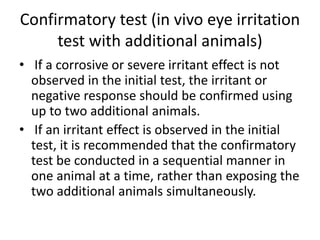
Confirmatory test (in vivo eye irritation
test with additional animals)
• If a corrosive or severe irritant effect is not
observed in the initial test, the irritant or
negative response should be confirmed using
up to two additional animals.
• If an irritant effect is observed in the initial
test, it is recommended that the confirmatory
test be conducted in a sequential manner in
one animal at a time, rather than exposing the
two additional animals simultaneously.
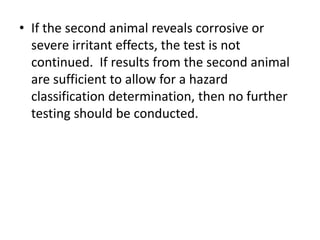
• If the second animal reveals corrosive or
severe irritant effects, the test is not
continued. If results from the second animal
are sufficient to allow for a hazard
classification determination, then no further
testing should be conducted.
Observation period
• The duration of the observation period
should be sufficient to evaluate fully the
magnitude and reversibility of the effects
observed.
• However, the experiment should be
terminated at any time that the animal shows
signs of severe pain or distress
• To determine reversibility of effects, the
animals should be observed normally for 21
days post administration of the test substance.
If reversibility is seen before 21 days, the
experiment should be terminated at that time.
Clinical observations and grading of
eye reactions
• The eyes should be comprehensively
evaluated for the presence or absence of
ocular lesions one hour post-TSA, followed by
at least daily evaluations.
• Animals should be evaluated several times
daily for the first 3 days to ensure that
termination decisions are made in a timely
manner.
• Test animals should be routinely evaluated for
the entire duration of the study for clinical
signs of pain and/or distress (e.g. repeated
pawing or rubbing of the eye, excessive
blinking, excessive tearing) at least twice daily,
with a minimum of 6 hours between
observations, or more often if necessary.
• This is necessary to:
(i) adequately assess animals for evidence of
pain and distress in order to make informed
decisions on the need to increase the dosage
of analgesics and
(ii) assess animals for evidence of established
humane endpoints in order to make informed
decisions on whether it is appropriate to
humanely euthanize animals, and to ensure
that such decisions are made in a timely
manner.
• Digital photographs of observed lesions may
be collected for reference and to provide a
permanent record of the extent of ocular
damage.
• Animals should be kept on test no longer than
necessary once definitive information has
been obtained. Animals showing severe pain
or distress should be humanely killed without
delay, and the substance assessed accordingly.
• Animals with the following eye lesions post-
instillation should be humanely killed
• corneal perforation or significant corneal
ulceration including staphyloma; blood in the
anterior chamber of the eye; grade 4 corneal
opacity; absence of a light reflex which
persists for 72 hours; ulceration of the
conjunctival membrane; necrosis of the
conjunctivae or nictitating membrane; or
sloughing.
• This is because such lesions generally are not
reversible.
• Furthermore, it is recommended that the
following ocular lesions be used as humane
endpoints to terminate studies before the end
of the scheduled 21-day observation period.
• Once severe ocular effects have been
identified, an attending or qualified laboratory
animal veterinarian or personnel trained to
identify the clinical lesions should be
consulted for a clinical examination to
determine if the combination of these effects
warrants early study termination.
• The grades of ocular reaction (conjunctivae,
cornea and iris) should be obtained and
recorded at 1, 24, 48, and 72 hours following
test substance application.
• Animals that do not develop ocular lesions
may be terminated not earlier than 3 days
post instillation. Animals with ocular lesions
that are not severe should be observed until
the lesions clear, or for 21 days, at which time
the study is terminated.
• Observations should be performed and
recorded at a minimum of 1 hour, 24 hours, 48
hours, 72 hours, 7 days, 14 days, and 21 days
in order to determine the status of the lesions,
and their reversibility or irreversibility.
• More frequent observations should be
performed if necessary in order to determine
whether the test animal should be euthanized
out of humane considerations or removed
from the study due to negative results
• Examination of reactions can be facilitated by
use of a binocular loupe, hand slit-lamp,
biomicroscope, or other suitable device. After
recording the observations at 24 hours, the
eyes may be further examined with the aid of
fluorescein.
DATA AND REPORTING
1. Evaluation of results
• The ocular irritation scores should be
evaluated in conjunction with the nature and
severity of lesions, and their reversibility or
lack of reversibility.
• The individual scores do not represent an
absolute standard for the irritant properties of
a material, as other effects of the test material
are also evaluated.
• Instead, individual scores should be viewed as
reference values and are only meaningful
when supported by a full description and
evaluation of all observations.
Test report
• The test report should include the following
information:
1. description of relevant data available from
prior testing
2. data derived in each step of testing strategy
3. description of in vitro tests performed,
including details of procedures, results
obtained with test/reference substances
4. description of in vivo dermal irritation /
corrosion study performed, including results
obtained
5. weight-of-the-evidence analysis for
performing in vivo study
Test substance:
1. identification data (e.g. chemical name and if
available CAS number, purity, known
impurities, source, lot number)
2. physical nature and physicochemical
properties (e.g. pH, volatility, solubility,
stability, reactivity with water)
3. in case of a mixture, components should be
identified including identification data of the
constituent substances (e.g. chemical names
and if available CAS numbers) and their
concentration
4. dose applied
Vehicle
1. identification, concentration (where
appropriate), volume used
2. justification for choice of vehicle.
Test animals:
1. species/strain used, rationale for using
animals other than albino rabbit
2. age of each animal at start of study
3. number of animals of each sex in test and
control groups (if required)
4. individual animal weights at start and
conclusion of test
5. source, housing conditions, diet
Anaesthetics and analgesics
1. doses and times when topical anaesthetics
and systemic analgesics were administered
2. if local anaesthetic is used, identification,
purity, type, and potential interaction with
test substance.
Results:
1. description of method used to score irritation
at each observation time (e.g., hand slitlamp,
biomicroscope, fluorescein)
2. tabulation of irritant/corrosive response data
for each animal at each observation time up
to removal of each animal from the test
3. narrative description of the degree and
nature of irritation or corrosion observed
4. description of any other lesions observed in
the eye (e.g., vascularization, pannus
formation, adhesions, staining)
5. description of non-ocular local and systemic
adverse effects, record of clinical signs of pain
and distress, digital photographs, and
histopathological findings, if any.
Interpretation of the results
• Extrapolation of the results of eye irritation
studies in laboratory animals to humans is
valid only to a limited degree. In many cases
the albino rabbit is more sensitive than
humans to ocular irritants or corrosives.
• Care should be taken in the interpretation of
data to exclude irritation resulting from
secondary infection.
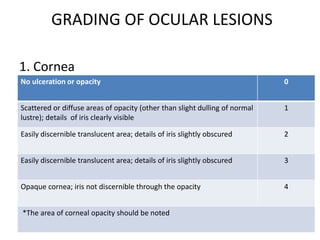
GRADING OF OCULAR LESIONS
1. Cornea
No ulceration or opacity 0
Scattered or diffuse areas of opacity (other than slight dulling of normal
lustre); details of iris clearly visible
1
Easily discernible translucent area; details of iris slightly obscured 2
Easily discernible translucent area; details of iris slightly obscured 3
Opaque cornea; iris not discernible through the opacity 4
*The area of corneal opacity should be noted
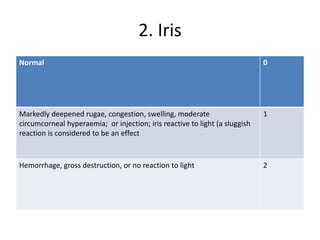
2. Iris
Normal 0
Markedly deepened rugae, congestion, swelling, moderate
circumcorneal hyperaemia; or injection; iris reactive to light (a sluggish
reaction is considered to be an effect
1
Hemorrhage, gross destruction, or no reaction to light 2
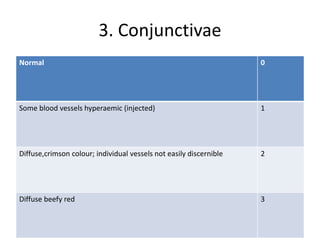
3. Conjunctivae
Normal 0
Some blood vessels hyperaemic (injected) 1
Diffuse,crimson colour; individual vessels not easily discernible 2
Diffuse beefy red 3
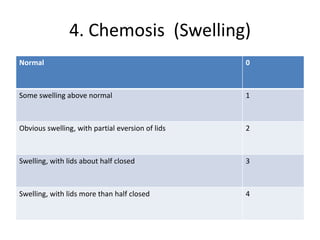
4. Chemosis (Swelling)
Normal 0
Some swelling above normal 1
Obvious swelling, with partial eversion of lids 2
Swelling, with lids about half closed 3
Swelling, with lids more than half closed 4
Acute eye irritation oecd

Acute eye irritation oecd

  • 1.
    ACUTE EYE IRRITATION OECDGUIDELINE 405 BY: PRIYA SHUKLA SSR COLLEGE OF PHARMACY DEPARTMENT PHARMACOLOGY
  • 2.
    INTRODUCTION • Acute EyeIrritation/Corrosion Guideline was adopted in 1981 and updated in 1987, 2002, and 2012. • The latest article was updated on 9 october 2017.
  • 3.
    • In previousreviews of this Test Guideline, special attention was given to possible improvements through the evaluation of all existing information on the test substance in order to avoid unnecessary testing in laboratory animals and thereby address animal welfare concerns.
  • 4.
    • Testing inanimals should only be conducted if determined to be necessary after consideration of available alternative methods, and use of those determined tobe appropriate. • The latest update mainly focused on the use of analgesics and anesthetics without impacting the basic concept and structure of the Test Guideline.
  • 5.
    • The reviewconcluded that the use of topical anesthetics and systemic analgesics could avoid most or all pain and distress without affecting the outcome of the test, and recommended that these substances should always be used.
  • 6.
    • Topical anesthetics,systemic analgesics, and humane endpointsshould be routinely used during acute eye irritation and corrosion in vivotesting.Exceptions to their use should be justified. • The refinements described in this proposal will substantially reduceor avoid animal pain and distress in most testing situations
  • 7.
    • Balanced preemptivepain management should include • (i) routine pretreatment with a topical anesthetic (e.g., proparacaine or tetracaine) and a systemic analgesic (e.g. buprenorphine), • (ii)routine post-treatment schedule of systemic analgesia (e.g., buprenorphine and meloxicam), • (iii) scheduled observation, monitoring, and recording of animals for clinical signs of pain and/or distress, and • (iv) scheduled observation, monitoring, and recording of the nature, severity, and progression of all eye injuries.
  • 8.
    INITIAL CONSIDERATIONS • Forcertain substances, such an analysis may indicate the need for in vivo studies of the ocular corrosion/irritation potential of the substance. • In all such cases, before considering the use of the in vivo eye test, preferably a study of the in vitroand/or in vivo skin corrosion effects of the substance should be conducted first and evaluated in accordance with the sequential testing strategy in Test Guideline 404
  • 9.
    PRINCIPLE OF THEIN VIVO TEST • Following pretreatment with a systemic analgesic and induction of appropriate topical anesthesia, the substance to be tested is applied in a single dose to one of the eyes of the experimental animal; the untreated eye serves as the control. • The degree of eye irritation/corrosion is evaluated by scoring lesions of conjunctiva, cornea, and iris, at specific intervals.
  • 10.
    • Other effectsin the eye and adverse systemic effects are also described to provide a complete evaluation of the effects. The duration of the study should be sufficient to evaluate the reversibility or irreversibility of the effects.
  • 11.
    PREPARATIONS FOR THEIN VIVO TEST • 1. Selection of species :- • The albino rabbit is the preferable laboratory animal and healthy young adult animals are used. A rationale for using other strains or species should be provided.
  • 12.
    2. Preparation ofanimals • Both eyes of each experimental animal provisionally selected for testing should be examined within 24 hours before testing starts. Animals showing eye irritation, ocular defects, or pre-existing corneal injury should not be used.
  • 13.
    3. Housing andfeeding conditions • Animals should be individually housed. • The temperature of the experimental animal room should be 20°C (± 3°C) for rabbits. • Although the relative humidity should be at least 30% and preferably not exceed 70%, other than during room cleaning, the aim should be 50-60%.
  • 14.
    • Lighting shouldbe artificial, the sequence being 12 hours light, 12 hours dark. • Excessive light intensity should be avoided.
  • 15.
    TEST PROCEDURE Use oftopical anesthetics and systemic analgesics • The following procedures are recommended to avoid or minimize pain and distress in ocular safety testing procedures. 1. Sixty minutes prior to test substance application (TSA), buprenorphine 0.01 mg/kg is administered by subcutaneous injection (SC) to provide a therapeutic level of systemic analgesia.
  • 16.
    2. Buprenorphine andother similar opiod analgesics administered systemically are not known or expected to alter ocular responses 3. Five minutes prior to TSA, one or two drops of a topical ocular anesthetic (e.g. 0.5% proparacaine hydrochloride or 0.5% tetracaine hydrochloride) are applied to each eye.
  • 17.
    4. In orderto avoid possible interference with the study, a topical anesthetic that does not contain preservatives is recommended. 5. The eye of each animal that is not treated with a test article, but which is treated with topical anesthetics, serves as a control. 6. If the test substance is anticipated to cause significant pain and distress, it should not normally be tested in vivo.
  • 18.
    7.However, in caseof doubt or where testing is necessary, consideration should be given to additional applications of the topical anesthetic at 5-minute intervals prior to TSA. 8.Users should be aware that multiple applications of topical anesthetics could potentially cause a slight increase in the severity and/or time required for chemically- induced lesions to clear.
  • 19.
    9. Eight hoursafter TSA, buprenorphine 0.01 mg/kg SC and meloxicam 0.5 mg/kg SC are administered to provide a continued therapeutic level of systemic analgesia. 10. While there are no data to suggest that meloxicam has anti-inflammatory effects on the eye when administered SC once daily, meloxicam should not be administered until at least 8 hours after TSA in order to avoid any possible interference with the study
  • 20.
    11. After theinitial 8-hour post-TSA treatment, buprenorphine 0.01 mg/kg SC should be administered every 12 hours, in conjunction with meloxicam 0.5 mg/kg SC every 24 hours, until the ocular lesions resolve and no clinical signs of pain and distress are present.
  • 21.
    12. Sustained-release preparationsof analgesics are available that could be considered to decrease the frequency of analgesic dosing. 13. “Rescue” analgesia should be given immediately after TSA if pre-emptive analgesia and topical anesthesia are inadequate.
  • 22.
    14. If ananimal shows signs of pain and distress during the study, a “rescue” dose of buprenorphine 0.03 mg/kg SC would be given immediately and repeated as often as every 8 hours, if necessary, instead of 0.01 mg/kg SC every 12 hours. 15. Meloxicam 0.5 mg/kg SC would be administered every 24 hours in conjunction with the “rescue” dose of buprenorphine, but not until at least 8 hours post-TSA.
  • 23.
    Application of thetest substance • The test substance should be placed in the conjunctival sac of one eye of each animal after gently pulling the lower lid away from the eyeball. • The lids are then gently held together for about one second in order to prevent loss of the material. The other eye, which remains untreated, serves as a control.
  • 24.
    Irrigation 1. The eyesof the test animals should not be washed for at least 24 hours following instillation of the test substance, except for solids and in case of immediate corrosive or irritating effects. At 24 hours a washout may be used if considered appropriate. 2. Use of a satellite group of animals to investigate the influence of washing is not recommended unless it is scientifically justified.
  • 25.
    • If asatellite group is needed, two rabbits should be used. Conditions of washing should be carefully documented, e.g., time of washing; composition and temperature of wash solution; duration, volume, and velocity of application.
  • 26.
    Dose level 1. Testingof liquids :- For testing liquids, a dose of 0.1 mL is used. Pump sprays should not be used for instilling the substance directly into the eye. The liquid spray should be expelled and collected in a container prior to instilling 0.1 mL into the eye.
  • 27.
    (2) Testing ofsolids • When testing solids, pastes, and particulate substances, the amount used should have a volume of 0.1 mL or a weight of not more than 100 mg. • The test material should be ground to a fine dust.
  • 28.
    • The volumeof solid material should be measured after gently compacting it, e.g. by tapping the measuring container. • If the solid test substance has not been removed from the eye of the test animal by physiological mechanisms at the first observation time point of 1 hour after treatment, the eye may be rinsed with saline or distilled water.
  • 29.
    (3) Testing ofaerosols • It is recommended that all pump sprays and aerosols be collected prior to instillation into the eye. • The one exception is for substances in pressurised aerosol containers, which cannot be collected due to vaporisation.
  • 30.
    • In suchcases, the eye should be held open, and the test substance administered to the eye in a simple burst of about one second, from a distance of 10 cm directly in front of the eye. • This distance may vary depending on the pressure of the spray and its contents. Care should be taken not to damage the eye from the pressure of the spray.
  • 31.
    • In appropriatecases, there may be a need to evaluate the potential for “mechanical” damage to the eye from the force of the spray. • An estimate of the dose from an aerosol can be made by simulating the test as follows: the substance is sprayed on to weighing paper through an opening the size of a rabbit eye placed directly before the paper.
  • 32.
    • The weightincrease of the paper is used to approximate the amount sprayed into the eye. • For volatile substances, the dose may be estimated by weighing a receiving container before and after removal of the test material.
  • 33.
    Initial test (invivo eye irritation/corrosion test using one animal) • It is strongly recommended that the in vivo test be performed initially using one animal • Observations should allow for determination of severity and reversibility before proceeding to a confirmatory test in a second animal. • If the results of this test indicate the substance to be corrosive or a severe irritant to the eye using the procedure described, further testing for ocular irritancy should not be performed.
  • 34.
    Confirmatory test (invivo eye irritation test with additional animals) • If a corrosive or severe irritant effect is not observed in the initial test, the irritant or negative response should be confirmed using up to two additional animals. • If an irritant effect is observed in the initial test, it is recommended that the confirmatory test be conducted in a sequential manner in one animal at a time, rather than exposing the two additional animals simultaneously.
  • 35.
    • If thesecond animal reveals corrosive or severe irritant effects, the test is not continued. If results from the second animal are sufficient to allow for a hazard classification determination, then no further testing should be conducted.
  • 36.
    Observation period • Theduration of the observation period should be sufficient to evaluate fully the magnitude and reversibility of the effects observed. • However, the experiment should be terminated at any time that the animal shows signs of severe pain or distress
  • 37.
    • To determinereversibility of effects, the animals should be observed normally for 21 days post administration of the test substance. If reversibility is seen before 21 days, the experiment should be terminated at that time.
  • 38.
    Clinical observations andgrading of eye reactions • The eyes should be comprehensively evaluated for the presence or absence of ocular lesions one hour post-TSA, followed by at least daily evaluations. • Animals should be evaluated several times daily for the first 3 days to ensure that termination decisions are made in a timely manner.
  • 39.
    • Test animalsshould be routinely evaluated for the entire duration of the study for clinical signs of pain and/or distress (e.g. repeated pawing or rubbing of the eye, excessive blinking, excessive tearing) at least twice daily, with a minimum of 6 hours between observations, or more often if necessary.
  • 40.
    • This isnecessary to: (i) adequately assess animals for evidence of pain and distress in order to make informed decisions on the need to increase the dosage of analgesics and
  • 41.
    (ii) assess animalsfor evidence of established humane endpoints in order to make informed decisions on whether it is appropriate to humanely euthanize animals, and to ensure that such decisions are made in a timely manner.
  • 42.
    • Digital photographsof observed lesions may be collected for reference and to provide a permanent record of the extent of ocular damage. • Animals should be kept on test no longer than necessary once definitive information has been obtained. Animals showing severe pain or distress should be humanely killed without delay, and the substance assessed accordingly.
  • 43.
    • Animals withthe following eye lesions post- instillation should be humanely killed • corneal perforation or significant corneal ulceration including staphyloma; blood in the anterior chamber of the eye; grade 4 corneal opacity; absence of a light reflex which persists for 72 hours; ulceration of the conjunctival membrane; necrosis of the conjunctivae or nictitating membrane; or sloughing.
  • 44.
    • This isbecause such lesions generally are not reversible. • Furthermore, it is recommended that the following ocular lesions be used as humane endpoints to terminate studies before the end of the scheduled 21-day observation period.
  • 45.
    • Once severeocular effects have been identified, an attending or qualified laboratory animal veterinarian or personnel trained to identify the clinical lesions should be consulted for a clinical examination to determine if the combination of these effects warrants early study termination.
  • 46.
    • The gradesof ocular reaction (conjunctivae, cornea and iris) should be obtained and recorded at 1, 24, 48, and 72 hours following test substance application. • Animals that do not develop ocular lesions may be terminated not earlier than 3 days post instillation. Animals with ocular lesions that are not severe should be observed until the lesions clear, or for 21 days, at which time the study is terminated.
  • 47.
    • Observations shouldbe performed and recorded at a minimum of 1 hour, 24 hours, 48 hours, 72 hours, 7 days, 14 days, and 21 days in order to determine the status of the lesions, and their reversibility or irreversibility. • More frequent observations should be performed if necessary in order to determine whether the test animal should be euthanized out of humane considerations or removed from the study due to negative results
  • 48.
    • Examination ofreactions can be facilitated by use of a binocular loupe, hand slit-lamp, biomicroscope, or other suitable device. After recording the observations at 24 hours, the eyes may be further examined with the aid of fluorescein.
  • 49.
    DATA AND REPORTING 1.Evaluation of results • The ocular irritation scores should be evaluated in conjunction with the nature and severity of lesions, and their reversibility or lack of reversibility. • The individual scores do not represent an absolute standard for the irritant properties of a material, as other effects of the test material are also evaluated.
  • 50.
    • Instead, individualscores should be viewed as reference values and are only meaningful when supported by a full description and evaluation of all observations.
  • 51.
    Test report • Thetest report should include the following information: 1. description of relevant data available from prior testing 2. data derived in each step of testing strategy 3. description of in vitro tests performed, including details of procedures, results obtained with test/reference substances
  • 52.
    4. description ofin vivo dermal irritation / corrosion study performed, including results obtained 5. weight-of-the-evidence analysis for performing in vivo study
  • 53.
    Test substance: 1. identificationdata (e.g. chemical name and if available CAS number, purity, known impurities, source, lot number) 2. physical nature and physicochemical properties (e.g. pH, volatility, solubility, stability, reactivity with water)
  • 54.
    3. in caseof a mixture, components should be identified including identification data of the constituent substances (e.g. chemical names and if available CAS numbers) and their concentration 4. dose applied
  • 55.
    Vehicle 1. identification, concentration(where appropriate), volume used 2. justification for choice of vehicle.
  • 56.
    Test animals: 1. species/strainused, rationale for using animals other than albino rabbit 2. age of each animal at start of study 3. number of animals of each sex in test and control groups (if required) 4. individual animal weights at start and conclusion of test 5. source, housing conditions, diet
  • 57.
    Anaesthetics and analgesics 1.doses and times when topical anaesthetics and systemic analgesics were administered 2. if local anaesthetic is used, identification, purity, type, and potential interaction with test substance.
  • 58.
    Results: 1. description ofmethod used to score irritation at each observation time (e.g., hand slitlamp, biomicroscope, fluorescein) 2. tabulation of irritant/corrosive response data for each animal at each observation time up to removal of each animal from the test
  • 59.
    3. narrative descriptionof the degree and nature of irritation or corrosion observed 4. description of any other lesions observed in the eye (e.g., vascularization, pannus formation, adhesions, staining) 5. description of non-ocular local and systemic adverse effects, record of clinical signs of pain and distress, digital photographs, and histopathological findings, if any.
  • 60.
    Interpretation of theresults • Extrapolation of the results of eye irritation studies in laboratory animals to humans is valid only to a limited degree. In many cases the albino rabbit is more sensitive than humans to ocular irritants or corrosives. • Care should be taken in the interpretation of data to exclude irritation resulting from secondary infection.
  • 61.
    GRADING OF OCULARLESIONS 1. Cornea No ulceration or opacity 0 Scattered or diffuse areas of opacity (other than slight dulling of normal lustre); details of iris clearly visible 1 Easily discernible translucent area; details of iris slightly obscured 2 Easily discernible translucent area; details of iris slightly obscured 3 Opaque cornea; iris not discernible through the opacity 4 *The area of corneal opacity should be noted
  • 62.
    2. Iris Normal 0 Markedlydeepened rugae, congestion, swelling, moderate circumcorneal hyperaemia; or injection; iris reactive to light (a sluggish reaction is considered to be an effect 1 Hemorrhage, gross destruction, or no reaction to light 2
  • 63.
    3. Conjunctivae Normal 0 Someblood vessels hyperaemic (injected) 1 Diffuse,crimson colour; individual vessels not easily discernible 2 Diffuse beefy red 3
  • 64.
    4. Chemosis (Swelling) Normal0 Some swelling above normal 1 Obvious swelling, with partial eversion of lids 2 Swelling, with lids about half closed 3 Swelling, with lids more than half closed 4