OECD GUIDELINE FOR ACUTE
EYE IRRITATION (405)
PRESENTED BY : SEJAL AGRAWAL
CONTENT :
 Introduction of toxicity
 OECD guideline for toxicity studies
 Acute eye irritation
 Principle
 Initial test of acute eye irritation
 Conformational test of acute eye irritation
 Observational
 Conclusion
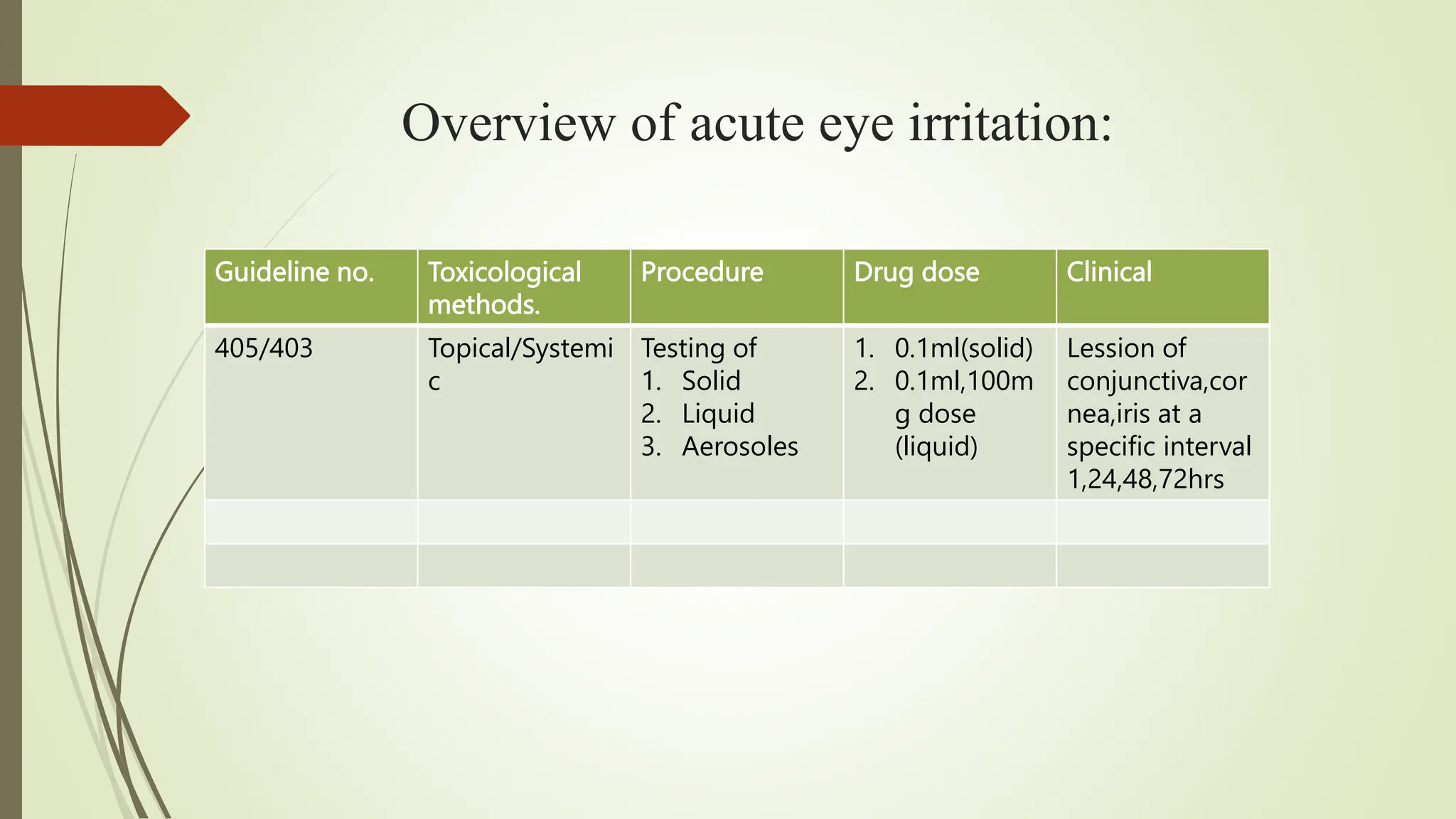
Overview of acute eye irritation:
Guideline no. Toxicological
methods.
Procedure Drug dose Clinical
405/403 Topical/Systemi
c
Testing of
1. Solid
2. Liquid
3. Aerosoles
1. 0.1ml(solid)
2. 0.1ml,100m
g dose
(liquid)
Lession of
conjunctiva,cor
nea,iris at a
specific interval
1,24,48,72hrs
Introduction:
 TOXICITY : Toxicity is the science dealing with properties, action, toxicity, fatal dose
detection or interpretation of result of toxicological analysis and treatment of poison.
 The poison is any substances which causing harmful effect to the body. The drug also a
poison if not given in proper concentration OR The poison is a drug if given in appropriate
concentration.
INTRODUCTION :
ACUTE EYE IRRITATION
1. IRRITATION:
 In biology and physiology, is a state of inflammation or painful reaction to allergy or cell-
lining damage.
2. IRRITANT:
 A stimulus or agent which induces the state of irritation is an irritant.
CAUSES OF IRRITATION :
Due to chemical agent
 Mechanical
 Chemical
 Radiation
 Irritation can also be induced by some allergic response due to exposure of some
allergens for example contact dermatitis, irritation of mucosal membranes and
pruritus(itching).
 The eye is also a source of chronic irritation , disorders like Sjogren syndrome, where
one dose not make tears, can cause a dry eye sensation which feels very unpleasant.
 Blepharitis is dryness and itching on the upper eyelids.
Acute eye irritation /corrosion-405
 OECD guideline for testing of chemical are periodically reviewed to ensure that they
reflect the best available science .
 In previous reviews of this Test Guideline (TG), special attention was given to possible
improvements through the evaluation of all existing information on the test chemical in
order to avoid unnecessary testing in laboratory animals and thereby address animal
welfare concerns.
 This updated version of TG 405 (originally adopted in 1981 and updated in 1987, 2002,
2012, 2020 and 2021)
 Integrated Approaches to Testing and Assessment (IATA) for Serious Eye Damage and Eye
Irritation (1), proposing a modular approach for eye irritation and serious eye damage
testing
 The IATA describes several modules which group information sources and analysis tools, and (I)
provides guidance on how to integrate and use existing testing and non testing data for the
assessment of the eye irritation and serious eye damage potentials of chemicals and (ii) proposes
an approach when further testing is needed
 ICCVAM and an independent international scientific peer reviewed the usefulness and limitation
of routinely using topical anesthetics .
 Interagency coordinating committee on the validation of alternative methods.
Balanced preemptive pain management should
include:
 Routine pre treatment with a topical anesthetics.
 Routine post-treatment schedule of systemic analgesia.
 Scheduled observation, monitoring, and recording of the nature, severity, and progression
of all eye injuries.
Initial considerations
 For certain substances, such an analysis may indicated the need for in vivo studies of the
ocular corrosion/irritation potential of the substances.
 In all such cases, before consideration the use of the in vivo eye test, preferably a study of
the in vitro or in vivo skin corrosion effects of the substance should be conducted first and
evaluated in accordance with the sequential testing strategy in Test Guideline 405.
PRINCIPLE
 Following pretreatment with a systemic analgesic and instillation of appropriate topical anesthesia,
the test chemical is applied in a single dose to one of the eyes of the experimental animal; the
untreated eye serves as the control.
 The degree of eye irritation/serious eye damage is evaluated by scoring lesions of conjunctiva,
cornea, and iris, at specific intervals
 The duration of the study should be sufficient to evaluate the reversibility or irreversibility of the
effects.
 Animals showing signs of severe distress or pain at any stage of the test or lesions consistent with
the humane endpoints. should be humanely killed, and the test chemical assessed accordingly
without performing further testing with more animals.
 Criteria for making the decision to humanely kill moribund and severely suffering animals are the
subject of a separate guidance document.
PREPARATION FOR THE IN VIVO TEST:
 Selection of species
 The albino rabbit is the preferable laboratory animal and healthy young adult animals are used.
 A rationale for using other strains or species should be provided of weight 1.5kg to 3kg.
 Preparation of animals
 Both eyes of each experimental animal provisionally selected for testing should be examined within
 24 hours before testing starts. Animals showing eye irritation, ocular defects, or pre-existing corneal
injury should not be used.
 Housing and feeding conditions
 Animals should be individually housed. The temperature of the experimental animal room should be
20°C (± 3°C) for rabbits.
 Although the relative humidity should be at least 30% and preferably not exceed 70%, other than during
room cleaning, the aim should be 50-60%.
 Lighting should be artificial, the sequence being 12 hours light, 12 hours dark. Excessive light intensity
should be avoided.
 For feeding, conventional laboratory diets may be used with an unrestricted supply of drinking water.
PROCEDURE
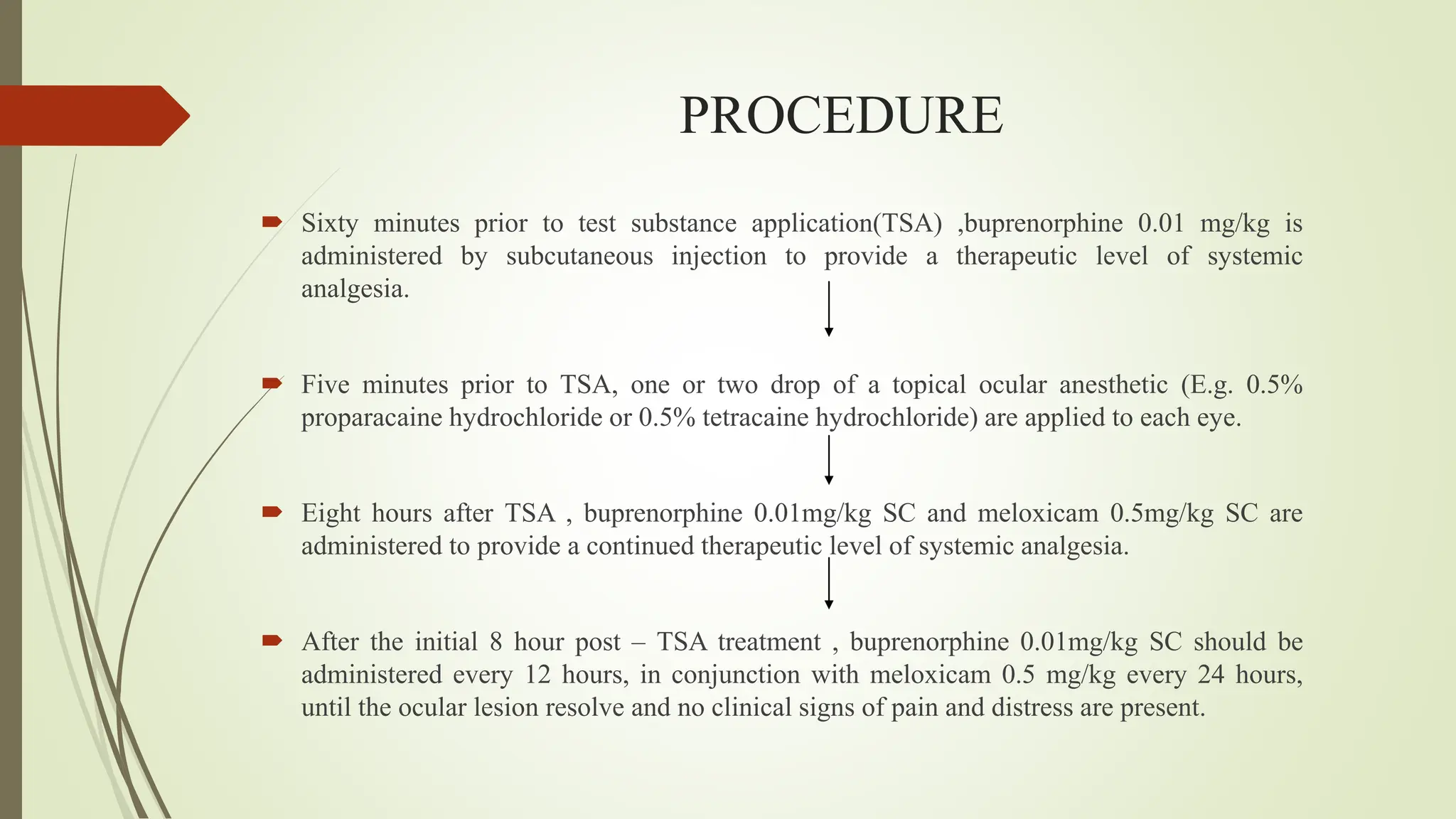
 Sixty minutes prior to test substance application(TSA) ,buprenorphine 0.01 mg/kg is
administered by subcutaneous injection to provide a therapeutic level of systemic
analgesia.
 Five minutes prior to TSA, one or two drop of a topical ocular anesthetic (E.g. 0.5%
proparacaine hydrochloride or 0.5% tetracaine hydrochloride) are applied to each eye.
 Eight hours after TSA , buprenorphine 0.01mg/kg SC and meloxicam 0.5mg/kg SC are
administered to provide a continued therapeutic level of systemic analgesia.
 After the initial 8 hour post – TSA treatment , buprenorphine 0.01mg/kg SC should be
administered every 12 hours, in conjunction with meloxicam 0.5 mg/kg every 24 hours,
until the ocular lesion resolve and no clinical signs of pain and distress are present.
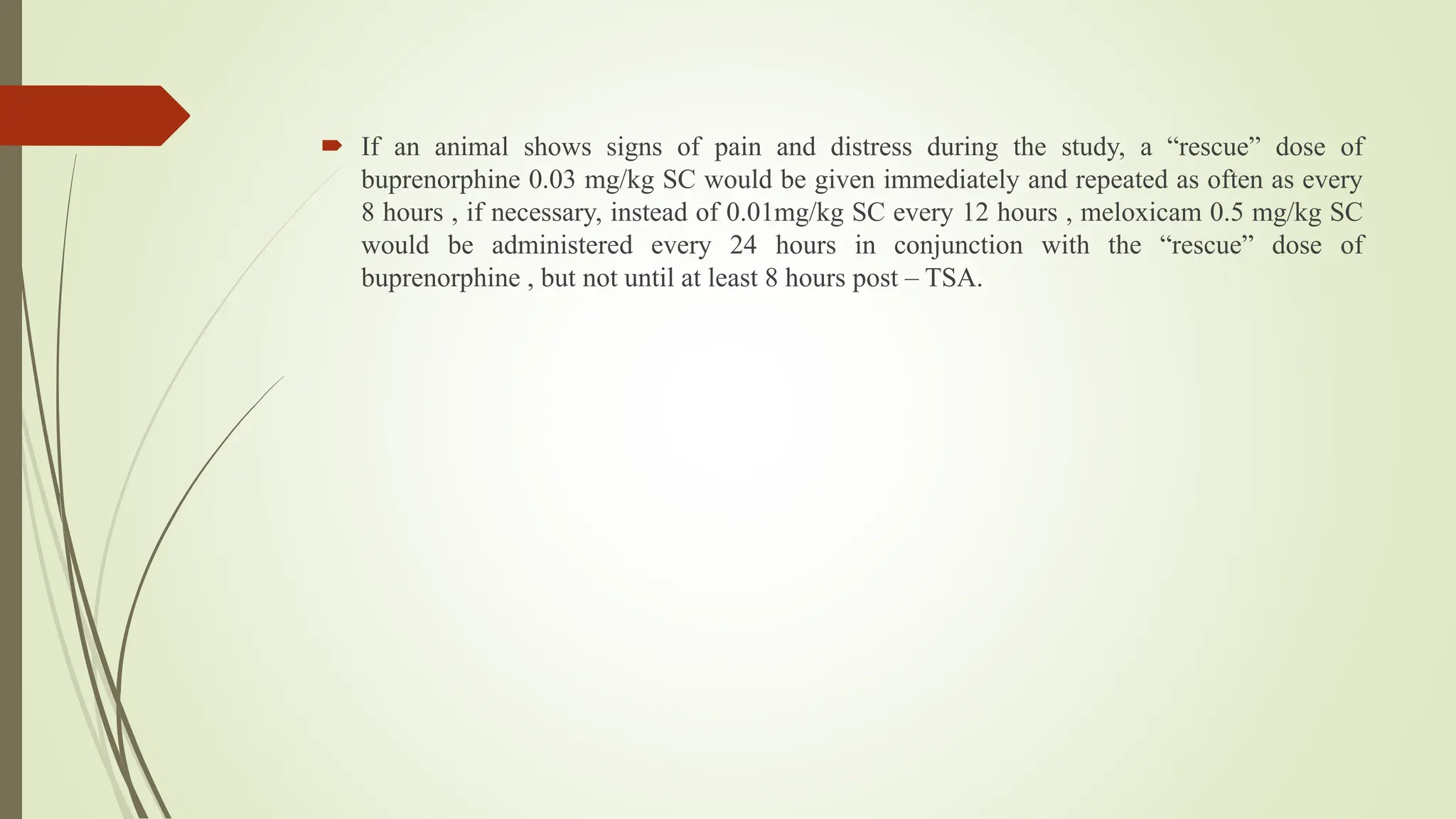
 If an animal shows signs of pain and distress during the study, a “rescue” dose of
buprenorphine 0.03 mg/kg SC would be given immediately and repeated as often as every
8 hours , if necessary, instead of 0.01mg/kg SC every 12 hours , meloxicam 0.5 mg/kg SC
would be administered every 24 hours in conjunction with the “rescue” dose of
buprenorphine , but not until at least 8 hours post – TSA.
Application of the test substance:
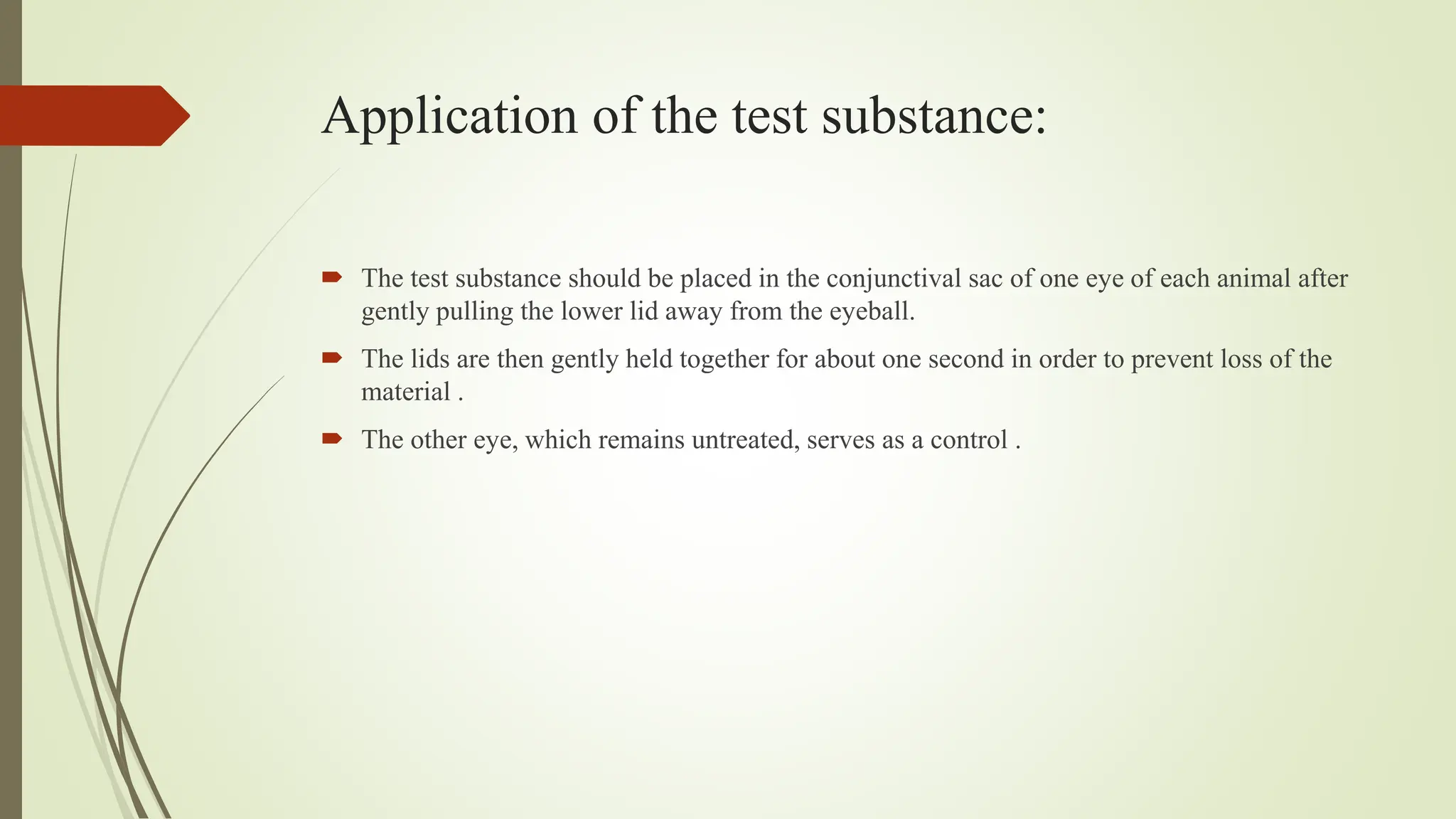
 The test substance should be placed in the conjunctival sac of one eye of each animal after
gently pulling the lower lid away from the eyeball.
 The lids are then gently held together for about one second in order to prevent loss of the
material .
 The other eye, which remains untreated, serves as a control .
Initial test (In vivo eye irritation/corrosion test
using one animal):
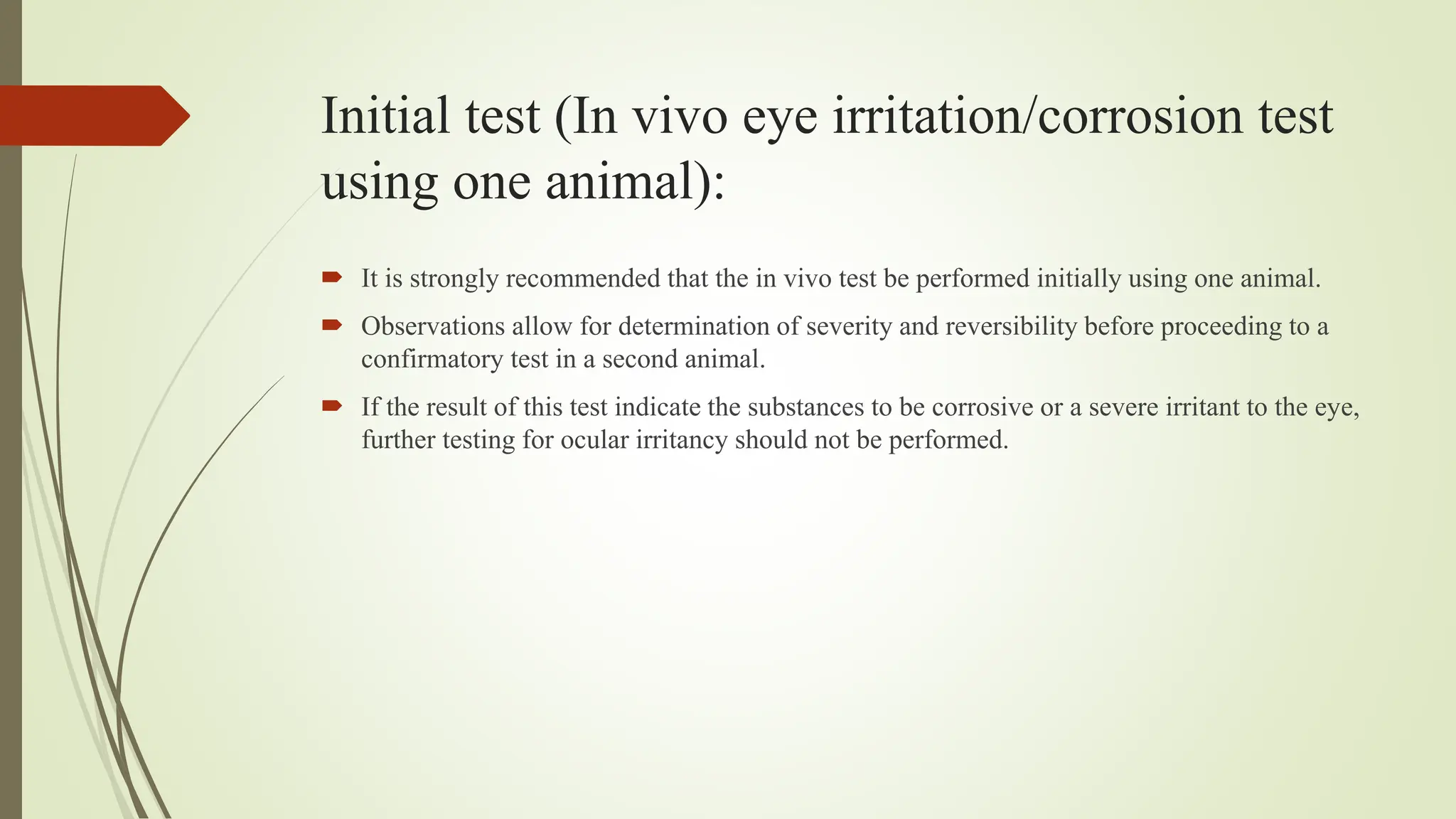
 It is strongly recommended that the in vivo test be performed initially using one animal.
 Observations allow for determination of severity and reversibility before proceeding to a
confirmatory test in a second animal.
 If the result of this test indicate the substances to be corrosive or a severe irritant to the eye,
further testing for ocular irritancy should not be performed.
Confirmatory test ( In vivo eye irritation test
with additional animals)
 If a corrosive or severe irritant effect is not observed in the initial test, the irritant or
negative response should be confirmed using up to two additional animals.
 If an irritant effect is observed in the initial test, it is recommended that the confirmatory
test be conducted in a sequential manner in one animal at a time, rather then exposing the
two additional animals simultaneously.
 If the second animal reveals corrosive or severe irritant effect, the test is not continued.
 If result from the second animal are sufficient to allow for a hazard classification
determination , then no further testing should be conducted.
Observation period
 The duration of the observation period should be sufficient to evaluate fully the magnitude
and reversibility of the effect observed. However, the experiment should be terminated at
any time that the animal shows signs of severe pain or distress.
 To determine reversibility of effects, the animals should be observed normally for 21 days
post administration of the test substance. If reversibility is seen before 21 days, the
experiment should be terminated at that time.
Clinical observation and grading of eye
reaction :
 The eye should be comprehensively evaluated for the presence or absence of ocular lesion
one hour post-TSA followed by at least daily evaluation .
 Animal should be evaluated several time daily for the first 3 days to ensure that termination
decision are made in a timely manner.
 Test animal should be routinely evaluated for the entire duration of the study for clinical
signs of pain or distress at least twice daily, with a minimum of 6 hours between
observation, or more often if necessary.
ACUTE EYE IRRITATION OECD GUIDELINE BY SEJAL AGRAWAL

ACUTE EYE IRRITATION OECD GUIDELINE BY SEJAL AGRAWAL

  • 1.
    OECD GUIDELINE FORACUTE EYE IRRITATION (405) PRESENTED BY : SEJAL AGRAWAL
  • 2.
    CONTENT :  Introductionof toxicity  OECD guideline for toxicity studies  Acute eye irritation  Principle  Initial test of acute eye irritation  Conformational test of acute eye irritation  Observational  Conclusion
  • 3.
    Overview of acuteeye irritation: Guideline no. Toxicological methods. Procedure Drug dose Clinical 405/403 Topical/Systemi c Testing of 1. Solid 2. Liquid 3. Aerosoles 1. 0.1ml(solid) 2. 0.1ml,100m g dose (liquid) Lession of conjunctiva,cor nea,iris at a specific interval 1,24,48,72hrs
  • 4.
    Introduction:  TOXICITY :Toxicity is the science dealing with properties, action, toxicity, fatal dose detection or interpretation of result of toxicological analysis and treatment of poison.  The poison is any substances which causing harmful effect to the body. The drug also a poison if not given in proper concentration OR The poison is a drug if given in appropriate concentration.
  • 5.
    INTRODUCTION : ACUTE EYEIRRITATION 1. IRRITATION:  In biology and physiology, is a state of inflammation or painful reaction to allergy or cell- lining damage. 2. IRRITANT:  A stimulus or agent which induces the state of irritation is an irritant.
  • 6.
    CAUSES OF IRRITATION: Due to chemical agent  Mechanical  Chemical  Radiation  Irritation can also be induced by some allergic response due to exposure of some allergens for example contact dermatitis, irritation of mucosal membranes and pruritus(itching).  The eye is also a source of chronic irritation , disorders like Sjogren syndrome, where one dose not make tears, can cause a dry eye sensation which feels very unpleasant.  Blepharitis is dryness and itching on the upper eyelids.
  • 7.
    Acute eye irritation/corrosion-405  OECD guideline for testing of chemical are periodically reviewed to ensure that they reflect the best available science .  In previous reviews of this Test Guideline (TG), special attention was given to possible improvements through the evaluation of all existing information on the test chemical in order to avoid unnecessary testing in laboratory animals and thereby address animal welfare concerns.  This updated version of TG 405 (originally adopted in 1981 and updated in 1987, 2002, 2012, 2020 and 2021)  Integrated Approaches to Testing and Assessment (IATA) for Serious Eye Damage and Eye Irritation (1), proposing a modular approach for eye irritation and serious eye damage testing
  • 8.
     The IATAdescribes several modules which group information sources and analysis tools, and (I) provides guidance on how to integrate and use existing testing and non testing data for the assessment of the eye irritation and serious eye damage potentials of chemicals and (ii) proposes an approach when further testing is needed  ICCVAM and an independent international scientific peer reviewed the usefulness and limitation of routinely using topical anesthetics .  Interagency coordinating committee on the validation of alternative methods.
  • 9.
    Balanced preemptive painmanagement should include:  Routine pre treatment with a topical anesthetics.  Routine post-treatment schedule of systemic analgesia.  Scheduled observation, monitoring, and recording of the nature, severity, and progression of all eye injuries.
  • 10.
    Initial considerations  Forcertain substances, such an analysis may indicated the need for in vivo studies of the ocular corrosion/irritation potential of the substances.  In all such cases, before consideration the use of the in vivo eye test, preferably a study of the in vitro or in vivo skin corrosion effects of the substance should be conducted first and evaluated in accordance with the sequential testing strategy in Test Guideline 405.
  • 11.
    PRINCIPLE  Following pretreatmentwith a systemic analgesic and instillation of appropriate topical anesthesia, the test chemical is applied in a single dose to one of the eyes of the experimental animal; the untreated eye serves as the control.  The degree of eye irritation/serious eye damage is evaluated by scoring lesions of conjunctiva, cornea, and iris, at specific intervals  The duration of the study should be sufficient to evaluate the reversibility or irreversibility of the effects.  Animals showing signs of severe distress or pain at any stage of the test or lesions consistent with the humane endpoints. should be humanely killed, and the test chemical assessed accordingly without performing further testing with more animals.  Criteria for making the decision to humanely kill moribund and severely suffering animals are the subject of a separate guidance document.
  • 12.
    PREPARATION FOR THEIN VIVO TEST:  Selection of species  The albino rabbit is the preferable laboratory animal and healthy young adult animals are used.  A rationale for using other strains or species should be provided of weight 1.5kg to 3kg.  Preparation of animals  Both eyes of each experimental animal provisionally selected for testing should be examined within  24 hours before testing starts. Animals showing eye irritation, ocular defects, or pre-existing corneal injury should not be used.  Housing and feeding conditions  Animals should be individually housed. The temperature of the experimental animal room should be 20°C (± 3°C) for rabbits.  Although the relative humidity should be at least 30% and preferably not exceed 70%, other than during room cleaning, the aim should be 50-60%.  Lighting should be artificial, the sequence being 12 hours light, 12 hours dark. Excessive light intensity should be avoided.  For feeding, conventional laboratory diets may be used with an unrestricted supply of drinking water.
  • 13.
    PROCEDURE  Sixty minutesprior to test substance application(TSA) ,buprenorphine 0.01 mg/kg is administered by subcutaneous injection to provide a therapeutic level of systemic analgesia.  Five minutes prior to TSA, one or two drop of a topical ocular anesthetic (E.g. 0.5% proparacaine hydrochloride or 0.5% tetracaine hydrochloride) are applied to each eye.  Eight hours after TSA , buprenorphine 0.01mg/kg SC and meloxicam 0.5mg/kg SC are administered to provide a continued therapeutic level of systemic analgesia.  After the initial 8 hour post – TSA treatment , buprenorphine 0.01mg/kg SC should be administered every 12 hours, in conjunction with meloxicam 0.5 mg/kg every 24 hours, until the ocular lesion resolve and no clinical signs of pain and distress are present.
  • 14.
     If ananimal shows signs of pain and distress during the study, a “rescue” dose of buprenorphine 0.03 mg/kg SC would be given immediately and repeated as often as every 8 hours , if necessary, instead of 0.01mg/kg SC every 12 hours , meloxicam 0.5 mg/kg SC would be administered every 24 hours in conjunction with the “rescue” dose of buprenorphine , but not until at least 8 hours post – TSA.
  • 15.
    Application of thetest substance:  The test substance should be placed in the conjunctival sac of one eye of each animal after gently pulling the lower lid away from the eyeball.  The lids are then gently held together for about one second in order to prevent loss of the material .  The other eye, which remains untreated, serves as a control .
  • 16.
    Initial test (Invivo eye irritation/corrosion test using one animal):  It is strongly recommended that the in vivo test be performed initially using one animal.  Observations allow for determination of severity and reversibility before proceeding to a confirmatory test in a second animal.  If the result of this test indicate the substances to be corrosive or a severe irritant to the eye, further testing for ocular irritancy should not be performed.
  • 17.
    Confirmatory test (In vivo eye irritation test with additional animals)  If a corrosive or severe irritant effect is not observed in the initial test, the irritant or negative response should be confirmed using up to two additional animals.  If an irritant effect is observed in the initial test, it is recommended that the confirmatory test be conducted in a sequential manner in one animal at a time, rather then exposing the two additional animals simultaneously.  If the second animal reveals corrosive or severe irritant effect, the test is not continued.  If result from the second animal are sufficient to allow for a hazard classification determination , then no further testing should be conducted.
  • 18.
    Observation period  Theduration of the observation period should be sufficient to evaluate fully the magnitude and reversibility of the effect observed. However, the experiment should be terminated at any time that the animal shows signs of severe pain or distress.  To determine reversibility of effects, the animals should be observed normally for 21 days post administration of the test substance. If reversibility is seen before 21 days, the experiment should be terminated at that time.
  • 19.
    Clinical observation andgrading of eye reaction :  The eye should be comprehensively evaluated for the presence or absence of ocular lesion one hour post-TSA followed by at least daily evaluation .  Animal should be evaluated several time daily for the first 3 days to ensure that termination decision are made in a timely manner.  Test animal should be routinely evaluated for the entire duration of the study for clinical signs of pain or distress at least twice daily, with a minimum of 6 hours between observation, or more often if necessary.