Organization For Economic Co-operation
And Development Guidelines – 451.
By-
Ms. Prajakta Hingole
Ms. Debrupa Dutta
Mr. Gopal Khodve
Mr. Devesh Rana
OECD
carcinogenicity testing
1
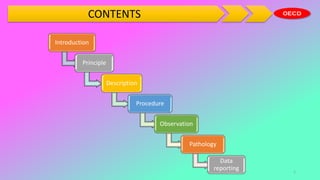
Introduction
Principle
Description
Procedure
Observation
Pathology
Data
reporting
CONTENTS
2
INTRODUCTION
 The objectives of carcinogenicity studies covered by this test guideline include:
• To identification of the carcinogenic properties of a chemical,
• To identification of target organ(s) of carcinogenicity
• To identification of the time to appearance of neoplasms Characterization of the tumor dose-response relationship
• To Identification of a no-observed-adverse-effect level (NOAEL) or point of departure for establishment of a
Benchmark Dose (BMD)
• To Extrapolation of carcinogenic effects to low dose human exposure levels
 The Organization for Economical and Co-operation Development (OECD) was used for testing of chemicals.
 The original OECD guideline 451 for carcinogenicity study was adopted in 1981.
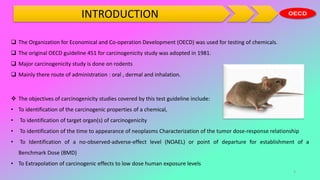
 Major carcinogenicity study is done on rodents
 Mainly there route of administration : oral , dermal and inhalation.
3
PRINCIPLE
• The test substance is administered daily in graduated doses.
• Observed closely for the signs of toxicity and for the development of neoplastic lesions.
• Died or killed animals are necropsied and at the conclusion of surviving animals are also killed and
necropsied.
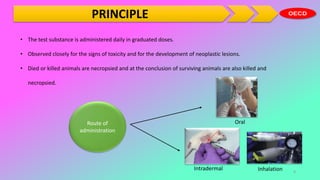
Route of
administration
Oral
Intradermal Inhalation 4
DESCRIPTION OF METHOD
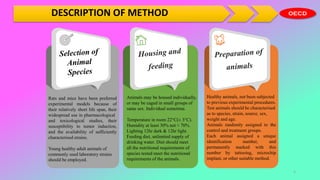
Rats and mice have been preferred
experimental models because of
their relatively short life span, their
widespread use in pharmacological-
and toxicological studies, their
susceptibility to tumor induction,
and the availability of sufficiently
characterised strains.
Young healthy adult animals of
commonly used laboratory strains
should be employed.
Animals may be housed individually,
or may be caged in small groups of
same sex. Individual sometime.
Temperature in room 22C(± 3C).
Humidity at least 30% not < 70%.
Lighting 12hr dark & 12hr light.
Feeding diet, unlimited supply of
drinking water. Diet should meet
all the nutritional requirements of
species tested meet the nutritional
requirements of the animals.
Healthy animals, not been subjected
to previous experimental procedures.
Test animals should be characterised
as to species, strain, source, sex,
weight and age.
Animals randomly assigned to the
control and treatment groups.
Each animal assigned a unique
identification number, and
permanently marked with this
number by tattooing, microchip
implant, or other suitable method.
5
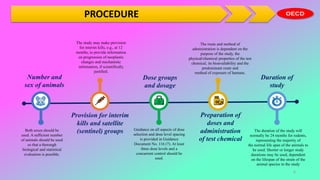
PROCEDURE
Duration of
study
The duration of the study will
normally be 24 months for rodents,
representing the majority of
the normal life span of the animals to
be used. Shorter or longer study
durations may be used, dependent
on the lifespan of the strain of the
animal species in the study
Dose groups
and dosage
Guidance on all aspects of dose
selection and dose level spacing
is provided in Guidance
Document No. 116 (7). At least
three dose levels and a
concurrent control should be
used.
Number and
sex of animals
Both sexes should be
used. A sufficient number
of animals should be used
so that a thorough
biological and statistical
evaluation is possible.
The study may make provision
for interim kills, e.g., at 12
months, to provide information
on progression of neoplastic
changes and mechanistic
information, if scientifically
justified.
Provision for interim
kills and satellite
(sentinel) groups
The route and method of
administration is dependent on the
purpose of the study, the
physical/chemical properties of the test
chemical, its bioavailability and the
predominant route and
method of exposure of humans.
Preparation of
doses and
administration
of test chemical
6
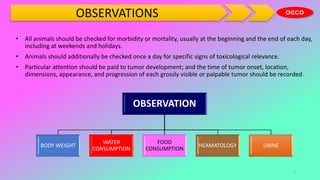
OBSERVATIONS
• All animals should be checked for morbidity or mortality, usually at the beginning and the end of each day,
including at weekends and holidays.
• Animals should additionally be checked once a day for specific signs of toxicological relevance.
• Particular attention should be paid to tumor development; and the time of tumor onset, location,
dimensions, appearance, and progression of each grossly visible or palpable tumor should be recorded.
7
OBSERVATION
BODY WEIGHT
WATER
CONSUMPTION
FOOD
CONSUMPTION
HEAMATOLOGY URINE
8
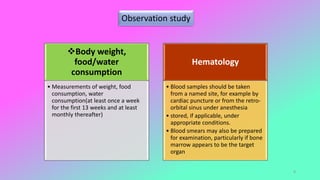
Body weight,
food/water
consumption
• Measurements of weight, food
consumption, water
consumption(at least once a week
for the first 13 weeks and at least
monthly thereafter)
Hematology
• Blood samples should be taken
from a named site, for example by
cardiac puncture or from the retro-
orbital sinus under anesthesia
• stored, if applicable, under
appropriate conditions.
• Blood smears may also be prepared
for examination, particularly if bone
marrow appears to be the target
organ
Observation study
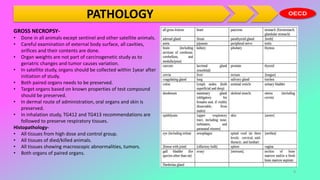
PATHOLOGY
GROSS NECROPSY-
• Done in all animals except sentinel and other satellite animals.
• Careful examination of external body surface, all cavities,
orifices and their contents are done.
• Organ weights are not part of carcinogenetic study as to
geriatric changes and tumor causes variation.
• In satellite study, organs should be collected within 1year after
initiation of study.
• Both paired organs needs to be preserved.
• Target organs based on known properties of test compound
should be preserved.
• In dermal route of administration, oral organs and skin is
preserved.
• In inhalation study, TG412 and TG413 recommendations are
followed to preserve respiratory tissues.
Histopathology-
• All tissues from high dose and control group.
• All tissues of died/killed animals.
• All tissues showing macroscopic abnormalities, tumors.
• Both organs of paired organs.
9
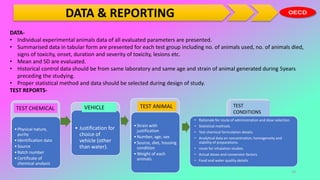
DATA & REPORTING
DATA-
• Individual experimental animals data of all evaluated parameters are presented.
• Summarised data in tabular form are presented for each test group including no. of animals used, no. of animals died,
signs of toxicity, onset, duration and severity of toxicity, lesions etc.
• Mean and SD are evaluated.
• Historical control data should be from same laboratory and same age and strain of animal generated during 5years
preceding the studying.
• Proper statistical method and data should be selected during design of study.
TEST REPORTS-
•Physical nature,
purity
•Identification data
•Source
•Batch number
•Certificate of
chemical analysis
• Justification for
choice of
vehicle (other
than water).
•Strain with
justification
•Number, age, sex
•Source, diet, housing
condition
•Weight of each
animals.
TEST CHEMICAL VEHICLE TEST ANIMAL
• Rationale for route of administration and dose selection.
• Statistical methods.
• Test chemical formulation details.
• Analytical data on concentration, homogeneity and
stability of preparations.
• route for inhalation studies.
• Actual doses and conversion factors.
• Food and water quality details
TEST
CONDITIONS
10
1
2
3
4
General
Clinical findings
Necropsy data
Histopathology
Survival data; Body weight changes; Food consumption, calculations of food
efficiency, if made, and water consumption; Toxicokinetic data if available;
Ophthalmoscopy; Hematology; Clinical chemistry (if available);
Signs of toxicity; Incidence (and, if scored, severity) of any
abnormality; Nature, severity, and duration of clinical observations
(whether transitory or permanent);
Terminal body weight;
Organ weights and their ratios, if applicable;
Necropsy findings; Incidence and severity of
abnormalities
Non neoplastic histopathological findings;
Neoplastic histopathological findings;
Correlation between gross and
microscopic findings
RESULTS
11
12
REFERENCE
• OECD/OCDE 451, OECD GUIDELINE FOR THE TESTING OF CHEMICALS, 25 JUNE 2018.
Thank you
Thank
you
13

Oecd 541 guidelines

  • 1.
    Organization For EconomicCo-operation And Development Guidelines – 451. By- Ms. Prajakta Hingole Ms. Debrupa Dutta Mr. Gopal Khodve Mr. Devesh Rana OECD carcinogenicity testing 1
  • 2.
  • 3.
    INTRODUCTION  The objectivesof carcinogenicity studies covered by this test guideline include: • To identification of the carcinogenic properties of a chemical, • To identification of target organ(s) of carcinogenicity • To identification of the time to appearance of neoplasms Characterization of the tumor dose-response relationship • To Identification of a no-observed-adverse-effect level (NOAEL) or point of departure for establishment of a Benchmark Dose (BMD) • To Extrapolation of carcinogenic effects to low dose human exposure levels  The Organization for Economical and Co-operation Development (OECD) was used for testing of chemicals.  The original OECD guideline 451 for carcinogenicity study was adopted in 1981.  Major carcinogenicity study is done on rodents  Mainly there route of administration : oral , dermal and inhalation. 3
  • 4.
    PRINCIPLE • The testsubstance is administered daily in graduated doses. • Observed closely for the signs of toxicity and for the development of neoplastic lesions. • Died or killed animals are necropsied and at the conclusion of surviving animals are also killed and necropsied. Route of administration Oral Intradermal Inhalation 4
  • 5.
    DESCRIPTION OF METHOD Ratsand mice have been preferred experimental models because of their relatively short life span, their widespread use in pharmacological- and toxicological studies, their susceptibility to tumor induction, and the availability of sufficiently characterised strains. Young healthy adult animals of commonly used laboratory strains should be employed. Animals may be housed individually, or may be caged in small groups of same sex. Individual sometime. Temperature in room 22C(± 3C). Humidity at least 30% not < 70%. Lighting 12hr dark & 12hr light. Feeding diet, unlimited supply of drinking water. Diet should meet all the nutritional requirements of species tested meet the nutritional requirements of the animals. Healthy animals, not been subjected to previous experimental procedures. Test animals should be characterised as to species, strain, source, sex, weight and age. Animals randomly assigned to the control and treatment groups. Each animal assigned a unique identification number, and permanently marked with this number by tattooing, microchip implant, or other suitable method. 5
  • 6.
    PROCEDURE Duration of study The durationof the study will normally be 24 months for rodents, representing the majority of the normal life span of the animals to be used. Shorter or longer study durations may be used, dependent on the lifespan of the strain of the animal species in the study Dose groups and dosage Guidance on all aspects of dose selection and dose level spacing is provided in Guidance Document No. 116 (7). At least three dose levels and a concurrent control should be used. Number and sex of animals Both sexes should be used. A sufficient number of animals should be used so that a thorough biological and statistical evaluation is possible. The study may make provision for interim kills, e.g., at 12 months, to provide information on progression of neoplastic changes and mechanistic information, if scientifically justified. Provision for interim kills and satellite (sentinel) groups The route and method of administration is dependent on the purpose of the study, the physical/chemical properties of the test chemical, its bioavailability and the predominant route and method of exposure of humans. Preparation of doses and administration of test chemical 6
  • 7.
    OBSERVATIONS • All animalsshould be checked for morbidity or mortality, usually at the beginning and the end of each day, including at weekends and holidays. • Animals should additionally be checked once a day for specific signs of toxicological relevance. • Particular attention should be paid to tumor development; and the time of tumor onset, location, dimensions, appearance, and progression of each grossly visible or palpable tumor should be recorded. 7 OBSERVATION BODY WEIGHT WATER CONSUMPTION FOOD CONSUMPTION HEAMATOLOGY URINE
  • 8.
    8 Body weight, food/water consumption • Measurementsof weight, food consumption, water consumption(at least once a week for the first 13 weeks and at least monthly thereafter) Hematology • Blood samples should be taken from a named site, for example by cardiac puncture or from the retro- orbital sinus under anesthesia • stored, if applicable, under appropriate conditions. • Blood smears may also be prepared for examination, particularly if bone marrow appears to be the target organ Observation study
  • 9.
    PATHOLOGY GROSS NECROPSY- • Donein all animals except sentinel and other satellite animals. • Careful examination of external body surface, all cavities, orifices and their contents are done. • Organ weights are not part of carcinogenetic study as to geriatric changes and tumor causes variation. • In satellite study, organs should be collected within 1year after initiation of study. • Both paired organs needs to be preserved. • Target organs based on known properties of test compound should be preserved. • In dermal route of administration, oral organs and skin is preserved. • In inhalation study, TG412 and TG413 recommendations are followed to preserve respiratory tissues. Histopathology- • All tissues from high dose and control group. • All tissues of died/killed animals. • All tissues showing macroscopic abnormalities, tumors. • Both organs of paired organs. 9
  • 10.
    DATA & REPORTING DATA- •Individual experimental animals data of all evaluated parameters are presented. • Summarised data in tabular form are presented for each test group including no. of animals used, no. of animals died, signs of toxicity, onset, duration and severity of toxicity, lesions etc. • Mean and SD are evaluated. • Historical control data should be from same laboratory and same age and strain of animal generated during 5years preceding the studying. • Proper statistical method and data should be selected during design of study. TEST REPORTS- •Physical nature, purity •Identification data •Source •Batch number •Certificate of chemical analysis • Justification for choice of vehicle (other than water). •Strain with justification •Number, age, sex •Source, diet, housing condition •Weight of each animals. TEST CHEMICAL VEHICLE TEST ANIMAL • Rationale for route of administration and dose selection. • Statistical methods. • Test chemical formulation details. • Analytical data on concentration, homogeneity and stability of preparations. • route for inhalation studies. • Actual doses and conversion factors. • Food and water quality details TEST CONDITIONS 10
  • 11.
    1 2 3 4 General Clinical findings Necropsy data Histopathology Survivaldata; Body weight changes; Food consumption, calculations of food efficiency, if made, and water consumption; Toxicokinetic data if available; Ophthalmoscopy; Hematology; Clinical chemistry (if available); Signs of toxicity; Incidence (and, if scored, severity) of any abnormality; Nature, severity, and duration of clinical observations (whether transitory or permanent); Terminal body weight; Organ weights and their ratios, if applicable; Necropsy findings; Incidence and severity of abnormalities Non neoplastic histopathological findings; Neoplastic histopathological findings; Correlation between gross and microscopic findings RESULTS 11
  • 12.
    12 REFERENCE • OECD/OCDE 451,OECD GUIDELINE FOR THE TESTING OF CHEMICALS, 25 JUNE 2018.
  • 13.