
BY : PRIYA SHUKLA
Flow cytometry is a technology that is used
to analyse the physical and chemical
characteristics of particles in a fluid as it
passes through at least one laser. Cell
components are fluorescently labelled and
then excited by the laser to emit light at
varying wavelengths.
 The fluorescence can be measured to
determine various properties of single
particles, which are usually cells. Up to
thousands of particles per second can be
analysed as they pass through the liquid
stream.
 Examples of the properties measured include
the particle’s relative granularity, size and
fluorescence intensity as well as its internal
complexity. An optical-to-electronic coupling
system is used to record the way in which the
particle emits fluorescence and scatters
incident light from the laser.
 A flow cytometer has five main components:
 a flow cell
 a measuring system
 a detector
 an amplification system
 a computer for analysis of the signals.
 The flow cell has a liquid stream (sheath fluid),
which carries and aligns the cells so that they
pass single file through the light beam for
sensing. The measuring system commonly use
measurement of impedance (or conductivity)
and optical systems - lamps (mercury, xenon);
high-power water-cooled lasers (argon
, krypton , dye laser); low-power air-cooled
lasers (argon (488 nm), red-HeNe (633 nm),
green-HeNe, HeCd (UV)); diode lasers (blue,
green, red, violet) resulting in light signals.
 . The detector and analog-to-digital
conversion (ADC) system converts analog
measurements of forward-scattered light
(FSC) and side-scattered light (SSC) as well as
dye-specific fluorescence signals into digital
signals that can be processed by a computer.
The amplification system can
be linear or logarithmic.
 The process of collecting data from samples
using the flow cytometer is termed
'acquisition'. Acquisition is mediated by a
computer physically connected to the flow
cytometer, and the software which handles
the digital interface with the cytometer.
 The software is capable of adjusting
parameters (e.g., voltage, compensation) for
the sample being tested, and also assists in
displaying initial sample information while
acquiring sample data to ensure that
parameters are set correctly.
 Early flow cytometers were, in general,
experimental devices, but technological
advances have enabled widespread
applications for use in a variety of both
clinical and research purposes.
 Due to these developments, a considerable
market for instrumentation, analysis
software, as well as the reagents used in
acquisition such as fluorescently
labeled antibodies has developed.
 Modern instruments usually have multiple
lasers and fluorescence detectors. The
current record for a commercial instrument is
ten lasers and 30 fluorescence detectors.
Increasing the number of lasers and detectors
allows for multiple antibody labeling, and can
more precisely identify a target population by
their phenotypic markers.
 Certain instruments can even take digital
images of individual cells, allowing for the
analysis of fluorescent signal location within
or on the surface of cells.
 Cells must pass uniformly through the center
of focused laser beams to accurately measure
optical properties of cells in any flow
cytometer.
 The purpose of the fluidic system is to move
the cells one by one through the lasers beam
and through-out the instrument. Fluidics in a
flow cytometer with cell sorting capabilities
also use the stream to carry sorted cells into
collection tubes or wells.
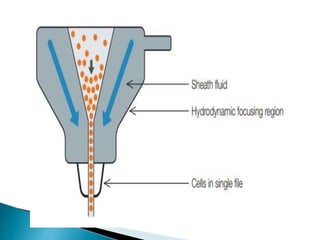
 For precise positioning of cells in a liquid jet the
hydrodynamic focusing technique is used in most
cytometers. The cells in suspension enter into
the instrument enclosed by an outer sheath fluid.
 The sample core is maintained in the center of
the sheath fluid. The sample input rate or how
fast the cells flow through to the laser
interrogation can be controlled by the pressure
of the sheath fluid on the sample core. Under
optimal conditions there is no mixing of the
central fluid stream and the sheath fluid.
 Acoustic focusing technology is used in some
flow cytometers to support hydrodynamic
focusing. Acoustic waves (>2MHz) pre-focus
the sample before introduction to sheath
fluid. The pre-focused sample is then
injected into the hydrodynamic core and
flowed through the instrument. This may help
with increasing data accuracy under high
sample input rates.
 Optical filters
 Light emitted from fluorophores are in a
spectrum of wavelengths and combining multiple
fluorophores may cause overlap. To add
specificity, optical filters and dichroic mirrors are
used filter and move light to the detectors such
as photomultiplier tubes (PMTs) or avalanche
photodiodes (APD). Optical filters are designed as
band pass (BP), long pass (LP), or short pass (SP)
filters. Most flow cytometers uses dichroic
mirrors and band pass filters to select specific
bands of the optical spectrum.
 Spectral flow cytometry uses prisms or
gratings to disperse the emitted light of a
marker across a detector array. This allows
for the full spectra from each particle to be
measured. The measured spectra from single
cells are subsequently unmixed by using
reference spectra of all used dyes and the
autofluorescence spectrum. This may allow
for a wider panel design and the application
of new biological markers.
Imaging flow cytometry :
 Imaging flow cytometry (IFC) captures
multichannel images of cells. Detectors used
in imaging platforms can be equipped with
charge-coupled device (CCD) or
complementary metal-oxide-semiconductor
(CMOS) to capture images of individually .
 Flow cytometry is used to perform several
procedures including:
 Cell counting
 Cell sorting
 Detection of biomarkers
 Protein engineering
 Determining cell characteristics and function
 Detecting microorganisms
 Protein engineering detection
 Diagnosis of health disorders such as blood
cancers
 Flow cytometry has numerous applications in
science, including those relevant to
healthcare. The technology has been widely
used in the diagnosis of health conditions,
particularly diseases of the blood such as
leukemia, although it is also commonly used
in the various different fields of clinical
practice as well as in basic research and
clinical trials.
 Some examples of the fields this technology
is used in include molecular biology,
immunology, pathology, marine science and
plant biology. In medicine, flow cytometry is a
vital laboratory process used in
transplantation, oncology, hematology,
genetics and prenatal diagnosis. In marine
biology, the abundance and distribution of
photosynthetic plankton can be analysed.
 Flow cytometry can also be used in the field
of protein engineering, to help identify cell
surface protein variants.
Flow cytometry

Flow cytometry

  • 1.
    BY : PRIYASHUKLA
  • 2.
    Flow cytometry isa technology that is used to analyse the physical and chemical characteristics of particles in a fluid as it passes through at least one laser. Cell components are fluorescently labelled and then excited by the laser to emit light at varying wavelengths.
  • 3.
     The fluorescencecan be measured to determine various properties of single particles, which are usually cells. Up to thousands of particles per second can be analysed as they pass through the liquid stream.  Examples of the properties measured include the particle’s relative granularity, size and fluorescence intensity as well as its internal complexity. An optical-to-electronic coupling system is used to record the way in which the particle emits fluorescence and scatters incident light from the laser.
  • 5.
     A flowcytometer has five main components:  a flow cell  a measuring system  a detector  an amplification system  a computer for analysis of the signals.
  • 6.
     The flowcell has a liquid stream (sheath fluid), which carries and aligns the cells so that they pass single file through the light beam for sensing. The measuring system commonly use measurement of impedance (or conductivity) and optical systems - lamps (mercury, xenon); high-power water-cooled lasers (argon , krypton , dye laser); low-power air-cooled lasers (argon (488 nm), red-HeNe (633 nm), green-HeNe, HeCd (UV)); diode lasers (blue, green, red, violet) resulting in light signals.
  • 7.
     . Thedetector and analog-to-digital conversion (ADC) system converts analog measurements of forward-scattered light (FSC) and side-scattered light (SSC) as well as dye-specific fluorescence signals into digital signals that can be processed by a computer. The amplification system can be linear or logarithmic.
  • 8.
     The processof collecting data from samples using the flow cytometer is termed 'acquisition'. Acquisition is mediated by a computer physically connected to the flow cytometer, and the software which handles the digital interface with the cytometer.  The software is capable of adjusting parameters (e.g., voltage, compensation) for the sample being tested, and also assists in displaying initial sample information while acquiring sample data to ensure that parameters are set correctly.
  • 9.
     Early flowcytometers were, in general, experimental devices, but technological advances have enabled widespread applications for use in a variety of both clinical and research purposes.  Due to these developments, a considerable market for instrumentation, analysis software, as well as the reagents used in acquisition such as fluorescently labeled antibodies has developed.
  • 10.
     Modern instrumentsusually have multiple lasers and fluorescence detectors. The current record for a commercial instrument is ten lasers and 30 fluorescence detectors. Increasing the number of lasers and detectors allows for multiple antibody labeling, and can more precisely identify a target population by their phenotypic markers.
  • 11.
     Certain instrumentscan even take digital images of individual cells, allowing for the analysis of fluorescent signal location within or on the surface of cells.
  • 12.
     Cells mustpass uniformly through the center of focused laser beams to accurately measure optical properties of cells in any flow cytometer.  The purpose of the fluidic system is to move the cells one by one through the lasers beam and through-out the instrument. Fluidics in a flow cytometer with cell sorting capabilities also use the stream to carry sorted cells into collection tubes or wells.
  • 14.
     For precisepositioning of cells in a liquid jet the hydrodynamic focusing technique is used in most cytometers. The cells in suspension enter into the instrument enclosed by an outer sheath fluid.  The sample core is maintained in the center of the sheath fluid. The sample input rate or how fast the cells flow through to the laser interrogation can be controlled by the pressure of the sheath fluid on the sample core. Under optimal conditions there is no mixing of the central fluid stream and the sheath fluid.
  • 16.
     Acoustic focusingtechnology is used in some flow cytometers to support hydrodynamic focusing. Acoustic waves (>2MHz) pre-focus the sample before introduction to sheath fluid. The pre-focused sample is then injected into the hydrodynamic core and flowed through the instrument. This may help with increasing data accuracy under high sample input rates.
  • 18.
     Optical filters Light emitted from fluorophores are in a spectrum of wavelengths and combining multiple fluorophores may cause overlap. To add specificity, optical filters and dichroic mirrors are used filter and move light to the detectors such as photomultiplier tubes (PMTs) or avalanche photodiodes (APD). Optical filters are designed as band pass (BP), long pass (LP), or short pass (SP) filters. Most flow cytometers uses dichroic mirrors and band pass filters to select specific bands of the optical spectrum.
  • 20.
     Spectral flowcytometry uses prisms or gratings to disperse the emitted light of a marker across a detector array. This allows for the full spectra from each particle to be measured. The measured spectra from single cells are subsequently unmixed by using reference spectra of all used dyes and the autofluorescence spectrum. This may allow for a wider panel design and the application of new biological markers.
  • 21.
    Imaging flow cytometry:  Imaging flow cytometry (IFC) captures multichannel images of cells. Detectors used in imaging platforms can be equipped with charge-coupled device (CCD) or complementary metal-oxide-semiconductor (CMOS) to capture images of individually .
  • 23.
     Flow cytometryis used to perform several procedures including:  Cell counting  Cell sorting  Detection of biomarkers  Protein engineering  Determining cell characteristics and function  Detecting microorganisms  Protein engineering detection  Diagnosis of health disorders such as blood cancers
  • 24.
     Flow cytometryhas numerous applications in science, including those relevant to healthcare. The technology has been widely used in the diagnosis of health conditions, particularly diseases of the blood such as leukemia, although it is also commonly used in the various different fields of clinical practice as well as in basic research and clinical trials.
  • 25.
     Some examplesof the fields this technology is used in include molecular biology, immunology, pathology, marine science and plant biology. In medicine, flow cytometry is a vital laboratory process used in transplantation, oncology, hematology, genetics and prenatal diagnosis. In marine biology, the abundance and distribution of photosynthetic plankton can be analysed.
  • 26.
     Flow cytometrycan also be used in the field of protein engineering, to help identify cell surface protein variants.