DERMAL IRRITATION AND
DERMAL TOXICITY STUDIES
Presented by
Yash Vikhankar
M Pharm​
CONTENTS
DERMAL IRRITATION
• INTRODUCTION
• PRINCIPLE
• PREPARATION OF THE IN VIVO TEST
• TEST PROCEDURE
• OBSRVAATION AND GRAADNG
DERMAL TOXICITY
• INTRODUCTION
• PRINCIPLE
• TEST PROCEDURE
INTRODUCTION
Dermal irritation is the production of reversible damage of
the skin following the application of a test chemical for up
to 4 hours.
Corrosive reactions are typified by ulcers, bleeding, bloody
scabs, and, by the end of observation at 14 days, by
discoloration due to blanching of the skin, complete areas
of alopecia, and scars. Histopathology should be
considered to evaluate questionable lesions.
Dermal corrosion is the production of irreversible damage
of the skin; namely. visible necrosis through the epidermis
and into the dermis, following the application of a test
chemical for up to four hours.
Presentation title 3
PRINCIPLE
• The test chemical to be tested is applied in a single dose to the skin of an
experimental animal; untreated skin areas of the test animal serve as the
control.
• The degree of irritation/corrosion is read and scored at specified intervals and is
further described in order to provide a complete evaluation of the effects.

• The duration of the study should be sufficient to evaluate the reversibility or
irreversibility of the effects observed.
• Animals showing continuing signs of severe distress and/or pain at any stage of the
test should be humanely killed, and the test chemical assessed accordingly.
• Criteria for making the decision to humanely kill moribund and severely suffering
animals are the subject of a separate guidance document.
PREPARATION FOR IN VIVO TEST
Presentation title 5
Selection of animal species:-
• The Albino Rabbit is preferable
laboratory animal and healthy
young adult rabbits are used.
• A rationale for other species
should provided
ALBINO RABBIT
CONT…
Presentation title 6
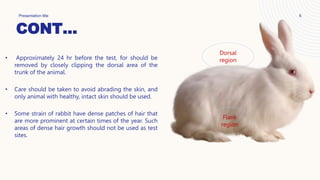
• Approximately 24 hr before the test, for should be
removed by closely clipping the dorsal area of the
trunk of the animal.
• Care should be taken to avoid abrading the skin, and
only animal with healthy, intact skin should be used.
• Some strain of rabbit have dense patches of hair that
are more prominent at certain times of the year. Such
areas of dense hair growth should not be used as test
sites.
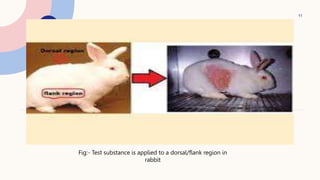
Dorsal
region
Flank
region
HOUSING ANG FEEDING CONDITIONS:-
• Rabbit at least 12 weeks old and body weight 1.5 kg-3.0 kg.
• The temperature should be 20 c (± 30C) for rabbits.
• Relative humidity should be at least 30% and preferably not exceed 70%,
other than during room cleaning; the aim should be 50-60%.
• Lighting should be 12 hours light, 12 hours dark.
• For feeding, conventional laboratory diets may be used with an
unrestricted supply of drinking water.
7
Presentation title 8
HANDLING AND RESTRAINT
• Rabbits are especially susceptible to the effects of stress and
should always be approached in a calm and confident manner.
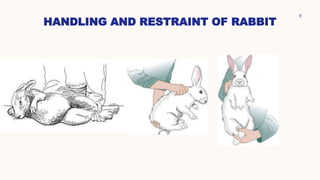
• The handler is restraining the rabbit firmly by the scruff with
the other hand ready to support the animal's hindquarters.
• There is no one correct method of handling or restraining
animals, but the general principle is that it should not cause
pain or discomfort to the animal. It should also be comfortable
for the handler.
HANDLING AND RESTRAINT OF RABBIT
9
TEST PROCEDURE
Presentation title 10
Dose level:-
• A dose of 0.5 mL of liquid or 0.5 g of solid or paste is applied to the test site.
Application of the test chemical:
• The test chemical should be applied to a dorsal flank region (approximately 6 cm 2)
of skin and covered with a gauze patch, which is held in place with non- irritating
tape.
• In cases in which direct application is not possible (e.g., liquids or some pastes), the
test chemical should first be applied to the gauze patch, which is then applied to
the skin.
• The patch should be loosely held in contact with the skin by means of a suitable
semi-occlusive dressing for the duration of the exposure period.
11
Fig:- Test substance is applied to a dorsal/flank region in
rabbit
12
• If the test chemical is applied to the patch, it should be
attached to the skin in such a manner that there is good
contact and uniform distribution of the test chemical on the
skin.
• Access by the animal to the patch and ingestion or inhalation
of the test chemical should be prevented.
• Liquid test chemicals are generally used undiluted.
• When testing solids (which may be pulverized, if considered
necessary), the test chemical should be moistened with the
smallest amount of water (or, where necessary, of another
suitable vehicle) sufficient to ensure good skin contact.
Presentation title 13
• When vehicles other than water are used, the potential influence of the
vehicle on irritation of the skin by the test chemical should be minimal, if
any.
• At the end of the exposure period, which is normally 4 hours, residual test
chemical should be removed, where practicable, using water or an
appropriate solvent without altering the existing response or the integrity
of the epidermis.
Presentation title 14
INITIAL TEST (USING ONE ANIMAL):-
When a test chemical has been judged to be corrosive, irritant or non-
classified on the basis of a weight of evidence analyses or of previous in
vitro testing, further in vivo testing is normally not necessary.
However, in the cases where additional data are felt warranted, the in
vivo test is performed initially using one animal and applying the
following approach.
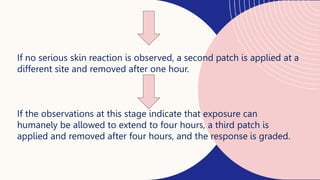
Up to three test patches are applied sequentially to the animal. The first
patch is removed after three minutes.
If no serious skin reaction is observed, a second patch is applied at a
different site and removed after one hour.
If the observations at this stage indicate that exposure can
humanely be allowed to extend to four hours, a third patch is
applied and removed after four hours, and the response is graded.
Presentation title 16
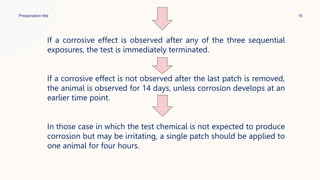
If a corrosive effect is observed after any of the three sequential
exposures, the test is immediately terminated.
If a corrosive effect is not observed after the last patch is removed,
the animal is observed for 14 days, unless corrosion develops at an
earlier time point.
In those case in which the test chemical is not expected to produce
corrosion but may be irritating, a single patch should be applied to
one animal for four hours.
Presentation title 17
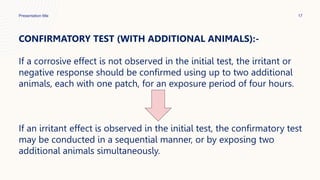
CONFIRMATORY TEST (WITH ADDITIONAL ANIMALS):-
If a corrosive effect is not observed in the initial test, the irritant or
negative response should be confirmed using up to two additional
animals, each with one patch, for an exposure period of four hours.
If an irritant effect is observed in the initial test, the confirmatory test
may be conducted in a sequential manner, or by exposing two
additional animals simultaneously.
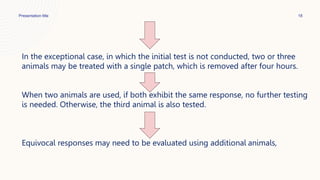
Presentation title 18
In the exceptional case, in which the initial test is not conducted, two or three
animals may be treated with a single patch, which is removed after four hours.
When two animals are used, if both exhibit the same response, no further testing
is needed. Otherwise, the third animal is also tested.
Equivocal responses may need to be evaluated using additional animals,
Presentation title 19
OBSERVATION PERIOD
• The duration of the observation period should be sufficient to evaluate fully
the reversibility of the effects observed.
• The experiment should be terminated at any time that the animal shows
continuing signs of severe pain or distress.
• To determine the reversibility of effects, the animals should be observed up
to 14 days after removal of the patches.
• If reversibility is seen before 14 days, the experiment should be
terminated at that time.
Presentation title 20
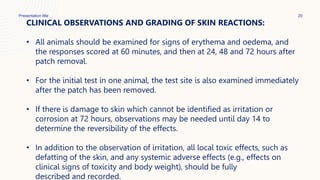
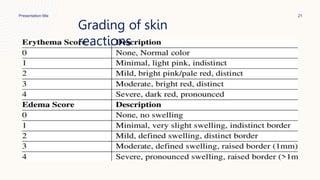
CLINICAL OBSERVATIONS AND GRADING OF SKIN REACTIONS:
• All animals should be examined for signs of erythema and oedema, and
the responses scored at 60 minutes, and then at 24, 48 and 72 hours after
patch removal.
• For the initial test in one animal, the test site is also examined immediately
after the patch has been removed.
• If there is damage to skin which cannot be identified as irritation or
corrosion at 72 hours, observations may be needed until day 14 to
determine the reversibility of the effects.
• In addition to the observation of irritation, all local toxic effects, such as
defatting of the skin, and any systemic adverse effects (e.g., effects on
clinical signs of toxicity and body weight), should be fully
described and recorded.
Presentation title 21
Grading of skin
reactions
Presentation title 22
DERMAL TOXICITY STUDIES
INTRODUCTION:-
• Dermal toxicity involves the assessment and evaluation of the toxic
characteristics of substance. It is useful where the exposure to
dermal route is likely.
Presentation title 23
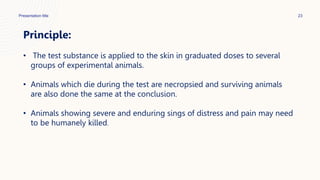
Principle:
• The test substance is applied to the skin in graduated doses to several
groups of experimental animals.
• Animals which die during the test are necropsied and surviving animals
are also done the same at the conclusion.
• Animals showing severe and enduring sings of distress and pain may need
to be humanely killed.
Presentation title 24
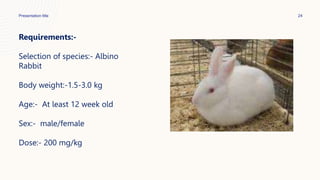
Requirements:-
Selection of species:- Albino
Rabbit
Body weight:-1.5-3.0 kg
Age:- At least 12 week old
Sex:- male/female
Dose:- 200 mg/kg
Presentation title 25
Preparation of test item:
• Solid- Moistened with distilled water/vehicle
• Liquids- applied directly without dilution.
Preparation of test animals:
• One day before application of the items, 10% of the total body surface area of
the animals will be clipped with electric clipper/ shaved with razor blade/
depilated with VEET cream.
• The position of clipping will be the area starting at the scapulac (shoulders) to
wring of the ilium (hipbone) and half way down the flunk on each side.
Presentation title 26
Test Procedure
Test material should be applied on shaved skin covering not less than 10% of the total body
surface area.
Porous gauze dressing should be used to hold liquid material in place.
Formulations with different concentrations (at least 3) of test substance, several fold higher
than the clinical dosage form should be used.
Presentation title 27
Period of application may vary from 7 to 90 days depending on the clinical
duration of use.
Where skin irritation is grossly visible in the initial studies, a recovery group
should be included in the subsequent repeated study.
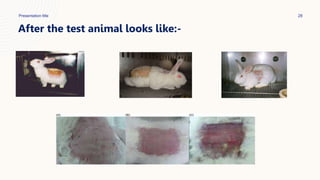
Local signs (erythema, oedema and Escher formation) as well as histopathological
examination of sites of application should be used for evaluation of results.
Presentation title 28
After the test animal looks like:-
Presentation title 29
Reference:-
• OECD/OCDE, Test No. 404; “Acute Dermal Irritation/Corrosion ‘. 28
July 2015 OECD publishing. Peris Page no. 1-8
• Robert A. Turner, Screening Methods in Pharmacology: 1 st edition;
Academic press an imprint of Elsevier, page no. 279-281.
• OECD Guidelines for testing of chemicals , ‘Repeated Dose Dermal
Toxicity’, 21/28-day study page no. 1
Presentation title 30

dermal irritation and dermal toxicity studies.pptx

  • 1.
    DERMAL IRRITATION AND DERMALTOXICITY STUDIES Presented by Yash Vikhankar M Pharm​
  • 2.
    CONTENTS DERMAL IRRITATION • INTRODUCTION •PRINCIPLE • PREPARATION OF THE IN VIVO TEST • TEST PROCEDURE • OBSRVAATION AND GRAADNG DERMAL TOXICITY • INTRODUCTION • PRINCIPLE • TEST PROCEDURE
  • 3.
    INTRODUCTION Dermal irritation isthe production of reversible damage of the skin following the application of a test chemical for up to 4 hours. Corrosive reactions are typified by ulcers, bleeding, bloody scabs, and, by the end of observation at 14 days, by discoloration due to blanching of the skin, complete areas of alopecia, and scars. Histopathology should be considered to evaluate questionable lesions. Dermal corrosion is the production of irreversible damage of the skin; namely. visible necrosis through the epidermis and into the dermis, following the application of a test chemical for up to four hours. Presentation title 3
  • 4.
    PRINCIPLE • The testchemical to be tested is applied in a single dose to the skin of an experimental animal; untreated skin areas of the test animal serve as the control. • The degree of irritation/corrosion is read and scored at specified intervals and is further described in order to provide a complete evaluation of the effects. • The duration of the study should be sufficient to evaluate the reversibility or irreversibility of the effects observed. • Animals showing continuing signs of severe distress and/or pain at any stage of the test should be humanely killed, and the test chemical assessed accordingly. • Criteria for making the decision to humanely kill moribund and severely suffering animals are the subject of a separate guidance document.
  • 5.
    PREPARATION FOR INVIVO TEST Presentation title 5 Selection of animal species:- • The Albino Rabbit is preferable laboratory animal and healthy young adult rabbits are used. • A rationale for other species should provided ALBINO RABBIT
  • 6.
    CONT… Presentation title 6 •Approximately 24 hr before the test, for should be removed by closely clipping the dorsal area of the trunk of the animal. • Care should be taken to avoid abrading the skin, and only animal with healthy, intact skin should be used. • Some strain of rabbit have dense patches of hair that are more prominent at certain times of the year. Such areas of dense hair growth should not be used as test sites. Dorsal region Flank region
  • 7.
    HOUSING ANG FEEDINGCONDITIONS:- • Rabbit at least 12 weeks old and body weight 1.5 kg-3.0 kg. • The temperature should be 20 c (± 30C) for rabbits. • Relative humidity should be at least 30% and preferably not exceed 70%, other than during room cleaning; the aim should be 50-60%. • Lighting should be 12 hours light, 12 hours dark. • For feeding, conventional laboratory diets may be used with an unrestricted supply of drinking water. 7
  • 8.
    Presentation title 8 HANDLINGAND RESTRAINT • Rabbits are especially susceptible to the effects of stress and should always be approached in a calm and confident manner. • The handler is restraining the rabbit firmly by the scruff with the other hand ready to support the animal's hindquarters. • There is no one correct method of handling or restraining animals, but the general principle is that it should not cause pain or discomfort to the animal. It should also be comfortable for the handler.
  • 9.
  • 10.
    TEST PROCEDURE Presentation title10 Dose level:- • A dose of 0.5 mL of liquid or 0.5 g of solid or paste is applied to the test site. Application of the test chemical: • The test chemical should be applied to a dorsal flank region (approximately 6 cm 2) of skin and covered with a gauze patch, which is held in place with non- irritating tape. • In cases in which direct application is not possible (e.g., liquids or some pastes), the test chemical should first be applied to the gauze patch, which is then applied to the skin. • The patch should be loosely held in contact with the skin by means of a suitable semi-occlusive dressing for the duration of the exposure period.
  • 11.
    11 Fig:- Test substanceis applied to a dorsal/flank region in rabbit
  • 12.
    12 • If thetest chemical is applied to the patch, it should be attached to the skin in such a manner that there is good contact and uniform distribution of the test chemical on the skin. • Access by the animal to the patch and ingestion or inhalation of the test chemical should be prevented. • Liquid test chemicals are generally used undiluted. • When testing solids (which may be pulverized, if considered necessary), the test chemical should be moistened with the smallest amount of water (or, where necessary, of another suitable vehicle) sufficient to ensure good skin contact.
  • 13.
    Presentation title 13 •When vehicles other than water are used, the potential influence of the vehicle on irritation of the skin by the test chemical should be minimal, if any. • At the end of the exposure period, which is normally 4 hours, residual test chemical should be removed, where practicable, using water or an appropriate solvent without altering the existing response or the integrity of the epidermis.
  • 14.
    Presentation title 14 INITIALTEST (USING ONE ANIMAL):- When a test chemical has been judged to be corrosive, irritant or non- classified on the basis of a weight of evidence analyses or of previous in vitro testing, further in vivo testing is normally not necessary. However, in the cases where additional data are felt warranted, the in vivo test is performed initially using one animal and applying the following approach. Up to three test patches are applied sequentially to the animal. The first patch is removed after three minutes.
  • 15.
    If no seriousskin reaction is observed, a second patch is applied at a different site and removed after one hour. If the observations at this stage indicate that exposure can humanely be allowed to extend to four hours, a third patch is applied and removed after four hours, and the response is graded.
  • 16.
    Presentation title 16 Ifa corrosive effect is observed after any of the three sequential exposures, the test is immediately terminated. If a corrosive effect is not observed after the last patch is removed, the animal is observed for 14 days, unless corrosion develops at an earlier time point. In those case in which the test chemical is not expected to produce corrosion but may be irritating, a single patch should be applied to one animal for four hours.
  • 17.
    Presentation title 17 CONFIRMATORYTEST (WITH ADDITIONAL ANIMALS):- If a corrosive effect is not observed in the initial test, the irritant or negative response should be confirmed using up to two additional animals, each with one patch, for an exposure period of four hours. If an irritant effect is observed in the initial test, the confirmatory test may be conducted in a sequential manner, or by exposing two additional animals simultaneously.
  • 18.
    Presentation title 18 Inthe exceptional case, in which the initial test is not conducted, two or three animals may be treated with a single patch, which is removed after four hours. When two animals are used, if both exhibit the same response, no further testing is needed. Otherwise, the third animal is also tested. Equivocal responses may need to be evaluated using additional animals,
  • 19.
    Presentation title 19 OBSERVATIONPERIOD • The duration of the observation period should be sufficient to evaluate fully the reversibility of the effects observed. • The experiment should be terminated at any time that the animal shows continuing signs of severe pain or distress. • To determine the reversibility of effects, the animals should be observed up to 14 days after removal of the patches. • If reversibility is seen before 14 days, the experiment should be terminated at that time.
  • 20.
    Presentation title 20 CLINICALOBSERVATIONS AND GRADING OF SKIN REACTIONS: • All animals should be examined for signs of erythema and oedema, and the responses scored at 60 minutes, and then at 24, 48 and 72 hours after patch removal. • For the initial test in one animal, the test site is also examined immediately after the patch has been removed. • If there is damage to skin which cannot be identified as irritation or corrosion at 72 hours, observations may be needed until day 14 to determine the reversibility of the effects. • In addition to the observation of irritation, all local toxic effects, such as defatting of the skin, and any systemic adverse effects (e.g., effects on clinical signs of toxicity and body weight), should be fully described and recorded.
  • 21.
  • 22.
    Presentation title 22 DERMALTOXICITY STUDIES INTRODUCTION:- • Dermal toxicity involves the assessment and evaluation of the toxic characteristics of substance. It is useful where the exposure to dermal route is likely.
  • 23.
    Presentation title 23 Principle: •The test substance is applied to the skin in graduated doses to several groups of experimental animals. • Animals which die during the test are necropsied and surviving animals are also done the same at the conclusion. • Animals showing severe and enduring sings of distress and pain may need to be humanely killed.
  • 24.
    Presentation title 24 Requirements:- Selectionof species:- Albino Rabbit Body weight:-1.5-3.0 kg Age:- At least 12 week old Sex:- male/female Dose:- 200 mg/kg
  • 25.
    Presentation title 25 Preparationof test item: • Solid- Moistened with distilled water/vehicle • Liquids- applied directly without dilution. Preparation of test animals: • One day before application of the items, 10% of the total body surface area of the animals will be clipped with electric clipper/ shaved with razor blade/ depilated with VEET cream. • The position of clipping will be the area starting at the scapulac (shoulders) to wring of the ilium (hipbone) and half way down the flunk on each side.
  • 26.
    Presentation title 26 TestProcedure Test material should be applied on shaved skin covering not less than 10% of the total body surface area. Porous gauze dressing should be used to hold liquid material in place. Formulations with different concentrations (at least 3) of test substance, several fold higher than the clinical dosage form should be used.
  • 27.
    Presentation title 27 Periodof application may vary from 7 to 90 days depending on the clinical duration of use. Where skin irritation is grossly visible in the initial studies, a recovery group should be included in the subsequent repeated study. Local signs (erythema, oedema and Escher formation) as well as histopathological examination of sites of application should be used for evaluation of results.
  • 28.
    Presentation title 28 Afterthe test animal looks like:-
  • 29.
    Presentation title 29 Reference:- •OECD/OCDE, Test No. 404; “Acute Dermal Irritation/Corrosion ‘. 28 July 2015 OECD publishing. Peris Page no. 1-8 • Robert A. Turner, Screening Methods in Pharmacology: 1 st edition; Academic press an imprint of Elsevier, page no. 279-281. • OECD Guidelines for testing of chemicals , ‘Repeated Dose Dermal Toxicity’, 21/28-day study page no. 1
  • 30.