BY,
SHEBINA. A
ROLL NO:
15
Materials that respond to a stimulus in the
form of a mechanical property change such
as a dimensional or a viscosity change.
Eg: Simple amplifier ( converts low energy signal
into high power signal)
Transducer( energy of the amplified control
signal is converted into work)
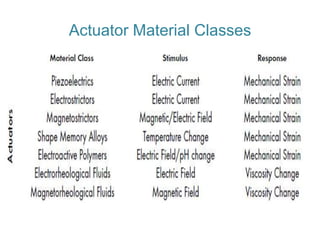
Actuator Material Classes
Actuator Materials
• Shape Memory Alloys
• Magnetostrictive Materials
• Piezoelectric & Electrostrictive Materials
• Electrorheological & Magnetorheological
Fluids
Shape Memory Alloys
• Ability of material to regain its original
shape when heated to a temp, after being
deformed at a lower temp.
• Shape memory effect occurs in a no: of
alloys, which undergo a special type of
transformation called the ‘
• SMAs are useful for actuators as they
change
shape
 tiffness
 osition
 atural frequency and
 ther mechanical characteristics
in response to temp or electromagnetic
fields. The diverse applications for these
metals have made them increasingly
important
Types:-
• Copper - aluminium - nickel
• Copper - zinc - aluminium
• Iron - manganese - silicon
(nitinol) – most useful
• Ni-Ti has that this
alloy exhibits above transformation temperature
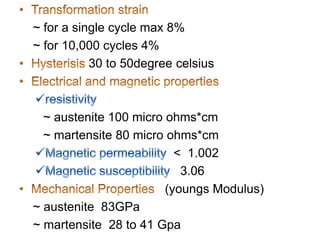
~ for a single cycle max 8%
~ for 10,000 cycles 4%
30 to 50degree celsius
~ austenite 100 micro ohms*cm
~ martensite 80 micro ohms*cm
< 1.002
3.06
(youngs Modulus)
~ austenite 83GPa
~ martensite 28 to 41 Gpa
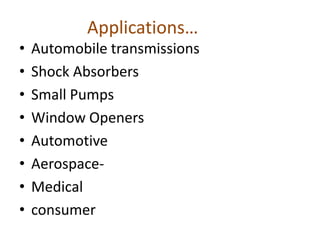
Applications…
• Automobile transmissions
• Shock Absorbers
• Small Pumps
• Window Openers
• Automotive
• Aerospace-
• Medical
• consumer
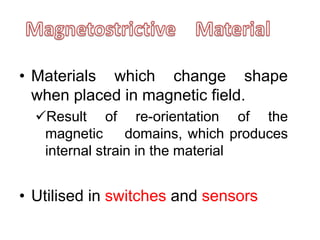
• Materials which change shape
when placed in magnetic field.
Result of re-orientation of the
magnetic domains, which produces
internal strain in the material
• Utilised in switches and sensors
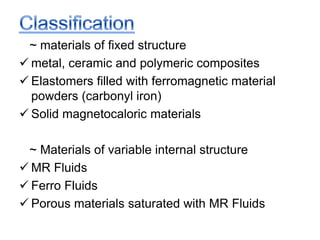
~ materials of fixed structure
 metal, ceramic and polymeric composites
 Elastomers filled with ferromagnetic material
powders (carbonyl iron)
 Solid magnetocaloric materials
~ Materials of variable internal structure
 MR Fluids
 Ferro Fluids
 Porous materials saturated with MR Fluids
Electrical energy mechanical energy
• Giant Magnetostrictive Materials such as rare
earth-iron feature magnetostrains two orders
of magnitude larger than Ni
• Terfenol – D : commercially available
• Positive microstrains of 1000 to 2000ppm are
reported to terfenol-D
• NiMnGa alloys offering a microstrain up 6%
• Young's modulus- 2.5-3.5x10¹⁰ N/m3
• Tensile strength- 28MPa
• Compressive strength- 300MPa
• Density- 9250kg/m3
• Strain- 0.6%
• Force : offer large force
• Voltage : Its is adjusted by no:of
turns in the coil. With high current
and large section wires, required
magnetic field produced with low
voltage
Applications
• Active noise and vibration cancellation
• Sonar
• Fuel injection
• Medical
• Nozzle anti-clogging system (paper)
• Screening applications
• Metals casting industry
• Sonar transducers – very high power
transducers, long range transmissions
and communication applications
• Hydraulic valves – high speed valves
• Inchworm motors – in low frequency
sound transducers
• Materials that exhibit an electrical polarization
with an applied mechanical stress
• 2 types
~ piezoceramic
 relatively stiff
Large piezoelectric constant
~ piezopolymer
Relatively flexible
Large voltage capacity
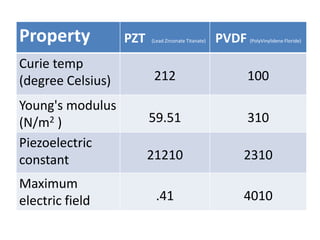
Property PZT (Lead Zirconate Titanate) PVDF (PolyVinylidene Floride)
Curie temp
(degree Celsius) 212 100
Young's modulus
(N/m2 ) 59.51 310
Piezoelectric
constant 21210 2310
Maximum
electric field .41 4010
• A change in dimensions of material
due to the application of electric field
• Non – linear response
• No hysteresis
• A quick response time
• Higher displacements with good
reproducibility
~ APPLICATIONS
• Micro positioned
• Adaptive optics
• Rheology is the science of the flow and
deformation of matter. i.e., response of the
matter to a force or stress
• Viscous fluid can be altered by ER fluids by
application of electric field. Response time is
typically a millisecond
• Colloidal suspensions of dielectric solids in
non-conducting liquids
• In absence of electric field, colloidal
suspension –fine particle, uniformly
distributed
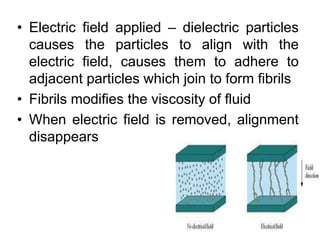
• Electric field applied – dielectric particles
causes the particles to align with the
electric field, causes them to adhere to
adjacent particles which join to form fibrils
• Fibrils modifies the viscosity of fluid
• When electric field is removed, alignment
disappears
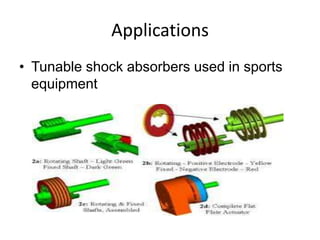
Applications
• Tunable shock absorbers used in sports
equipment
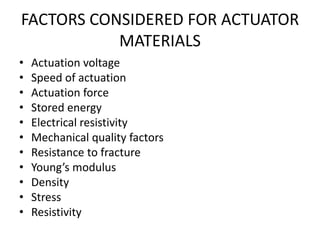
FACTORS CONSIDERED FOR ACTUATOR
MATERIALS
• Actuation voltage
• Speed of actuation
• Actuation force
• Stored energy
• Electrical resistivity
• Mechanical quality factors
• Resistance to fracture
• Young’s modulus
• Density
• Stress
• Resistivity

Actuators in smart materials

  • 1.
  • 2.
    Materials that respondto a stimulus in the form of a mechanical property change such as a dimensional or a viscosity change. Eg: Simple amplifier ( converts low energy signal into high power signal) Transducer( energy of the amplified control signal is converted into work)
  • 3.
  • 4.
    Actuator Materials • ShapeMemory Alloys • Magnetostrictive Materials • Piezoelectric & Electrostrictive Materials • Electrorheological & Magnetorheological Fluids
  • 5.
    Shape Memory Alloys •Ability of material to regain its original shape when heated to a temp, after being deformed at a lower temp. • Shape memory effect occurs in a no: of alloys, which undergo a special type of transformation called the ‘
  • 6.
    • SMAs areuseful for actuators as they change shape  tiffness  osition  atural frequency and  ther mechanical characteristics in response to temp or electromagnetic fields. The diverse applications for these metals have made them increasingly important
  • 7.
    Types:- • Copper -aluminium - nickel • Copper - zinc - aluminium • Iron - manganese - silicon (nitinol) – most useful • Ni-Ti has that this alloy exhibits above transformation temperature
  • 8.
    ~ for asingle cycle max 8% ~ for 10,000 cycles 4% 30 to 50degree celsius ~ austenite 100 micro ohms*cm ~ martensite 80 micro ohms*cm < 1.002 3.06 (youngs Modulus) ~ austenite 83GPa ~ martensite 28 to 41 Gpa
  • 9.
    Applications… • Automobile transmissions •Shock Absorbers • Small Pumps • Window Openers • Automotive • Aerospace- • Medical • consumer
  • 10.
    • Materials whichchange shape when placed in magnetic field. Result of re-orientation of the magnetic domains, which produces internal strain in the material • Utilised in switches and sensors
  • 11.
    ~ materials offixed structure  metal, ceramic and polymeric composites  Elastomers filled with ferromagnetic material powders (carbonyl iron)  Solid magnetocaloric materials ~ Materials of variable internal structure  MR Fluids  Ferro Fluids  Porous materials saturated with MR Fluids
  • 12.
    Electrical energy mechanicalenergy • Giant Magnetostrictive Materials such as rare earth-iron feature magnetostrains two orders of magnitude larger than Ni • Terfenol – D : commercially available • Positive microstrains of 1000 to 2000ppm are reported to terfenol-D • NiMnGa alloys offering a microstrain up 6%
  • 13.
    • Young's modulus-2.5-3.5x10¹⁰ N/m3 • Tensile strength- 28MPa • Compressive strength- 300MPa • Density- 9250kg/m3 • Strain- 0.6%
  • 14.
    • Force :offer large force • Voltage : Its is adjusted by no:of turns in the coil. With high current and large section wires, required magnetic field produced with low voltage
  • 15.
    Applications • Active noiseand vibration cancellation • Sonar • Fuel injection • Medical • Nozzle anti-clogging system (paper) • Screening applications • Metals casting industry
  • 16.
    • Sonar transducers– very high power transducers, long range transmissions and communication applications • Hydraulic valves – high speed valves • Inchworm motors – in low frequency sound transducers
  • 17.
    • Materials thatexhibit an electrical polarization with an applied mechanical stress • 2 types ~ piezoceramic  relatively stiff Large piezoelectric constant ~ piezopolymer Relatively flexible Large voltage capacity
  • 18.
    Property PZT (LeadZirconate Titanate) PVDF (PolyVinylidene Floride) Curie temp (degree Celsius) 212 100 Young's modulus (N/m2 ) 59.51 310 Piezoelectric constant 21210 2310 Maximum electric field .41 4010
  • 19.
    • A changein dimensions of material due to the application of electric field • Non – linear response • No hysteresis • A quick response time • Higher displacements with good reproducibility
  • 20.
    ~ APPLICATIONS • Micropositioned • Adaptive optics
  • 21.
    • Rheology isthe science of the flow and deformation of matter. i.e., response of the matter to a force or stress • Viscous fluid can be altered by ER fluids by application of electric field. Response time is typically a millisecond • Colloidal suspensions of dielectric solids in non-conducting liquids • In absence of electric field, colloidal suspension –fine particle, uniformly distributed
  • 22.
    • Electric fieldapplied – dielectric particles causes the particles to align with the electric field, causes them to adhere to adjacent particles which join to form fibrils • Fibrils modifies the viscosity of fluid • When electric field is removed, alignment disappears
  • 23.
    Applications • Tunable shockabsorbers used in sports equipment
  • 24.
    FACTORS CONSIDERED FORACTUATOR MATERIALS • Actuation voltage • Speed of actuation • Actuation force • Stored energy • Electrical resistivity • Mechanical quality factors • Resistance to fracture • Young’s modulus • Density • Stress • Resistivity