TOPIC:
SMARTMATERIALS
SMART MATERIAL
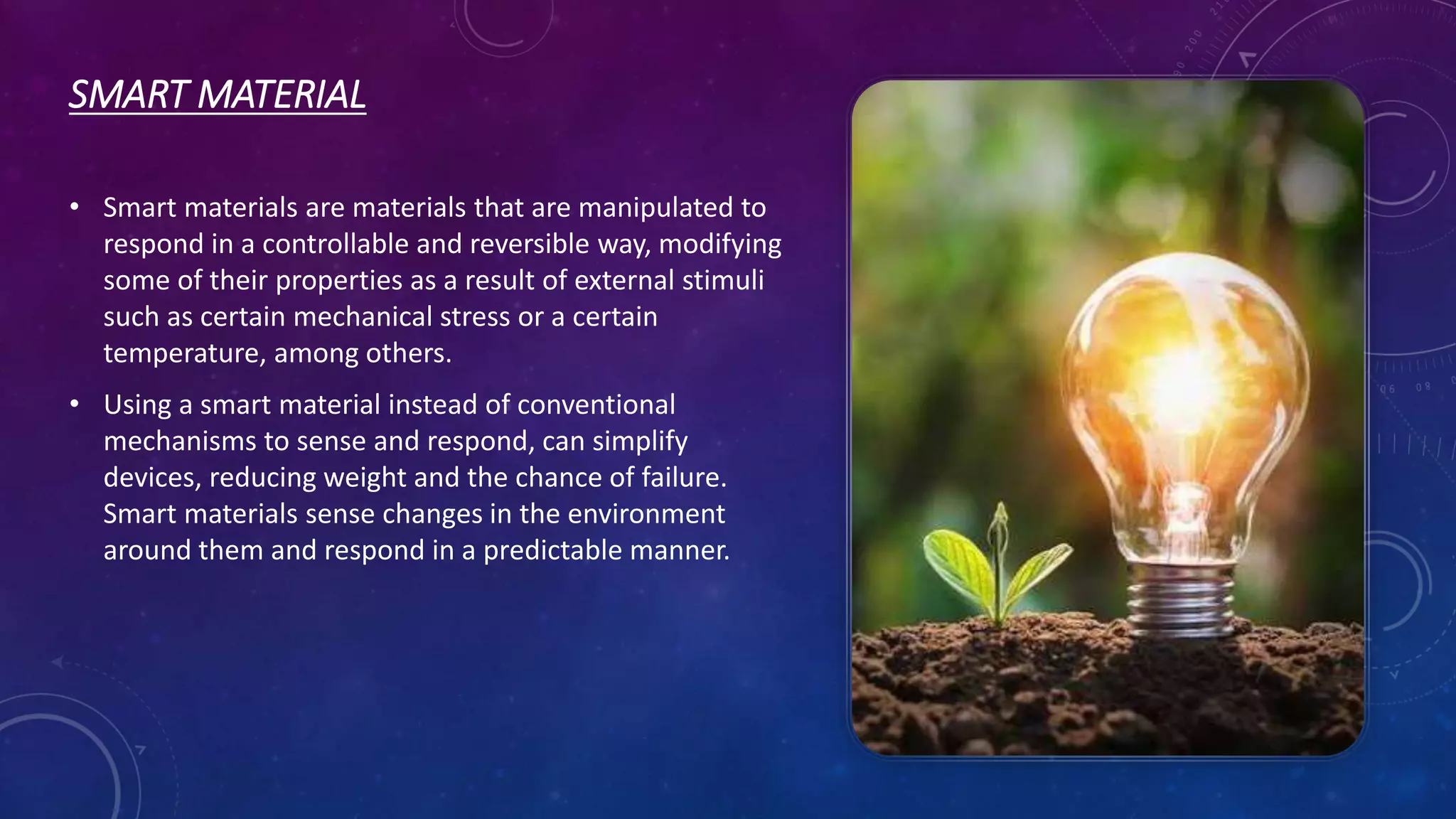
• Smart materials are materials that are manipulated to
respond in a controllable and reversible way, modifying
some of their properties as a result of external stimuli
such as certain mechanical stress or a certain
temperature, among others.
• Using a smart material instead of conventional
mechanisms to sense and respond, can simplify
devices, reducing weight and the chance of failure.
Smart materials sense changes in the environment
around them and respond in a predictable manner.
PROPERTIES OF SMART MATERIALS
• Sensing materials and device
• Actuation Materials and device
• Control device and techniques
• Self-detection , Self-diagnostic
• Self-corrective , Self-controlled , Self-healing
• Shock-absorbers, Damage arrest
CLASSIFICATION OF SMART MATERIALS
• Piezoelectric material
• Electrostrictive material
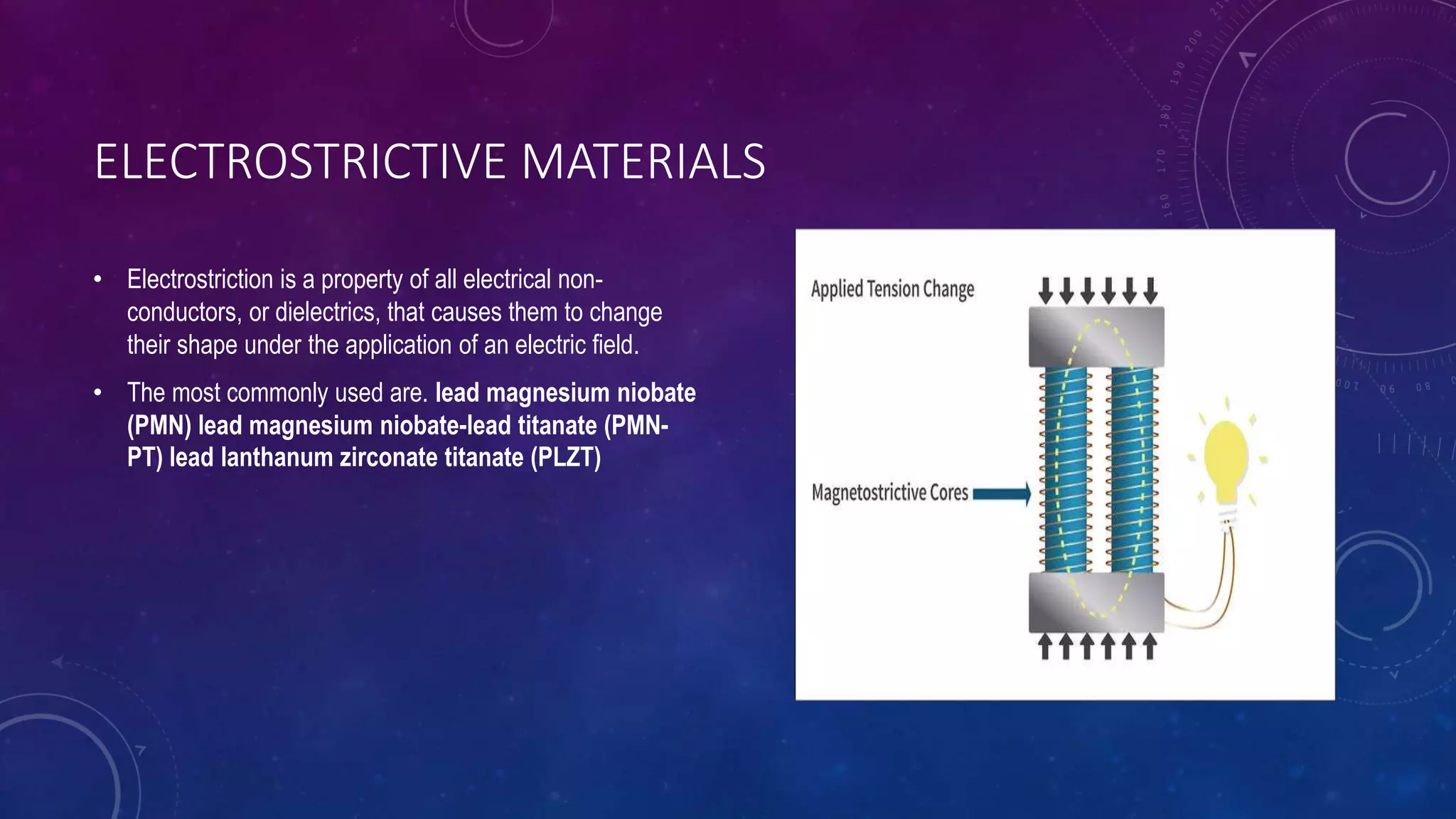
• Magnetostrictive material
• Rheological material
• Electrochromic material
• Thermoresponsive material
MAGNETOSTRICTIVE MATERIALS
• Magnetostrictive materials are a class of smart
materials that can convert energy between the
magnetic and elastic states. For this reason,
magnetostrictive materials and devices based on these
materials are often referred to as transducers.
• Materials are used in medical devices and industrial
vibrators, ultrasonic cleaning devices, underwater
sonar, vibration or noise control systems, and in many
other applications
PIEZOELECTRIC MATERIALS
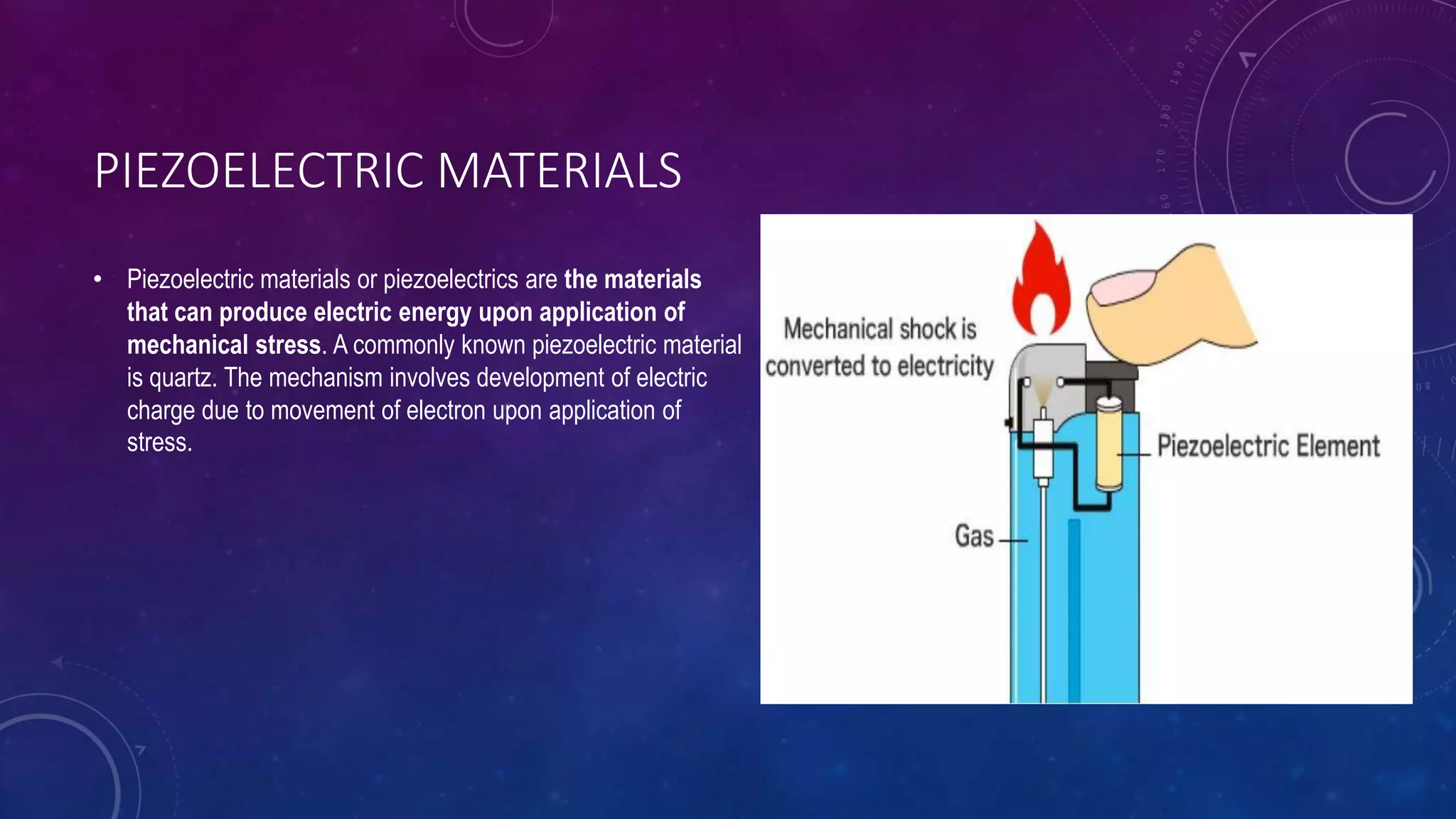
• Piezoelectric materials or piezoelectrics are the materials
that can produce electric energy upon application of
mechanical stress. A commonly known piezoelectric material
is quartz. The mechanism involves development of electric
charge due to movement of electron upon application of
stress.
ELECTROSTRICTIVE MATERIALS
• Electrostriction is a property of all electrical non-
conductors, or dielectrics, that causes them to change
their shape under the application of an electric field.
• The most commonly used are. lead magnesium niobate
(PMN) lead magnesium niobate-lead titanate (PMN-
PT) lead lanthanum zirconate titanate (PLZT)
RHEOLOGICAL MATERIAL
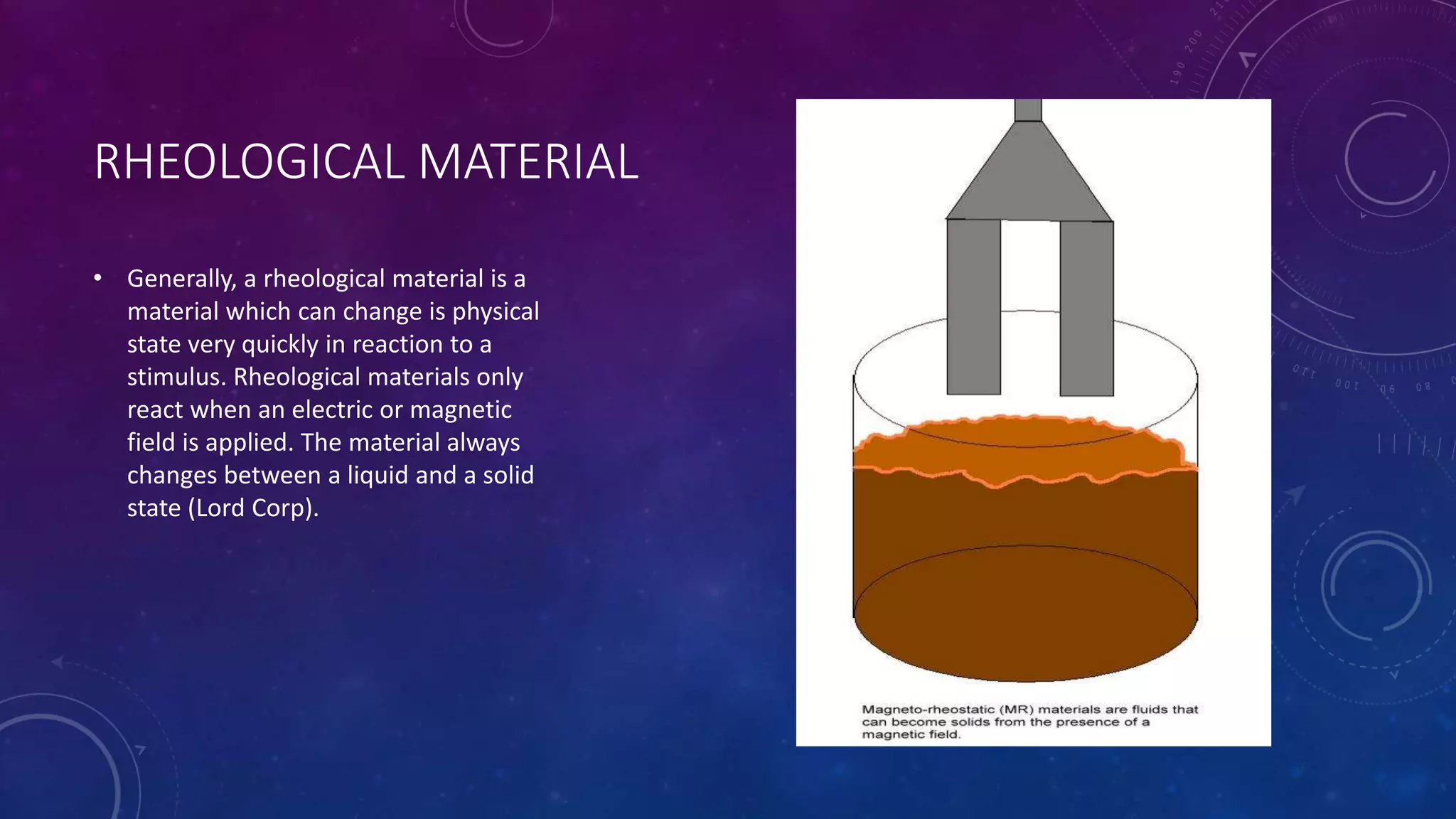
• Generally, a rheological material is a
material which can change is physical
state very quickly in reaction to a
stimulus. Rheological materials only
react when an electric or magnetic
field is applied. The material always
changes between a liquid and a solid
state (Lord Corp).
ELECTROCHROMIC MATERIAL
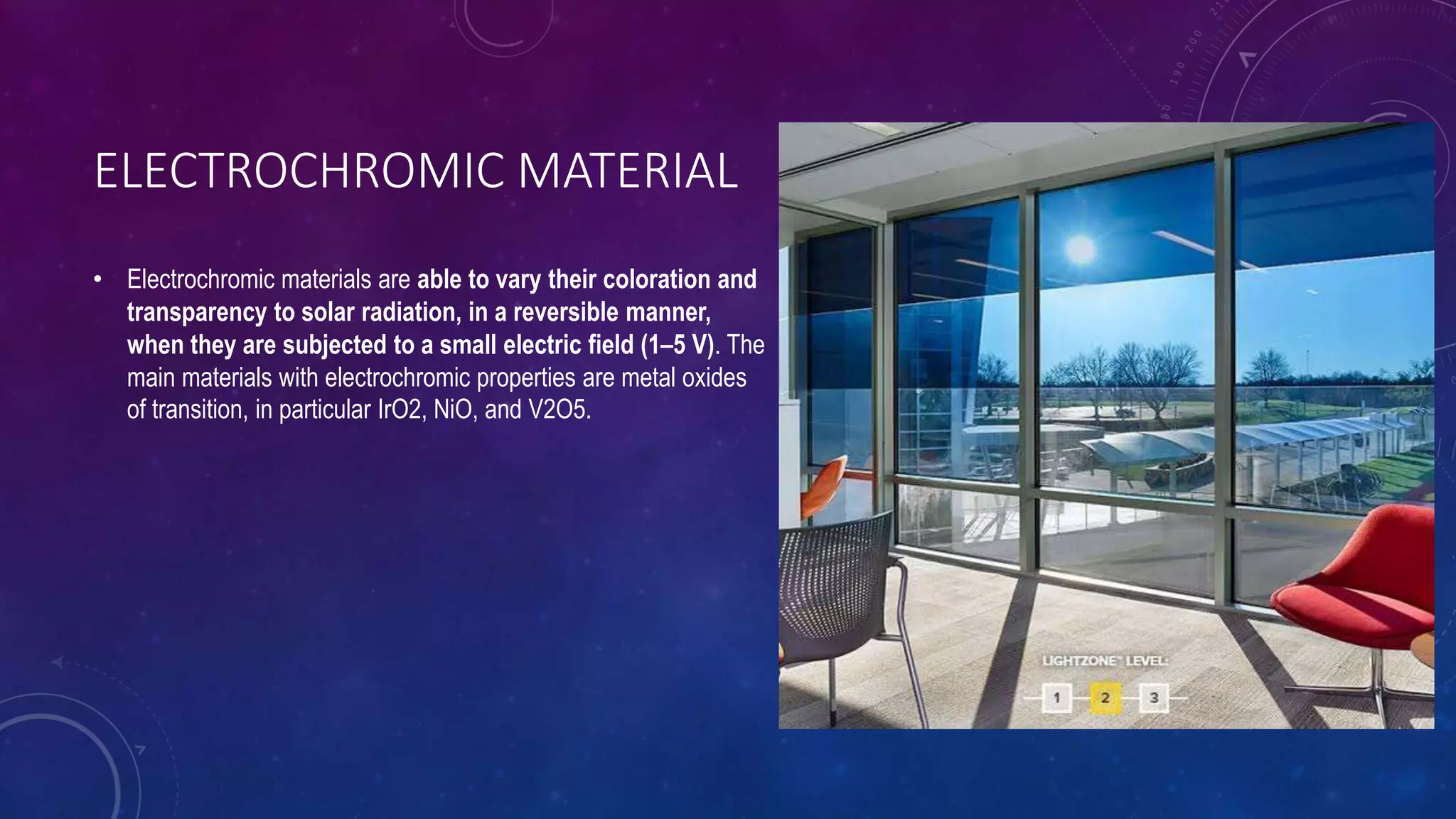
• Electrochromic materials are able to vary their coloration and
transparency to solar radiation, in a reversible manner,
when they are subjected to a small electric field (1–5 V). The
main materials with electrochromic properties are metal oxides
of transition, in particular IrO2, NiO, and V2O5.
THERMORESPONSIVE MATERIAL
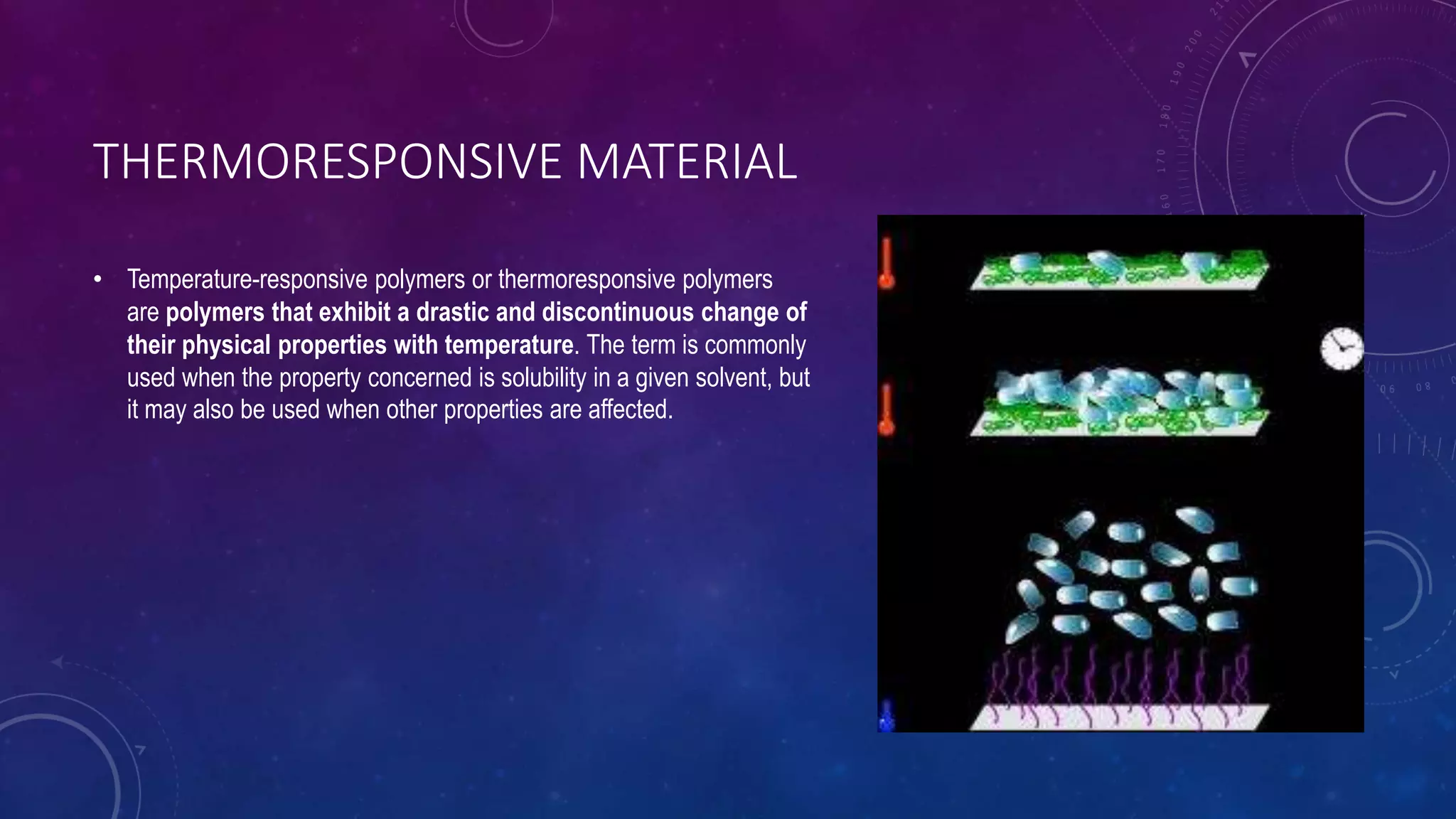
• Temperature-responsive polymers or thermoresponsive polymers
are polymers that exhibit a drastic and discontinuous change of
their physical properties with temperature. The term is commonly
used when the property concerned is solubility in a given solvent, but
it may also be used when other properties are affected.
ADVANTAGES OF SMART MATERIAL
• The main advantage of smart materials is that they give to material new
capabilities without the need of sensors, actuators or electronics. For
this reason, it is possible to get products that interact with the environment or
with people without the need for them to be connected to the electricity
supplies
DISADVANTAGES OF SMART MATERIAL
• vibration or lighting/color changes are used to get our attention, this
might be useful if it is used sparingly. If we get a lot of buzzes
against our skin, or our clothing rapidly is changing color or
displays or lights are blinking at us too much, smart fabrics
products could make people sick.
THANK YOU

Presentation.pptx

  • 1.
  • 2.
    SMART MATERIAL • Smartmaterials are materials that are manipulated to respond in a controllable and reversible way, modifying some of their properties as a result of external stimuli such as certain mechanical stress or a certain temperature, among others. • Using a smart material instead of conventional mechanisms to sense and respond, can simplify devices, reducing weight and the chance of failure. Smart materials sense changes in the environment around them and respond in a predictable manner.
  • 3.
    PROPERTIES OF SMARTMATERIALS • Sensing materials and device • Actuation Materials and device • Control device and techniques • Self-detection , Self-diagnostic • Self-corrective , Self-controlled , Self-healing • Shock-absorbers, Damage arrest
  • 4.
    CLASSIFICATION OF SMARTMATERIALS • Piezoelectric material • Electrostrictive material • Magnetostrictive material • Rheological material • Electrochromic material • Thermoresponsive material
  • 5.
    MAGNETOSTRICTIVE MATERIALS • Magnetostrictivematerials are a class of smart materials that can convert energy between the magnetic and elastic states. For this reason, magnetostrictive materials and devices based on these materials are often referred to as transducers. • Materials are used in medical devices and industrial vibrators, ultrasonic cleaning devices, underwater sonar, vibration or noise control systems, and in many other applications
  • 6.
    PIEZOELECTRIC MATERIALS • Piezoelectricmaterials or piezoelectrics are the materials that can produce electric energy upon application of mechanical stress. A commonly known piezoelectric material is quartz. The mechanism involves development of electric charge due to movement of electron upon application of stress.
  • 7.
    ELECTROSTRICTIVE MATERIALS • Electrostrictionis a property of all electrical non- conductors, or dielectrics, that causes them to change their shape under the application of an electric field. • The most commonly used are. lead magnesium niobate (PMN) lead magnesium niobate-lead titanate (PMN- PT) lead lanthanum zirconate titanate (PLZT)
  • 8.
    RHEOLOGICAL MATERIAL • Generally,a rheological material is a material which can change is physical state very quickly in reaction to a stimulus. Rheological materials only react when an electric or magnetic field is applied. The material always changes between a liquid and a solid state (Lord Corp).
  • 9.
    ELECTROCHROMIC MATERIAL • Electrochromicmaterials are able to vary their coloration and transparency to solar radiation, in a reversible manner, when they are subjected to a small electric field (1–5 V). The main materials with electrochromic properties are metal oxides of transition, in particular IrO2, NiO, and V2O5.
  • 10.
    THERMORESPONSIVE MATERIAL • Temperature-responsivepolymers or thermoresponsive polymers are polymers that exhibit a drastic and discontinuous change of their physical properties with temperature. The term is commonly used when the property concerned is solubility in a given solvent, but it may also be used when other properties are affected.
  • 11.
    ADVANTAGES OF SMARTMATERIAL • The main advantage of smart materials is that they give to material new capabilities without the need of sensors, actuators or electronics. For this reason, it is possible to get products that interact with the environment or with people without the need for them to be connected to the electricity supplies
  • 12.
    DISADVANTAGES OF SMARTMATERIAL • vibration or lighting/color changes are used to get our attention, this might be useful if it is used sparingly. If we get a lot of buzzes against our skin, or our clothing rapidly is changing color or displays or lights are blinking at us too much, smart fabrics products could make people sick.
  • 13.