Gayon, Jio RossGayon, Jio Ross
Godfrey S.Godfrey S.
Oarde, Kevin Victor L.Oarde, Kevin Victor L.
Zaide, John Chester A.Zaide, John Chester A.
Wind TunnelWind Tunnel
2/26
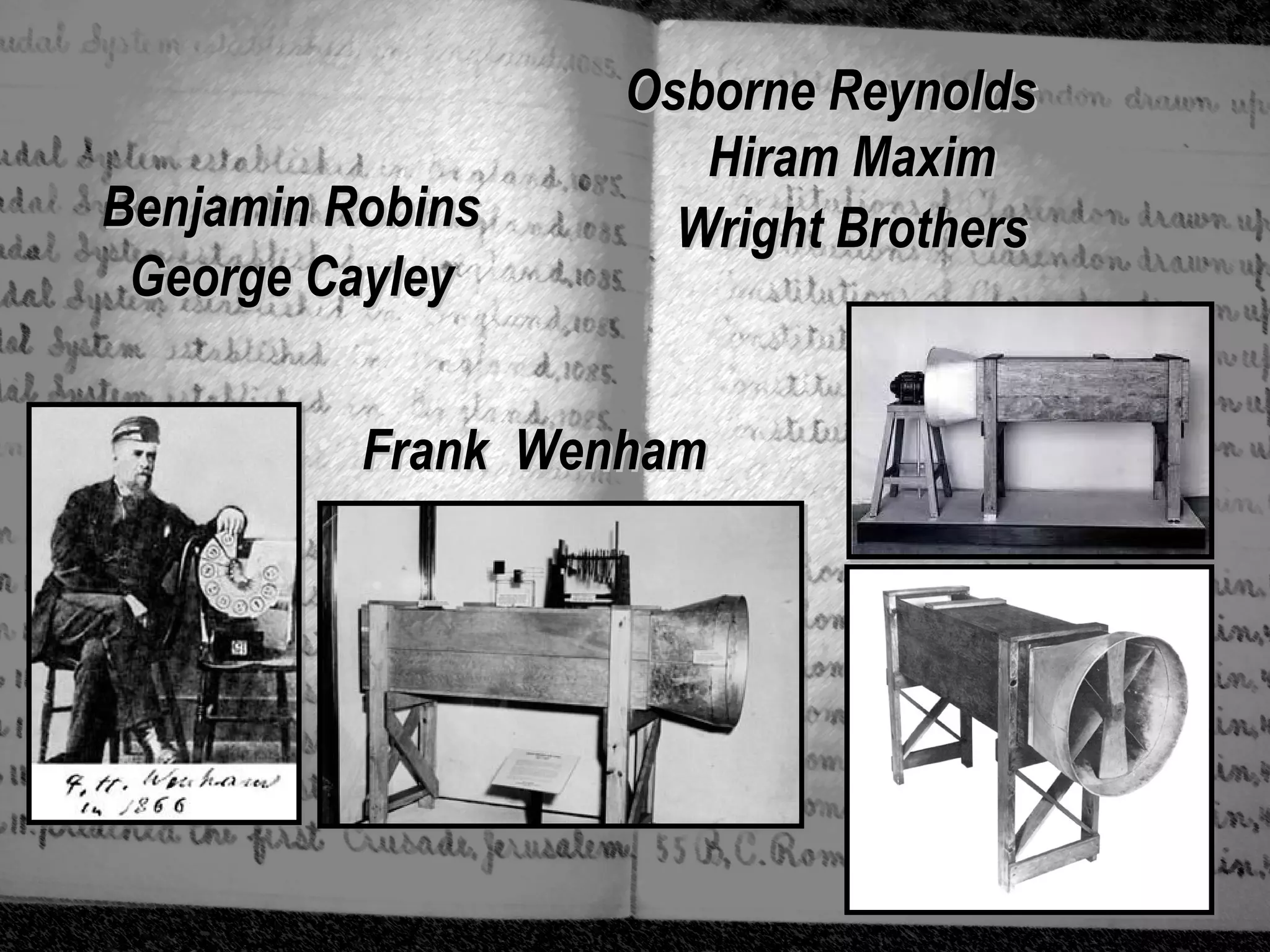
Frank WenhamFrank Wenham
Benjamin RobinsBenjamin Robins
George CayleyGeorge Cayley
Osborne ReynoldsOsborne Reynolds
Hiram MaximHiram Maxim
Wright BrothersWright Brothers
3/26
IntroductionIntroduction
What is a Wind Tunnel?
AE 412
Introduction Classifications Elements Types Shapes Flow Visualization
 a facility that provides a controllable
flow field for investigating various flow
phenomena and testing aerodynamic
models
 a tool used in aerodynamic research
to study the effects of air moving past
solid objects
*** Advantage: experiments can be performed under well-controlled
flow circumstances compared to open environment experiments
4/26
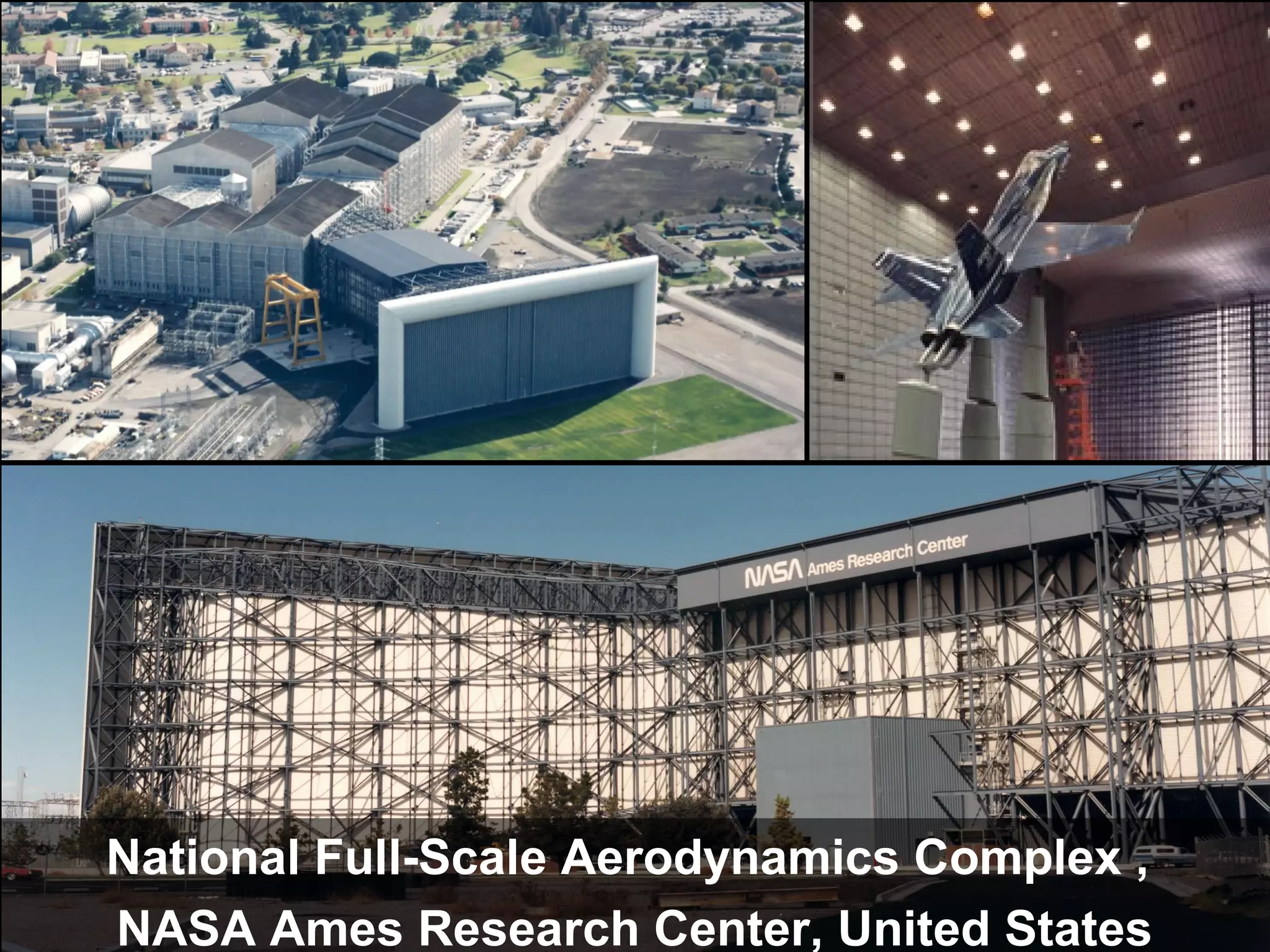
National Full-Scale Aerodynamics Complex ,
NASA Ames Research Center, United States
5/26
Aeronautical Wind Tunnels
Automobile Tunnels
Aeroacoustic Tunnels
Classifications of Wind TunnelClassifications of Wind Tunnel
Introduction Classifications Elements Types Shapes Flow Visualization
AE 412
6/26
Aeronautical Wind TunnelsAeronautical Wind Tunnels
High Reynold’s Number Tunnels
Pressurized Tunnels
Heavy Gas Tunnels
Cryogenic Tunnels
High-altitude Tunnels
V/STOL Tunnels
Spin Tunnels
Introduction Classifications Elements Types Shapes Flow Visualization
AE 412
7/26
Tunnels are also classified by flow speed:
Subsonic (M<.8),
Transonic (.8<M<1.2),
Supersonic (1.2<M<5.0), or
Hypersonic (M>5.0)
Introduction Classifications Elements Types Shapes Flow Visualization
AE 412
8/26
Wind tunnels may also be classified according to their
air pressure:
atmospheric
variable- density
or their size:
ordinary
full-scale
Introduction Classifications Elements Types Shapes Flow Visualization
AE 412
9/26
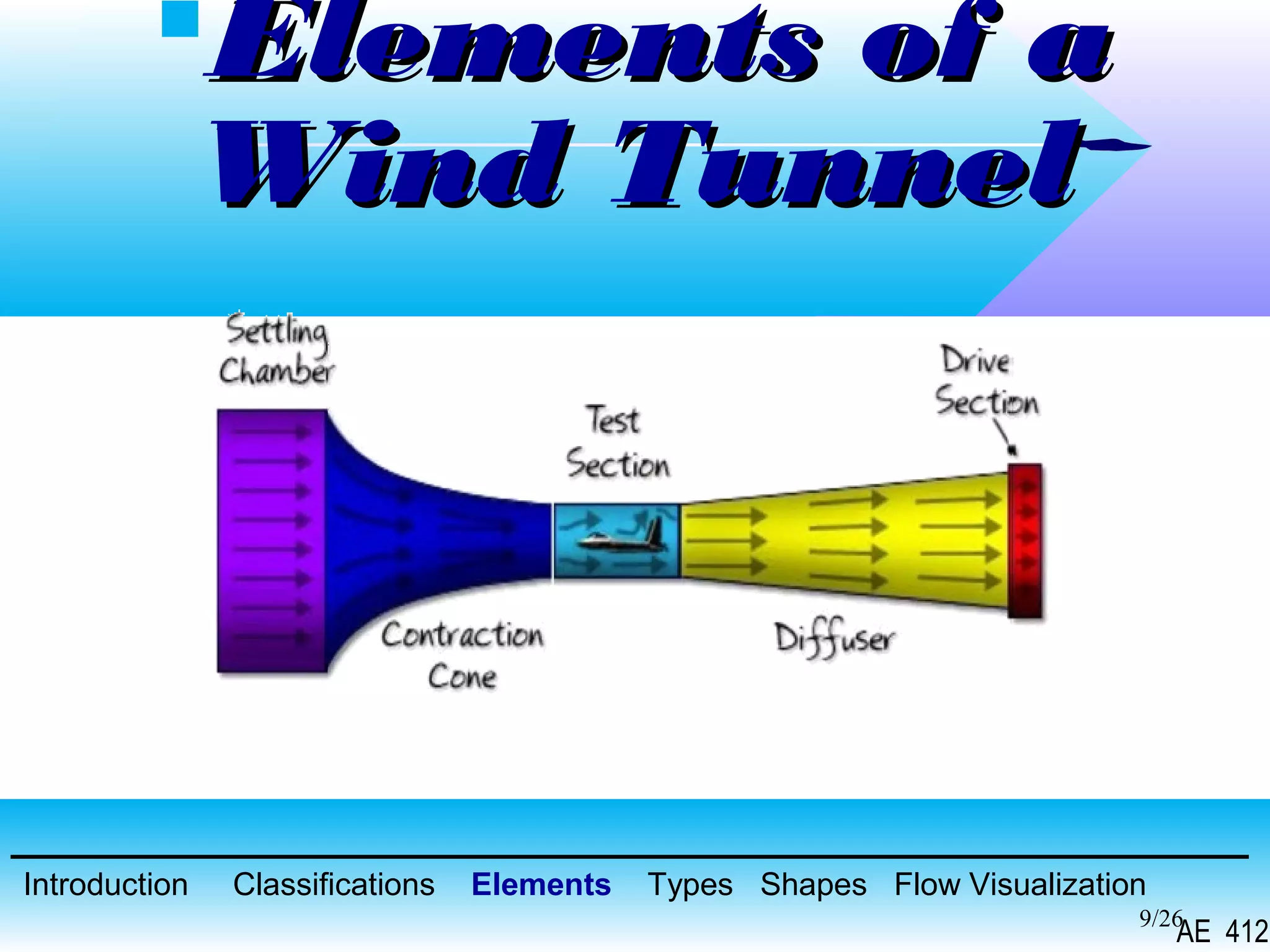
Elements of aElements of a
Wind TunnelWind Tunnel
Introduction Classifications Elements Types Shapes Flow Visualization
AE 412
10/26
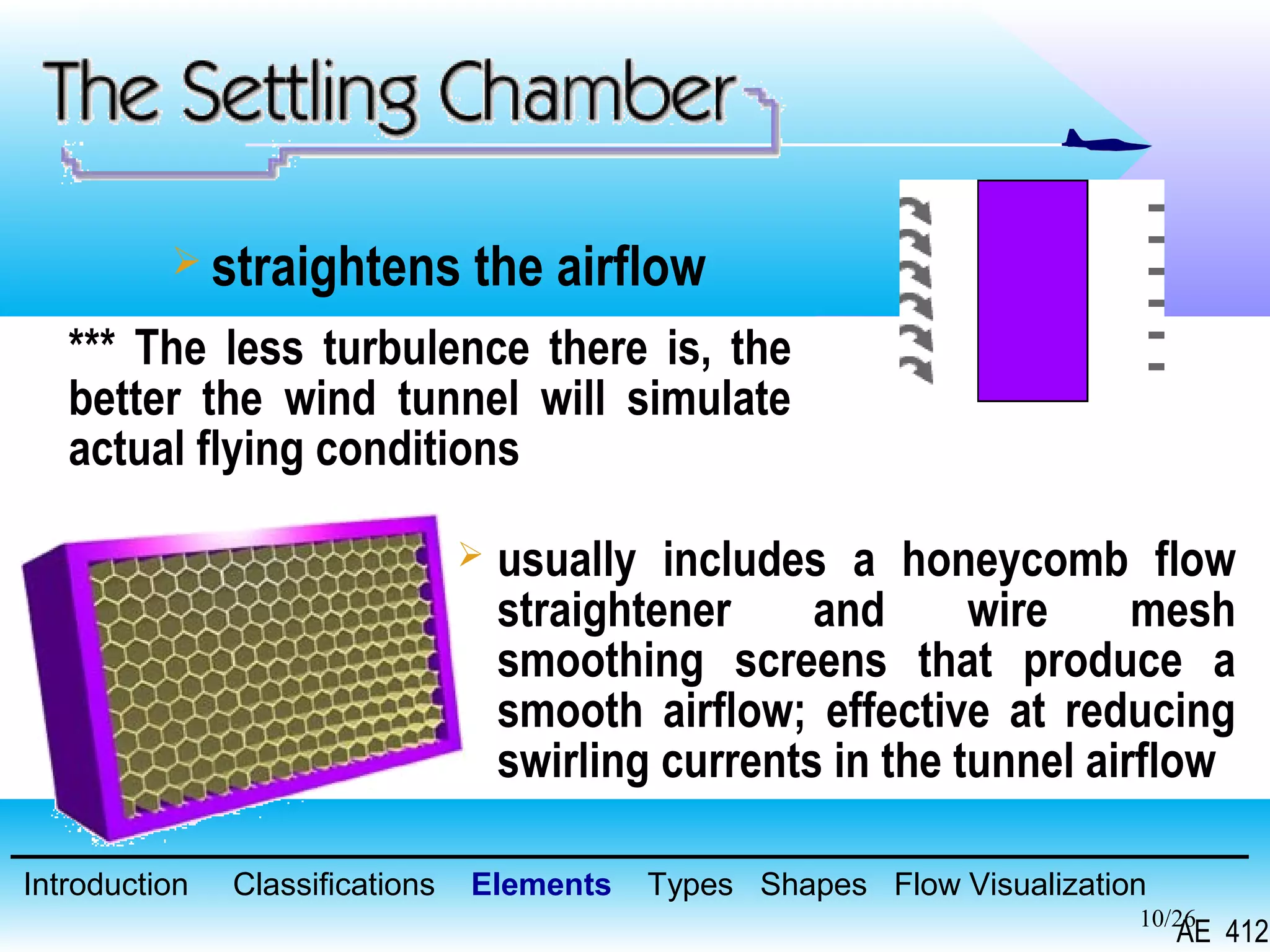
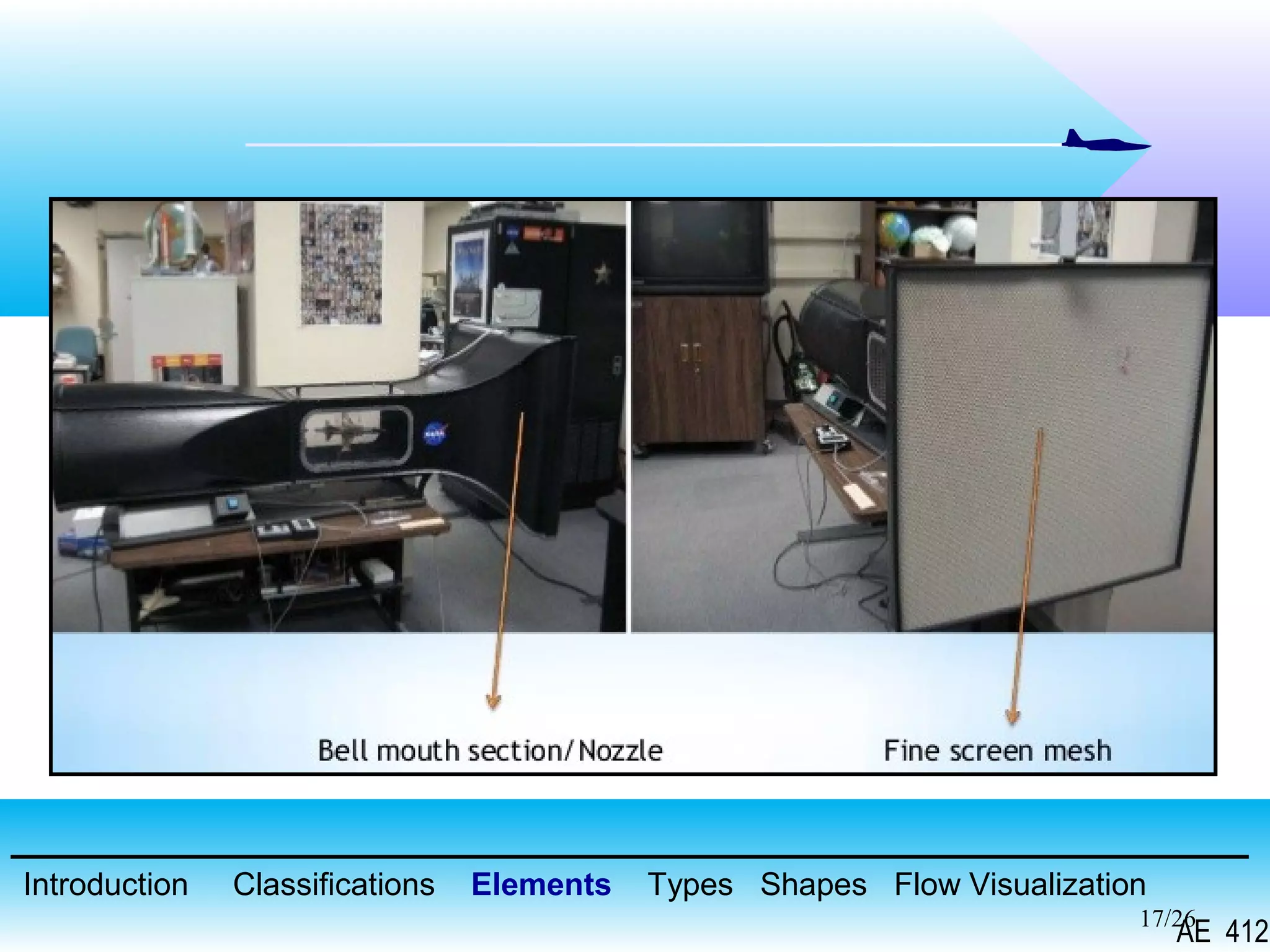
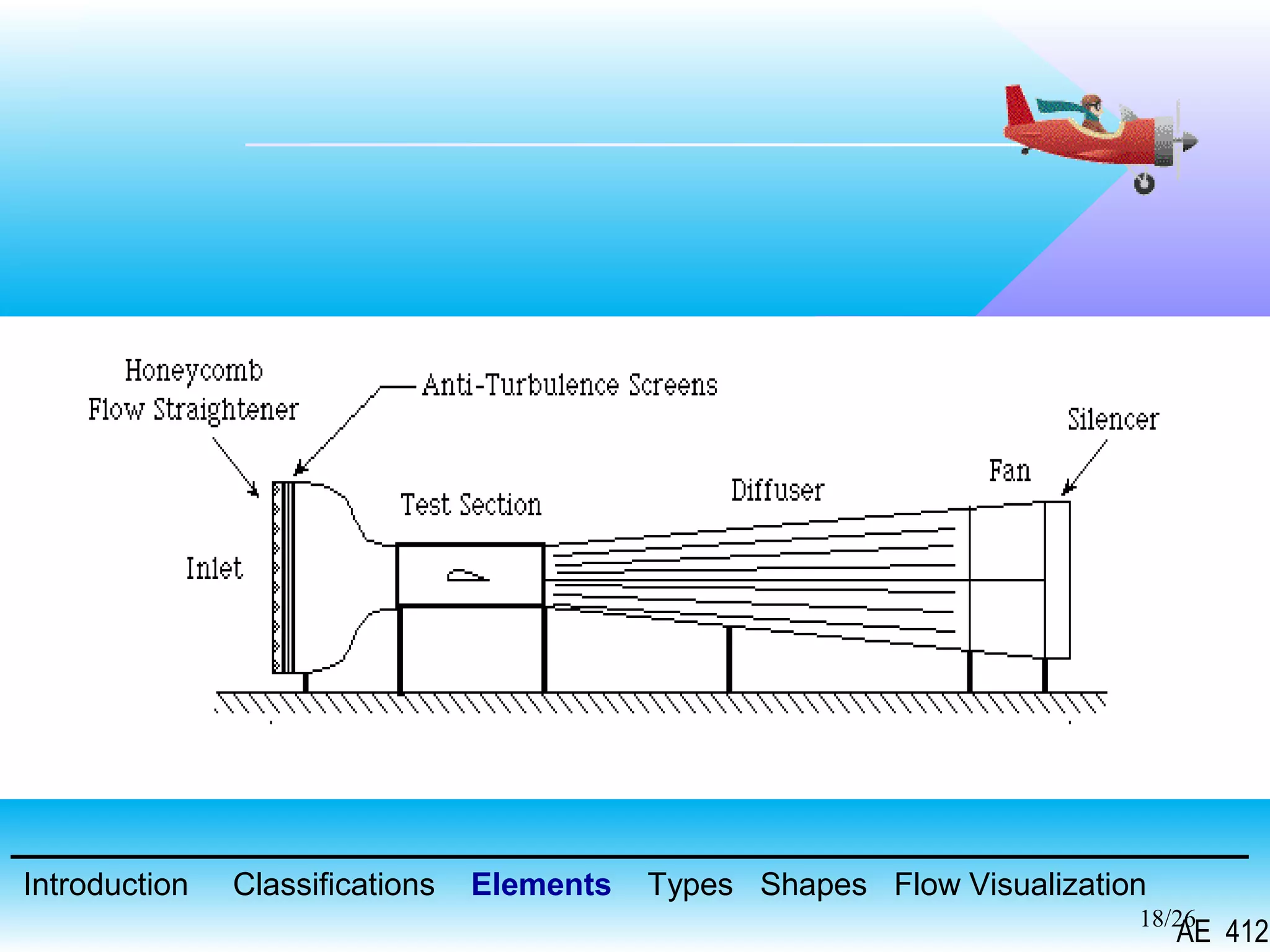
 straightens the airflow
*** The less turbulence there is, the
better the wind tunnel will simulate
actual flying conditions
 usually includes a honeycomb flow
straightener and wire mesh
smoothing screens that produce a
smooth airflow; effective at reducing
swirling currents in the tunnel airflow
Introduction Classifications Elements Types Shapes Flow Visualization
AE 412
11/26
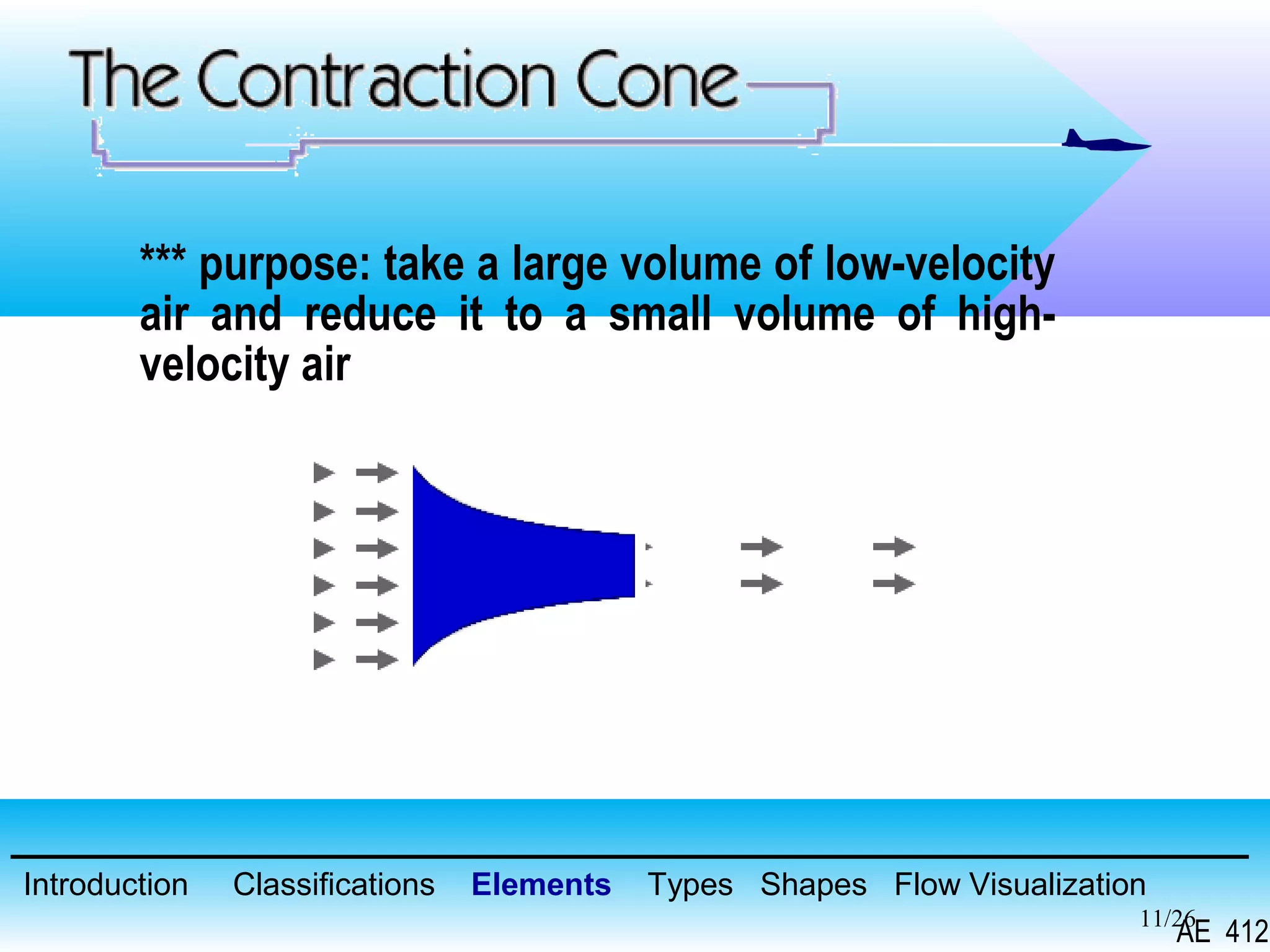
*** purpose: take a large volume of low-velocity
air and reduce it to a small volume of high-
velocity air
Introduction Classifications Elements Types Shapes Flow Visualization
AE 412
12/26
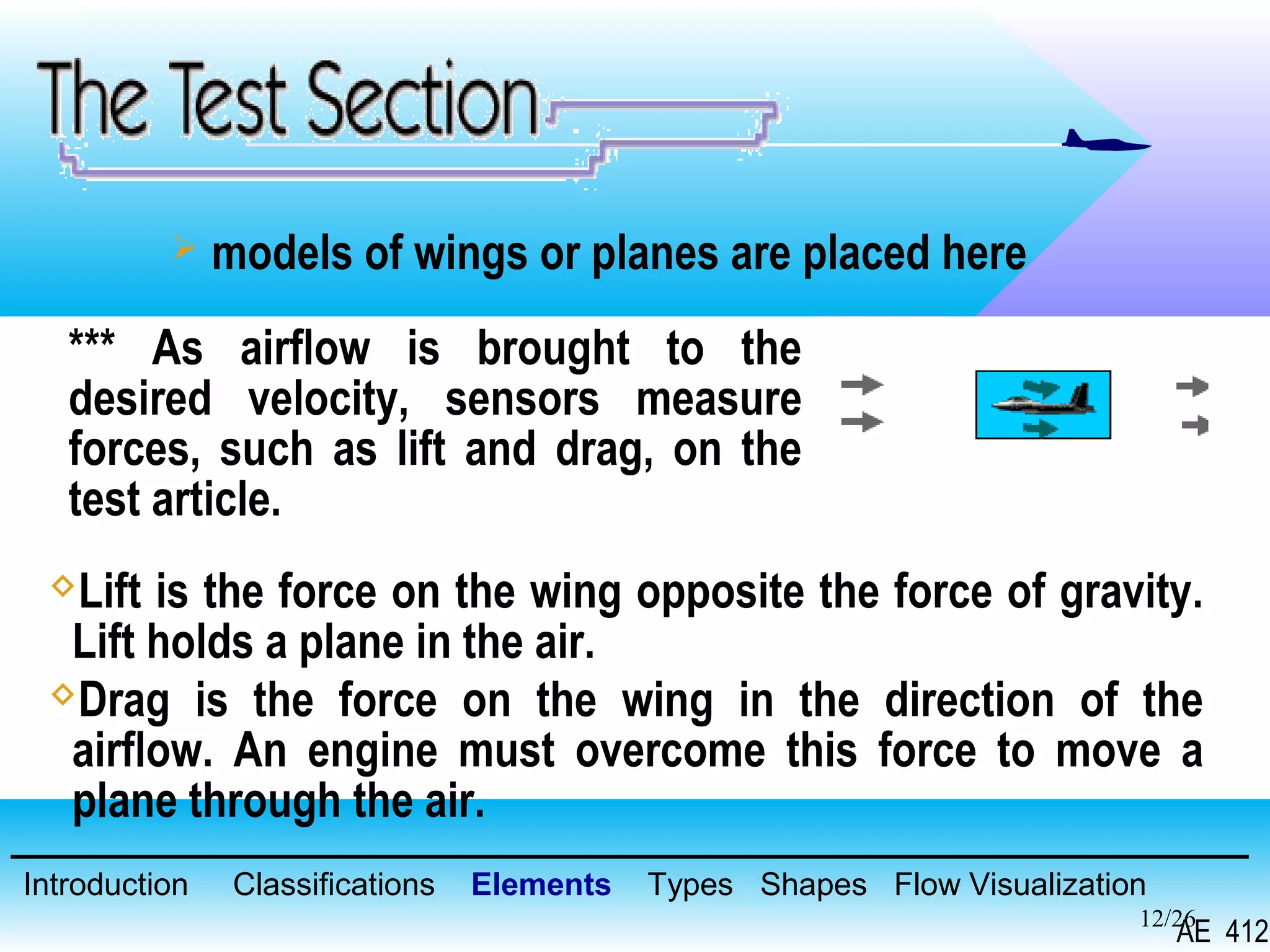
 models of wings or planes are placed here
*** As airflow is brought to the
desired velocity, sensors measure
forces, such as lift and drag, on the
test article.
Lift is the force on the wing opposite the force of gravity.
Lift holds a plane in the air.
Drag is the force on the wing in the direction of the
airflow. An engine must overcome this force to move a
plane through the air.
Introduction Classifications Elements Types Shapes Flow Visualization
AE 412
13/26
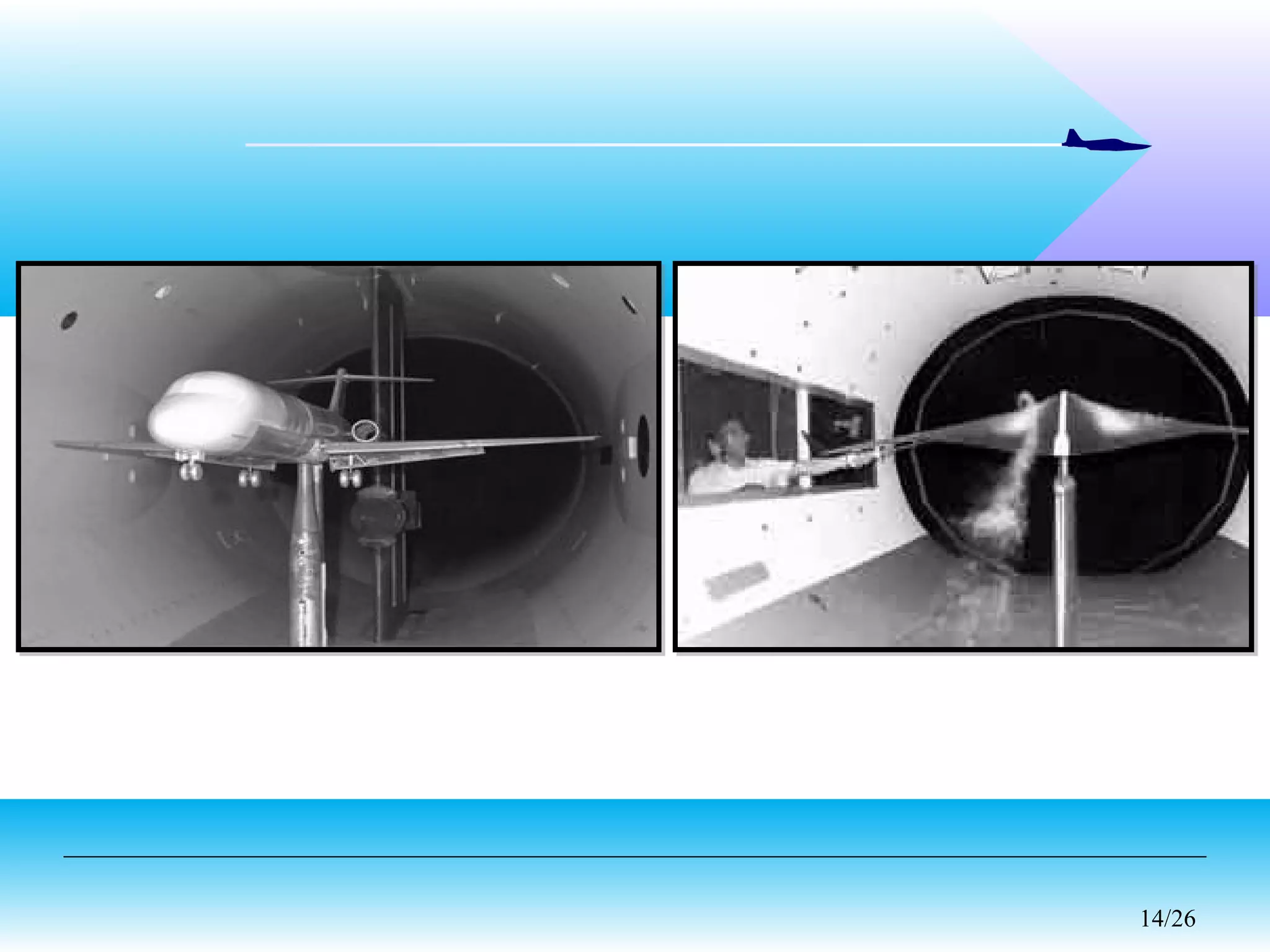
Shapes of Test SectionShapes of Test Section
Rectangular (General Purpose)
Circular (Axisymmetric Model)
Elliptical (Aircraft Model)
AE 412
Introduction Classifications Elements Types Shapes Flow Visualization
14/26
15/26
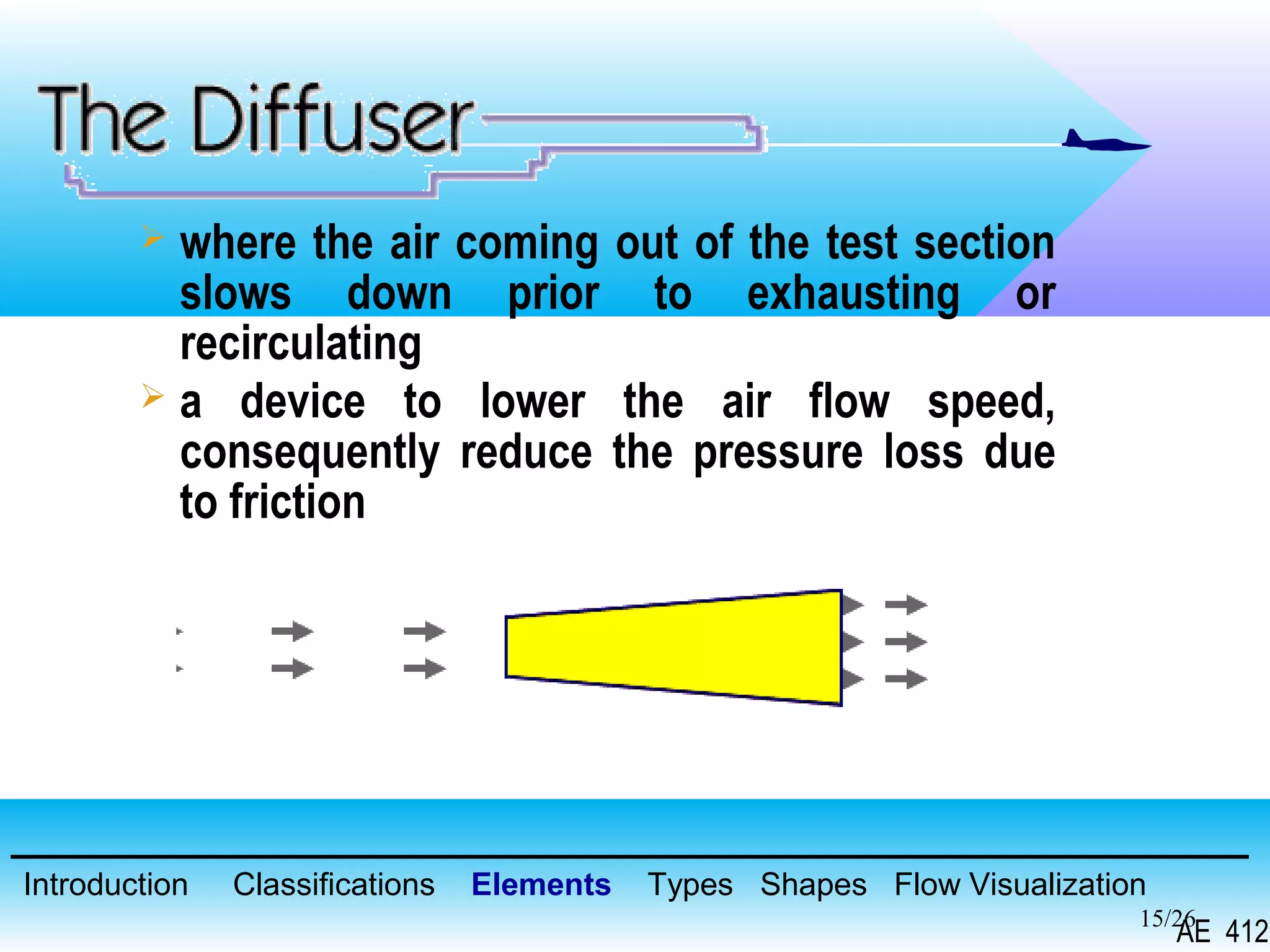
 where the air coming out of the test section
slows down prior to exhausting or
recirculating
 a device to lower the air flow speed,
consequently reduce the pressure loss due
to friction
Introduction Classifications Elements Types Shapes Flow Visualization
AE 412
16/26
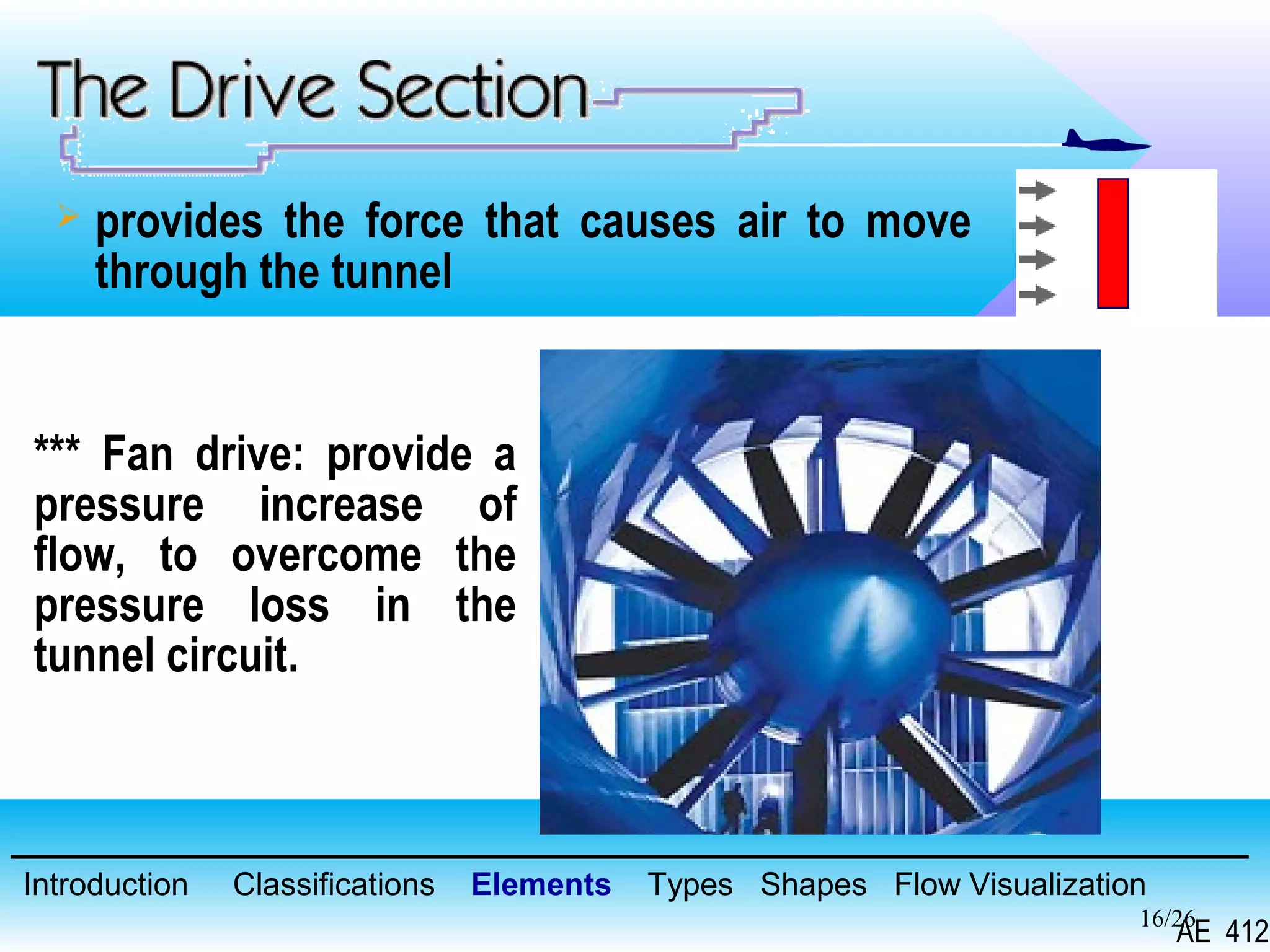
 provides the force that causes air to move
through the tunnel
*** Fan drive: provide a
pressure increase of
flow, to overcome the
pressure loss in the
tunnel circuit.
Introduction Classifications Elements Types Shapes Flow Visualization
AE 412
17/26
Introduction Classifications Elements Types Shapes Flow Visualization
AE 412
18/26
Introduction Classifications Elements Types Shapes Flow Visualization
AE 412
19/26
Introduction Classifications Elements Types Shapes Flow Visualization
AE 412
20/26
Introduction Classifications Elements Types Shapes Flow Visualization
AE 412
21/26
Types of Wind TunnelTypes of Wind Tunnel
Closed-type
Open-type
Introduction Classifications Elements Types Shapes Flow Visualization
AE 412
Blowdown
Shock Tube
22/26
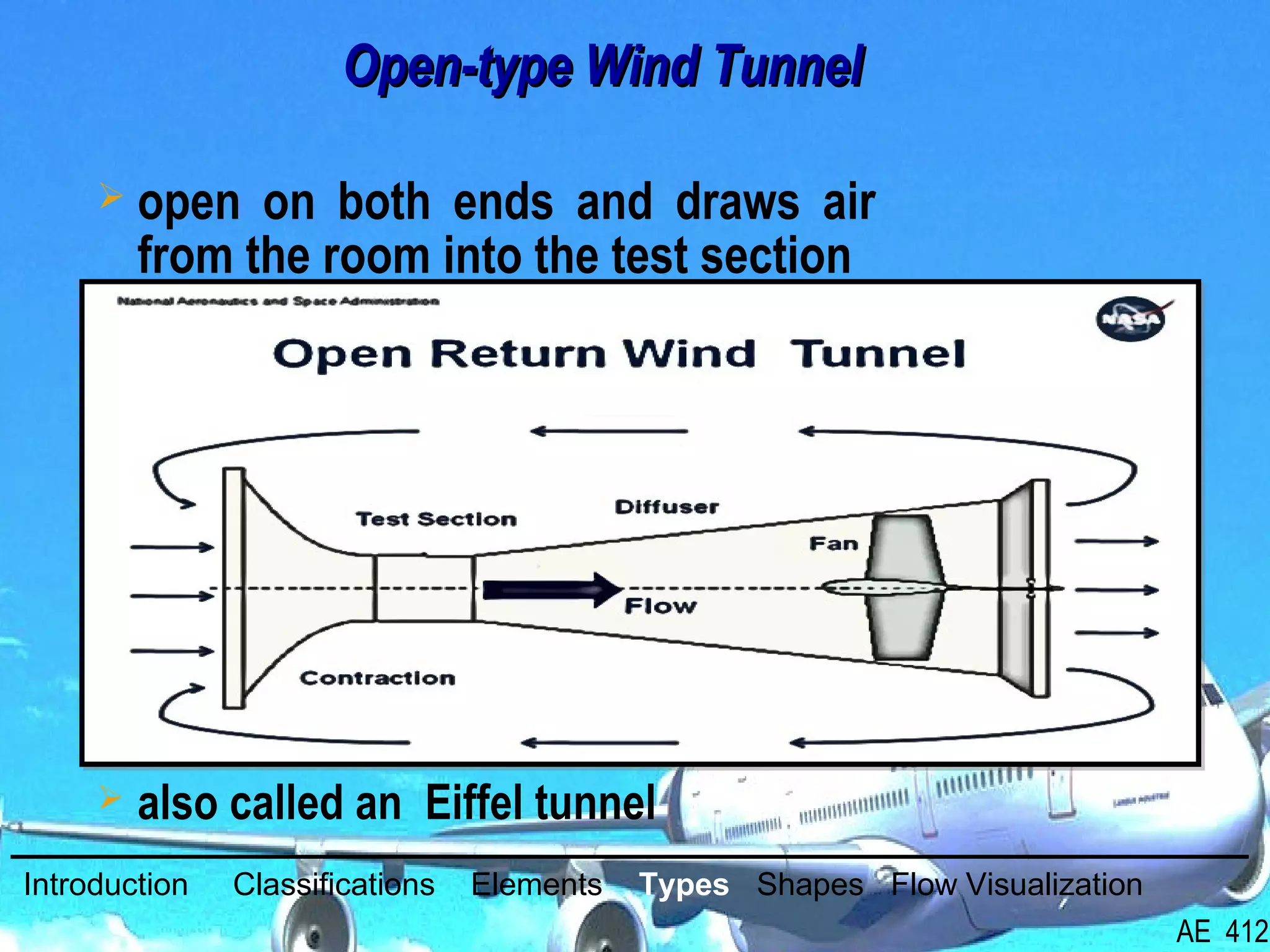
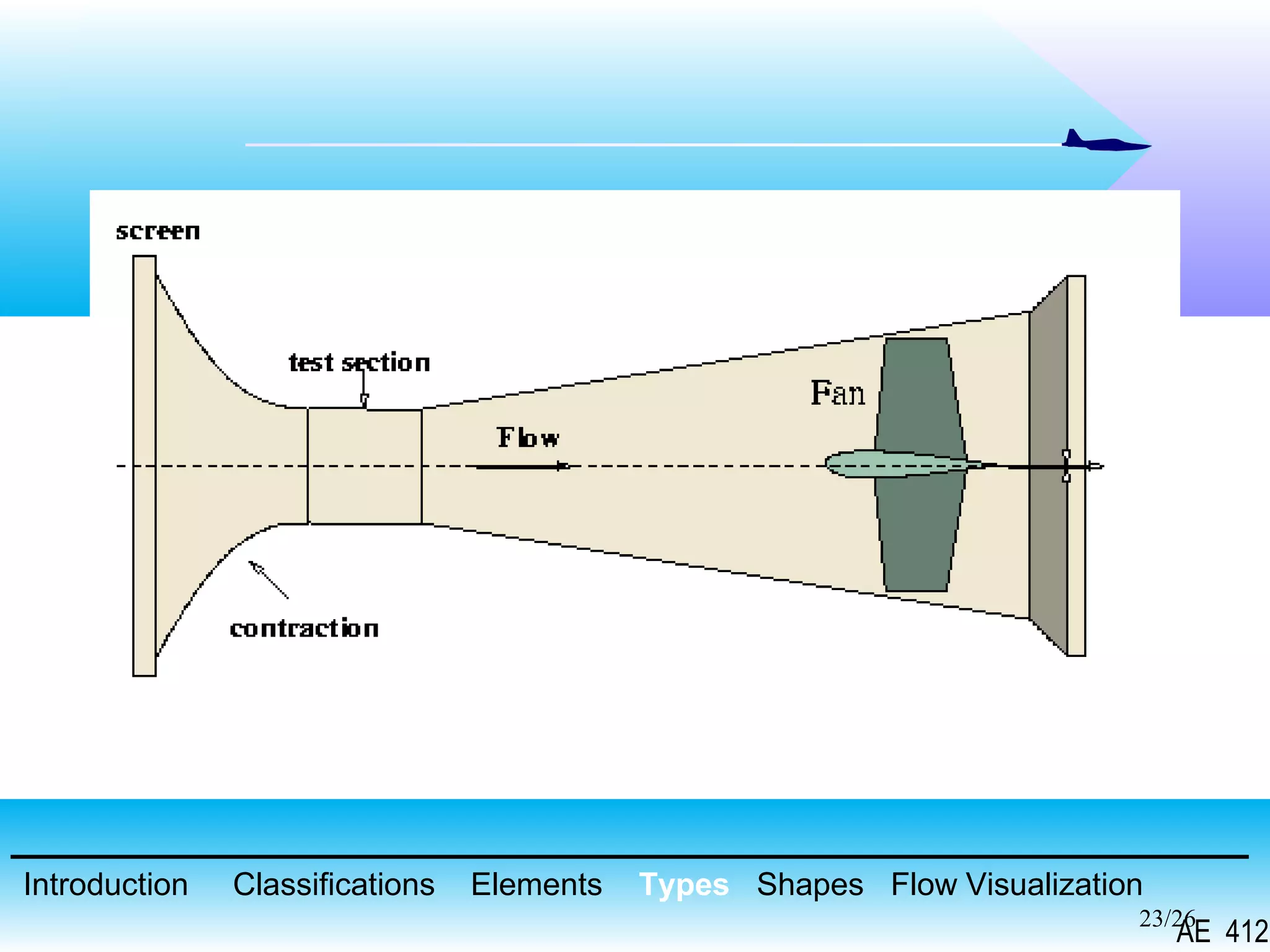
Open-type Wind TunnelOpen-type Wind Tunnel
 also called an Eiffel tunnel
 open on both ends and draws air
from the room into the test section
Introduction Classifications Elements Types Shapes Flow Visualization
AE 412
23/26
Introduction Classifications Elements Types Shapes Flow Visualization
AE 412
24/26
AdvantagesAdvantages
Low construction cost.
Superior design for propulsion and smoke
visualization. There is no accumulation of exhaust
products in an open tunnel
DisadvantagesDisadvantages
Poor flow quality possible in the test section
High operating costs
Noisy operation
Introduction Classifications Elements Types Shapes Flow Visualization
AE 412
25/26
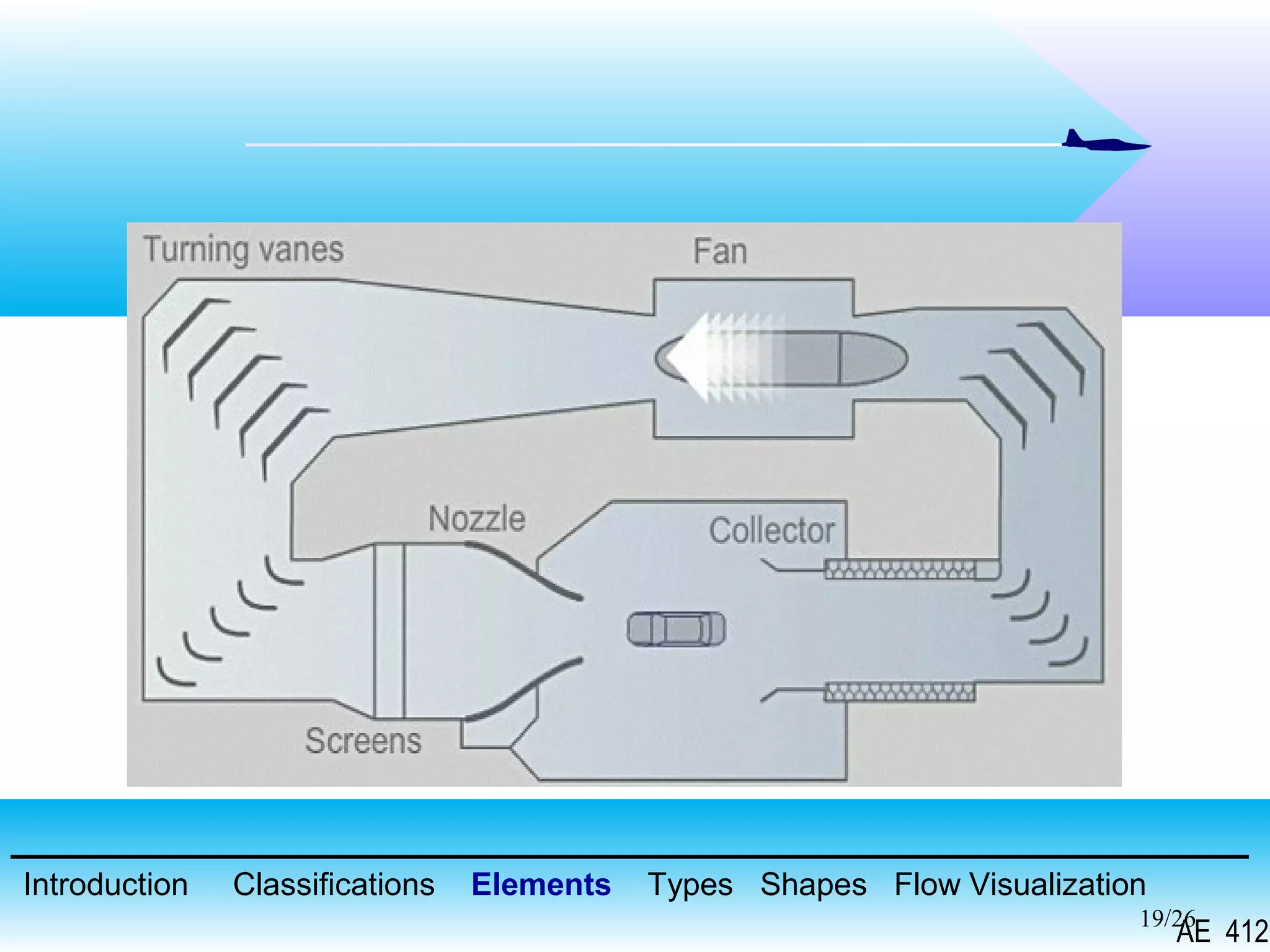
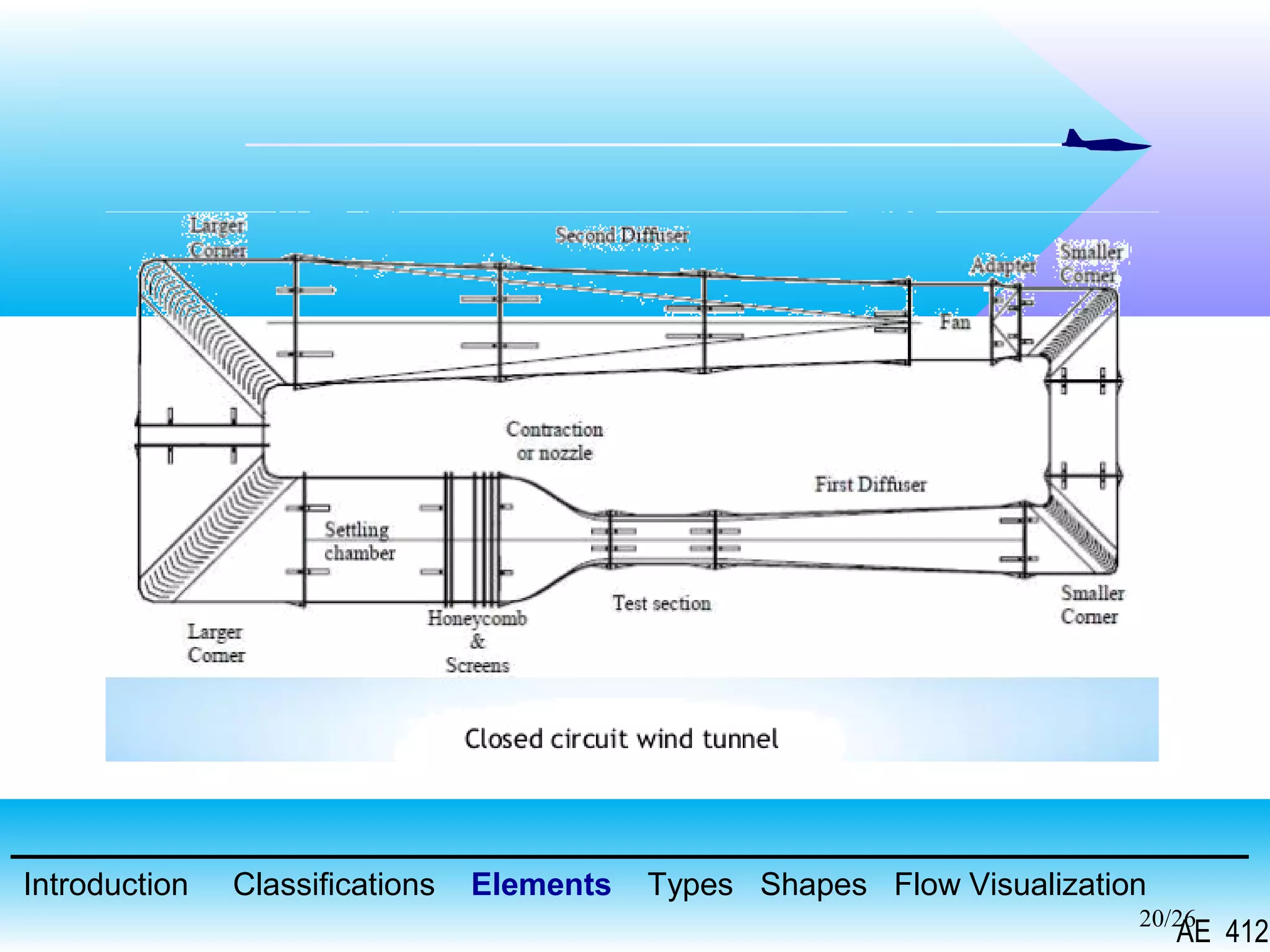
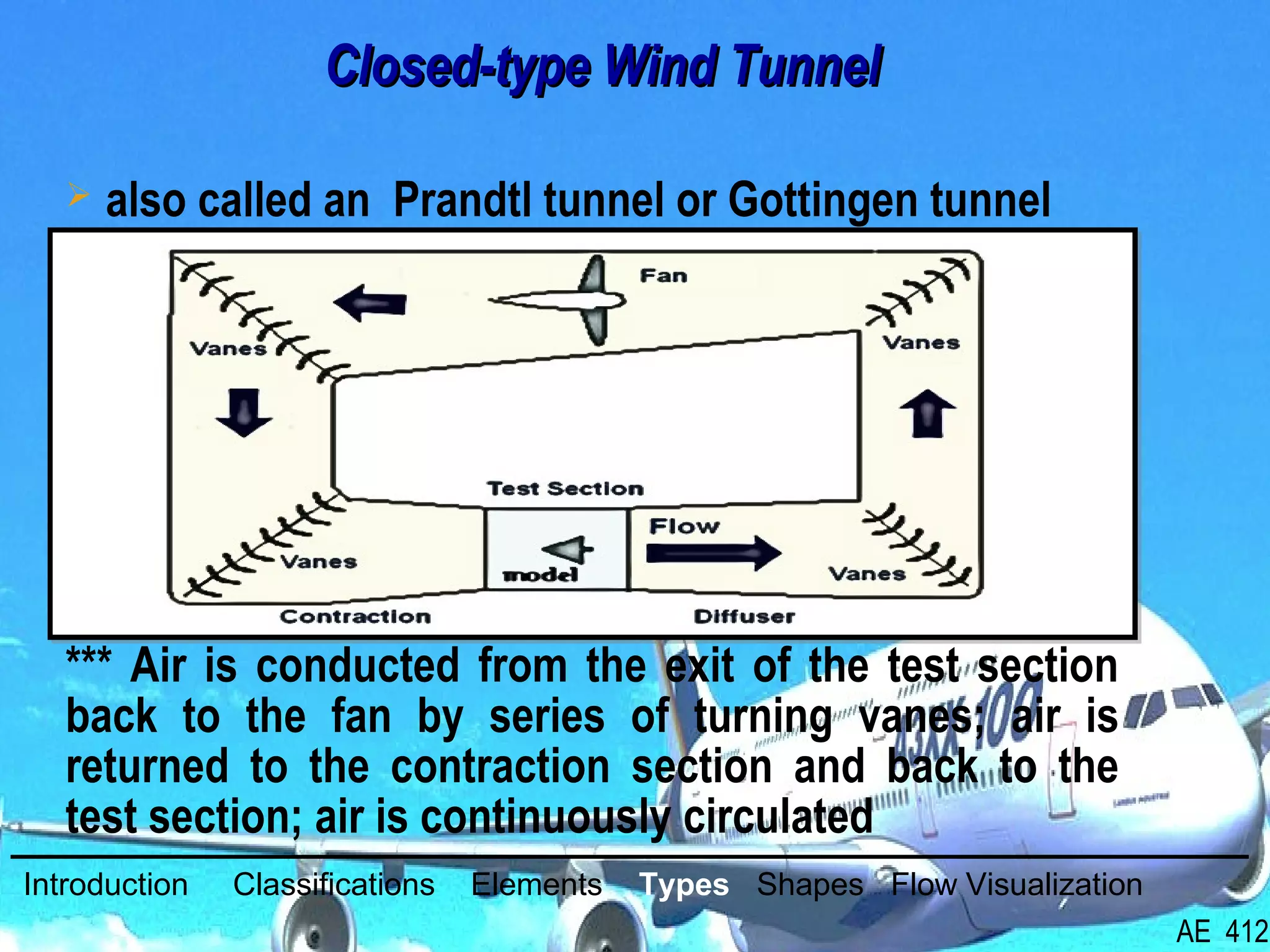
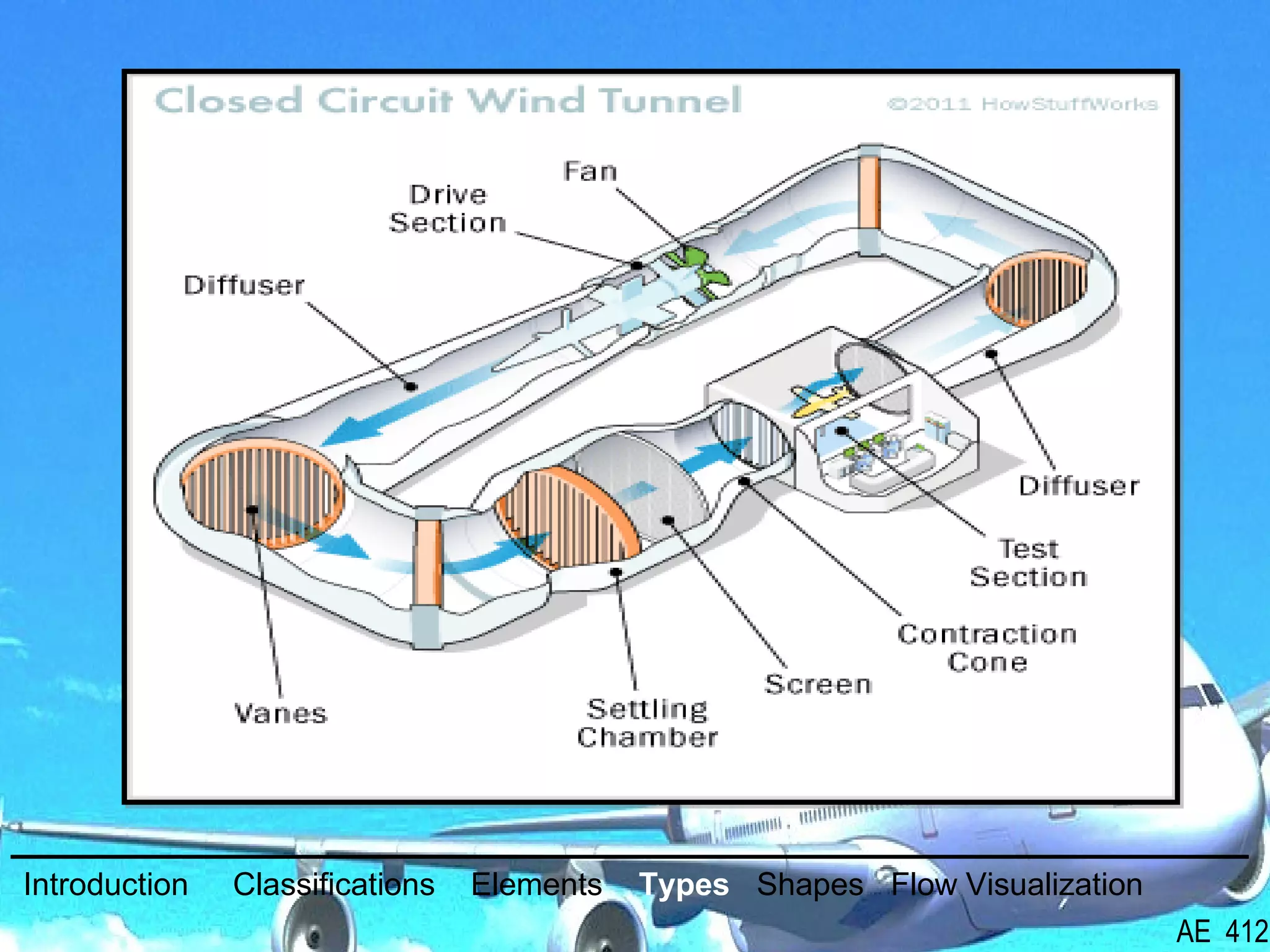
Closed-type Wind TunnelClosed-type Wind Tunnel
 also called an Prandtl tunnel or Gottingen tunnel
*** Air is conducted from the exit of the test section
back to the fan by series of turning vanes; air is
returned to the contraction section and back to the
test section; air is continuously circulated
Introduction Classifications Elements Types Shapes Flow Visualization
AE 412
26/26
Introduction Classifications Elements Types Shapes Flow Visualization
AE 412
27/26
Introduction Classifications Elements Types Shapes Flow Visualization
AE 412
28/26
Introduction Classifications Elements Types Shapes Flow Visualization
AE 412
29/26
AdvantagesAdvantages
Superior flow quality in the test section
Low operating costs
Quiet operation
DisadvantagesDisadvantages
Higher construction cost
Inferior design for propulsion and smoke visualization
Hotter running conditions than an open return tunnel
Introduction Classifications Elements Types Shapes Flow Visualization
AE 412
30/26
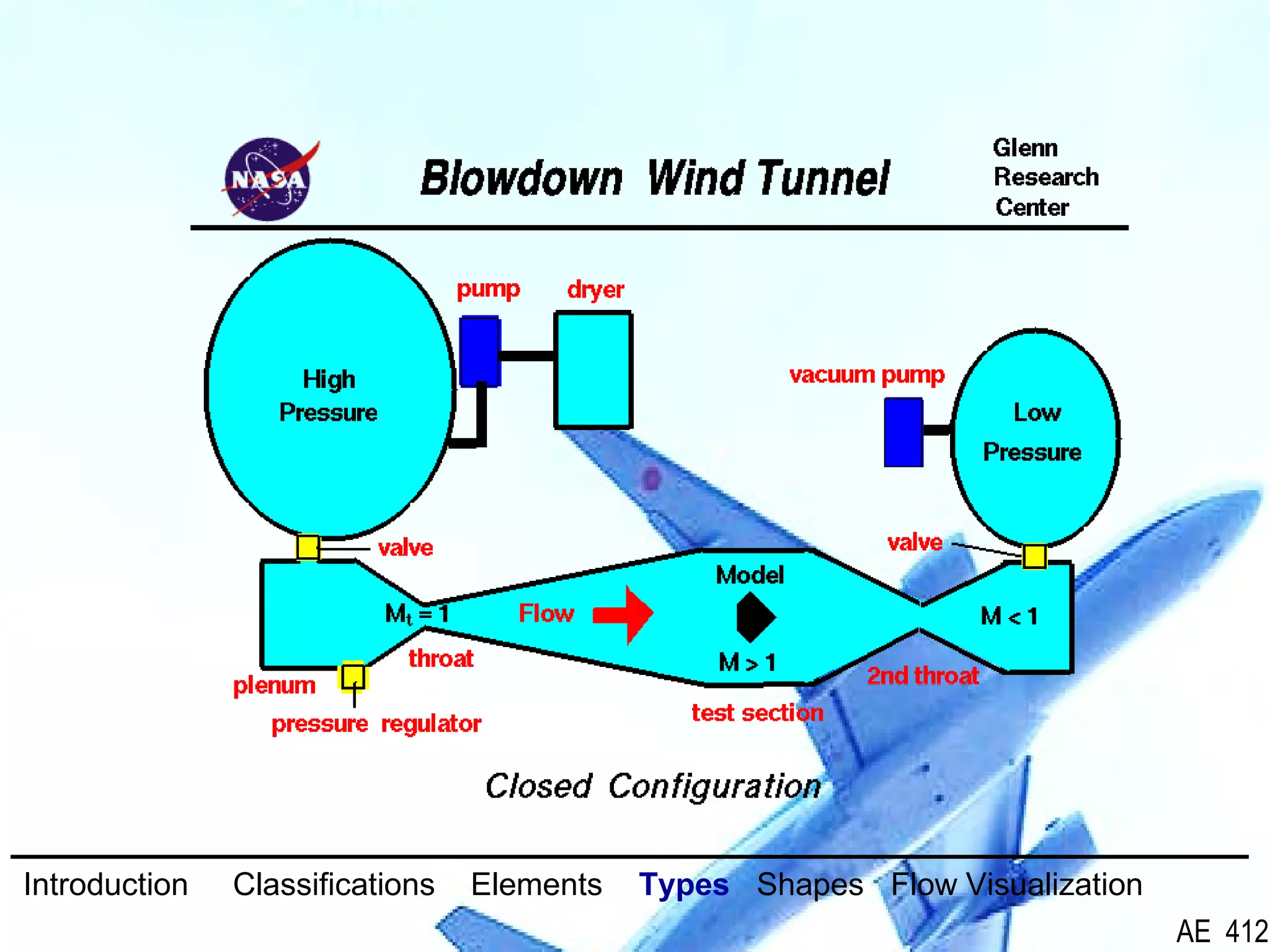
has a high pressure vessel upstream of the test
section and a low pressure reservoir downstream
of the test section
used for supersonic testing.
Blowdown Wind TunnelBlowdown Wind Tunnel
used for hypersonic testing
Shock TubeShock Tube
Introduction Classifications Elements Types Shapes Flow Visualization
AE 412
31/26
Introduction Classifications Elements Types Shapes Flow Visualization
AE 412
32/26
AdvantagesAdvantages
High Mach capability
Lower construction and operating costs.
Superior design for propulsion and smoke visualization
Smaller loads on model during startup because of faster
starts
DisadvantagesDisadvantages
Shorter test times require faster (often more expensive)
instrumentation.
Need for pressure regulator valves.
Noisy operation.
Introduction Classifications Elements Types Shapes Flow Visualization
AE 412
33/26
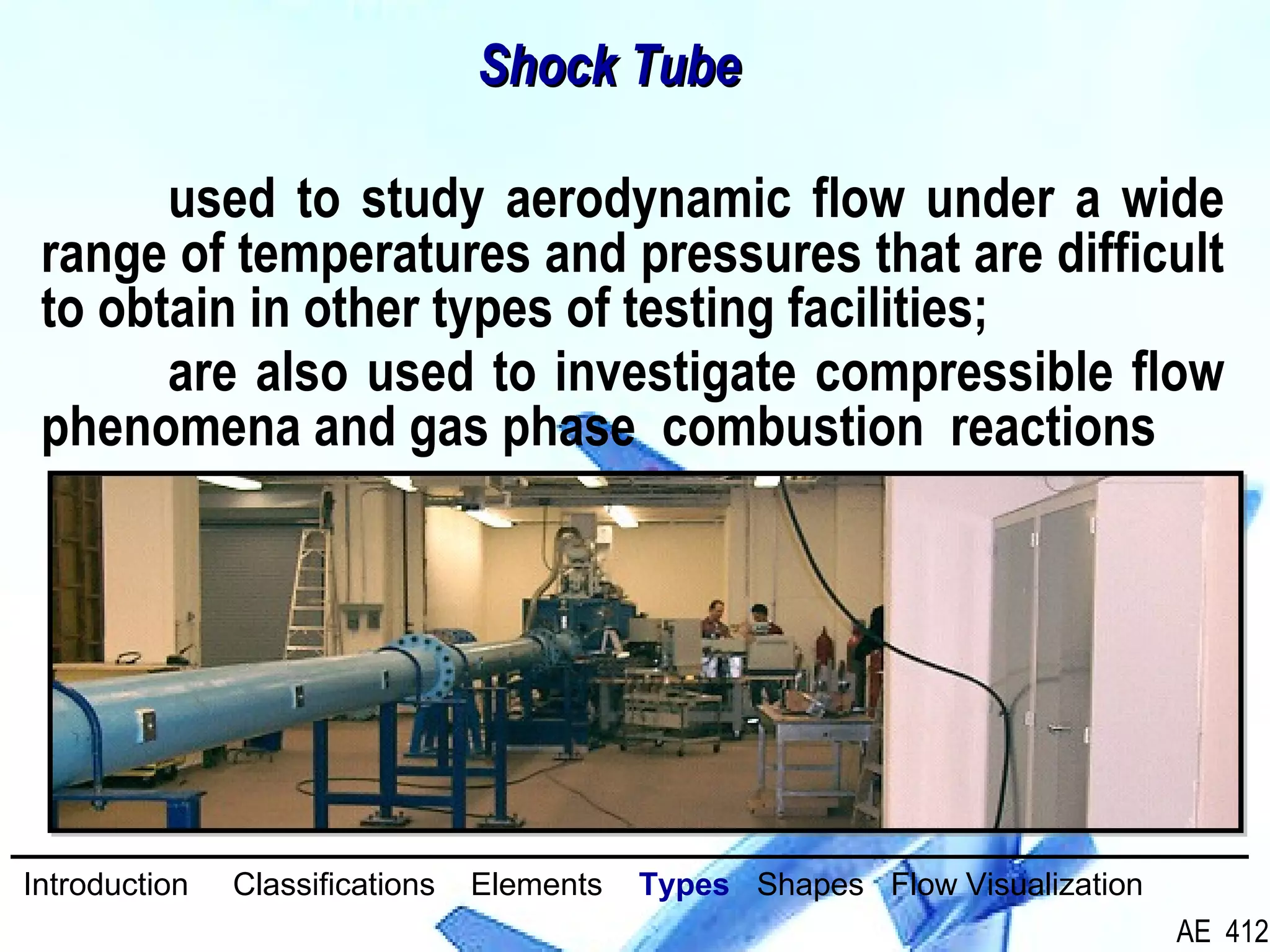
used to study aerodynamic flow under a wide
range of temperatures and pressures that are difficult
to obtain in other types of testing facilities;
are also used to investigate compressible flow
phenomena and gas phase combustion reactions
Shock TubeShock Tube
Introduction Classifications Elements Types Shapes Flow Visualization
AE 412
34/26
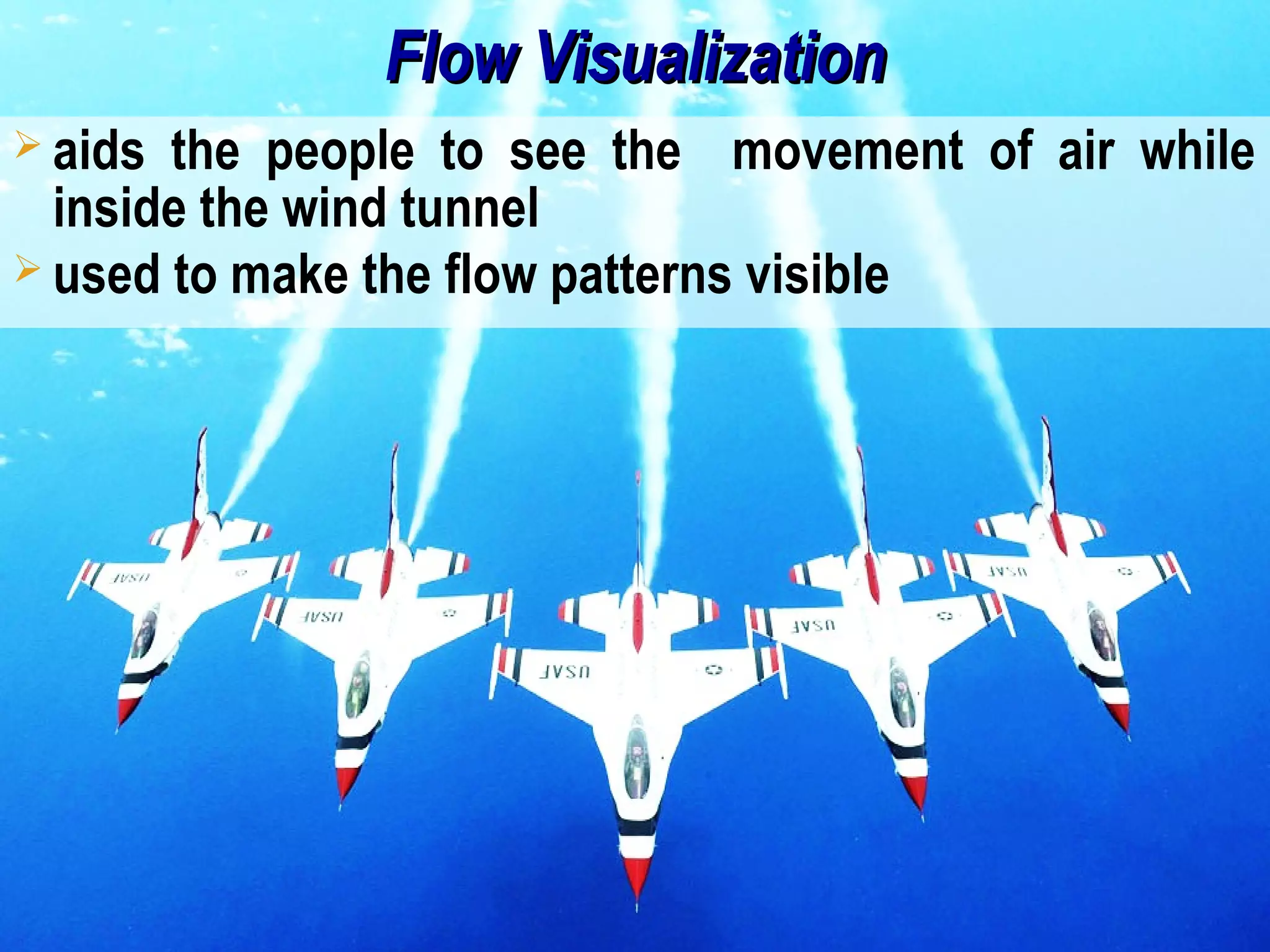
Flow VisualizationFlow Visualization
 aids the people to see the movement of air while
inside the wind tunnel
 used to make the flow patterns visible
35/26
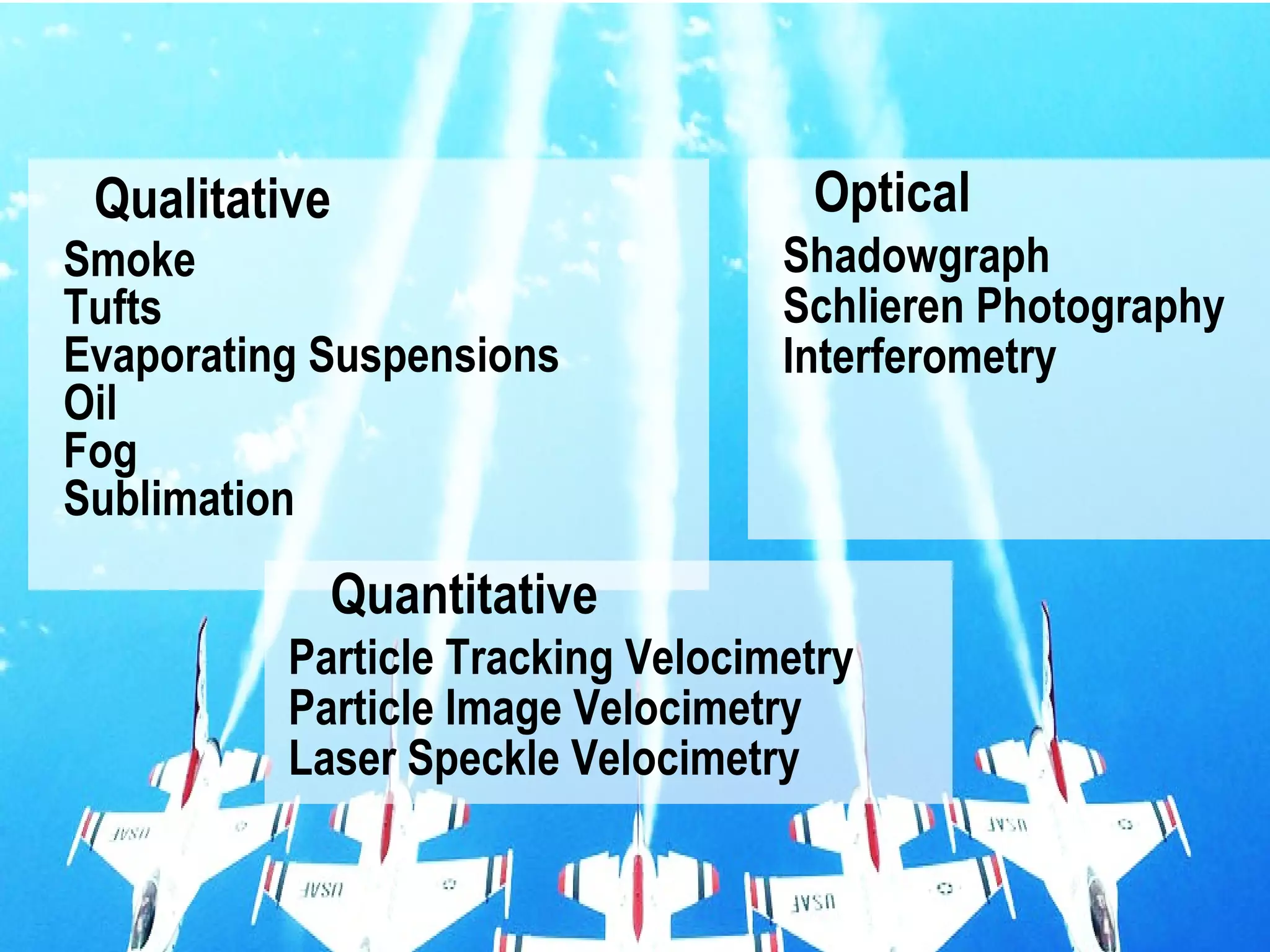
Qualitative
Smoke
Tufts
Evaporating Suspensions
Oil
Fog
Sublimation
Quantitative
Particle Tracking Velocimetry
Particle Image Velocimetry
Laser Speckle Velocimetry
Optical
Shadowgraph
Schlieren Photography
Interferometry
36/26
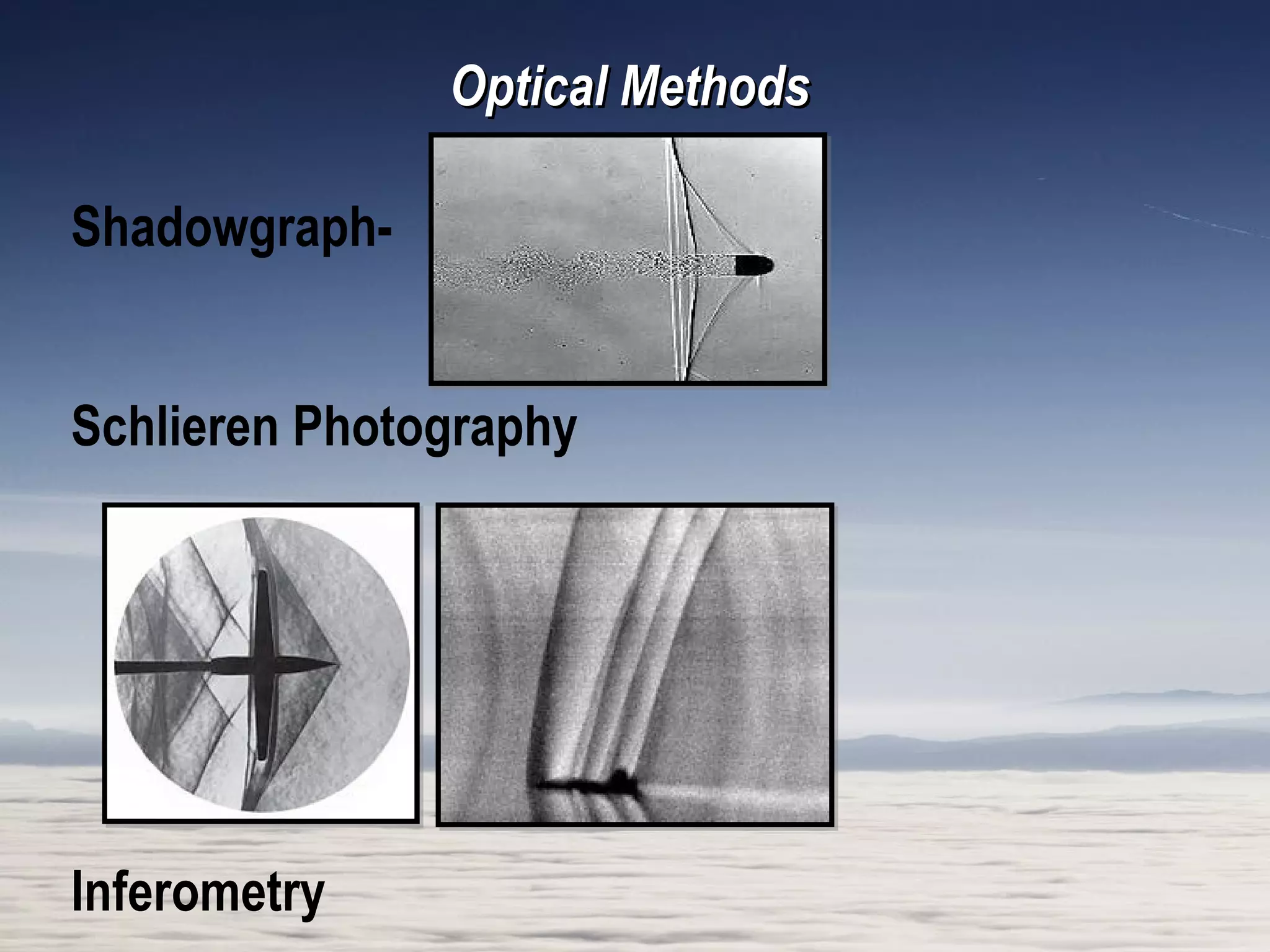
Shadowgraph-
Schlieren Photography
Inferometry
Optical MethodsOptical Methods
37/26
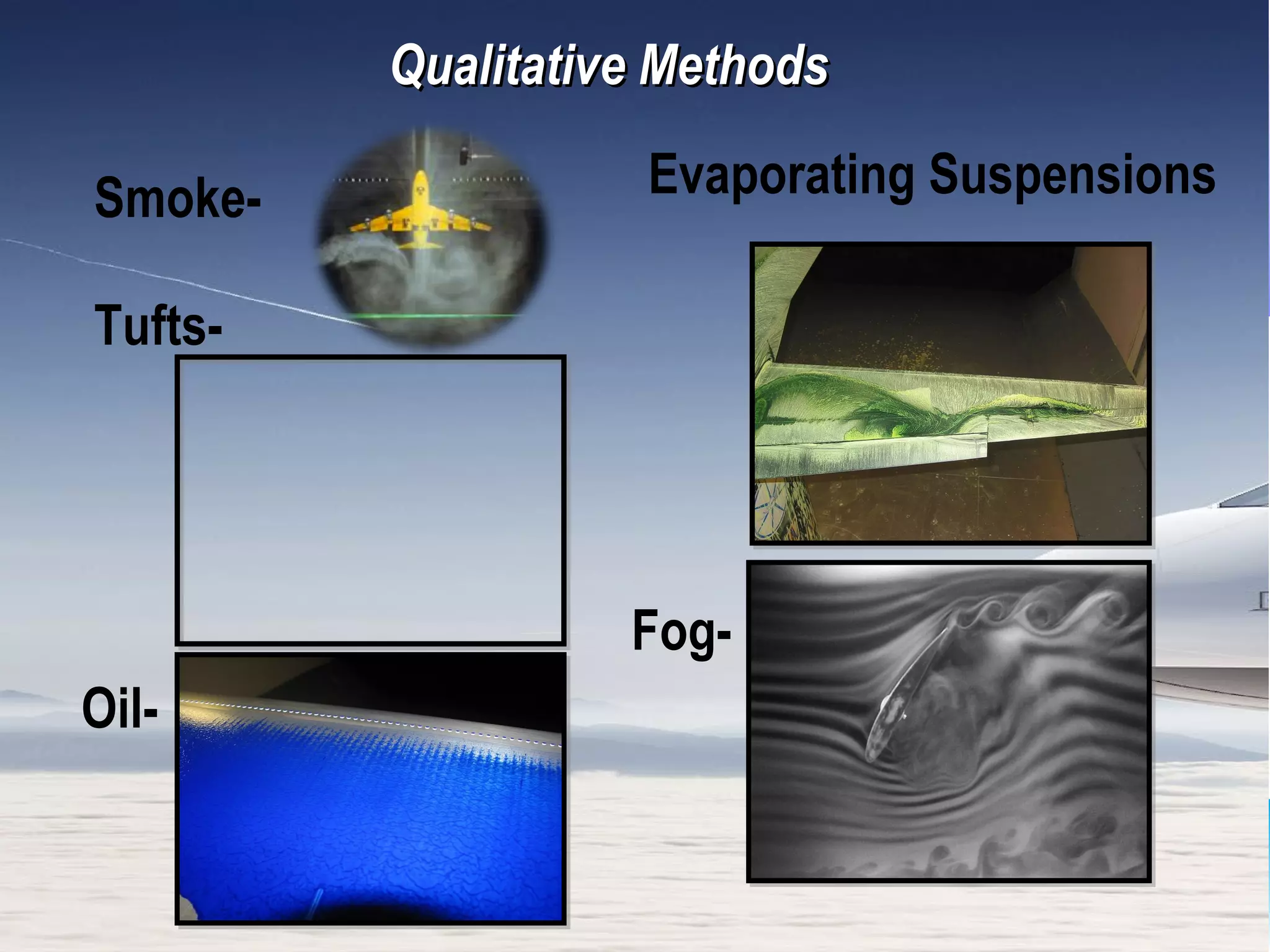
Smoke-
Tufts-
Oil-
Qualitative MethodsQualitative Methods
Evaporating Suspensions
Fog-
38/26
Quantitative MethodsQuantitative Methods
Particle Tracking Velocimetry
Particle Image Velocimetry
Laser Speckle Velocimetry

Wind tunnel

  • 1.
    Gayon, Jio RossGayon,Jio Ross Godfrey S.Godfrey S. Oarde, Kevin Victor L.Oarde, Kevin Victor L. Zaide, John Chester A.Zaide, John Chester A. Wind TunnelWind Tunnel
  • 2.
    2/26 Frank WenhamFrank Wenham BenjaminRobinsBenjamin Robins George CayleyGeorge Cayley Osborne ReynoldsOsborne Reynolds Hiram MaximHiram Maxim Wright BrothersWright Brothers
  • 3.
    3/26 IntroductionIntroduction What is aWind Tunnel? AE 412 Introduction Classifications Elements Types Shapes Flow Visualization  a facility that provides a controllable flow field for investigating various flow phenomena and testing aerodynamic models  a tool used in aerodynamic research to study the effects of air moving past solid objects *** Advantage: experiments can be performed under well-controlled flow circumstances compared to open environment experiments
  • 4.
    4/26 National Full-Scale AerodynamicsComplex , NASA Ames Research Center, United States
  • 5.
    5/26 Aeronautical Wind Tunnels AutomobileTunnels Aeroacoustic Tunnels Classifications of Wind TunnelClassifications of Wind Tunnel Introduction Classifications Elements Types Shapes Flow Visualization AE 412
  • 6.
    6/26 Aeronautical Wind TunnelsAeronauticalWind Tunnels High Reynold’s Number Tunnels Pressurized Tunnels Heavy Gas Tunnels Cryogenic Tunnels High-altitude Tunnels V/STOL Tunnels Spin Tunnels Introduction Classifications Elements Types Shapes Flow Visualization AE 412
  • 7.
    7/26 Tunnels are alsoclassified by flow speed: Subsonic (M<.8), Transonic (.8<M<1.2), Supersonic (1.2<M<5.0), or Hypersonic (M>5.0) Introduction Classifications Elements Types Shapes Flow Visualization AE 412
  • 8.
    8/26 Wind tunnels mayalso be classified according to their air pressure: atmospheric variable- density or their size: ordinary full-scale Introduction Classifications Elements Types Shapes Flow Visualization AE 412
  • 9.
    9/26 Elements of aElementsof a Wind TunnelWind Tunnel Introduction Classifications Elements Types Shapes Flow Visualization AE 412
  • 10.
    10/26  straightens theairflow *** The less turbulence there is, the better the wind tunnel will simulate actual flying conditions  usually includes a honeycomb flow straightener and wire mesh smoothing screens that produce a smooth airflow; effective at reducing swirling currents in the tunnel airflow Introduction Classifications Elements Types Shapes Flow Visualization AE 412
  • 11.
    11/26 *** purpose: takea large volume of low-velocity air and reduce it to a small volume of high- velocity air Introduction Classifications Elements Types Shapes Flow Visualization AE 412
  • 12.
    12/26  models ofwings or planes are placed here *** As airflow is brought to the desired velocity, sensors measure forces, such as lift and drag, on the test article. Lift is the force on the wing opposite the force of gravity. Lift holds a plane in the air. Drag is the force on the wing in the direction of the airflow. An engine must overcome this force to move a plane through the air. Introduction Classifications Elements Types Shapes Flow Visualization AE 412
  • 13.
    13/26 Shapes of TestSectionShapes of Test Section Rectangular (General Purpose) Circular (Axisymmetric Model) Elliptical (Aircraft Model) AE 412 Introduction Classifications Elements Types Shapes Flow Visualization
  • 14.
  • 15.
    15/26  where theair coming out of the test section slows down prior to exhausting or recirculating  a device to lower the air flow speed, consequently reduce the pressure loss due to friction Introduction Classifications Elements Types Shapes Flow Visualization AE 412
  • 16.
    16/26  provides theforce that causes air to move through the tunnel *** Fan drive: provide a pressure increase of flow, to overcome the pressure loss in the tunnel circuit. Introduction Classifications Elements Types Shapes Flow Visualization AE 412
  • 17.
    17/26 Introduction Classifications ElementsTypes Shapes Flow Visualization AE 412
  • 18.
    18/26 Introduction Classifications ElementsTypes Shapes Flow Visualization AE 412
  • 19.
    19/26 Introduction Classifications ElementsTypes Shapes Flow Visualization AE 412
  • 20.
    20/26 Introduction Classifications ElementsTypes Shapes Flow Visualization AE 412
  • 21.
    21/26 Types of WindTunnelTypes of Wind Tunnel Closed-type Open-type Introduction Classifications Elements Types Shapes Flow Visualization AE 412 Blowdown Shock Tube
  • 22.
    22/26 Open-type Wind TunnelOpen-typeWind Tunnel  also called an Eiffel tunnel  open on both ends and draws air from the room into the test section Introduction Classifications Elements Types Shapes Flow Visualization AE 412
  • 23.
    23/26 Introduction Classifications ElementsTypes Shapes Flow Visualization AE 412
  • 24.
    24/26 AdvantagesAdvantages Low construction cost. Superiordesign for propulsion and smoke visualization. There is no accumulation of exhaust products in an open tunnel DisadvantagesDisadvantages Poor flow quality possible in the test section High operating costs Noisy operation Introduction Classifications Elements Types Shapes Flow Visualization AE 412
  • 25.
    25/26 Closed-type Wind TunnelClosed-typeWind Tunnel  also called an Prandtl tunnel or Gottingen tunnel *** Air is conducted from the exit of the test section back to the fan by series of turning vanes; air is returned to the contraction section and back to the test section; air is continuously circulated Introduction Classifications Elements Types Shapes Flow Visualization AE 412
  • 26.
    26/26 Introduction Classifications ElementsTypes Shapes Flow Visualization AE 412
  • 27.
    27/26 Introduction Classifications ElementsTypes Shapes Flow Visualization AE 412
  • 28.
    28/26 Introduction Classifications ElementsTypes Shapes Flow Visualization AE 412
  • 29.
    29/26 AdvantagesAdvantages Superior flow qualityin the test section Low operating costs Quiet operation DisadvantagesDisadvantages Higher construction cost Inferior design for propulsion and smoke visualization Hotter running conditions than an open return tunnel Introduction Classifications Elements Types Shapes Flow Visualization AE 412
  • 30.
    30/26 has a highpressure vessel upstream of the test section and a low pressure reservoir downstream of the test section used for supersonic testing. Blowdown Wind TunnelBlowdown Wind Tunnel used for hypersonic testing Shock TubeShock Tube Introduction Classifications Elements Types Shapes Flow Visualization AE 412
  • 31.
    31/26 Introduction Classifications ElementsTypes Shapes Flow Visualization AE 412
  • 32.
    32/26 AdvantagesAdvantages High Mach capability Lowerconstruction and operating costs. Superior design for propulsion and smoke visualization Smaller loads on model during startup because of faster starts DisadvantagesDisadvantages Shorter test times require faster (often more expensive) instrumentation. Need for pressure regulator valves. Noisy operation. Introduction Classifications Elements Types Shapes Flow Visualization AE 412
  • 33.
    33/26 used to studyaerodynamic flow under a wide range of temperatures and pressures that are difficult to obtain in other types of testing facilities; are also used to investigate compressible flow phenomena and gas phase combustion reactions Shock TubeShock Tube Introduction Classifications Elements Types Shapes Flow Visualization AE 412
  • 34.
    34/26 Flow VisualizationFlow Visualization aids the people to see the movement of air while inside the wind tunnel  used to make the flow patterns visible
  • 35.
    35/26 Qualitative Smoke Tufts Evaporating Suspensions Oil Fog Sublimation Quantitative Particle TrackingVelocimetry Particle Image Velocimetry Laser Speckle Velocimetry Optical Shadowgraph Schlieren Photography Interferometry
  • 36.
  • 37.
  • 38.
    38/26 Quantitative MethodsQuantitative Methods ParticleTracking Velocimetry Particle Image Velocimetry Laser Speckle Velocimetry