Activity Planning
Objectives, Project Schedule, Network
Planning Model, Time Dimension,
Identifying Critical Path
Unit - 6
Activity Planning in Software Project Management
Activity planning is a critical component of software project
management, ensuring that the project is completed on time
and within budget while meeting the specified requirements.
This involves defining activities, establishing a project
schedule, and using various models to manage and optimize
project timelines.
Objectives
The primary objectives of activity planning in software project
management include:
Defining Activities: Breaking down the project into manageable
tasks and activities.
Sequencing Activities: Determining the order of activities based
on dependencies and project requirements.
Estimating Resources: Identifying the resources required for each
activity, including personnel, tools, and time.
Allocating Time: Assigning start and end times to each activity
to ensure a logical flow and efficient use of resources.
Setting Milestones: Establishing significant points in the
project timeline to measure progress and ensure alignment
with goals.
Project Schedule
A project schedule is a detailed plan that outlines all activities, their
durations, and the sequence in which they will be performed. Key
components include:
Task List: A comprehensive list of all tasks and activities required to
complete the project.
Dependencies: Relationships between tasks that dictate the order in which
they must be completed.
Duration Estimates: The amount of time each task is expected to take.
Milestones: Significant events or achievements in the project timeline.
Gantt Chart: A visual representation of the project schedule, showing tasks,
durations, and dependencies.
Network Planning Model
Network planning models are used to represent the sequence and
interdependencies of project activities. The most commonly used models
are:
Program Evaluation and Review Technique (PERT): Uses probabilistic time
estimates to account for uncertainty in activity durations. It helps in
identifying the minimum time needed to complete a project by calculating
the expected time for each activity.
Critical Path Method (CPM): Focuses on identifying the longest sequence of
dependent tasks (the critical path) that determines the minimum project
duration. CPM uses deterministic time estimates and is ideal for projects
with well-defined tasks and timelines.
Time Dimension
The time dimension in project management refers to the scheduling
aspect, which includes:
Start and Finish Times: The specific times when each task begins and
ends.
Float/Slack Time: The amount of time a task can be delayed without
affecting the overall project completion date.
Lead and Lag Time: Lead time allows for tasks to overlap, while lag
time inserts delays between tasks.
Identifying Critical Path
The critical path is the sequence of activities that determines the
shortest possible duration to complete a project. Identifying the critical
path involves:
Listing Activities: Identifying all tasks involved in the project.
Determining Dependencies: Establishing the relationships and
dependencies between tasks.
Estimating Duration: Assigning time estimates to each task.
Constructing the Network Diagram: Creating a visual representation of
the task sequence and dependencies.
Calculating the Critical Path: Using algorithms to determine the
longest path through the network diagram, which represents the
critical path. This includes:
• Forward Pass: Calculating the earliest start and finish times for each
task.
• Backward Pass: Determining the latest start and finish times that will
not delay the project.
• Identifying Float: Calculating the float for each task to understand
flexibility.
The critical path has zero float, meaning any delay in these tasks
directly impacts the project completion date. Effective management of
the critical path ensures timely project delivery.
Conclusion
Activity planning in software project management is essential for
successful project execution. By defining objectives, creating a detailed
project schedule, utilizing network planning models, understanding the
time dimension, and identifying the critical path, project managers can
effectively plan, execute, and monitor software projects to ensure they
meet their goals within the constraints of time and resources.
Sample Questions
1. What are the primary objectives of activity planning in software project management?
2. How do you define activities in the context of a software project?
3. What techniques can be used to sequence activities in a software project?
4. How do you estimate resources required for project activities?
5. What is the importance of setting milestones in activity planning?
6. Can you explain the process of breaking down a project into manageable tasks?
7. What are the key components of a project schedule?
8. How do you create a task list for a software project?
9. What methods can be used to determine task dependencies?
10. How do you estimate the duration of tasks in a project schedule?
11. What is a Gantt chart and how is it used in project scheduling?
12. How do you manage and adjust a project schedule when unexpected delays occur?
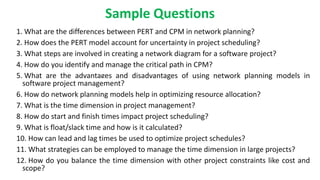
1. What are the differences between PERT and CPM in network planning?
2. How does the PERT model account for uncertainty in project scheduling?
3. What steps are involved in creating a network diagram for a software project?
4. How do you identify and manage the critical path in CPM?
5. What are the advantages and disadvantages of using network planning models in
software project management?
6. How do network planning models help in optimizing resource allocation?
7. What is the time dimension in project management?
8. How do start and finish times impact project scheduling?
9. What is float/slack time and how is it calculated?
10. How can lead and lag times be used to optimize project schedules?
11. What strategies can be employed to manage the time dimension in large projects?
12. How do you balance the time dimension with other project constraints like cost and
scope?
Sample Questions

Activity Planning: Objectives, Project Schedule, Network Planning Model. Time Dimension. Identifying Critical Path.

  • 1.
    Activity Planning Objectives, ProjectSchedule, Network Planning Model, Time Dimension, Identifying Critical Path Unit - 6
  • 2.
    Activity Planning inSoftware Project Management Activity planning is a critical component of software project management, ensuring that the project is completed on time and within budget while meeting the specified requirements. This involves defining activities, establishing a project schedule, and using various models to manage and optimize project timelines.
  • 3.
    Objectives The primary objectivesof activity planning in software project management include: Defining Activities: Breaking down the project into manageable tasks and activities. Sequencing Activities: Determining the order of activities based on dependencies and project requirements. Estimating Resources: Identifying the resources required for each activity, including personnel, tools, and time.
  • 4.
    Allocating Time: Assigningstart and end times to each activity to ensure a logical flow and efficient use of resources. Setting Milestones: Establishing significant points in the project timeline to measure progress and ensure alignment with goals.
  • 5.
    Project Schedule A projectschedule is a detailed plan that outlines all activities, their durations, and the sequence in which they will be performed. Key components include: Task List: A comprehensive list of all tasks and activities required to complete the project. Dependencies: Relationships between tasks that dictate the order in which they must be completed. Duration Estimates: The amount of time each task is expected to take. Milestones: Significant events or achievements in the project timeline. Gantt Chart: A visual representation of the project schedule, showing tasks, durations, and dependencies.
  • 6.
    Network Planning Model Networkplanning models are used to represent the sequence and interdependencies of project activities. The most commonly used models are: Program Evaluation and Review Technique (PERT): Uses probabilistic time estimates to account for uncertainty in activity durations. It helps in identifying the minimum time needed to complete a project by calculating the expected time for each activity. Critical Path Method (CPM): Focuses on identifying the longest sequence of dependent tasks (the critical path) that determines the minimum project duration. CPM uses deterministic time estimates and is ideal for projects with well-defined tasks and timelines.
  • 7.
    Time Dimension The timedimension in project management refers to the scheduling aspect, which includes: Start and Finish Times: The specific times when each task begins and ends. Float/Slack Time: The amount of time a task can be delayed without affecting the overall project completion date. Lead and Lag Time: Lead time allows for tasks to overlap, while lag time inserts delays between tasks.
  • 8.
    Identifying Critical Path Thecritical path is the sequence of activities that determines the shortest possible duration to complete a project. Identifying the critical path involves: Listing Activities: Identifying all tasks involved in the project. Determining Dependencies: Establishing the relationships and dependencies between tasks. Estimating Duration: Assigning time estimates to each task. Constructing the Network Diagram: Creating a visual representation of the task sequence and dependencies.
  • 9.
    Calculating the CriticalPath: Using algorithms to determine the longest path through the network diagram, which represents the critical path. This includes: • Forward Pass: Calculating the earliest start and finish times for each task. • Backward Pass: Determining the latest start and finish times that will not delay the project. • Identifying Float: Calculating the float for each task to understand flexibility. The critical path has zero float, meaning any delay in these tasks directly impacts the project completion date. Effective management of the critical path ensures timely project delivery.
  • 10.
    Conclusion Activity planning insoftware project management is essential for successful project execution. By defining objectives, creating a detailed project schedule, utilizing network planning models, understanding the time dimension, and identifying the critical path, project managers can effectively plan, execute, and monitor software projects to ensure they meet their goals within the constraints of time and resources.
  • 11.
    Sample Questions 1. Whatare the primary objectives of activity planning in software project management? 2. How do you define activities in the context of a software project? 3. What techniques can be used to sequence activities in a software project? 4. How do you estimate resources required for project activities? 5. What is the importance of setting milestones in activity planning? 6. Can you explain the process of breaking down a project into manageable tasks? 7. What are the key components of a project schedule? 8. How do you create a task list for a software project? 9. What methods can be used to determine task dependencies? 10. How do you estimate the duration of tasks in a project schedule? 11. What is a Gantt chart and how is it used in project scheduling? 12. How do you manage and adjust a project schedule when unexpected delays occur?
  • 12.
    1. What arethe differences between PERT and CPM in network planning? 2. How does the PERT model account for uncertainty in project scheduling? 3. What steps are involved in creating a network diagram for a software project? 4. How do you identify and manage the critical path in CPM? 5. What are the advantages and disadvantages of using network planning models in software project management? 6. How do network planning models help in optimizing resource allocation? 7. What is the time dimension in project management? 8. How do start and finish times impact project scheduling? 9. What is float/slack time and how is it calculated? 10. How can lead and lag times be used to optimize project schedules? 11. What strategies can be employed to manage the time dimension in large projects? 12. How do you balance the time dimension with other project constraints like cost and scope? Sample Questions