Presented By,
Soni Urmi A.
160160702014
Department of Computer Engineering
Government Engineering College,
Modasa
Guided By,
Prof. M. M. Goyani
Department of Computer Engineering
Government Engineering College,
Modasa
Google App Engine
Outlines
• Introduction: Cloud Computing
• Cloud Computing Services
• GAE Cloud Computing Services
• Introduction: Google App Engine (GAE)
• Features
• GAE Application Lifecycle
• GAE Components
• Runtime Environment
• Quotas
• Comparison
• Advantages and Disadvantages
• Scope of Improvement
• Conclusion
Introduction: Cloud Computing
• Shared pool of configurable computing resources
• On-demand network access
• Provisioned by service providers
• Pay-per-usage basis
Cloud Computing Services
Source: Gartner AADI Summit Dec 2009
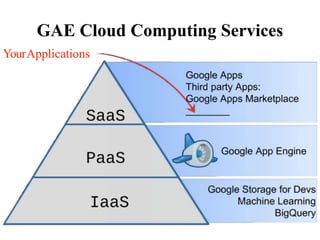
GAE Cloud Computing Services
YourApplications
Introduction: Google App Engine (GAE)
• Cloud computing platform that is built on top of Google’s
infrastructure
• Web framework that allows hosting web applications on
Google managed Data centers
• Dynamic Web Server, with full support to common web
technologies
• GQL – SQL like syntax
• Integration with Google Account through APIs
Features
• Automatic scaling and load balancing
• Static files - Static files use Google’s CDN
• Easy logs - View logs in web console
• Easy deployment - Literally 1-click deploy
• Free quota - 99% of apps will pay nothing
• Affordable scaling - Prices better than AWS
• No configuration - No need to configure OS or servers
• Easy security - Google patches OS/servers
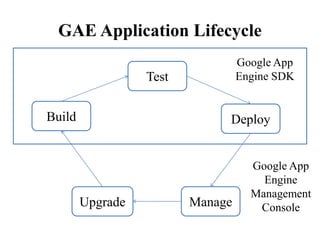
GAE Application Lifecycle
Build
Manage
Test
Upgrade
Deploy
Google App
Engine SDK
Google App
Engine
Management
Console
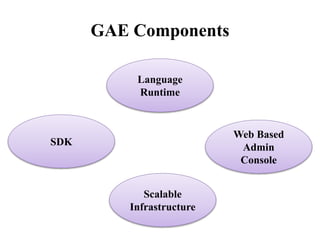
GAE Components
SDK
Scalable
Infrastructure
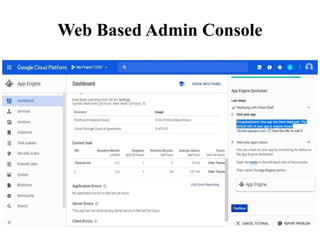
Web Based
Admin
Console
Language
Runtime
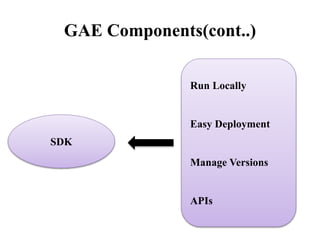
GAE Components(cont..)
SDK
Run Locally
Easy Deployment
Manage Versions
APIs
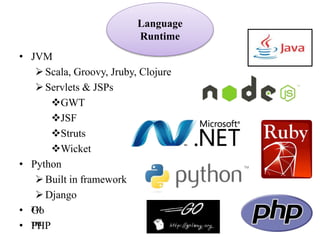
Language
Runtime
• JVM
Scala, Groovy, Jruby, Clojure
Servlets & JSPs
GWT
JSF
Struts
Wicket
• Python
Built in framework
Django
• ™Go
• ™PHP
Web Based Admin Console
Python Runtime Environment
Google Web Toolkit (GWT)
Mashup Editor Google Gears
Google Gadgets Others
Python & Django
Google App Engine (GAE)
Dynamic, Scalable Runtime
Google Accounts
GAE Datastore GData
Social Graph API Others
Cloud
Capabilities
Cloud
Computing
Services
Support
Services
Integration
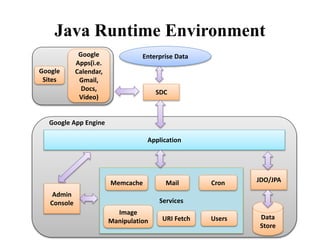
Java Runtime Environment
Services
Memcache
URI Fetch
Mail
Image
Manipulation Users
Cron
Admin
Console
JDO/JPA
Data
Store
Application
Enterprise Data
SDC
Google
Sites
Google
Apps(i.e.
Calendar,
Gmail,
Docs,
Video)
Google App Engine
Core APIs
Cron
Quotas
1. Free quotas
 An amount for every application
 Exceeded by paid applications
2. Spending limits
 Project owner and billing administrator
 To manage application cost
 Exceeded slightly (as application is disabled)
3. Safety limits
 Set by Google to protect the integrity
 Ensure that no over-consumption of resources
 Get an error, if try to exceed
Google App Engine Amazon Web Services
Cloud Services PaaS PaaS, IaaS
Platforms Supported Linux, Windows Server
2008
Linux, Open Solaris,
Windows Server 2003
Virtualization Platform Application Container OS level running on a Xen
Hypervisor
Storage BigTable and MegaStore Amazon Simple Storage
and SimpleDB
Control Interface API API Command Line
Languages Supported Java, PHP, Python, Ruby,
Go
Java, PHP, Python, Ruby
Load Balancing Auto Round Robin
Data after termination Google will not take any
action for 90 days after the
effective date of
termination
Amazon will not take any
action for a period of 30
days after the
effective date of
termination
Advantages
• Automatic scalability
• Infrastructure for security
• No maintenance
• Performance and reliability
• Free -up to a certain limit of consumed resources
• Easy to build
• Speed
• Cost efficient hosting
• Platform independence
Disadvantages
• You Are at Google’s Mercy
• Violation of Policies
• Forget Porting
• It is Free only upto certain limit
• Programming Languages are limited
• File/system access restricted
• The size of the app must be such that it can be loaded into the
memory in not more than 30seconds as the space allocated to
your app on the cloud is limited.
Scope of Improvement
• More Languages on App Engine
• Scheduled jobs
• Large download/upload support
• Purchasing additional capacity
• More space for large files – in uploading and downloading
• Data store - import and export for large volumes of data Pay-
as-you-go billing - for resource usage over free quota
Conclusion
• Flexibility: Java or Python APIs, no 'lock-in‘
• Security: sandbox environment, rich APIs
• Easy to Start: generous free quota
• Easy to Scale: uses Google infrastructure
References
1. Rabi Prasad Padhy, Manas Ranjan Patra, Suresh Chandra Satapathy,
“X-as-a-Service: Cloud Computing with Google App Engine, Amazon
Web Services, Microsoft Azure and Force.com”, International Journal
of Computer Science and Telecommunications ,vol. 2, no. 9, December
2011
2. Maciej Malawski, Maciej Kuzniar, Piotr Wjcik, Marian Bubak, “How
to Use Google App Engine for Free Computing”,2011
3. Alexander Zahariev, ”Google App Engine”, Helsinki University of
Technology, 2010
4. M. R. V. Sashi Bhusan Maharana, R. Iswarya, V. Santosh Kumar,
“Google App Engine WHY GOOGLE BUILD APP,” Int. J. Eng.
Manag. Res., vol. 5, no. 6, pp. 536–538, 2015
5. S. Srivastava, V. Trehan, P. Yadav, N. Manga, and S. Gupta, “Google
App Engine,” ISO Certif. Int. J. Eng. Innov. Technol., vol. 9001, no. 3,
pp. 163–165, 2008
Thank You

Google App Engine

  • 1.
    Presented By, Soni UrmiA. 160160702014 Department of Computer Engineering Government Engineering College, Modasa Guided By, Prof. M. M. Goyani Department of Computer Engineering Government Engineering College, Modasa Google App Engine
  • 2.
    Outlines • Introduction: CloudComputing • Cloud Computing Services • GAE Cloud Computing Services • Introduction: Google App Engine (GAE) • Features • GAE Application Lifecycle • GAE Components • Runtime Environment • Quotas • Comparison • Advantages and Disadvantages • Scope of Improvement • Conclusion
  • 3.
    Introduction: Cloud Computing •Shared pool of configurable computing resources • On-demand network access • Provisioned by service providers • Pay-per-usage basis
  • 5.
    Cloud Computing Services Source:Gartner AADI Summit Dec 2009
  • 6.
    GAE Cloud ComputingServices YourApplications
  • 7.
    Introduction: Google AppEngine (GAE) • Cloud computing platform that is built on top of Google’s infrastructure • Web framework that allows hosting web applications on Google managed Data centers • Dynamic Web Server, with full support to common web technologies • GQL – SQL like syntax • Integration with Google Account through APIs
  • 8.
    Features • Automatic scalingand load balancing • Static files - Static files use Google’s CDN • Easy logs - View logs in web console • Easy deployment - Literally 1-click deploy • Free quota - 99% of apps will pay nothing • Affordable scaling - Prices better than AWS • No configuration - No need to configure OS or servers • Easy security - Google patches OS/servers
  • 9.
    GAE Application Lifecycle Build Manage Test Upgrade Deploy GoogleApp Engine SDK Google App Engine Management Console
  • 10.
  • 11.
    GAE Components(cont..) SDK Run Locally EasyDeployment Manage Versions APIs
  • 12.
    Language Runtime • JVM Scala, Groovy,Jruby, Clojure Servlets & JSPs GWT JSF Struts Wicket • Python Built in framework Django • ™Go • ™PHP
  • 13.
  • 14.
    Python Runtime Environment GoogleWeb Toolkit (GWT) Mashup Editor Google Gears Google Gadgets Others Python & Django Google App Engine (GAE) Dynamic, Scalable Runtime Google Accounts GAE Datastore GData Social Graph API Others Cloud Capabilities Cloud Computing Services Support Services Integration
  • 15.
    Java Runtime Environment Services Memcache URIFetch Mail Image Manipulation Users Cron Admin Console JDO/JPA Data Store Application Enterprise Data SDC Google Sites Google Apps(i.e. Calendar, Gmail, Docs, Video) Google App Engine
  • 16.
  • 17.
    Quotas 1. Free quotas An amount for every application  Exceeded by paid applications 2. Spending limits  Project owner and billing administrator  To manage application cost  Exceeded slightly (as application is disabled) 3. Safety limits  Set by Google to protect the integrity  Ensure that no over-consumption of resources  Get an error, if try to exceed
  • 18.
    Google App EngineAmazon Web Services Cloud Services PaaS PaaS, IaaS Platforms Supported Linux, Windows Server 2008 Linux, Open Solaris, Windows Server 2003 Virtualization Platform Application Container OS level running on a Xen Hypervisor Storage BigTable and MegaStore Amazon Simple Storage and SimpleDB Control Interface API API Command Line Languages Supported Java, PHP, Python, Ruby, Go Java, PHP, Python, Ruby Load Balancing Auto Round Robin Data after termination Google will not take any action for 90 days after the effective date of termination Amazon will not take any action for a period of 30 days after the effective date of termination
  • 19.
    Advantages • Automatic scalability •Infrastructure for security • No maintenance • Performance and reliability • Free -up to a certain limit of consumed resources • Easy to build • Speed • Cost efficient hosting • Platform independence
  • 20.
    Disadvantages • You Areat Google’s Mercy • Violation of Policies • Forget Porting • It is Free only upto certain limit • Programming Languages are limited • File/system access restricted • The size of the app must be such that it can be loaded into the memory in not more than 30seconds as the space allocated to your app on the cloud is limited.
  • 21.
    Scope of Improvement •More Languages on App Engine • Scheduled jobs • Large download/upload support • Purchasing additional capacity • More space for large files – in uploading and downloading • Data store - import and export for large volumes of data Pay- as-you-go billing - for resource usage over free quota
  • 22.
    Conclusion • Flexibility: Javaor Python APIs, no 'lock-in‘ • Security: sandbox environment, rich APIs • Easy to Start: generous free quota • Easy to Scale: uses Google infrastructure
  • 23.
    References 1. Rabi PrasadPadhy, Manas Ranjan Patra, Suresh Chandra Satapathy, “X-as-a-Service: Cloud Computing with Google App Engine, Amazon Web Services, Microsoft Azure and Force.com”, International Journal of Computer Science and Telecommunications ,vol. 2, no. 9, December 2011 2. Maciej Malawski, Maciej Kuzniar, Piotr Wjcik, Marian Bubak, “How to Use Google App Engine for Free Computing”,2011 3. Alexander Zahariev, ”Google App Engine”, Helsinki University of Technology, 2010 4. M. R. V. Sashi Bhusan Maharana, R. Iswarya, V. Santosh Kumar, “Google App Engine WHY GOOGLE BUILD APP,” Int. J. Eng. Manag. Res., vol. 5, no. 6, pp. 536–538, 2015 5. S. Srivastava, V. Trehan, P. Yadav, N. Manga, and S. Gupta, “Google App Engine,” ISO Certif. Int. J. Eng. Innov. Technol., vol. 9001, no. 3, pp. 163–165, 2008
  • 24.