18MBH464J–ITPROJECTMANAGEMENT
Chapter-2
PROJECT SCHEDULING
Scheduling in project management is the listing of activities,
deliverables, and milestones within a project. A schedule also
usually includes a planned start and finish date, duration, and
resources assigned to each activity. Effective project scheduling is
a critical component of successful time management, especially
for professional service businesses.
PreparedBy: Dr.R. Mohandas,Asst. Prof., Department of
Computer Science &Engineering ,SRMIST. 2
PROJECT SCHEDULING
When people discuss the processes for building a schedule, they
are usually referring to the first six processes of time
management:
• Plan schedule management
• Define project activities
• Sequence activities
• Estimate resources
• Estimate durations
• Develop the project schedule
PreparedBy: Dr.R. Mohandas,Asst. Prof., Department of
Computer Science &Engineering ,SRMIST. 3
How to do scheduling in project
management
There are three main types of project schedules:
Master project schedule: A master schedule
PreparedBy: Dr.R. Mohandas,Asst. Prof., Department of
Computer Science &Engineering ,SRMIST. 4
tends to be a
simplified list of tasks with a timeline or project calendar.
Milestone schedule or summary schedule: This type of project
schedule tracks major milestones and key deliverables, but not
every task is required to complete the project.
A detailed project schedule: This is the most thorough project
schedule, as it identifies and tracks every project activity. If you
have a complex, large, or lengthy project, it’s important to have a
detailed project schedule to help track everything.
Project Scheduling Techniques
The most common form of project schedule is a Gantt chart. Both a
milestone schedule and a detailed project schedule can be created as a
Gantt chart. Two other popular project management scheduling
techniques include the critical path method (CPM) and the program
evaluation and review technique (PERT). Adjust your plans
You can easily change dates
and deadlines, and drag and
drop tasks. project
scheduler’s dynamic timeline
automatically adjusts
everything around your
changes. All adjustments are
automatically shared with
team.
PreparedBy: Dr.R. Mohandas,Asst. Prof., Department of
Computer Science &Engineering ,SRMIST. 5
Benefits of project scheduling in
project management
Project scheduling provides the following benefits:
• Assists with tracking, reporting, and communicating progress
• Ensures everyone is on the same page with tasks,
dependencies, and deadlines
• Highlights issues and concerns, such as a lack of resources
• Identifies task relationships
• Monitors progress and identify issues early
PreparedBy: Dr.R. Mohandas,Asst. Prof., Department of
Computer Science &Engineering ,SRMIST. 6
Seven tips for creating a solid project
schedule
1.Get input from stakeholders: Don’t create your schedule in
isolation. It’s important to use your team and other stakeholders to
identify tasks, resources, dependencies, and durations.
2.Reference past projects: Looking at previous projects with
similar scope and requirements can help create realistic estimates
and ensure you haven’t forgotten any tasks.
3.Keep risk in mind: Identify and document any factors that pose
a risk to staying on schedule. This will help your risk management
efforts.
PreparedBy: Dr.R. Mohandas,Asst. Prof., Department of
Computer Science &Engineering ,SRMIST. 7
Seven tips for creating a solid project
schedule
4.Consider any non-work time: For example, make sure vacations
and holidays are reflected in your schedule so that you’re not
assuming people will be working when they’re not.
PreparedBy: Dr.R. Mohandas,Asst. Prof., Department of
Computer Science &Engineering ,SRMIST. 8
5.Define the critical
project’s critical path
path on your project: Identifying your
allows you to prioritize and allocate
resources to the most important tasks in the project.
Seven tips for creating a solid project
schedule
6. Record scheduling assumptions: Write down the logic behind
your scheduling predictions. For example, if you assume it will
only take 10 hours to complete a task because you have a senior
engineer. Then, if you end up with a junior engineer, you can
understand and explain why it took twice as long as planned.
PreparedBy: Dr.R. Mohandas,Asst. Prof., Department of
Computer Science &Engineering ,SRMIST. 9
Seven tips for creating a solid project
schedule
7.Include project milestones: Milestones are events or markers
that stand for an important point in your project. They’re useful
for creating a summary schedule, reporting to executives, and
identifying problems early. Here are some milestone examples:
Project kickoff
Design approvals
Completion of requirements
Product implementation
Project closeout
PreparedBy: Dr.R. Mohandas,Asst. Prof., Department of
Computer Science &Engineering ,SRMIST. 1
0
Defining a Task set
A task set is a collection of software engineering work tasks,
milestones, and deliverables that must be accomplished to
complete a particular project. The task set to be chosen must
provide enough discipline to achieve high software quality. But, at
the same time, it must not burden the project team with
unnecessary work.
Task sets are designed to accommodate different types of projects
and different degrees of rigor.
PreparedBy: Dr.R. Mohandas,Asst. Prof., Department of
Computer Science &Engineering ,SRMIST. 1
1
Defining a Task set
Although it is difficult to develop a comprehensive taxonomy of
software project types, most software organizations encounter the
following projects:
• Concept development projects that are initiated to explore some
new business concept or application of some new technology.
• New application development projects that are undertaken as a
consequence of a specific customer request.
• Application enhancement projects that occur when existing
software undergoes major modifications to function,
performance, or interfaces that are observable by the end-user.
PreparedBy: Dr.R. Mohandas,Asst. Prof., Department of
Computer Science &Engineering ,SRMIST. 1
2
Defining a Task set
• Application maintenance projects that correct, adapt, or extend
existing software in ways that may not be immediately obvious
to the end-user.
• Reengineering projects that are undertaken with the intent of
rebuilding an existing (legacy) system in whole or in part.
PreparedBy: Dr.R. Mohandas,Asst. Prof., Department of
Computer Science &Engineering ,SRMIST. 1
3
Defining Network set
Individual tasks and subtasks have interdependencies based on
their sequence. In addition, when more than one person is
involved in a software engineering project, it is likely that
development activities and tasks will be performed in parallel.
When this occurs, concurrent tasks must be coordinated so that
they will be complete when later tasks require their work
product(s).
PreparedBy: Dr.R. Mohandas,Asst. Prof., Department of
Computer Science &Engineering ,SRMIST. 1
4
Defining Network set
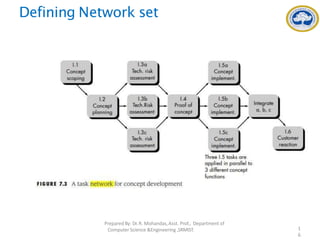
A task network, also called an activity network, is a graphic
representation of the task flow for a project. It is sometimes used
as the mechanism through which task sequence and dependencies
are input to an automated project scheduling tool.
In its simplest form (used when creating a macroscopic schedule),
the task network depicts major software engineering tasks.
PreparedBy: Dr.R. Mohandas,Asst. Prof., Department of
Computer Science &Engineering ,SRMIST. 1
5
Defining Network set
PreparedBy: Dr.R. Mohandas,Asst. Prof., Department of
Computer Science &Engineering ,SRMIST. 1
6
Critical Path Method
Definition of CPM
Developed in the late 1950s, Critical Path Method or CPM is an
algorithm used for planning, scheduling, coordination and
control of activities in a project. Here, it is assumed that the
activity duration is fixed and certain. CPM is used to compute the
earliest and latest possible start time for each activity.
Prepared By: Dr
. R. Mohandas,Asst. Prof.,
Departmentof Computer Science &Engineering
,SRMIST.
1
7
Critical Path Method
The process differentiates the critical and non-critical activities
to reduce the time and avoid the queue generation in the
process. The reason for the identification of critical activities is
that, if any activity is delayed, it will cause the whole process to
suffer. That is why it is named as Critical Path Method.
Prepared By: Dr
. R. Mohandas,Asst. Prof.,
Departmentof Computer Science &Engineering
,SRMIST.
1
8
Critical Path Method
In this method, first of all, a list is prepared consisting of all
the activities needed to complete a project, followed by the
computation of time required to complete each activity.
After that, the dependency between the activities is
determined. Here, ‘path’ is defined as a sequence of
activities in a network. The critical path is the path with the
highest length.
Prepared By: Dr
. R. Mohandas,Asst. Prof.,
Departmentof Computer Science &Engineering
,SRMIST.
1
9
Critical Path Method
The critical path method (CPM) is a technique where you
identify tasks that are necessary for project completion
and determine scheduling flexibilities. A critical path in
project management is the longest sequence of activities
that must be finished on time in order for the entire project
to be complete.
PreparedBy: Dr.R. Mohandas,Asst. Prof., Department of
Computer Science &Engineering ,SRMIST. 2
0
Critical Path Method
With the help of CPM, we’ll be able to create a model that enables
you to determine the following:
• Tasks required to complete the project
• Dependencies between tasks
• The duration required to complete an activity
Now, before we can get started with CPM or Critical Path
Method, we’ll have to understand two major concepts which are
Events andActivities
PreparedBy: Dr.R. Mohandas,Asst. Prof., Department of
Computer Science &Engineering ,SRMIST. 2
1
Critical Path Method
PreparedBy: Dr.R. Mohandas,Asst. Prof., Department of
Computer Science &Engineering ,SRMIST. 2
2
Critical Path Method
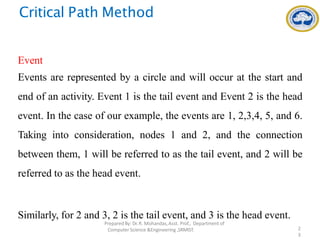
Event
Events are represented by a circle and will occur at the start and
end of an activity. Event 1 is the tail event and Event 2 is the head
event. In the case of our example, the events are 1, 2,3,4, 5, and 6.
Taking into consideration, nodes 1 and 2, and the connection
between them, 1 will be referred to as the tail event, and 2 will be
referred to as the head event.
Similarly, for 2 and 3, 2 is the tail event, and 3 is the head event.
PreparedBy: Dr.R. Mohandas,Asst. Prof., Department of
Computer Science &Engineering ,SRMIST. 2
3
Critical Path Method
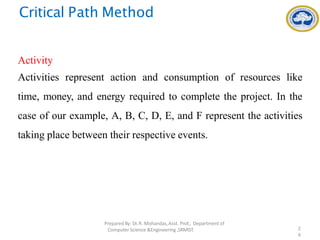
Activity
Activities represent action and consumption of resources like
time, money, and energy required to complete the project. In the
case of our example, A, B, C, D, E, and F represent the activities
taking place between their respective events.
PreparedBy: Dr.R. Mohandas,Asst. Prof., Department of
Computer Science &Engineering ,SRMIST. 2
4
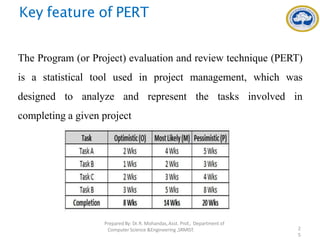
Key feature of PERT
The Program (or Project) evaluation and review technique (PERT)
is a statistical tool used in project management, which was
designed to analyze and represent the tasks involved in
completing a given project
PreparedBy: Dr.R. Mohandas,Asst. Prof., Department of
Computer Science &Engineering ,SRMIST. 2
5
Key feature of PERT
PreparedBy: Dr.R. Mohandas,Asst. Prof., Department of
Computer Science &Engineering ,SRMIST. 2
6
Critical Path Method
PreparedBy: Dr.R. Mohandas,Asst. Prof., Department of
Computer Science &Engineering ,SRMIST. 2
7
Critical Path Method
Definition of CPM
Developed in the late 1950s, Critical Path Method or CPM is an
algorithm used for planning, scheduling, coordination and
control of activities in a project. Here, it is assumed that the
activity duration is fixed and certain. CPM is used to compute the
earliest and latest possible start time for each activity.
Prepared By: Dr
. R. Mohandas,Asst. Prof.,
Departmentof Computer Science &Engineering
,SRMIST.
2
8
Critical Path Method
The process differentiates the critical and non-critical activities
to reduce the time and avoid the queue generation in the
process. The reason for the identification of critical activities is
that, if any activity is delayed, it will cause the whole process to
suffer. That is why it is named as Critical Path Method.
Prepared By: Dr
. R. Mohandas,Asst. Prof.,
Departmentof Computer Science &Engineering
,SRMIST.
2
9
Critical Path Method
In this method, first of all, a list is prepared consisting of all
the activities needed to complete a project, followed by the
computation of time required to complete each activity.
After that, the dependency between the activities is
determined. Here, ‘path’ is defined as a sequence of
activities in a network. The critical path is the path with the
highest length.
Prepared By: Dr
. R. Mohandas,Asst. Prof.,
Departmentof Computer Science &Engineering
,SRMIST.
3
0
Characteristics of CPM
Characteristics of CPM or Critical Path Method are:
1. CPM uses activity oriented network
2. Duration of any activity can be estimated with a good
accuracy
3. It is used mostly in construction projects
4. It is used mostly for repetitive kind of projects
5. It can be used to control both time and cost during project
planning
6. Cost optimization is of primary importance in CPM. It is also
the controlling factor.
PreparedBy: Dr.R. Mohandas,Asst. Prof., Department of
Computer Science &Engineering ,SRMIST. 3
1
Characteristics of CPM
Characteristics of CPM or Critical Path Method are:
Crashing is a compression technique applied to CPM, to shorten
the project duration, along with least additional cost.
CPM is used to compute the earliest and latest possible start time
for each activity.
In CPM, cost optimization is given prime importance. The time
for the completion of the project depends upon cost optimization.
The cost is not directly proportioned to time. Thus, the cost is the
controlling factor.
PreparedBy: Dr.R. Mohandas,Asst. Prof., Department of
Computer Science &Engineering ,SRMIST. 3
2
Characteristics of CPM
PreparedBy: Dr.R. Mohandas,Asst. Prof., Department of
Computer Science &Engineering ,SRMIST.
3
3
Characteristics of CPM or Critical Path Method are:
CPM uses activity oriented network.
Duration of activity may be estimated with a fair degree of
accuracy.
It is used extensively in construction projects.
CPM is the management of repetitive projects.
The deterministic concept is used.
CPM can control both time and cost when planning.
Identifies the critical and non-critical activities of the project so
that we can focus more on the critical activities and complete the
project on time.
Comparison of network based project
management techniques, PERT and CPM
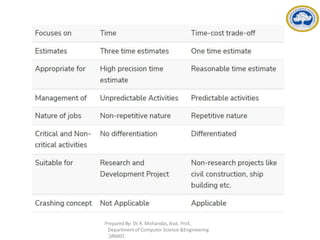
Project management can be understood as a systematic way of
planning, scheduling, executing, monitoring, controlling the
different aspects of the project, so as to attain the goal made at
the time of project formulation. PERT and CPM are the two
network-based project management techniques, which exhibit
the flow and sequence of the activities and events.
Prepared By: Dr.R. Mohandas,Asst. Prof., Department of
Computer Science &Engineering ,SRMIST.
Comparison of network based project
management techniques, PERT and CPM
Project management can be understood as a systematic way of
planning, scheduling, executing, monitoring, controlling the
different aspects of the project, so as to attain the goal made at
the time of project formulation. PERT and CPM are the two
network-based project management techniques, which exhibit
the flow and sequence of the activities and events. CPM is
different from PERT in a way that the latter concentrates
on time while the former stresses on the time-cost trade-
off
Prepared By: Dr.R. Mohandas,Asst. Prof., Department of
Computer Science &Engineering ,SRMIST.
Prepared By: Dr
. R. Mohandas,Asst. Prof.,
Departmentof Computer Science &Engineering
,SRMIST.
Prepared By: Dr
. R. Mohandas,Asst. Prof.,
Departmentof Computer Science &Engineering
,SRMIST.
Key Differences Between PERT and CPM
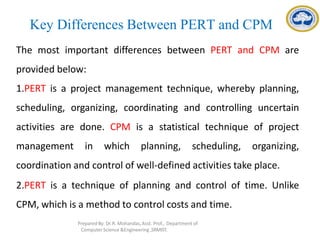
The most important differences between PERT and CPM are
provided below:
1.PERT is a project management technique, whereby planning,
scheduling, organizing, coordinating and controlling uncertain
activities are done. CPM is a statistical technique of project
management in which planning, scheduling, organizing,
coordination and control of well-defined activities take place.
2.PERT is a technique of planning and control of time. Unlike
CPM, which is a method to control costs and time.
Prepared By: Dr.R. Mohandas,Asst. Prof., Department of
Computer Science &Engineering ,SRMIST.
Key Differences Between PERT and CPM
The most important differences between PERT and CPM are
provided below:
1.PERT is a project management technique, whereby planning,
scheduling, organizing, coordinating and controlling uncertain
activities are done. CPM is a statistical technique of project
management in which planning, scheduling, organizing,
coordination and control of well-defined activities take place.
2.PERT is a technique of planning and control of time. Unlike
CPM, which is a method to control costs and time.
Prepared By: Dr.R. Mohandas,Asst. Prof., Department of
Computer Science &Engineering ,SRMIST.
Key Differences Between PERT and CPM
3.PERT is set according to events while CPM is aligned towards
activities.
4. A deterministic model is used in CPM. Conversely, PERT uses a
probabilistic model.
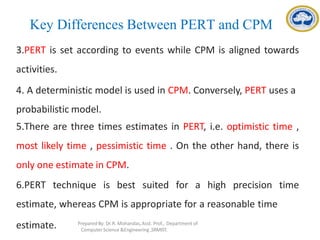
5.There are three times estimates in PERT, i.e. optimistic time ,
most likely time , pessimistic time . On the other hand, there is
only one estimate in CPM.
6.PERT technique is best suited for a high precision time
estimate, whereas CPM is appropriate for a reasonable time
estimate. Prepared By: Dr.R. Mohandas,Asst. Prof., Department of
Computer Science &Engineering ,SRMIST.
Key Differences Between PERT and CPM
7.PERT deals with unpredictable activities, but CPM deals with
predictable activities.
8. PERT is used where the nature of the job is non-repetitive. In
contrast to, CPM involves the job of repetitive nature.
9.There is a demarcation between critical and non-critical
activities in CPM, which is not in the case of PERT.
Prepared By: Dr.R. Mohandas,Asst. Prof., Department of
Computer Science &Engineering ,SRMIST.
Key Differences Between PERT and CPM
10.PERT is best for research and development projects, but CPM
is for non-research projects like construction projects.
11.Crashing is a compression technique applied to CPM, to
shorten the project duration, along with the least additional
cost. The crashing concept is not applicable to PERT.
Prepared By: Dr.R. Mohandas,Asst. Prof., Department of
Computer Science &Engineering ,SRMIST.
Float calculations and it’s importance
What Is Float in Project Management?
Put simply, project management float is the amount of time a
given task can be delayed without causing a delay in the entire
project. But, there’s a little more to it than that. In fact, there are
two distinct types of float that project managers use to manage
task timelines: total float and free float.
Prepared By: Dr.R. Mohandas,Asst. Prof., Department of
Computer Science &Engineering ,SRMIST.
Float calculations and it’s importance
Total float
•The total amount of time a task can be delayed without affecting
the final project delivery date
•Usually what PMs are referring to when they talk about "project
float"
•Can compromise a project's final delivery date and is of more
concern than free float
Prepared By: Dr.R. Mohandas,Asst. Prof., Department of
Computer Science &Engineering ,SRMIST.
Float calculations and it’s importance
Free float
• The amount of time a task can be delayed without impacting
other tasks in the path
• Referred to less often than total float
• Usually not a huge concern to project delivery
Prepared By: Dr.R. Mohandas,Asst. Prof., Department of
Computer Science &Engineering ,SRMIST.
Benefits of float in project management
As you can imagine, project float — sometimes called project
“slack” — is highly beneficial for project managers, particularly
those who oversee large, complicated projects with multiple task
paths.
Of course, project float helps tremendously with resource
management, scheduling, and keeping projects on track for a
timely delivery. But float is also extremely valuable for PMs
working with contractors and internal resource managers.
Prepared By: Dr.R. Mohandas,Asst. Prof., Department of
Computer Science &Engineering ,SRMIST.
Benefits of float in project management
• For example, by knowing precisely how much free float and
total float a particular task has, you give your contractors
more leeway to work with. This means they can optimize their
schedule by choosing the best crew for the job, working as
materials arrive, working in the best weather conditions, and
avoiding overtime.
• Similarly, internal resource managers benefit from the
flexibility project slack provides. Instead of feeling pressured
by tight, non-negotiable deadlines, project float gives them
the breathing room needed to allocate resources in the most
efficient manner possible.
Prepared By: Dr.R. Mohandas,Asst. Prof., Department of
Computer Science &Engineering ,SRMIST.
How to calculate float in project management
Before you can calculate total or free float, you must first
identify and map your project’s critical and non-critical tasks. Of
course, the tasks that make up your critical path are dependent
on one another. By definition, then, there will be no float in the
project’s critical path. However, in complex projects that contain
more than one task path, float will come into play in your non-
critical paths.
Prepared By: Dr.R. Mohandas,Asst. Prof., Department of
Computer Science &Engineering ,SRMIST.
How to calculate float in project management
To calculate total float, subtract the task’s earliest finish (EF)
date from its latest finish (LF) date. It looks like this: LF - EF =
total float. Alternately, you can subtract the task’s earliest start
(ES) date from its latest start (LS) date, like this: LS - ES = total
float. Both of these formulas will give you the task’s total float.
Free float, on the other hand, is calculated by subtracting the
task’s earliest finish date from its earliest start date. That formula
looks like this: ES - EF = free float.
Prepared By: Dr.R. Mohandas,Asst. Prof., Department of
Computer Science &Engineering ,SRMIST.
An example of float in project management
Let's look at a simple example of how float can arise in a project.
Imagine you are building an extension on the ground floor of
your home, and you set a deadline of six months. In order to
build the extension, the following tasks need to be completed:
• Laying the foundations
• Plumbing and electricity
• Plastering and painting
• Laying the floor
Prepared By: Dr.R. Mohandas,Asst. Prof., Department of
Computer Science &Engineering ,SRMIST.
An example of float in project management
The plumbing and electricity cannot be installed until the
foundations have been properly laid, which will take six weeks.
However, in your project schedule, you have allocated eight
weeks for foundations to be laid. This means that laying
foundations can start two weeks after your project's start date
without affecting the scheduled installation of plumbing and
electricity. The float for laying the foundations is, therefore, two
weeks
Prepared By: Dr.R. Mohandas,Asst. Prof., Department of
Computer Science &Engineering ,SRMIST.
How to use float for better project management
No matter your preferred project management framework or
style, understanding total and free float can help you and your
teams improve resource management, internal and external
scheduling, and project delivery. The great part about float is
that it can be implemented in just about every PM framework,
including Agile, Kanban, critical path, PERT, waterfall, and more.
Prepared By: Dr.R. Mohandas,Asst. Prof., Department of
Computer Science &Engineering ,SRMIST.
Project Cost Control
Cost control is the task of overseeing and managing project
expenses and preparing for potential financial risks. This is
typically the project manager's responsibility. Cost control
involves managing the budget, as well as planning, and preparing
for potential risks. Risks can set projects back and sometimes
even require unexpected expenses. Preparation for these
setbacks can save your team time and potentially, money.
Prepared By: Dr.R. Mohandas,Asst. Prof., Department of
Computer Science &Engineering ,SRMIST.
Project Cost Control Important Steps
1. Measure differences from baseline budget
2. Forecast final costs
3. Determine possible corrective actions
4. Implement and evaluate corrective actions
Prepared By: Dr.R. Mohandas,Asst. Prof., Department of
Computer Science &Engineering ,SRMIST.
Steps to implement Cost Control in projects
1. Review the budget frequently
2. Communicate with all team members
3. Control project scope
4. Track individual components
5. Revise budget if necessary
Prepared By: Dr.R. Mohandas,Asst. Prof., Department of
Computer Science &Engineering ,SRMIST.

IT project management-IT project management-Unit-2.pptx

  • 1.
  • 2.
    PROJECT SCHEDULING Scheduling inproject management is the listing of activities, deliverables, and milestones within a project. A schedule also usually includes a planned start and finish date, duration, and resources assigned to each activity. Effective project scheduling is a critical component of successful time management, especially for professional service businesses. PreparedBy: Dr.R. Mohandas,Asst. Prof., Department of Computer Science &Engineering ,SRMIST. 2
  • 3.
    PROJECT SCHEDULING When peoplediscuss the processes for building a schedule, they are usually referring to the first six processes of time management: • Plan schedule management • Define project activities • Sequence activities • Estimate resources • Estimate durations • Develop the project schedule PreparedBy: Dr.R. Mohandas,Asst. Prof., Department of Computer Science &Engineering ,SRMIST. 3
  • 4.
    How to doscheduling in project management There are three main types of project schedules: Master project schedule: A master schedule PreparedBy: Dr.R. Mohandas,Asst. Prof., Department of Computer Science &Engineering ,SRMIST. 4 tends to be a simplified list of tasks with a timeline or project calendar. Milestone schedule or summary schedule: This type of project schedule tracks major milestones and key deliverables, but not every task is required to complete the project. A detailed project schedule: This is the most thorough project schedule, as it identifies and tracks every project activity. If you have a complex, large, or lengthy project, it’s important to have a detailed project schedule to help track everything.
  • 5.
    Project Scheduling Techniques Themost common form of project schedule is a Gantt chart. Both a milestone schedule and a detailed project schedule can be created as a Gantt chart. Two other popular project management scheduling techniques include the critical path method (CPM) and the program evaluation and review technique (PERT). Adjust your plans You can easily change dates and deadlines, and drag and drop tasks. project scheduler’s dynamic timeline automatically adjusts everything around your changes. All adjustments are automatically shared with team. PreparedBy: Dr.R. Mohandas,Asst. Prof., Department of Computer Science &Engineering ,SRMIST. 5
  • 6.
    Benefits of projectscheduling in project management Project scheduling provides the following benefits: • Assists with tracking, reporting, and communicating progress • Ensures everyone is on the same page with tasks, dependencies, and deadlines • Highlights issues and concerns, such as a lack of resources • Identifies task relationships • Monitors progress and identify issues early PreparedBy: Dr.R. Mohandas,Asst. Prof., Department of Computer Science &Engineering ,SRMIST. 6
  • 7.
    Seven tips forcreating a solid project schedule 1.Get input from stakeholders: Don’t create your schedule in isolation. It’s important to use your team and other stakeholders to identify tasks, resources, dependencies, and durations. 2.Reference past projects: Looking at previous projects with similar scope and requirements can help create realistic estimates and ensure you haven’t forgotten any tasks. 3.Keep risk in mind: Identify and document any factors that pose a risk to staying on schedule. This will help your risk management efforts. PreparedBy: Dr.R. Mohandas,Asst. Prof., Department of Computer Science &Engineering ,SRMIST. 7
  • 8.
    Seven tips forcreating a solid project schedule 4.Consider any non-work time: For example, make sure vacations and holidays are reflected in your schedule so that you’re not assuming people will be working when they’re not. PreparedBy: Dr.R. Mohandas,Asst. Prof., Department of Computer Science &Engineering ,SRMIST. 8 5.Define the critical project’s critical path path on your project: Identifying your allows you to prioritize and allocate resources to the most important tasks in the project.
  • 9.
    Seven tips forcreating a solid project schedule 6. Record scheduling assumptions: Write down the logic behind your scheduling predictions. For example, if you assume it will only take 10 hours to complete a task because you have a senior engineer. Then, if you end up with a junior engineer, you can understand and explain why it took twice as long as planned. PreparedBy: Dr.R. Mohandas,Asst. Prof., Department of Computer Science &Engineering ,SRMIST. 9
  • 10.
    Seven tips forcreating a solid project schedule 7.Include project milestones: Milestones are events or markers that stand for an important point in your project. They’re useful for creating a summary schedule, reporting to executives, and identifying problems early. Here are some milestone examples: Project kickoff Design approvals Completion of requirements Product implementation Project closeout PreparedBy: Dr.R. Mohandas,Asst. Prof., Department of Computer Science &Engineering ,SRMIST. 1 0
  • 11.
    Defining a Taskset A task set is a collection of software engineering work tasks, milestones, and deliverables that must be accomplished to complete a particular project. The task set to be chosen must provide enough discipline to achieve high software quality. But, at the same time, it must not burden the project team with unnecessary work. Task sets are designed to accommodate different types of projects and different degrees of rigor. PreparedBy: Dr.R. Mohandas,Asst. Prof., Department of Computer Science &Engineering ,SRMIST. 1 1
  • 12.
    Defining a Taskset Although it is difficult to develop a comprehensive taxonomy of software project types, most software organizations encounter the following projects: • Concept development projects that are initiated to explore some new business concept or application of some new technology. • New application development projects that are undertaken as a consequence of a specific customer request. • Application enhancement projects that occur when existing software undergoes major modifications to function, performance, or interfaces that are observable by the end-user. PreparedBy: Dr.R. Mohandas,Asst. Prof., Department of Computer Science &Engineering ,SRMIST. 1 2
  • 13.
    Defining a Taskset • Application maintenance projects that correct, adapt, or extend existing software in ways that may not be immediately obvious to the end-user. • Reengineering projects that are undertaken with the intent of rebuilding an existing (legacy) system in whole or in part. PreparedBy: Dr.R. Mohandas,Asst. Prof., Department of Computer Science &Engineering ,SRMIST. 1 3
  • 14.
    Defining Network set Individualtasks and subtasks have interdependencies based on their sequence. In addition, when more than one person is involved in a software engineering project, it is likely that development activities and tasks will be performed in parallel. When this occurs, concurrent tasks must be coordinated so that they will be complete when later tasks require their work product(s). PreparedBy: Dr.R. Mohandas,Asst. Prof., Department of Computer Science &Engineering ,SRMIST. 1 4
  • 15.
    Defining Network set Atask network, also called an activity network, is a graphic representation of the task flow for a project. It is sometimes used as the mechanism through which task sequence and dependencies are input to an automated project scheduling tool. In its simplest form (used when creating a macroscopic schedule), the task network depicts major software engineering tasks. PreparedBy: Dr.R. Mohandas,Asst. Prof., Department of Computer Science &Engineering ,SRMIST. 1 5
  • 16.
    Defining Network set PreparedBy:Dr.R. Mohandas,Asst. Prof., Department of Computer Science &Engineering ,SRMIST. 1 6
  • 17.
    Critical Path Method Definitionof CPM Developed in the late 1950s, Critical Path Method or CPM is an algorithm used for planning, scheduling, coordination and control of activities in a project. Here, it is assumed that the activity duration is fixed and certain. CPM is used to compute the earliest and latest possible start time for each activity. Prepared By: Dr . R. Mohandas,Asst. Prof., Departmentof Computer Science &Engineering ,SRMIST. 1 7
  • 18.
    Critical Path Method Theprocess differentiates the critical and non-critical activities to reduce the time and avoid the queue generation in the process. The reason for the identification of critical activities is that, if any activity is delayed, it will cause the whole process to suffer. That is why it is named as Critical Path Method. Prepared By: Dr . R. Mohandas,Asst. Prof., Departmentof Computer Science &Engineering ,SRMIST. 1 8
  • 19.
    Critical Path Method Inthis method, first of all, a list is prepared consisting of all the activities needed to complete a project, followed by the computation of time required to complete each activity. After that, the dependency between the activities is determined. Here, ‘path’ is defined as a sequence of activities in a network. The critical path is the path with the highest length. Prepared By: Dr . R. Mohandas,Asst. Prof., Departmentof Computer Science &Engineering ,SRMIST. 1 9
  • 20.
    Critical Path Method Thecritical path method (CPM) is a technique where you identify tasks that are necessary for project completion and determine scheduling flexibilities. A critical path in project management is the longest sequence of activities that must be finished on time in order for the entire project to be complete. PreparedBy: Dr.R. Mohandas,Asst. Prof., Department of Computer Science &Engineering ,SRMIST. 2 0
  • 21.
    Critical Path Method Withthe help of CPM, we’ll be able to create a model that enables you to determine the following: • Tasks required to complete the project • Dependencies between tasks • The duration required to complete an activity Now, before we can get started with CPM or Critical Path Method, we’ll have to understand two major concepts which are Events andActivities PreparedBy: Dr.R. Mohandas,Asst. Prof., Department of Computer Science &Engineering ,SRMIST. 2 1
  • 22.
    Critical Path Method PreparedBy:Dr.R. Mohandas,Asst. Prof., Department of Computer Science &Engineering ,SRMIST. 2 2
  • 23.
    Critical Path Method Event Eventsare represented by a circle and will occur at the start and end of an activity. Event 1 is the tail event and Event 2 is the head event. In the case of our example, the events are 1, 2,3,4, 5, and 6. Taking into consideration, nodes 1 and 2, and the connection between them, 1 will be referred to as the tail event, and 2 will be referred to as the head event. Similarly, for 2 and 3, 2 is the tail event, and 3 is the head event. PreparedBy: Dr.R. Mohandas,Asst. Prof., Department of Computer Science &Engineering ,SRMIST. 2 3
  • 24.
    Critical Path Method Activity Activitiesrepresent action and consumption of resources like time, money, and energy required to complete the project. In the case of our example, A, B, C, D, E, and F represent the activities taking place between their respective events. PreparedBy: Dr.R. Mohandas,Asst. Prof., Department of Computer Science &Engineering ,SRMIST. 2 4
  • 25.
    Key feature ofPERT The Program (or Project) evaluation and review technique (PERT) is a statistical tool used in project management, which was designed to analyze and represent the tasks involved in completing a given project PreparedBy: Dr.R. Mohandas,Asst. Prof., Department of Computer Science &Engineering ,SRMIST. 2 5
  • 26.
    Key feature ofPERT PreparedBy: Dr.R. Mohandas,Asst. Prof., Department of Computer Science &Engineering ,SRMIST. 2 6
  • 27.
    Critical Path Method PreparedBy:Dr.R. Mohandas,Asst. Prof., Department of Computer Science &Engineering ,SRMIST. 2 7
  • 28.
    Critical Path Method Definitionof CPM Developed in the late 1950s, Critical Path Method or CPM is an algorithm used for planning, scheduling, coordination and control of activities in a project. Here, it is assumed that the activity duration is fixed and certain. CPM is used to compute the earliest and latest possible start time for each activity. Prepared By: Dr . R. Mohandas,Asst. Prof., Departmentof Computer Science &Engineering ,SRMIST. 2 8
  • 29.
    Critical Path Method Theprocess differentiates the critical and non-critical activities to reduce the time and avoid the queue generation in the process. The reason for the identification of critical activities is that, if any activity is delayed, it will cause the whole process to suffer. That is why it is named as Critical Path Method. Prepared By: Dr . R. Mohandas,Asst. Prof., Departmentof Computer Science &Engineering ,SRMIST. 2 9
  • 30.
    Critical Path Method Inthis method, first of all, a list is prepared consisting of all the activities needed to complete a project, followed by the computation of time required to complete each activity. After that, the dependency between the activities is determined. Here, ‘path’ is defined as a sequence of activities in a network. The critical path is the path with the highest length. Prepared By: Dr . R. Mohandas,Asst. Prof., Departmentof Computer Science &Engineering ,SRMIST. 3 0
  • 31.
    Characteristics of CPM Characteristicsof CPM or Critical Path Method are: 1. CPM uses activity oriented network 2. Duration of any activity can be estimated with a good accuracy 3. It is used mostly in construction projects 4. It is used mostly for repetitive kind of projects 5. It can be used to control both time and cost during project planning 6. Cost optimization is of primary importance in CPM. It is also the controlling factor. PreparedBy: Dr.R. Mohandas,Asst. Prof., Department of Computer Science &Engineering ,SRMIST. 3 1
  • 32.
    Characteristics of CPM Characteristicsof CPM or Critical Path Method are: Crashing is a compression technique applied to CPM, to shorten the project duration, along with least additional cost. CPM is used to compute the earliest and latest possible start time for each activity. In CPM, cost optimization is given prime importance. The time for the completion of the project depends upon cost optimization. The cost is not directly proportioned to time. Thus, the cost is the controlling factor. PreparedBy: Dr.R. Mohandas,Asst. Prof., Department of Computer Science &Engineering ,SRMIST. 3 2
  • 33.
    Characteristics of CPM PreparedBy:Dr.R. Mohandas,Asst. Prof., Department of Computer Science &Engineering ,SRMIST. 3 3 Characteristics of CPM or Critical Path Method are: CPM uses activity oriented network. Duration of activity may be estimated with a fair degree of accuracy. It is used extensively in construction projects. CPM is the management of repetitive projects. The deterministic concept is used. CPM can control both time and cost when planning. Identifies the critical and non-critical activities of the project so that we can focus more on the critical activities and complete the project on time.
  • 34.
    Comparison of networkbased project management techniques, PERT and CPM Project management can be understood as a systematic way of planning, scheduling, executing, monitoring, controlling the different aspects of the project, so as to attain the goal made at the time of project formulation. PERT and CPM are the two network-based project management techniques, which exhibit the flow and sequence of the activities and events. Prepared By: Dr.R. Mohandas,Asst. Prof., Department of Computer Science &Engineering ,SRMIST.
  • 35.
    Comparison of networkbased project management techniques, PERT and CPM Project management can be understood as a systematic way of planning, scheduling, executing, monitoring, controlling the different aspects of the project, so as to attain the goal made at the time of project formulation. PERT and CPM are the two network-based project management techniques, which exhibit the flow and sequence of the activities and events. CPM is different from PERT in a way that the latter concentrates on time while the former stresses on the time-cost trade- off Prepared By: Dr.R. Mohandas,Asst. Prof., Department of Computer Science &Engineering ,SRMIST.
  • 36.
    Prepared By: Dr .R. Mohandas,Asst. Prof., Departmentof Computer Science &Engineering ,SRMIST.
  • 37.
    Prepared By: Dr .R. Mohandas,Asst. Prof., Departmentof Computer Science &Engineering ,SRMIST.
  • 38.
    Key Differences BetweenPERT and CPM The most important differences between PERT and CPM are provided below: 1.PERT is a project management technique, whereby planning, scheduling, organizing, coordinating and controlling uncertain activities are done. CPM is a statistical technique of project management in which planning, scheduling, organizing, coordination and control of well-defined activities take place. 2.PERT is a technique of planning and control of time. Unlike CPM, which is a method to control costs and time. Prepared By: Dr.R. Mohandas,Asst. Prof., Department of Computer Science &Engineering ,SRMIST.
  • 39.
    Key Differences BetweenPERT and CPM The most important differences between PERT and CPM are provided below: 1.PERT is a project management technique, whereby planning, scheduling, organizing, coordinating and controlling uncertain activities are done. CPM is a statistical technique of project management in which planning, scheduling, organizing, coordination and control of well-defined activities take place. 2.PERT is a technique of planning and control of time. Unlike CPM, which is a method to control costs and time. Prepared By: Dr.R. Mohandas,Asst. Prof., Department of Computer Science &Engineering ,SRMIST.
  • 40.
    Key Differences BetweenPERT and CPM 3.PERT is set according to events while CPM is aligned towards activities. 4. A deterministic model is used in CPM. Conversely, PERT uses a probabilistic model. 5.There are three times estimates in PERT, i.e. optimistic time , most likely time , pessimistic time . On the other hand, there is only one estimate in CPM. 6.PERT technique is best suited for a high precision time estimate, whereas CPM is appropriate for a reasonable time estimate. Prepared By: Dr.R. Mohandas,Asst. Prof., Department of Computer Science &Engineering ,SRMIST.
  • 41.
    Key Differences BetweenPERT and CPM 7.PERT deals with unpredictable activities, but CPM deals with predictable activities. 8. PERT is used where the nature of the job is non-repetitive. In contrast to, CPM involves the job of repetitive nature. 9.There is a demarcation between critical and non-critical activities in CPM, which is not in the case of PERT. Prepared By: Dr.R. Mohandas,Asst. Prof., Department of Computer Science &Engineering ,SRMIST.
  • 42.
    Key Differences BetweenPERT and CPM 10.PERT is best for research and development projects, but CPM is for non-research projects like construction projects. 11.Crashing is a compression technique applied to CPM, to shorten the project duration, along with the least additional cost. The crashing concept is not applicable to PERT. Prepared By: Dr.R. Mohandas,Asst. Prof., Department of Computer Science &Engineering ,SRMIST.
  • 43.
    Float calculations andit’s importance What Is Float in Project Management? Put simply, project management float is the amount of time a given task can be delayed without causing a delay in the entire project. But, there’s a little more to it than that. In fact, there are two distinct types of float that project managers use to manage task timelines: total float and free float. Prepared By: Dr.R. Mohandas,Asst. Prof., Department of Computer Science &Engineering ,SRMIST.
  • 44.
    Float calculations andit’s importance Total float •The total amount of time a task can be delayed without affecting the final project delivery date •Usually what PMs are referring to when they talk about "project float" •Can compromise a project's final delivery date and is of more concern than free float Prepared By: Dr.R. Mohandas,Asst. Prof., Department of Computer Science &Engineering ,SRMIST.
  • 45.
    Float calculations andit’s importance Free float • The amount of time a task can be delayed without impacting other tasks in the path • Referred to less often than total float • Usually not a huge concern to project delivery Prepared By: Dr.R. Mohandas,Asst. Prof., Department of Computer Science &Engineering ,SRMIST.
  • 46.
    Benefits of floatin project management As you can imagine, project float — sometimes called project “slack” — is highly beneficial for project managers, particularly those who oversee large, complicated projects with multiple task paths. Of course, project float helps tremendously with resource management, scheduling, and keeping projects on track for a timely delivery. But float is also extremely valuable for PMs working with contractors and internal resource managers. Prepared By: Dr.R. Mohandas,Asst. Prof., Department of Computer Science &Engineering ,SRMIST.
  • 47.
    Benefits of floatin project management • For example, by knowing precisely how much free float and total float a particular task has, you give your contractors more leeway to work with. This means they can optimize their schedule by choosing the best crew for the job, working as materials arrive, working in the best weather conditions, and avoiding overtime. • Similarly, internal resource managers benefit from the flexibility project slack provides. Instead of feeling pressured by tight, non-negotiable deadlines, project float gives them the breathing room needed to allocate resources in the most efficient manner possible. Prepared By: Dr.R. Mohandas,Asst. Prof., Department of Computer Science &Engineering ,SRMIST.
  • 48.
    How to calculatefloat in project management Before you can calculate total or free float, you must first identify and map your project’s critical and non-critical tasks. Of course, the tasks that make up your critical path are dependent on one another. By definition, then, there will be no float in the project’s critical path. However, in complex projects that contain more than one task path, float will come into play in your non- critical paths. Prepared By: Dr.R. Mohandas,Asst. Prof., Department of Computer Science &Engineering ,SRMIST.
  • 49.
    How to calculatefloat in project management To calculate total float, subtract the task’s earliest finish (EF) date from its latest finish (LF) date. It looks like this: LF - EF = total float. Alternately, you can subtract the task’s earliest start (ES) date from its latest start (LS) date, like this: LS - ES = total float. Both of these formulas will give you the task’s total float. Free float, on the other hand, is calculated by subtracting the task’s earliest finish date from its earliest start date. That formula looks like this: ES - EF = free float. Prepared By: Dr.R. Mohandas,Asst. Prof., Department of Computer Science &Engineering ,SRMIST.
  • 50.
    An example offloat in project management Let's look at a simple example of how float can arise in a project. Imagine you are building an extension on the ground floor of your home, and you set a deadline of six months. In order to build the extension, the following tasks need to be completed: • Laying the foundations • Plumbing and electricity • Plastering and painting • Laying the floor Prepared By: Dr.R. Mohandas,Asst. Prof., Department of Computer Science &Engineering ,SRMIST.
  • 51.
    An example offloat in project management The plumbing and electricity cannot be installed until the foundations have been properly laid, which will take six weeks. However, in your project schedule, you have allocated eight weeks for foundations to be laid. This means that laying foundations can start two weeks after your project's start date without affecting the scheduled installation of plumbing and electricity. The float for laying the foundations is, therefore, two weeks Prepared By: Dr.R. Mohandas,Asst. Prof., Department of Computer Science &Engineering ,SRMIST.
  • 52.
    How to usefloat for better project management No matter your preferred project management framework or style, understanding total and free float can help you and your teams improve resource management, internal and external scheduling, and project delivery. The great part about float is that it can be implemented in just about every PM framework, including Agile, Kanban, critical path, PERT, waterfall, and more. Prepared By: Dr.R. Mohandas,Asst. Prof., Department of Computer Science &Engineering ,SRMIST.
  • 53.
    Project Cost Control Costcontrol is the task of overseeing and managing project expenses and preparing for potential financial risks. This is typically the project manager's responsibility. Cost control involves managing the budget, as well as planning, and preparing for potential risks. Risks can set projects back and sometimes even require unexpected expenses. Preparation for these setbacks can save your team time and potentially, money. Prepared By: Dr.R. Mohandas,Asst. Prof., Department of Computer Science &Engineering ,SRMIST.
  • 54.
    Project Cost ControlImportant Steps 1. Measure differences from baseline budget 2. Forecast final costs 3. Determine possible corrective actions 4. Implement and evaluate corrective actions Prepared By: Dr.R. Mohandas,Asst. Prof., Department of Computer Science &Engineering ,SRMIST.
  • 55.
    Steps to implementCost Control in projects 1. Review the budget frequently 2. Communicate with all team members 3. Control project scope 4. Track individual components 5. Revise budget if necessary Prepared By: Dr.R. Mohandas,Asst. Prof., Department of Computer Science &Engineering ,SRMIST.