ACTIVE LEARNING STRATEGY IN
THE TEACHING OF GRADE 8
SCIENCE CONCEPTS: A LESSON
STUDY
LLIDO, PAULA MARIE
MADELO, BRIX
TABORADA, UNYCIE
BACKGROUND
ACTIVE LEARNING STRATEGY TO STUDENTS’ PERFORMANCE
 Students should be actively engage in active learning activities such as
class discussions because it will build a positive relationship with student
persistence (Braxton, Milem, & Sullivan, 2000).
 An abundance of literature regarding the operationalization of the term “active
learning” defines the term as a process in which the learners assume a
dynamic, energetic, and involved role in his or her own learning process
( Brown, 2008; Candela et al., 2006; Popkess and Mc Daniel, 2011;
Salamonsom et al., 2009)
 Dewey (1916/2011) believed that students must be active to learn effectively as “there is no such
thing as genuine knowledge and fruitful understanding except as the offspring of doing” (p.264).
BACKGROUND
• Beichner et al. (2007) studied 1,600 physics students at the university level for
5 years and found that students in active learning physics classes had
greater learning experiences than students in traditional lecture-based
physics classes.
• Lesson study can be defined as a teacher- led instructional improvement
cycle in which teachers work collaboratively to: formulate goals for student
learning, plan a lesson, teach and/or observe the lesson, reflect on the
gathered evidence, revise the lesson for improvement, and re-teach the
revised lesson ( Perry & Lewis, 2003; Curcio, 2002)
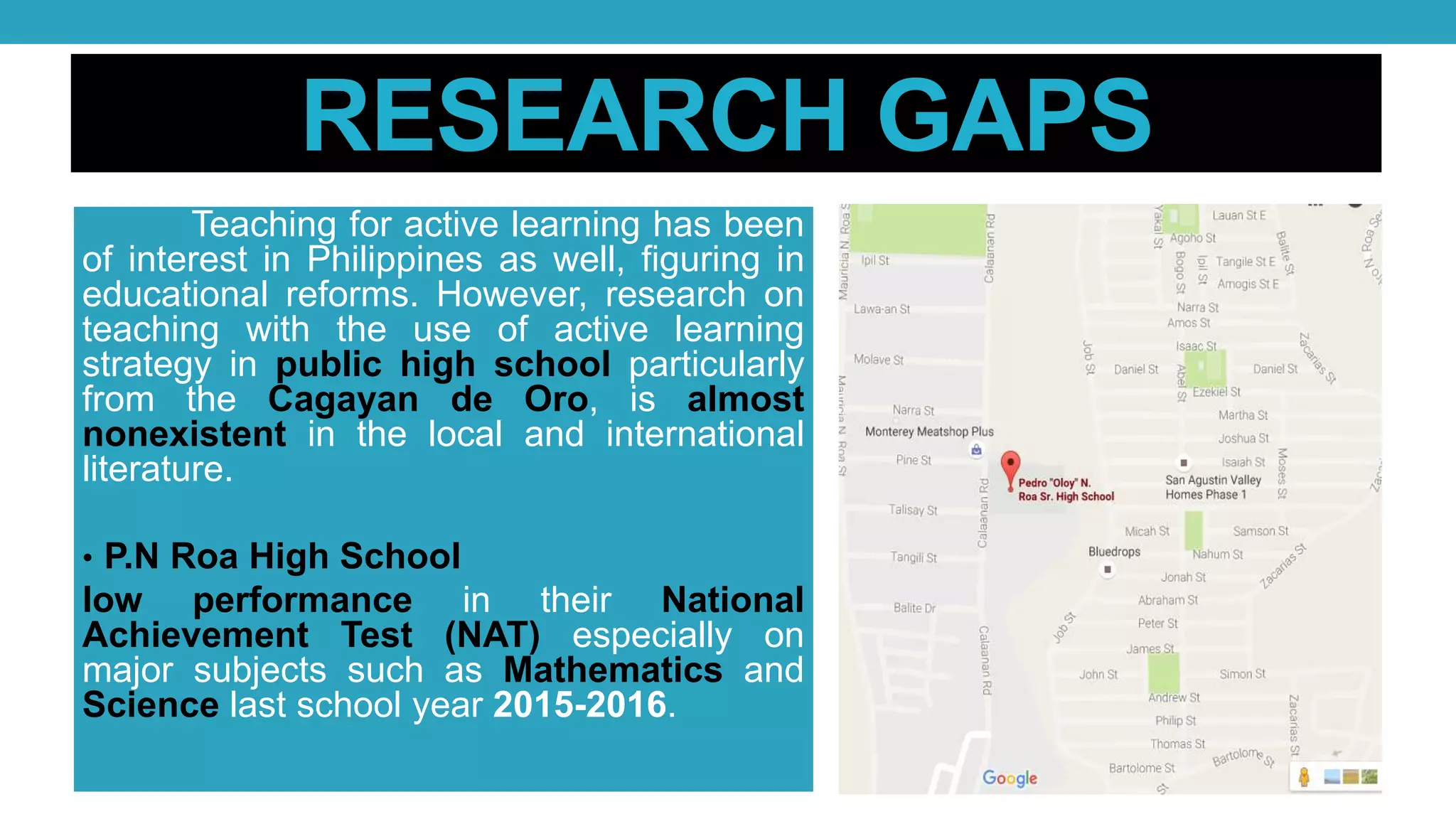
RESEARCH GAPS
Teaching for active learning has been
of interest in Philippines as well, figuring in
educational reforms. However, research on
teaching with the use of active learning
strategy in public high school particularly
from the Cagayan de Oro, is almost
nonexistent in the local and international
literature.
• P.N Roa High School
low performance in their National
Achievement Test (NAT) especially on
major subjects such as Mathematics and
Science last school year 2015-2016.
BACKGROUND
The researchers used Active Learning Strategy (through activities) to
promote learning and enhance collaboration among students. It keeps learning
active and student-centered, in a non-threatening environment. An activity can
be used to promote critical thinking and reasoning. One advantage of using
activity, as a teaching strategy, is that students have the opportunity for
immediate feedback, through the discussion of correct answers and their
rationales. Another advantage of activities is the opportunity for instructors to
facilitate discussion and clarify misconceptions (Glendon and Ulrich, 2005 ).
RESEARCH OBJECTIVES
•To determine the significance of Active Learning
Strategy to the students’ performance in the given
lesson.
•To design an effective lesson study with all the
revision and improvement of the action research.
THEORETICAL FRAMEWORK
THEORY OF CONSTRUCTIVISM
BY JEAN PIAGET
Active Learning Strategy is based in Jean Piaget’s theory of
Constructivism. Constructivism emphasizes understanding
and meaning, and students construct knowledge through
their experiences with the concepts and their environment
based on their prior knowledge and experiences (Posner,
2004).
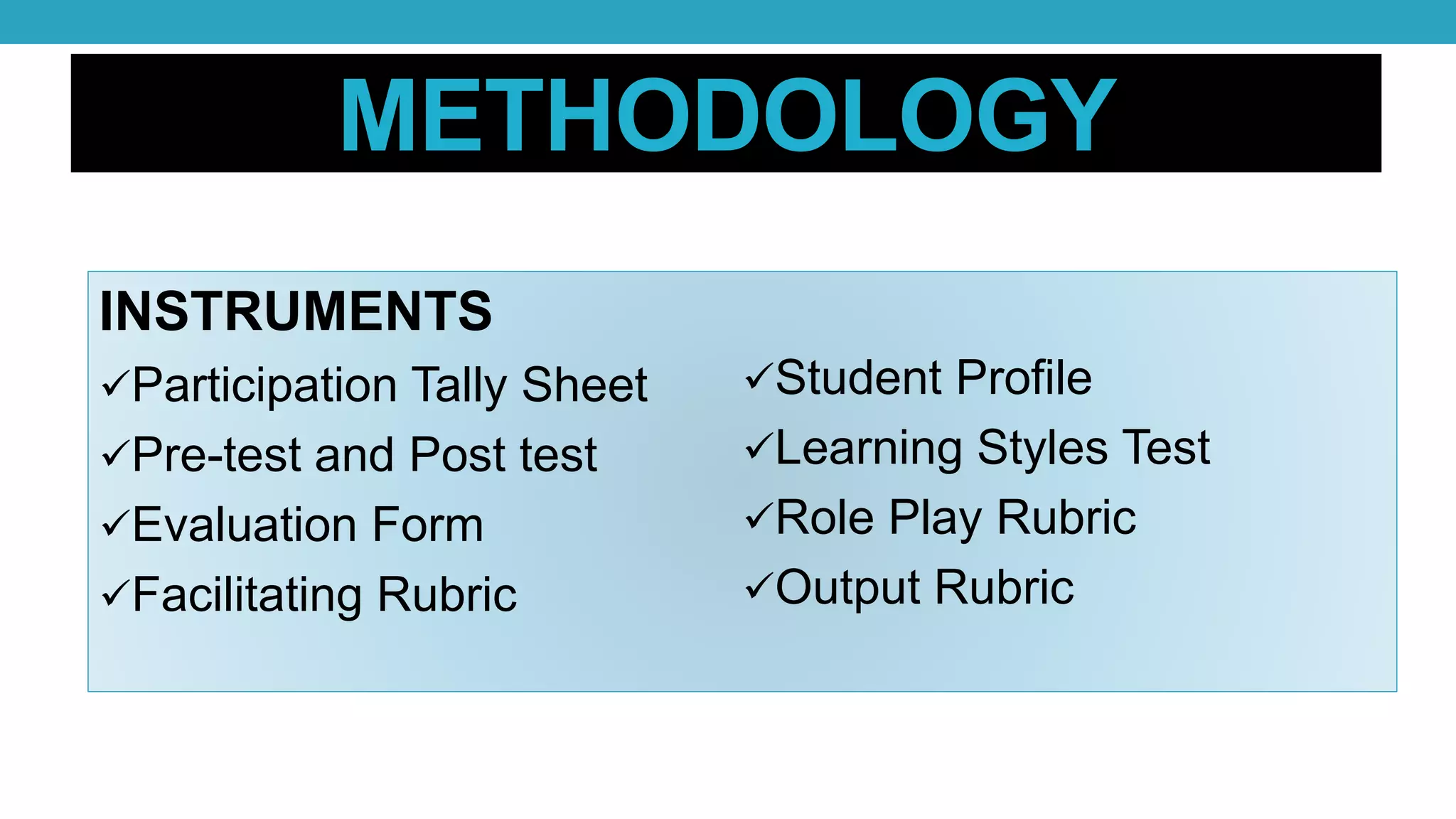
METHODOLOGY
INSTRUMENTS
Participation Tally Sheet
Pre-test and Post test
Evaluation Form
Facilitating Rubric
Student Profile
Learning Styles Test
Role Play Rubric
Output Rubric
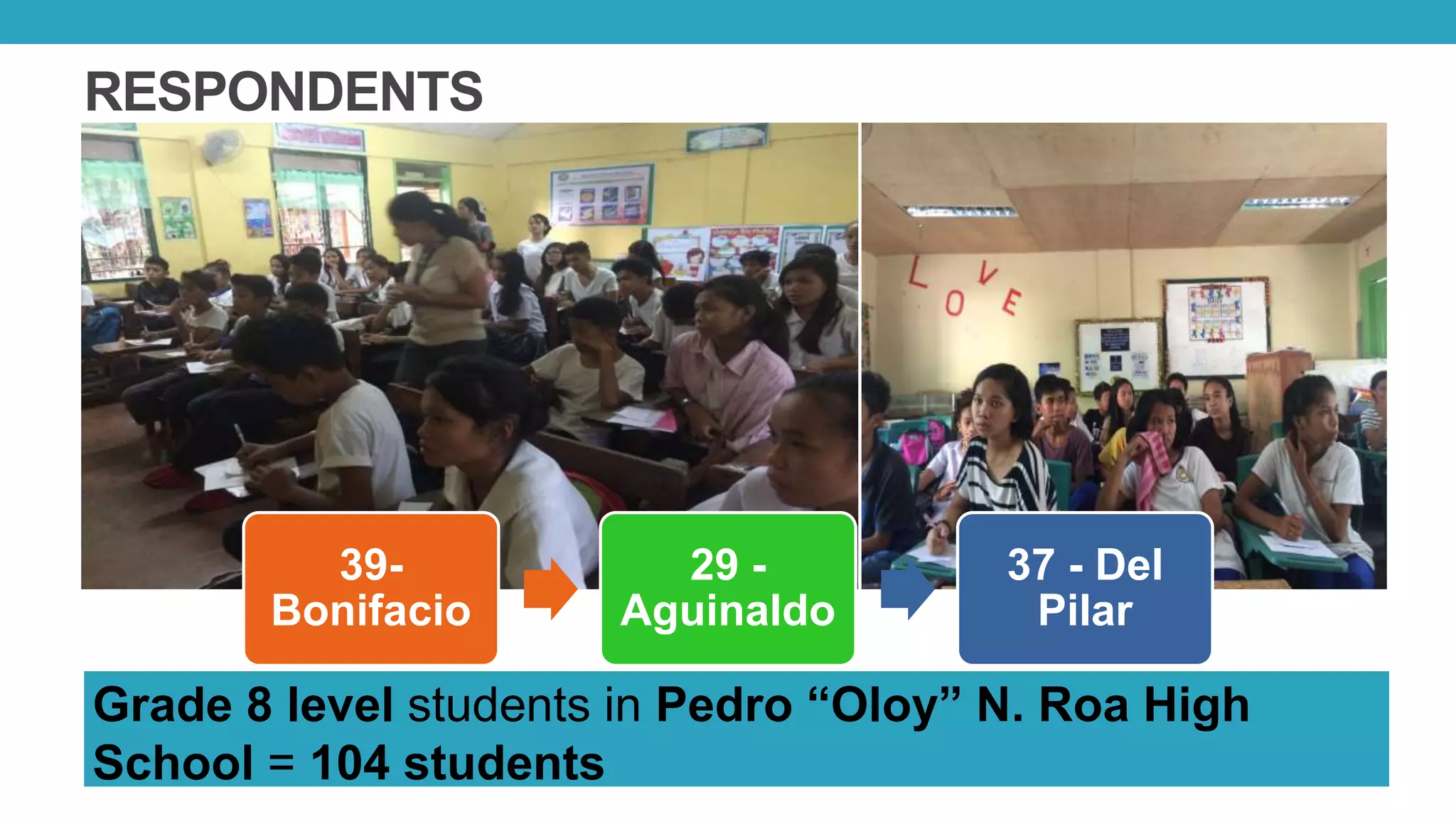
RESPONDENTS
Grade 8 level students in Pedro “Oloy” N. Roa High
School = 104 students
39-
Bonifacio
29 -
Aguinaldo
37 - Del
Pilar
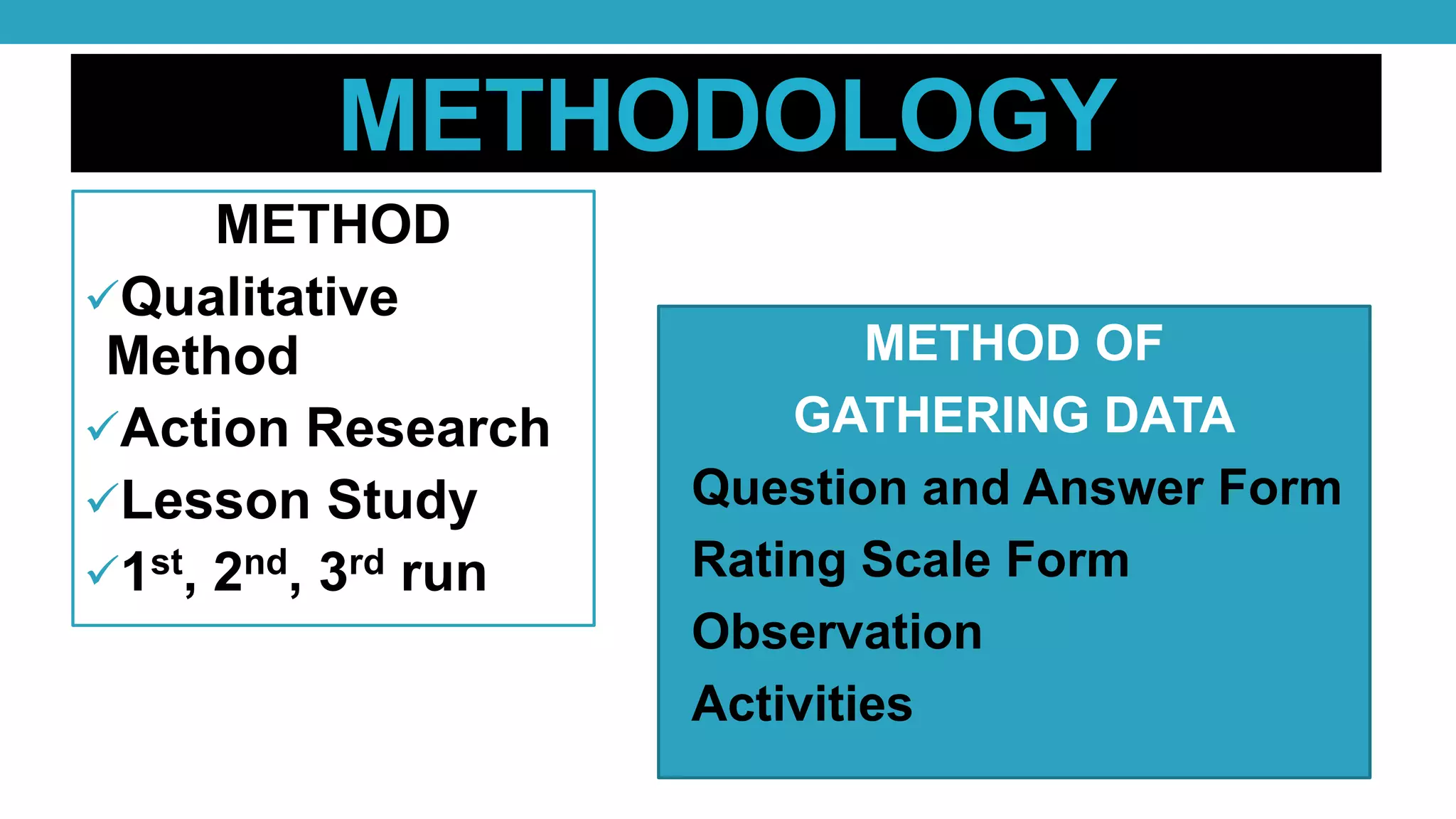
METHODOLOGY
METHOD
Qualitative
Method
Action Research
Lesson Study
1st, 2nd, 3rd run
METHOD OF
GATHERING DATA
Question and Answer Form
Rating Scale Form
Observation
Activities
RESULTS & DISCUSSION
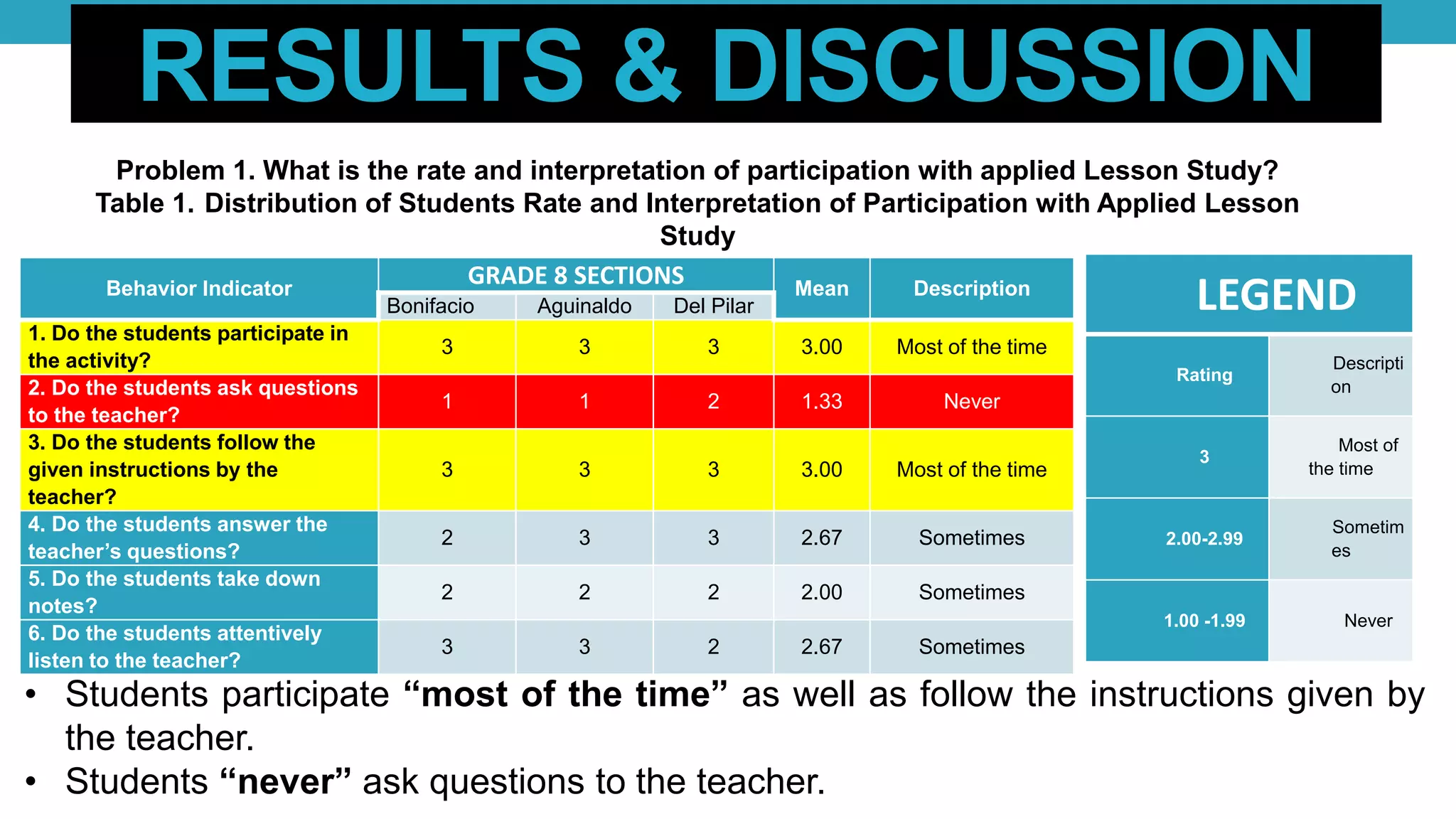
Problem 1. What is the rate and interpretation of participation with applied Lesson Study?
Table 1. Distribution of Students Rate and Interpretation of Participation with Applied Lesson
Study
Behavior Indicator
GRADE 8 SECTIONS Mean Description
Bonifacio Aguinaldo Del Pilar
1. Do the students participate in
the activity?
3 3 3 3.00 Most of the time
2. Do the students ask questions
to the teacher?
1 1 2 1.33 Never
3. Do the students follow the
given instructions by the
teacher?
3 3 3 3.00 Most of the time
4. Do the students answer the
teacher’s questions?
2 3 3 2.67 Sometimes
5. Do the students take down
notes?
2 2 2 2.00 Sometimes
6. Do the students attentively
listen to the teacher?
3 3 2 2.67 Sometimes
LEGEND
Rating
Descripti
on
3
Most of
the time
2.00-2.99
Sometim
es
1.00 -1.99 Never
• Students participate “most of the time” as well as follow the instructions given by
the teacher.
• Students “never” ask questions to the teacher.
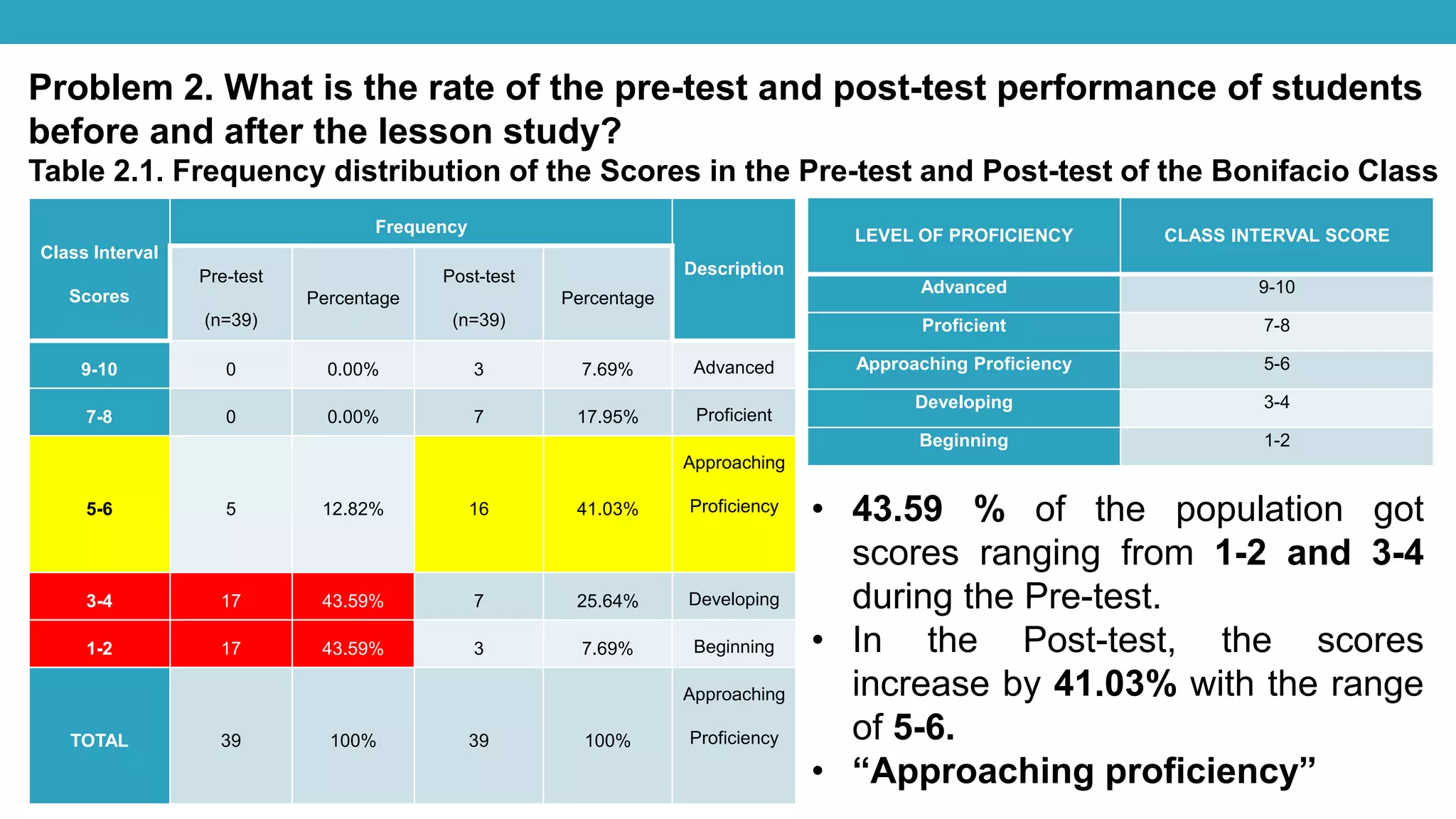
Problem 2. What is the rate of the pre-test and post-test performance of students
before and after the lesson study?
Table 2.1. Frequency distribution of the Scores in the Pre-test and Post-test of the Bonifacio Class
Class Interval
Scores
Frequency
DescriptionPre-test
(n=39)
Percentage
Post-test
(n=39)
Percentage
9-10 0 0.00% 3 7.69% Advanced
7-8 0 0.00% 7 17.95% Proficient
5-6 5 12.82% 16 41.03%
Approaching
Proficiency
3-4 17 43.59% 7 25.64% Developing
1-2 17 43.59% 3 7.69% Beginning
TOTAL 39 100% 39 100%
Approaching
Proficiency
LEVEL OF PROFICIENCY CLASS INTERVAL SCORE
Advanced 9-10
Proficient 7-8
Approaching Proficiency 5-6
Developing 3-4
Beginning 1-2
• 43.59 % of the population got
scores ranging from 1-2 and 3-4
during the Pre-test.
• In the Post-test, the scores
increase by 41.03% with the range
of 5-6.
• “Approaching proficiency”
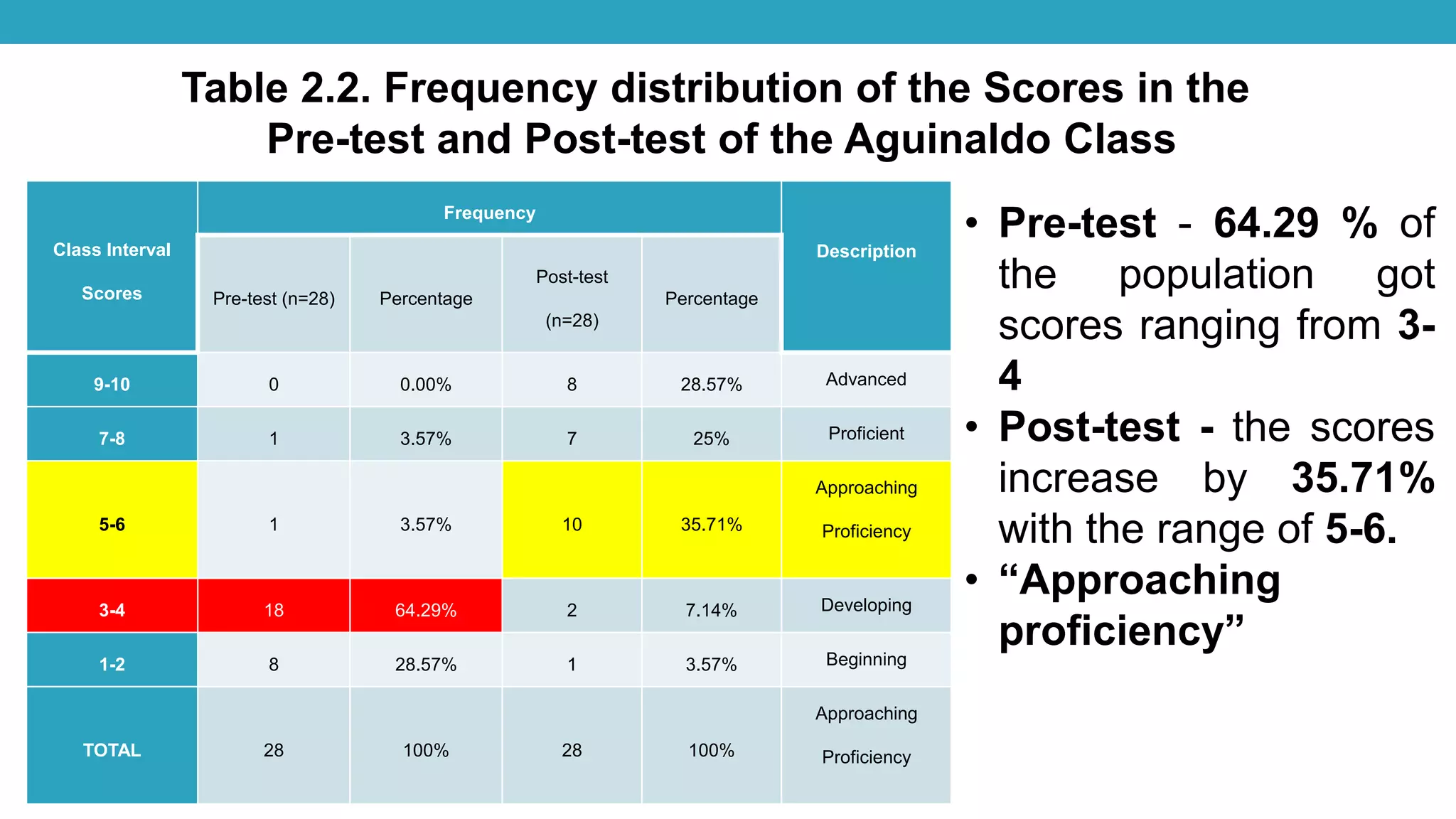
Table 2.2. Frequency distribution of the Scores in the
Pre-test and Post-test of the Aguinaldo Class
Class Interval
Scores
Frequency
Description
Pre-test (n=28) Percentage
Post-test
(n=28)
Percentage
9-10 0 0.00% 8 28.57% Advanced
7-8 1 3.57% 7 25% Proficient
5-6 1 3.57% 10 35.71%
Approaching
Proficiency
3-4 18 64.29% 2 7.14% Developing
1-2 8 28.57% 1 3.57% Beginning
TOTAL 28 100% 28 100%
Approaching
Proficiency
• Pre-test - 64.29 % of
the population got
scores ranging from 3-
4
• Post-test - the scores
increase by 35.71%
with the range of 5-6.
• “Approaching
proficiency”
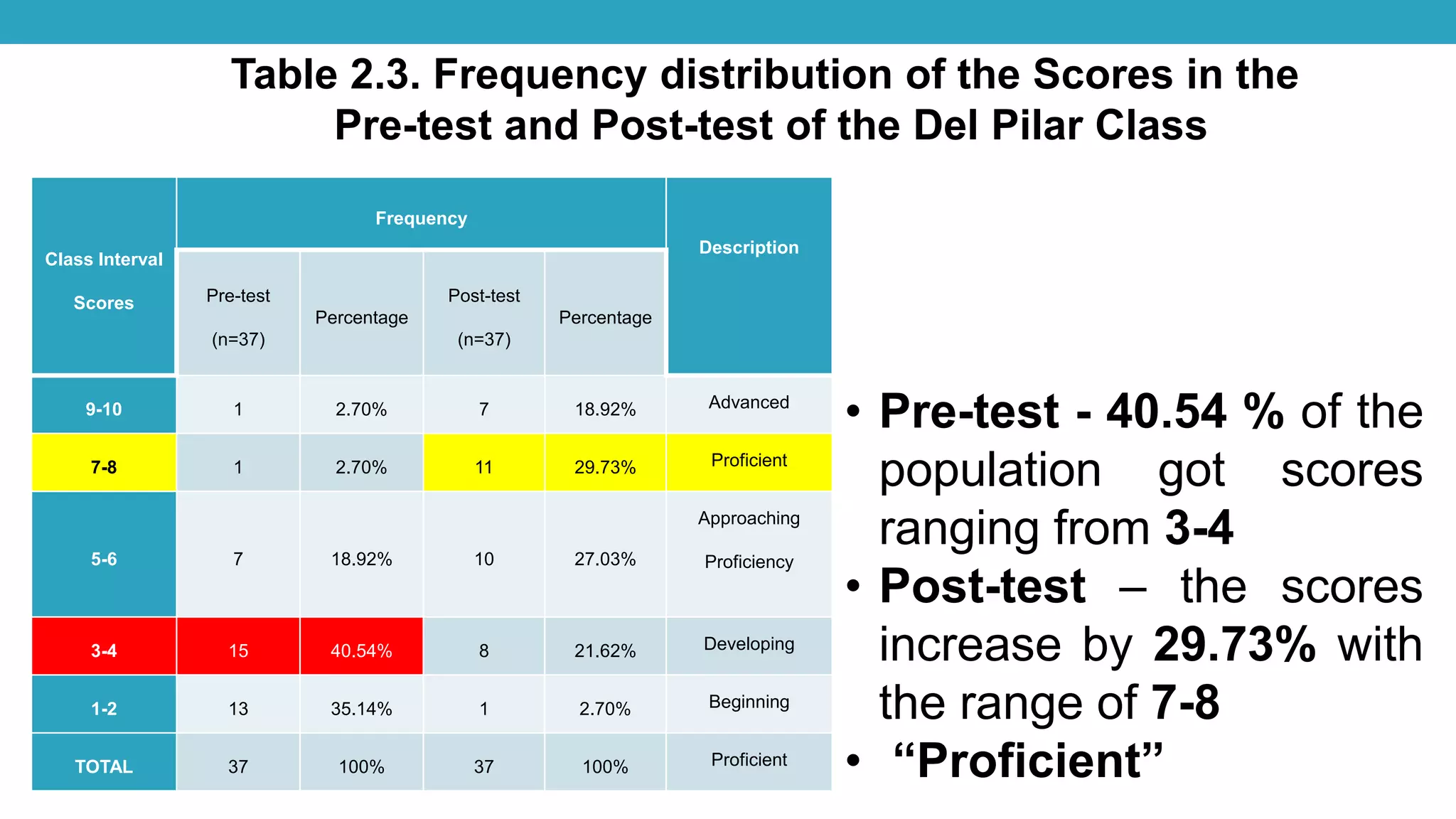
Table 2.3. Frequency distribution of the Scores in the
Pre-test and Post-test of the Del Pilar Class
Class Interval
Scores
Frequency
Description
Pre-test
(n=37)
Percentage
Post-test
(n=37)
Percentage
9-10 1 2.70% 7 18.92% Advanced
7-8 1 2.70% 11 29.73% Proficient
5-6 7 18.92% 10 27.03%
Approaching
Proficiency
3-4 15 40.54% 8 21.62% Developing
1-2 13 35.14% 1 2.70% Beginning
TOTAL 37 100% 37 100% Proficient
• Pre-test - 40.54 % of the
population got scores
ranging from 3-4
• Post-test – the scores
increase by 29.73% with
the range of 7-8
• “Proficient”
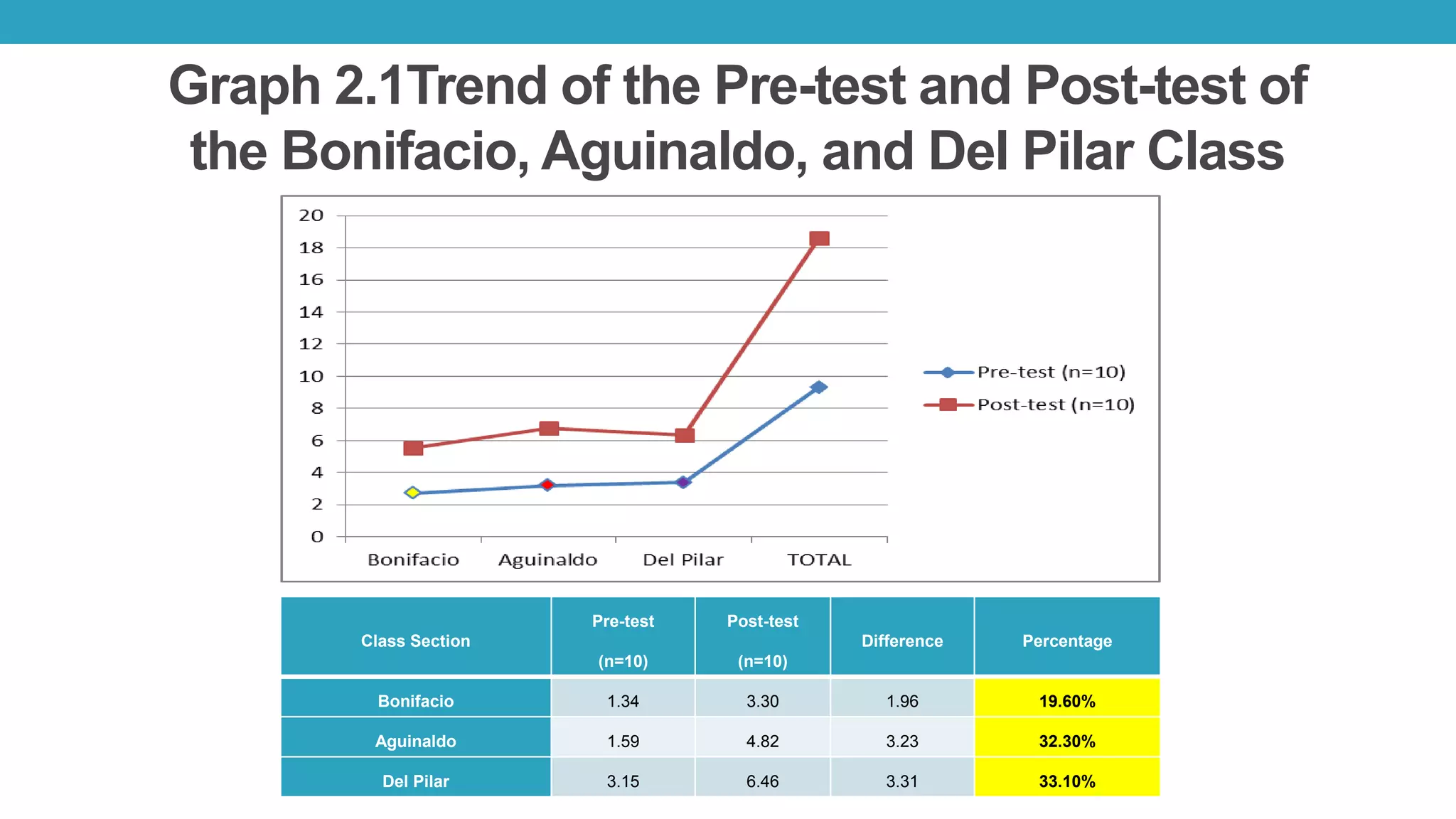
Graph 2.1Trend of the Pre-test and Post-test of
the Bonifacio, Aguinaldo, and Del Pilar Class
Class Section
Pre-test
(n=10)
Post-test
(n=10)
Difference Percentage
Bonifacio 1.34 3.30 1.96 19.60%
Aguinaldo 1.59 4.82 3.23 32.30%
Del Pilar 3.15 6.46 3.31 33.10%
RESULTS & DISCUSSION
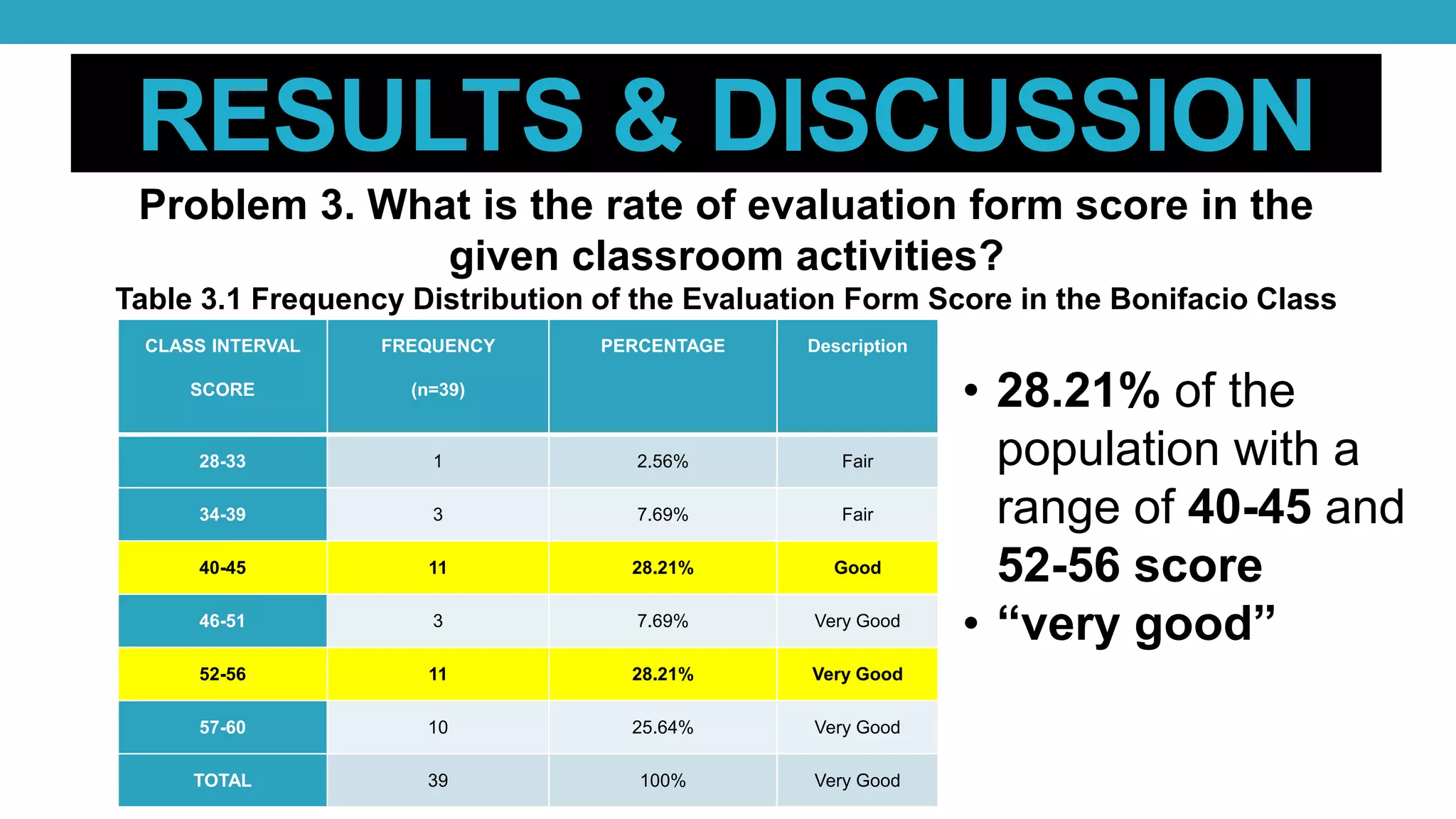
Problem 3. What is the rate of evaluation form score in the
given classroom activities?
Table 3.1 Frequency Distribution of the Evaluation Form Score in the Bonifacio Class
CLASS INTERVAL
SCORE
FREQUENCY
(n=39)
PERCENTAGE Description
28-33 1 2.56% Fair
34-39 3 7.69% Fair
40-45 11 28.21% Good
46-51 3 7.69% Very Good
52-56 11 28.21% Very Good
57-60 10 25.64% Very Good
TOTAL 39 100% Very Good
• 28.21% of the
population with a
range of 40-45 and
52-56 score
• “very good”
RESULTS & DISCUSSION
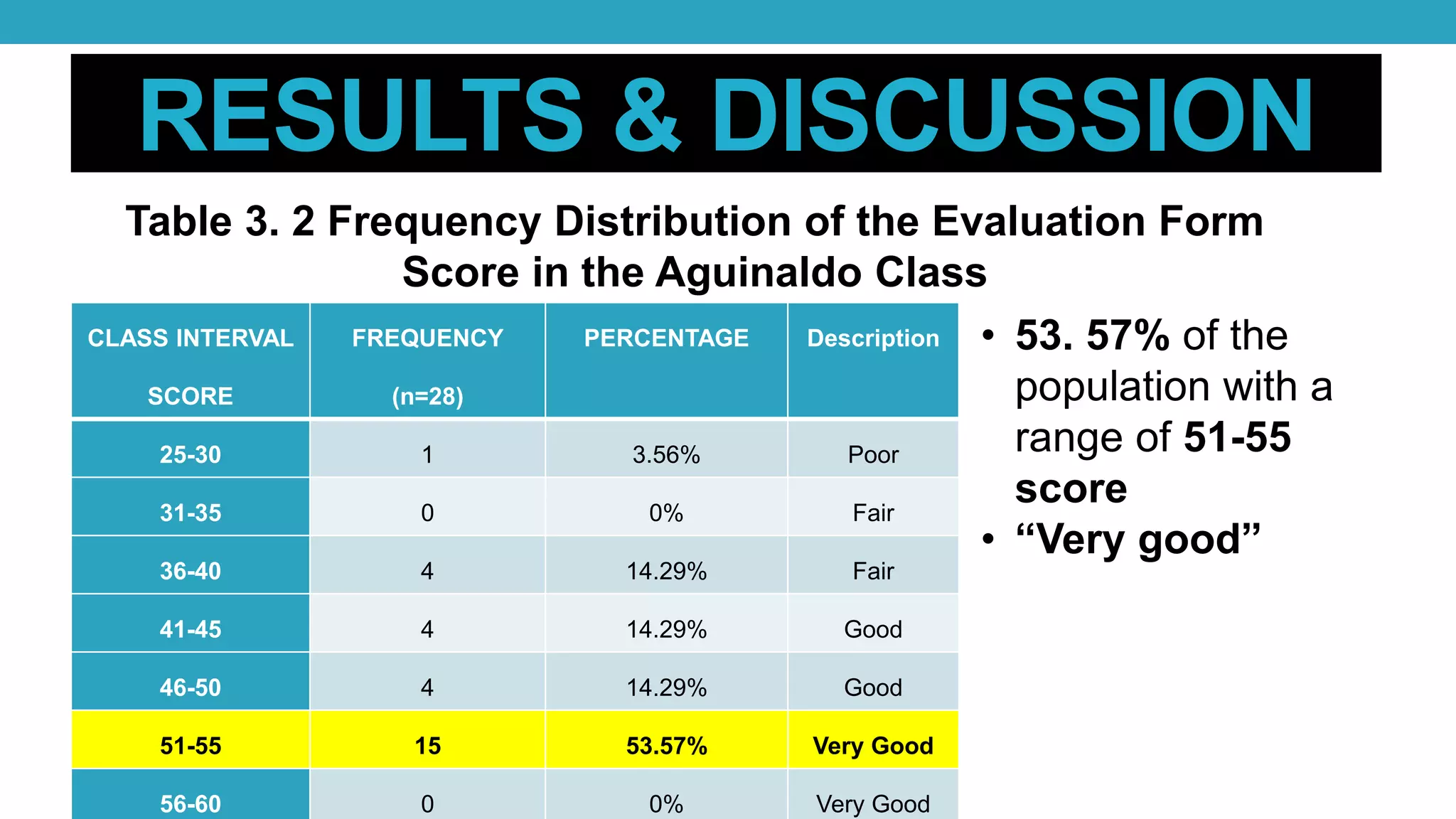
Table 3. 2 Frequency Distribution of the Evaluation Form
Score in the Aguinaldo Class
CLASS INTERVAL
SCORE
FREQUENCY
(n=28)
PERCENTAGE Description
25-30 1 3.56% Poor
31-35 0 0% Fair
36-40 4 14.29% Fair
41-45 4 14.29% Good
46-50 4 14.29% Good
51-55 15 53.57% Very Good
56-60 0 0% Very Good
• 53. 57% of the
population with a
range of 51-55
score
• “Very good”
RESULTS & DISCUSSION
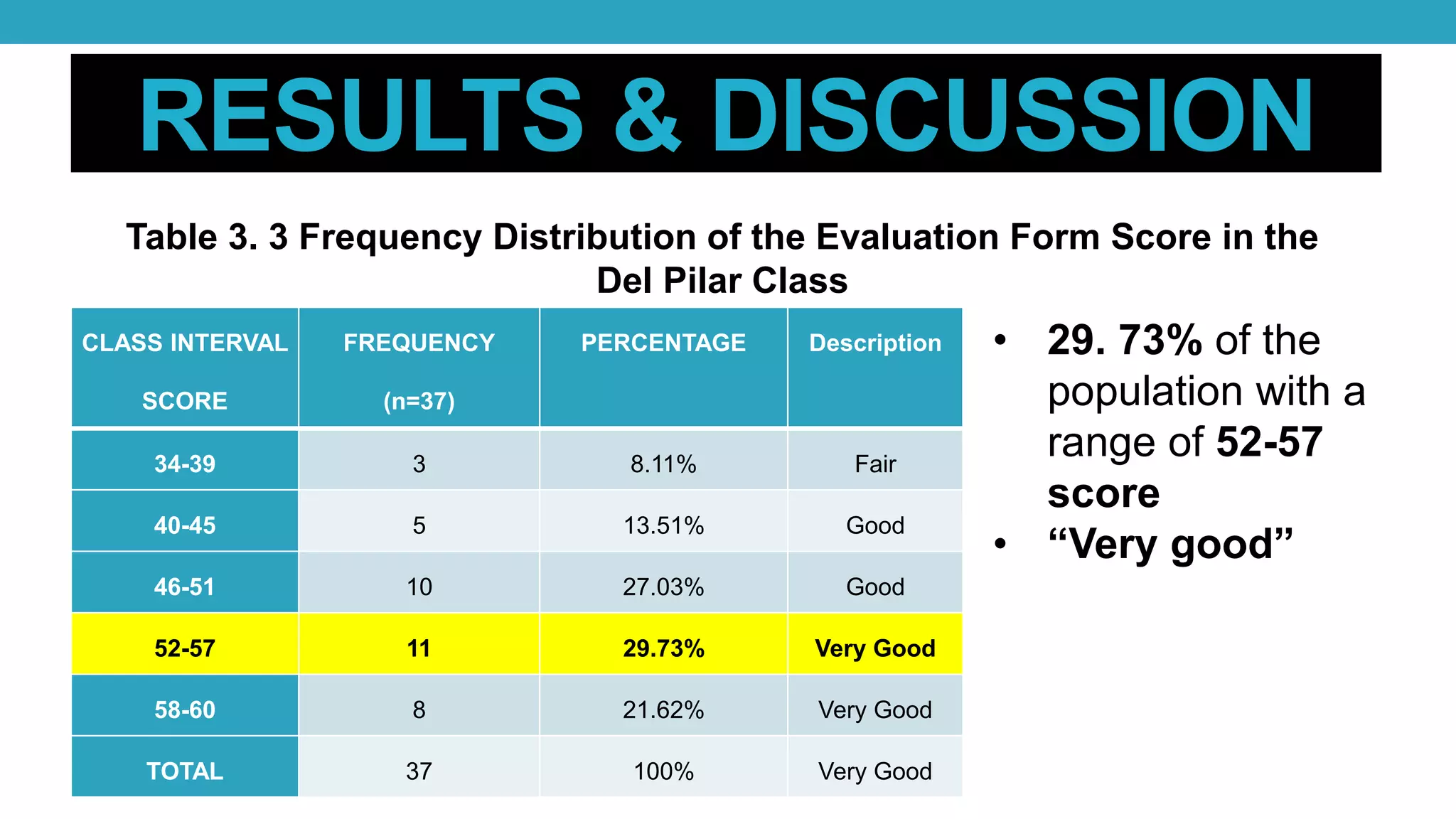
Table 3. 3 Frequency Distribution of the Evaluation Form Score in the
Del Pilar Class
CLASS INTERVAL
SCORE
FREQUENCY
(n=37)
PERCENTAGE Description
34-39 3 8.11% Fair
40-45 5 13.51% Good
46-51 10 27.03% Good
52-57 11 29.73% Very Good
58-60 8 21.62% Very Good
TOTAL 37 100% Very Good
• 29. 73% of the
population with a
range of 52-57
score
• “Very good”
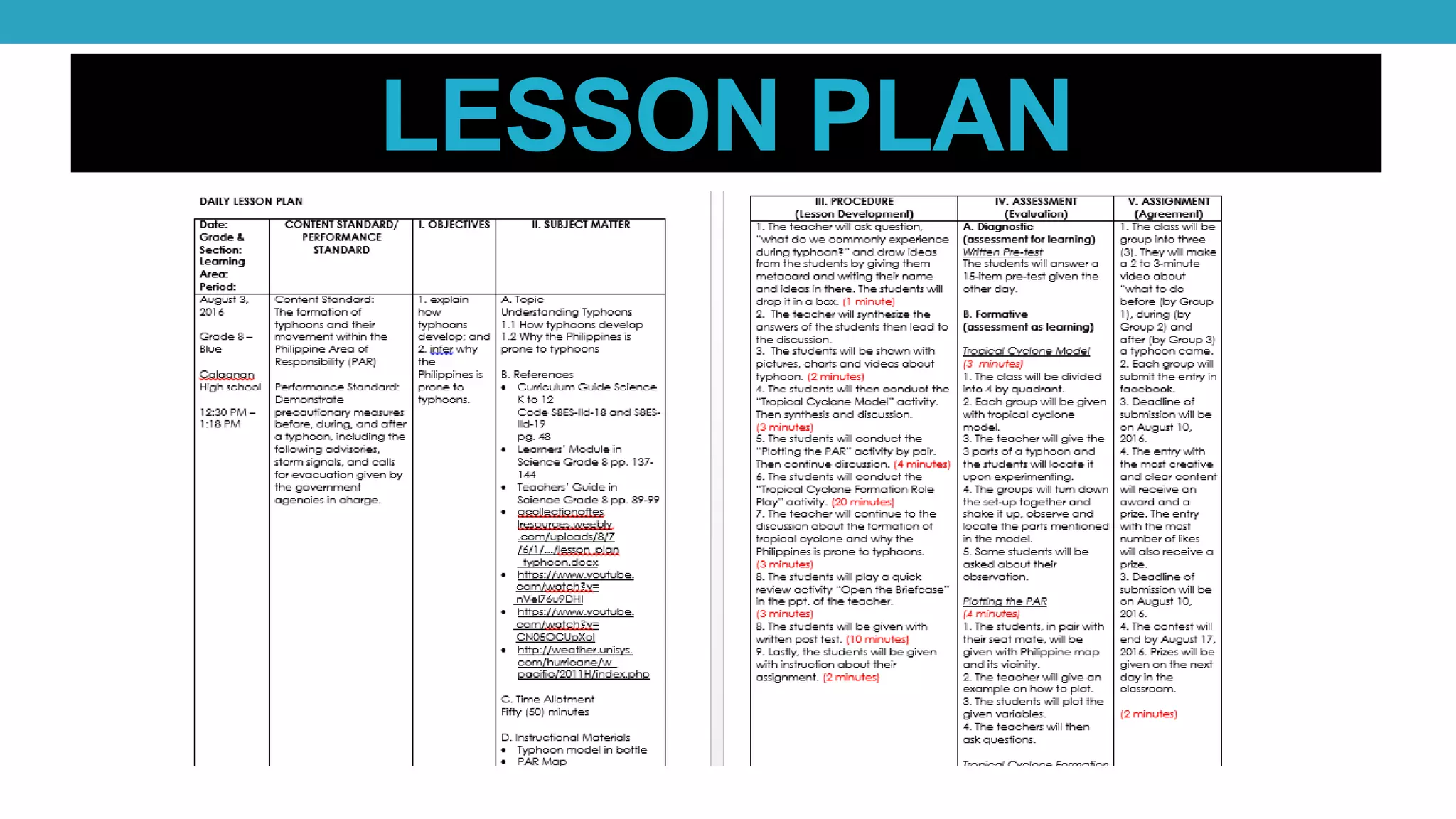
LESSON PLAN
CONCLUSION
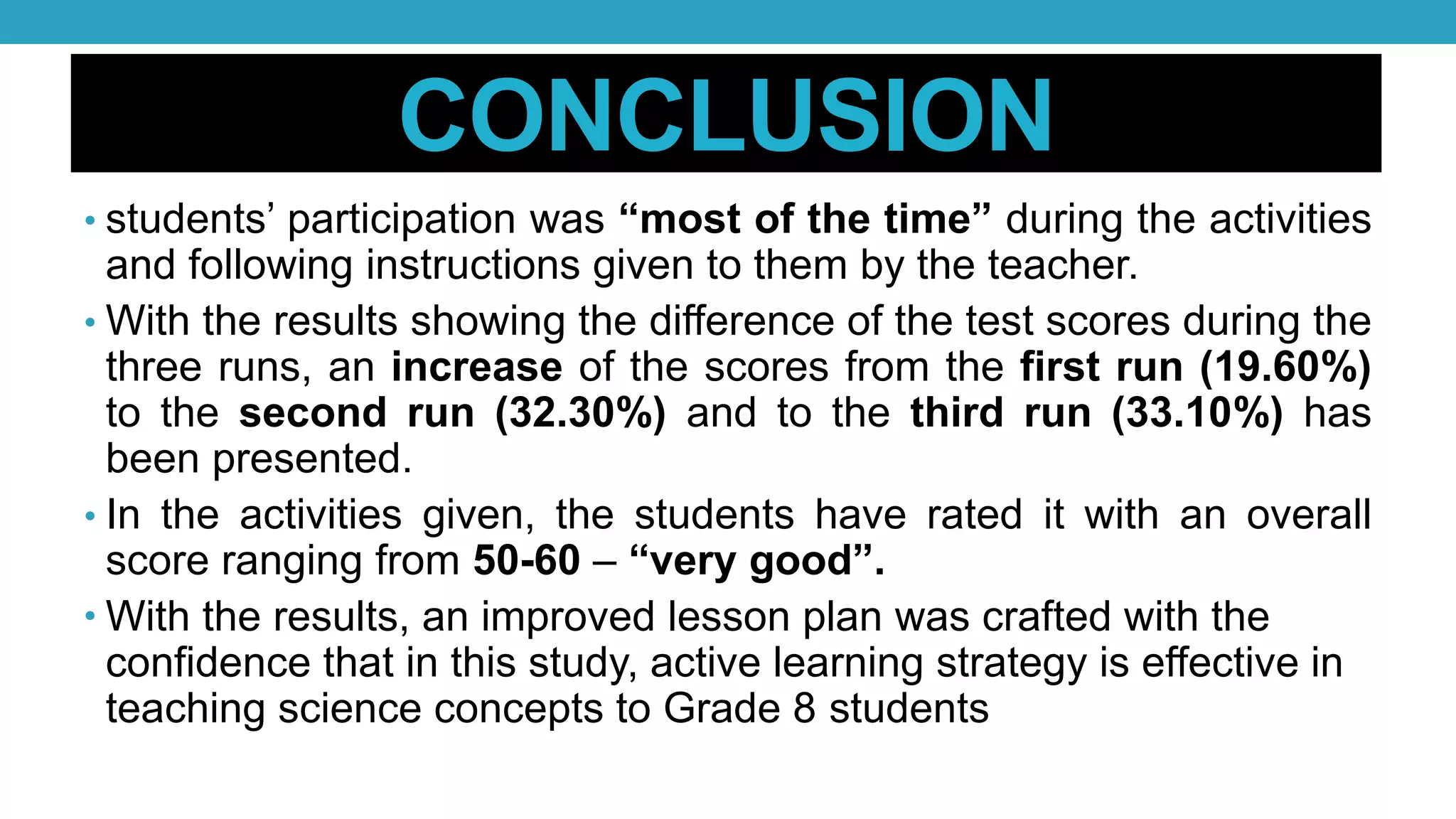
• students’ participation was “most of the time” during the activities
and following instructions given to them by the teacher.
• With the results showing the difference of the test scores during the
three runs, an increase of the scores from the first run (19.60%)
to the second run (32.30%) and to the third run (33.10%) has
been presented.
• In the activities given, the students have rated it with an overall
score ranging from 50-60 – “very good”.
• With the results, an improved lesson plan was crafted with the
confidence that in this study, active learning strategy is effective in
teaching science concepts to Grade 8 students
RECOMMENDATIONS
FOR THE TEACHERS: Active Learning must be used as a
teaching strategy to enable students be engaged in the
Teaching Learning Process rather than using the Traditional
way.
FOR THE INSTITUTION: Seminars/workshops about using
of Active Learning Strategy must be conducted so that
teachers will be able to know the limitation in utilizing this
strategy.
RECOMMENDATIONS
FOR THE FUTURE RESEARCHER: Since this is an active
learning (using different activities), a small number of
participants is best in utilizing this research.
BIBLIOGRAPHY
• Boomer, G. (1988).Teachers learning: Improving Australian schools through inservice teacher training and
development. Canberra: AGPS.
• Chester, M., & Fox, R. (1966).Role playing methods in the classroom. Chicago: Science Research Association.
• Ching-Huei Chen, & Bruce Howard. (2010). Effect of Live Simulation on Middle School Students' Attitudes and
Learning toward Science. Journal of Educational Technology & Society, 13(1), 133-139. Retrieved from
http://www.jstor.org/stable/jeductechsoci.13.1.133
• Cobern, W. W. (1993). Contextual constructivism: The impact of culture on the learning and teaching of
science. In K. Tobin (Ed.),The practice of constructivism in science education. Washington, DC: American
Association for the Advancement of Science.
• Cole, A. (1989). Researcher and teacher: Partners in theory building.Journal of Education for Teaching, 15,
225–237.
• Erickson, G. (1991). Collaborative inquiry and the professional development of science teachers.The Journal of
Educational Thought, 25, 228–245.
• Hiotis, H. (1993). Using creative writing and drama to learn science.Australian Science Teachers Journal, 39,
37–40.
• Hildebrand, G. M. (1989). Creating a gender inclusive science education.Australian Science Teachers Journal,
35, 7–16.
• Ladrousse, G. P. (1989).Role play. Oxford: Oxford University Press.
Active Learning Strategy in Teaching Science to Grade 8 Students: A Lesson Study

Active Learning Strategy in Teaching Science to Grade 8 Students: A Lesson Study

  • 1.
    ACTIVE LEARNING STRATEGYIN THE TEACHING OF GRADE 8 SCIENCE CONCEPTS: A LESSON STUDY LLIDO, PAULA MARIE MADELO, BRIX TABORADA, UNYCIE
  • 2.
    BACKGROUND ACTIVE LEARNING STRATEGYTO STUDENTS’ PERFORMANCE  Students should be actively engage in active learning activities such as class discussions because it will build a positive relationship with student persistence (Braxton, Milem, & Sullivan, 2000).  An abundance of literature regarding the operationalization of the term “active learning” defines the term as a process in which the learners assume a dynamic, energetic, and involved role in his or her own learning process ( Brown, 2008; Candela et al., 2006; Popkess and Mc Daniel, 2011; Salamonsom et al., 2009)  Dewey (1916/2011) believed that students must be active to learn effectively as “there is no such thing as genuine knowledge and fruitful understanding except as the offspring of doing” (p.264).
  • 3.
    BACKGROUND • Beichner etal. (2007) studied 1,600 physics students at the university level for 5 years and found that students in active learning physics classes had greater learning experiences than students in traditional lecture-based physics classes. • Lesson study can be defined as a teacher- led instructional improvement cycle in which teachers work collaboratively to: formulate goals for student learning, plan a lesson, teach and/or observe the lesson, reflect on the gathered evidence, revise the lesson for improvement, and re-teach the revised lesson ( Perry & Lewis, 2003; Curcio, 2002)
  • 4.
    RESEARCH GAPS Teaching foractive learning has been of interest in Philippines as well, figuring in educational reforms. However, research on teaching with the use of active learning strategy in public high school particularly from the Cagayan de Oro, is almost nonexistent in the local and international literature. • P.N Roa High School low performance in their National Achievement Test (NAT) especially on major subjects such as Mathematics and Science last school year 2015-2016.
  • 5.
    BACKGROUND The researchers usedActive Learning Strategy (through activities) to promote learning and enhance collaboration among students. It keeps learning active and student-centered, in a non-threatening environment. An activity can be used to promote critical thinking and reasoning. One advantage of using activity, as a teaching strategy, is that students have the opportunity for immediate feedback, through the discussion of correct answers and their rationales. Another advantage of activities is the opportunity for instructors to facilitate discussion and clarify misconceptions (Glendon and Ulrich, 2005 ).
  • 6.
    RESEARCH OBJECTIVES •To determinethe significance of Active Learning Strategy to the students’ performance in the given lesson. •To design an effective lesson study with all the revision and improvement of the action research.
  • 7.
    THEORETICAL FRAMEWORK THEORY OFCONSTRUCTIVISM BY JEAN PIAGET Active Learning Strategy is based in Jean Piaget’s theory of Constructivism. Constructivism emphasizes understanding and meaning, and students construct knowledge through their experiences with the concepts and their environment based on their prior knowledge and experiences (Posner, 2004).
  • 8.
    METHODOLOGY INSTRUMENTS Participation Tally Sheet Pre-testand Post test Evaluation Form Facilitating Rubric Student Profile Learning Styles Test Role Play Rubric Output Rubric
  • 9.
    RESPONDENTS Grade 8 levelstudents in Pedro “Oloy” N. Roa High School = 104 students 39- Bonifacio 29 - Aguinaldo 37 - Del Pilar
  • 10.
    METHODOLOGY METHOD Qualitative Method Action Research Lesson Study 1st,2nd, 3rd run METHOD OF GATHERING DATA Question and Answer Form Rating Scale Form Observation Activities
  • 11.
    RESULTS & DISCUSSION Problem1. What is the rate and interpretation of participation with applied Lesson Study? Table 1. Distribution of Students Rate and Interpretation of Participation with Applied Lesson Study Behavior Indicator GRADE 8 SECTIONS Mean Description Bonifacio Aguinaldo Del Pilar 1. Do the students participate in the activity? 3 3 3 3.00 Most of the time 2. Do the students ask questions to the teacher? 1 1 2 1.33 Never 3. Do the students follow the given instructions by the teacher? 3 3 3 3.00 Most of the time 4. Do the students answer the teacher’s questions? 2 3 3 2.67 Sometimes 5. Do the students take down notes? 2 2 2 2.00 Sometimes 6. Do the students attentively listen to the teacher? 3 3 2 2.67 Sometimes LEGEND Rating Descripti on 3 Most of the time 2.00-2.99 Sometim es 1.00 -1.99 Never • Students participate “most of the time” as well as follow the instructions given by the teacher. • Students “never” ask questions to the teacher.
  • 12.
    Problem 2. Whatis the rate of the pre-test and post-test performance of students before and after the lesson study? Table 2.1. Frequency distribution of the Scores in the Pre-test and Post-test of the Bonifacio Class Class Interval Scores Frequency DescriptionPre-test (n=39) Percentage Post-test (n=39) Percentage 9-10 0 0.00% 3 7.69% Advanced 7-8 0 0.00% 7 17.95% Proficient 5-6 5 12.82% 16 41.03% Approaching Proficiency 3-4 17 43.59% 7 25.64% Developing 1-2 17 43.59% 3 7.69% Beginning TOTAL 39 100% 39 100% Approaching Proficiency LEVEL OF PROFICIENCY CLASS INTERVAL SCORE Advanced 9-10 Proficient 7-8 Approaching Proficiency 5-6 Developing 3-4 Beginning 1-2 • 43.59 % of the population got scores ranging from 1-2 and 3-4 during the Pre-test. • In the Post-test, the scores increase by 41.03% with the range of 5-6. • “Approaching proficiency”
  • 13.
    Table 2.2. Frequencydistribution of the Scores in the Pre-test and Post-test of the Aguinaldo Class Class Interval Scores Frequency Description Pre-test (n=28) Percentage Post-test (n=28) Percentage 9-10 0 0.00% 8 28.57% Advanced 7-8 1 3.57% 7 25% Proficient 5-6 1 3.57% 10 35.71% Approaching Proficiency 3-4 18 64.29% 2 7.14% Developing 1-2 8 28.57% 1 3.57% Beginning TOTAL 28 100% 28 100% Approaching Proficiency • Pre-test - 64.29 % of the population got scores ranging from 3- 4 • Post-test - the scores increase by 35.71% with the range of 5-6. • “Approaching proficiency”
  • 14.
    Table 2.3. Frequencydistribution of the Scores in the Pre-test and Post-test of the Del Pilar Class Class Interval Scores Frequency Description Pre-test (n=37) Percentage Post-test (n=37) Percentage 9-10 1 2.70% 7 18.92% Advanced 7-8 1 2.70% 11 29.73% Proficient 5-6 7 18.92% 10 27.03% Approaching Proficiency 3-4 15 40.54% 8 21.62% Developing 1-2 13 35.14% 1 2.70% Beginning TOTAL 37 100% 37 100% Proficient • Pre-test - 40.54 % of the population got scores ranging from 3-4 • Post-test – the scores increase by 29.73% with the range of 7-8 • “Proficient”
  • 15.
    Graph 2.1Trend ofthe Pre-test and Post-test of the Bonifacio, Aguinaldo, and Del Pilar Class Class Section Pre-test (n=10) Post-test (n=10) Difference Percentage Bonifacio 1.34 3.30 1.96 19.60% Aguinaldo 1.59 4.82 3.23 32.30% Del Pilar 3.15 6.46 3.31 33.10%
  • 16.
    RESULTS & DISCUSSION Problem3. What is the rate of evaluation form score in the given classroom activities? Table 3.1 Frequency Distribution of the Evaluation Form Score in the Bonifacio Class CLASS INTERVAL SCORE FREQUENCY (n=39) PERCENTAGE Description 28-33 1 2.56% Fair 34-39 3 7.69% Fair 40-45 11 28.21% Good 46-51 3 7.69% Very Good 52-56 11 28.21% Very Good 57-60 10 25.64% Very Good TOTAL 39 100% Very Good • 28.21% of the population with a range of 40-45 and 52-56 score • “very good”
  • 17.
    RESULTS & DISCUSSION Table3. 2 Frequency Distribution of the Evaluation Form Score in the Aguinaldo Class CLASS INTERVAL SCORE FREQUENCY (n=28) PERCENTAGE Description 25-30 1 3.56% Poor 31-35 0 0% Fair 36-40 4 14.29% Fair 41-45 4 14.29% Good 46-50 4 14.29% Good 51-55 15 53.57% Very Good 56-60 0 0% Very Good • 53. 57% of the population with a range of 51-55 score • “Very good”
  • 18.
    RESULTS & DISCUSSION Table3. 3 Frequency Distribution of the Evaluation Form Score in the Del Pilar Class CLASS INTERVAL SCORE FREQUENCY (n=37) PERCENTAGE Description 34-39 3 8.11% Fair 40-45 5 13.51% Good 46-51 10 27.03% Good 52-57 11 29.73% Very Good 58-60 8 21.62% Very Good TOTAL 37 100% Very Good • 29. 73% of the population with a range of 52-57 score • “Very good”
  • 19.
  • 20.
    CONCLUSION • students’ participationwas “most of the time” during the activities and following instructions given to them by the teacher. • With the results showing the difference of the test scores during the three runs, an increase of the scores from the first run (19.60%) to the second run (32.30%) and to the third run (33.10%) has been presented. • In the activities given, the students have rated it with an overall score ranging from 50-60 – “very good”. • With the results, an improved lesson plan was crafted with the confidence that in this study, active learning strategy is effective in teaching science concepts to Grade 8 students
  • 21.
    RECOMMENDATIONS FOR THE TEACHERS:Active Learning must be used as a teaching strategy to enable students be engaged in the Teaching Learning Process rather than using the Traditional way. FOR THE INSTITUTION: Seminars/workshops about using of Active Learning Strategy must be conducted so that teachers will be able to know the limitation in utilizing this strategy.
  • 22.
    RECOMMENDATIONS FOR THE FUTURERESEARCHER: Since this is an active learning (using different activities), a small number of participants is best in utilizing this research.
  • 23.
    BIBLIOGRAPHY • Boomer, G.(1988).Teachers learning: Improving Australian schools through inservice teacher training and development. Canberra: AGPS. • Chester, M., & Fox, R. (1966).Role playing methods in the classroom. Chicago: Science Research Association. • Ching-Huei Chen, & Bruce Howard. (2010). Effect of Live Simulation on Middle School Students' Attitudes and Learning toward Science. Journal of Educational Technology & Society, 13(1), 133-139. Retrieved from http://www.jstor.org/stable/jeductechsoci.13.1.133 • Cobern, W. W. (1993). Contextual constructivism: The impact of culture on the learning and teaching of science. In K. Tobin (Ed.),The practice of constructivism in science education. Washington, DC: American Association for the Advancement of Science. • Cole, A. (1989). Researcher and teacher: Partners in theory building.Journal of Education for Teaching, 15, 225–237. • Erickson, G. (1991). Collaborative inquiry and the professional development of science teachers.The Journal of Educational Thought, 25, 228–245. • Hiotis, H. (1993). Using creative writing and drama to learn science.Australian Science Teachers Journal, 39, 37–40. • Hildebrand, G. M. (1989). Creating a gender inclusive science education.Australian Science Teachers Journal, 35, 7–16. • Ladrousse, G. P. (1989).Role play. Oxford: Oxford University Press.

Editor's Notes

  • #8 Active learning is based in Jean Piaget’s theory of Constructivism. Constructivism emphasizes understanding and meaning, and students construct knowledge through their experiences with the concepts and their environment based on their prior knowledge and experiences (Posner, 2004). The curricula involves an in-depth focus on the concepts, which are taught in relation to students’ background knowledge and experience in order to add meaning and pique interest, and includes an emphasis on skills, including problem solving and critical thinking, with students evaluated through projects, interviews, observations, and written assignments (Posner, 2004).