EDUCATIONAL PLANNING By: LYDIA M. LLIDO
WHY PLAN?
What kind of planning we want? SYSTEMATIC, REALISTIC, and
SUSTAINED.
Planning this way will help us to:
Set priorities for the best of the school’s limited resources
Respond to changes taking place in community,
province/region, and DepEd
Focus on improving the quality of teaching in school
Establish consistency of purpose and direction
HOW DO I BEGIN TO PLAN?
Two initial stages which must be undertaken before we actually plan for our
school.
STAGE 1: ENVIRONMENTAL SCANNING AND DATA COLLECTION
An examination of the environment, both within and outside the school is
important so that we can define opportunities that are worth considering, as
well as identify risks that we will face.
1. Assessment of external environment includes the ff:
School’s program and services
Socio-cultural, economic, and political developments in local and national
community that may influence the school’s mission
Major educational trends in the country that are likely to create some
impact on the school
2. Assessment of school’s resources:
Curriculum and instructional materials
Non-academic services, e.g guidance, sports, community
relations, etc.;
Teaching and non-teaching personnel
Pupil characteristics and achievement levels
Physical plant and equipment
Organizational set-up
STAGE 2: SETTING OUR OBJECTIVES
1. Identifying the gaps
To define how much we have to do, it first necessary to
find out how far we are from where we want to be. We
must know the distance from where we are now (starting
point) and where will we go (objectives).
For example: given some guidelines, set some pupil
achievement targets for school. For this, we must first know
the students’ profile and how far our students are from
achieving the target.
2. Generating and Selecting Alternative strategies
We draw up the alternative strategies for closing the gaps.
Assess the advantage and disadvantages. A significant factor in
decision-making is the capability of our school to provide the
resources (financial, manpower) to support chosen alternative.
3. Translating strategies into operational plans
Strategies need to be broken down into more specific action
plans. Planning at this level involves laying out a detailed “road
map” for each strategy, including:
Defining specific activities, arranged in sequence
Determining time frames (start and end of activities)
Specifying check points
Identifying resources needed and available
Providing evaluation mechanisms
4. Writing the plan
The written plan is a record of everything we have done so far.
To summarize, this plan specifies:
Statement of the objectives to be reached at a specific time
Summary of school’s area of competence (strength, weaknesses)
Assessment of risk
Operational/ activity plans
Inventory of available resources
5. Implementing the plan
All hard work will have been for nothing if plans remain merely
a written document.
During the implementation, regularly review the plan, and
monitor activities at given points in time.
A feedback system must be established to all the team and
community.
6. Evaluating and modifying the plan
It is a positive effort to identify causes for success and failures.
The evaluation determines:
Which objectives were achieved and to what degree
Which plans were effective and why?
Which plans failed or were not carried out and why?
The whole experience of planning is thus reflected on, and we
learn how we can improve the next planning effort.
HOW DO I SUSTAIN THE PROCESS?
It is advisable to go through the whole process annually. An
annual planning process enables us to extend our plan one year
each time. In each way, we ensure that:
Members of school community have a clearer picture of the
directions and broader understanding of problem.
Our school survives because we are able to forecast changes
and opportunities and to avoid dangers.
TEACHERS’ RESOURCE CENTER AND
PROFESSIONALS’ TRAINING INSTITUTE
This is an executive summary or resume (based on detailed
study) of a plan to establish a Teachers’ Resource Center and
Professional Training Institute, by Ernesto A. Franco. The
educational institute that wants this plan should consider its
appropriate revisions- particularly in terms of scales, size and
reach. To him, management implementation capacity is critical
to the proper design and execution of plan.
1. TARGET MARKET
This project ahs its target market the 522, 000 teachers of
public and private elementary, secondary, and tertiary
education in the Philippines. Teachers are a book-reading
group, responsive to professional training and upgrading that
will elevate their position classification and enhance their
personal growth.
2. SITUATION AND NEED
These teachers comprise 40 percent of the total number of
professional and technical people in the Philippines.
Unfortunately, teachers represent the lowest-qualified people to
perform the job of teaching.
3. PROJECT CONCEPT
Establish an open learning Teachers’ Resource Center (TRC),
using multi-mode delivery system, educational technology, and
giving quality for profits. At the same time, the TRC will also be
a Professional Training Institute. Program will consist mainly of
training courses or non-degree programs. These courses may run
anywhere from 1 week to 2-3 months, depends on the course
and participants. Later, the training courses can be expanded to
different professionals.
4. PROPOSED PROJECT SPONSORS
Here, Franco had suggested a set of founders from a national
bookstore organization, private foundation, and a management
company. He advises not to look for partners simply because
they have money or resources, but also because of their critical
management capabilities.
5. OBJECTIVES
The project will aim for:
A. GENERAL. These are to:
1. Make a lasting contribution to education through quality teacher training.
2. Assist in expanding labor markets for teachers here and abroad.
3. Serve as a clearinghouse on teacher education science and technology.
4. Be an interactive center for professional, social, and personal upgrading
of teachers.
5. Generate high ROI from training business for the stockholders.
6. Keep teachers exposed to state-of-the-art training and development.
B. SPECIFIC FOR FOUNDERS
The proposed objectives for national bookstore or organization are:
1. Optimize 4th floor of its Cubao building and get a higher ROI.
2. Build a permanent teacher-clientele for its books, training programs, and
instructional materials.
3. Establish strong public relations in education sector of lasting benefit.
4. Establish a permanent teacher-training program supported by other
organizers.
5. Influence policies, strategies and programs for teachers in private sectors.
6. share in profitable enterprise.
6. PROGRAM AND PHASING
A. PHASE 1:
From 1 to 3 years, programs will concentrate on Training.
Materials Development, and Exhibits. Training will be either
Basic or Advance, or custom-tailored for specific school; will
encompass all aspects of teacher’s functions; and focus on
professional development, personal enhancement, and inter-
relationship and coordination roles. Materials development will
cover print, audio, and audio-video materials design,
preparation and distribution. Finally, exhibits will include book
and materials displays, annual book fairs, teachers aids
exhibitions, etc.
6. PROGRAM AND PHASING
B. PHASE 2:
From years 4 to 5, there will be the addition of Career
Improvement, Finishing School, and International Lectures.
Career improvement will encompass special training courses
aimed at the emotional, physical health, as well as intellectual
development of teachers. Finishing school will be a masteral-
level type of seminars and conferences. International lectures
will bring outstanding teacher-training experts and
distinguished teachers. The focus will be outstanding Asian
teachers, not American/Europeans.
7. GOVERNMENT AND MANAGEMENT
A 5-man Board of Trustees from the 3 organizing groups: an
Executive Committee of 3 selected by the Board; and a Project
Implementation Unit of 3 years duration to set up, initially
manage, and lay the groundwork for long-term operations of
the Center.
8. BENEFITS
This was a very detailed portion on the plans specifying
numbers, benefits, both quantitative and a huge market and
client needs. Profits to the organizers will come from:
1. Training fees
2. Book Club fees
3. Sales of training materials
4. Sellers’exhibits
5. Possible teachers’lotteries
6. Optimized use of Cubao building
Before a final decision was made, a detailed project feasibility
was prepared by a project team over 3 months indicating the
marketing technical, academic, organizational, financial, legal,
and tax-aspects of the project.
WHY LITTLE QUALITY: NO PASSION FOR
PRECISION
In an international forum, Ernesto Franco observed that the
Filipino’s lack of appreciation and weak productive ability to
generate quality in his mind, actions, and outputs, are due to
the lack of precision in Filipino education and family
upbringing.
This lack of precision is displayed by many Filipino habits:
1. The easy response we give to questions and queries, with the
phrase: OK lang, pwede na, pasado…”
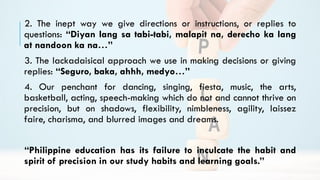
2. The inept way we give directions or instructions, or replies to
questions: “Diyan lang sa tabi-tabi, malapit na, derecho ka lang
at nandoon ka na…”
3. The lackadaisical approach we use in making decisions or giving
replies: “Seguro, baka, ahhh, medyo…”
4. Our penchant for dancing, singing, fiesta, music, the arts,
basketball, acting, speech-making which do not and cannot thrive on
precision, but on shadows, flexibility, nimbleness, agility, laissez
faire, charisma, and blurred images and dreams.
“Philippine education has its failure to inculcate the habit and
spirit of precision in our study habits and learning goals.”
THANK YOU FOR LISTENING!

Educational Planning

  • 1.
  • 2.
    WHY PLAN? What kindof planning we want? SYSTEMATIC, REALISTIC, and SUSTAINED. Planning this way will help us to: Set priorities for the best of the school’s limited resources Respond to changes taking place in community, province/region, and DepEd Focus on improving the quality of teaching in school Establish consistency of purpose and direction
  • 3.
    HOW DO IBEGIN TO PLAN? Two initial stages which must be undertaken before we actually plan for our school. STAGE 1: ENVIRONMENTAL SCANNING AND DATA COLLECTION An examination of the environment, both within and outside the school is important so that we can define opportunities that are worth considering, as well as identify risks that we will face. 1. Assessment of external environment includes the ff: School’s program and services Socio-cultural, economic, and political developments in local and national community that may influence the school’s mission Major educational trends in the country that are likely to create some impact on the school
  • 4.
    2. Assessment ofschool’s resources: Curriculum and instructional materials Non-academic services, e.g guidance, sports, community relations, etc.; Teaching and non-teaching personnel Pupil characteristics and achievement levels Physical plant and equipment Organizational set-up
  • 5.
    STAGE 2: SETTINGOUR OBJECTIVES 1. Identifying the gaps To define how much we have to do, it first necessary to find out how far we are from where we want to be. We must know the distance from where we are now (starting point) and where will we go (objectives). For example: given some guidelines, set some pupil achievement targets for school. For this, we must first know the students’ profile and how far our students are from achieving the target.
  • 6.
    2. Generating andSelecting Alternative strategies We draw up the alternative strategies for closing the gaps. Assess the advantage and disadvantages. A significant factor in decision-making is the capability of our school to provide the resources (financial, manpower) to support chosen alternative.
  • 7.
    3. Translating strategiesinto operational plans Strategies need to be broken down into more specific action plans. Planning at this level involves laying out a detailed “road map” for each strategy, including: Defining specific activities, arranged in sequence Determining time frames (start and end of activities) Specifying check points Identifying resources needed and available Providing evaluation mechanisms
  • 8.
    4. Writing theplan The written plan is a record of everything we have done so far. To summarize, this plan specifies: Statement of the objectives to be reached at a specific time Summary of school’s area of competence (strength, weaknesses) Assessment of risk Operational/ activity plans Inventory of available resources
  • 9.
    5. Implementing theplan All hard work will have been for nothing if plans remain merely a written document. During the implementation, regularly review the plan, and monitor activities at given points in time. A feedback system must be established to all the team and community.
  • 10.
    6. Evaluating andmodifying the plan It is a positive effort to identify causes for success and failures. The evaluation determines: Which objectives were achieved and to what degree Which plans were effective and why? Which plans failed or were not carried out and why? The whole experience of planning is thus reflected on, and we learn how we can improve the next planning effort.
  • 11.
    HOW DO ISUSTAIN THE PROCESS? It is advisable to go through the whole process annually. An annual planning process enables us to extend our plan one year each time. In each way, we ensure that: Members of school community have a clearer picture of the directions and broader understanding of problem. Our school survives because we are able to forecast changes and opportunities and to avoid dangers.
  • 13.
    TEACHERS’ RESOURCE CENTERAND PROFESSIONALS’ TRAINING INSTITUTE This is an executive summary or resume (based on detailed study) of a plan to establish a Teachers’ Resource Center and Professional Training Institute, by Ernesto A. Franco. The educational institute that wants this plan should consider its appropriate revisions- particularly in terms of scales, size and reach. To him, management implementation capacity is critical to the proper design and execution of plan.
  • 14.
    1. TARGET MARKET Thisproject ahs its target market the 522, 000 teachers of public and private elementary, secondary, and tertiary education in the Philippines. Teachers are a book-reading group, responsive to professional training and upgrading that will elevate their position classification and enhance their personal growth. 2. SITUATION AND NEED These teachers comprise 40 percent of the total number of professional and technical people in the Philippines. Unfortunately, teachers represent the lowest-qualified people to perform the job of teaching.
  • 15.
    3. PROJECT CONCEPT Establishan open learning Teachers’ Resource Center (TRC), using multi-mode delivery system, educational technology, and giving quality for profits. At the same time, the TRC will also be a Professional Training Institute. Program will consist mainly of training courses or non-degree programs. These courses may run anywhere from 1 week to 2-3 months, depends on the course and participants. Later, the training courses can be expanded to different professionals.
  • 16.
    4. PROPOSED PROJECTSPONSORS Here, Franco had suggested a set of founders from a national bookstore organization, private foundation, and a management company. He advises not to look for partners simply because they have money or resources, but also because of their critical management capabilities.
  • 17.
    5. OBJECTIVES The projectwill aim for: A. GENERAL. These are to: 1. Make a lasting contribution to education through quality teacher training. 2. Assist in expanding labor markets for teachers here and abroad. 3. Serve as a clearinghouse on teacher education science and technology. 4. Be an interactive center for professional, social, and personal upgrading of teachers. 5. Generate high ROI from training business for the stockholders. 6. Keep teachers exposed to state-of-the-art training and development.
  • 18.
    B. SPECIFIC FORFOUNDERS The proposed objectives for national bookstore or organization are: 1. Optimize 4th floor of its Cubao building and get a higher ROI. 2. Build a permanent teacher-clientele for its books, training programs, and instructional materials. 3. Establish strong public relations in education sector of lasting benefit. 4. Establish a permanent teacher-training program supported by other organizers. 5. Influence policies, strategies and programs for teachers in private sectors. 6. share in profitable enterprise.
  • 19.
    6. PROGRAM ANDPHASING A. PHASE 1: From 1 to 3 years, programs will concentrate on Training. Materials Development, and Exhibits. Training will be either Basic or Advance, or custom-tailored for specific school; will encompass all aspects of teacher’s functions; and focus on professional development, personal enhancement, and inter- relationship and coordination roles. Materials development will cover print, audio, and audio-video materials design, preparation and distribution. Finally, exhibits will include book and materials displays, annual book fairs, teachers aids exhibitions, etc.
  • 20.
    6. PROGRAM ANDPHASING B. PHASE 2: From years 4 to 5, there will be the addition of Career Improvement, Finishing School, and International Lectures. Career improvement will encompass special training courses aimed at the emotional, physical health, as well as intellectual development of teachers. Finishing school will be a masteral- level type of seminars and conferences. International lectures will bring outstanding teacher-training experts and distinguished teachers. The focus will be outstanding Asian teachers, not American/Europeans.
  • 21.
    7. GOVERNMENT ANDMANAGEMENT A 5-man Board of Trustees from the 3 organizing groups: an Executive Committee of 3 selected by the Board; and a Project Implementation Unit of 3 years duration to set up, initially manage, and lay the groundwork for long-term operations of the Center.
  • 22.
    8. BENEFITS This wasa very detailed portion on the plans specifying numbers, benefits, both quantitative and a huge market and client needs. Profits to the organizers will come from: 1. Training fees 2. Book Club fees 3. Sales of training materials 4. Sellers’exhibits 5. Possible teachers’lotteries 6. Optimized use of Cubao building
  • 23.
    Before a finaldecision was made, a detailed project feasibility was prepared by a project team over 3 months indicating the marketing technical, academic, organizational, financial, legal, and tax-aspects of the project.
  • 25.
    WHY LITTLE QUALITY:NO PASSION FOR PRECISION In an international forum, Ernesto Franco observed that the Filipino’s lack of appreciation and weak productive ability to generate quality in his mind, actions, and outputs, are due to the lack of precision in Filipino education and family upbringing. This lack of precision is displayed by many Filipino habits: 1. The easy response we give to questions and queries, with the phrase: OK lang, pwede na, pasado…”
  • 26.
    2. The ineptway we give directions or instructions, or replies to questions: “Diyan lang sa tabi-tabi, malapit na, derecho ka lang at nandoon ka na…” 3. The lackadaisical approach we use in making decisions or giving replies: “Seguro, baka, ahhh, medyo…” 4. Our penchant for dancing, singing, fiesta, music, the arts, basketball, acting, speech-making which do not and cannot thrive on precision, but on shadows, flexibility, nimbleness, agility, laissez faire, charisma, and blurred images and dreams. “Philippine education has its failure to inculcate the habit and spirit of precision in our study habits and learning goals.”
  • 27.
    THANK YOU FORLISTENING!