PHS CARPStacey, Cameron, Matt, Cat, Brennan
Introduction Population: Patuxent High School in Lusby, MD  (Calvert County)
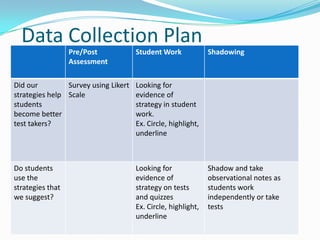
Biology, Social Studies, English Need: According to Principal Highsmith + SIP. . .Students have difficulty taking tests because they don’t understand the language or intent of questionsPurpose: To determine if explicitly teaching test-taking skills will improve students’ test-taking skillsResearch QuestionsDid our strategies help students become better test takers?Do students use the strategies that we suggest?
Strategy, Rationale, and Justification1.  Key Words Circle the important words that show what the question is asking.2.	 Rephrase Test QuestionsStudent puts question in his/her own wordsOur strategy may ameliorate test-taking ability for all disciplines which may lead to improvement in standardized tests Peer-reviewed research supports the specific test-taking strategies that we have chosen (Chittooran & Miles 2001)
MethodsAdministering pre-test of test-taking strategiesExplicitly teach strategies (one per week)Continue with strategies throughout the week(s) Observe class and collect student work to look for strategy useAdminister post-testRun T-tests to look for significance
Data Collection Plan
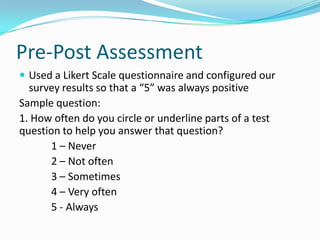
Pre-Post AssessmentUsed a LikertScale questionnaire and configured our survey results so that a “5” was always positiveSample question: 1. How often do you circle or underline parts of a test question to help you answer that question?	1 – Never	2 – Not often	3 – Sometimes	4 – Very often	5 - Always
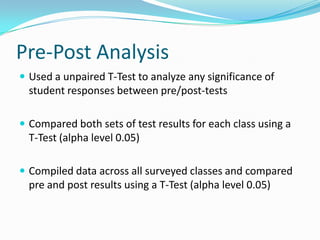
Pre-Post AnalysisUsed a unpaired T-Test to analyze any significance of student responses between pre/post-testsCompared both sets of test results for each class using a T-Test (alpha level 0.05)Compiled data across all surveyed classes and compared pre and post results using a T-Test (alpha level 0.05)
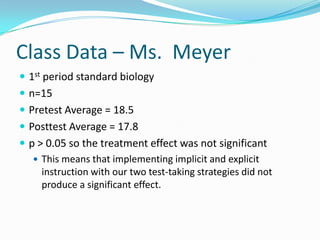
Class Data – Ms.  Meyer  1st period standard biology n=15Pretest Average = 18.5Posttest Average = 17.8p > 0.05 so the treatment effect was not significant This means that implementing implicit and explicit instruction with our two test-taking strategies did not produce a significant effect.
Observations/Student WorkI observed very few students using the strategies during class work.Results were slightly better when I looked at students quizzes and observed students while testing which was encouraging. Ex. Organelle vs. Process
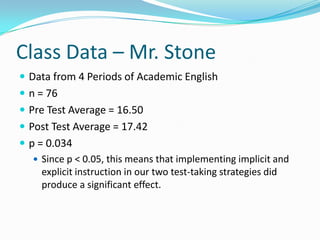
Class Data – Mr. StoneData from 4 Periods of Academic Englishn = 76Pre Test Average = 16.50Post Test Average = 17.42p = 0.034Since p < 0.05, this means that implementing implicit and explicit instruction in our two test-taking strategies did produce a significant effect.
Observations/Student WorkI observed a moderate amount of students using the strategies during daily class work. However, during exams when students were reminded of the strategies and encouraged to use them I observed a greater number of students applying the strategies.
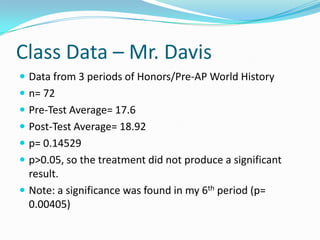
Class Data – Mr. DavisData from 3 periods of Honors/Pre-AP World Historyn= 72Pre-Test Average= 17.6Post-Test Average= 18.92p= 0.14529p>0.05, so the treatment did not produce a significant result.Note: a significance was found in my 6th period (p= 0.00405)
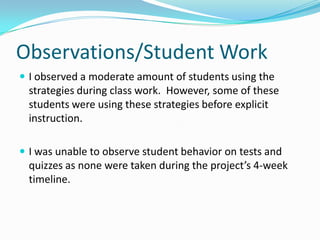
Observations/Student WorkI observed a moderate amount of students using the strategies during class work.  However, some of these students were using these strategies before explicit instruction.I was unable to observe student behavior on tests and quizzes as none were taken during the project’s 4-week timeline.
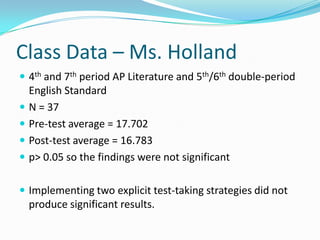
Class Data – Ms. Holland 4th and 7th period AP Literature and 5th/6th double-period English StandardN = 37Pre-test average = 17.702Post-test average = 16.783p> 0.05 so the findings were not significantImplementing two explicit test-taking strategies did not produce significant results.
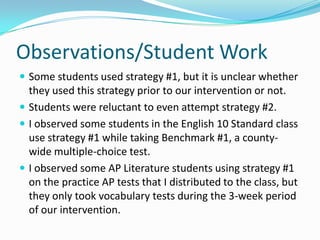
Observations/Student Work Some students used strategy #1, but it is unclear whether they used this strategy prior to our intervention or not. Students were reluctant to even attempt strategy #2. I observed some students in the English 10 Standard class use strategy #1 while taking Benchmark #1, a county-wide multiple-choice test. I observed some AP Literature students using strategy #1 on the practice AP tests that I distributed to the class, but they only took vocabulary tests during the 3-week period of our intervention.
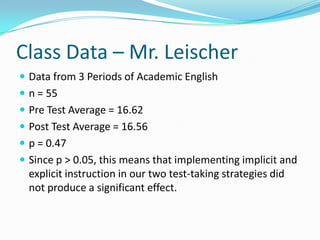
Class Data – Mr. LeischerData from 3 Periods of Academic Englishn = 55Pre Test Average = 16.62Post Test Average = 16.56p = 0.47Since p > 0.05, this means that implementing implicit and explicit instruction in our two test-taking strategies did not produce a significant effect.
Observations/Student WorkI observed a small amount of student using the strategies we taught. However, most of these students were already using similar strategies before instruction.Observation of strategies took place during district-level benchmark exam and HSA-style question practice sessions.
ConclusionsWe found that the overall effect of our treatment effect is not significantn= 256 ; p = 0.0581
ConclusionsIt is unclear whether our test strategies improved student performance or not. Evidence is mixed about whether students use the strategies that we taught. Because of the way we collected our data and differences in n numbers were unable to do the question by question analysis needed to tease apart the data
Implications for ResearchRepeat with more time and greater nIs there a difference between subjects?Introduce in earlier gradeLook at differences in test scores comparing students who were taught/used the strategies compared to a control group

PHS carp

  • 1.
    PHS CARPStacey, Cameron,Matt, Cat, Brennan
  • 2.
    Introduction Population: PatuxentHigh School in Lusby, MD (Calvert County)
  • 3.
    Biology, Social Studies,English Need: According to Principal Highsmith + SIP. . .Students have difficulty taking tests because they don’t understand the language or intent of questionsPurpose: To determine if explicitly teaching test-taking skills will improve students’ test-taking skillsResearch QuestionsDid our strategies help students become better test takers?Do students use the strategies that we suggest?
  • 4.
    Strategy, Rationale, andJustification1. Key Words Circle the important words that show what the question is asking.2. Rephrase Test QuestionsStudent puts question in his/her own wordsOur strategy may ameliorate test-taking ability for all disciplines which may lead to improvement in standardized tests Peer-reviewed research supports the specific test-taking strategies that we have chosen (Chittooran & Miles 2001)
  • 5.
    MethodsAdministering pre-test oftest-taking strategiesExplicitly teach strategies (one per week)Continue with strategies throughout the week(s) Observe class and collect student work to look for strategy useAdminister post-testRun T-tests to look for significance
  • 6.
  • 7.
    Pre-Post AssessmentUsed aLikertScale questionnaire and configured our survey results so that a “5” was always positiveSample question: 1. How often do you circle or underline parts of a test question to help you answer that question? 1 – Never 2 – Not often 3 – Sometimes 4 – Very often 5 - Always
  • 8.
    Pre-Post AnalysisUsed aunpaired T-Test to analyze any significance of student responses between pre/post-testsCompared both sets of test results for each class using a T-Test (alpha level 0.05)Compiled data across all surveyed classes and compared pre and post results using a T-Test (alpha level 0.05)
  • 9.
    Class Data –Ms. Meyer 1st period standard biology n=15Pretest Average = 18.5Posttest Average = 17.8p > 0.05 so the treatment effect was not significant This means that implementing implicit and explicit instruction with our two test-taking strategies did not produce a significant effect.
  • 10.
    Observations/Student WorkI observedvery few students using the strategies during class work.Results were slightly better when I looked at students quizzes and observed students while testing which was encouraging. Ex. Organelle vs. Process
  • 11.
    Class Data –Mr. StoneData from 4 Periods of Academic Englishn = 76Pre Test Average = 16.50Post Test Average = 17.42p = 0.034Since p < 0.05, this means that implementing implicit and explicit instruction in our two test-taking strategies did produce a significant effect.
  • 12.
    Observations/Student WorkI observeda moderate amount of students using the strategies during daily class work. However, during exams when students were reminded of the strategies and encouraged to use them I observed a greater number of students applying the strategies.
  • 13.
    Class Data –Mr. DavisData from 3 periods of Honors/Pre-AP World Historyn= 72Pre-Test Average= 17.6Post-Test Average= 18.92p= 0.14529p>0.05, so the treatment did not produce a significant result.Note: a significance was found in my 6th period (p= 0.00405)
  • 14.
    Observations/Student WorkI observeda moderate amount of students using the strategies during class work. However, some of these students were using these strategies before explicit instruction.I was unable to observe student behavior on tests and quizzes as none were taken during the project’s 4-week timeline.
  • 15.
    Class Data –Ms. Holland 4th and 7th period AP Literature and 5th/6th double-period English StandardN = 37Pre-test average = 17.702Post-test average = 16.783p> 0.05 so the findings were not significantImplementing two explicit test-taking strategies did not produce significant results.
  • 16.
    Observations/Student Work Somestudents used strategy #1, but it is unclear whether they used this strategy prior to our intervention or not. Students were reluctant to even attempt strategy #2. I observed some students in the English 10 Standard class use strategy #1 while taking Benchmark #1, a county-wide multiple-choice test. I observed some AP Literature students using strategy #1 on the practice AP tests that I distributed to the class, but they only took vocabulary tests during the 3-week period of our intervention.
  • 17.
    Class Data –Mr. LeischerData from 3 Periods of Academic Englishn = 55Pre Test Average = 16.62Post Test Average = 16.56p = 0.47Since p > 0.05, this means that implementing implicit and explicit instruction in our two test-taking strategies did not produce a significant effect.
  • 18.
    Observations/Student WorkI observeda small amount of student using the strategies we taught. However, most of these students were already using similar strategies before instruction.Observation of strategies took place during district-level benchmark exam and HSA-style question practice sessions.
  • 19.
    ConclusionsWe found thatthe overall effect of our treatment effect is not significantn= 256 ; p = 0.0581
  • 20.
    ConclusionsIt is unclearwhether our test strategies improved student performance or not. Evidence is mixed about whether students use the strategies that we taught. Because of the way we collected our data and differences in n numbers were unable to do the question by question analysis needed to tease apart the data
  • 21.
    Implications for ResearchRepeatwith more time and greater nIs there a difference between subjects?Introduce in earlier gradeLook at differences in test scores comparing students who were taught/used the strategies compared to a control group

Editor's Notes

  • #2 MAtt
  • #3 MAtt
  • #4 matt
  • #5 Cat
  • #6 Brennan
  • #7 Brennan
  • #8 Stacey
  • #9 Stacey
  • #10 Stacey This isn’t very surprising because my sample size was really small.
  • #11 StaceyI observed this even on the days where I taught the strategies and explicitly told students that I wanted to see them using the strategies
  • #12 Matt
  • #13 Matt
  • #14 BrennanOverall significance was likely not found due to the academic abilities of my students who already used some of the intervention strategies to certain extents.
  • #15 Brennan
  • #16 Cat
  • #17 Cat
  • #18 Cameron
  • #19 Cameron
  • #20 Cameron
  • #21 Cameron
  • #22 Cat