
TEACHING
APPROACHES
& METHODS
UNDER K-12
CURRICULUMBy: NOEL VALEDICT R. IMUS
DEPARTMENT OF EDUCATION
LIKE OR DISLIKE
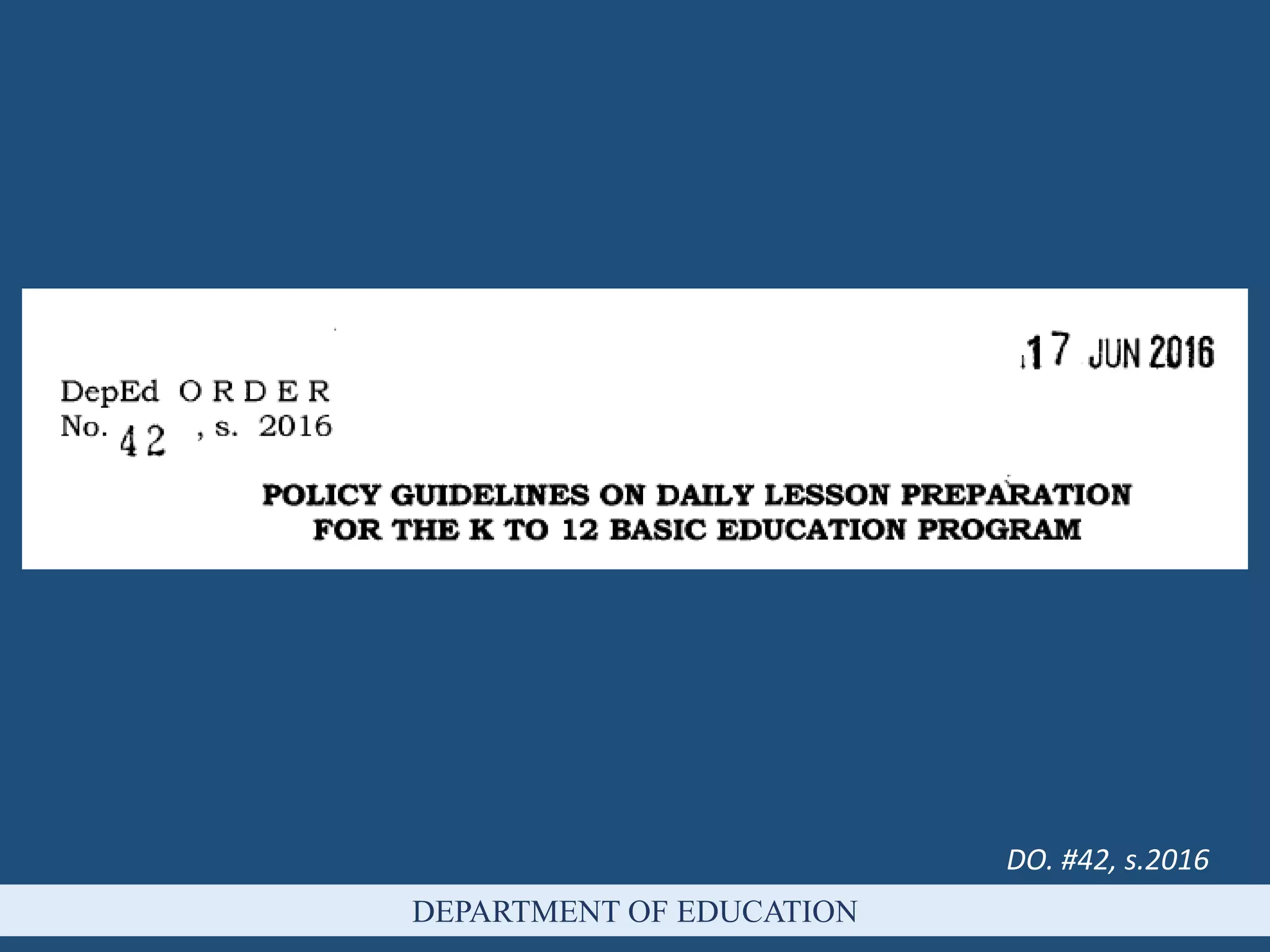
DO. #42, s.2016
DEPARTMENT OF EDUCATION
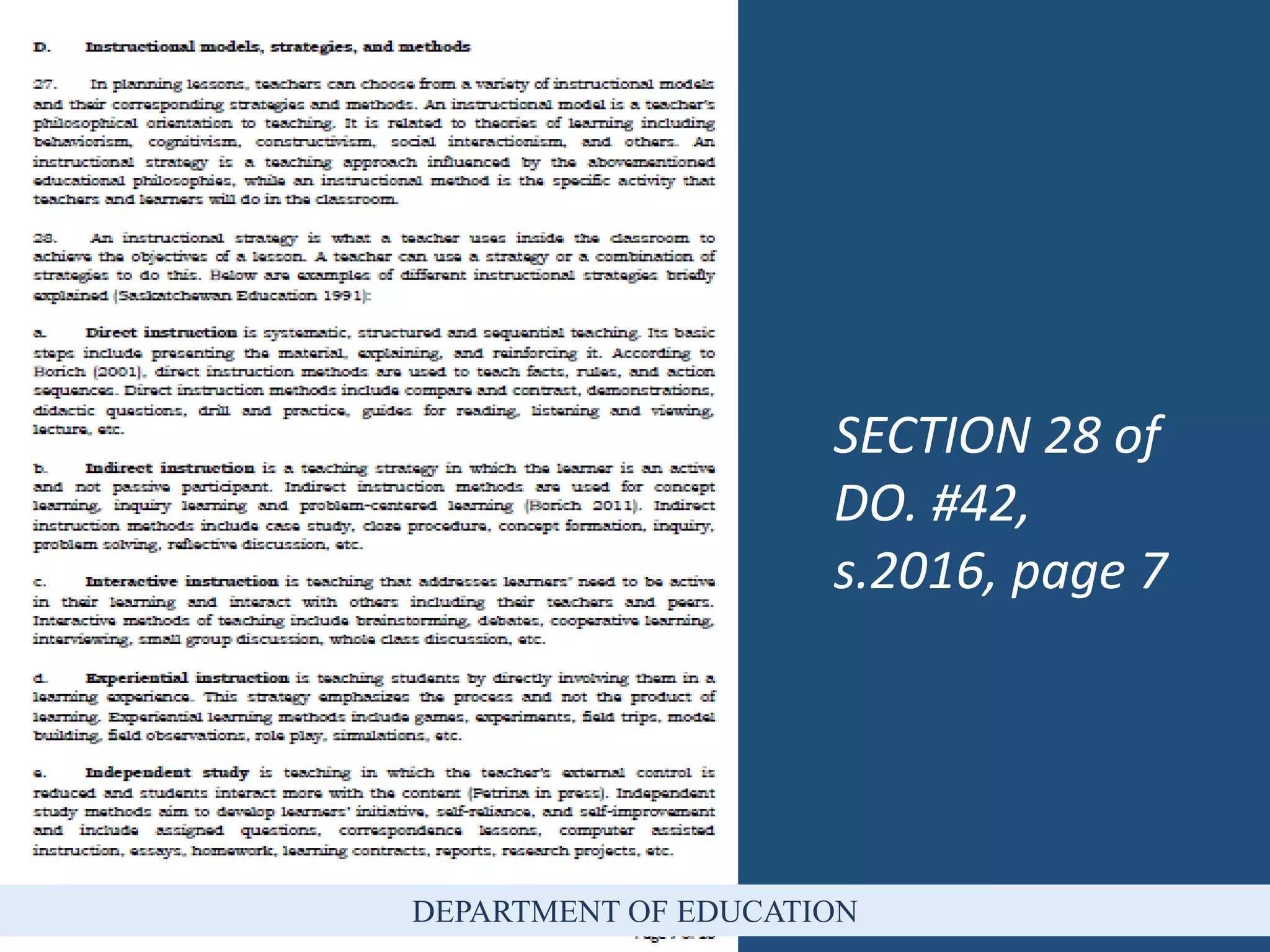
SECTION 28 of
DO. #42,
s.2016, page 7
DEPARTMENT OF EDUCATION
27. In planning lessons, teachers
can choose from a variety of
instructional models and their
corresponding strategies and
methods.
D. Instructional models,
strategies, and methods
DO. #42, s.2016,section 27 page 7
DEPARTMENT OF EDUCATION
An instructional model is a teacher’s
philosophical orientation to teaching.
It is related to theories of learning
including behaviorism, cognitivism,
constructivism, social interactionism,
and others.
D. Instructional models,
strategies, and methods
DO. #42, s.2016, page 7
DEPARTMENT OF EDUCATION
D. Instructional models,
strategies, and methods
An instructional strategy is a teaching
approach influenced by the
abovementioned educational philosophies,
while an instructional method is the specific
activity that teachers and learners will do in
the classroom.
DO. #42, s.2016, page 7
DEPARTMENT OF EDUCATION
28. An instructional
strategy is what a teacher
uses inside the classroom
to achieve the objectives
of a lesson. A teacher can
use a strategy or a
combination of strategies
to do this.
DEPARTMENT OF EDUCATION
DO. #42, s.2016, page 7
(Saskatchewan Education 1991):
1. DIRECT INSTRUCTION
DEPARTMENT OF EDUCATION
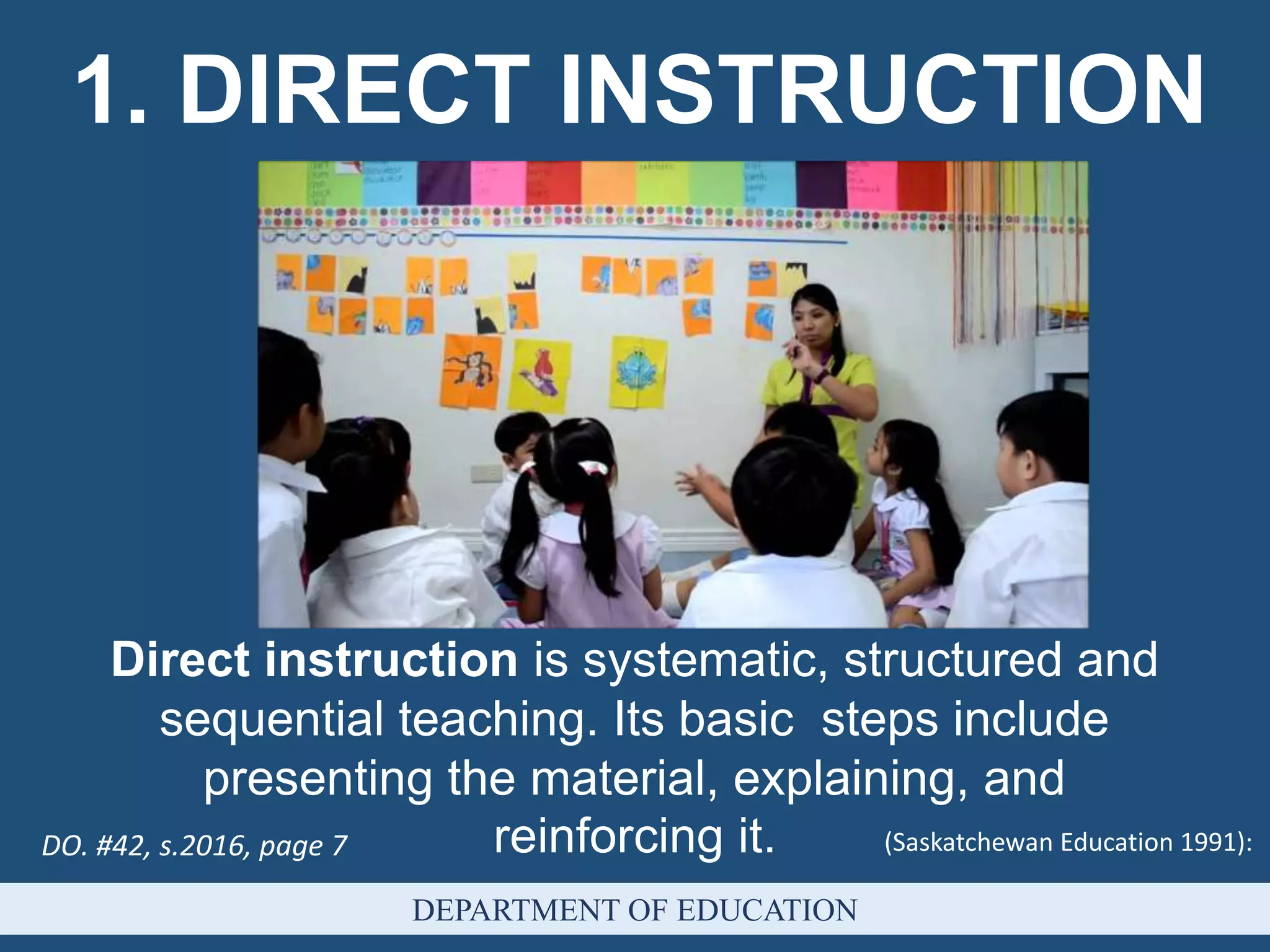
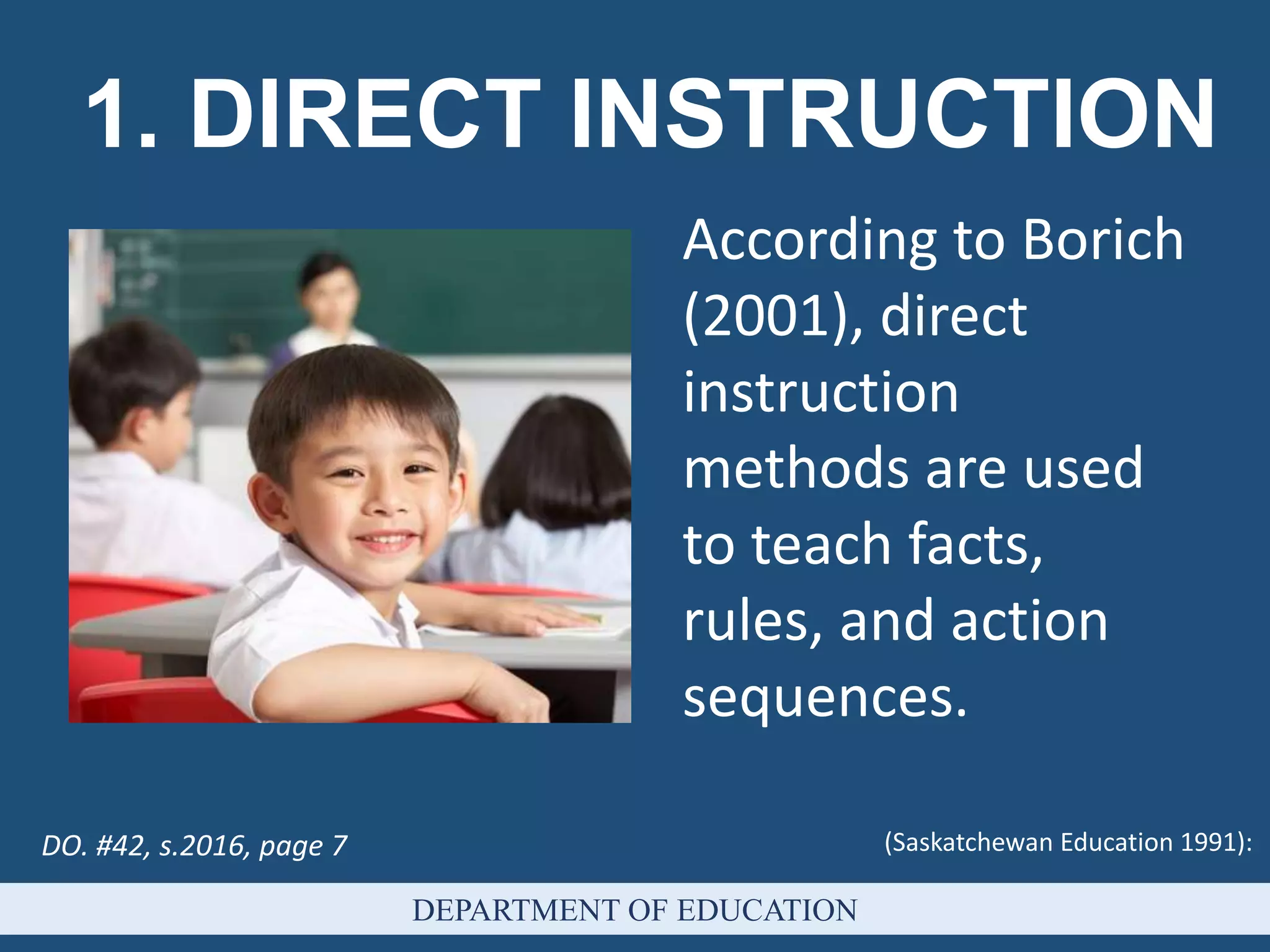
Direct instruction is systematic, structured and
sequential teaching. Its basic steps include
presenting the material, explaining, and
reinforcing it.DO. #42, s.2016, page 7
(Saskatchewan Education 1991):
1. DIRECT INSTRUCTION
DEPARTMENT OF EDUCATION
According to Borich
(2001), direct
instruction
methods are used
to teach facts,
rules, and action
sequences.
DO. #42, s.2016, page 7
DEPARTMENT OF EDUCATION
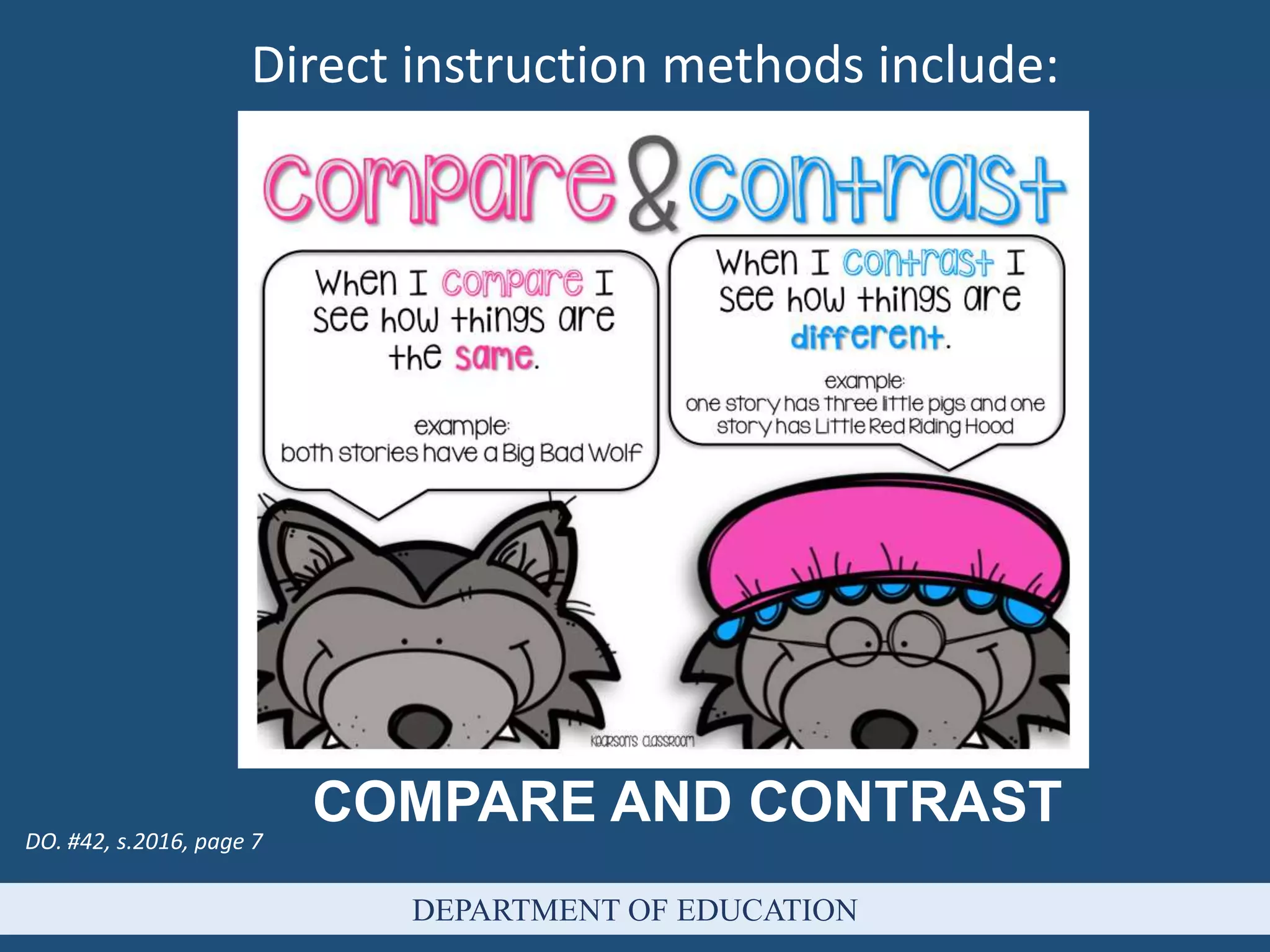
Direct instruction methods include:
COMPARE AND CONTRASTDO. #42, s.2016, page 7
DEPARTMENT OF EDUCATION
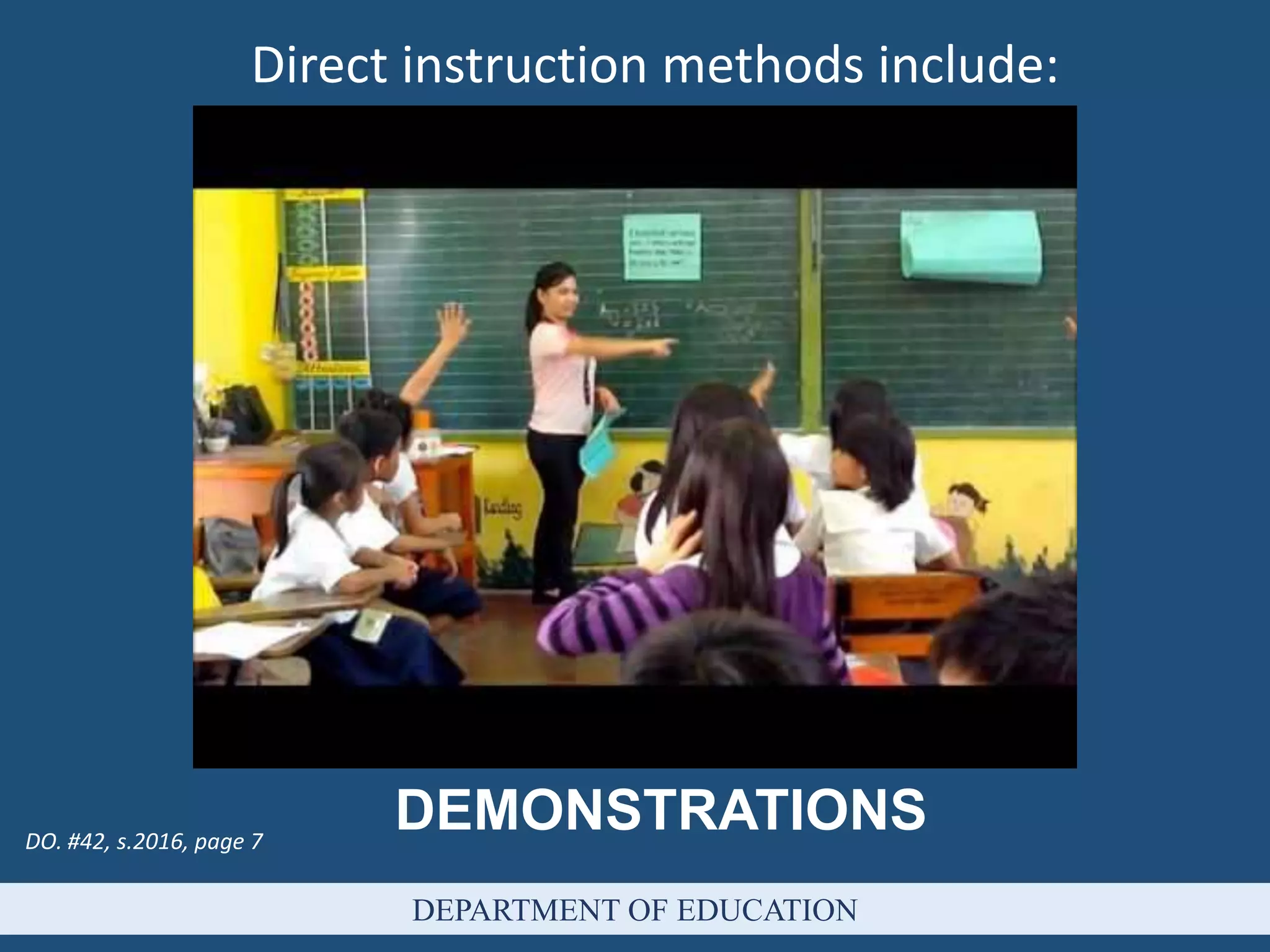
Direct instruction methods include:
DEMONSTRATIONSDO. #42, s.2016, page 7
DEPARTMENT OF EDUCATION
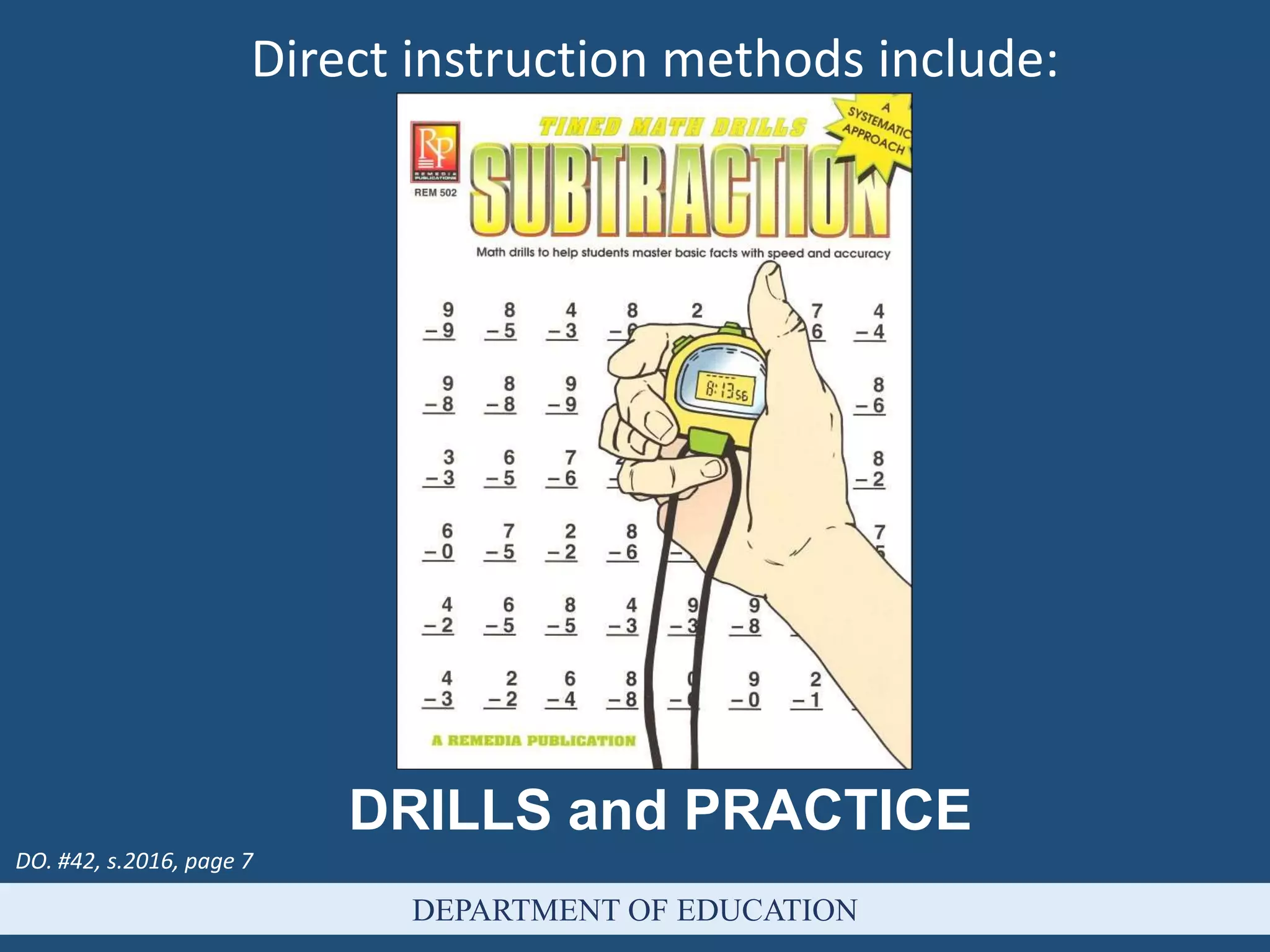
Direct instruction methods include:
DRILLS and PRACTICE
DO. #42, s.2016, page 7
DEPARTMENT OF EDUCATION
Direct instruction methods include:
LISTENING, VIEWING LECTURE
DO. #42, s.2016, page 7
(Saskatchewan Education 1991):
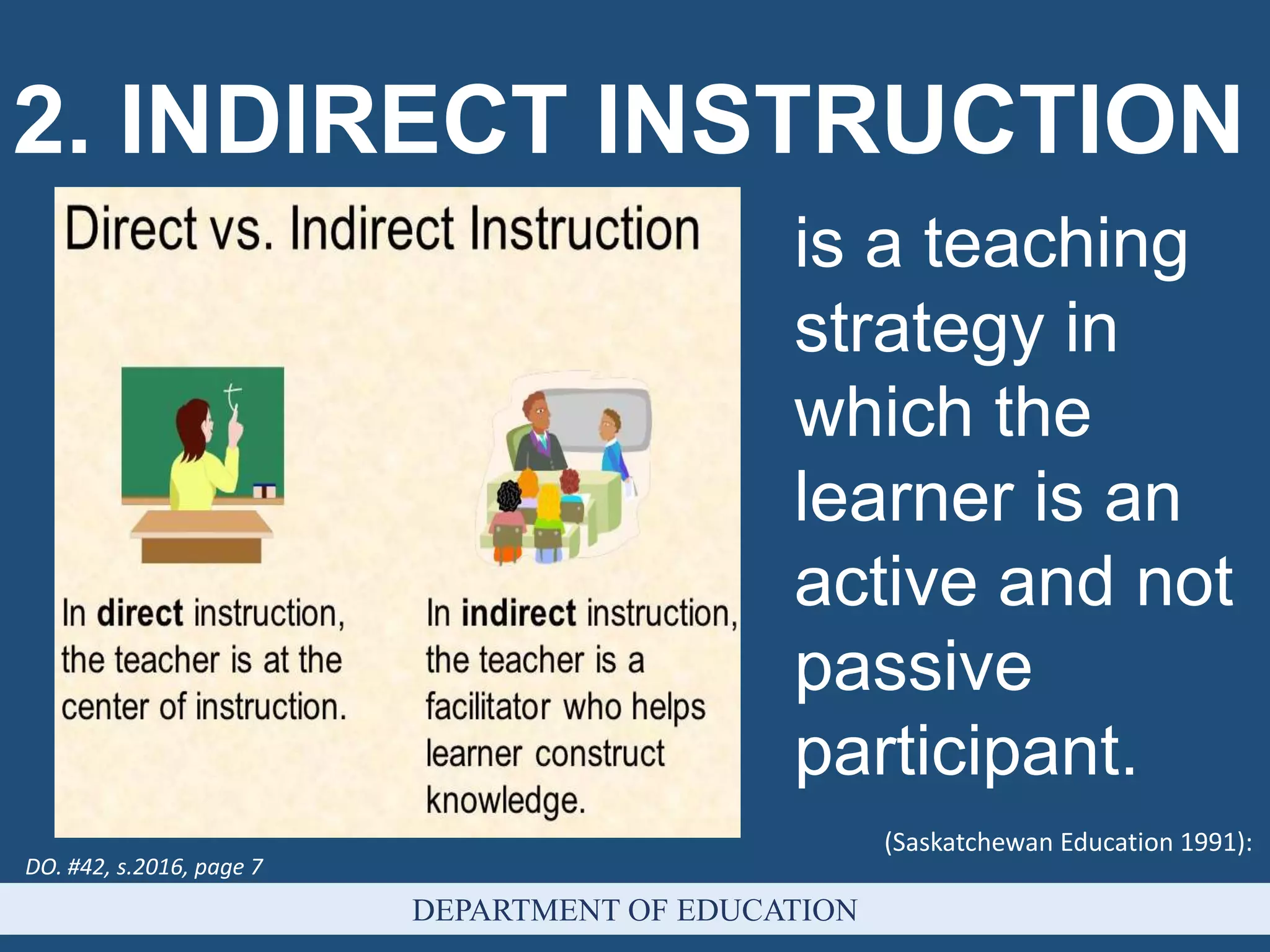
2. INDIRECT INSTRUCTION
DEPARTMENT OF EDUCATION
is a teaching
strategy in
which the
learner is an
active and not
passive
participant.
DO. #42, s.2016, page 7
DEPARTMENT OF EDUCATION
Indirect instruction methods are used for
concept learning, inquiry learning and
problem-centered learning (Borich 2011).
DO. #42, s.2016, page 7
DEPARTMENT OF EDUCATION
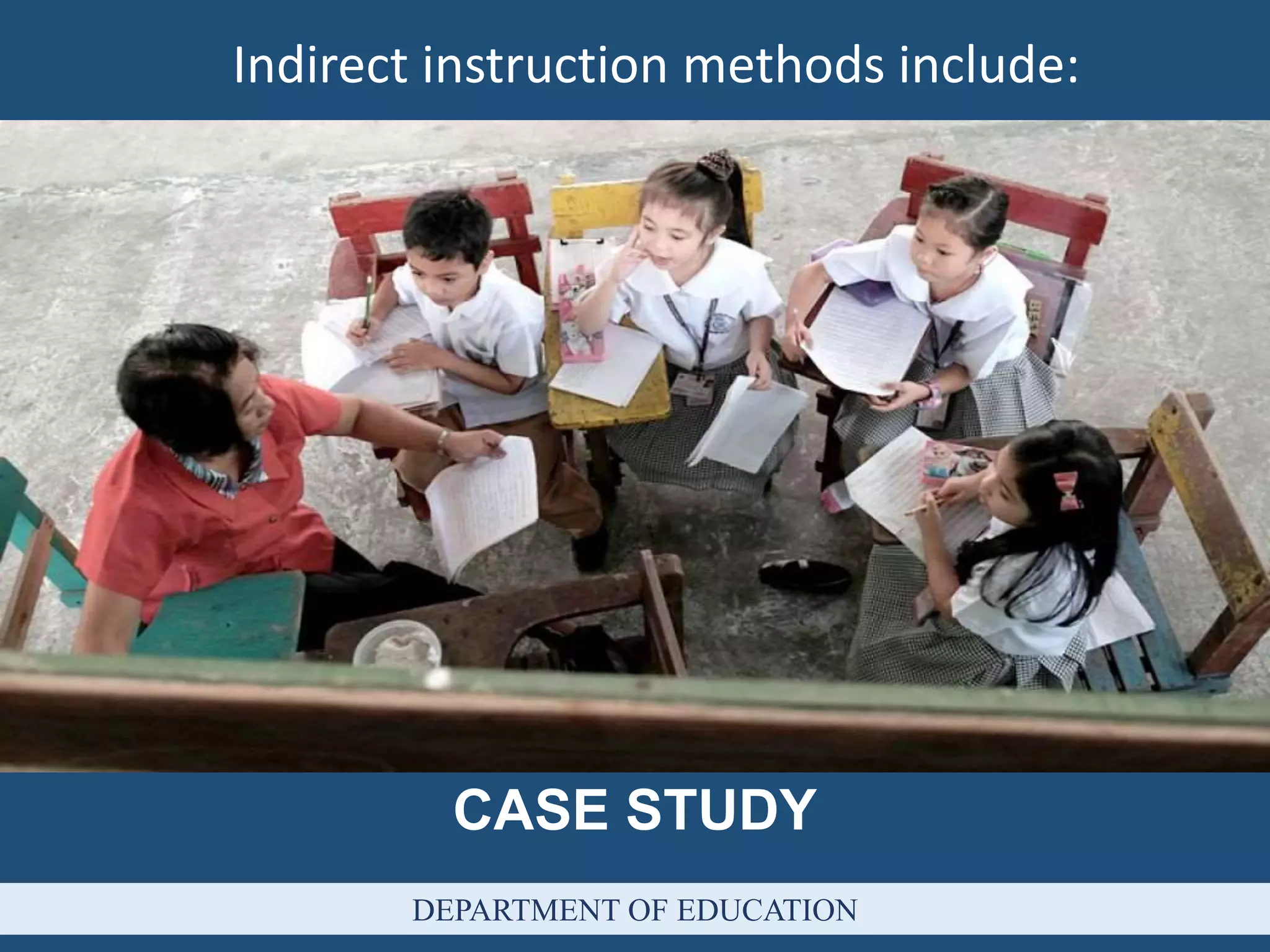
Indirect instruction methods include:
CASE STUDY
DEPARTMENT OF EDUCATION
Indirect instruction methods include:
CLOZE PROCEDURE
DEPARTMENT OF EDUCATION
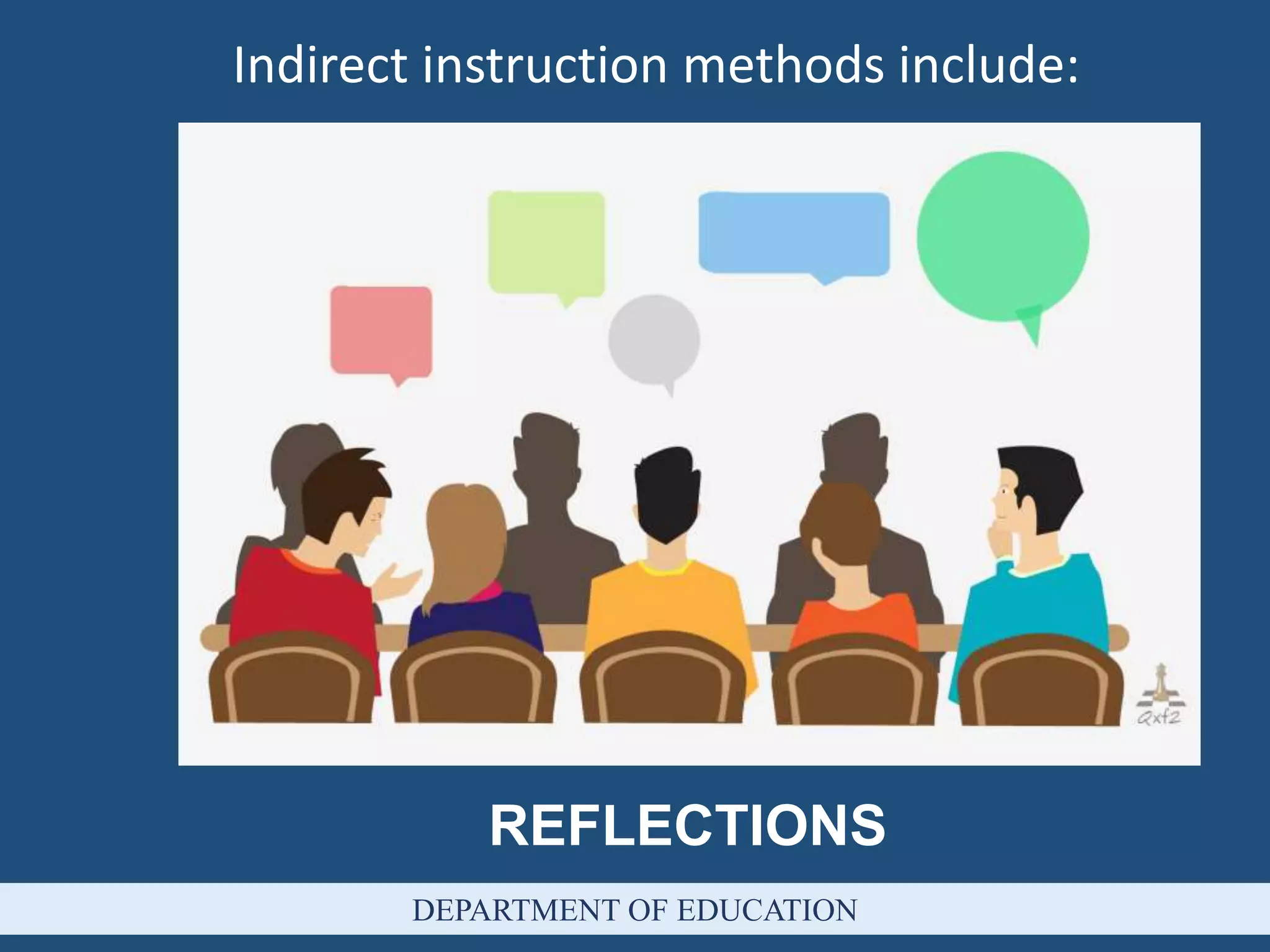
Indirect instruction methods include:
REFLECTIONS
(Saskatchewan Education 1991):
3. INTERACTIVE INSTRUCTION
DEPARTMENT OF EDUCATION
is teaching that
addresses learners’
need to be active in
their learning and
interact with others
including their
teachers and peers.
DEPARTMENT OF EDUCATION
Interactive instruction methods include:
DEBATE
DEPARTMENT OF EDUCATION
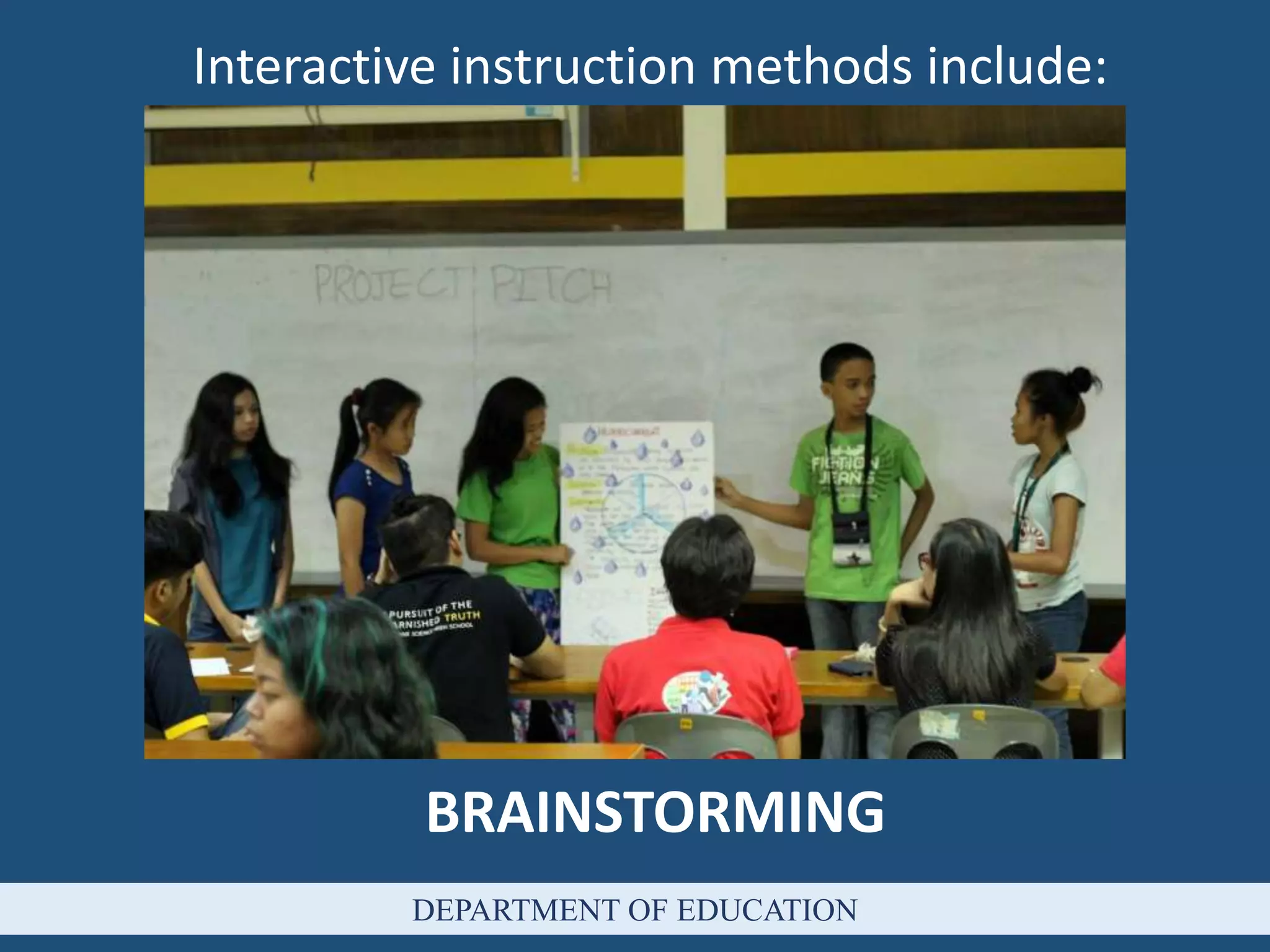
Interactive instruction methods include:
BRAINSTORMING
DEPARTMENT OF EDUCATION
Interactive instruction methods include:
COOPERATIVE LEARNING
DEPARTMENT OF EDUCATION
Interactive instruction methods include:
INTERVIEWING
DEPARTMENT OF EDUCATION
Interactive instruction methods include:
SMALL GROUP DISCUSSION
(Saskatchewan Education 1991):
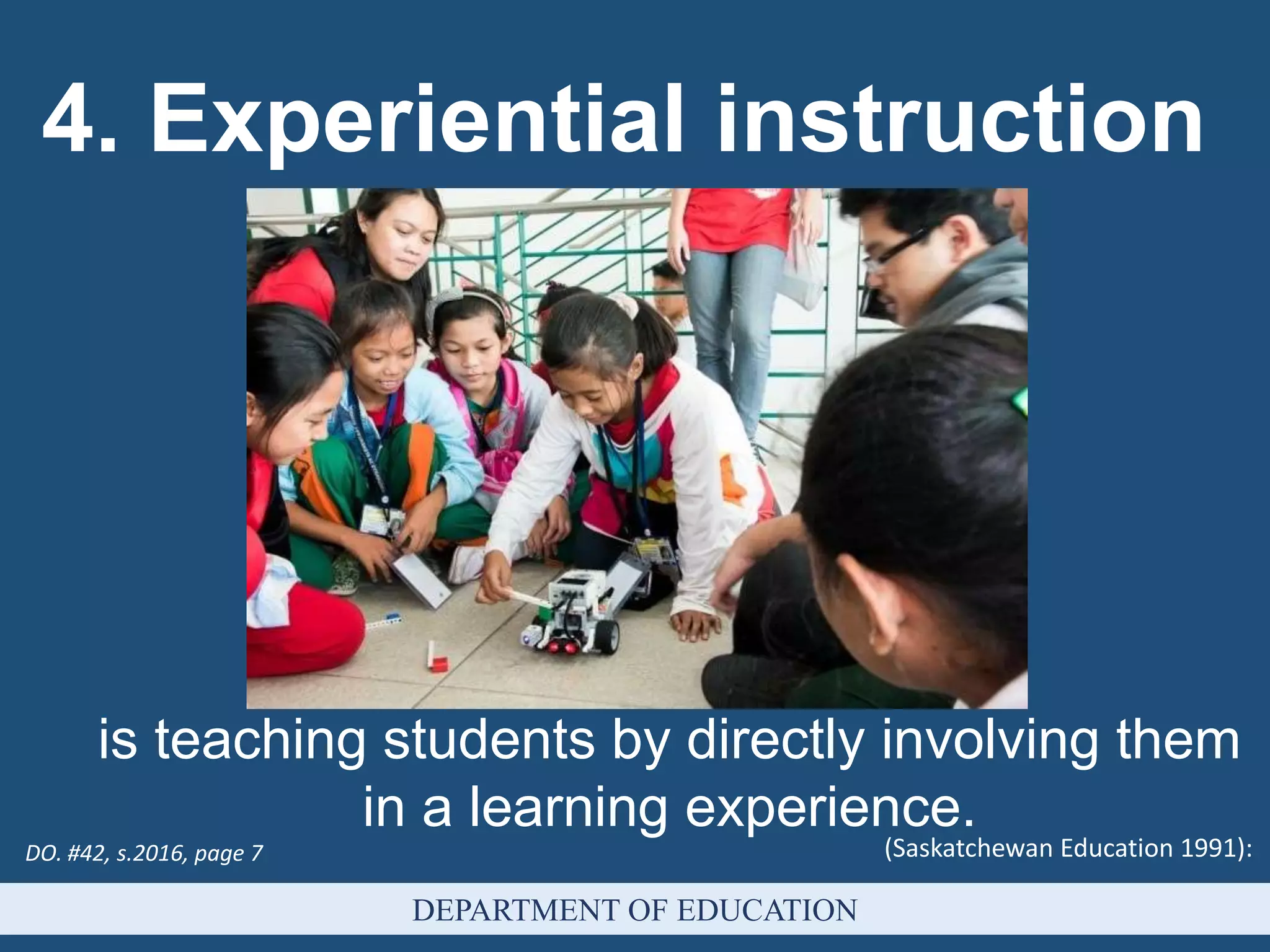
4. Experiential instruction
DEPARTMENT OF EDUCATION
is teaching students by directly involving them
in a learning experience.
DO. #42, s.2016, page 7
DEPARTMENT OF EDUCATION
Experiential instruction methods includes:
GAMESDO. #42, s.2016, page 7
DEPARTMENT OF EDUCATION
Experiential instruction methods includes:
experiments
DEPARTMENT OF EDUCATION
Experiential instruction methods includes:
Role play
DO. #42, s.2016, page 7
DEPARTMENT OF EDUCATION
Experiential instruction methods includes:
FIELD TRIPSDO. #42, s.2016, page 7
DEPARTMENT OF EDUCATION
Experiential instruction methods includes:
simulationsDO. #42, s.2016, page 7
(Saskatchewan Education 1991):
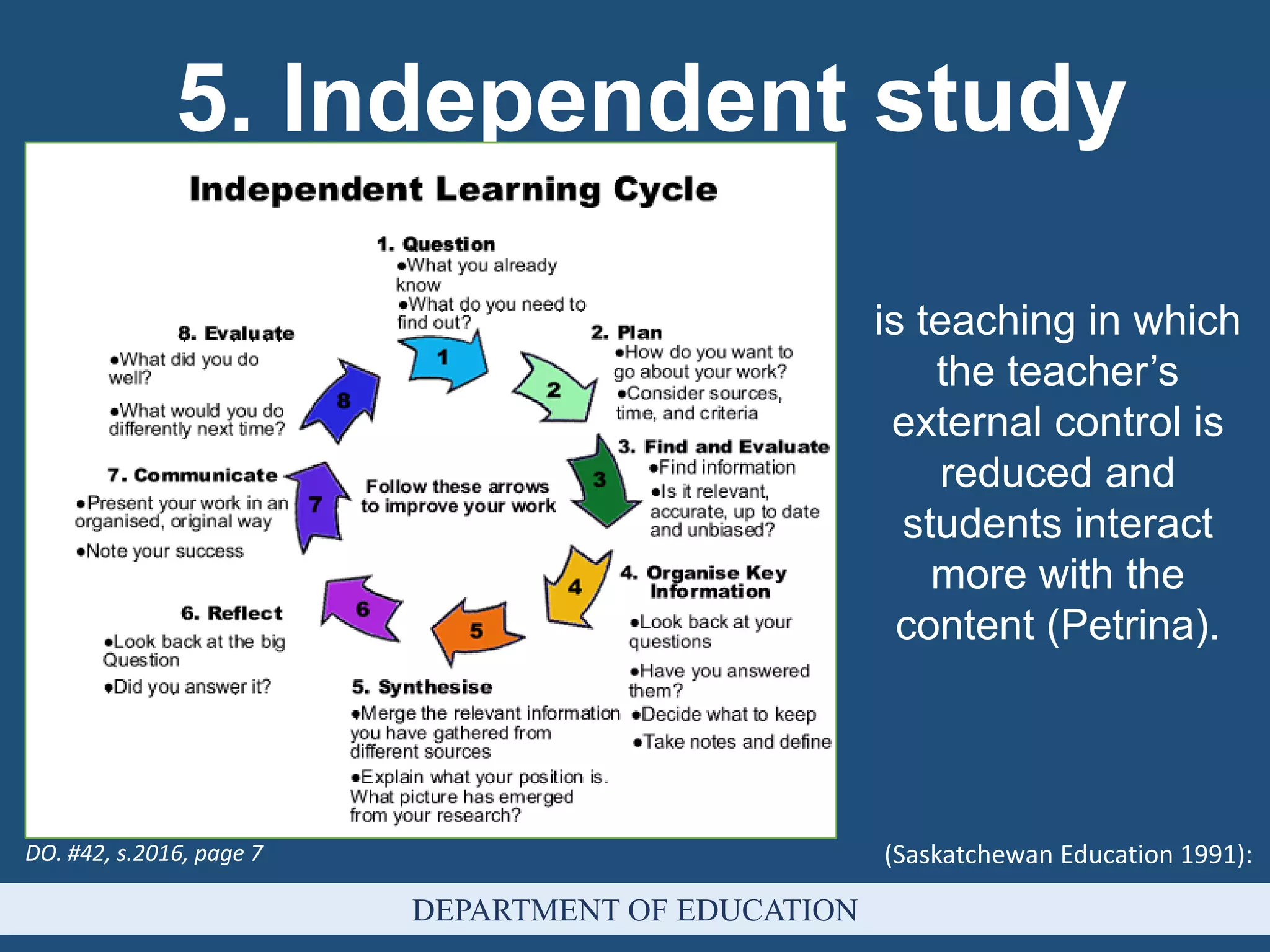
5. Independent study
DEPARTMENT OF EDUCATION
is teaching in which
the teacher’s
external control is
reduced and
students interact
more with the
content (Petrina).
DO. #42, s.2016, page 7
(Saskatchewan Education 1991):
5. Independent study
DEPARTMENT OF EDUCATION
Independent study methods aim to
develop learners’ initiative, self-
reliance, and self-improvement
DO. #42, s.2016, page 7
DEPARTMENT OF EDUCATION
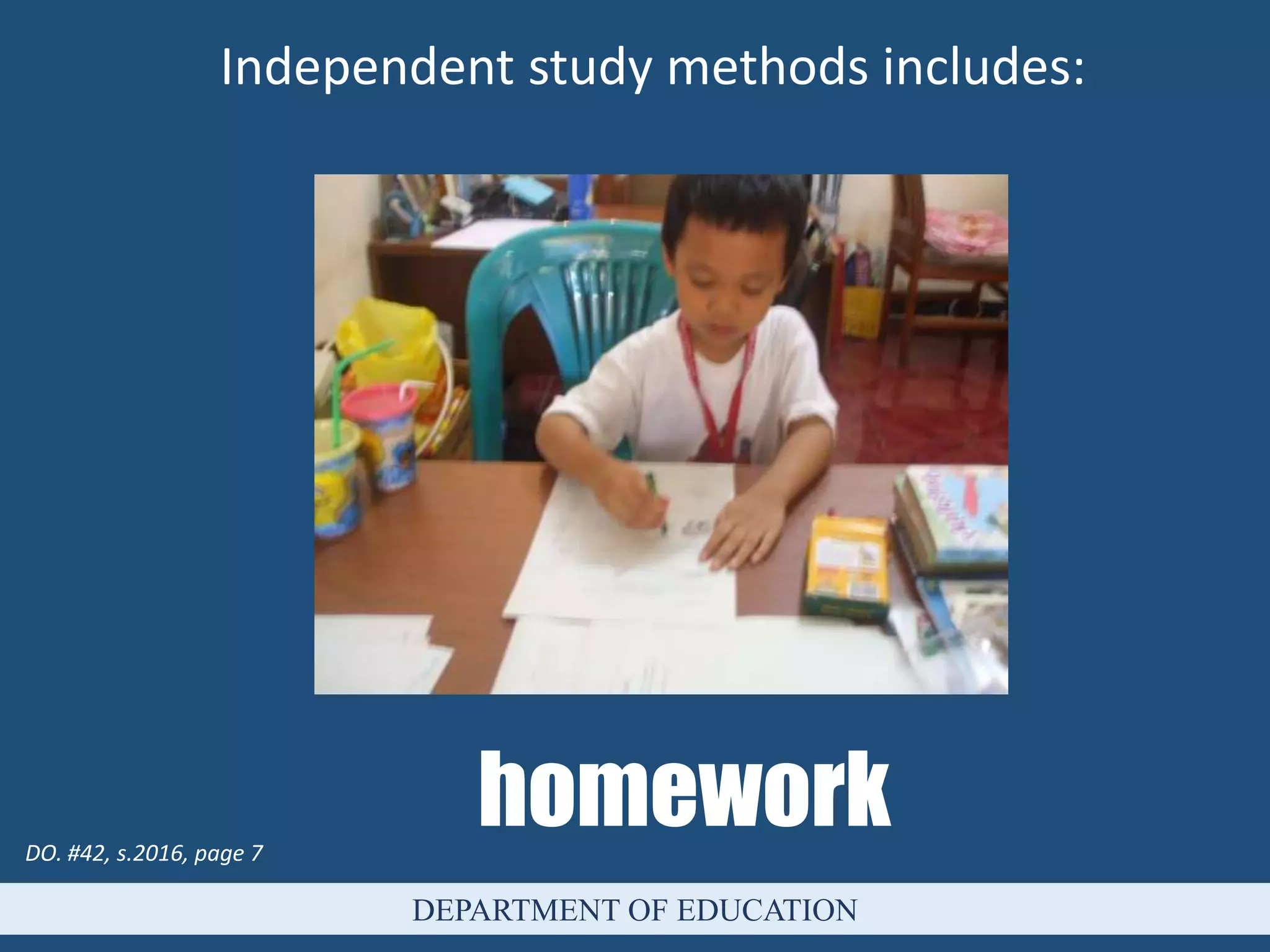
Independent study methods includes:
researchesDO. #42, s.2016, page 7
DEPARTMENT OF EDUCATION
Independent study methods includes:
reportsDO. #42, s.2016, page 7
DEPARTMENT OF EDUCATION
Independent study methods includes:
homeworkDO. #42, s.2016, page 7
DEPARTMENT OF EDUCATION
29. In planning lessons, teachers can
employ and combine a variety of
teaching strategies and methods to
deliver instruction.
DO. #42, s.2016, page 8
DEPARTMENT OF EDUCATION
…In choosing strategies and methods to
use in teaching, the teacher has to
consider learner diversity and whether or
not the strategies or methods will respond
to what learners inside the classroom need.
DO. #42, s.2016, page 8
DEPARTMENT OF EDUCATION
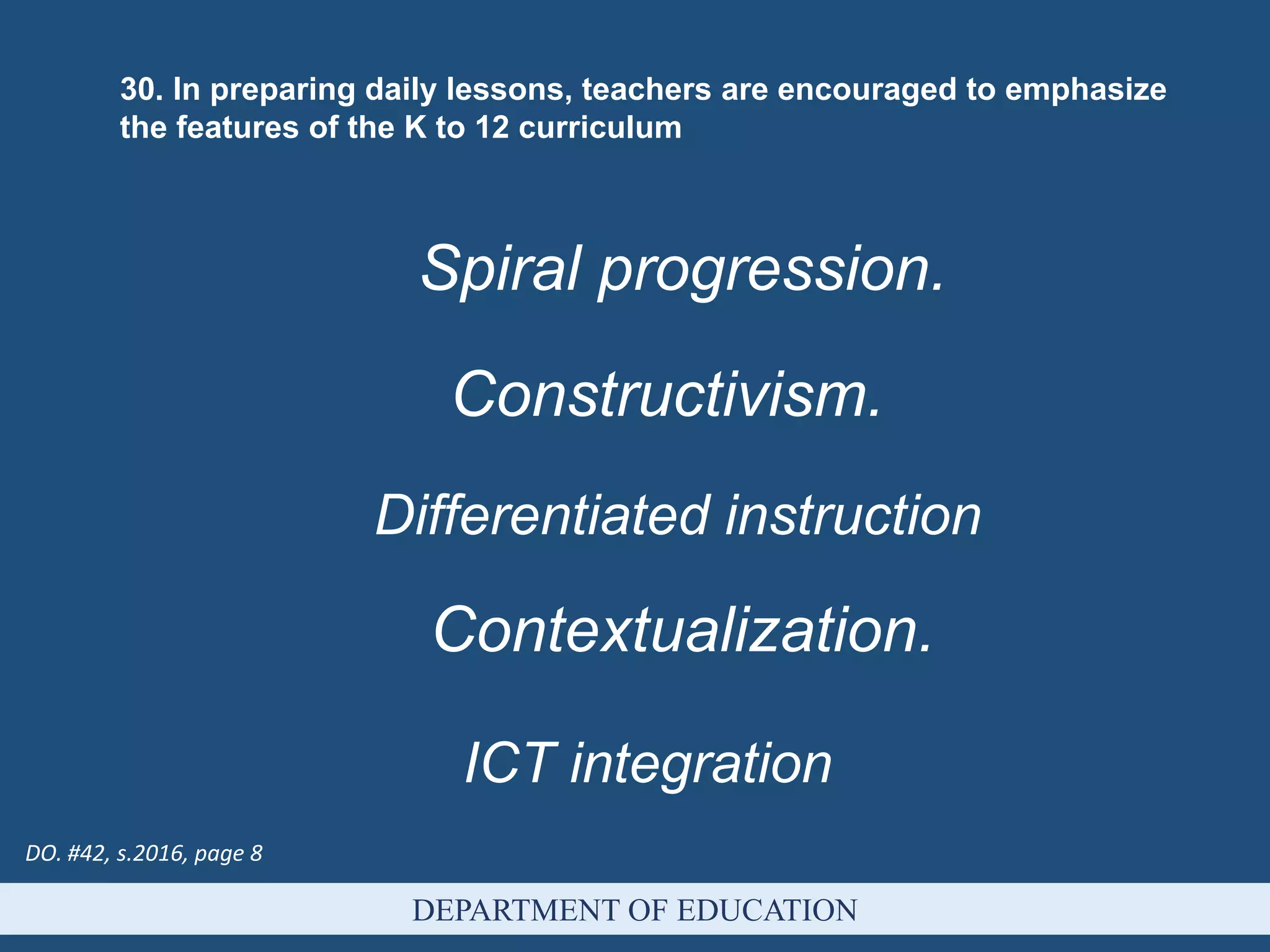
30. In preparing daily lessons, teachers are encouraged to emphasize
the features of the K to 12 curriculum
Spiral progression.
Constructivism.
Differentiated instruction
Contextualization.
ICT integration
DO. #42, s.2016, page 8
DEPARTMENT OF EDUCATION
Teachers should make sure that in preparing lessons,
learners are able to revisit previously encountered
topics with an increasing level of complexity and
that lessons build on previous learning.
Spiral progression.
DO. #42, s.2016, page 8
DEPARTMENT OF EDUCATION
Teachers should provide learners with
opportunities to organize or re-organize
their thinking and construct knowledge
that is meaningful to them. (Piaget 1950).
Constructivism
DO. #42, s.2016, page 8
DEPARTMENT OF EDUCATION
Teachers can employ strategies that allow
collaboration among learners, so that
learners of varying skills can benefit from
interaction with one another.Vygotsky (1978)
Constructivism
DO. #42, s.2016, page 8
DEPARTMENT OF EDUCATION
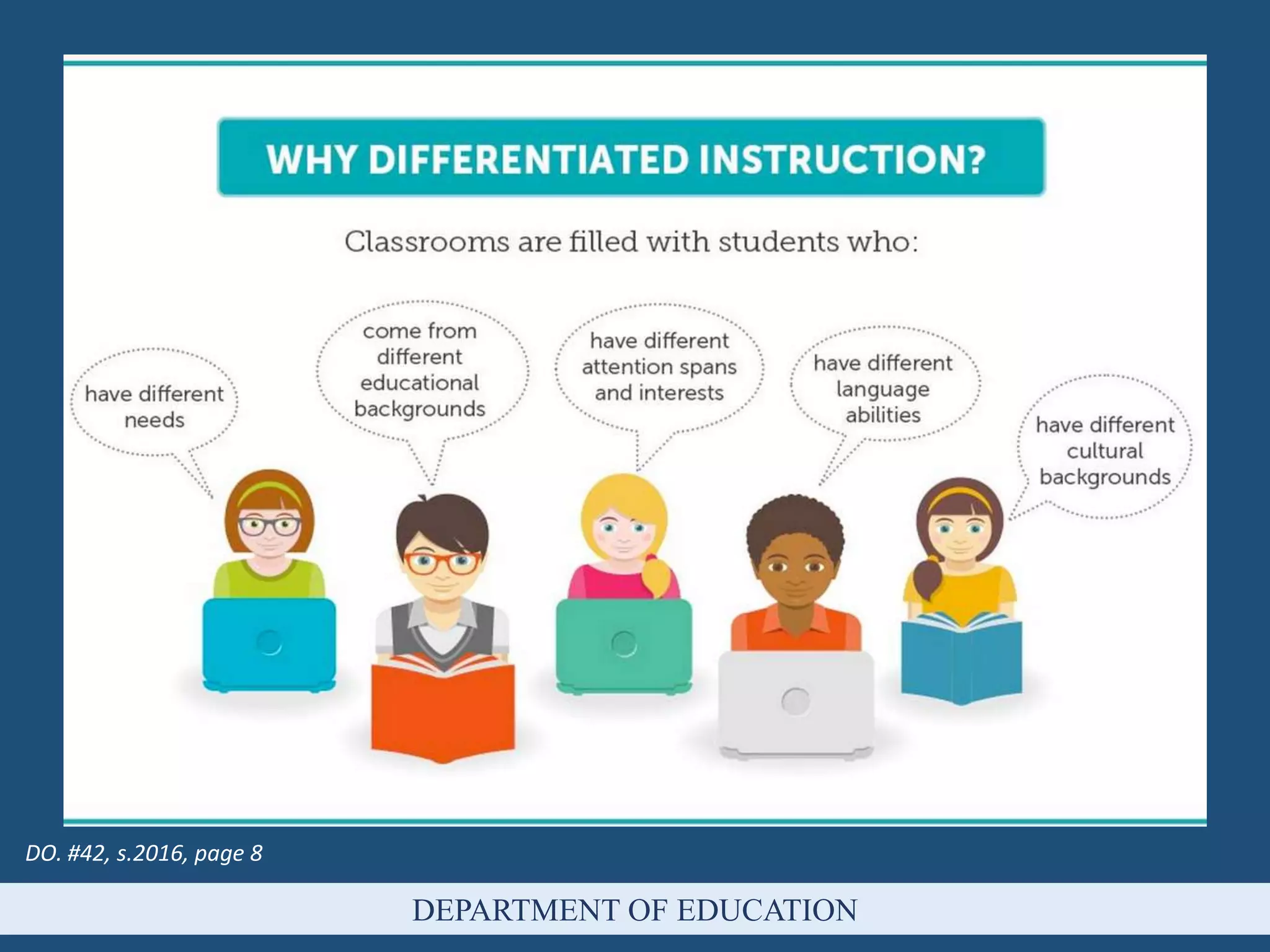
means providing multiple learning options
in the classroom so that learners of
varying interests, abilities, and needs are
able to take in the same content
appropriate to their needs,Ravitch (2007),
Differentiated instruction.
DO. #42, s.2016, page 8
DEPARTMENT OF EDUCATION
DO. #42, s.2016, page 8
DEPARTMENT OF EDUCATION
DO. #42, s.2016, page 9
DEPARTMENT OF EDUCATION
DO. #42, s.2016, page 9
Various instructional strategies and methods can be
delivered using ICT. Use of ICTs in lessons is also
one way of differentiating instruction inside the K to
12 classroom.
ICTintegration
DEPARTMENT OF EDUCATION
THANK YOU FOR
LISTENING!

Teaching Strategies, Approaches and Methods Under DepEd K-12 Curriculum

Editor's Notes

  • #43 ensuring that lessons engage and challenge learners and tap into the learners’
  • #44 ensuring that lessons engage and challenge learners and tap into the learners’
  • #45 ensuring that lessons engage and challenge learners and tap into the learners’
  • #46 ensuring that lessons engage and challenge learners and tap into the learners’
  • #47 ensuring that lessons engage and challenge learners and tap into the learners’
  • #48 ensuring that lessons engage and challenge learners and tap into the learners’
  • #49 ensuring that lessons engage and challenge learners and tap into the learners’