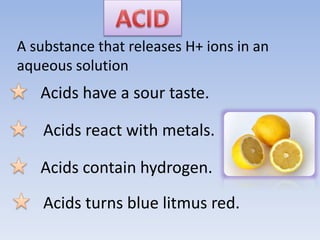
A substance that releases H+ ions in an
aqueous solution
Acids have a sour taste.
Acids react with metals.
Acids contain hydrogen.
Acids turns blue litmus red.
An acid is a chemical substance whose aqueous solutions are
characterized by a sour taste, the ability to turn
bluelitmus red, and the ability to react with bases and certain
metals (like calcium) to form salts.
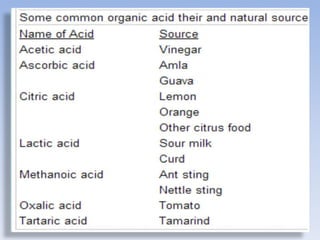
Common examples of acids include hydrochloric acid , acetic
acid sulfuric acid (used in car batteries), and tartaric acid As
these examples show, acids can be solutions or pure
substances, and can be derived from solids, liquids, or gases.
Strong acids and some concentrated weak acids are corrosive,
but there are exceptions such as carboranes and boric acid.
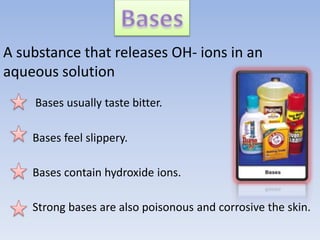
A substance that releases OH- ions in an
aqueous solution
Bases usually taste bitter.
Bases feel slippery.
Bases contain hydroxide ions.
Strong bases are also poisonous and corrosive the skin.
A base is a chemical species that donates electrons
or hydroxide ions or that accepts protons.
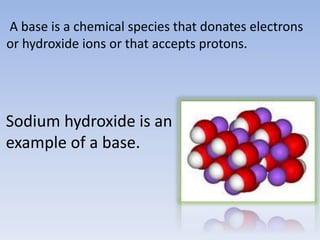
Sodium hydroxide is an
example of a base.
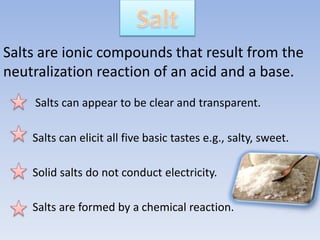
Salts are ionic compounds that result from the
neutralization reaction of an acid and a base.
Salts can appear to be clear and transparent.
Salts can elicit all five basic tastes e.g., salty, sweet.
Solid salts do not conduct electricity.
Salts are formed by a chemical reaction.
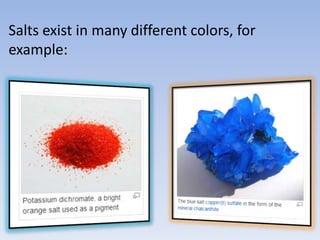
Salts exist in many different colors, for
example:
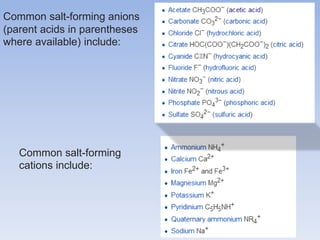
Common salt-forming anions
(parent acids in parentheses
where available) include:
Common salt-forming
cations include:
Acid, Base and Salt

Acid, Base and Salt

  • 2.
    A substance thatreleases H+ ions in an aqueous solution Acids have a sour taste. Acids react with metals. Acids contain hydrogen. Acids turns blue litmus red.
  • 3.
    An acid isa chemical substance whose aqueous solutions are characterized by a sour taste, the ability to turn bluelitmus red, and the ability to react with bases and certain metals (like calcium) to form salts. Common examples of acids include hydrochloric acid , acetic acid sulfuric acid (used in car batteries), and tartaric acid As these examples show, acids can be solutions or pure substances, and can be derived from solids, liquids, or gases. Strong acids and some concentrated weak acids are corrosive, but there are exceptions such as carboranes and boric acid.
  • 5.
    A substance thatreleases OH- ions in an aqueous solution Bases usually taste bitter. Bases feel slippery. Bases contain hydroxide ions. Strong bases are also poisonous and corrosive the skin.
  • 6.
    A base isa chemical species that donates electrons or hydroxide ions or that accepts protons. Sodium hydroxide is an example of a base.
  • 8.
    Salts are ioniccompounds that result from the neutralization reaction of an acid and a base. Salts can appear to be clear and transparent. Salts can elicit all five basic tastes e.g., salty, sweet. Solid salts do not conduct electricity. Salts are formed by a chemical reaction.
  • 9.
    Salts exist inmany different colors, for example:
  • 10.
    Common salt-forming anions (parentacids in parentheses where available) include: Common salt-forming cations include: