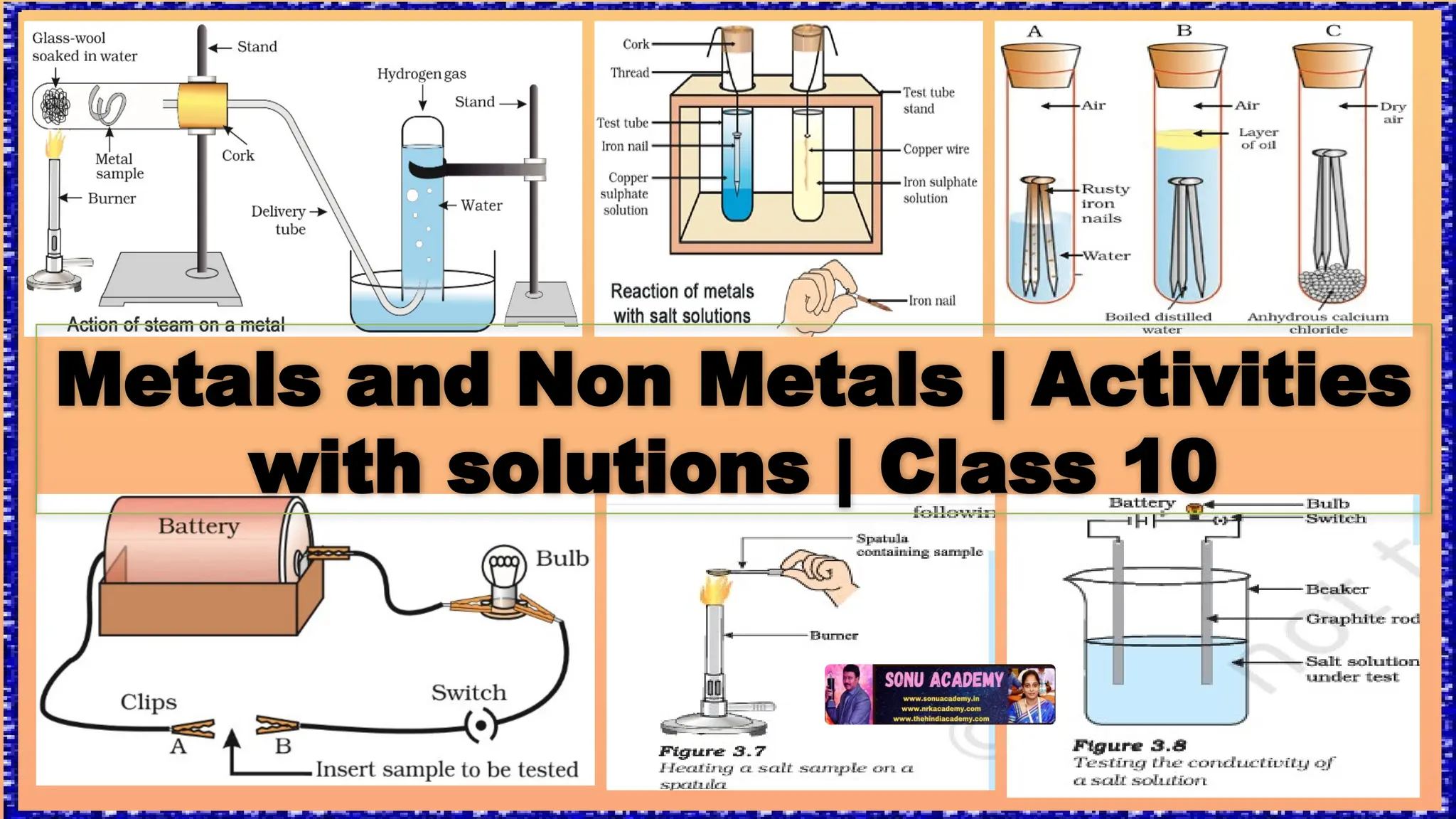
Metals and Non Metals | Activities
with solutions | Class 10
Metals and Non Metals | Activity 3.1 with solutions | Class 10
Procedure: Take samples of iron, copper aluminium, and magnesium. Note the appearance
of each sample. Clean the surface of each sample by rubbing them with sandpaper and note
their appearance again.
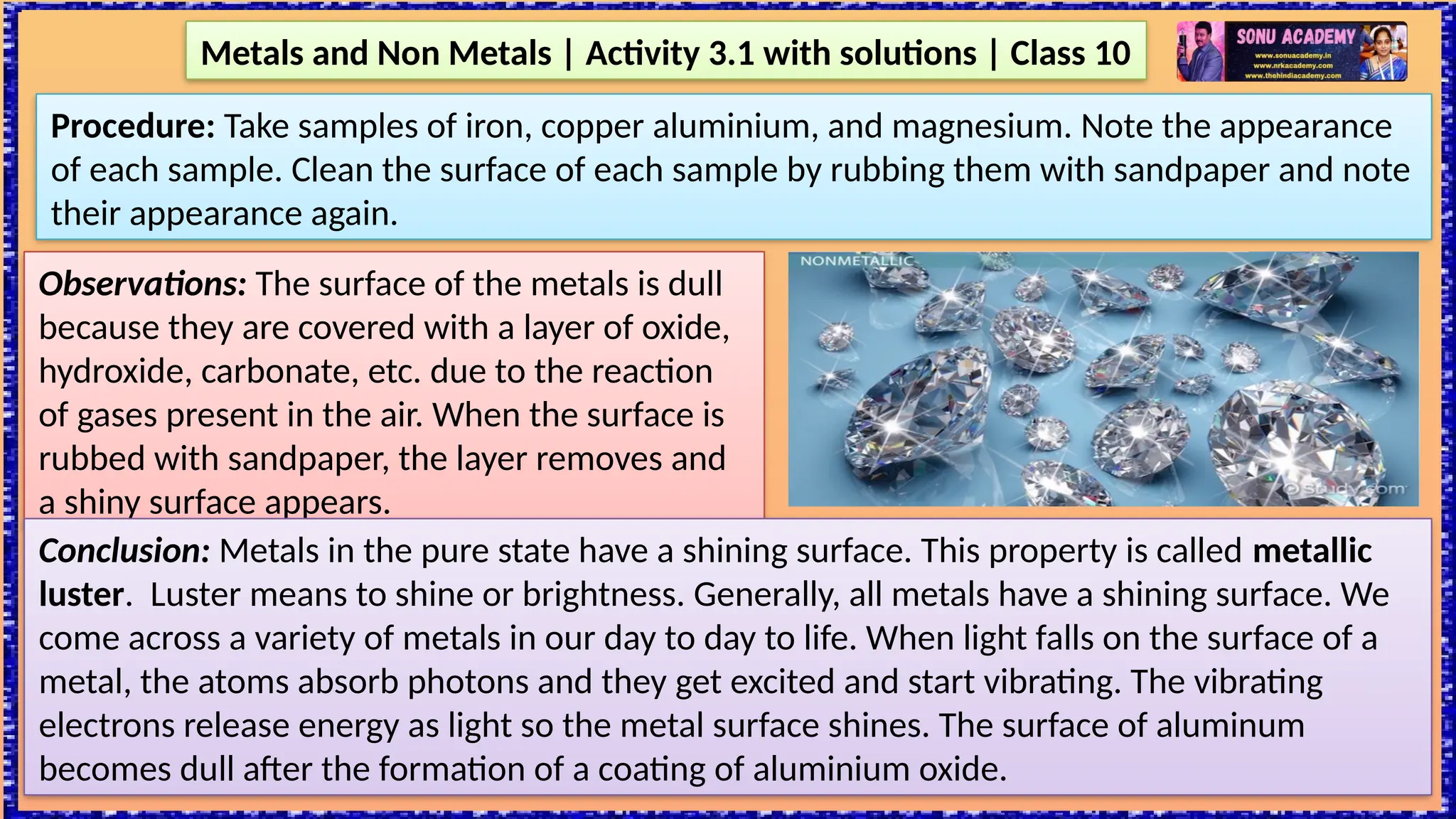
Observations: The surface of the metals is dull
because they are covered with a layer of oxide,
hydroxide, carbonate, etc. due to the reaction
of gases present in the air. When the surface is
rubbed with sandpaper, the layer removes and
a shiny surface appears.
Conclusion: Metals in the pure state have a shining surface. This property is called metallic
luster. Luster means to shine or brightness. Generally, all metals have a shining surface. We
come across a variety of metals in our day to day to life. When light falls on the surface of a
metal, the atoms absorb photons and they get excited and start vibrating. The vibrating
electrons release energy as light so the metal surface shines. The surface of aluminum
becomes dull after the formation of a coating of aluminium oxide.
Metals and Non Metals | Activity 3.2 with solutions | Class 10
Procedure: Take small pieces of iron, copper, aluminium, and magnesium. Try to cut these
metals with a sharp knife and note your observations. Hold a piece of sodium metal with a
pair of tongs. Put it on a watch glass and try to cut it with a knife. What do you observe?
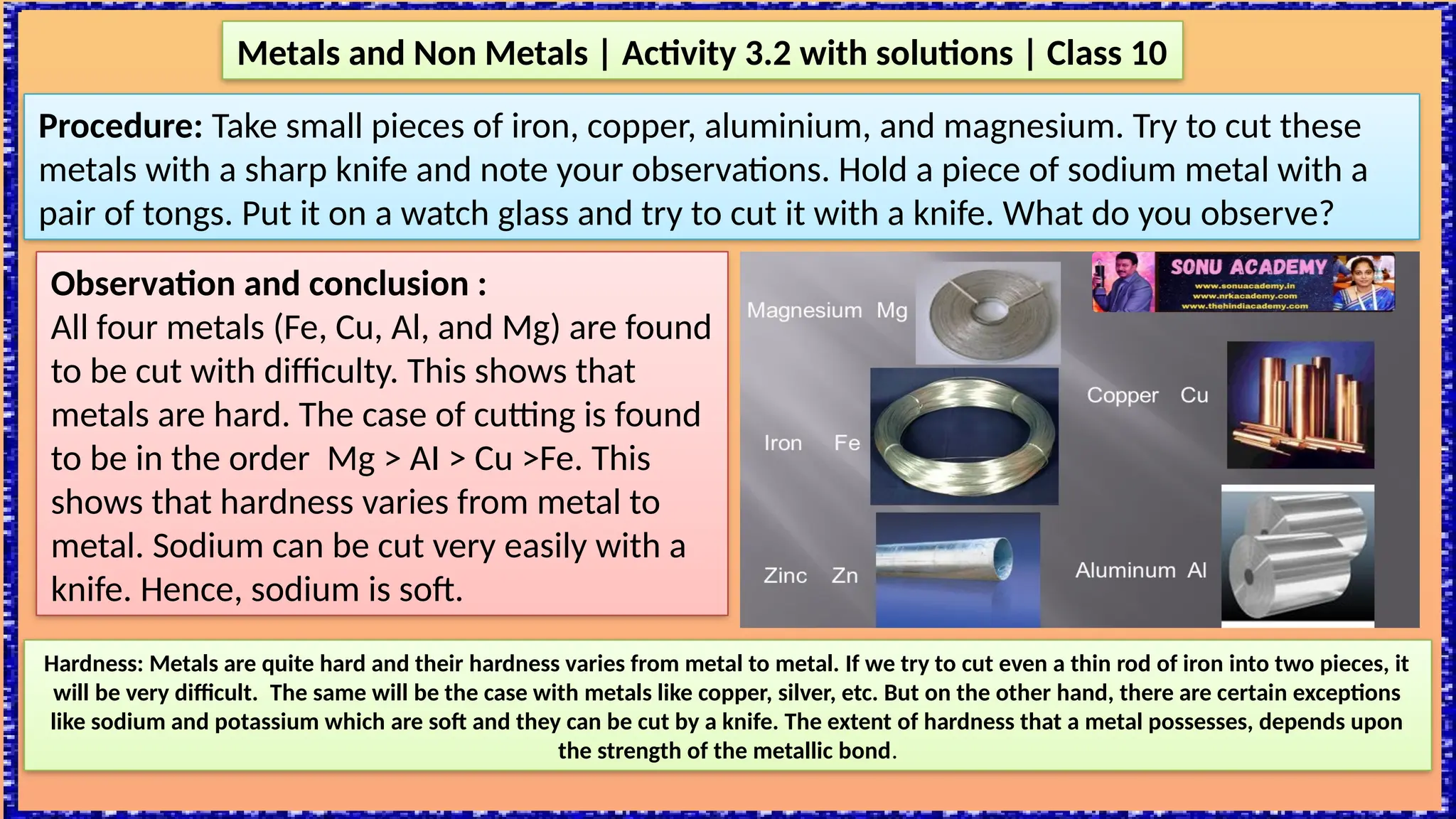
Observation and conclusion :
All four metals (Fe, Cu, Al, and Mg) are found
to be cut with difficulty. This shows that
metals are hard. The case of cutting is found
to be in the order Mg > AI > Cu >Fe. This
shows that hardness varies from metal to
metal. Sodium can be cut very easily with a
knife. Hence, sodium is soft.
Hardness: Metals are quite hard and their hardness varies from metal to metal. If we try to cut even a thin rod of iron into two pieces, it
will be very difficult. The same will be the case with metals like copper, silver, etc. But on the other hand, there are certain exceptions
like sodium and potassium which are soft and they can be cut by a knife. The extent of hardness that a metal possesses, depends upon
the strength of the metallic bond.
Hardness: Metals are quite hard and their
hardness varies from metal to metal. If we try to
cut even a thin rod of iron into two pieces, it will
be very difficult. The same will be the case with
metals like copper, silver, etc. But on the other
hand, there are certain exceptions like sodium
and potassium which are soft and they can be
cut by a knife. The extent of hardness that a
metal possesses, depends upon the strength of
the metallic bond.
Metals and Non Metals | Activity 3.2 with solutions | Class 10
Caution: Always handle sodium metal with care.
Dry it by pressing between the folds of a filter
paper.
Metals and Non Metals | Activity 3.3 with solutions | Class 10
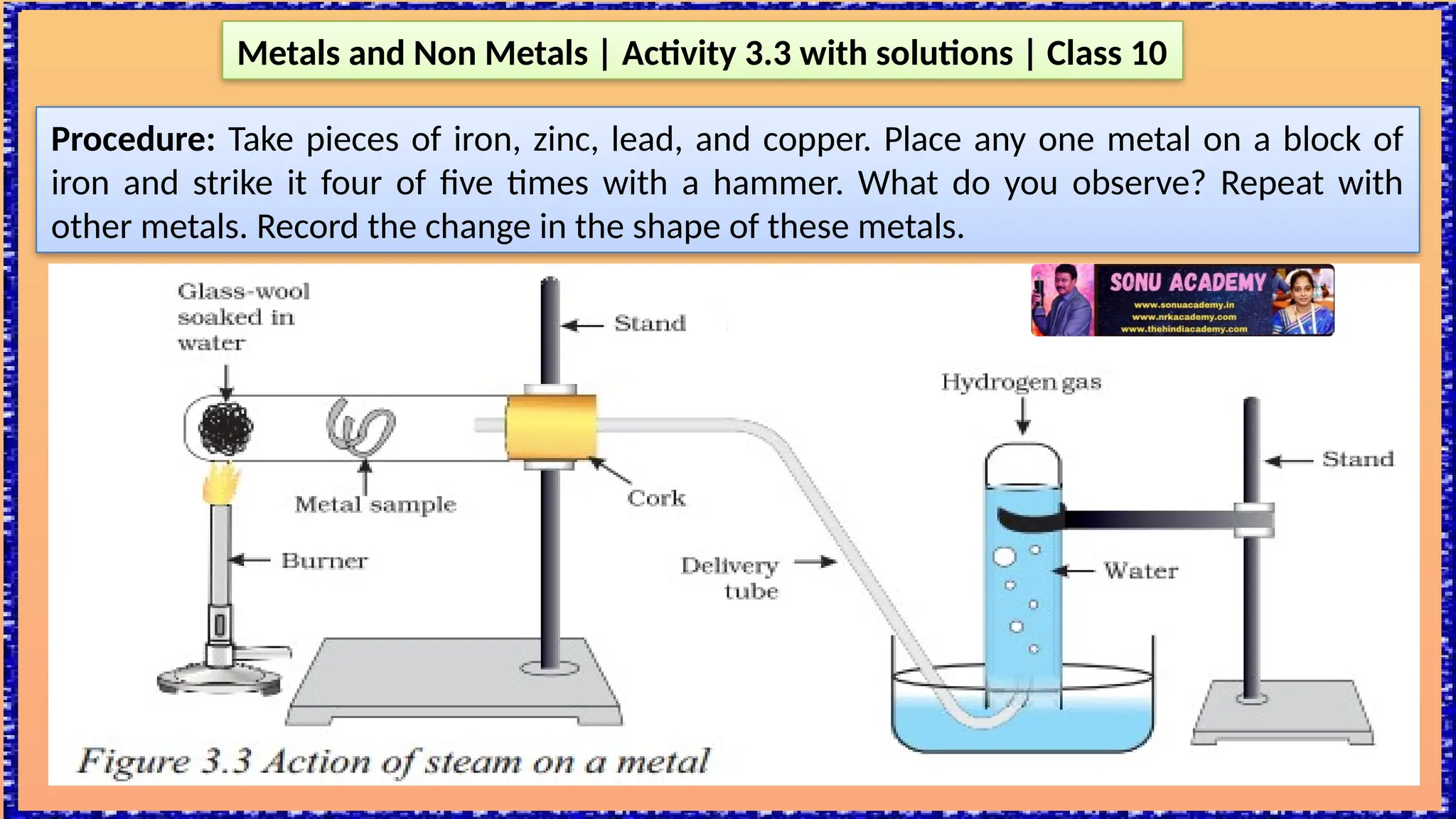
Procedure: Take pieces of iron, zinc, lead, and copper. Place any one metal on a block of
iron and strike it four of five times with a hammer. What do you observe? Repeat with
other metals. Record the change in the shape of these metals.
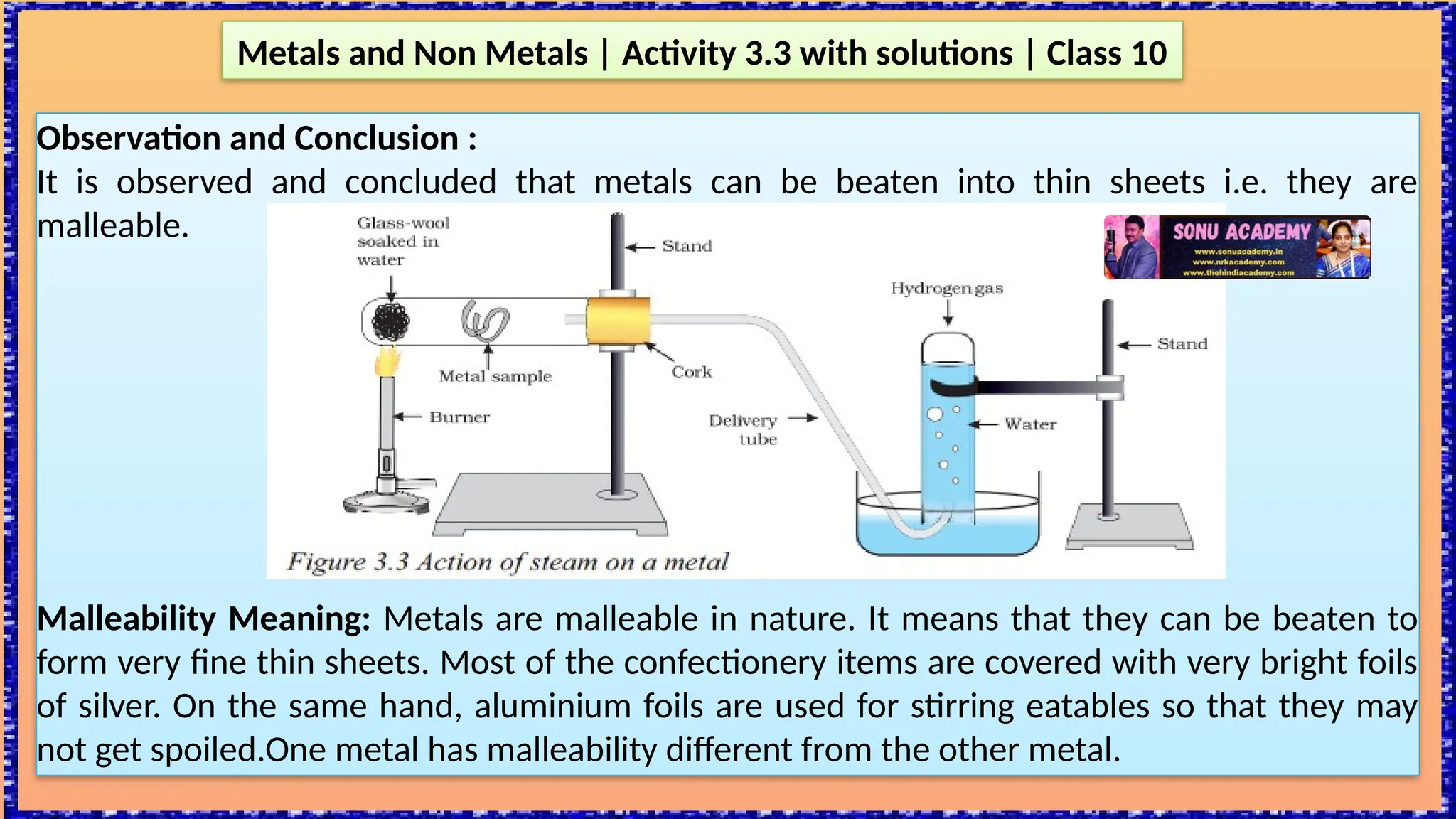
Observation and Conclusion :
It is observed and concluded that metals can be beaten into thin sheets i.e. they are
malleable.
Malleability Meaning: Metals are malleable in nature. It means that they can be beaten to
form very fine thin sheets. Most of the confectionery items are covered with very bright foils
of silver. On the same hand, aluminium foils are used for stirring eatables so that they may
not get spoiled.One metal has malleability different from the other metal.
Metals and Non Metals | Activity 3.3 with solutions | Class 10
Metals and Non Metals | Activity 3.4 with solutions | Class 10
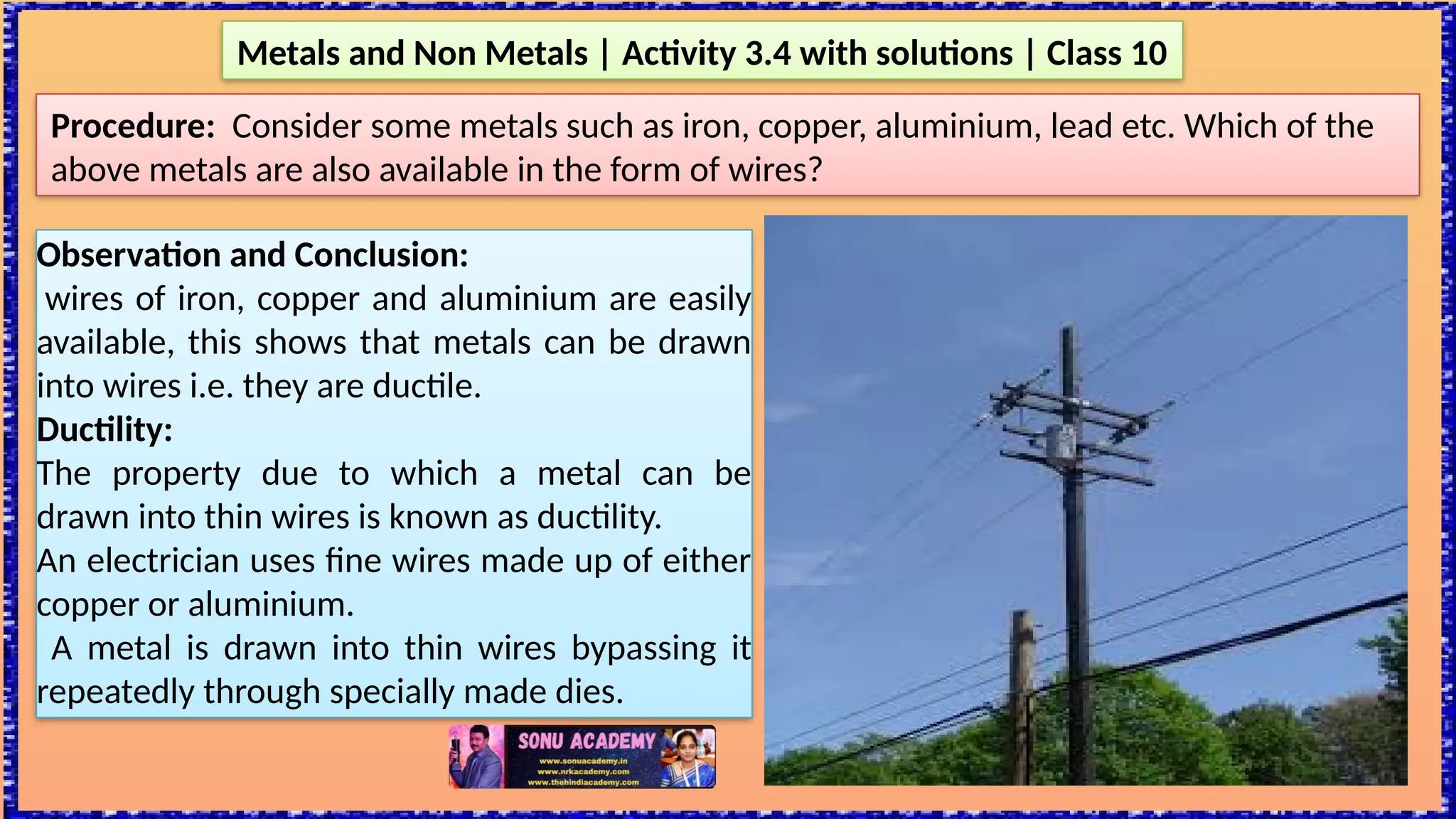
Procedure: Consider some metals such as iron, copper, aluminium, lead etc. Which of the
above metals are also available in the form of wires?
Observation and Conclusion:
wires of iron, copper and aluminium are easily
available, this shows that metals can be drawn
into wires i.e. they are ductile.
Ductility:
The property due to which a metal can be
drawn into thin wires is known as ductility.
An electrician uses fine wires made up of either
copper or aluminium.
A metal is drawn into thin wires bypassing it
repeatedly through specially made dies.
Metals and Non Metals | Activity 3.5 with solutions | Class 10
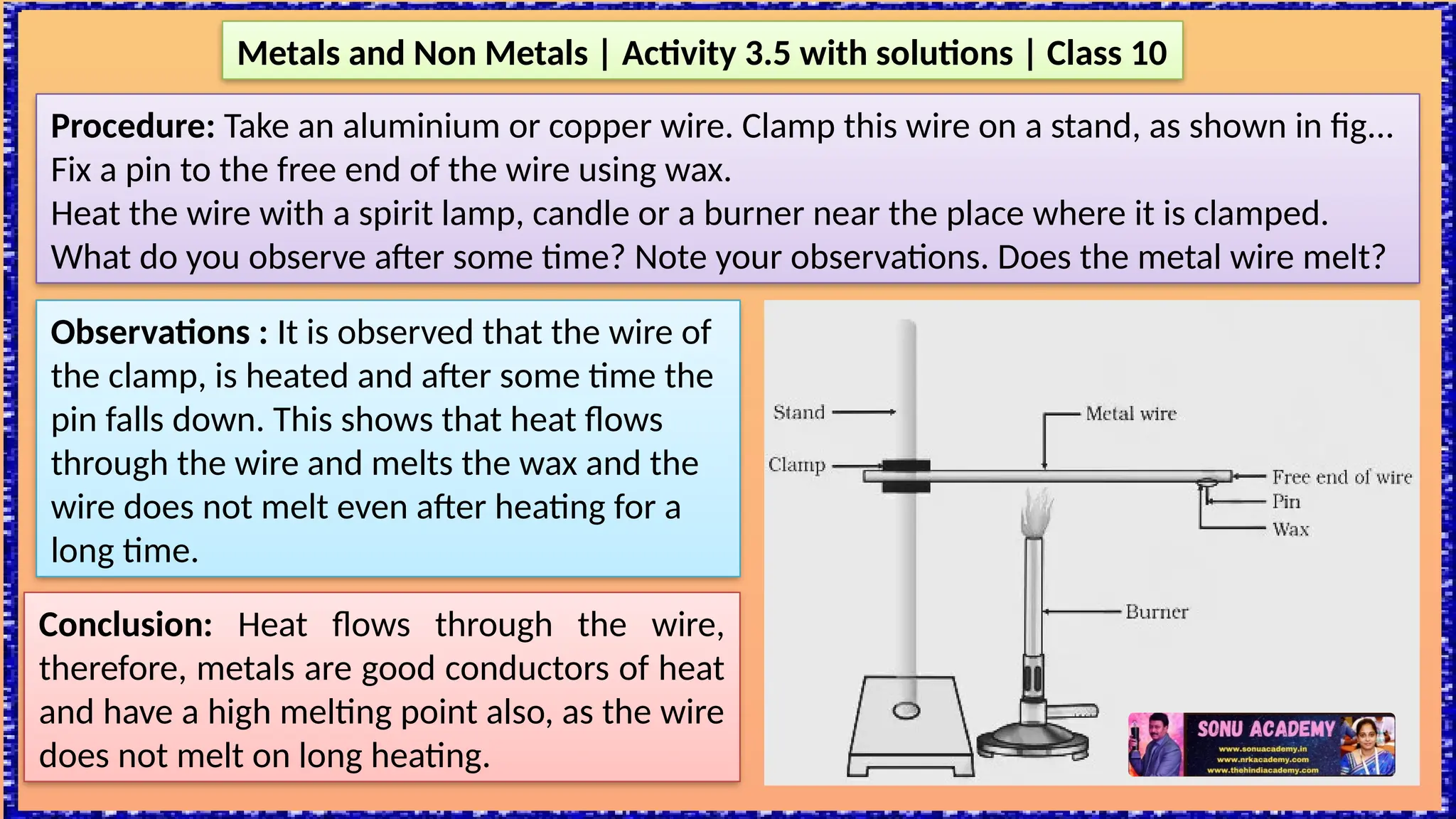
Procedure: Take an aluminium or copper wire. Clamp this wire on a stand, as shown in fig...
Fix a pin to the free end of the wire using wax.
Heat the wire with a spirit lamp, candle or a burner near the place where it is clamped.
What do you observe after some time? Note your observations. Does the metal wire melt?
Observations : It is observed that the wire of
the clamp, is heated and after some time the
pin falls down. This shows that heat flows
through the wire and melts the wax and the
wire does not melt even after heating for a
long time.
Conclusion: Heat flows through the wire,
therefore, metals are good conductors of heat
and have a high melting point also, as the wire
does not melt on long heating.
Metals and Non Metals | Activity 3.6 with solutions | Class 10
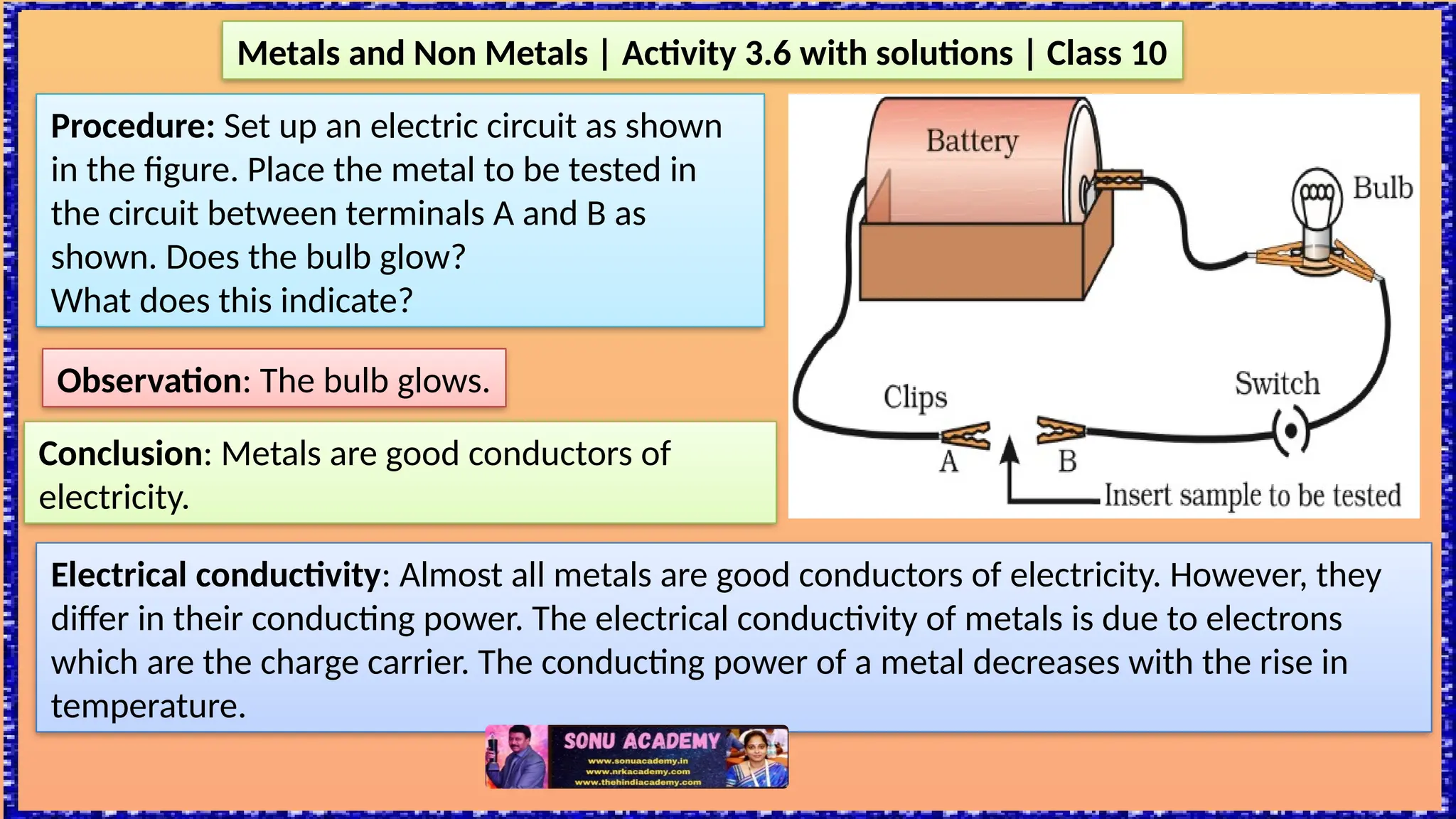
Procedure: Set up an electric circuit as shown
in the figure. Place the metal to be tested in
the circuit between terminals A and B as
shown. Does the bulb glow?
What does this indicate?
Observation: The bulb glows.
Conclusion: Metals are good conductors of
electricity.
Electrical conductivity: Almost all metals are good conductors of electricity. However, they
differ in their conducting power. The electrical conductivity of metals is due to electrons
which are the charge carrier. The conducting power of a metal decreases with the rise in
temperature.
Metals and Non Metals | Activity 3.7 with solutions | Class 10
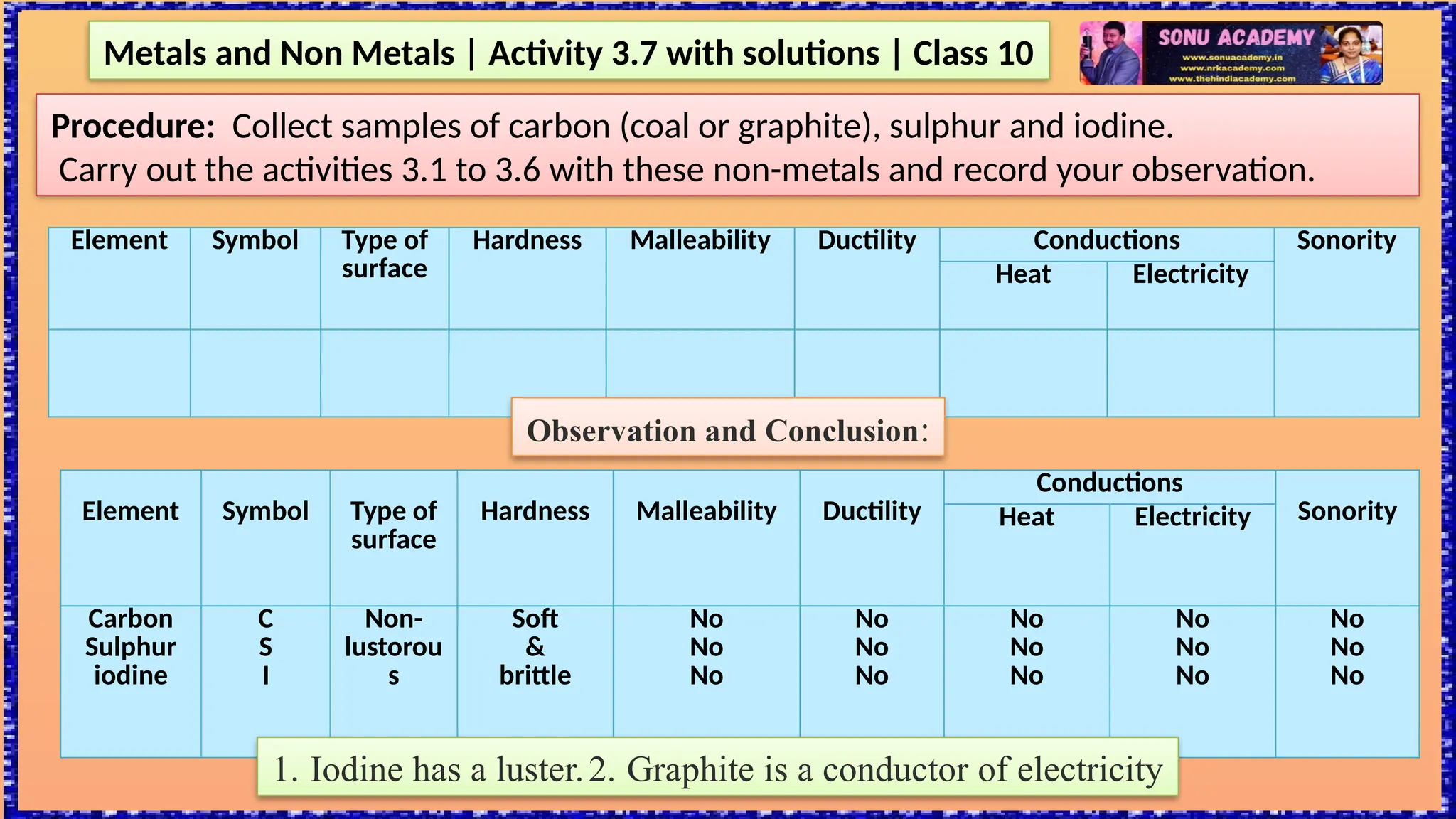
Procedure: Collect samples of carbon (coal or graphite), sulphur and iodine.
Carry out the activities 3.1 to 3.6 with these non-metals and record your observation.
Element Symbol Type of
surface
Hardness Malleability Ductility Conductions Sonority
Heat Electricity
Element Symbol Type of
surface
Hardness Malleability Ductility
Conductions
Sonority
Heat Electricity
Carbon
Sulphur
iodine
C
S
I
Non-
lustorou
s
Soft
&
brittle
No
No
No
No
No
No
No
No
No
No
No
No
No
No
No
Observation and Conclusion:
1. Iodine has a luster.2. Graphite is a conductor of electricity
Metals and Non Metals | Activity 3.8 with solutions | Class 10
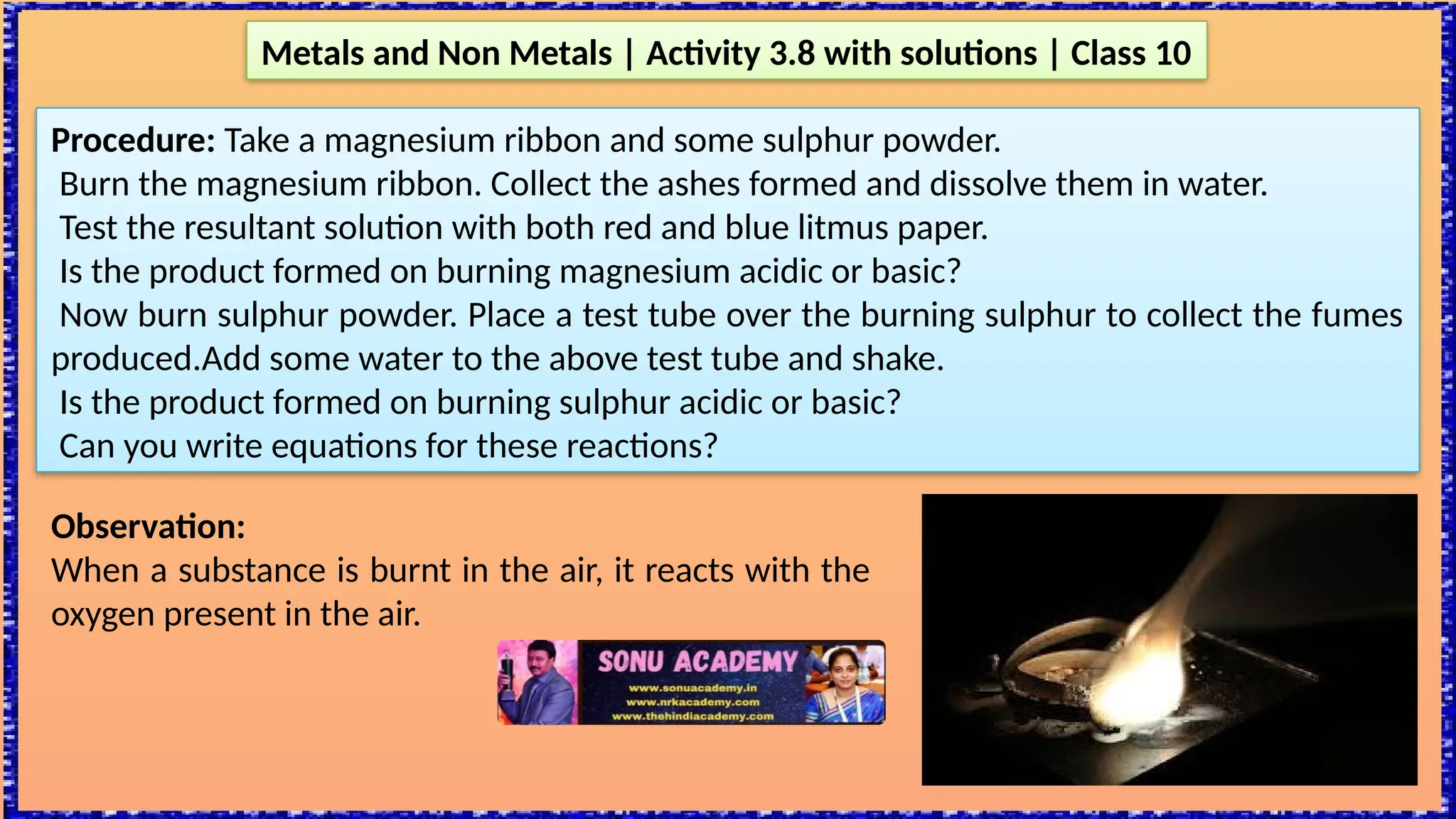
Procedure: Take a magnesium ribbon and some sulphur powder.
Burn the magnesium ribbon. Collect the ashes formed and dissolve them in water.
Test the resultant solution with both red and blue litmus paper.
Is the product formed on burning magnesium acidic or basic?
Now burn sulphur powder. Place a test tube over the burning sulphur to collect the fumes
produced.Add some water to the above test tube and shake.
Is the product formed on burning sulphur acidic or basic?
Can you write equations for these reactions?
Observation:
When a substance is burnt in the air, it reacts with the
oxygen present in the air.
Metals and Non Metals | Activity 3.8 with solutions | Class 10
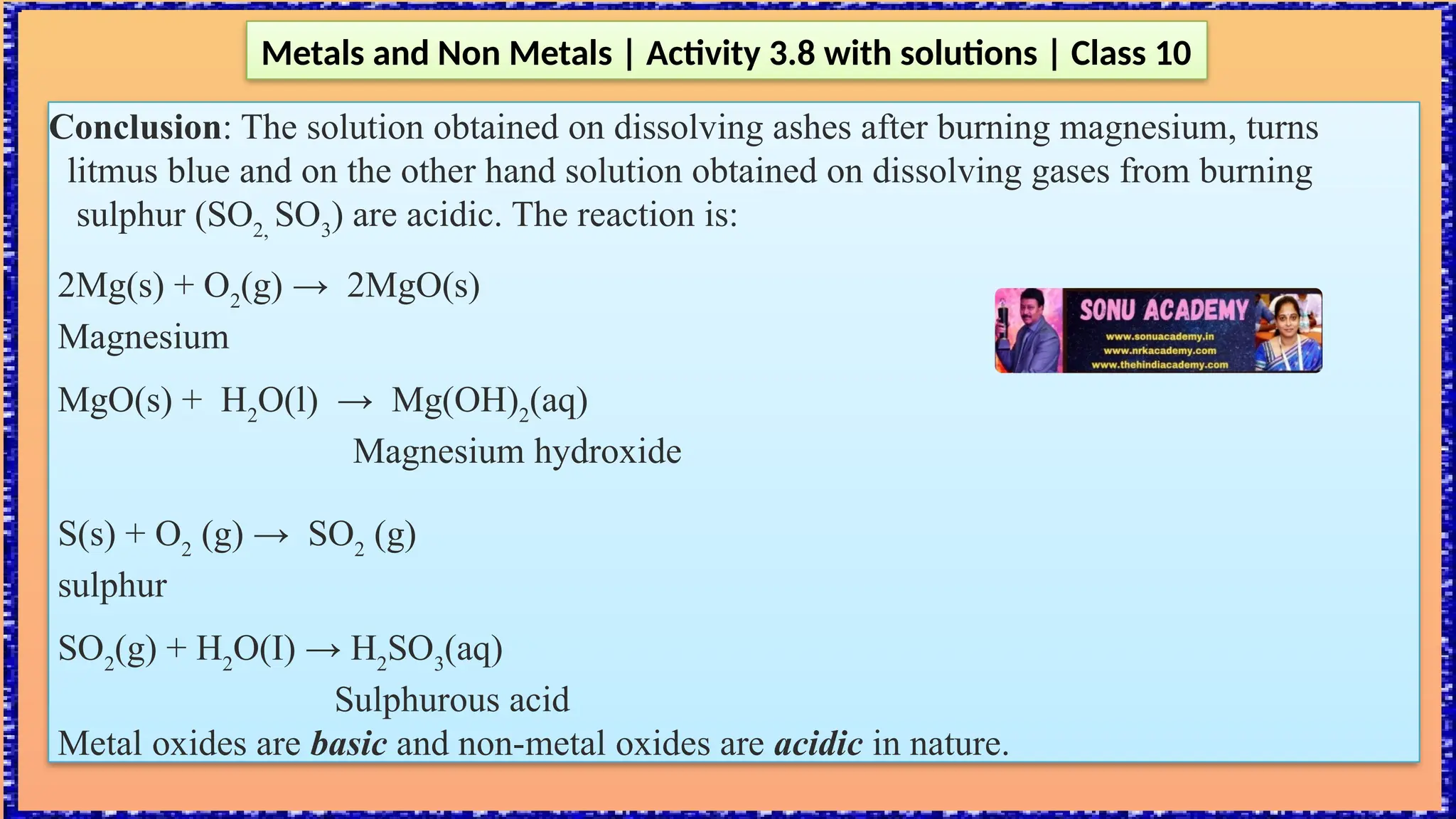
Conclusion: The solution obtained on dissolving ashes after burning magnesium, turns
litmus blue and on the other hand solution obtained on dissolving gases from burning
sulphur (SO2,
SO3
) are acidic. The reaction is:
2Mg(s) + O2
(g) → 2MgO(s)
Magnesium
MgO(s) + H2
O(l) → Mg(OH)2
(aq)
Magnesium hydroxide
S(s) + O2
(g) → SO2
(g)
sulphur
SO2
(g) + H2
O(I) → H2
SO3
(aq)
Sulphurous acid
Metal oxides are basic and non-metal oxides are acidic in nature.
Metals and Non Metals | Activity 3.9 with solutions | Class 10
Note: This activities need the teacher’s assistance. It would be better if students wear eye
protection.
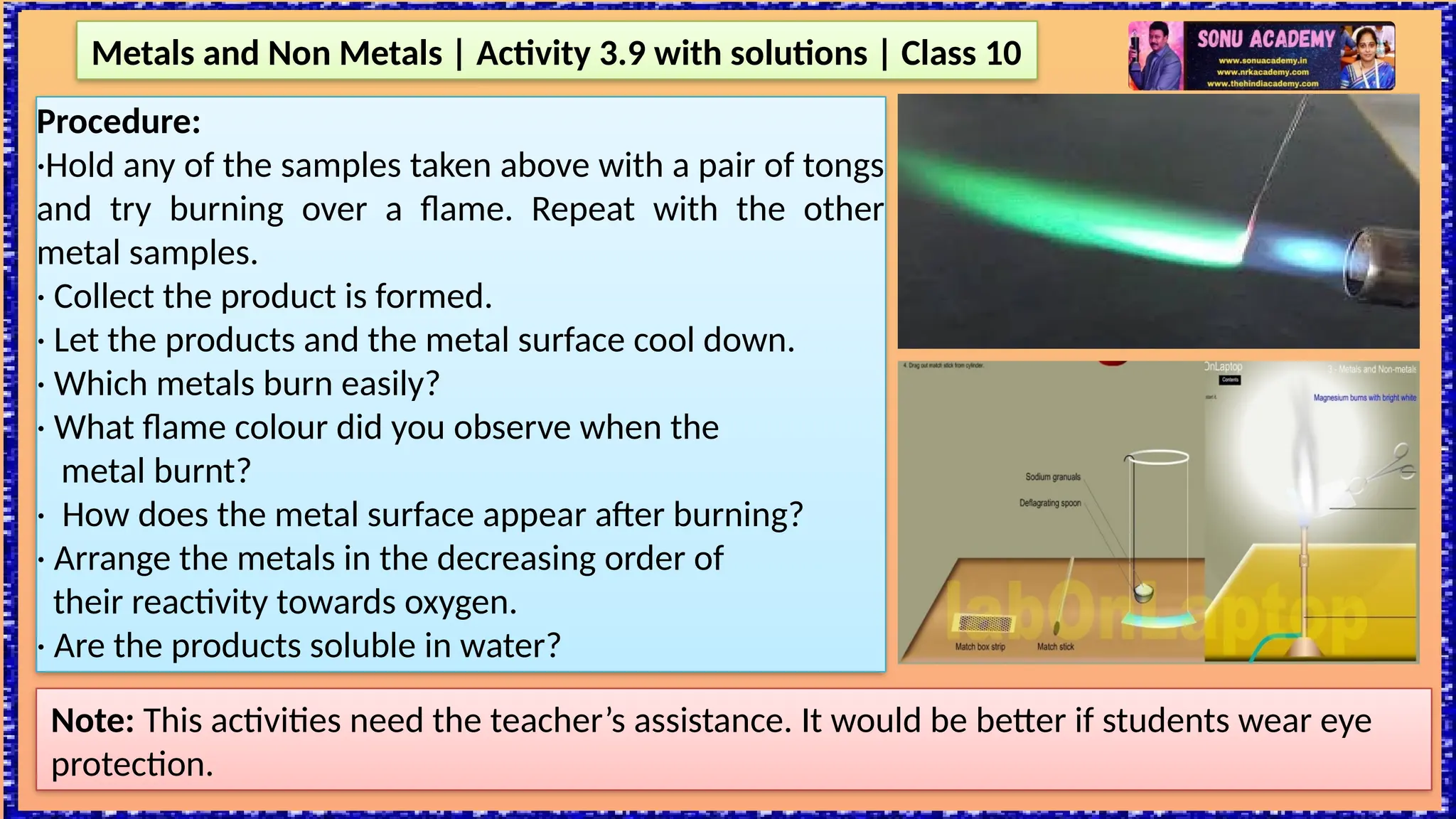
Procedure:
·Hold any of the samples taken above with a pair of tongs
and try burning over a flame. Repeat with the other
metal samples.
· Collect the product is formed.
· Let the products and the metal surface cool down.
· Which metals burn easily?
· What flame colour did you observe when the
metal burnt?
· How does the metal surface appear after burning?
· Arrange the metals in the decreasing order of
their reactivity towards oxygen.
· Are the products soluble in water?
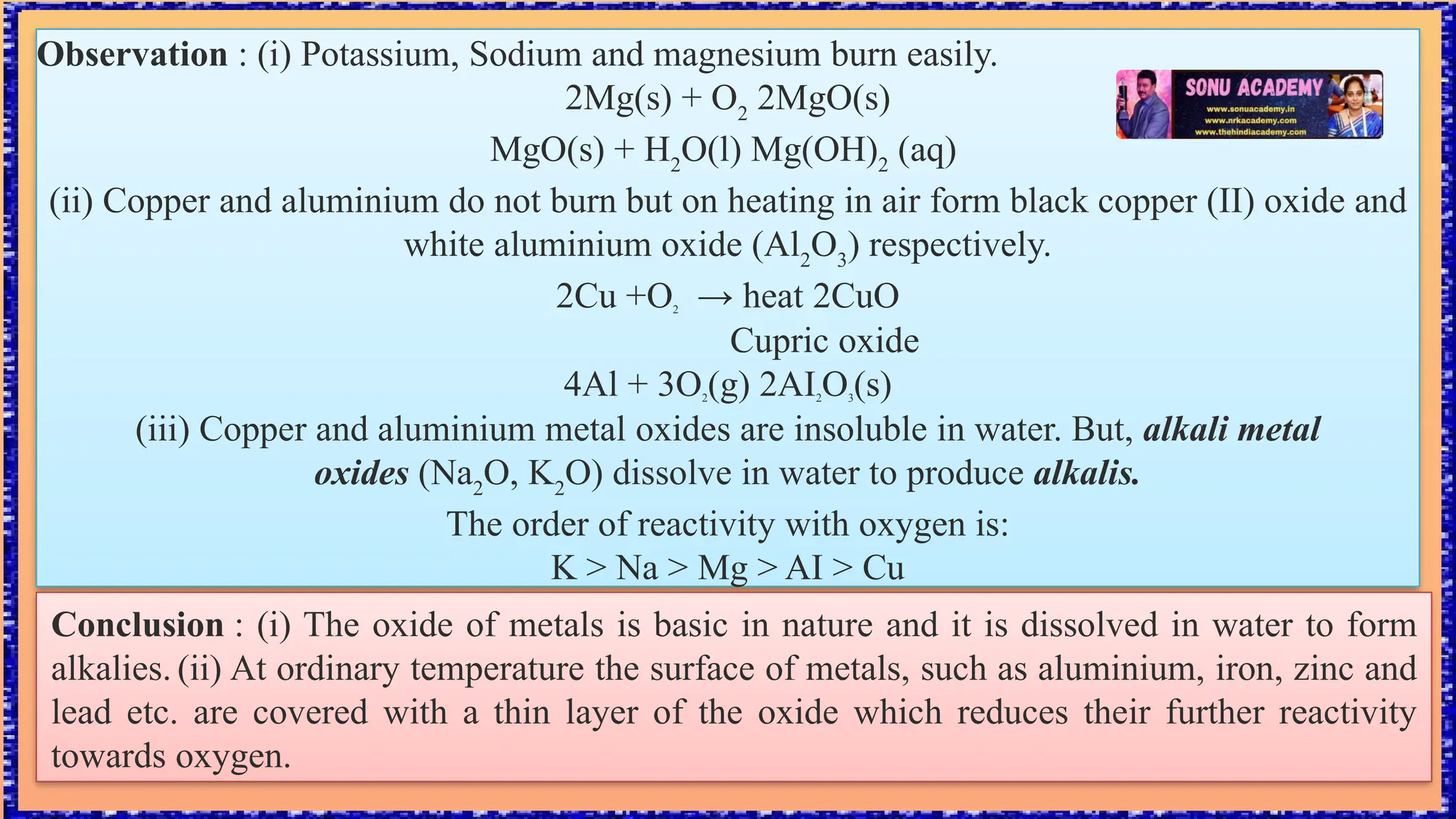
Observation : (i) Potassium, Sodium and magnesium burn easily.
2Mg(s) + O2
2MgO(s)
MgO(s) + H2
O(l) Mg(OH)2
(aq)
(ii) Copper and aluminium do not burn but on heating in air form black copper (II) oxide and
white aluminium oxide (Al2
O3
) respectively.
2Cu +O2
→ heat 2CuO
Cupric oxide
4Al + 3O2
(g) 2AI2
O3
(s)
(iii) Copper and aluminium metal oxides are insoluble in water. But, alkali metal
oxides (Na2
O, K2
O) dissolve in water to produce alkalis.
The order of reactivity with oxygen is:
K > Na > Mg > AI > Cu
Conclusion : (i) The oxide of metals is basic in nature and it is dissolved in water to form
alkalies. (ii) At ordinary temperature the surface of metals, such as aluminium, iron, zinc and
lead etc. are covered with a thin layer of the oxide which reduces their further reactivity
towards oxygen.
Metals and Non Metals | Activity 3.10 with solutions | Class 10
Procedure: Collect the samples of the same metals.
· Put small pieces of the samples separately in beakers half-filled with cold water.
·Which metals reacted with cold water? Arrange them in the increasing order of their reactivity with cold
water. Did any metal produce fire on water? Does any metal start floating after some time?
· Put the metals that did not react with cold water in beakers half-filled with hot water.
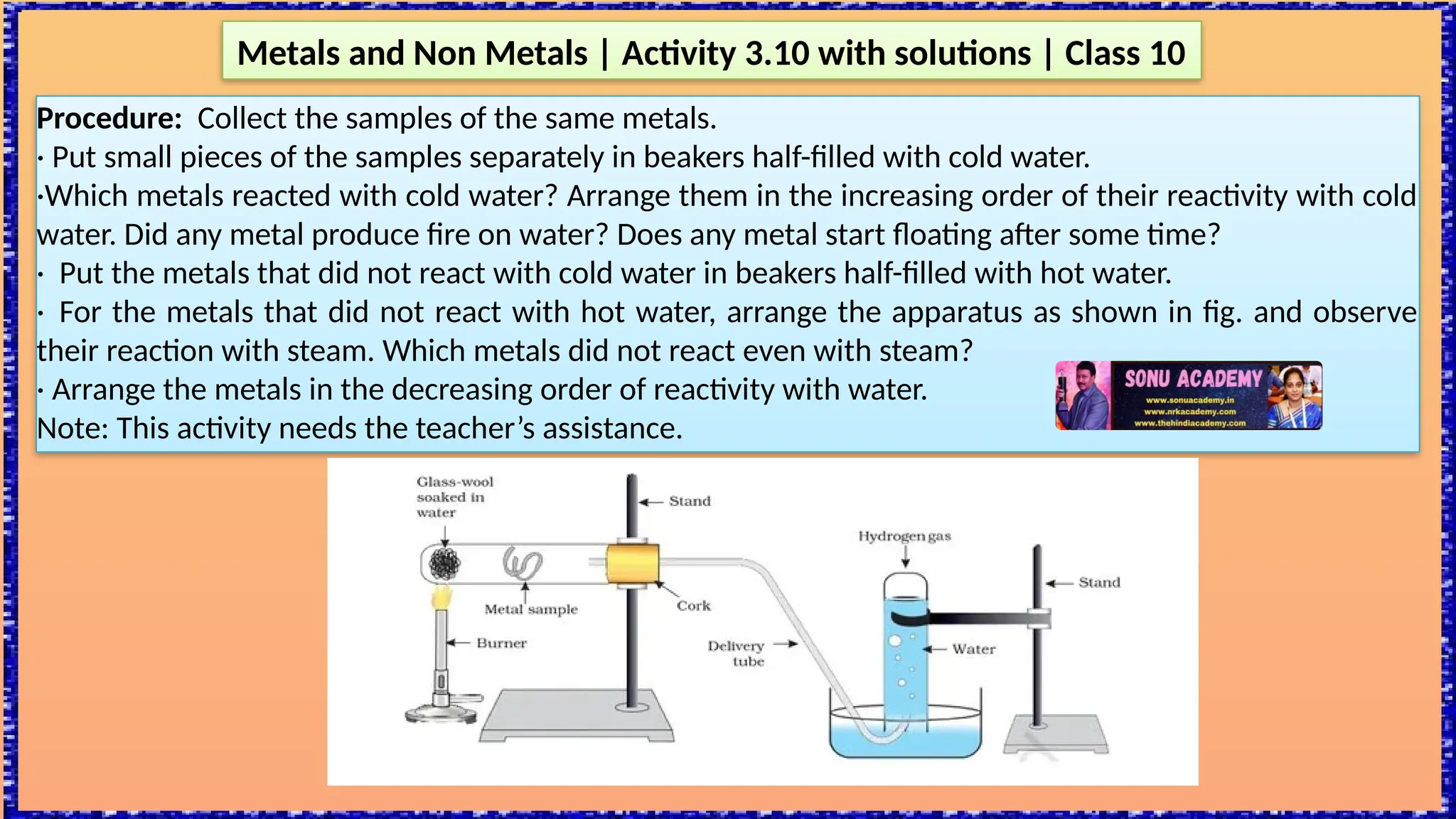
· For the metals that did not react with hot water, arrange the apparatus as shown in fig. and observe
their reaction with steam. Which metals did not react even with steam?
· Arrange the metals in the decreasing order of reactivity with water.
Note: This activity needs the teacher’s assistance.
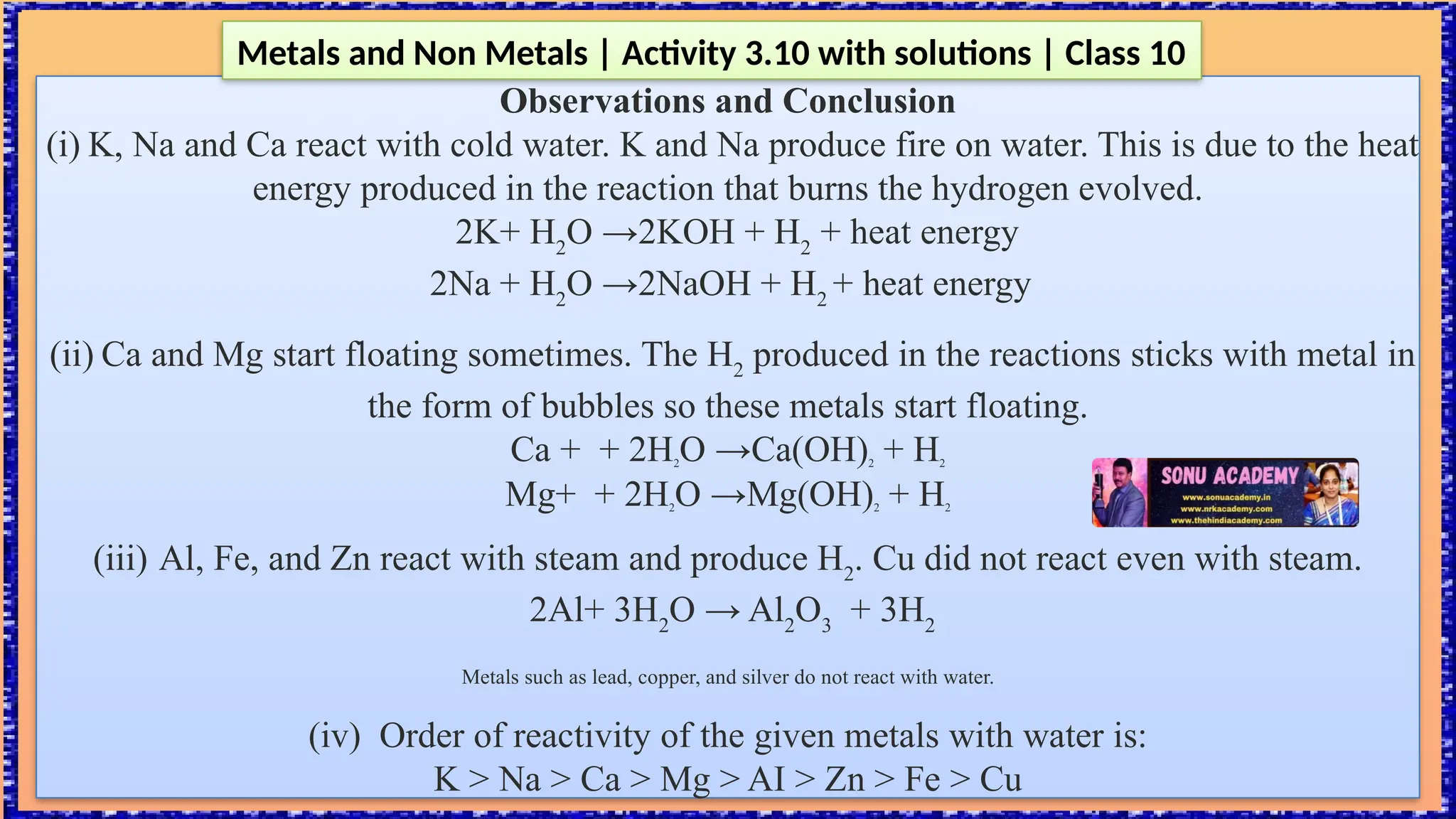
Observations and Conclusion
(i) K, Na and Ca react with cold water. K and Na produce fire on water. This is due to the heat
energy produced in the reaction that burns the hydrogen evolved.
2K+ H2
O →2KOH + H2
+ heat energy
2Na + H2
O →2NaOH + H2
+ heat energy
(ii) Ca and Mg start floating sometimes. The H2
produced in the reactions sticks with metal in
the form of bubbles so these metals start floating.
Ca + + 2H2
O →Ca(OH)2
+ H2
Mg+ + 2H2O →Mg(OH)2 + H2
(iii) Al, Fe, and Zn react with steam and produce H2
. Cu did not react even with steam.
2Al+ 3H2
O → Al2
O3
+ 3H2
Metals such as lead, copper, and silver do not react with water.
(iv) Order of reactivity of the given metals with water is:
K > Na > Ca > Mg > AI > Zn > Fe > Cu
Metals and Non Metals | Activity 3.10 with solutions | Class 10
Metals and Non Metals | Activity 3.11 with solutions | Class 10
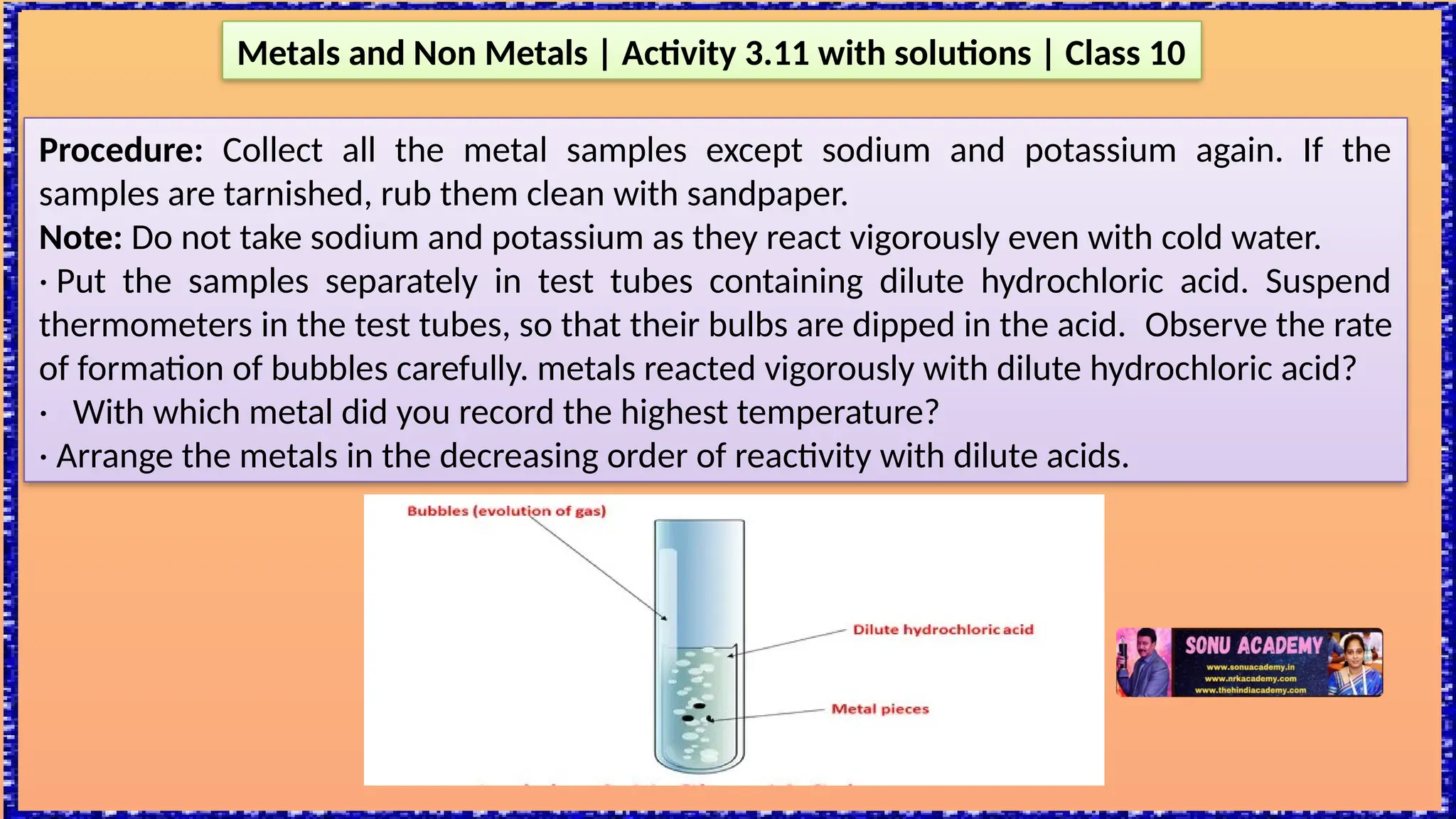
Procedure: Collect all the metal samples except sodium and potassium again. If the
samples are tarnished, rub them clean with sandpaper.
Note: Do not take sodium and potassium as they react vigorously even with cold water.
· Put the samples separately in test tubes containing dilute hydrochloric acid. Suspend
thermometers in the test tubes, so that their bulbs are dipped in the acid. Observe the rate
of formation of bubbles carefully. metals reacted vigorously with dilute hydrochloric acid?
· With which metal did you record the highest temperature?
· Arrange the metals in the decreasing order of reactivity with dilute acids.
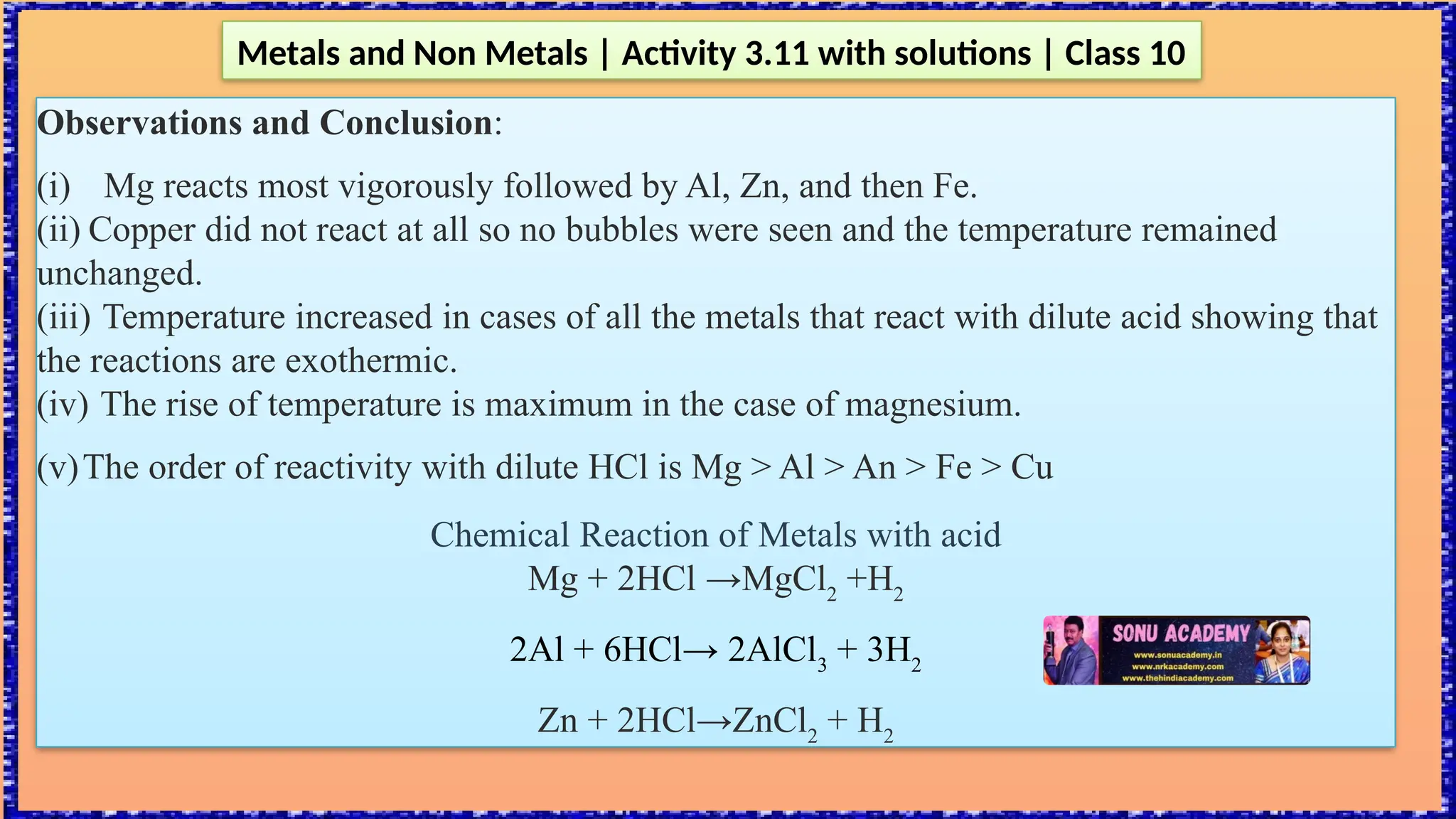
Observations and Conclusion:
(i) Mg reacts most vigorously followed by Al, Zn, and then Fe.
(ii) Copper did not react at all so no bubbles were seen and the temperature remained
unchanged.
(iii) Temperature increased in cases of all the metals that react with dilute acid showing that
the reactions are exothermic.
(iv) The rise of temperature is maximum in the case of magnesium.
(v)The order of reactivity with dilute HCl is Mg > Al > An > Fe > Cu
Chemical Reaction of Metals with acid
Mg + 2HCl →MgCl2
+H2
2Al + 6HCl→ 2AlCl3
+ 3H2
Zn + 2HCl→ZnCl2
+ H2
Metals and Non Metals | Activity 3.11 with solutions | Class 10
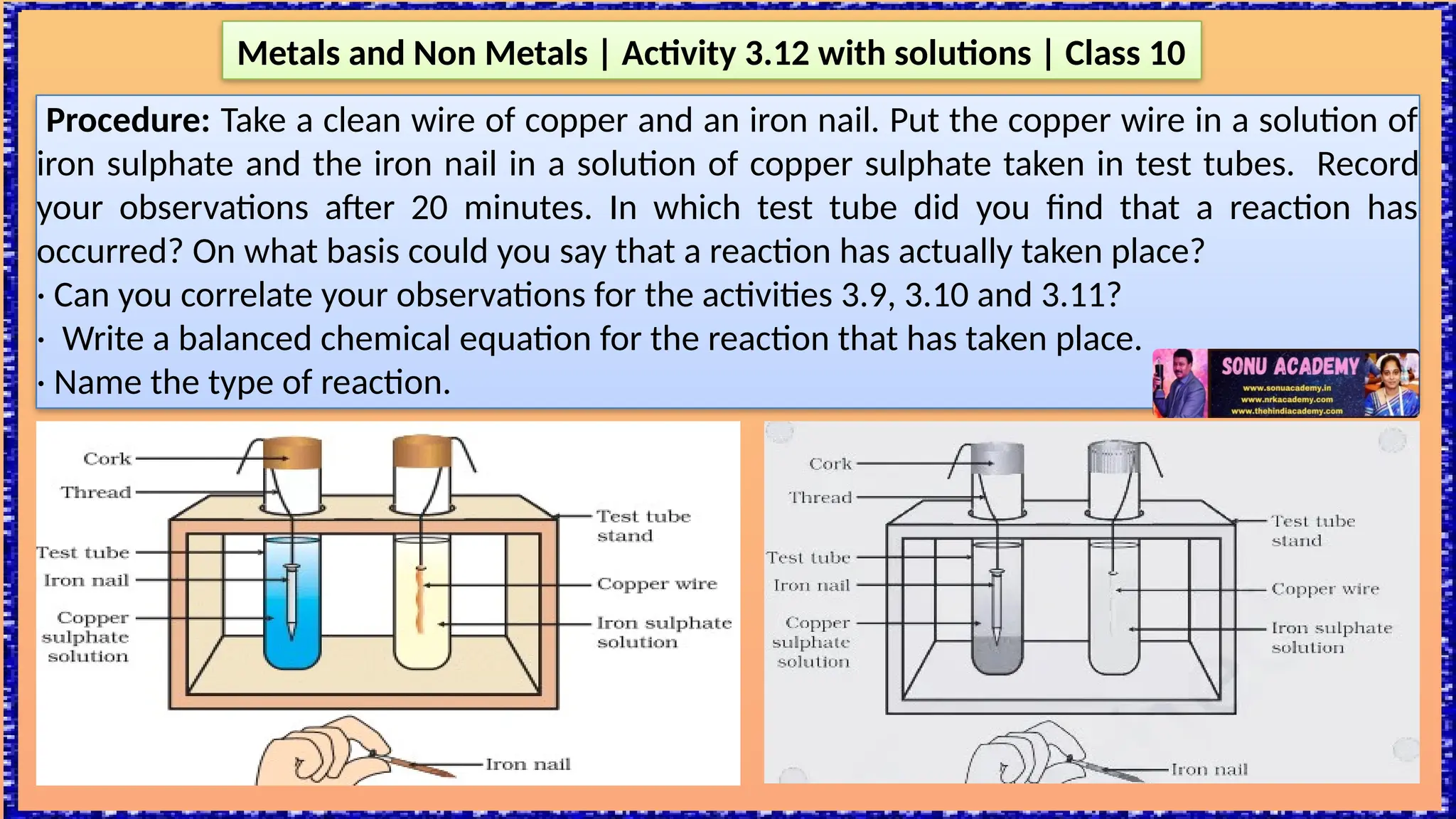
Procedure: Take a clean wire of copper and an iron nail. Put the copper wire in a solution of
iron sulphate and the iron nail in a solution of copper sulphate taken in test tubes. Record
your observations after 20 minutes. In which test tube did you find that a reaction has
occurred? On what basis could you say that a reaction has actually taken place?
· Can you correlate your observations for the activities 3.9, 3.10 and 3.11?
· Write a balanced chemical equation for the reaction that has taken place.
· Name the type of reaction.
Metals and Non Metals | Activity 3.12 with solutions | Class 10
Observations and Conclusion:
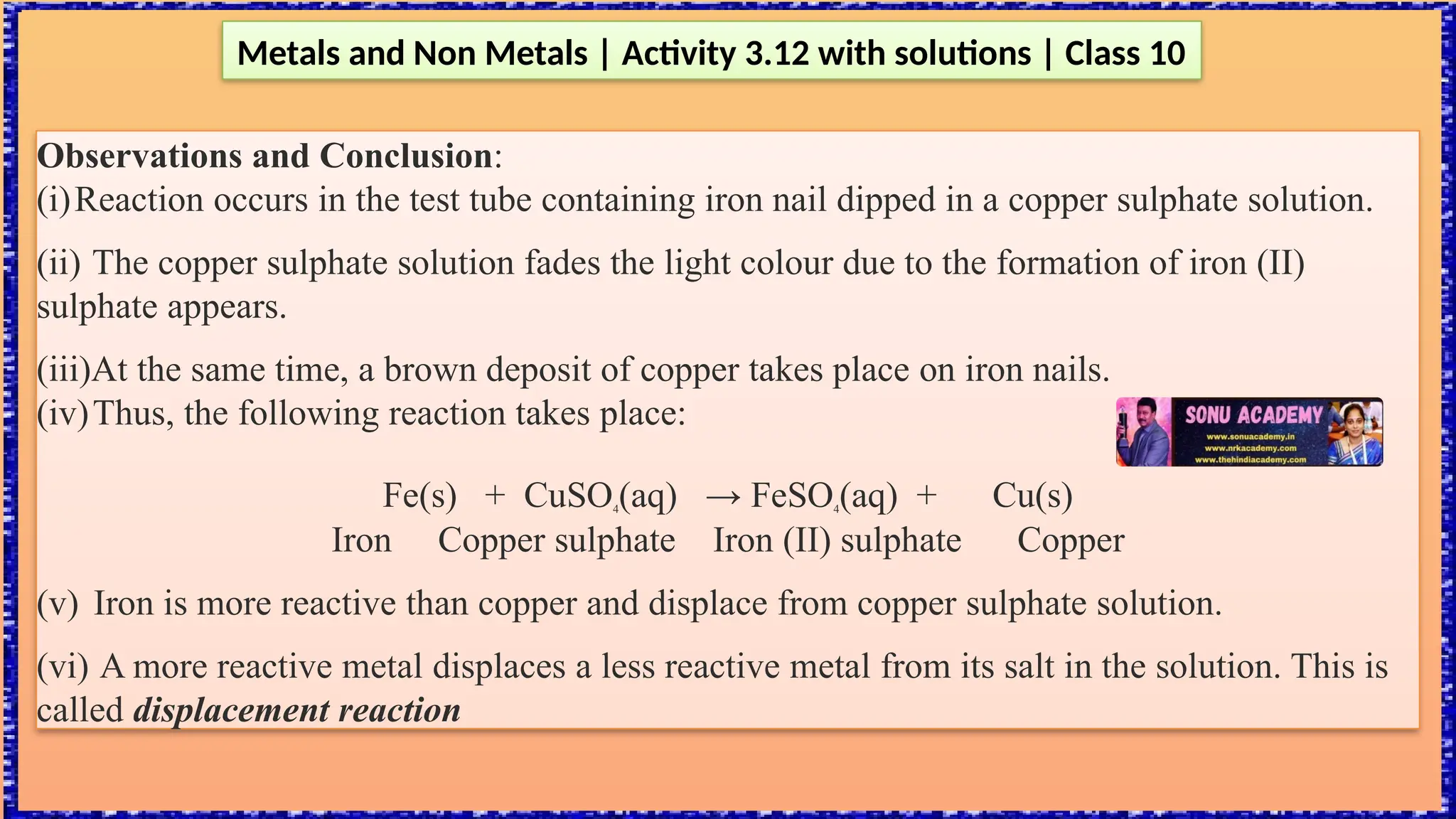
(i)Reaction occurs in the test tube containing iron nail dipped in a copper sulphate solution.
(ii) The copper sulphate solution fades the light colour due to the formation of iron (II)
sulphate appears.
(iii)At the same time, a brown deposit of copper takes place on iron nails.
(iv)Thus, the following reaction takes place:
Fe(s) + CuSO4
(aq) → FeSO4
(aq) + Cu(s)
Iron Copper sulphate Iron (II) sulphate Copper
(v) Iron is more reactive than copper and displace from copper sulphate solution.
(vi) A more reactive metal displaces a less reactive metal from its salt in the solution. This is
called displacement reaction
Metals and Non Metals | Activity 3.13 with solutions | Class 10
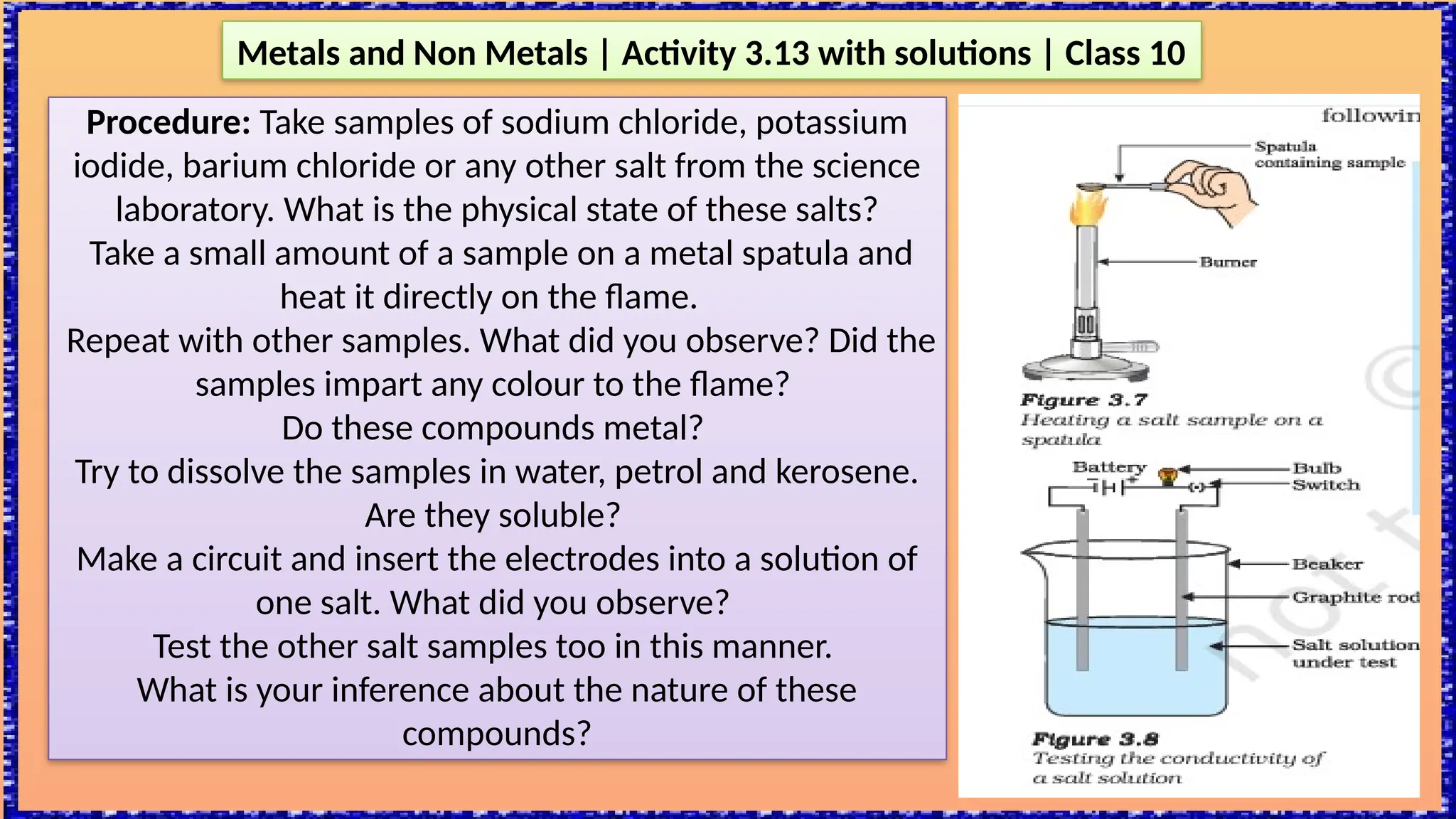
Procedure: Take samples of sodium chloride, potassium
iodide, barium chloride or any other salt from the science
laboratory. What is the physical state of these salts?
Take a small amount of a sample on a metal spatula and
heat it directly on the flame.
Repeat with other samples. What did you observe? Did the
samples impart any colour to the flame?
Do these compounds metal?
Try to dissolve the samples in water, petrol and kerosene.
Are they soluble?
Make a circuit and insert the electrodes into a solution of
one salt. What did you observe?
Test the other salt samples too in this manner.
What is your inference about the nature of these
compounds?
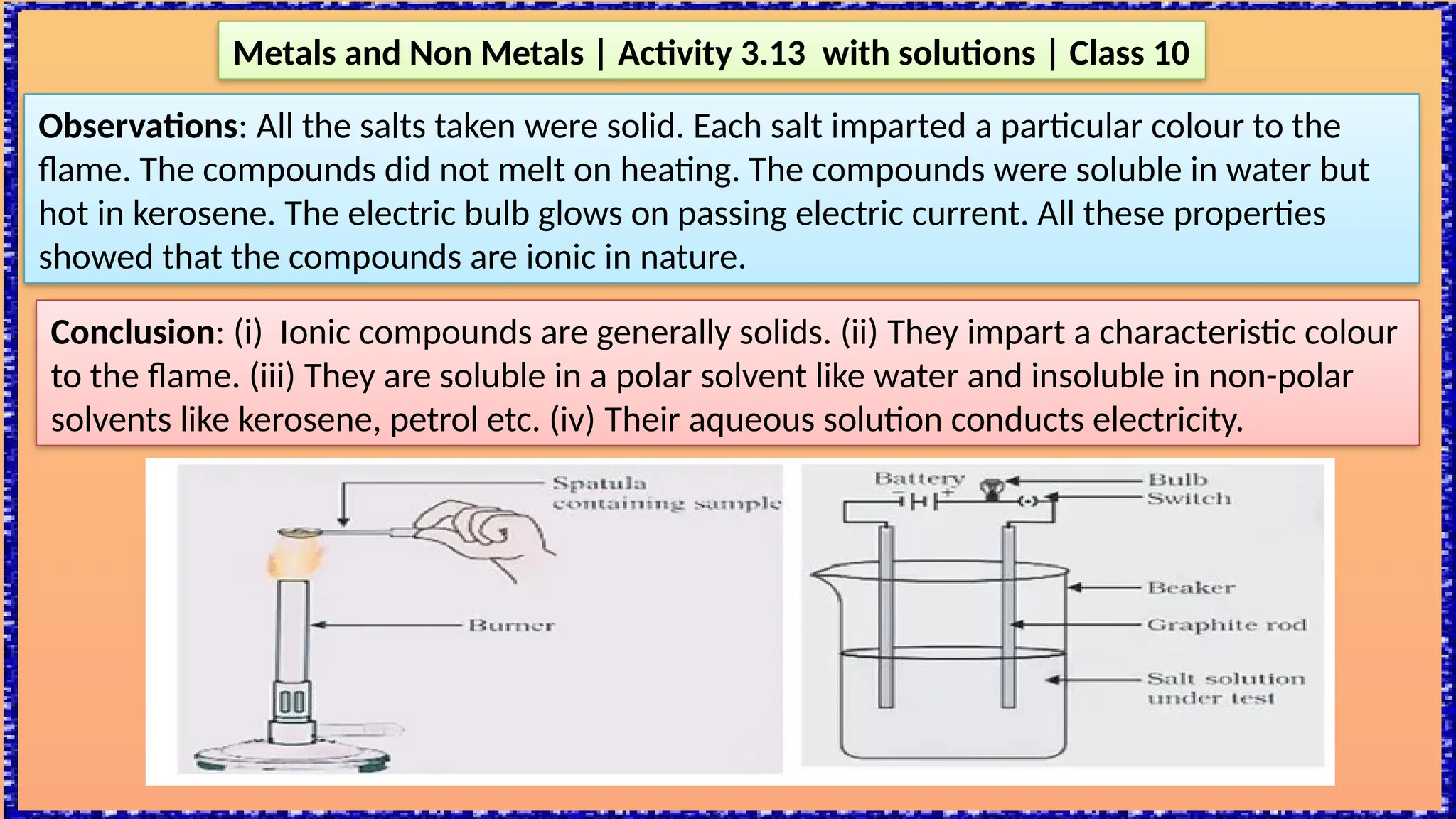
Observations: All the salts taken were solid. Each salt imparted a particular colour to the
flame. The compounds did not melt on heating. The compounds were soluble in water but
hot in kerosene. The electric bulb glows on passing electric current. All these properties
showed that the compounds are ionic in nature.
Conclusion: (i) Ionic compounds are generally solids. (ii) They impart a characteristic colour
to the flame. (iii) They are soluble in a polar solvent like water and insoluble in non-polar
solvents like kerosene, petrol etc. (iv) Their aqueous solution conducts electricity.
Metals and Non Metals | Activity 3.13 with solutions | Class 10
Metals and Non Metals | Activity 3.14 with solutions | Class 10
Aim - To find the conditions that are responsible for rusting
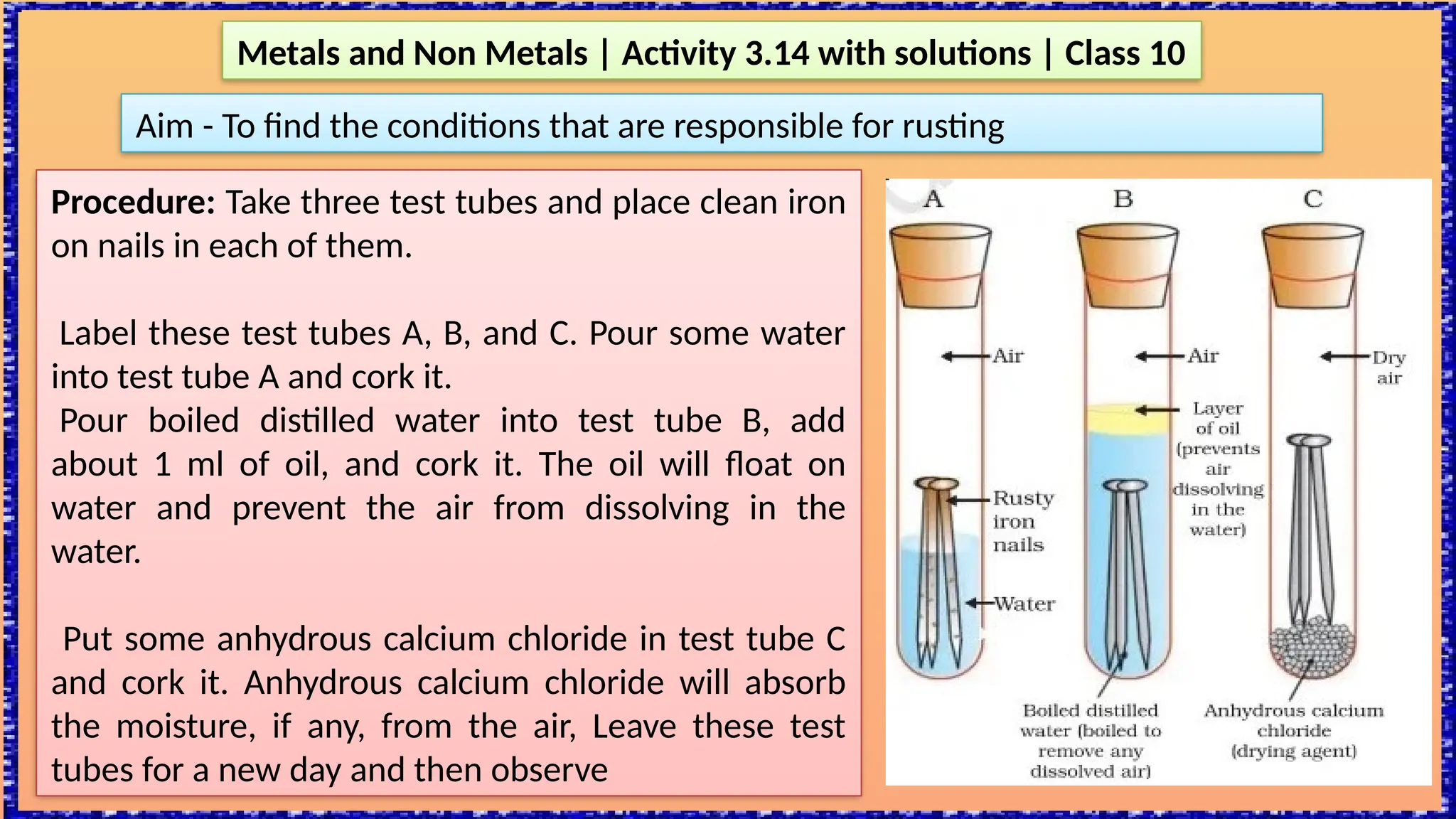
Procedure: Take three test tubes and place clean iron
on nails in each of them.
Label these test tubes A, B, and C. Pour some water
into test tube A and cork it.
Pour boiled distilled water into test tube B, add
about 1 ml of oil, and cork it. The oil will float on
water and prevent the air from dissolving in the
water.
Put some anhydrous calcium chloride in test tube C
and cork it. Anhydrous calcium chloride will absorb
the moisture, if any, from the air, Leave these test
tubes for a new day and then observe
Metals and Non Metals | Activity 3.14 with solutions | Class 10
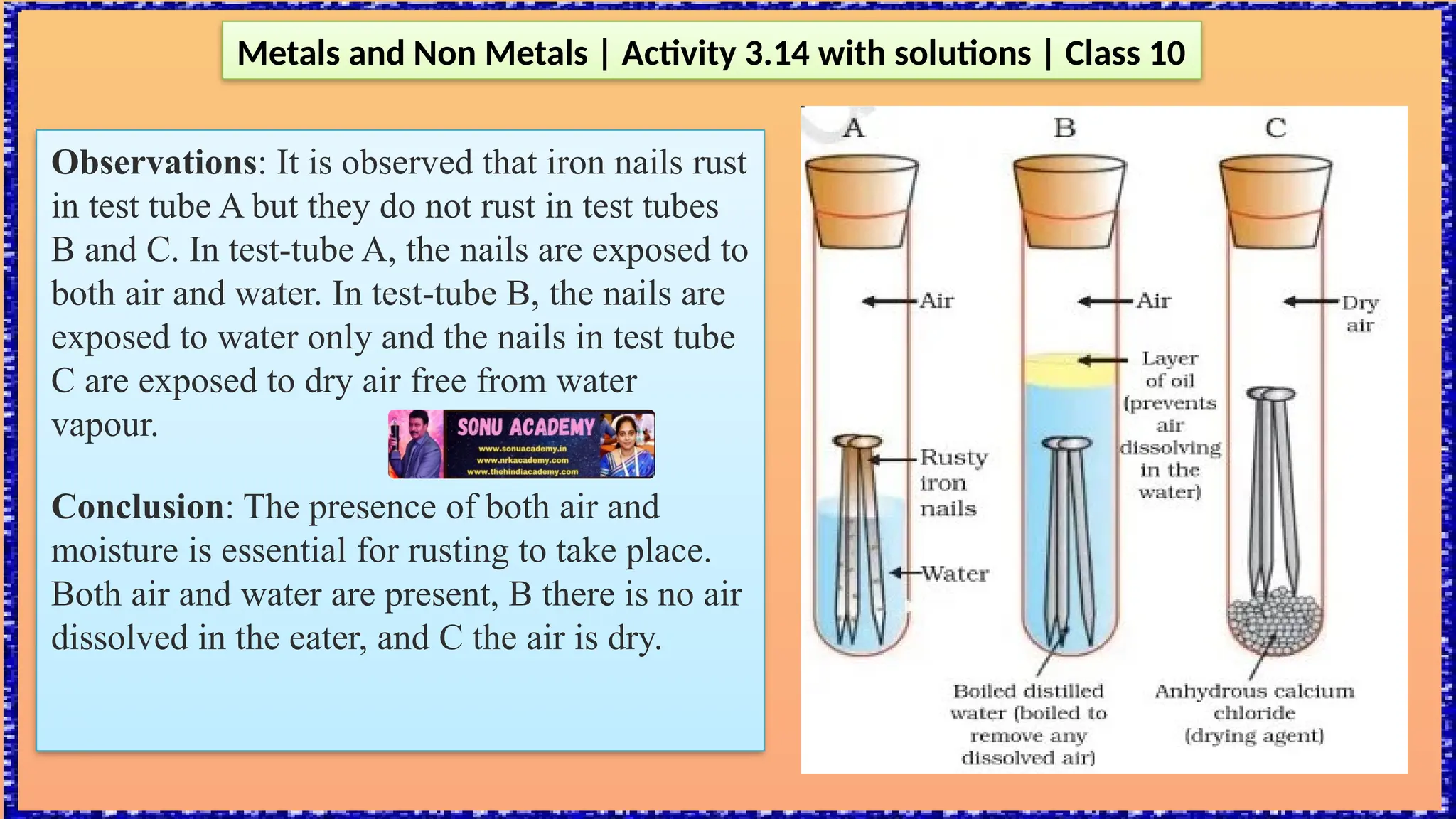
Observations: It is observed that iron nails rust
in test tube A but they do not rust in test tubes
B and C. In test-tube A, the nails are exposed to
both air and water. In test-tube B, the nails are
exposed to water only and the nails in test tube
C are exposed to dry air free from water
vapour.
Conclusion: The presence of both air and
moisture is essential for rusting to take place.
Both air and water are present, B there is no air
dissolved in the eater, and C the air is dry.

Metals and Non metals - Activities with solution | class X

  • 1.
    Metals and NonMetals | Activities with solutions | Class 10
  • 2.
    Metals and NonMetals | Activity 3.1 with solutions | Class 10 Procedure: Take samples of iron, copper aluminium, and magnesium. Note the appearance of each sample. Clean the surface of each sample by rubbing them with sandpaper and note their appearance again. Observations: The surface of the metals is dull because they are covered with a layer of oxide, hydroxide, carbonate, etc. due to the reaction of gases present in the air. When the surface is rubbed with sandpaper, the layer removes and a shiny surface appears. Conclusion: Metals in the pure state have a shining surface. This property is called metallic luster. Luster means to shine or brightness. Generally, all metals have a shining surface. We come across a variety of metals in our day to day to life. When light falls on the surface of a metal, the atoms absorb photons and they get excited and start vibrating. The vibrating electrons release energy as light so the metal surface shines. The surface of aluminum becomes dull after the formation of a coating of aluminium oxide.
  • 3.
    Metals and NonMetals | Activity 3.2 with solutions | Class 10 Procedure: Take small pieces of iron, copper, aluminium, and magnesium. Try to cut these metals with a sharp knife and note your observations. Hold a piece of sodium metal with a pair of tongs. Put it on a watch glass and try to cut it with a knife. What do you observe? Observation and conclusion : All four metals (Fe, Cu, Al, and Mg) are found to be cut with difficulty. This shows that metals are hard. The case of cutting is found to be in the order Mg > AI > Cu >Fe. This shows that hardness varies from metal to metal. Sodium can be cut very easily with a knife. Hence, sodium is soft. Hardness: Metals are quite hard and their hardness varies from metal to metal. If we try to cut even a thin rod of iron into two pieces, it will be very difficult. The same will be the case with metals like copper, silver, etc. But on the other hand, there are certain exceptions like sodium and potassium which are soft and they can be cut by a knife. The extent of hardness that a metal possesses, depends upon the strength of the metallic bond.
  • 4.
    Hardness: Metals arequite hard and their hardness varies from metal to metal. If we try to cut even a thin rod of iron into two pieces, it will be very difficult. The same will be the case with metals like copper, silver, etc. But on the other hand, there are certain exceptions like sodium and potassium which are soft and they can be cut by a knife. The extent of hardness that a metal possesses, depends upon the strength of the metallic bond. Metals and Non Metals | Activity 3.2 with solutions | Class 10 Caution: Always handle sodium metal with care. Dry it by pressing between the folds of a filter paper.
  • 5.
    Metals and NonMetals | Activity 3.3 with solutions | Class 10 Procedure: Take pieces of iron, zinc, lead, and copper. Place any one metal on a block of iron and strike it four of five times with a hammer. What do you observe? Repeat with other metals. Record the change in the shape of these metals.
  • 6.
    Observation and Conclusion: It is observed and concluded that metals can be beaten into thin sheets i.e. they are malleable. Malleability Meaning: Metals are malleable in nature. It means that they can be beaten to form very fine thin sheets. Most of the confectionery items are covered with very bright foils of silver. On the same hand, aluminium foils are used for stirring eatables so that they may not get spoiled.One metal has malleability different from the other metal. Metals and Non Metals | Activity 3.3 with solutions | Class 10
  • 7.
    Metals and NonMetals | Activity 3.4 with solutions | Class 10 Procedure: Consider some metals such as iron, copper, aluminium, lead etc. Which of the above metals are also available in the form of wires? Observation and Conclusion: wires of iron, copper and aluminium are easily available, this shows that metals can be drawn into wires i.e. they are ductile. Ductility: The property due to which a metal can be drawn into thin wires is known as ductility. An electrician uses fine wires made up of either copper or aluminium. A metal is drawn into thin wires bypassing it repeatedly through specially made dies.
  • 8.
    Metals and NonMetals | Activity 3.5 with solutions | Class 10 Procedure: Take an aluminium or copper wire. Clamp this wire on a stand, as shown in fig... Fix a pin to the free end of the wire using wax. Heat the wire with a spirit lamp, candle or a burner near the place where it is clamped. What do you observe after some time? Note your observations. Does the metal wire melt? Observations : It is observed that the wire of the clamp, is heated and after some time the pin falls down. This shows that heat flows through the wire and melts the wax and the wire does not melt even after heating for a long time. Conclusion: Heat flows through the wire, therefore, metals are good conductors of heat and have a high melting point also, as the wire does not melt on long heating.
  • 9.
    Metals and NonMetals | Activity 3.6 with solutions | Class 10 Procedure: Set up an electric circuit as shown in the figure. Place the metal to be tested in the circuit between terminals A and B as shown. Does the bulb glow? What does this indicate? Observation: The bulb glows. Conclusion: Metals are good conductors of electricity. Electrical conductivity: Almost all metals are good conductors of electricity. However, they differ in their conducting power. The electrical conductivity of metals is due to electrons which are the charge carrier. The conducting power of a metal decreases with the rise in temperature.
  • 10.
    Metals and NonMetals | Activity 3.7 with solutions | Class 10 Procedure: Collect samples of carbon (coal or graphite), sulphur and iodine. Carry out the activities 3.1 to 3.6 with these non-metals and record your observation. Element Symbol Type of surface Hardness Malleability Ductility Conductions Sonority Heat Electricity Element Symbol Type of surface Hardness Malleability Ductility Conductions Sonority Heat Electricity Carbon Sulphur iodine C S I Non- lustorou s Soft & brittle No No No No No No No No No No No No No No No Observation and Conclusion: 1. Iodine has a luster.2. Graphite is a conductor of electricity
  • 11.
    Metals and NonMetals | Activity 3.8 with solutions | Class 10 Procedure: Take a magnesium ribbon and some sulphur powder. Burn the magnesium ribbon. Collect the ashes formed and dissolve them in water. Test the resultant solution with both red and blue litmus paper. Is the product formed on burning magnesium acidic or basic? Now burn sulphur powder. Place a test tube over the burning sulphur to collect the fumes produced.Add some water to the above test tube and shake. Is the product formed on burning sulphur acidic or basic? Can you write equations for these reactions? Observation: When a substance is burnt in the air, it reacts with the oxygen present in the air.
  • 12.
    Metals and NonMetals | Activity 3.8 with solutions | Class 10 Conclusion: The solution obtained on dissolving ashes after burning magnesium, turns litmus blue and on the other hand solution obtained on dissolving gases from burning sulphur (SO2, SO3 ) are acidic. The reaction is: 2Mg(s) + O2 (g) → 2MgO(s) Magnesium MgO(s) + H2 O(l) → Mg(OH)2 (aq) Magnesium hydroxide S(s) + O2 (g) → SO2 (g) sulphur SO2 (g) + H2 O(I) → H2 SO3 (aq) Sulphurous acid Metal oxides are basic and non-metal oxides are acidic in nature.
  • 13.
    Metals and NonMetals | Activity 3.9 with solutions | Class 10 Note: This activities need the teacher’s assistance. It would be better if students wear eye protection. Procedure: ·Hold any of the samples taken above with a pair of tongs and try burning over a flame. Repeat with the other metal samples. · Collect the product is formed. · Let the products and the metal surface cool down. · Which metals burn easily? · What flame colour did you observe when the metal burnt? · How does the metal surface appear after burning? · Arrange the metals in the decreasing order of their reactivity towards oxygen. · Are the products soluble in water?
  • 14.
    Observation : (i)Potassium, Sodium and magnesium burn easily. 2Mg(s) + O2 2MgO(s) MgO(s) + H2 O(l) Mg(OH)2 (aq) (ii) Copper and aluminium do not burn but on heating in air form black copper (II) oxide and white aluminium oxide (Al2 O3 ) respectively. 2Cu +O2 → heat 2CuO Cupric oxide 4Al + 3O2 (g) 2AI2 O3 (s) (iii) Copper and aluminium metal oxides are insoluble in water. But, alkali metal oxides (Na2 O, K2 O) dissolve in water to produce alkalis. The order of reactivity with oxygen is: K > Na > Mg > AI > Cu Conclusion : (i) The oxide of metals is basic in nature and it is dissolved in water to form alkalies. (ii) At ordinary temperature the surface of metals, such as aluminium, iron, zinc and lead etc. are covered with a thin layer of the oxide which reduces their further reactivity towards oxygen.
  • 15.
    Metals and NonMetals | Activity 3.10 with solutions | Class 10 Procedure: Collect the samples of the same metals. · Put small pieces of the samples separately in beakers half-filled with cold water. ·Which metals reacted with cold water? Arrange them in the increasing order of their reactivity with cold water. Did any metal produce fire on water? Does any metal start floating after some time? · Put the metals that did not react with cold water in beakers half-filled with hot water. · For the metals that did not react with hot water, arrange the apparatus as shown in fig. and observe their reaction with steam. Which metals did not react even with steam? · Arrange the metals in the decreasing order of reactivity with water. Note: This activity needs the teacher’s assistance.
  • 16.
    Observations and Conclusion (i)K, Na and Ca react with cold water. K and Na produce fire on water. This is due to the heat energy produced in the reaction that burns the hydrogen evolved. 2K+ H2 O →2KOH + H2 + heat energy 2Na + H2 O →2NaOH + H2 + heat energy (ii) Ca and Mg start floating sometimes. The H2 produced in the reactions sticks with metal in the form of bubbles so these metals start floating. Ca + + 2H2 O →Ca(OH)2 + H2 Mg+ + 2H2O →Mg(OH)2 + H2 (iii) Al, Fe, and Zn react with steam and produce H2 . Cu did not react even with steam. 2Al+ 3H2 O → Al2 O3 + 3H2 Metals such as lead, copper, and silver do not react with water. (iv) Order of reactivity of the given metals with water is: K > Na > Ca > Mg > AI > Zn > Fe > Cu Metals and Non Metals | Activity 3.10 with solutions | Class 10
  • 17.
    Metals and NonMetals | Activity 3.11 with solutions | Class 10 Procedure: Collect all the metal samples except sodium and potassium again. If the samples are tarnished, rub them clean with sandpaper. Note: Do not take sodium and potassium as they react vigorously even with cold water. · Put the samples separately in test tubes containing dilute hydrochloric acid. Suspend thermometers in the test tubes, so that their bulbs are dipped in the acid. Observe the rate of formation of bubbles carefully. metals reacted vigorously with dilute hydrochloric acid? · With which metal did you record the highest temperature? · Arrange the metals in the decreasing order of reactivity with dilute acids.
  • 18.
    Observations and Conclusion: (i)Mg reacts most vigorously followed by Al, Zn, and then Fe. (ii) Copper did not react at all so no bubbles were seen and the temperature remained unchanged. (iii) Temperature increased in cases of all the metals that react with dilute acid showing that the reactions are exothermic. (iv) The rise of temperature is maximum in the case of magnesium. (v)The order of reactivity with dilute HCl is Mg > Al > An > Fe > Cu Chemical Reaction of Metals with acid Mg + 2HCl →MgCl2 +H2 2Al + 6HCl→ 2AlCl3 + 3H2 Zn + 2HCl→ZnCl2 + H2 Metals and Non Metals | Activity 3.11 with solutions | Class 10
  • 19.
    Procedure: Take aclean wire of copper and an iron nail. Put the copper wire in a solution of iron sulphate and the iron nail in a solution of copper sulphate taken in test tubes. Record your observations after 20 minutes. In which test tube did you find that a reaction has occurred? On what basis could you say that a reaction has actually taken place? · Can you correlate your observations for the activities 3.9, 3.10 and 3.11? · Write a balanced chemical equation for the reaction that has taken place. · Name the type of reaction. Metals and Non Metals | Activity 3.12 with solutions | Class 10
  • 20.
    Metals and NonMetals | Activity 3.12 with solutions | Class 10 Observations and Conclusion: (i)Reaction occurs in the test tube containing iron nail dipped in a copper sulphate solution. (ii) The copper sulphate solution fades the light colour due to the formation of iron (II) sulphate appears. (iii)At the same time, a brown deposit of copper takes place on iron nails. (iv)Thus, the following reaction takes place: Fe(s) + CuSO4 (aq) → FeSO4 (aq) + Cu(s) Iron Copper sulphate Iron (II) sulphate Copper (v) Iron is more reactive than copper and displace from copper sulphate solution. (vi) A more reactive metal displaces a less reactive metal from its salt in the solution. This is called displacement reaction
  • 21.
    Metals and NonMetals | Activity 3.13 with solutions | Class 10 Procedure: Take samples of sodium chloride, potassium iodide, barium chloride or any other salt from the science laboratory. What is the physical state of these salts? Take a small amount of a sample on a metal spatula and heat it directly on the flame. Repeat with other samples. What did you observe? Did the samples impart any colour to the flame? Do these compounds metal? Try to dissolve the samples in water, petrol and kerosene. Are they soluble? Make a circuit and insert the electrodes into a solution of one salt. What did you observe? Test the other salt samples too in this manner. What is your inference about the nature of these compounds?
  • 22.
    Observations: All thesalts taken were solid. Each salt imparted a particular colour to the flame. The compounds did not melt on heating. The compounds were soluble in water but hot in kerosene. The electric bulb glows on passing electric current. All these properties showed that the compounds are ionic in nature. Conclusion: (i) Ionic compounds are generally solids. (ii) They impart a characteristic colour to the flame. (iii) They are soluble in a polar solvent like water and insoluble in non-polar solvents like kerosene, petrol etc. (iv) Their aqueous solution conducts electricity. Metals and Non Metals | Activity 3.13 with solutions | Class 10
  • 23.
    Metals and NonMetals | Activity 3.14 with solutions | Class 10 Aim - To find the conditions that are responsible for rusting Procedure: Take three test tubes and place clean iron on nails in each of them. Label these test tubes A, B, and C. Pour some water into test tube A and cork it. Pour boiled distilled water into test tube B, add about 1 ml of oil, and cork it. The oil will float on water and prevent the air from dissolving in the water. Put some anhydrous calcium chloride in test tube C and cork it. Anhydrous calcium chloride will absorb the moisture, if any, from the air, Leave these test tubes for a new day and then observe
  • 24.
    Metals and NonMetals | Activity 3.14 with solutions | Class 10 Observations: It is observed that iron nails rust in test tube A but they do not rust in test tubes B and C. In test-tube A, the nails are exposed to both air and water. In test-tube B, the nails are exposed to water only and the nails in test tube C are exposed to dry air free from water vapour. Conclusion: The presence of both air and moisture is essential for rusting to take place. Both air and water are present, B there is no air dissolved in the eater, and C the air is dry.