Shake your Acids, Bases and
           Salts!
Introduction
We daily use in our life a large number of
  substances such as lemon, tamarind,
common salt, sugar, vinegar etc. Do they
 have same taste? You find that some of
   these taste sour, some bitter, some
          sweet and some salty.
Learning Objectives

•To classify the common household
substances if they are acids, bases or
salts.

•To determine the pH of the substances.

•To describe the result of the
investigation and characteristics of each
substance.
A Brief Overview of Acids and Bases


http://www.youtube.com/watch?v=tNvP3-174_M

          Watch the short clip
Preliminary Task

   Search for any substance that you
     can see outside and inside the
   school premises and bring it in the
      classroom. Be back after 15
                minutes.
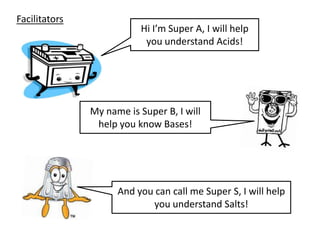
Facilitators
                          Hi I’m Super A, I will help
                           you understand Acids!


               My name is Super B, I will
                help you know Bases!


                     And you can call me Super S, I will help
                            you understand Salts!
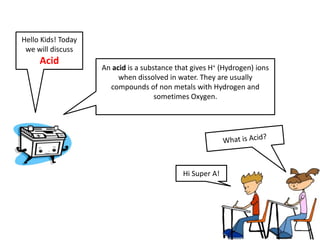
Hello Kids! Today
 we will discuss
     Acid
                    An acid is a substance that gives H+ (Hydrogen) ions
                         when dissolved in water. They are usually
                      compounds of non metals with Hydrogen and
                                     sometimes Oxygen.


                                             Hi Super A!
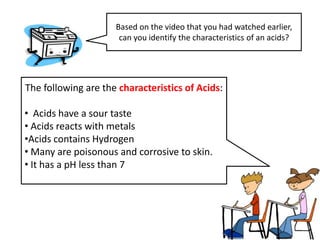
Based on the video that you had watched earlier,
                      can you identify the characteristics of an acids?


The following are the characteristics of Acids:

• Acids have a sour taste
• Acids reacts with metals
•Acids contains Hydrogen
• Many are poisonous and corrosive to skin.
• It has a pH less than 7
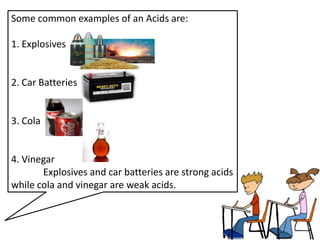
Some common examples of an Acids are:

1. Explosives


2. Car Batteries


3. Cola


4. Vinegar
       Explosives and car batteries are strong acids
while cola and vinegar are weak acids.
Now, lets go on with Base. A Base is a
substance that gives OH- (hydroxide)
  ions when dissolved in water. The
 solution of a base in water is called
               an alkali.
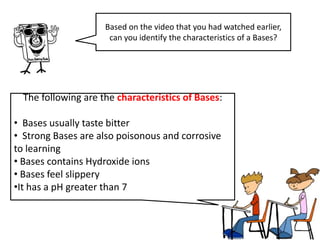
Based on the video that you had watched earlier,
                      can you identify the characteristics of a Bases?


  The following are the characteristics of Bases:

• Bases usually taste bitter
• Strong Bases are also poisonous and corrosive
to learning
• Bases contains Hydroxide ions
• Bases feel slippery
•It has a pH greater than 7
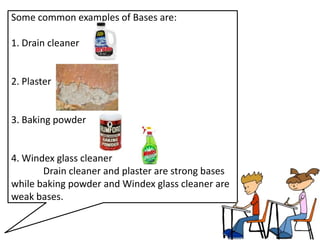
Some common examples of Bases are:

1. Drain cleaner


2. Plaster


3. Baking powder


4. Windex glass cleaner
       Drain cleaner and plaster are strong bases
while baking powder and Windex glass cleaner are
weak bases.
Reactions between acids and bases


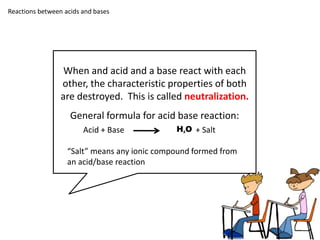
                  When and acid and a base react with each
                 other, the characteristic properties of both
                 are destroyed. This is called neutralization.
                    General formula for acid base reaction:
                        Acid + Base           H2O + Salt

                   “Salt” means any ionic compound formed from
                   an acid/base reaction
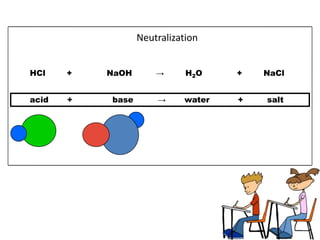
Neutralization


HCl    +   NaOH       →      H 2O   +   NaCl


acid   +   base       →     water   +   salt
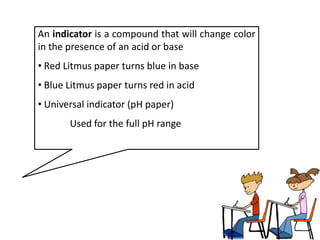
An indicator is a compound that will change color
in the presence of an acid or base
• Red Litmus paper turns blue in base
• Blue Litmus paper turns red in acid
• Universal indicator (pH paper)
       Used for the full pH range
pH stands for “potential hydrogen” and is a
measure of how many H+ ions there are in
solution.
        The MORE H+ there are, the LOWER the
pH will be.
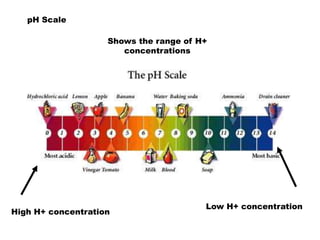
pH Scale

                    Shows the range of H+
                       concentrations


                                        Low H+ concentration
High H+ concentration
A Salt results when an acid reacts with a base.
The H+ and OH- ions combine to form water. This
process is called as neutralization.

       The non metallic ions of the acid and the
metal ions of the base form the salt.

          Acid + Base —-> Salt + Water
The following are the characteristics of Salts:

• Salts can be of several different colors
• Usually salts are odorless
•Salts have pH = 7. They are neutral
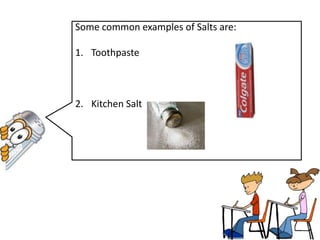
Some common examples of Salts are:

1. Toothpaste


2. Kitchen Salt
Activity
Summary
       Acid is a substance that gives H+ (Hydrogen) ions when dissolved in
water. Acids have a sour taste, reacts with metals and contains Hydrogen.
Many are poisonous and corrosive to skin. It has a pH less than 7 and turns
blue litmus paper to red. Some of the common examples of an acid are car
batteries, explosives, cola, vinegar, etc.

      While Base is a substance that gives OH- (hydroxide) ions when
dissolved in water. The solution of a base in water is called an alkali. It
usually taste bitter, contains Hydroxide ions, feel slippery and strong bases
are also poisonous and corrosive to learning. It has a pH greater than 7 and
turn red litmus paper to blue. Some common examples are glass/drain
cleaner, baking powder, plaster, etc.

     Salt results when an acid reacts with a base. The H+ and OH- ions
combine to form water. This process is called as neutralization. Salts can be
of several different color , usually odorless and have pH = 7. Some common
examples are toothpaste, kitchen salt, etc.
Assignment


        Look for other 15 household
            substances, check its
      ingredients and identify why it is
        an acid, base or salt. Give its
             formula if possible.
Reference
http://schooltutoring.com/help/three-important-types-of-chemicals-acid-bases-
salts/


http://www.shodor.org/unchem/basic/ab/


http://www.knockhardy.org.uk/sci_htm_files/08SALTS.PDF


http://www.slideboom.com/presentations/546519/ACIDS,-BASES-%26-SALTS

Shake your acids, bases and salts

  • 1.
    Shake your Acids,Bases and Salts!
  • 2.
    Introduction We daily usein our life a large number of substances such as lemon, tamarind, common salt, sugar, vinegar etc. Do they have same taste? You find that some of these taste sour, some bitter, some sweet and some salty.
  • 3.
    Learning Objectives •To classifythe common household substances if they are acids, bases or salts. •To determine the pH of the substances. •To describe the result of the investigation and characteristics of each substance.
  • 4.
    A Brief Overviewof Acids and Bases http://www.youtube.com/watch?v=tNvP3-174_M Watch the short clip
  • 5.
    Preliminary Task Search for any substance that you can see outside and inside the school premises and bring it in the classroom. Be back after 15 minutes.
  • 6.
    Facilitators Hi I’m Super A, I will help you understand Acids! My name is Super B, I will help you know Bases! And you can call me Super S, I will help you understand Salts!
  • 7.
    Hello Kids! Today we will discuss Acid An acid is a substance that gives H+ (Hydrogen) ions when dissolved in water. They are usually compounds of non metals with Hydrogen and sometimes Oxygen. Hi Super A!
  • 8.
    Based on thevideo that you had watched earlier, can you identify the characteristics of an acids? The following are the characteristics of Acids: • Acids have a sour taste • Acids reacts with metals •Acids contains Hydrogen • Many are poisonous and corrosive to skin. • It has a pH less than 7
  • 9.
    Some common examplesof an Acids are: 1. Explosives 2. Car Batteries 3. Cola 4. Vinegar Explosives and car batteries are strong acids while cola and vinegar are weak acids.
  • 10.
    Now, lets goon with Base. A Base is a substance that gives OH- (hydroxide) ions when dissolved in water. The solution of a base in water is called an alkali.
  • 11.
    Based on thevideo that you had watched earlier, can you identify the characteristics of a Bases? The following are the characteristics of Bases: • Bases usually taste bitter • Strong Bases are also poisonous and corrosive to learning • Bases contains Hydroxide ions • Bases feel slippery •It has a pH greater than 7
  • 12.
    Some common examplesof Bases are: 1. Drain cleaner 2. Plaster 3. Baking powder 4. Windex glass cleaner Drain cleaner and plaster are strong bases while baking powder and Windex glass cleaner are weak bases.
  • 13.
    Reactions between acidsand bases When and acid and a base react with each other, the characteristic properties of both are destroyed. This is called neutralization. General formula for acid base reaction: Acid + Base H2O + Salt “Salt” means any ionic compound formed from an acid/base reaction
  • 14.
    Neutralization HCl + NaOH → H 2O + NaCl acid + base → water + salt
  • 15.
    An indicator isa compound that will change color in the presence of an acid or base • Red Litmus paper turns blue in base • Blue Litmus paper turns red in acid • Universal indicator (pH paper) Used for the full pH range
  • 16.
    pH stands for“potential hydrogen” and is a measure of how many H+ ions there are in solution. The MORE H+ there are, the LOWER the pH will be.
  • 17.
    pH Scale Shows the range of H+ concentrations Low H+ concentration High H+ concentration
  • 18.
    A Salt resultswhen an acid reacts with a base. The H+ and OH- ions combine to form water. This process is called as neutralization. The non metallic ions of the acid and the metal ions of the base form the salt. Acid + Base —-> Salt + Water
  • 19.
    The following arethe characteristics of Salts: • Salts can be of several different colors • Usually salts are odorless •Salts have pH = 7. They are neutral
  • 20.
    Some common examplesof Salts are: 1. Toothpaste 2. Kitchen Salt
  • 21.
  • 22.
    Summary Acid is a substance that gives H+ (Hydrogen) ions when dissolved in water. Acids have a sour taste, reacts with metals and contains Hydrogen. Many are poisonous and corrosive to skin. It has a pH less than 7 and turns blue litmus paper to red. Some of the common examples of an acid are car batteries, explosives, cola, vinegar, etc. While Base is a substance that gives OH- (hydroxide) ions when dissolved in water. The solution of a base in water is called an alkali. It usually taste bitter, contains Hydroxide ions, feel slippery and strong bases are also poisonous and corrosive to learning. It has a pH greater than 7 and turn red litmus paper to blue. Some common examples are glass/drain cleaner, baking powder, plaster, etc. Salt results when an acid reacts with a base. The H+ and OH- ions combine to form water. This process is called as neutralization. Salts can be of several different color , usually odorless and have pH = 7. Some common examples are toothpaste, kitchen salt, etc.
  • 23.
    Assignment Look for other 15 household substances, check its ingredients and identify why it is an acid, base or salt. Give its formula if possible.
  • 24.

Editor's Notes

  • #2 Salts
  • #5 Watch the short clip
  • #6 Search for any substance that you can see outside and inside the school premises and bring it in the classroom. Be back after 15 mintues.
  • #7 New Friends, New Learning
  • #12 pH greater than 7
  • #21 Kitchen Salt